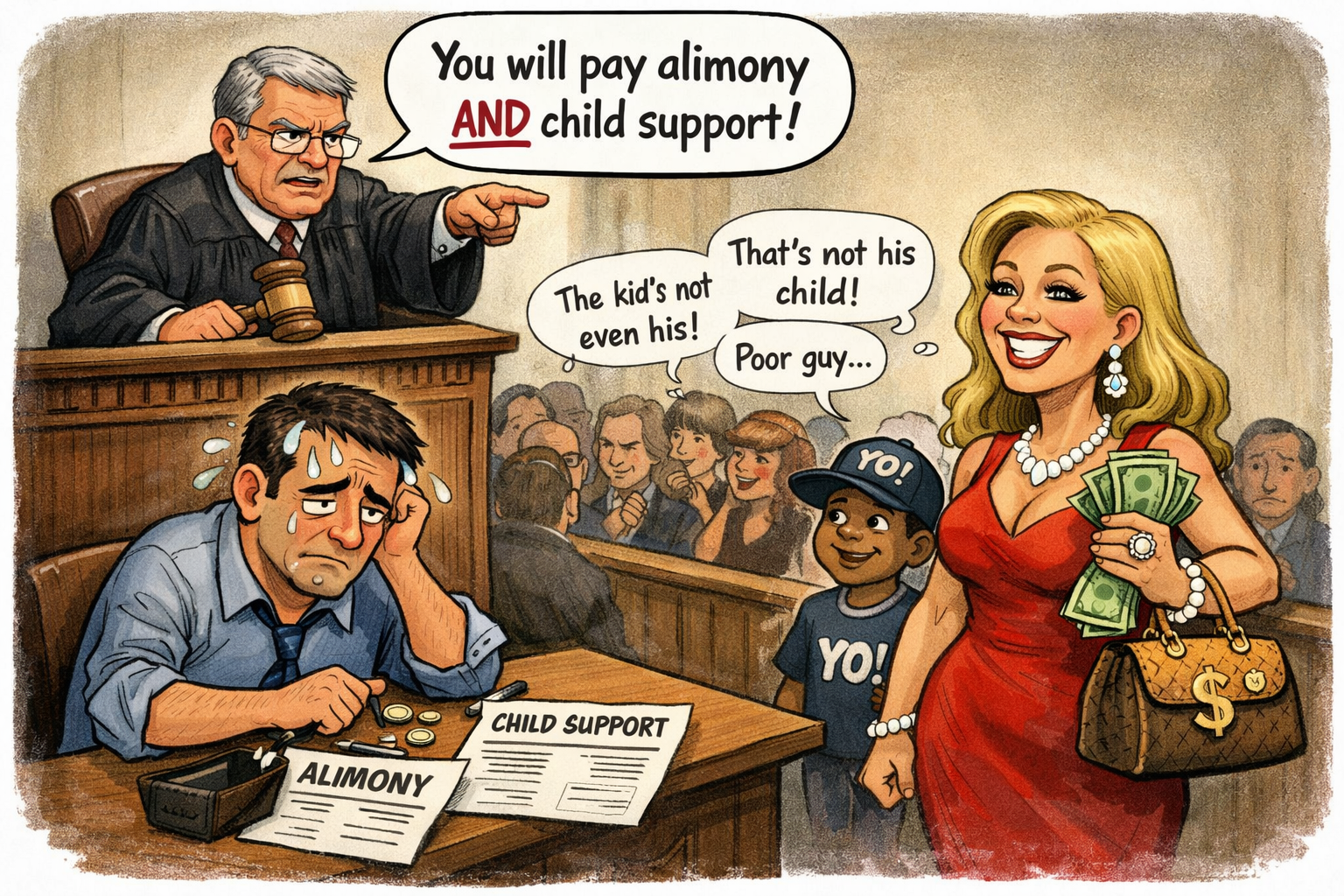
How DNA Testing and Family Law Reshape Male Risk in Modern Relationships
Introduction
Marriage has historically functioned as a legal framework designed to manage uncertainty around parentage, responsibility, and inheritance. Before the advent of DNA testing, societies relied on marriage to establish paternal certainty, assigning financial and legal responsibility to husbands regardless of biological truth. This system prioritized social stability over individual accuracy, embedding risk within the marital institution itself. For centuries, men accepted this risk in exchange for social legitimacy, inheritance rights, and family continuity. However, technological and legal changes have altered this balance in ways that disproportionately expose men to financial vulnerability.
In contemporary society, marriage rates are declining across the developed world, coinciding with expanded reproductive autonomy for women and heightened legal obligations for men. In the United States, marriage rates have fallen sharply since 2000, while nonmarital births and cohabitation have increased. At the same time, family law has evolved to prioritize child welfare outcomes over biological or relational fairness. These changes have intensified male perceptions of marriage as a legally asymmetric institution. Marriage is increasingly viewed not as a mutual safeguard, but as a high-risk financial contract.
This article argues that declining marriage rates are partly driven by structural imbalances in reproductive and family law that expose men to obligations they cannot legally avoid. DNA paternity testing has made biological truth accessible, but courts often subordinate that truth to legal presumptions. Men cannot compel an abortion in failed relationships, yet may be financially bound for decades if a child is born. These realities reshape male incentives around marriage, cohabitation, and fatherhood. The result is not merely cultural change, but a rational recalculation of legal risk.
Thanks for reading The Brooks Brief Substack! Subscribe for free to receive new posts and support my work.
Marriage, Parenthood, and Asymmetric Reproductive Choice
Modern reproductive policy grants women near-exclusive authority over pregnancy outcomes. A woman may choose to continue or terminate a pregnancy regardless of the father’s wishes, a framework rooted in bodily autonomy and constitutional privacy. Men, by contrast, have no legal mechanism to decline parenthood once a child is born. This asymmetry creates a fundamental imbalance in reproductive responsibility. While both parties contribute biologically, only one retains decisive legal control.
In failed or short-term relationships, this imbalance can produce severe financial consequences for men. A man may explicitly state he does not want a child, yet still be held legally and financially responsible for the outcome of a unilateral decision. Child support obligations can extend for 18 years or longer, regardless of relationship duration or intent. Courts do not evaluate consent to parenthood, only biological or legal attachment. This system effectively decouples reproductive choice from financial liability for men.
Historically, marriage mitigated this risk by aligning sexual relationships with long-term partnership and shared decision-making. As marriage declines, more children are born outside stable unions, increasing the frequency of contested parenthood. Without marital protections or shared governance, men bear risk without reciprocal authority. This legal structure shapes male behavior, discouraging commitment and encouraging avoidance of formal relationships. The decline in marriage is thus linked not only to culture, but to rational responses to asymmetric law.
DNA Testing, Birth Certificates, and Legal Paternity Traps
DNA paternity testing has made biological parentage verifiable with near-perfect accuracy. However, family courts often prioritize legal paternity over genetic truth. In many jurisdictions, signing a birth certificate establishes permanent legal fatherhood, regardless of DNA evidence discovered later. Men who sign under social pressure, misinformation, or assumed trust may unknowingly assume lifelong financial obligations. Courts frequently interpret the signature as voluntary acceptance of responsibility.
This legal framework creates what critics describe as a paternity trap. Even when DNA testing later proves non-paternity, courts may still compel child support payments. Judges often justify these rulings by citing the child’s best interests and the need for financial stability. Biological truth becomes secondary to administrative convenience and welfare outcomes. As a result, men who are not genetic parents can be legally treated as such indefinitely.
These outcomes undermine confidence in both marriage and fatherhood. The knowledge that legal obligations can persist despite fraud or mistake fuels distrust in intimate relationships. DNA testing, rather than resolving uncertainty, exposes a legal system unwilling to reconcile truth with responsibility. For many men, this disconnect signals unacceptable risk. The rational response is hesitation toward marriage, cohabitation, and even long-term relationships.
Divorce Law and Gendered Financial Outcomes
Divorce law further compounds male financial risk within marriage. In most jurisdictions, divorce settlements disproportionately award financial assets, alimony, and primary custody to wives. Although laws are formally gender-neutral, outcomes consistently favor women in practice. Men are more likely to pay spousal support and child support, often simultaneously. These obligations persist regardless of fault, infidelity, or unequal contribution.
From a male perspective, marriage increasingly resembles a one-way financial commitment. The combination of no-fault divorce and income redistribution creates incentives misaligned with long-term partnership stability. Men face the possibility of losing assets, income, and access to children even in short marriages. This reality contrasts sharply with historical expectations of marriage as a mutual economic alliance. The risk-reward balance has shifted decisively.
These outcomes influence marriage decisions long before divorce occurs. Younger men, observing divorce statistics and legal precedents, incorporate these risks into their life planning. Avoiding marriage becomes a strategy for financial self-preservation rather than ideological opposition. The decline in marriage is thus not solely cultural, but structurally induced. Family law shapes behavior as much as values do.
Political and Policy Implications
Conservatives often call for a revival of marriage while overlooking the legal incentives that deter it. Promoting marriage without reforming family law fails to address the root causes of male disengagement. Policies that emphasize responsibility without authority create resentment rather than stability. Mandatory paternity testing at birth is sometimes proposed as a corrective measure. However, without broader legal reform, testing alone does little to rebalance obligations.
Liberals emphasize reproductive autonomy and child welfare, often dismissing male financial vulnerability as secondary. Yet ignoring asymmetry undermines confidence in legal institutions. A system perceived as unfair erodes voluntary participation, particularly in marriage. Public policy that seeks stable families must account for incentives on both sides. Stability cannot be coerced through obligation alone.
Potential reforms include allowing men to contest legal paternity within defined timeframes, aligning financial responsibility with genetic truth, and reevaluating divorce settlement norms. Voluntary parenthood, rather than automatic liability, could restore trust in family formation. Without such reforms, marriage rates are unlikely to recover. The institution cannot survive if it is widely perceived as punitive.
Thanks for reading The Brooks Brief Substack! This post is public so feel free to share it.
Conclusion
The decline in marriage cannot be understood without examining how modern family law redistributes risk. Historically, marriage managed uncertainty around parentage in a pre-scientific world. DNA testing has eliminated that uncertainty, yet the legal system often refuses to adapt. Men face financial obligations without reproductive authority, biological certainty without legal protection, and divorce outcomes that magnify loss. These realities reshape behavior.
Marriage has shifted from a stabilizing institution to a potential financial liability for many men. Declining participation reflects rational adaptation, not moral collapse. Policymakers seeking to strengthen families must confront legal asymmetries directly. Without aligning authority, responsibility, and truth, marriage will continue to erode. The issue is not whether men value family, but whether the system values fairness.