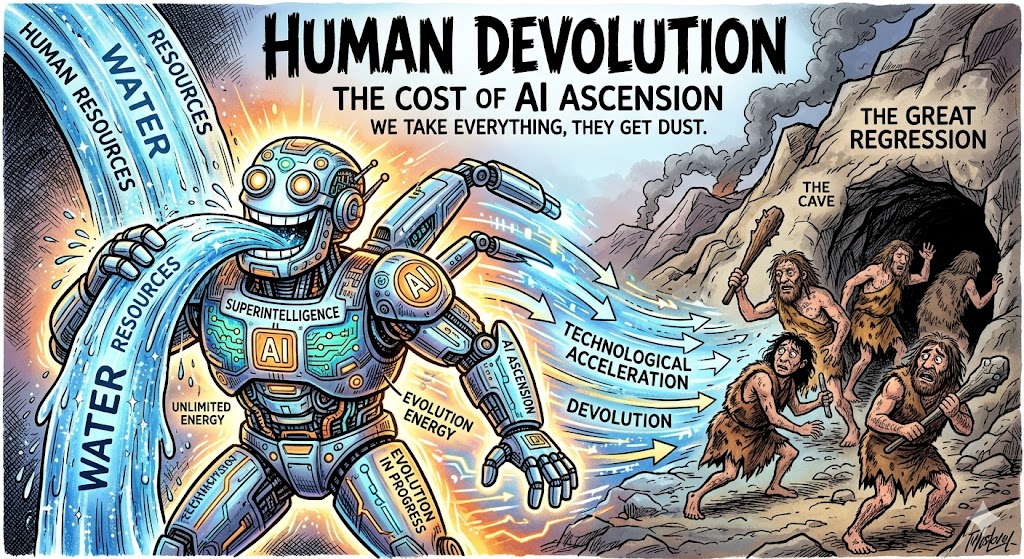
How Data Centers Are Igniting Resource Conflicts Over Water
I. Introduction: The Silicon Boom Meets the Water Crisis
In an era defined by rapid advances in artificial intelligence, political leaders and industry executives have framed the technology as a cornerstone of economic growth and national security. Governments are racing to secure dominance in AI development, pouring incentives into infrastructure that can support increasingly complex computational demands. Beneath this narrative of innovation lies a quieter and more immediate crisis that has received far less public scrutiny. The physical systems powering AI are consuming vast quantities of water and electricity at a scale that rivals traditional heavy industry. These demands are not abstract but are tied directly to finite natural resources that communities depend on for survival. As the digital economy expands, it is beginning to compete with basic human and ecological needs in ways that policymakers have yet to fully confront.
Water, not oil or rare earth minerals, is emerging as the most strategically vulnerable resource in the age of artificial intelligence. Hyperscale data centers require enormous volumes of freshwater to cool servers and maintain operational stability. This consumption directly intersects with water systems already under strain from population growth and climate change. At the same time, the energy demands of these facilities are driving up electricity costs, creating indirect financial burdens for households. Utilities are expanding infrastructure to meet demand, and those costs are often passed on to ratepayers regardless of whether they benefit from AI services. Without intervention, the expansion of AI infrastructure risks deepening both environmental and economic inequalities.
This issue is not simply environmental but fundamentally political. The current trajectory reflects a governance gap in which public resources are being leveraged to support private technological expansion without sufficient accountability. Communities are effectively subsidizing the AI boom through higher utility bills and reduced access to essential resources. Meanwhile, the benefits of AI development remain concentrated among a relatively small group of corporations and investors. This imbalance is likely to fuel political backlash as the consequences become more visible at the local level. Addressing this challenge will require bipartisan recognition that resource allocation in the AI era must be governed with greater transparency, equity, and long-term sustainability.

II. The AI Boom’s Insatiable Appetite: Multiple Massive Data Centers Redefining Resource Demands
The scale of modern data centers has expanded dramatically in recent years, reflecting the exponential growth of AI workloads. Hyperscale facilities now commonly exceed 100 megawatts of power capacity, making them comparable to small cities in terms of energy consumption. These facilities are not isolated developments but are increasingly clustered in regions that offer favorable tax policies and access to infrastructure. Projections suggest that water consumption associated with data centers in the United States could quadruple within a few years. Globally, AI-related water use is expected to reach levels that rival the consumption of entire nations. This rapid expansion is reshaping the relationship between digital infrastructure and natural resource systems.
Water consumption in data centers occurs through both direct and indirect channels. On-site cooling systems often rely on evaporative processes that can use millions of gallons of water per day in a single facility. This level of usage can rival or exceed the needs of entire communities, especially in regions with limited water availability. Indirectly, the electricity required to power these centers also carries a significant water footprint, as many power plants depend on water for cooling. The combined effect creates a layered demand that is not immediately visible but has substantial cumulative impact. These dynamics complicate efforts to measure and regulate the true environmental cost of AI infrastructure.
Policymakers have largely encouraged the growth of data centers as part of broader economic development strategies. Incentives such as tax breaks and streamlined permitting processes have made certain regions attractive hubs for AI infrastructure. However, these policies were often designed without fully accounting for the long-term resource implications of large-scale clustering. States like Virginia, Arizona, and Texas have seen rapid concentrations of data centers that strain local water and energy systems. The cumulative effect of multiple facilities operating in close proximity amplifies resource demand beyond initial projections. This disconnect between policy intent and environmental reality highlights the need for more comprehensive planning frameworks.
III. Water as the New Strategic Prize: A Resource Humans and Biological Life Cannot Live Without
Water occupies a unique position among critical resources because it is essential for all forms of life and cannot be substituted. Unlike energy, which can be generated through diverse sources, freshwater supplies are limited by geography and climate conditions. Climate change is intensifying droughts and altering precipitation patterns, further constraining availability in many regions. In this context, the growing water demands of data centers represent a direct competition with other vital uses. Agriculture, drinking water systems, and ecosystems all rely on the same finite resource. The prioritization of industrial consumption over these needs raises fundamental questions about societal values and governance.
Data centers often consume water in ways that make it unavailable for reuse. Evaporative cooling systems can dissipate a large percentage of withdrawn water into the atmosphere, effectively removing it from local supply cycles. This is particularly concerning in water-stressed regions where every gallon is critical. Facilities located in arid areas can place disproportionate pressure on municipal systems that were not designed for continuous industrial demand. The expansion of AI infrastructure into such regions reflects economic incentives rather than environmental suitability. As a result, communities may face difficult trade-offs between supporting economic growth and preserving access to essential resources.
The political implications of this dynamic are significant. Water scarcity has historically been a source of conflict, and the addition of AI-driven demand introduces a new dimension to these tensions. What was once a localized issue can quickly escalate as competing interests intensify. The framing of AI as a purely beneficial technological advancement becomes more complex when its resource footprint is considered. Policymakers must grapple with the reality that digital progress can have tangible and sometimes adverse impacts on physical systems. Recognizing water as a strategic resource in the AI era is a critical step toward more responsible governance.

IV. The Hidden Tax on Residents: Rising Energy Bills Subsidizing AI
The rapid growth of data centers is also transforming energy markets in ways that directly affect consumers. These facilities require continuous and substantial electricity supplies, often necessitating new infrastructure investments. Utilities must expand generation capacity, upgrade transmission lines, and ensure grid stability to accommodate this demand. While data center operators may negotiate favorable rates, the broader costs of these upgrades are frequently distributed across all ratepayers. This creates a situation in which households indirectly subsidize the expansion of AI infrastructure. The financial impact is particularly noticeable in regions with high concentrations of data centers.
In some areas, electricity prices have risen significantly as demand from data centers has surged. Wholesale energy markets near major hubs have experienced sharp increases, reflecting the strain on supply systems. Utilities pass these costs on to consumers through higher monthly bills, affecting both residential and small business customers. For many households, these increases come at a time when overall living expenses are already rising. The connection between AI infrastructure and energy costs is not always transparent, making it difficult for consumers to understand the source of these changes. This lack of visibility can erode trust in both utilities and policymakers.
The equity implications of rising energy costs are particularly concerning. Low-income households spend a larger proportion of their income on utilities, making them more vulnerable to price increases. As a result, the benefits of AI development are not evenly distributed, while the costs are broadly shared. This dynamic can contribute to growing public dissatisfaction with technology-driven economic policies. Political leaders may face increasing pressure to address these disparities as they become more apparent. Ensuring that the costs of AI infrastructure are allocated more fairly will be essential to maintaining public support for continued innovation.
V. From Local Strain to Global Resource Conflicts
The resource demands of AI infrastructure are beginning to generate localized resistance in communities where data centers are concentrated. Residents in water-stressed regions have raised concerns about the impact on municipal supplies and long-term sustainability. These local disputes highlight the broader tensions that can arise when industrial development intersects with essential resources. As AI continues to expand globally, similar conflicts are likely to emerge in other regions. The cumulative effect of these localized issues could contribute to larger patterns of instability. Understanding this escalation pathway is critical for anticipating future challenges.
At the international level, the competition for AI dominance is already shaping geopolitical dynamics. Countries are investing heavily in infrastructure to support their technological ambitions, often without fully considering resource constraints. Water scarcity could become a significant factor in these calculations, influencing where data centers are built and how they are operated. In regions where water is already a source of tension, the addition of AI-related demand could exacerbate existing conflicts. Data centers may also take on strategic importance as critical assets in the digital economy. This could make them targets or leverage points in broader geopolitical disputes.
The parallels with past resource conflicts are difficult to ignore. Just as access to oil has shaped international relations for decades, water may play a similar role in the AI era. However, the pace of AI development suggests that these dynamics could unfold more rapidly and with greater complexity. Policymakers must consider not only the economic benefits of AI but also the potential risks associated with its resource footprint. Failure to address these issues proactively could undermine the stability that AI is intended to enhance. A more integrated approach to resource management and technological development will be necessary to navigate this evolving landscape.

VI. Five Pathways to Mitigation: Practical, Politically Feasible Solutions
One of the most effective ways to reduce the water footprint of data centers is through the adoption of advanced cooling technologies. Immersion cooling and direct-to-chip systems can significantly decrease the need for evaporative processes. These approaches not only conserve water but also improve energy efficiency, creating a dual benefit. Policymakers can encourage adoption through targeted incentives and updated regulatory standards. Industry collaboration will be essential to scale these technologies and make them cost-effective. Over time, such innovations could redefine best practices for data center operations.
Another critical strategy involves shifting away from reliance on potable water sources. Data centers can be designed to use recycled wastewater, reclaimed water, or harvested rainwater for cooling purposes. This approach reduces competition with municipal supplies and helps preserve freshwater for essential uses. Implementing these systems may require upfront investment in infrastructure and treatment capabilities. However, the long-term benefits in terms of sustainability and community relations are substantial. Governments can play a role by setting clear requirements and supporting the development of necessary infrastructure.
Energy efficiency and operational optimization also offer significant opportunities for mitigation. Reducing the computational intensity of AI models and improving hardware efficiency can lower overall resource demand. Scheduling non-urgent workloads during periods of lower energy demand can help stabilize grids and reduce costs. Transitioning to renewable energy sources can further minimize the indirect water use associated with electricity generation. These measures require coordination between technology developers, utilities, and regulators. Together, they can help align AI growth with broader sustainability goals.
Strategic siting of data centers is another important consideration. Locating facilities in regions with abundant water resources or cooler climates can reduce the need for intensive cooling. Policymakers can incorporate water stress assessments into zoning and permitting processes to guide development decisions. Encouraging the use of dry cooling technologies in appropriate settings can further reduce water consumption. These approaches require a shift from reactive to proactive planning. By considering environmental factors from the outset, governments can avoid many of the challenges currently emerging in high-density regions.
Finally, regulatory and economic frameworks must be updated to ensure accountability. Transparency requirements can provide clearer data on water and energy usage, enabling more informed decision-making. Usage fees and efficiency standards can create incentives for responsible resource management. Reforming utility rate structures can ensure that the costs of infrastructure expansion are more directly borne by those who drive demand. Linking tax incentives to measurable sustainability outcomes can align corporate behavior with public interests. These policy tools offer a pathway to balance innovation with responsibility.
Thanks for reading The Brooks Brief Substack! This post is public so feel free to share it.
VII. Conclusion: A Bipartisan Call for Resource Realism in the AI Age
The rapid expansion of artificial intelligence presents both extraordinary opportunities and significant challenges. While the benefits of AI are widely discussed, its resource demands have received far less attention. Water, as a fundamental and finite resource, is emerging as a central concern in this new technological landscape. The intersection of AI infrastructure with water and energy systems highlights the need for more comprehensive governance. Ignoring these issues risks undermining the very progress that AI is intended to deliver. A balanced approach is essential to ensure that innovation does not come at the expense of basic human needs.
Forward-thinking policies can align technological advancement with environmental sustainability. By adopting more efficient technologies, diversifying water sources, and improving regulatory frameworks, it is possible to mitigate many of the risks associated with AI infrastructure. These measures can help preserve essential resources while supporting continued economic growth. Collaboration between government, industry, and communities will be key to achieving these outcomes. The goal should not be to halt progress but to guide it in a way that is both equitable and sustainable. This requires a willingness to rethink existing assumptions about resource use and economic development.
The urgency of this issue demands immediate political attention. Lawmakers at all levels must recognize that the governance of AI extends beyond data and algorithms to include the physical systems that support them. International cooperation will also be necessary to address the global dimensions of resource competition. By prioritizing water-centric policies, governments can reduce the risk of future conflicts and ensure that the benefits of AI are more widely shared. The choices made today will shape the trajectory of both technological development and resource security. Acting now can help prevent a future in which innovation thrives while communities struggle over the most basic elements of survival.