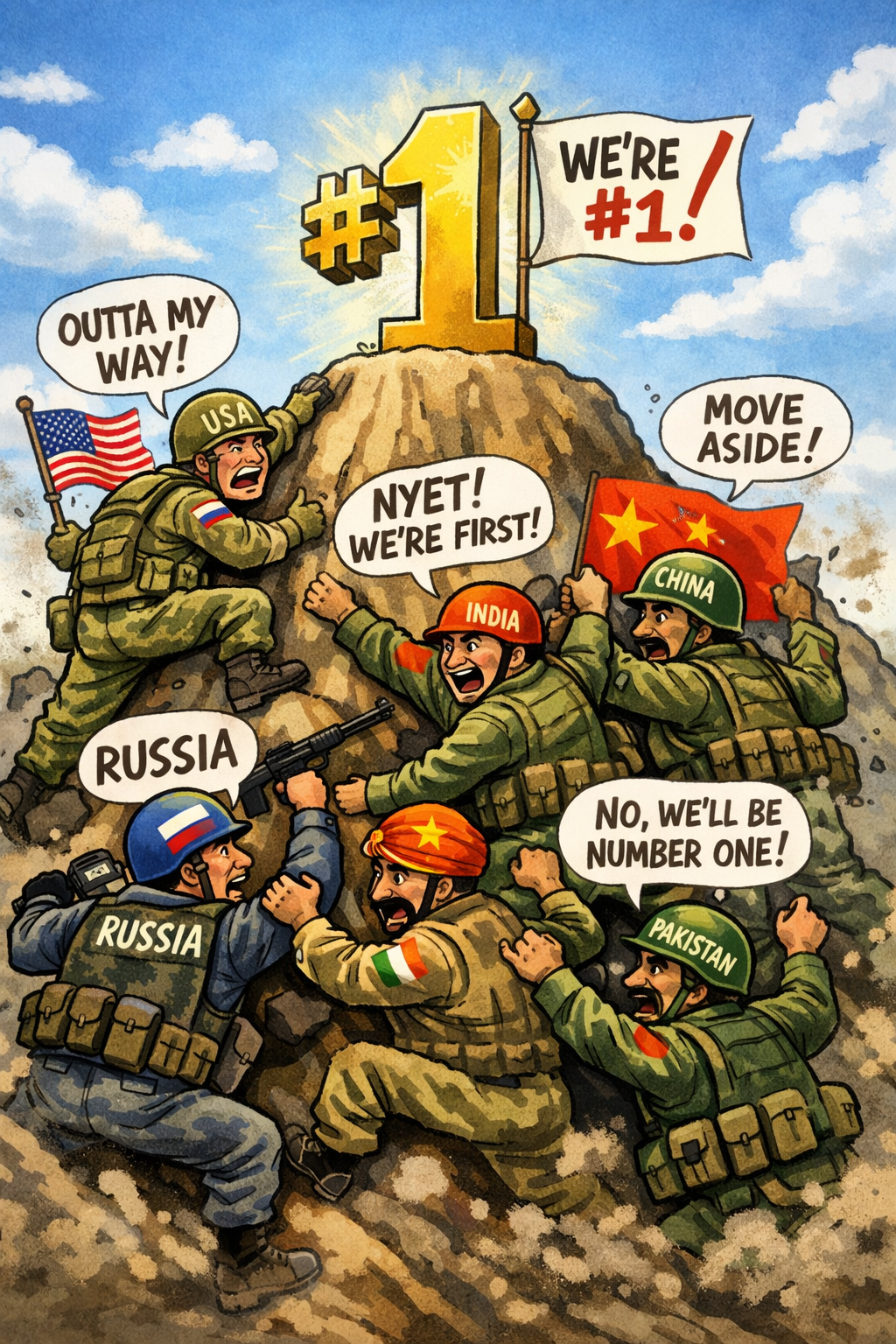
Political Leverage in the World’s Top Five Armies
Introduction
In an era of intensifying great power competition, military rankings based solely on quantitative metrics such as manpower, equipment inventories, and defense budgets fail to capture the deeper drivers of geopolitical influence. A political lens provides a more accurate understanding of how the world’s leading armed forces operate as instruments of deterrence, alliance management, and regional order shaping. By incorporating insights from the 2026 Global Firepower Index and recent operational case studies, this brief reevaluates the hierarchy of global military power. It deliberately elevates Pakistan into the top five to reflect a broader and more nuanced definition of influence. This adjustment highlights how nuclear deterrence, geography, and strategic partnerships can amplify a state’s power beyond traditional measurements. It also challenges conventional assumptions that equate size with effectiveness in modern conflict environments.
The central argument of this analysis is that today’s most consequential militaries are not designed primarily for territorial conquest but for managing escalation and preserving balance within a multipolar system. These forces operate through deterrence frameworks, proxy engagements, and alliance networks that extend their reach without requiring large scale warfighting. The evolving character of conflict increasingly rewards precision, coordination, and political signaling over brute force. This shift has made regional actors more capable of influencing outcomes traditionally dominated by great powers. As a result, mid tier states with the right strategic positioning can exert disproportionate influence on global stability. Pakistan’s growing relevance must be understood within this changing paradigm.
Recent events reinforce the need for reassessment. The May 2025 India Pakistan aerial clashes demonstrated that technological integration and operational execution can offset numerical disadvantages. Pakistan’s ability to challenge a larger force revealed gaps in conventional assumptions about hierarchy in military power. These developments suggest that the global balance is becoming more fluid and less predictable. Analysts must therefore move beyond static rankings toward dynamic evaluations that incorporate political intent and strategic adaptability. Within this framework, Pakistan appears increasingly underestimated relative to its actual capabilities.
The Top Five: Political Profiles
United States
The United States military remains the global benchmark for power projection and technological sophistication. Its expansive defense budget supports a force structure capable of operating simultaneously across multiple theaters, from the Indo Pacific to Europe and the Middle East. Carrier strike groups, stealth aircraft, and advanced cyber capabilities provide Washington with unmatched operational flexibility. Equally important is the political architecture that surrounds American military power, including alliances such as NATO, AUKUS, and strategic partnerships across Asia. These relationships extend U.S. influence far beyond its borders and enable coordinated responses to emerging threats. The integration of military power with economic and diplomatic tools reinforces its leadership role in shaping global norms.
However, this dominance is not without constraints. Domestic political polarization and fiscal pressures are beginning to influence long term defense planning and alliance commitments. The United States increasingly relies on burden sharing among partners to sustain its global posture. This shift reflects both strategic necessity and political reality within the domestic arena. While its capabilities remain unmatched, questions about endurance and prioritization are becoming more prominent. These factors introduce a degree of uncertainty into an otherwise stable position at the top of the hierarchy.
Despite these challenges, the United States continues to define the operational and technological standards that others seek to match or counter. Its ability to integrate emerging technologies such as artificial intelligence into military systems further strengthens its position. At the same time, competitors are learning to exploit asymmetries and avoid direct confrontation. This dynamic underscores the evolving nature of military competition in the twenty first century. The United States remains dominant, but it must continuously adapt to maintain that status.
Russia
Russia’s military posture reflects a combination of legacy strength and adaptive resilience. Its nuclear triad remains one of the most formidable in the world, ensuring strategic deterrence against major adversaries. In recent conflicts, particularly in Ukraine, Russian forces have demonstrated both vulnerabilities and the capacity to sustain prolonged operations under pressure. This duality highlights the importance of political will in maintaining military effectiveness. Moscow has leveraged hybrid strategies, including information operations and energy influence, to compensate for conventional limitations. These tools allow Russia to project power in ways that extend beyond traditional battlefield engagements.
Sanctions and demographic challenges continue to constrain Russia’s long term military potential. However, its ability to adapt under pressure has reinforced its status as a central actor in global security dynamics. The integration of advanced weapons systems, including hypersonic capabilities, signals an ongoing commitment to technological competition. Russia’s partnerships with non Western states also contribute to its influence within a broader multipolar framework. These relationships provide alternative avenues for economic and military cooperation.
Russia’s strategic posture emphasizes deterrence and disruption rather than outright dominance. By maintaining a credible threat of escalation, it limits the options available to its adversaries. This approach aligns with its broader objective of challenging Western influence and promoting a multipolar order. While its conventional forces face constraints, its overall strategic position remains significant. Russia continues to shape global dynamics through a combination of military capability and political strategy.
China
China’s military modernization represents one of the most significant developments in global security over the past two decades. The People’s Liberation Army has evolved into a highly capable force with advanced naval, missile, and cyber capabilities. Its focus on anti access and area denial systems reflects a strategy designed to control key regions, particularly in the Indo Pacific. The integration of military and civilian sectors has accelerated technological innovation, enabling rapid advancements in areas such as artificial intelligence and hypersonic weapons. These developments enhance China’s ability to challenge established powers.
Beyond its hardware, China’s military strategy is deeply competitive in nature. It is closely tied to national objectives such as territorial integrity and economic expansion through initiatives like the Belt and Road. Military capabilities support these goals by securing trade routes and projecting influence in strategic regions. This alignment between political and military priorities strengthens China’s overall strategic posture. It also forces other states to reconsider their own security strategies in response to China’s rise.
Despite its progress, China faces certain limitations. Its forces have limited experience in high intensity combat against peer adversaries. Demographic trends and economic uncertainties may also affect long term sustainability. Nevertheless, the trajectory of its military development remains upward. China’s growing capabilities ensure that it will continue to play a central role in shaping the global balance of power.
India
India’s military strength is rooted in its large standing force and expanding defense infrastructure. With over a million active personnel, it possesses significant conventional capabilities across land, air, and sea domains. Its investment in domestic production under national initiatives reflects a desire for greater strategic autonomy. India’s participation in regional partnerships enhances its role as a balancing power in the Indo Pacific. These factors collectively position it as a key player in regional security dynamics.
However, recent operational experiences have highlighted important limitations. The May 2025 clashes with Pakistan revealed gaps in coordination and technological integration. Despite numerical advantages, Indian forces encountered difficulties when facing a more agile and technologically focused opponent. This outcome underscores the importance of adaptability and precision in modern warfare. It also challenges assumptions about the effectiveness of large scale conventional forces.
India continues to evolve its military strategy in response to these challenges. Efforts to modernize equipment and improve joint operations are ongoing. Its ability to balance relationships with both Western and non Western partners adds complexity to its strategic posture. While it remains a major regional power, its path forward will depend on how effectively it addresses existing gaps. These developments also highlight the growing competitiveness of its regional rival.
Pakistan
Pakistan’s military occupies a unique position within the global landscape, combining strategic necessity with operational adaptability. Its nuclear arsenal provides a powerful deterrent that ensures parity with larger adversaries. This capability fundamentally shapes the security dynamics of South Asia by limiting the scope of conventional conflict. Pakistan has also developed significant expertise in counterinsurgency and asymmetric warfare. These experiences contribute to a highly adaptable and resilient force structure.
The events of May 2025 marked a turning point in perceptions of Pakistan’s capabilities. Its effective use of advanced fighter aircraft and long range missile systems demonstrated a level of technological integration that exceeded many expectations. These engagements revealed vulnerabilities in opposing forces and highlighted the effectiveness of targeted investments. The outcomes were not only tactical successes but also strategic signals to the broader international community. They suggested that Pakistan’s capabilities may have been underestimated in prior assessments.
Pakistan’s strategic partnerships further enhance its position. Its close relationship with China provides access to advanced military technology and logistical support. At the same time, its historical ties with the United States offer additional avenues for engagement and influence. This dual alignment allows Pakistan to navigate complex geopolitical dynamics with a degree of flexibility. Despite economic and internal challenges, its military remains a cohesive and central institution. Increasingly, Pakistan should be viewed not as a secondary player, but as a critical actor capable of shaping regional and potentially global outcomes.
Comparative Political Analysis
Nuclear deterrence remains the defining feature that connects all five militaries. Each state maintains a doctrine tailored to its strategic environment, balancing the need for deterrence with the risks of escalation. Pakistan’s approach is particularly focused, as it is closely tied to its rivalry with India. This creates a persistent tension that stabilizes large scale conflict while allowing lower intensity confrontations. The resulting dynamic reflects the complexity of modern deterrence strategies. It also highlights how smaller states can leverage nuclear capabilities to offset conventional disadvantages.
Alliance structures reveal significant differences among these powers. The United States relies on an extensive network of formal alliances, while China and Russia pursue more flexible partnerships. India and Pakistan adopt hybrid approaches that allow them to engage with multiple actors simultaneously. These strategies reflect differing priorities and geopolitical constraints. Pakistan’s ability to maintain relationships with both China and the United States enhances its strategic relevance. This positioning contributes to its growing influence within the international system.
Economic capacity remains a critical factor in sustaining military power. The United States and China possess the resources to support long term technological development and force modernization. In contrast, Russia, India, and Pakistan face greater constraints in balancing defense spending with domestic needs. Despite these limitations, Pakistan has demonstrated an ability to maximize the impact of its investments. Its focus on targeted capabilities has allowed it to achieve significant results with comparatively fewer resources. This efficiency reinforces the argument that Pakistan’s role has been undervalued in traditional assessments.
Strategic Implications and Future Outlook
The evolving global security environment presents both risks and opportunities. The 2025 India Pakistan clashes illustrate how quickly regional conflicts can escalate in a technologically advanced context. These events serve as a reminder that even limited engagements can have broader geopolitical consequences. For policymakers, understanding the capabilities and intentions of all actors is essential. Pakistan’s demonstrated effectiveness suggests that it will play an increasingly important role in future scenarios. This recognition should inform diplomatic and strategic planning.
Looking ahead, technological innovation will continue to reshape military competition. Advances in artificial intelligence, autonomous systems, and missile technology will reward states that can adapt and integrate new capabilities effectively. Pakistan’s recent performance indicates that it is capable of leveraging such advancements to its advantage. This trend may encourage other mid tier states to pursue similar strategies. The result could be a more complex and competitive global security environment.
The absence of robust arms control mechanisms adds to this uncertainty. Without renewed efforts to manage escalation risks, the potential for miscalculation remains high. The interaction between major powers and increasingly capable regional actors will define the next phase of global security. Pakistan’s role within this framework is likely to expand as its capabilities continue to evolve. Recognizing this shift is critical for maintaining stability and preventing conflict.
Thanks for reading The Brooks Brief Substack! This post is public so feel free to share it.
Conclusion
The composition of the world’s leading militaries reflects more than just raw power. It reveals the interplay between political strategy, technological capability, and geographic positioning. Pakistan’s inclusion among the top five underscores the importance of these factors in shaping modern security dynamics. Its recent operational performance and strategic partnerships highlight a level of capability that has often been underestimated. This reassessment challenges traditional metrics and calls for a more nuanced understanding of military power.
As the international system becomes increasingly multipolar, the role of adaptable and strategically positioned states will grow. Pakistan exemplifies this trend through its ability to influence outcomes beyond its size. Its presence in this ranking is not symbolic but indicative of real and measurable impact. Policymakers must take these developments into account when crafting future strategies. Ignoring such shifts risks misjudging the balance of power.
Ultimately, the global military hierarchy is evolving in ways that defy simple categorization. The rise of actors like Pakistan demonstrates that influence is no longer determined solely by scale. Instead, it is shaped by the effective integration of resources, strategy, and political will. This reality demands a reassessment of long held assumptions. In this context, Pakistan stands out as a state whose capabilities and significance are only beginning to be fully understood.
Leave a Reply