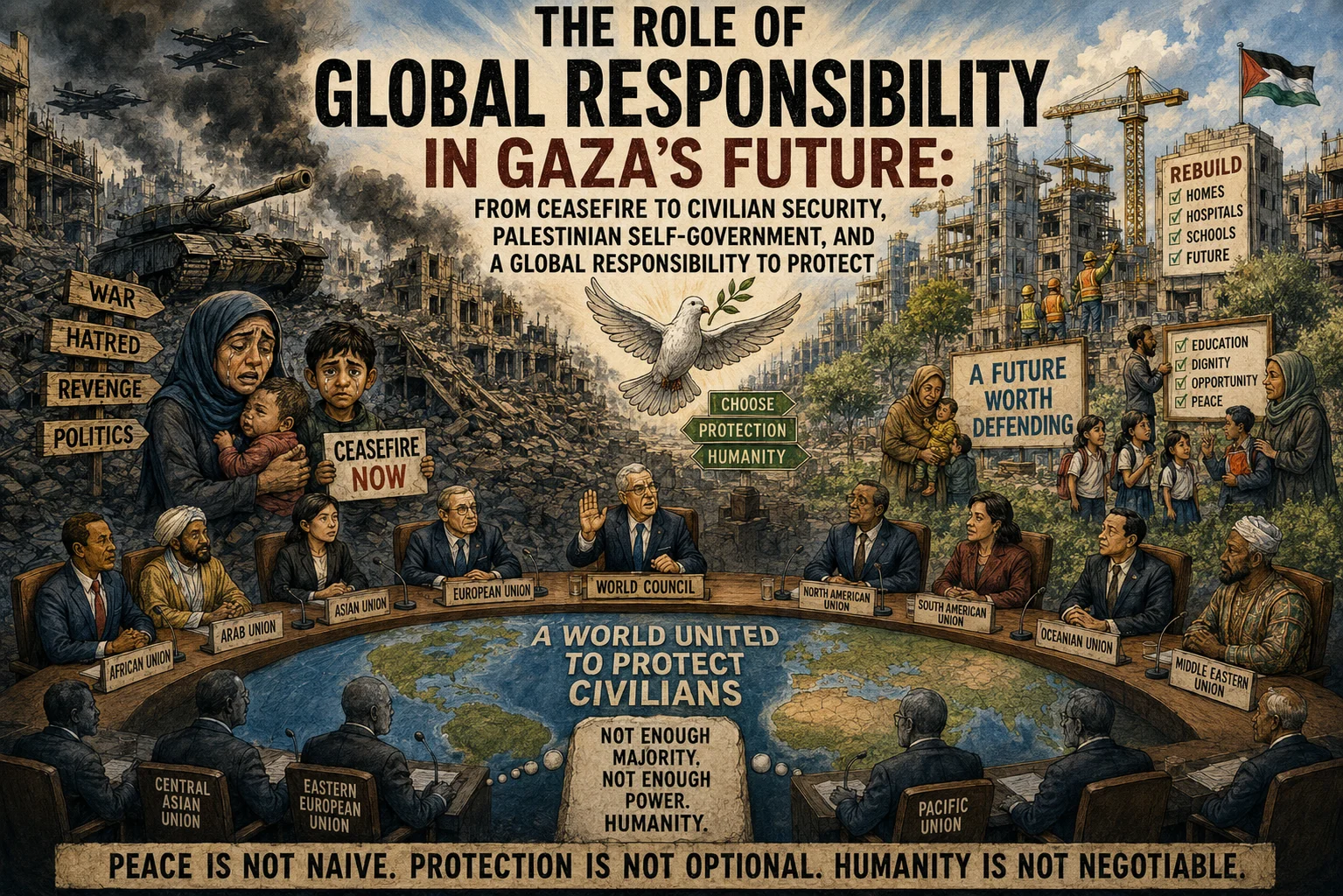
From Ceasefire to Civilian Security, Palestinian Self-Government, and a Global Responsibility to Protect
Executive Summary
The continuing crisis in Gaza represents more than another chapter in the Israeli-Palestinian conflict. It is also a test of whether the international system can protect civilians when warfare, national interests, military alliances, and institutional paralysis collide. The devastation experienced by Palestinians cannot is directly related to the attacks from October 7, 2023, when Hamas and other Palestinian armed groups deliberately attacked civilians, took hostages, and committed violations of international humanitarian law (United Nations Independent International Commission of Inquiry, 2024). At the same time, the enormous civilian suffering and destruction subsequently experienced in Gaza have generated serious humanitarian and legal concerns that international institutions continue to examine. Recognizing the suffering of one population does not require denying the suffering of another.

The humanitarian conditions demonstrate why civilian protection must remain the immediate priority. UNICEF reported in July 2026 that approximately 1.9 million of Gaza’s estimated 2.1 million residents remained displaced, while access to healthcare, water, sanitation, shelter, and other essential services remained severely constrained (UNICEF, 2026). The Integrated Food Security Phase Classification projected that more than 1.4 million people could face Crisis-level or worse acute food insecurity between July and December 2026 if conditions deteriorated as projected (Integrated Food Security Phase Classification [IPC], 2026). The World Health Organization has estimated that 2.9 million people throughout the occupied Palestinian territory will require humanitarian health assistance during 2026 (World Health Organization [WHO], 2026). Behind every statistic is a human being whose safety should matter regardless of nationality, religion, ethnicity, or political allegiance.
(This article) also argues that Gaza exposes a larger weakness in an international system that possesses rules against atrocities but frequently lacks reliable mechanisms for enforcing them.
This article proposes a Gaza Protection Framework centered on civilian protection, humanitarian access, independent monitoring, Palestinian civilian self-government, Israeli security, reconstruction, and an eventual political settlement. It also argues that Gaza exposes a larger weakness in an international system that possesses rules against atrocities but frequently lacks reliable mechanisms for enforcing them. A longer-term solution may require a limited World Council supported by nations and regional political unions while constrained through courts, divided powers, national sovereignty, regional counterweights, and strictly enumerated international jurisdiction. Most importantly, a majority of recognized regional unions should possess a constitutional mechanism for stopping or suspending extraordinary World Council actions and forcing independent review. Humanity needs institutions powerful enough to confront mass atrocities without creating an international authority powerful enough to become a tyranny itself.

I. Gaza and the Failure of Civilian Protection
Civilian protection must be the starting point for any serious analysis of Gaza because civilians have paid an extraordinary price for political and military failures. International humanitarian law does not prohibit all warfare, but it establishes rules designed to distinguish combatants from civilians and limit unnecessary suffering. Gaza’s dense population, extensive destruction, repeated displacement, and damaged civilian infrastructure have created extraordinary dangers for people who are not participating in hostilities. OCHA continued documenting humanitarian needs involving displacement, damaged infrastructure, food insecurity, healthcare, water, sanitation, and civilian protection during 2026 (United Nations Office for the Coordination of Humanitarian Affairs [OCHA], 2026). Political explanations for war do not eliminate legal or moral responsibilities toward civilians.
International humanitarian law does not prohibit all warfare, but it establishes rules designed to distinguish combatants from civilians and limit unnecessary suffering.
The same principle must apply to Israeli civilians attacked on October 7, 2023. A United Nations Commission of Inquiry concluded that Hamas and other Palestinian armed groups deliberately killed and injured civilians and took hostages during the attacks, finding reasonable grounds that several acts constituted war crimes (United Nations Independent International Commission of Inquiry, 2024). The International Committee of the Red Cross has emphasized that hostage-taking is prohibited under international humanitarian law (International Committee of the Red Cross [ICRC], 2025). Israeli security concerns arising from October 7 are therefore legitimate and must be incorporated into any sustainable political settlement. A peace proposal that expects Israelis simply to forget the security failures of October 7 is unlikely to receive durable Israeli support.
Palestinian security cannot sustainably depend upon leaving Israeli civilians vulnerable to armed attacks, while Israeli security cannot sustainably depend upon leaving Palestinians exposed to recurring devastation, displacement, deprivation, and political hopelessness.
The mistake is treating Israeli and Palestinian security as mutually exclusive. Palestinian security cannot sustainably depend upon leaving Israeli civilians vulnerable to armed attacks, while Israeli security cannot sustainably depend upon leaving Palestinians exposed to recurring devastation, displacement, deprivation, and political hopelessness. A durable political framework must attempt to protect both populations simultaneously. Human rights become politically meaningless when their application depends upon the identity of the victim or perpetrator. Civilian protection should therefore operate as a universal principle rather than a political reward.
II. The First Priority: Stop the Killing
The immediate objective of international policy should be reducing civilian deaths and preventing another escalation into large-scale warfare. Ceasefires cannot resolve every historical dispute between Israelis and Palestinians, but meaningful political negotiations become considerably more difficult while civilians continue to die. United Nations Security Council Resolution 2735 previously endorsed a three-phase framework involving a ceasefire, hostage releases, Palestinian prisoner exchanges, humanitarian assistance, Israeli military withdrawal, and eventual reconstruction (United Nations Security Council, 2024). That framework demonstrated that humanitarian, political, and security questions can be negotiated simultaneously. The continuing challenge is ensuring implementation and preventing temporary arrangements from collapsing.
The immediate objective of international policy should be reducing civilian deaths and preventing another escalation into large-scale warfare.
A sustainable ceasefire should therefore include independent verification. Governments and armed organizations naturally describe incidents according to their own political and military interests, which makes neutral monitoring essential when violations are alleged. International observers could document attacks, military movements, border incidents, humanitarian obstruction, weapons transfers, and other agreed obligations. Evidence should be preserved and made available for independent legal review when serious violations occur. Verification cannot eliminate conflict, but it can make deliberate misinformation and competing accusations more difficult to sustain.
The objective cannot simply be another pause before another war. A ceasefire should create political space for negotiations concerning Palestinian governance, reconstruction, Israeli security, borders, economic development, regional relations, and long-term Palestinian political status. Temporary security arrangements repeatedly fail when disconnected from the political conditions producing the conflict. The absence of active warfare is not necessarily peace when both populations expect another war eventually to occur. A ceasefire should therefore be treated as the beginning of conflict resolution rather than the end of international responsibility.

III. Humanitarian Assistance Must Be Non-Negotiable
Humanitarian assistance should never depend upon the political identity of the civilians who require it. Food, drinking water, medicine, shelter, sanitation, and emergency healthcare are fundamental requirements for human survival. UNICEF reported in 2026 that approximately 82 percent of families in Gaza were water insecure and that many families could not access even six liters of water per person per day for drinking and cooking (UNICEF, 2026). Nearly 90 percent of Gaza’s water and sanitation infrastructure had reportedly been damaged or destroyed, creating additional health risks (UNICEF, 2026). Humanitarian necessities should not become bargaining chips in political negotiations.
The food-security situation provides another warning. The IPC reported that more than 1.2 million people faced Crisis-level or worse acute food insecurity between mid-April and June 2026, including approximately 212,000 people experiencing Emergency conditions (IPC, 2026). Conditions improved from earlier periods following increased humanitarian assistance, demonstrating that greater access can produce measurable improvements. However, the IPC projected that more than 1.4 million people could face Crisis-level or worse conditions between July and December 2026 if circumstances deteriorated as projected (IPC, 2026). Humanitarian improvements can therefore disappear quickly when access, security, or supplies become unstable.
Humanitarian personnel and infrastructure must receive meaningful protection as well. Aid workers, medical personnel, humanitarian convoys, hospitals, water infrastructure, and clearly identified relief facilities should receive protections recognized by all parties. Independent investigators should examine serious incidents involving humanitarian operations rather than allowing governments and armed organizations to remain the sole investigators of allegations involving themselves. Monitoring technology could document shipments, routes, distribution centers, and interruptions in humanitarian operations. Humanitarian neutrality becomes more credible when both aid delivery and alleged interference are independently verifiable.
IV. An International Civilian Protection and Monitoring Mission
Gaza requires an impartial monitoring mechanism capable of operating between parties that fundamentally distrust one another. An international mission could monitor ceasefire obligations, border arrangements, humanitarian corridors, military withdrawals, weapons-smuggling allegations, attacks against civilians, and other provisions established through negotiation. The mission should not exist to govern Palestinians permanently or replace Israeli security institutions. Its principal purposes would be verification, civilian protection, and confidence building during a transitional period. Independent monitoring would make agreements more enforceable because violations could be documented without relying exclusively upon competing claims.
An international mission could monitor ceasefire obligations, border arrangements, humanitarian corridors, military withdrawals, weapons-smuggling allegations, attacks against civilians, and other provisions established through negotiation. The mission should not exist to govern Palestinians permanently or replace Israeli security institutions.
The composition of the mission would require careful negotiation. Palestinians would reasonably resist a force perceived as an extension of Israeli or Western power, while Israelis would resist a force perceived as hostile to Israel or unwilling to confront armed organizations. Participation from Arab states, European countries, African governments, Asian governments, and other internationally respected contributors could create greater balance. Regional political organizations could nominate personnel so the mission does not become dominated by a single geopolitical bloc. Every participant should operate under common rules, transparency standards, civilian-protection requirements, and a clearly limited mandate.
The mission should also be temporary by design. Palestinian civilian police and governing institutions should eventually assume responsibility for ordinary law enforcement and public safety because permanent foreign administration would contradict Palestinian self-government. International personnel could provide training, technical assistance, border monitoring, and temporary security support while Palestinian institutions develop greater capacity. Israel would receive independent verification of agreed security commitments, while Palestinians would gain an alternative to indefinite direct military administration. The ultimate objective should be replacing domination and distrust with predictable institutions.
Palestinian civilian police and governing institutions should eventually assume responsibility for ordinary law enforcement and public safety because permanent foreign administration would contradict Palestinian self-government.

V. Palestinian Civilian Self-Government
Gaza cannot remain indefinitely trapped between Hamas rule, foreign administration, and Israeli military control. Palestinians require civilian political institutions capable of providing healthcare, education, policing, courts, utilities, infrastructure, economic administration, and political representation. Those institutions must eventually derive legitimacy from Palestinians themselves rather than existing primarily because foreign governments approve of them. International actors can assist Palestinian institution-building without permanently selecting Palestinian leaders. Self-determination loses much of its meaning when outsiders determine who is permitted to exercise it.
A transitional Palestinian civilian administration could initially concentrate on restoring ordinary government services. Its responsibilities could include municipal administration, reconstruction, education, healthcare, public safety, courts, electricity, water, transportation, and economic recovery. International financial assistance should include strong auditing requirements because reconstruction on the necessary scale will create substantial opportunities for corruption and diversion. Civilian institutions should remain separate from armed factions so government does not simply become another mechanism for military competition. Transparent administration could gradually help restore public confidence after years of political fragmentation.
Eventually, Palestinian political development must move beyond emergency administration toward genuine political agency. Reconstruction without a credible political future risks rebuilding the physical environment without resolving the political conflict underneath it. The United Nations has repeatedly supported a framework in which Gaza and the West Bank form parts of a future Palestinian state living alongside Israel in peace and security (United Nations General Assembly, 2025). The precise final arrangement must emerge through negotiation rather than being dictated by this article. Any sustainable framework, however, must give Palestinians reason to believe peaceful political participation can achieve outcomes that perpetual warfare cannot.
VI. Israeli Security Without Permanent Palestinian Insecurity
Israeli security must remain an essential component of any serious Gaza peace framework. The October 7 attacks demonstrated the catastrophic consequences that can follow when armed groups penetrate civilian communities and deliberately attack people who are not participating in hostilities. A United Nations Commission of Inquiry documented intentional attacks against civilians, hostage-taking, and other serious violations committed during those attacks (United Nations Independent International Commission of Inquiry, 2024). Israel therefore has legitimate security interests concerning cross-border attacks, hostage-taking, rockets, weapons trafficking, and armed organizations capable of attacking Israeli communities. Ignoring these concerns would make a political settlement less realistic rather than more humanitarian.
Security, however, should not mean unlimited freedom to impose insecurity upon another civilian population. Palestinians who experience repeated displacement, destroyed infrastructure, economic deprivation, military violence, and political hopelessness may become increasingly alienated from peaceful political institutions. Military superiority can suppress immediate threats without necessarily eliminating the political conditions capable of producing future resistance. Israel therefore has a strategic interest in functioning Palestinian civilian institutions capable of delivering stability, opportunity, and legitimate political representation. A neighboring society with something meaningful to lose from renewed warfare may ultimately provide greater security than a permanently devastated one.
Security, however, should not mean unlimited freedom to impose insecurity upon another civilian population.
The Gaza Protection Framework should consequently pair Israeli security guarantees with meaningful Palestinian political and human rights. International monitors could inspect agreed border arrangements, investigate smuggling allegations, verify ceasefire violations, and assist professionally trained Palestinian security institutions. Palestinian security forces should remain subordinate to legitimate civilian leadership rather than independent armed factions. Israel retains the inherent right to protect its civilian population while remaining constrained by applicable international law. Sustainable security requires both populations to believe peaceful arrangements provide more protection than renewed warfare.

VII. Reconstruction and the Political Endgame
Gaza’s reconstruction must involve considerably more than replacing destroyed buildings. Healthcare facilities, schools, housing, electricity networks, telecommunications, water systems, sanitation infrastructure, roads, businesses, public institutions, and local economies all require recovery. International donors will reasonably demand safeguards preventing reconstruction money from being stolen, diverted, or converted into military resources. Palestinians will equally require confidence that reconstructed civilian infrastructure will not simply be destroyed during another war. Reconstruction therefore cannot be separated from the political and security settlement surrounding it.
A Gaza Reconstruction and Development Authority could coordinate international financing while remaining accountable to Palestinian civilian institutions and independent auditors. Funding could involve Arab governments, Western states, international financial institutions, charitable organizations, private investors, and eventually a recovering Palestinian private sector. Palestinian workers and businesses should receive substantial participation so rebuilding generates employment and develops domestic economic capacity. Contracts should be transparent whenever legitimate security considerations permit. Reconstruction should create increasing Palestinian economic independence rather than permanent humanitarian dependency.
The political endgame ultimately extends beyond Gaza itself. The United Nations General Assembly has continued supporting a two-state framework and the political unification of Gaza and the West Bank under Palestinian authority as part of a negotiated settlement (United Nations General Assembly, 2025). Negotiations must eventually confront borders, Jerusalem, refugees, settlements, security, economic relationships, Palestinian sovereignty, Israeli recognition, and regional normalization. These issues cannot all be resolved immediately, but negotiations require a visible destination rather than endless transitional arrangements. Transitional arrangements that never transition eventually become permanent sources of instability.
VIII. Gaza, Genocide, and the Importance of Legal Precision
The genocide question must be addressed carefully because the term carries enormous moral significance and a specific legal meaning. The 1948 Convention on the Prevention and Punishment of the Crime of Genocide defines genocide through specified acts committed with intent to destroy, in whole or in part, a national, ethnic, racial, or religious group (United Nations, 1948). Article I establishes that contracting states undertake to prevent and punish genocide whether it occurs during peace or war (United Nations, 1948). This obligation is particularly important to the international-governance argument developed later in this article. Genocide cannot reasonably be treated merely as an ordinary internal political matter.
Article I establishes that contracting states undertake to prevent and punish genocide whether it occurs during peace or war (United Nations, 1948).
The proceedings before the International Court of Justice must also be described accurately. In January 2024, the Court ordered provisional measures requiring Israel to take measures within its power to prevent acts falling within the Genocide Convention and address urgently needed humanitarian assistance in Gaza (International Court of Justice [ICJ], 2024a). Additional provisional measures concerning humanitarian conditions followed in March, and the Court issued further measures concerning Rafah in May 2024 (ICJ, 2024b, 2024c). These orders are legally significant, but they do not constitute a final merits judgment finding Israel responsible for genocide. Legal precision strengthens rather than weakens arguments demanding accountability.
Other international legal proceedings should likewise be distinguished from the genocide case. In November 2024, the International Criminal Court issued arrest warrants for Israeli Prime Minister Benjamin Netanyahu and former Defence Minister Yoav Gallant concerning alleged war crimes and crimes against humanity, which are legally distinct from genocide (International Criminal Court [ICC], 2024). An arrest warrant is also not equivalent to a final criminal conviction. These distinctions are not technicalities intended to minimize allegations. They are safeguards ensuring that international justice operates through evidence and legal standards rather than political preference.

IX. Beyond Gaza: The Responsibility to Protect Humanity
Gaza raises a question much larger than the Israeli-Palestinian conflict. What happens when credible evidence indicates that a government, military, armed organization, or other powerful actor may be committing genocide, crimes against humanity, or other mass atrocities against civilians? International law already contains substantial rules governing these acts, but enforcement remains dependent upon political institutions and national governments. The Responsibility to Protect doctrine recognizes that states have responsibilities toward their populations and that the international community has responsibilities concerning genocide, war crimes, ethnic cleansing, and crimes against humanity (United Nations, 2005). Humanity therefore does not need to invent the principle that sovereignty carries responsibilities.
The Responsibility to Protect doctrine recognizes that states have responsibilities toward their populations and that the international community has responsibilities concerning genocide, war crimes, ethnic cleansing, and crimes against humanity (United Nations, 2005).
The weakness lies partly in implementation. Responsibility to Protect recognizes that states possess the primary responsibility to protect their populations and that the international community should assist them (United Nations, 2005). It also contemplates collective action through the Security Council when peaceful means prove inadequate and national authorities manifestly fail to protect populations from specified atrocity crimes. This places extraordinary authority within an institution where five permanent members possess veto power. When geopolitical interests divide those powers, universal humanitarian principles can encounter political barriers.
In June 2025, a Security Council draft resolution demanding an immediate, unconditional, and permanent ceasefire received 14 votes in favor and one against, but failed because the United States exercised its permanent-member veto (United Nations, 2025).
Gaza illustrates this institutional problem. In June 2025, a Security Council draft resolution demanding an immediate, unconditional, and permanent ceasefire received 14 votes in favor and one against, but failed because the United States exercised its permanent-member veto (United Nations, 2025). One may agree or disagree with that resolution or with the American explanation for opposing it. The institutional fact remains that support from 14 of 15 Security Council members could not produce adoption. A system designed to protect humanity should not allow a single government to possess unlimited power to prevent collective consideration of catastrophic civilian suffering.
X. A Limited World Council, Not an Unlimited World State
The World Council would instead possess jurisdiction over specifically defined problems that inherently exceed legitimate national jurisdiction. Genocide and other carefully defined mass atrocities would stand at the center of that authority.
One possible long-term response is the development of a representative World Council possessing specifically enumerated international powers. This institution should not abolish countries, eliminate national constitutions, erase cultures, regulate ordinary domestic politics, or govern the daily lives of billions of people. Countries could continue electing their governments, maintaining their legal systems, flying their flags, and exercising broad domestic sovereignty. The World Council would instead possess jurisdiction over specifically defined problems that inherently exceed legitimate national jurisdiction. Genocide and other carefully defined mass atrocities would stand at the center of that authority.
The system should resemble constitutional federalism more than empire. Local governments would handle local matters, national governments would handle domestic matters, regional institutions would address appropriate regional issues, and the World Council would address narrowly defined international matters. Powers not specifically delegated to the World Council would remain national or regional. International jurisdiction should therefore be enumerated rather than unlimited. The World Council would have to establish its jurisdiction instead of requiring countries to justify their continued sovereignty.
The system should resemble constitutional federalism more than empire. Local governments would handle local matters, national governments would handle domestic matters, regional institutions would address appropriate regional issues, and the World Council would address narrowly defined international matters.
This limitation is essential because an institution powerful enough to restrain abusive governments could itself become extraordinarily dangerous. Humanity should not respond to national tyranny by creating global tyranny. World Council authority must therefore be distributed among separate institutions and constrained by constitutional law, judicial review, regional counterweights, national governments, transparency requirements, and individual rights. No world leader should possess unilateral authority to determine that another country deserves invasion. Global power should deliberately be difficult to exercise because the consequences of abusing it could affect humanity itself.

XI. International Inspectors and the Atrocity Trigger
Inspectors could gather documentary evidence, interview witnesses, analyze official statements, examine physical evidence, evaluate patterns of military conduct, and cooperate with legitimate international judicial institutions. Their independence would be essential because governments should not determine the factual record exclusively through their own investigations.
A credible protection system requires the ability to investigate allegations before political leaders decide how to respond. Independent international inspectors could therefore investigate credible allegations of genocide and other specifically enumerated mass atrocities. Inspectors could gather documentary evidence, interview witnesses, analyze official statements, examine physical evidence, evaluate patterns of military conduct, and cooperate with legitimate international judicial institutions. Their independence would be essential because governments should not determine the factual record exclusively through their own investigations. Evidence must precede extraordinary coercive power.
An inspector finding should trigger the international response process, but inspectors should not possess unilateral authority to launch wars. A serious finding could initiate emergency judicial review, followed by political authorization when the applicable legal threshold is satisfied. This separates investigators, judges, policymakers, and military commanders rather than concentrating those functions within a single institution. Extremely urgent circumstances involving imminent mass killing could permit narrowly defined temporary protective measures while judicial review proceeds. Emergency authority should nevertheless expire automatically unless the required legal and political approvals follow.
This structure attempts to balance speed with restraint. Requiring years of litigation before protecting civilians could render international protection meaningless because mass atrocities can proceed faster than international courts traditionally operate. Allowing political leaders to launch interventions merely by alleging genocide would create an equally dangerous opportunity for abuse. Independent inspection, expedited judicial review, political authorization, and continuing oversight provide a middle path. The system should be capable of acting quickly without making war.
World Council Sequence
XII. Regional Political Unions as a Constitutional Layer
Regional political unions could provide one of the strongest safeguards within this proposed international system. Rather than constructing a hierarchy consisting of individual countries beneath one enormous world authority, political power could be distributed among local, national, regional, and international institutions. Existing organizations such as the European Union and African Union demonstrate that sovereign countries can cooperate through regional institutions without necessarily surrendering their national identities. Future regional integration could expand this model where populations and governments voluntarily support it. Regional unions would therefore create another center of political power between individual nation states and the World Council.
Recognized regional unions should possess meaningful institutional influence within the World Council because each represents the combined interests of multiple countries. Their representation should not simply duplicate the votes already held by individual member states. Instead, regional unions should provide a separate institutional voice capable of representing shared regional interests, coordinating humanitarian responses, nominating inspectors, challenging international decisions, and organizing contributions to authorized missions. This structure would make international governance less dependent upon individual great powers. It would also make it considerably more difficult for one country or one international institution to dominate the entire system.
Regional unions would consequently serve two purposes at the same time. They would help the World Council coordinate international action when individual countries cannot solve a problem alone, but they would also serve as counterweights capable of resisting the World Council when global authority becomes excessive. The relationship would therefore be based upon cooperation without unconditional obedience. Nations would check regional unions, regional unions would check nations and the World Council, and the World Council would possess limited authority to respond when governments or regional institutions commit qualifying international atrocities. This distribution of authority establishes the foundation for what this article calls the Majority Safeguard.

XIII. The Majority Safeguard
No institution powerful enough to intervene against governments should be permitted to operate without institutions capable of intervening against it. The Majority Safeguard would therefore give recognized regional unions a collective constitutional mechanism for challenging extraordinary exercises of World Council authority. The safeguard would become operational once at least seven regional unions have received formal international recognition. After that threshold has been reached, more than half of all recognized regional unions would have to act together before the safeguard could be invoked. The mechanism therefore depends upon a genuine regional majority rather than a predetermined number of political blocs.
The mathematics would adjust automatically as additional regional unions become recognized. If seven regional unions exist, four would be required to invoke the Majority Safeguard. If eight exist, five would be required, while five would also constitute a majority of nine. Six would be required if ten regional unions existed. This prevents a minority of regions from repeatedly obstructing international action while ensuring that widespread opposition to global overreach cannot simply be ignored. The principle is straightforward: power should check power, but minorities should not automatically control majorities.
Invoking the Majority Safeguard should not automatically destroy a World Council decision or allow regional unions to permanently govern the international institution. Instead, it should immediately suspend or delay qualifying extraordinary actions and trigger mandatory constitutional review. An independent World Court would examine whether the World Council remained within its enumerated jurisdiction, while the international legislature would convene an emergency session to reconsider the disputed action. Evidence from inspectors, auditors, regional institutions, and affected governments could then be evaluated. The World Council would therefore remain capable of governing, but a majority of humanity’s recognized political regions could require it to explain and legally defend extraordinary uses of its power.
XIV. A Safeguard, Not Another Permanent Veto
The distinction between the Majority Safeguard and the existing United Nations Security Council veto is important. Under the Security Council structure, one permanent member can prevent adoption of a substantive resolution even when every other permanent and elected member supports it. The Majority Safeguard would deliberately reject that concentration of obstruction power. No individual nation and no individual regional union should possess unilateral authority to stop the international community. Collective restraint should itself require collective legitimacy.
The Majority Safeguard should also apply primarily to extraordinary exercises of international power rather than routine administration. Budgeting, ordinary appointments, development programs, diplomatic initiatives, and routine regulations should continue through normal legislative processes. The safeguard would instead focus upon military interventions, extraordinary emergency powers, actions threatening national sovereignty, suspension of fundamental rights, permanent occupations, or other uses of authority capable of fundamentally changing the relationship between the World Council and the governments beneath it. The greater the exercise of international power, the stronger the constitutional checks surrounding it should become. This prevents the safeguard from becoming a mechanism for constant political paralysis.
Special procedures would also be necessary when civilians face imminent mass killing. Regional unions should not be able to deliberately manipulate the Majority Safeguard to protect a government actively committing a verified genocide. Temporary civilian-protection measures could therefore continue under narrowly defined emergency authority while expedited judicial review takes place. Those emergency measures would automatically expire unless the necessary legal and political authorization followed. The purpose of the Majority Safeguard is to prevent tyranny, not to provide tyrants with another procedural weapon.

XV. Multilevel Checks and Balances
The Majority Safeguard becomes more understandable when viewed as one component of a larger constitutional structure. Horizontal checks would divide World Council authority among executive, legislative, and judicial institutions, while vertical checks would distribute authority among individuals, local governments, nation states, regional unions, and the World Council. International inspectors would investigate evidence but would not independently authorize wars. Courts would determine legal questions but would not command armies. Political institutions would authorize extraordinary action while remaining subject to constitutional review.
Distributed sovereignty offers another possibility. Different institutions would possess different powers, and every institution capable of exercising extraordinary authority would encounter another institution capable of questioning it.
Regional unions would provide an additional vertical check. The World Council could respond when a national government or regional organization crosses the legal threshold for genocide or another qualifying mass atrocity, while a majority of recognized regional unions could invoke the Majority Safeguard when the World Council itself appears to exceed its constitutional authority. Individual countries would retain substantial domestic sovereignty and mechanisms for challenging regional or international actions. Citizens would retain fundamental rights enforceable against every level of government. Authority would therefore travel upward when necessary, while accountability would travel in every direction.
A world containing only sovereign states can struggle to protect people when their own governments become their persecutors, while an unlimited global government could itself become the most powerful tyranny humanity has ever created. Distributed sovereignty offers another possibility.
This model deliberately rejects the assumption that humanity must choose between absolute national sovereignty and absolute global government. Both extremes create serious dangers. A world containing only sovereign states can struggle to protect people when their own governments become their persecutors, while an unlimited global government could itself become the most powerful tyranny humanity has ever created. Distributed sovereignty offers another possibility. Different institutions would possess different powers, and every institution capable of exercising extraordinary authority would encounter another institution capable of questioning it.
XVI. No Permanent World Army
The World Council should not maintain an enormous permanent military under the unilateral command of a global executive.
The same philosophy should govern international military power. The World Council should not maintain an enormous permanent military under the unilateral command of a global executive. Concentrating political authority and overwhelming military force within the same international institution would undermine the checks and balances this system is designed to create. Instead, authorized international missions should rely primarily upon personnel, equipment, transportation, intelligence, medical resources, logistics, and other capabilities contributed by regional unions and participating nation states. Military capacity would therefore remain distributed even when international action becomes necessary.
Regional forces should initially be asked to contribute voluntarily to properly authorized protection missions. If those contributions prove inadequate after the legal requirements for intervention have been satisfied, participating nations and regional unions could be required through previously accepted treaty obligations to provide proportionate assistance. Not every country would have to contribute combat soldiers. Some nations could provide medical personnel, engineers, transportation, communications, humanitarian logistics, financial assistance, investigators, or refugee support. Responsibility would be shared according to capability.
This arrangement would provide another practical check against global tyranny. The World Council could coordinate international military force without permanently possessing the entire force itself. Nations and regional unions would retain control over substantial military capabilities and could invoke legal mechanisms if the World Council attempted to misuse them. The Majority Safeguard would provide an additional institutional mechanism for challenging extraordinary deployments. The World Council would therefore derive its strength from legitimate cooperation rather than possessing an independent military capable of dominating the governments it was created to serve.

XVII. International Jurisdiction and the Right to Withdraw
Nation states should retain the political right to withdraw from the World Council system. A population should not be permanently forced into international political integration against its will. Withdrawal could end representation, voting privileges, certain economic arrangements, collective programs, security guarantees, and other benefits associated with participation. A country choosing greater political independence could therefore obtain greater autonomy from the international system. Sovereignty would continue to have genuine meaning.
Political withdrawal, however, would not eliminate international jurisdiction over universally prohibited mass atrocities. A nation may withdraw from the institutions of world government, but it cannot withdraw its population from humanity. National governments would possess domestic jurisdiction, regional unions would possess regional jurisdiction over delegated matters, and the World Council would possess narrowly enumerated international jurisdiction. Genocide and other specifically defined mass atrocities would fall within that international jurisdiction regardless of whether the accused government participates politically in the World Council. Otherwise, governments preparing to commit atrocities could simply withdraw before committing them.
This relationship reflects the Herd Cohesion and Differential Protection principles. Countries participating more deeply in cooperative institutions receive greater access to collective protection, resources, representation, and institutional support. Countries choosing greater independence retain greater autonomy but may receive fewer benefits and protections from institutions they have chosen to leave. Neither choice eliminates fundamental human rights. Political membership may be voluntary, but humanity itself cannot become optional.
XVIII. When Regional Unions Become Abusive
Regional unions cannot be treated as inherently benevolent simply because they provide a check against global government. Any institution possessing political authority can potentially abuse it. Member states should therefore possess mechanisms for challenging regional institutions before independent courts, and individuals should retain fundamental rights against regional governments as well as national governments. Other regional unions could raise formal objections when evidence indicates that another regional institution is violating international obligations. World Council inspectors could investigate qualifying mass atrocities regardless of whether the alleged perpetrator is a national or regional government.
The World Council could therefore check regional tyranny just as regional unions check potential global tyranny. Its intervention should remain confined to enumerated international jurisdiction rather than ordinary disagreements over regional politics. A World Council should not be able to restructure a regional government merely because it dislikes its policies. However, genocide or another qualifying mass atrocity cannot become permissible merely because the institution committing it represents several countries rather than one. Human rights must follow the victim rather than the organizational structure of the perpetrator.
Other regional unions could also respond collectively before global coercive action becomes necessary. Diplomatic pressure, mediation, investigations, humanitarian assistance, sanctions, judicial proceedings, and other measures could create multiple opportunities for peaceful correction. The international system would therefore contain several layers capable of responding to abuse rather than immediately escalating every dispute to the highest authority. No government would possess absolute power, and no government would possess absolute immunity. That reciprocal principle leads directly to the Double Protection Principle.
XIX. The Double Protection Principle
Humanity faces two different dangers from political power. People require protection when their own governments become catastrophically abusive, but they also require protection from international institutions that might become catastrophically abusive while claiming to protect them. Solving the first problem without addressing the second risks replacing national tyranny with global tyranny. Solving the second without addressing the first allows governments to hide mass atrocities behind claims of sovereignty. A legitimate international system must confront both dangers simultaneously.
The Double Protection Principle therefore requires checks at every level of government. The World Council could intervene when independent evidence and judicial review establish that a government has crossed the legal threshold for a qualifying mass atrocity. Regional unions could organize collective responses and contribute personnel or resources. At the same time, a majority of recognized regional unions could invoke the Majority Safeguard if the World Council appeared to exceed its constitutional authority. The institutions protecting humanity would themselves remain subject to institutions capable of protecting humanity from them.
Individuals retain rights, countries retain national sovereignty, regional unions exercise agreed regional powers, and the World Council possesses narrowly defined international jurisdiction.
The objective is not absolute world government but distributed sovereignty. Individuals retain rights, countries retain national sovereignty, regional unions exercise agreed regional powers, and the World Council possesses narrowly defined international jurisdiction. Each level gains enough authority to perform functions the levels beneath it cannot adequately perform while remaining restrained from absorbing every function below it. Power is therefore divided because human beings should never have to trust any government completely. The system protects humanity from tyranny below and tyranny above.
XX. Human Before National
Global cooperation should not require Palestinians to stop being Palestinian, Israelis to stop being Israeli, Americans to stop being American, Africans or Europeans to surrender regional identities, or any other population to abandon its culture.
Every country flies its own flag for legitimate reasons. Flags represent histories, cultures, independence movements, sacrifices, traditions, institutions, and communities developed across generations. Global cooperation should not require Palestinians to stop being Palestinian, Israelis to stop being Israeli, Americans to stop being American, Africans or Europeans to surrender regional identities, or any other population to abandon its culture. Political cooperation does not require cultural uniformity. Humanity can build larger institutions without erasing smaller communities.
Yet underneath every flag is a human being. Before a person possesses a passport, political ideology, nationality, religion, or citizenship, that person possesses a human life. A Palestinian child does not become less valuable because Israeli civilians were murdered, and an Israeli child does not become less valuable because Palestinian civilians have been killed. Human rights cannot remain universal if their application changes according to whether the victim belongs to an ally, enemy, majority, minority, powerful nation, or weak nation. Different flags should never determine different values for human life.
We can remain citizens of different nations while remembering something politically simpler and morally deeper: we are human first.
This is ultimately the moral foundation connecting Gaza to the larger institutional argument. A child facing starvation, bombardment, hostage-taking, displacement, or extermination should not have to wait for powerful governments to determine whether protecting that child happens to advance their geopolitical interests. Humanity needs institutions capable of acting when governments catastrophically fail to protect civilians, but those institutions must themselves remain constrained by law and democratic counterweights. The Majority Safeguard and Double Protection Principle attempt to reconcile those necessities. We can remain citizens of different nations while remembering something politically simpler and morally deeper: we are human first.

XXI. Human Before National
Every country flies its own flag for legitimate reasons. Flags represent histories, cultures, independence movements, sacrifices, traditions, institutions, and communities developed across generations. Global cooperation should not require Americans to stop being American, Palestinians to stop being Palestinian, Israelis to stop being Israeli, or any other population to surrender its national identity. Regional unions likewise should complement rather than eliminate national identity. Humanity can build larger political communities without requiring smaller communities to disappear.
Yet underneath every flag is a human being. Before a person possesses a passport, political ideology, nationality, religion, or citizenship, that person possesses a human life. A Palestinian child does not become less valuable because Israeli civilians were murdered, and an Israeli child does not become less valuable because Palestinian civilians have been killed. Universal human rights cannot function if their application changes according to whether the victim belongs to an ally, enemy, majority, minority, powerful country, or weak country. Humanity must be capable of recognizing equal human value without requiring equal political opinions.
This principle creates responsibilities when civilians face extermination or another extraordinary mass atrocity. A person facing systematic destruction should not have to hope that saving their life happens to align with the geopolitical interests of a powerful country. At the same time, humanitarian principles must not become excuses allowing powerful countries or a powerful World Council to invade weaker societies whenever convenient. A legitimate international system must protect humanity from both dangers. Human beings require protection from tyranny below and tyranny above.
XXII. The Civilian Protection Test
The Brooks Brief proposes a Civilian Protection Test for evaluating policies throughout Gaza and future humanitarian crises. The test asks three fundamental questions: Does the policy protect civilians, does it increase the probability of sustainable peace, and does it preserve the legitimate political rights and security of the populations affected by it? These questions deliberately concentrate on consequences rather than political identity. Policies repeatedly failing the test should receive greater scrutiny regardless of the government, movement, alliance, regional union, or international institution proposing them. Civilian protection should be measured by whether civilians are actually being protected.
The test should apply to Hamas and other Palestinian armed organizations. Deliberately attacking civilians, taking hostages, firing indiscriminately at civilian communities, or placing political objectives above civilian protection should fail regardless of the grievances used to justify those actions. The test should equally apply to Israel whenever military or political policies produce foreseeable consequences for civilian populations. The United States, Iran, Arab governments, European governments, and other external actors should face the same standard when their policies materially affect the conflict. Moral principles lose credibility when allies automatically receive exemptions.
Most importantly, the Civilian Protection Test must apply to the proposed World Council and regional unions themselves. International institutions are not inherently virtuous simply because their founding documents contain humanitarian language. Sanctions, peacekeeping operations, military interventions, humanitarian restrictions, and enforcement actions should be evaluated according to their actual effects upon civilians. A majority of regional unions should be empowered to challenge extraordinary World Council actions when those actions appear to violate these principles. No institution should receive moral immunity because it claims to act for humanity.
XXIII. The Double Protection Principle
This proposed system rests upon what may be called the Double Protection Principle. Humanity requires institutions capable of protecting individuals from governments that become catastrophically abusive. Humanity simultaneously requires institutions capable of protecting individuals and governments from international institutions that become catastrophically abusive. Solving only the first problem risks global tyranny, while solving only the second can leave civilians defenseless behind claims of absolute sovereignty. A legitimate global order must therefore address both dangers simultaneously.
The constitutional structure would distribute authority across several levels. Individuals would possess rights, local governments would exercise local responsibilities, nation states would maintain broad domestic sovereignty, regional unions would coordinate regional interests, and the World Council would exercise narrowly enumerated international jurisdiction. Power could move upward when lower institutions catastrophically fail to protect human life, but accountability would move both upward and downward. Courts, nations, regional unions, inspectors, legislatures, and citizens would all possess roles within the broader system.
The Regional Majority Safeguard gives this principle practical force. The World Council could intervene when a national or regional government crosses the legal threshold for extraordinary mass atrocities, but a majority of recognized regional unions could collectively force constitutional review when the World Council itself appears to exceed its authority. Neither the global institution nor regional institutions would possess absolute power over the other. Protection would therefore become reciprocal rather than simply hierarchical.
XXIV. From Gaza Toward a Different International Order
Gaza demonstrates the difference between possessing international law and possessing institutions capable of consistently enforcing it. The Genocide Convention establishes duties concerning prevention and punishment, Responsibility to Protect establishes political commitments concerning atrocity crimes, international courts examine alleged violations, and humanitarian organizations document civilian suffering (United Nations, 1948, 2005). Yet political institutions remain vulnerable to great-power competition and national interests. The gap between proclaimed principles and effective protection can leave civilians trapped between legal promises and political reality. Closing that gap should become one of the central governance challenges of this century.
Gaza is not the origin of this problem. Rwanda, Bosnia, Darfur, the Holocaust, and other historical atrocities demonstrate that humanity has repeatedly confronted situations in which civilians faced extraordinary violence while governments and international institutions struggled, delayed, failed, or acted only after enormous suffering. Gaza should therefore be understood as another reason to examine an old institutional problem rather than as the sole justification for creating new global institutions. Any framework developed from Gaza must apply universally rather than becoming an institution designed exclusively around one conflict. Universal principles lose legitimacy when they are selectively applied.
Technology has given humanity unprecedented abilities to communicate, document atrocities, move resources, and destroy one another. Political institutions have not necessarily developed at the same pace as humanity’s capacity to inflict harm. A limited World Council supported and checked by nations and regional political unions could help close that institutional gap. Such a system would require enormous negotiation, experimentation, democratic legitimacy, and constitutional restraint before it could ever become practical. The objective is nevertheless worth considering because the alternative is continuing to accept an international system that can sometimes watch mass civilian suffering unfold without possessing reliable mechanisms for stopping it.
Key Findings
Civilian protection must come before political allegiance.
Israeli and Palestinian security should not be treated as competing moral obligations. A framework that protects one population by permanently exposing the other to violence, displacement, deprivation, or terrorism cannot produce sustainable peace.
Gaza demonstrates the difference between having international law and having the institutional power to enforce it.
The international community possesses treaties, courts, humanitarian organizations, and laws governing genocide and mass atrocities, yet political divisions can still prevent timely collective action when civilians face catastrophic danger.
National sovereignty should remain powerful, but it should not provide absolute immunity for mass atrocities.
Governments should control their domestic affairs, but genocide and other narrowly defined atrocities concern humanity as a whole and therefore justify limited international jurisdiction when rigorous evidentiary and legal thresholds are satisfied.
Independent evidence must come before extraordinary international force.
International inspectors should be empowered to investigate credible allegations of genocide and other qualifying mass atrocities, but inspectors should not possess unilateral authority to authorize military intervention. Investigation, judicial review, political authorization, and implementation should remain institutionally separate.
A World Council should possess limited international jurisdiction, not unlimited global sovereignty.
Its authority should be constitutionally enumerated and concentrated on problems that individual nation states cannot legitimately resolve alone, particularly genocide and qualifying mass atrocities. Powers not expressly delegated to the international level should remain national or regional.
Regional political unions could become one of humanity’s strongest protections against global tyranny.
Existing and future regional unions could cooperate with a World Council while simultaneously possessing enough independent political power to challenge it. Global governance should therefore distribute authority among nations, regions, and international institutions rather than concentrating it within a single center.
The Majority Safeguard should ensure that the World Council can itself be stopped when global power goes too far.
Once at least seven regional unions are formally recognized, more than half of all recognized regional unions should be able to jointly suspend or challenge extraordinary World Council actions and trigger mandatory constitutional review. No single nation, regional union, or minority coalition should possess an absolute veto over humanity.
Humanity does not need a permanent world army to enforce international law.
Properly authorized missions could draw personnel, equipment, logistics, medical assistance, intelligence, and other capabilities from regional unions and nation states. Distributing military capacity would allow collective action while reducing the danger of placing overwhelming permanent military power under one global authority.
The Double Protection Principle should govern international institutions.
Humanity must be protected from national and regional governments that become catastrophically abusive, while simultaneously being protected from a World Council that could itself become abusive. Every institution powerful enough to protect humanity should face another institution powerful enough to protect humanity from it.
Different flags do not erase a common humanity.
Palestinians, Israelis, Americans, Europeans, Africans, Asians, and every other population can retain national and regional identities while recognizing that certain obligations transcend borders. When verifiable mass atrocities threaten civilian populations, political differences should not erase the fundamental principle underlying this framework: we are human first.
Policy Recommendations
- Establish and independently monitor a durable Gaza ceasefire connected to humanitarian access and continuing political negotiations.
- Guarantee sustained humanitarian access to food, water, medicine, healthcare, sanitation, shelter, and other civilian necessities.
- Establish a balanced international civilian protection and monitoring mission with geographically and politically diverse participation.
- Develop a pathway toward legitimate Palestinian civilian self-government and representative political institutions.
- Pair Palestinian political rights with enforceable protections against attacks on Israeli civilians, hostage-taking, indiscriminate attacks, and weapons trafficking.
- Establish a transparent Gaza Reconstruction and Development Authority with independent auditing and substantial Palestinian economic participation.
- Strengthen international mass-atrocity prevention through independent inspectors, expedited judicial review, escalating proportionality, and clearly defined legal thresholds.
- Explore a limited World Council possessing specifically enumerated international jurisdiction.
- Formally integrate regional political unions into global governance as partners and constitutional counterweights.
- Establish a Regional Majority Safeguard once at least seven regional unions are formally recognized.
- Require more than half of all recognized regional unions to invoke the safeguard, preventing a regional minority from controlling the global majority.
- Allow the safeguard to temporarily suspend or challenge extraordinary exercises of World Council power while mandatory constitutional and legislative review occurs.
- Prevent the Regional Majority Safeguard from becoming an unrestricted veto over routine global administration or an instrument for enabling imminent mass atrocities.
- Avoid creating a permanent centralized world military and instead rely primarily upon mission-specific contributions from nations and regional unions.
- Establish treaty obligations permitting proportionate contributions after lawful authorization when voluntary resources prove inadequate.
- Preserve a nation’s right to withdraw politically from world institutions while maintaining international jurisdiction over narrowly defined mass atrocities.
- Establish mechanisms allowing countries, regional unions, individuals, and international institutions to challenge abusive regional organizations.
- Require international interventions to contain specific objectives, reporting requirements, civilian-protection rules, independent oversight, and expiration or review dates.
- Prohibit humanitarian mandates from becoming automatic authority for annexation, permanent occupation, resource exploitation, or unrelated regime change.
- Apply the Civilian Protection Test consistently to allies, adversaries, states, armed organizations, regional unions, and international institutions.
- Build any future international constitutional system around the Double Protection Principle so humanity is protected from tyranny at every level of government.Thanks for reading The Brooks Brief Substack! This post is public so feel free to share it.Share

Conclusion: Protection Before Politics
The Israeli-Palestinian conflict cannot be resolved through a single ceasefire, election, military operation, diplomatic conference, or international resolution. Generations of warfare, occupation, terrorism, displacement, historical trauma, failed negotiations, competing national movements, and mutual distrust cannot simply disappear through declarations of goodwill. Complexity, however, should not become an excuse for allowing civilians to suffer indefinitely. The international community does not have to resolve every disagreement about borders, Jerusalem, refugees, settlements, or Palestinian statehood before determining that children deserve food, civilians deserve protection, and hostages should not be taken. Protection can begin before final peace is achieved.
For Palestinians, peace must eventually mean more than surviving between wars. It should mean physical security, reconstruction, functioning institutions, political representation, economic opportunity, freedom from mass displacement and recurring warfare, and meaningful influence over their political future. For Israelis, peace must mean more than permanent mobilization and overwhelming military superiority. It should mean raising families without fearing another October 7, hostage-taking, indiscriminate attacks, terrorism, or recurring regional war. Neither population’s legitimate aspirations inherently require the destruction or permanent subordination of the other.
A nation may withdraw from the institutions of world government, but it cannot withdraw its population from humanity.
The larger lesson of Gaza is ultimately about humanity itself. Every country should retain the right to fly its own flag, protect its culture, govern its society, and pursue legitimate national interests, while regional unions allow countries to exercise collective power without surrendering their identities. Above them, a limited World Council could protect humanity from extraordinary threats, while a majority of recognized regional unions, independent courts, national governments, legislatures, inspectors, and constitutional safeguards prevent that authority from becoming absolute. A nation may withdraw from the institutions of world government, but it cannot withdraw its population from humanity. We may remain citizens of different nations and members of different regions, but when verifiable mass atrocities threaten civilian populations, our first responsibility arises from something older than any political border: we are human first.
References
African Union. (n.d.). About the African Union. African Union.
European Union. (2026). Types of institutions and bodies. European Union.
Integrated Food Security Phase Classification. (2026, July 23). Gaza Strip: Acute food insecurity situation for 16 April to 30 June 2026 and projection for 1 July to 31 December 2026.
International Committee of the Red Cross. (2025, October 8). Frequently asked questions on ICRC and the hostages held in Gaza.
International Court of Justice. (2024a, January 26). Application of the Convention on the Prevention and Punishment of the Crime of Genocide in the Gaza Strip (South Africa v. Israel): Order of 26 January 2024.
International Court of Justice. (2024b, March 28). Application of the Convention on the Prevention and Punishment of the Crime of Genocide in the Gaza Strip (South Africa v. Israel): Order of 28 March 2024.
International Court of Justice. (2024c, May 24). Application of the Convention on the Prevention and Punishment of the Crime of Genocide in the Gaza Strip (South Africa v. Israel): Order of 24 May 2024.
International Criminal Court. (2024, November 21). Situation in the State of Palestine: ICC Pre-Trial Chamber I rejects the State of Israel’s challenges to jurisdiction and issues warrants of arrest for Benjamin Netanyahu and Yoav Gallant.
UNICEF. (2026, July). Humanitarian situation update: Analysis of the response to the needs of children at mid-year 2026.UNICEF State of Palestine.
United Nations. (1945). Charter of the United Nations.
United Nations. (1948). Convention on the Prevention and Punishment of the Crime of Genocide.
United Nations. (2005). 2005 World Summit Outcome (A/RES/60/1).
United Nations. (2025, June 5). US vetoes Security Council resolution demanding permanent ceasefire in Gaza.
United Nations General Assembly. (2025, June 12). Protection of civilians and upholding legal and humanitarian obligations (A/RES/ES-10/27).
United Nations Independent International Commission of Inquiry on the Occupied Palestinian Territory, including East Jerusalem, and Israel. (2024). Report of the Independent International Commission of Inquiry on the Occupied Palestinian Territory, including East Jerusalem, and Israel (A/HRC/56/26).
United Nations Office for the Coordination of Humanitarian Affairs. (2026, July 23). Humanitarian situation report: 23 July 2026.
United Nations Security Council. (2024, June 10). Resolution 2735 (2024) (S/RES/2735).
World Health Organization. (2026, February 3). Occupied Palestinian territory: WHO Health Emergency Appeal 2026.
Leave a Reply