
THE LEGACY OF HERCULES: FROM MYTHOLOGY TO THE FUTURE OF FLIGHT
Before Hercules became the name of a legendary aircraft, it belonged to one of the greatest heroes of ancient mythology. Hercules was the Roman name for the Greek hero Heracles, the son of Zeus and the mortal woman Alcmene. Through Zeus, his lineage extended to the Titans and the earliest generations of the gods. Through Alcmene, Hercules descended from Perseus, the hero who defeated Medusa. He was therefore born from a bloodline of gods, kings, warriors, and monsters.
Hercules became famous for his extraordinary strength, endurance, and Twelve Labors. His legend was not simply about physical power. It was about surviving impossible trials, overcoming punishment, and completing missions that no ordinary person could accomplish. That legacy made the name “Hercules” appropriate for aircraft designed to carry tremendous weight and perform missions under extreme conditions.
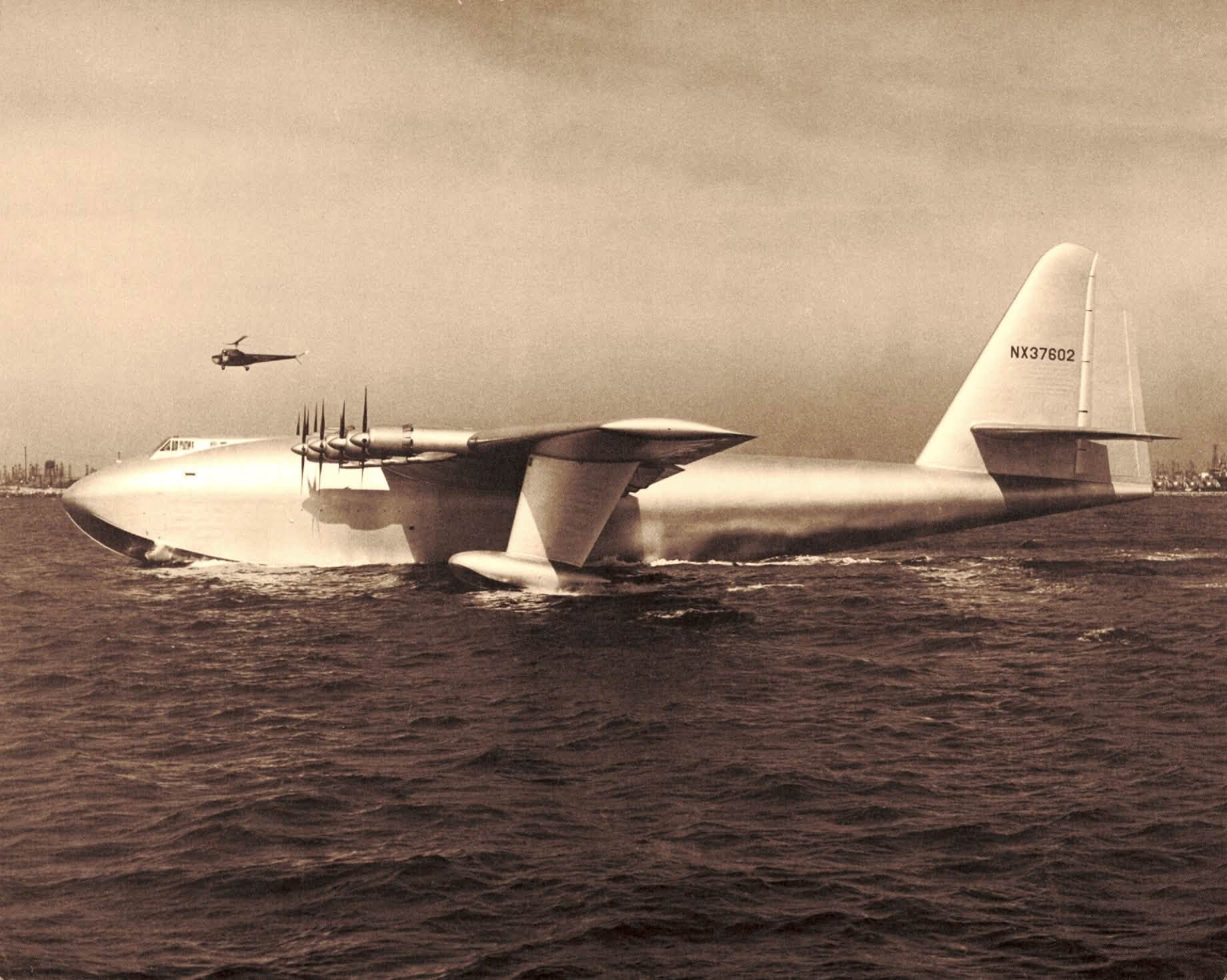
Decades before today’s largest passenger aircraft entered service, Howard Hughes pursued his own Hercules. The Hughes H-4 Hercules, popularly called the “Spruce Goose,” was an enormous flying boat built during World War II. It was designed to carry troops and equipment across the ocean while avoiding German submarines. Its boat-shaped hull allowed it to take off from and land on water, demonstrating the potential of a massive aircraft that did not depend entirely on conventional runways.
The H-4 flew only once, during a brief demonstration in 1947, and it never entered commercial service. Nevertheless, Hughes helped prove that an extremely large aircraft could operate from the water. Long before the full vision was realized, the Hercules represented an early step toward heavy aircraft capable of combining aviation with maritime transportation.
From the mythical son of Zeus, to Howard Hughes’ flying boat, to the C-130 and AC-130, the Hercules name has always represented strength under pressure. Our concept carries that lineage forward by combining the reach of a transport, the support capabilities of a gunship, and the speed and maneuverability of a next-generation stealth aircraft.
The legend of Hercules is still evolving.

Logistics
Land

LCK-18X Autonomous Tractor

AI-Driven. Driver-Ready. Built for the DarkGrid.
The LCK-18X Autonomous Tractor is designed to bring the same automation philosophy behind the LCK logistics network onto the highway. Rather than treating the tractor as a separate transportation system, the LCK-18X becomes another connected component of the supply chain, capable of moving an LCK Lite or Podliner between warehouses, distribution centers, ports, and final destinations with substantially less dependence on continuous manual driving.
Its defining feature is AI-assisted autonomous operation backed by human control. Radar, lidar, forward and side cameras, rear cameras, blind-spot monitoring, and a roof-mounted 360-degree camera array provide overlapping environmental awareness. The driving system can conceptually manage highway cruising, lane positioning, following distance, collision avoidance, low-speed maneuvering, trailer alignment, and automated docking. A conventional steering wheel, pedals, displays, and controls remain available so a qualified driver can assume control whenever necessary.

Driver comfort is equally important. When the vehicle is safely parked or operating in an appropriate autonomous mode, the two front seats can swivel 180 degrees, transforming the cockpit into part of the living space. A retractable floor-mounted table creates a workspace or dining area between the seats and sleeper compartment. Behind it, two extended bunks give a two-person driving team dedicated sleeping areas. The result is closer to a compact mobile office and sleeper than a conventional tractor cab.
For fleet operators, connectivity could become one of the LCK-18X’s biggest advantages. Vehicle health, trailer status, route progress, energy consumption, cargo connection and maintenance information can be integrated into fleet-management software. Combined with the LCK Lite and Podliner, this creates the potential for an automated chain in which cargo moves from warehouse → LCK pod → Podliner/Lite → autonomous tractor → destination while remaining digitally tracked throughout the journey.
The estimated $285,000–$325,000 conceptual mature-production price represents a substantial premium over a basic Class 8 tractor, but the business case is based on what the additional investment provides: autonomous-driving hardware, redundant sensing, fleet connectivity, hybrid-electric propulsion, automated trailer integration, a significantly upgraded sleeper/work environment, and compatibility with the broader LCK logistics ecosystem. Actual costs, range, efficiency and autonomous capabilities would require engineering development, certification and real-world validation.
LCK-18X AUTONOMOUS TRACTOR
Built to Connect. Designed to Deliver.
Independent conceptual design. Pricing and specifications are preliminary design targets, not manufacturer quotations or certified performance figures.
LCK-18X vs. LCK-18X Lite: Two Trailers for Different Logistics Networks

The LCK-18X Podliner and LCK-18X Lite are designed around the same universal AquaPod standard, but they use two different automation strategies. Both are 53-foot smart semitrailers equipped with an LCK Universal Transfer Interface and space for up to 48 physical pod positions. Approximately 36 fully loaded AP-1 AquaPods can be transported within the proposed road-weight target, depending on cargo weight and configuration. The major difference is whether the automated loading equipment travels with the trailer or remains at the facility. This gives customers the option to prioritize maximum flexibility or a lower acquisition cost.

The full LCK-18X Podliner is a self-contained automated trailer with an estimated price of $1,050,000. It carries its own robotic transfer arm, bidirectional center conveyor, two-level storage racks, powered restraints and an 80-kWh auxiliary battery system. Its onboard equipment is designed to complete an automated pod exchange in approximately 18 to 25 minutes. Because the automation travels with the trailer, the full Podliner can operate across a larger network of compatible ports, warehouses, airfields and mobile LCK receiving systems. This version is best suited for logistics companies, emergency-response networks and operators that regularly serve multiple destinations with different levels of infrastructure.
The LCK-18X Lite has an estimated trailer price of $495,000 and removes the heavy robotic arm, conveyor and large auxiliary power system from the trailer. Instead, it carries lightweight ceiling tracks, pod restraints, sensors and the LCK docking coupler. When the trailer reaches an equipped warehouse or factory, a facility-owned robotic arm enters on the ceiling tracks while a conventional telescoping conveyor extends across the trailer floor. The automation retracts into the building before the trailer departs, leaving only the AquaPods and lightweight transfer hardware onboard. This reduces estimated acquisition cost by $555,000 per trailer while also lowering trailer weight, maintenance requirements and mechanical complexity.

The Lite version is especially valuable for manufacturers, retailers, fulfillment centers and regional carriers operating between a predictable group of automated facilities. One warehouse robotic system can serve several Lite trailers, spreading the automation investment across a larger fleet. The reduced trailer weight may also provide additional payload flexibility, although final capacity must be confirmed through engineering and road certification. Companies using fixed, high-volume routes could purchase more trailers without installing a separate robot and conveyor in every unit. The tradeoff is that a Lite trailer cannot perform automated transfers at destinations that lack compatible facility equipment.

A large logistics operator could benefit from using both versions in the same network. Full LCK-18X Podliners could serve flexible routes, remote destinations and locations where self-contained automation is necessary. LCK-18X Lite trailers could handle repetitive movement between major factories, sorting hubs and distribution centers equipped with permanent LCK interfaces. Because both versions use the same AquaPods and docking standard, cargo can move between them without being repacked. Together, they create a scalable logistics system that balances automation, flexibility and cost.
All prices and performance figures are conceptual estimates. They exclude tractors, AquaPods, taxes, site preparation and facility automation, and require engineering, safety, regulatory and commercial validation.
LCK-18X Podliner: The Automated Land Link for LCK Logistics

The LCK-18X Podliner is designed to be the most compatible land vehicle for the LCK robotic logistics system. It transports standardized AP-1 AquaPods between factories, warehouses, ports, airfields, and naval facilities without requiring cargo to be repeatedly unpacked and handled. Instead of functioning as a conventional trailer, the Podliner serves as a mobile automated warehouse connected directly to the larger LCK distribution network. Its standardized transfer interface allows cargo to move efficiently between land, air, and sea vehicles. One vehicle can therefore support commercial distribution, maritime resupply, and rapid air delivery.
Inside the smart trailer, AquaPods are secured in two-level storage racks positioned along both sides of a central conveyor. Robotic transfer arms retrieve selected pods and place them onto the conveyor for loading or unloading. Each AquaPod can be digitally identified, scanned, inspected, routed, and tracked throughout its journey. This system allows operators to select individual cargo modules without unloading everything stored in front of them. It also reduces the need for forklifts to enter the trailer, helping limit congestion, cargo damage, and worker exposure around moving equipment.
When the Podliner reaches a compatible facility, the driver backs the trailer toward an LCK Universal Transfer Interface. Sensors assist with alignment before the interface seals, locks, and establishes power and data connections. The trailer’s restraints then release only the AquaPods approved for transfer. Its robotic arms and bidirectional conveyor move those pods directly into the receiving facility’s automated sorting system. The target is to complete a routine automated exchange in approximately 18 to 25 minutes, although final performance will depend on cargo configuration, facility design, and engineering validation.
The LCK-18X also introduces AI-assisted steering for the trailer’s rear tandem wheels. Cameras, lidar, articulation sensors, and path-prediction software help the trailer follow the tractor through tight intersections, loading yards, ports, and airfields. At low speeds, the rear wheels can counter-steer to reduce the turning envelope and help keep the trailer inside its intended lane. The system is designed to gradually center and lock the wheels as road speed increases. Driver override, manual yard controls, and a fail-safe center-lock mode remain available to keep the operator in control.
A physical trailer configuration could provide up to 48 AquaPod positions, with approximately 36 fully loaded AP-1 AquaPods serving as the road-legal planning target. The difference allows operators to balance cargo density, axle loading, pod weight, and route restrictions. After arriving at a port or airfield, the same AquaPods can be transferred into an AquaBox, an MT-007, a C-30 cargo aircraft, a Great White mobile warehouse, or another vehicle equipped with an LCK interface. Cargo remains inside its protected pod while the transportation platform changes around it. This creates a continuous logistics chain from the original shipper to the final land, air, or sea destination.

The conceptual mature-production price is estimated at $325,000 for the AI-assisted tractor and $1,050,000 for the automated smart trailer. Purchased separately, the two vehicles would total approximately $1,375,000. The proposed complete Podliner package is priced at $1,299,000, producing estimated bundle savings of $76,000. These figures exclude AquaPods, facility interfaces, taxes, destination charges, energy infrastructure, and site preparation. Prototype vehicles would likely cost more until manufacturing volume and supplier networks are established.

The LCK-18X Podliner is more than an eighteen-wheeler. It is the land-based connection that allows the LCK robotic logistics system to operate as one coordinated network. By combining automated storage, robotic loading, intelligent rear steering, and a universal transfer interface, the Podliner can help cargo move faster with fewer manual transfers. The result is a flexible logistics platform designed to connect warehouses, highways, ports, aircraft, and ships through the same standardized AquaPod system.
Introducing the estimated cost structure for the LCK-18X Podliner and AquaPod automated logistics system. The AI-assisted Class 8 tractor is projected to cost approximately $325,000, while the automated smart trailer is estimated at $1,050,000. Purchased separately, the two vehicles would cost $1,375,000. The proposed complete Podliner package is priced at $1,299,000, providing an estimated $76,000 bundle discount.
LCK Lite Retrofit System: Turn Existing Trailers Into Automated Podliners

The LCK Lite Retrofit System is designed around a simple idea: companies should not have to purchase an entirely new automated trailer fleet to participate in the LCK logistics network. Instead, existing compatible dry vans, reefers, and container-style trailers can be upgraded with a lightweight overhead track package that transforms them into LCK Lite Podliners.
Unlike the full LCK-18X, the retrofit trailer does not carry its own large robotic arm or full-length floor conveyor. The expensive automation remains at the warehouse, factory, distribution center, port, or other LCK-equipped facility. This reduces the amount of equipment traveling down the highway and allows one facility automation system to potentially service many trailers.
How the Retrofit Works
The retrofit begins by installing a reinforced but lightweight modular track structure along the trailer ceiling. The system can incorporate aluminum track rails, mounting brackets, powered trolley hardware, electrical and data connections, position sensors, safety stops, and an LCK-compatible control module. The goal is to make the installation modular enough that a compatible existing trailer can be converted without rebuilding its entire cargo floor.
When the trailer arrives at an LCK-equipped facility, it backs into the LCK Universal Interface. The interface aligns and secures the trailer while establishing power, data, and automation connections. The facility’s robotic handling equipment can then interface with the trailer’s ceiling-track system.
Instead of requiring workers and forklifts to repeatedly enter the trailer, the robotic system handles standardized Aquapods. Pods can be loaded, unloaded, repositioned, sorted, picked for a particular destination, or moved back toward the interface for delivery. Software can associate each pod with its destination, shipment, priority, weight, and other logistics information so that physical cargo movement becomes part of the facility’s digital logistics network.
Automation Stays at the Facility
The most important feature of the Lite architecture is the separation between mobile equipment and facility equipment. The trailer carries only the equipment necessary to securely transport pods and interact with LCK automation. The expensive robotic arms, conveyors, sorting equipment, and larger control systems can remain inside the facility.
That creates a hub-and-spoke approach to automation. A distribution center could invest in a sophisticated LCK Interface while operating dozens or potentially hundreds of comparatively inexpensive retrofit trailers. Instead of purchasing a robot and conveyor for every trailer, the company concentrates those assets where they are used most frequently.
This also reduces trailer tare weight. Every pound removed from permanently installed automation can potentially become additional payload capacity, subject to normal axle, gross vehicle weight, structural, and regulatory limitations.
From Regular Trailer to LCK Lite
The proposed retrofit package includes the ceiling track rails, trolley and lifting hardware, power and data bus, mounting structure, control module, positioning sensors, safety equipment, and interface hardware required to connect the trailer to the larger LCK ecosystem.
The concept is intended to support common 53-foot dry vans first, with additional configurations potentially developed for 48-foot trailers, refrigerated trailers, shipping containers, and specialized cargo bodies. Each trailer type would require an engineering survey to determine roof strength, mounting locations, load distribution, electrical requirements, and allowable pod weights before installation.
Once converted, the trailer becomes more than a box carrying freight. It becomes a mobile extension of an automated warehouse.
Estimated Retrofit Cost
For promotional and early planning purposes, we estimate a target installed retrofit price of approximately $39,500 per compatible trailer:
| Retrofit Component | Concept Estimate |
|---|---|
| Ceiling tracks, trolley, controls & retrofit hardware | $24,500 |
| Installation & structural mounting | $10,000 |
| Integration, calibration & testing | $3,500 |
| Operator training & documentation | $1,500 |
| Estimated Installed Price | $39,500 |
That figure is a concept target rather than a supplier quote. Actual production pricing would depend on trailer construction, track length, structural reinforcement, sensors, certification requirements, production volume, labor rates, and the amount of automation incorporated into the final design.

Why Retrofit?
The LCK Lite Retrofit System could dramatically lower the financial barrier to automated freight handling. A fleet operator would not necessarily have to discard thousands of conventional trailers simply because its warehouses are becoming automated. Compatible assets could instead be upgraded gradually as routes and facilities transition to the LCK standard.
That creates three levels of deployment: conventional trailers for traditional operations, retrofitted LCK Lite trailers for automation-equipped routes, and the approximately $1.05 million full LCK-18X concept for routes where self-contained onboard automation provides enough operational value to justify the additional equipment.
The result is an automation ecosystem rather than a single trailer.
Retrofit. Automate. Reduce Cost.
LCK Lite gives the existing trailer fleet a path into the automated logistics network.
All prices, capacities, installation times, savings figures, and performance specifications are preliminary concept targets and require structural engineering, prototype testing, regulatory review, supplier quotations, and commercial validation before being represented as production specifications.
 The system uses four specialized AquaPod configurations. The standard AP-1 Dry pod is estimated at $9,500 for tools, packaged electronics, replacement parts, clothing, food, and ordinary parcels. The refrigerated AP-1C Cold pod is projected at $28,500 for approved medicines, laboratory supplies, blood products, chilled food, and temperature-sensitive equipment. The reinforced AP-1S Secure pod is estimated at $18,500 for valuable electronics, sensitive documents, controlled supplies, and critical repair parts. The smaller AP-1H Half pod costs approximately $6,500 each or $12,000 per pair for priority parcels, diagnostic kits, samples, tools, and urgent replacement parts.

A practical 36-position road package would include 20 Dry pods, eight Cold pods, four Secure pods, and eight Half pods occupying four full positions. That mixed AquaPod fleet is estimated to cost $540,000. When combined with the discounted $1,299,000 Podliner package, the complete mobile land logistics system would cost approximately $1,839,000. Purchasing the tractor and trailer separately with the same pod package would raise the estimated total to $1,915,000.
 This investment creates more than a truck and a set of containers. AquaPods can be scanned, tracked, stored, selected, and moved through the trailer using robotic arms and a central conveyor. The Podliner can back into an LCK Universal Transfer Interface and exchange cargo without a forklift entering the trailer. The same pods are intended to move between factories, warehouses, ports, AquaBoxes, cargo aircraft, and ships equipped with compatible LCK interfaces.
The goal is to reduce repetitive cargo handling while improving speed, security, visibility, and flexibility. Cargo is packed once inside the correct AquaPod and remains protected as it moves between land, air, and sea transportation. Instead of rebuilding every shipment at each transfer point, the LCK system moves standardized cargo modules through one connected automated network.
These prices are conceptual mature-production estimates. Prototype development, engineering validation, certification, facility interfaces, charging equipment, site construction, taxes, and destination charges are not included

The AquaPods are purchased separately according to their cargo function:
• AP-1 Dry: $9,500
For ordinary parcels, tools, packaged electronics, replacement parts, clothing, PPE, maintenance supplies, and shelf-stable food.
• AP-1C Cold: $28,500
For approved medicines, vaccines, laboratory reagents, blood products, chilled food, produce, and temperature-sensitive equipment.
• AP-1S Secure: $18,500
For high-value electronics, controlled medical supplies, sensitive documents, encrypted equipment, precious materials, and critical repair parts.
• AP-1H Half: $6,500 each or $12,000 per pair
For smaller parcels, diagnostic kits, urgent replacement parts, samples, documents, tools, e-commerce orders, and returns.
A recommended 36-position road package would include 20 Dry pods, eight Cold pods, four Secure pods, and eight Half pods occupying four full positions. This mixed AquaPod fleet would cost approximately $540,000. Combined with the discounted $1,299,000 tractor and trailer package, the complete mobile system reaches the projected $1,839,000 total.

The LCK system is designed around one simple idea: pack the cargo once and transfer it automatically. AquaPods can move from a factory into the Podliner, through a port or airfield, and onto compatible land, air, or sea vehicles without rebuilding the shipment at every stop. Robotic handling, digital tracking, standardized interfaces, and AI-assisted maneuvering are intended to reduce delays, repetitive labor, cargo damage, and manual handling.
These figures are conceptual mature-production estimates. Prototype development, engineering validation, certification, fixed facility interfaces, AquaBoxes, aircraft, ships, charging equipment, construction, taxes, and destination charges are priced separately.
Complete LCK-18X mobile system: $1.839 million.
One system. Four pods. Every destination.

Introducing the LCK Locker Automated Logistics System, a concept designed to move cargo from ship to shore, airfield and fleet with minimal manual handling. Every shipment remains digitally tracked while waterproof containers, autonomous pallets, robotic arms and standardized LCK transfer interfaces keep the cargo moving.

The pathway begins aboard a commercial freighter, where robotic equipment removes cargo from conventional shipping containers and secures it inside padded, waterproof AquaPods. A controlled wet elevator lowers the pods into a protected water lane, where they float toward an LCK-A1 AquaBox. The AquaBox captures each pod, removes surface water, checks for leaks and transfers the cargo onto its internal conveyor.

After reaching shore, the AquaBox connects directly to the LCK Universal Transfer Interface. Automated pallets carry the cargo into a dark, energy-saving warehouse where it is scanned, sorted and stored. When a naval delivery order arrives, the system retrieves the correct pallet and transfers it through another LCK interface into a truck headed for a nearby airfield.

At the airfield, the truck connects to a mobile LCK aircraft interface aligned with the rear cargo ramp of the MT-007 Shadow Jump Jet. Powered rollers move the pallet into the aircraft, automated restraints secure it and the MT-007 departs for the receiving naval vessel. Its vertical-flight system allows it to land directly on the ship’s reinforced helipad without requiring a runway.

After landing, the pallet moves from the MT-007 into the ship’s protected logistics receiving area, where automated conveyors can route it to storage, maintenance teams, medical departments or immediate mission use. One cargo standard connects the freighter, AquaBox, warehouse, truck, aircraft and naval ship.
Freighter → AquaPod → AquaBox → LCK Interface → Automated Sorting → Truck → MT-007 → Naval Ship

The LCK Locker system is a conceptual vision for faster fleet logistics, reduced cargo handling, lower warehouse energy use and fewer personnel exposed to difficult loading environments.
LCK TruckBat: One Automated Loader for an Entire Fleet

The LCK TruckBat is a facility-owned robotic system designed to automate the loading and unloading of ordinary trailers and shipping containers. Its telescoping conveyor enters through the rear cargo doors while a robotic arm travels along the conveyor’s reinforced frame. Vision cameras, LiDAR and RFID sensors help the system identify, measure and position cargo safely. Interchangeable tool heads allow it to handle pallets, cartons, totes, drums and standardized AquaPods. Because the equipment retracts into the facility after each job, basic operation requires no permanent modification to the trailer. One TruckBat can serve multiple carriers, trailer types and daily deliveries from the same loading dock.

Estimated Turnaround Times
| Loading operation | Estimated time |
|---|---|
| Docking, alignment and system checks | 10–15 minutes |
| Partial load of approximately 10 pallets | 30–45 minutes |
| Unload a fully palletized 53-foot trailer | 65–95 minutes |
| Load a fully palletized 53-foot trailer | 65–95 minutes |
| Complete unload-and-reload turnaround | 2–3 hours |
| Mixed or irregular freight turnaround | 3–5 hours |
These estimates assume approximately 20 to 30 pallet movements per hour under controlled warehouse conditions. Actual turnaround will depend on cargo weight, packaging, trailer condition, scanning requirements and how many tool changes are required. Standardized pallets and AquaPods should produce the fastest and most predictable results. Mixed cartons, loose freight and irregular objects may require additional scanning and positioning time. Optional LCK Lite ceiling tracks can further improve AquaPod movement by allowing the TruckBat to transfer pods to an overhead trolley. Final operating times will be established through prototype testing and site-specific engineering.

With an estimated base price of $195,000, the TruckBat gives warehouses access to advanced automation without purchasing a specialized robotic trailer for every shipment. The system can support 48-foot trailers, 53-foot dry vans, refrigerated trailers and ISO shipping containers through an adjustable dock interface. Automated handling can reduce repetitive lifting, improve cargo placement and create more consistent scheduling at busy facilities. Digital cargo records can also help operators verify what entered the trailer, where it was placed and when the loading cycle was completed. The result is a flexible loading platform that remains at the facility while serving an entire network of conventional trucks and containers. Insert, load, retract and prepare the next trailer.
The LCK Postal Network: Faster Mail From Hub to Curb

The LCK-MC1 Postal Carrier is designed to connect automated mail facilities, local delivery routes, and supersonic cargo transportation through one coordinated logistics network. Unlike a conventional mail truck, the LCK-MC1 combines a human driver with automation that assists with loading, mail organization, curbside delivery, and outgoing-mail collection. The driver remains in control of the vehicle and handles oversized packages, signatures, damaged mailboxes, and unusual delivery conditions. Automated systems perform repetitive tasks that can consume valuable time during a normal postal route. This approach improves efficiency without removing human judgment from the delivery process. The LCK-MC1 has an estimated fleet-scale concept price of $195,000 per vehicle, excluding facility equipment.
Inside the LCK-MC1, sealed route-order cassettes organize letters and flats according to the sequence of delivery addresses. Barcode and optical-address scanners verify the mail before a compact presentation system prepares the bundle for the next stop. Once the vehicle is safely parked, a rear-right robotic arm can open a compatible curbside mailbox, insert the mail, collect outgoing letters, and close the box. The arm uses cameras, padded gripping surfaces, force sensors, and automatic safety interlocks to protect the mail and mailbox. The vehicle also provides an estimated electric range of 120 to 160 miles, with an optional series-hybrid configuration offering approximately 250 to 300 miles. A carrier can override the automation at any time and complete the delivery manually.

The LCK Cargo Pod System connects the vehicle directly to the automated sorting equipment inside a postal facility. Mail is placed into sealed route pods instead of being transferred repeatedly between loose trays, carts, and vehicle shelves. When the LCK-MC1 docks at the facility, floor rollers, alignment locks, and a secure digital manifest system automatically load the correct pods into the vehicle. The same interface can unload outgoing mail, returned packages, and undeliverable items at the end of the route. Charging can occur while the vehicle is being loaded, reducing the amount of time it remains out of service. This creates a protected and traceable flow of mail from the sorting machine to the delivery vehicle.
On a modeled 600-stop curbside route, the combined system could reduce total route time from approximately 7 hours and 20 minutes to about 5 hours. The estimate assumes preparation and loading decrease from 60 minutes to 20 minutes, while the average mailbox cycle decreases from 20 seconds to 10 seconds. Driving time remains unchanged in the calculation. Under those assumptions, the LCK-MC1 saves approximately 140 minutes and completes the route up to 32 percent faster. Actual results would depend on traffic, route density, weather, mailbox conditions, package volume, and the number of deliveries requiring driver assistance. The purpose of the automation is to help each carrier complete more work safely, accurately, and consistently.
For longer distances, the LCK system can connect with the conceptual C-140 Perseus supersonic cargo aircraft. The C-140 is designed to carry standardized LCK cargo pods at a targeted cruising speed of Mach 1.45, or approximately 960 miles per hour under the current performance model. Estimated airborne time from Los Angeles to New York is approximately 2 hours and 35 minutes, while Los Angeles to Honolulu is approximately 2 hours and 40 minutes. New York to London is modeled at approximately 3 hours and 36 minutes, compared with about 6 hours and 39 minutes for a conventional cargo jet traveling near 520 miles per hour. These estimates represent airborne line-haul time only and do not include security screening, weather delays, customs processing, or local distribution. When combined with automated LCK loading and the LCK-MC1 last-mile carrier, the C-140 could form the backbone of a faster mail network connecting sorting facilities, aircraft, delivery hubs, and curbside mailboxes.

Together, the LCK-MC1, automated cargo pods, and C-140 Perseus create a complete logistics system rather than three isolated vehicles. Mail can remain protected inside standardized containers as it moves from regional sorting to aircraft transportation and final delivery. Automated loading reduces manual handling, digital manifests strengthen accountability, and faster transportation shortens the time between distant communities. Human employees continue to supervise the system, resolve exceptions, and protect the integrity of every delivery. The result is a forward-looking postal network designed around speed, safety, energy efficiency, and reliable public service. All prices, specifications, and delivery times are conceptual estimates and do not represent an official USPS program or guaranteed performance.

Next-Generation Army Land Vehicles

The MT-120 Ares and MT-40 Atlas are next-generation land vehicle concepts developed primarily for the Army and allied ground forces. Together, they explore how improved armor, hybrid propulsion, remote weapons, active protection, digital controls, and safer crew arrangements could strengthen future armored formations. Both vehicles are designed to place soldiers under armor while giving them better awareness of the battlefield through cameras, thermal sensors, communications, and multifunction displays. Their hybrid power systems are intended to provide stronger low-speed torque, improved range, silent-watch capability, and enough electrical power for future defensive systems. Modular construction would also allow armor, sensors, weapons, and mission equipment to be upgraded without replacing the entire vehicle. These specifications remain conceptual targets that would require prototype construction, testing, and Army evaluation before operational use.

The MT-120 Ares is designed as a faster and more efficient main battle tank for Army armored brigades. Its three-person crew is positioned inside a protected hull capsule, separating the commander, driver, and gunner from the unmanned turret and isolated ammunition compartment. An automatic loader replaces the traditional human loader, potentially reducing crew exposure while helping the vehicle maintain a lower turret profile. The proposed 1,600-horsepower hybrid system gives the 65-ton Ares a projected power-to-weight ratio of 24.6 horsepower per ton, supporting quicker acceleration and a target road speed of 50 miles per hour. A 120 mm main cannon, active-protection system, modular armor, remote flank weapons, and roof-defense Gatling station would give the tank layered offensive and defensive capabilities. The Ares is intended to help Army units breach defended areas, protect supporting infantry, defeat armored threats, and survive increasingly dangerous drone and top-attack environments.


The MT-40 Atlas is designed primarily as a heavy Army infantry carrier that combines troop transportation with the suppressive power of an infantry fighting vehicle. Its forward compartment accommodates a commander, gunner, and driver, while the protected rear compartment carries a twelve-person dismount squad with blast-resistant seating and a clear aisle to the power-operated ramp. The squad can include fire-team leaders, automatic riflemen, grenadiers, anti-armor specialists, riflemen, and a combat medic, allowing the vehicle to transport a complete and flexible ground-combat element. A 40 mm autocannon, twin-.50-caliber flank stations, a roof-defense Gatling system, modular armor, active protection, and a double-V hull would help protect the squad during movement and dismount operations. The four-axle 8×8 design, 1,050-horsepower hybrid powertrain, run-flat tires, and central tire-inflation system are intended to combine heavy protection with speed and maneuverability. Working together, the Ares and Atlas could give future Army formations a coordinated tank and infantry team built around mobility, protection, firepower, digital awareness, and the safety of the soldiers inside.

Air
Our next concept applies that vision to the Boeing 747 airframe. Since more than 70 percent of Earth’s surface is covered by water, passenger aircraft could benefit from emergency flotation systems inspired by flying boats. A redesigned 747 could feature a reinforced watertight lower fuselage, compartmentalized flotation chambers, deployable stabilizing pontoons, strengthened lower surfaces, and controlled water-braking systems.

The objective would not be to turn every 747 into a traditional seaplane. The objective would be to create a passenger aircraft with a better chance of remaining stable and afloat following an emergency water landing. Such a design would require extensive engineering, testing, certification, corrosion protection, and structural reinforcement, but Hughes’ Hercules provides an important historical point of inspiration.
The Hercules name continued its aviation legacy with the C-130 military transport and the heavily armed AC-130 gunship. Unlike modern jet fighters, the AC-130 uses four turboprop engines and large propellers. It is designed to circle a target area and provide sustained fire support to forces on the ground. Its strengths are endurance, payload capacity, and precision support rather than supersonic speed or fighter-style maneuverability.

Our new concept takes the basic mission of the AC-130 and moves it into the stealth era. The propellers are replaced by four advanced turbofan engines with shielded intakes and thrust-vectoring exhaust nozzles. A blended, radar-deflecting fuselage, swept wings, canted tail surfaces, internal systems, and radar-absorbing materials would reduce its visibility.
The wings would use independently controlled spoilers, maneuvering surfaces, and split flaps. During a rapid turn, panels on one wing could increase drag and reduce lift while the opposite wing maintains or increases lift. Thrust vectoring would add another turning force, helping the aircraft roll, pitch, and redirect itself faster than a conventional gunship.
Because of its size and weight, this aircraft would not dogfight like a lightweight fighter. Its purpose would be to travel at high-subsonic or potentially supersonic speeds, accompany some stealth-fighter operations, provide electronic warfare and long-range fire support, and survive in airspace that would be too dangerous for a traditional propeller-driven gunship.
Executive Luxury Transport Concepts

The P-1000X Family: Regional Aviation Without Runway Dependence
The P-1000X family introduces a new class of civilian aircraft designed to connect communities, hospitals, airports, offshore facilities, and disaster areas without depending entirely on conventional runways. Both models combine wing-borne efficiency with vertical takeoff and landing capability. Four rotating electric ducted fans provide vertical lift and forward propulsion, while a fifth centerline fan supports takeoff, landing, and low-speed transition. Once sufficient forward speed is reached, the wings assume the lifting load and the center fan closes behind flush aerodynamic doors. This hybrid-electric architecture is intended to provide regional range that would be difficult to achieve with batteries alone.
The standard P-1000X is designed for passenger transportation, medical evacuation, and priority cargo delivery. The amphibious P-1000XA Sea Guardian expands those capabilities by adding a flying-boat hull, maritime rescue equipment, and the ability to operate from suitable bodies of water. Both aircraft retain conventional landing gear for airports and prepared landing zones. Operators could therefore use the same basic platform across urban, rural, island, offshore, and emergency-response networks. Mission interiors could be changed without permanently dedicating the aircraft to one role.
These aircraft are currently conceptual designs offered for investment, licensing, engineering development, and manufacturing partnerships. Prices represent projected mature-production targets rather than binding sales quotations. Final performance will depend on structural testing, propulsion development, certification, battery technology, and the selected mission equipment. Operators would also require appropriately sized vertiports because of the aircraft’s weight, downwash, and 58-foot operating width. The P-1000X family is intended to provide a credible foundation for developing a runway-optional regional transportation system.
P-1000X Civilian Multi-Mission Powered-Lift Transport

The P-1000X is the primary land-based model and the most economical entry into the aircraft family. Its cabin is sized for two pilots and as many as 16 passengers in a practical 2-by-2 seating arrangement. Unlike smaller urban air taxis, it is designed as a regional shuttle capable of connecting airports, business centers, islands, remote communities, and locations separated by difficult terrain. The aircraft can take off vertically when necessary or use a short runway to carry more cargo and preserve energy. Its targeted 300-knot cruise speed would make it considerably faster than most helicopters serving comparable regional missions.
Four electrically driven ducted fans rotate from vertical-lift position to horizontal cruise position through reinforced nacelle pivots. Two independent turboshaft generators provide continuous electrical power, while isolated battery modules supply additional energy during takeoff, transition, and landing. Opposing propulsion pods would operate through separated electrical buses to reduce the possibility that one failure disables multiple fans. The aircraft would also retain aerodynamic glide capability and conventional landing gear for emergency or routine runway landings. These features are intended to combine VTOL flexibility with the redundancy expected from a commercial regional aircraft.
The modular cabin allows the P-1000X to generate revenue across several markets instead of performing only one specialized mission. Passenger operators could use it for airport transfers, intercity transportation, island service, executive travel, and offshore access. Medical operators could install four stretchers, clinical workstations, oxygen, ventilators, and independent medical power. Cargo operators could use a reinforced roller floor and rear loading ramp for emergency supplies, pharmaceuticals, aircraft components, or high-value freight. This flexibility could help public agencies and commercial operators maintain higher aircraft utilization throughout the year.
Estimated P-1000X Specifications
| Specification | Conceptual design target |
|---|---|
| Aircraft type | Hybrid-electric civilian powered-lift transport |
| Flight crew | 2 pilots |
| Passenger capacity | 16 passengers |
| Medevac capacity | 4 stretchers and 2 to 4 clinicians |
| VTOL payload | Approximately 4,000 lb |
| Short-runway cargo capacity | Up to approximately 6,000 lb |
| Length | 62 ft |
| Wingspan | 58 ft |
| Height | 19 ft |
| Maximum takeoff weight | Approximately 28,500 lb |
| Operating empty weight | Approximately 18,000 to 20,000 lb |
| Cruise speed | Approximately 300 knots |
| Maximum speed | Approximately 360 knots |
| Practical VTOL range | Approximately 400 nautical miles |
| Runway-assisted range | Approximately 650 nautical miles |
| Service ceiling | Approximately 27,000 ft |
| Short-runway target | 1,500 to 2,500 ft |
| Minimum vertiport diameter | 80 ft with a 100-ft safety area |
| Estimated base price | Approximately $55 million |
| Expected production range | Approximately $45 million to $65 million |
| Medical-equipped version | Approximately $55 million to $75 million |
P-1000XA Sea Guardian Amphibious Rescue Transport

The P-1000XA Sea Guardian adapts the powered-lift platform for maritime rescue, coastal medicine, island transportation, and disaster response. Its reinforced flying-boat hull replaces the standard lower fuselage with a watertight deep-V structure containing bow chines, spray rails, sealed compartments, and water-impact reinforcement. Compact stabilizing sponsons help keep the aircraft upright while floating without creating the drag and structural complications associated with large external pontoons. Retractable wheeled landing gear allows the same aircraft to operate from airports, prepared vertiports, and suitable bodies of water. This combination would give emergency agencies access to locations that conventional airplanes and land-dependent VTOL aircraft cannot reach.
The Sea Guardian is intended to make controlled airplane-style water landings instead of descending vertically onto rough water. During water operations, the center lift fan would remain protected beneath sealed watertight doors to prevent spray ingestion. Raised external nacelles, corrosion-resistant materials, drainage systems, bilge pumps, leak sensors, and marine electrical protection would defend critical systems from saltwater exposure. Differential fan thrust and retractable water rudders would provide low-speed maneuvering after landing. Vertical flight would remain available for land operations, hovering during rescues, and carefully controlled operations over calm water.
A water-level rescue door and deployable platform would allow rescue swimmers and survivors to enter the aircraft without climbing into a conventional elevated cabin door. A powered hoist could recover injured people who cannot reach the platform, while thermal imaging, searchlights, surface-search radar, flotation equipment, and medical workstations would support nighttime and low-visibility operations. The cabin could transport four stretcher patients or evacuate approximately 12 survivors, depending on weight, fuel, and medical-equipment requirements. Potential missions include coastal search and rescue, offshore-platform evacuation, flood response, ship-to-hospital transport, island resupply, and disaster-relief deployment. The Sea Guardian would complement helicopters by offering greater regional speed, cabin capacity, and potential range.
Estimated P-1000XA Sea Guardian Specifications
| Specification | Conceptual design target |
|---|---|
| Aircraft type | Amphibious hybrid-electric powered-lift rescue transport |
| Flight crew | 2 pilots |
| Mission crew | 2 rescue specialists or clinicians |
| Rescue capacity | Up to approximately 12 survivors |
| Medevac capacity | 4 stretchers with medical personnel |
| VTOL payload | Approximately 3,200 lb |
| Water or runway-assisted payload | Approximately 5,000 lb |
| Length | Approximately 62 ft |
| Wingspan | Approximately 58 ft |
| Height | Approximately 20 ft |
| Maximum takeoff weight | Approximately 31,500 lb |
| Cruise speed | Approximately 290 knots |
| Maximum speed | Approximately 335 knots |
| Practical VTOL range | Approximately 360 nautical miles |
| Water or runway-assisted range | Approximately 600 nautical miles |
| Service ceiling | Approximately 25,000 ft |
| Landing systems | Flying-boat hull and retractable wheeled landing gear |
| Marine equipment | Water rudders, bilge pumps, rescue platform and powered hoist |
| Estimated equipped price | Approximately $82 million |
| Expected production range | Approximately $75 million to $90 million |
Two Aircraft, One Flexible Platform
The P-1000X offers the strongest balance of speed, payload, range, and acquisition cost for operators whose missions are primarily conducted from land. The P-1000XA adds maritime capability for organizations that must reach survivors, patients, vessels, islands, and flooded areas directly from the water. Both models share the same basic five-fan propulsion concept, modular cabin philosophy, twin-tail configuration, and regional-aircraft proportions. Common systems could simplify pilot training, maintenance, spare-parts inventories, and fleet expansion. An operator could therefore field both aircraft without supporting two completely unrelated aviation platforms.
Commercial customers could deploy the P-1000X for scheduled regional transportation during normal operations and rapidly convert it for medical or cargo assignments during emergencies. Government and humanitarian organizations could use the P-1000XA for coastal rescue, disaster relief, offshore evacuation, and rapid medical transport. Hospital networks could position either model as an airborne extension of critical-care infrastructure. Logistics companies could use short-runway or VTOL operations to move urgent freight around damaged roads, congested airports, or isolated terrain. The combined family is designed to keep operating when conventional transportation networks are unavailable.
The P-1000X and P-1000XA Sea Guardian are available as conceptual platforms for qualified investment, engineering, manufacturing, and licensing discussions. Development partners would have the opportunity to participate in propulsion refinement, aerodynamic validation, cabin integration, prototype construction, and certification planning. Mission packages could be tailored for passenger service, emergency medicine, maritime rescue, humanitarian operations, or high-priority logistics. All specifications and prices remain preliminary until validated through engineering analysis and flight testing. The objective is not merely to build another aircraft, but to create a flexible transportation system capable of reaching people wherever the runway ends.
MT-65C “Executive Nite Owl”
High-Speed Civilian Transportation Built Around Safety
The MT-65C “Executive Nite Owl” is a next-generation civilian rotorcraft concept designed around one uncompromising priority: protecting every person aboard. It combines the vertical landing capability of a helicopter with the speed, comfort, and range expected from premium executive transportation. Two independent turboshaft engines, coaxial counter-rotating rotors, an enclosed pusher fan, and advanced flight-control systems create several layers of operational protection. The aircraft is intended to carry two pilots and eight executive passengers, with a convertible configuration accommodating as many as ten passengers. Its potential applications include corporate transportation, emergency medical flights, offshore service, disaster response, government travel, and rapid regional transportation. Every proposed system supports the central design philosophy that performance is valuable only when it is supported by genuine redundancy and passenger protection.

Photo 1: Exterior Hero View
The MT-65C Executive Nite Owl combines an aerodynamic civilian fuselage, panoramic cockpit, twin turboshaft propulsion, two five-blade coaxial rotors, and an enclosed tail-mounted pusher fan.
Twin-Engine Redundancy That Protects the Entire Rotor System
The MT-65C is powered by two approximately 2,000-shaft-horsepower turboshaft engines located in separated, fire-protected compartments. Each engine would have its own fuel shutoff, fire-detection equipment, starter-generator, digital engine controller, reduction stage, and independent input shaft. A digital engine controller, commonly called FADEC, automatically manages engine performance while monitoring temperatures, pressure, speed, and fuel delivery. Isolation clutches would allow the aircraft to disconnect a damaged or malfunctioning engine without stopping the surviving engine. During normal operation, both engines contribute power to the coaxial rotor system and the enclosed pusher fan. If either engine fails, the system is designed to isolate it automatically while the remaining engine continues supplying power to both main rotors.
After an engine failure, the MT-65C would immediately enter a protected one-engine-inoperative mode. The pusher fan would disconnect because forward speed becomes secondary to maintaining lift and control. Nonessential electrical equipment would be reduced or shut down, preserving available power for the rotor system, flight controls, avionics, lubrication pumps, communications, and landing gear. An emergency battery would continue supporting essential systems during the transition. The surviving turboshaft would not be expected to maintain every normal-flight capability at maximum weight, but it should provide enough power for continued forward flight and a controlled landing under approved operating conditions. This approach makes realistic emergency recovery the goal instead of relying on an unrealistic promise that the aircraft could perform normally after losing half its engine power.
The central combining gearbox would remain one of the most important components in the aircraft. Because both engines ultimately feed one coaxial mast, the gearbox must be treated as a shared system requiring multiple internal safeguards. The proposed design includes two lubrication circuits, an electrically powered emergency oil pump, temperature monitoring, vibration sensors, metallic-debris detectors, and physically separated accessory systems. These features would provide the pilots with early warning of abnormal wear and help maintain lubrication after a primary pump failure. Modular input sections would also allow one damaged engine path to be isolated from the functioning side. The final aircraft would require extensive ground testing, endurance testing, and civilian certification before any one-engine capability could be guaranteed.

Photo 2: Redundant Power System Schematic
Engine A and Engine B operate through independent input shafts and isolation clutches. If one engine becomes inoperative, the remaining engine supplies both coaxial rotors while the pusher fan disconnects and nonessential loads are removed.
Safer Rotor Architecture
The MT-65C uses two coaxial rotors mounted on the same central axis, with five blades on the upper rotor and five on the lower rotor. The two rotor levels turn in opposite directions, balancing torque without requiring a conventional exposed tail rotor. Removing the traditional tail rotor reduces a major source of ground danger around helicopters, especially during passenger loading and operations in confined areas. Five blades on each rotor distribute aerodynamic loads across more lifting surfaces and could support lower rotor speeds during noise-sensitive operations. The coaxial arrangement also offers strong low-speed control, improved crosswind authority, and a compact operating footprint. These advantages would be especially valuable on rooftop helipads, private facilities, hospital landing zones, offshore platforms, and crowded airports.
An enclosed tail-mounted pusher fan supplies additional thrust during forward flight. This allows the coaxial rotors to concentrate more of their available power on lift instead of producing all the aircraft’s forward propulsion. The fan is surrounded by a protective structure, reducing the likelihood of accidental contact while the aircraft is on the ground. During an engine emergency, an automatic disconnect would remove the fan from the power system and redirect available power toward the main rotors. This priority system makes lift, aircraft control, and landing capability more important than maintaining maximum speed. The result is a compound helicopter architecture designed to be fast during normal operations and conservative when a serious fault is detected.
Passenger Protection Inside the Cabin
The Executive Nite Owl’s cabin is designed to provide luxury without sacrificing crash protection or emergency access. Its primary executive layout includes eight large seats arranged around worktables, with two certified folding seats available when ten-passenger capacity is required. Each permanent seat would be attached to an energy-absorbing structure and equipped with a multipoint safety restraint. The cabin floor and landing gear would be engineered to deform progressively during a hard landing, reducing the forces transferred to passengers. Wide sliding doors on both sides would provide more than one evacuation route, while illuminated floor markings and independent emergency lighting would remain available after a power interruption. External rescue handles and clearly marked door releases would help emergency personnel enter the aircraft quickly.
The proposed fuel system would use crash-resistant, self-sealing tanks positioned away from the passenger compartment whenever possible. Automatic fuel shutoff valves would respond to a severe impact or detected engine fire. Fire-resistant materials would separate the cabin, engines, fuel lines, electrical storage, and transmission areas. For overwater operations, inflatable emergency flotation devices could be integrated into the lower fuselage to help keep the aircraft upright after a controlled water landing. Emergency locator transmitters, satellite tracking, life-raft provisions, and personal flotation equipment could be included for offshore customers. These protections allow the aircraft to serve executive passengers while also supporting medical, government, and emergency-response missions.
Comfort remains important because fatigue can affect both passengers and flight crews. The proposed cabin includes acoustic insulation, vibration control, warm adjustable lighting, panoramic windows, charging ports, worktables, secure luggage storage, and a refreshment console. A flat aisle improves movement through the cabin and makes the aircraft more accessible during loading. The executive seating can be replaced with medical equipment, stretchers, rescue supplies, or a higher-density passenger arrangement. A secure forward partition separates the cockpit while still allowing communication with the pilots. The result is a cabin that feels refined but remains organized around restraint systems, clear walkways, emergency access, and practical aviation requirements.

Photo 3: Executive Cabin and Final Approach
The eight-seat executive cabin provides crashworthy seating, wide aisles, work surfaces, panoramic windows, and space for two additional folding seats. The lower view shows the MT-65C airborne on final approach with its landing gear extended.
Intelligent Flight Protection
The MT-65C is intended to use a digital fly-by-wire control system with multiple independent computing channels. Fly-by-wire replaces many direct mechanical control connections with computers that interpret pilot commands and coordinate the engines, rotor controls, pusher fan, and flight surfaces. Flight-envelope protection would help prevent excessive bank angles, dangerous rotor loading, uncontrolled descent rates, or other commands that could exceed structural limitations. The system could also stabilize the aircraft automatically during hover, approach, departure, and engine-out operations. Pilots would remain responsible for the flight, but the computers would assist them in keeping the aircraft within tested limits. Independent backup control channels would remain available if a primary computer failed.
A complete civilian sensor suite could include weather radar, terrain-awareness warnings, traffic-collision avoidance, satellite navigation, lidar obstacle detection, and synthetic vision. Lidar uses reflected laser light to identify obstacles and measure distance, making it useful near buildings, trees, power lines, and confined landing areas. Forward-looking cameras could help pilots evaluate landing zones at night or in reduced visibility. Rotor, engine, transmission, and structural sensors would continuously record vibration, temperature, pressure, and operating loads. Maintenance software could identify developing problems before they become emergencies. The proposed aircraft would also include inlet, rotor, windshield, and sensor de-icing for approved all-weather operations.
Speed Without Abandoning Safety
The MT-65C is projected to cruise at approximately 205 knots, or about 236 miles per hour, with a potential maximum speed near 235 knots, or about 270 miles per hour. Its estimated 500-nautical-mile range would allow it to connect cities and business centers that are too distant for many conventional helicopter services. Retractable landing gear, a streamlined composite fuselage, smooth external surfaces, and the tail-mounted pusher fan help reduce aerodynamic drag. The two engines would provide approximately 4,000 combined shaft horsepower during high-power operations. Maximum takeoff weight is provisionally estimated at 19,500 pounds, with approximately 6,700 pounds of useful load. These figures are engineering targets and would need to be confirmed through aerodynamic analysis, structural modeling, prototype testing, and certification.
Speed is treated as a normal operating benefit, not something the aircraft must preserve during an emergency. When the health-monitoring system detects a serious engine or transmission fault, the aircraft would automatically move away from its maximum-performance configuration. The pusher fan would disconnect, electrical demand would decrease, and the flight-control computers would establish a safer speed and power setting. Pilots would receive direct guidance toward an appropriate landing location based on altitude, fuel, terrain, wind, and remaining aircraft capability. This deliberate transition from high-speed transportation to protected recovery distinguishes the Executive Nite Owl’s proposed safety philosophy. The aircraft is designed to reach its destination quickly while always reserving the ability to slow down, stabilize, and land safely.

Photo 4: Three-View Sales Presentation
Three exterior perspectives illustrate the MT-65C’s streamlined fuselage, retractable landing gear, coaxial rotor system, twin-engine installation, panoramic cabin, and enclosed pusher fan.
A New Standard for Civilian Rotorcraft
The MT-65C Executive Nite Owl is envisioned as more than a luxury helicopter. Its adaptable cabin and redundant systems could support medical evacuation, search and rescue, offshore transportation, emergency management, corporate travel, and rapid government mobility. Operators would receive the speed of a compound rotorcraft without giving up vertical landing capability. Passengers would receive a quiet, spacious cabin surrounded by multiple layers of mechanical, electrical, structural, and operational protection. Maintenance teams would benefit from modular engine inputs and continuous aircraft-health monitoring. Pilots would receive automated assistance without surrendering final authority over the aircraft.
The estimated low-rate production price is approximately $34 million per aircraft in 2026 dollars, excluding research, development, testing, and certification expenses. Final pricing would depend on production volume, engine selection, avionics, cabin configuration, medical or offshore equipment, customer training, and long-term maintenance support. The concept’s value is not based solely on maximum speed or exterior appearance. Its most important feature is the way the engines, rotors, electronics, structure, cabin, and emergency systems are designed to protect one another. Redundancy is built into the aircraft’s mission rather than treated as an optional upgrade. That makes safety the MT-65C’s defining luxury.

The MT-65C remains a conceptual aircraft and has not been constructed, flight-tested, or certified. All dimensions, performance figures, safety capabilities, and pricing are preliminary estimates intended to guide continued engineering development. No emergency capability should be considered operational until it has been demonstrated through testing and approved by the appropriate aviation authorities. Even at the concept stage, however, the Executive Nite Owl establishes a clear objective for future civilian aviation. It proposes that the fastest aircraft in its class should also be designed to become the safest aircraft possible when something goes wrong.

Introducing the S-60L Shadowliner, a next-generation stealth luxury rotorcraft designed for discreet executive travel. The Shadowliner combines a low-observable graphite composite body with coaxial dual-drive rotors, shielded exhaust, retractable landing gear and a shrouded electric tail fan.

Inside, the aircraft accommodates two pilots and ten passengers in a private-jet-inspired cabin featuring premium seating, folding worktables, secure communications, exterior camera displays, active noise cancellation and vibration control.
Advanced radar, lidar, satellite navigation, inertial guidance and helicopter terrain awareness technology help the Shadowliner identify mountains, towers, wires and potential landing hazards. Its triple-redundant fly-by-wire system and separated rotor power paths are designed to provide additional control during an emergency.
Projected performance includes a cruising speed of 180–205 knots, a maximum speed approaching 240 knots and a range of 500–650 nautical miles.
Stealth on the outside. First-class comfort on the inside. Welcome aboard the Shadowliner.
Concept aircraft. Projected specifications have not been flight-tested.
Introducing the Concorde NX-50, a next-generation supersonic family aircraft available in classic pearl white or stealth-inspired midnight black. 


Designed for 50 passengers, the NX-50 combines the legendary Concorde silhouette with a projected Mach 4 cruising speed, Mach 5 dash capability, upgraded landing gear, tinted windows, heat-resistant materials and computer-controlled sonic-boom dampening. Split-panel air brakes on the twin tails create additional drag during descent, while wing-mounted speed brakes and carbon braking systems help bring this futuristic aircraft safely back to Earth.


Two colors. One unmistakable design. The Concorde legacy has entered a new generation.

P-140 Pegasus: Supersonic Passenger Travel for the Next Generation

The P-140 Pegasus is a conceptual commercial passenger airliner derived from the larger C-140 cargo-aircraft platform, transforming the high-speed architecture into a long-range passenger transport. The “P” designation represents Passenger, distinguishing the aircraft from the cargo-focused C-140 while retaining the Pegasus family’s supersonic performance philosophy. Designed around a target cruise speed of approximately Mach 1.5, the P-140 is intended to dramatically reduce travel times on long international routes while providing the space, comfort, safety and operational flexibility expected from a modern commercial airliner.
From the C-140 to the P-140

Rather than developing an entirely unrelated passenger aircraft, the P-140 would use the C-140 as its conceptual starting point. The aircraft would retain the family’s four-engine configuration, high-speed aerodynamic architecture, long fuselage and major flight-control concepts while receiving a completely redesigned passenger cabin, environmental-control system, emergency systems, baggage compartments and passenger-access arrangement.
The result would be two aircraft built around a common design philosophy: the C-140 for high-speed freight and the P-140 for high-speed passenger transportation. Where practical, common components, avionics and maintenance procedures could reduce development and fleet-support costs.
Designed Around Mach 1.5 Travel
The defining feature of the P-140 would be its target Mach 1.5 cruise capability. Rather than operating supersonically during the entire journey, Pegasus could use a dual-speed operating strategy. The aircraft could fly around conventional high-subsonic speeds over areas where sonic-boom restrictions apply before accelerating toward Mach 1.5 over appropriate oceanic or approved supersonic corridors.
That capability could substantially shorten long transoceanic flights. Routes that currently consume much of a traveler’s day could potentially be reduced by several hours, although actual gate-to-gate times would depend on routing, airspace restrictions, weather, airport operations and regulatory requirements.
A Supersonic Aircraft Built Around Passenger Comfort

Speed should not require passengers to accept the cramped environment historically associated with smaller supersonic aircraft. Because the P-140 is derived conceptually from a large cargo platform, its substantial fuselage provides an opportunity to design a considerably roomier passenger environment.
The cabin concept could include First Class, Business Class, Premium Economy and Economy, along with larger overhead storage, modern lavatories, improved sound insulation, high-speed connectivity and contemporary entertainment systems. Premium configurations could include lie-flat seating, lounge areas and private business spaces for travelers whose time savings justify the higher cost of supersonic transportation.
Dark tinted flight-deck windows combined with the white Pegasus exterior would establish a distinctive visual identity while maintaining the clean appearance associated with modern international airlines.
Speed When Speed Matters
Not every flight needs to operate at Mach 1.5. One of the strongest features of the P-140 concept would therefore be operational flexibility.
A carrier could operate the aircraft at efficient high-subsonic speeds when schedules permit and reserve Pegasus Express supersonic operation for long-distance routes where time savings justify higher fuel consumption and operating costs. This approach could make the aircraft more versatile than a design optimized exclusively for continuous supersonic operation.
The objective is not simply to build the fastest possible passenger airplane. It is to create an aircraft capable of intelligently balancing speed, range, passenger capacity and operating economics.
The Passenger Member of the Pegasus Family
The P-140 would establish a passenger counterpart to the C-140 platform:
C-140 Perseus: automated supersonic cargo transportation.
P-140 Pegasus: commercial supersonic passenger transportation.
A shared aircraft family could potentially create additional advantages for airlines operating both passenger and logistics divisions. Common cockpit architecture, engines, avionics, ground equipment and maintenance practices could simplify training and fleet support, subject to the substantial engineering differences required between cargo and passenger certification.
P-140 Pegasus Concept Targets
For the next design iteration, I would target approximately Mach 1.45–1.50 cruise, a Mach 1.65–1.70 maximum speed, a service ceiling around 50,000–55,000 feet, four supersonic-optimized turbofan engines and a passenger capacity in the neighborhood of 150–220 passengers, depending on cabin configuration.
The aircraft should also receive a longer aerodynamic nose, highly swept thin wing, supersonic engine inlets and a more aggressively tapered fuselage than the original C-140 artwork. Those changes would make sustained Mach 1.5 operation more credible while preserving enough internal volume for a commercially useful passenger cabin.
P-140 PEGASUS
THE WORLD JUST GOT CLOSER.
The P-140 Pegasus represents a different vision for commercial aviation: take the size and versatility of a modern transport aircraft, combine it with next-generation supersonic performance, and design the interior around the expectations of today’s passenger.
New York to London. Los Angeles to Tokyo. Los Angeles to Sydney. Hours returned to the passenger instead of hours spent in the air.
The C-140 was designed to move cargo faster.
The P-140 Pegasus is designed to move people faster.
The P-140 Pegasus is a conceptual aircraft. Passenger capacity, range, speed, pricing, travel times and other performance figures are design targets requiring detailed engineering, flight testing, certification and regulatory approval.
C-140 PERSEUS
C-140 Perseus: Supersonic Cargo for a Faster Global Economy

The Future of Freight Has Wings
The C-140 Perseus is a conceptual civilian supersonic cargo aircraft designed around a simple idea: international freight should move at the speed of modern commerce. Instead of adapting a passenger airliner into a freighter, the Perseus is envisioned from the beginning as a dedicated high-speed logistics platform. Its combination of Mach 1.3–1.5 cruise speed, automated cargo handling, standardized modular pods, and a projected 60,000–75,000-pound payload capacity could create a new category between conventional air freight and next-day logistics.
With a conceptual maximum speed of approximately Mach 1.7 and a service ceiling of roughly 50,000–55,000 feet, the C-140 is intended to spend much of its long-distance mission above slower commercial traffic and significant portions of the weather below. Its projected heavy-payload range of approximately 2,500–3,000 nautical miles would make the aircraft especially suited to high-value international routes where hours matter. Longer routes could be served through strategically positioned cargo hubs and refueling stops.
Built Around Cargo, Not Passenger Seats

The Perseus is designed around the LCK-Air Universal Interface, an automated cargo architecture intended to reduce one of the biggest bottlenecks in air freight: what happens while the airplane is sitting on the ground. Standardized cargo pods could move between warehouses, trucks, distribution hubs, and aircraft with less repacking and manual handling. Automated identification, weighing, positioning, locking, loading, and unloading could allow cargo to move through the logistics network as a continuous system rather than a series of disconnected transportation modes.
This approach could make the C-140 particularly valuable for express freight, e-commerce, automotive components, industrial equipment, electronics, medical supplies, replacement parts, and other high-value or time-sensitive cargo. The goal is not simply to build a faster airplane. It is to build a faster logistics network around it.
Turning Days Into Hours

On long international routes, aircraft speed becomes a major competitive advantage. A conventional cargo aircraft typically cruises around Mach 0.8, while the Perseus concept targets sustained cruise speeds as high as Mach 1.5. The greatest benefit would appear on long overwater routes where sustained supersonic operation is practical and regulatory restrictions can be accommodated.
A route that currently requires a large portion of a day in flight could potentially be shortened substantially, although actual door-to-door delivery times would still depend on routing, airport access, customs, weather, loading, and regulatory requirements. Combined with automated cargo transfer, the larger objective is to attack both sides of the delivery equation: less time in the air and less time sitting on the ground.
C-140 Perseus Concept Targets

| Specification | Concept Target |
|---|---|
| Mission | Civilian international express cargo |
| Supersonic cruise | Mach 1.3–1.5 |
| Maximum speed | Approx. Mach 1.7 |
| Service ceiling | 50,000–55,000 ft |
| Payload | 60,000–75,000 lb |
| Heavy-payload range | Approx. 2,500–3,000 nmi |
| Ferry range | 4,000+ nmi |
| Propulsion | 4 supersonic-capable turbofans |
| Cargo system | Automated LCK-Air interface |
| Crew concept | 2 pilots + optional loadmaster |
| Estimated mature-production target | Approx. $195 million |
A Commercial Aircraft, Not a Stealth Aircraft
Unlike military aircraft designed around low observability, the C-140 Perseus would prioritize speed, payload, maintainability, reliability, and operating economics. Eliminating unnecessary stealth requirements could reduce manufacturing complexity and make maintenance more practical for civilian operators. The aircraft would instead concentrate advanced technology where commercial customers could benefit most: aerodynamics, propulsion, flight controls, structural efficiency, cargo automation, predictive maintenance, and logistics software.
That distinction is important. The Perseus is not envisioned as a military aircraft converted for civilian service. It is a commercial supersonic freighter designed for logistics companies, manufacturers, freight operators, governments, humanitarian organizations, and businesses whose cargo loses value when it arrives late.
Speed Is Only Half the Story

The larger vision behind the C-140 Perseus is an integrated transportation network. An LCK-compatible pod could theoretically be packed at a factory, transported by truck to an air hub, automatically transferred aboard the Perseus, flown internationally, unloaded into the destination network, and transferred toward the customer with fewer intermediate handling steps.
That creates a different measure of aircraft performance. Instead of asking only how fast the airplane flies, the Perseus concept asks how quickly cargo can move from its point of origin to its final destination.
C-140 Perseus
Supersonic Cargo. Automated Logistics. Global Reach.
Delivering the future at Mach speed.

The C-140 Perseus, its specifications, performance figures, delivery-time estimates, and pricing are conceptual design targets rather than certified production-aircraft specifications.
A Three-Aircraft Supersonic Cargo Network

The C-140, C-30X, and C-140X Perseus form a tiered family of civilian supersonic cargo concepts designed for different parts of the logistics network. The original C-140 provides the foundation as a flexible commercial freighter capable of carrying urgent packages, industrial equipment, vehicles, medical supplies, and standardized cargo pods. The C-30X expands the concept into a high-volume blended-wing aircraft built for moving large amounts of freight between major regional and continental hubs. The C-140X Perseus becomes the long-range member of the family, carrying heavier loads across intercontinental routes. Together, these aircraft could connect local distribution systems, regional superhubs, and global logistics centers through one automated cargo network.
C-140 and C-140X Perseus

The original C-140 is a smaller and more flexible supersonic freighter with a concept payload of up to 75,000 pounds. It is designed for express freight, e-commerce shipments, pharmaceuticals, automotive components, machinery, and other time-sensitive cargo that does not require the capacity of a super-heavy aircraft. Its smaller size would make it better suited for secondary cargo airports, specialized logistics centers, and routes that cannot consistently fill a larger aircraft. The C-140X Perseus is a substantially enlarged derivative with a concept payload of 175 tonnes, approximately 1,300 cubic meters of cargo volume, and a projected range of 5,800 nautical miles at maximum payload. It also adds a longer fuselage, expanded modular freight compartments, reinforced landing gear, six adaptive-cycle turbofan engines, and greater capacity for automated cargo pods. While the original C-140 emphasizes flexibility and faster access to more destinations, the C-140X emphasizes long-range capacity and intercontinental freight movement.
Matching Each Aircraft to the Right Logistics System

The original C-140 fits best within a point-to-point express system or as a feeder aircraft connecting smaller markets to major cargo hubs. It could transport urgent medical shipments, replacement parts, premium e-commerce orders, and specialized freight without requiring the infrastructure needed for the larger models. The C-30X fits a high-volume hub-to-hub system where large numbers of LCK-compatible cargo pods must move between major regional or continental distribution centers. Its broad blended-wing cargo area is especially valuable for bulky freight, standardized containers, and routes with consistently high shipment volume. The C-140X Perseus fits an intercontinental trunk system connecting the largest global logistics hubs across oceans and long-distance trade corridors. In a complete network, the C-140X would handle the longest international routes, the C-30X would distribute large cargo volumes between regional superhubs, and the original C-140 would complete specialized or lower-volume connections.
Two Flagships Built for Supersonic Freight

The C-30X and C-140X Perseus serve as the dual flagship cargo concepts of The Brooks Brief. The C-30X has a projected maximum speed of Mach 1.60 and a supersonic cruise target of Mach 1.35, allowing its proposed 150-tonne payload to move between major hubs much faster than conventional subsonic freight. The C-140X Perseus has a projected maximum speed of Mach 1.70 and a cruise target of Mach 1.40, giving the larger aircraft the speed required for time-sensitive intercontinental operations. These speeds could reduce airborne transit times, but total delivery performance would still depend on routing, loading, customs processing, airport restrictions, and ground transportation. Automated loading, LCK-compatible cargo pods, and direct transfers between aircraft, warehouses, and trucks are intended to reduce the time spent on the ground. With estimated concept prices of $480 million for the C-30X and $550 million for the C-140X Perseus, both aircraft are positioned as premium platforms for a future automated supersonic logistics network.
The C-140, C-30X, and C-140X Perseus are conceptual aircraft whose specifications, prices, and performance targets remain subject to engineering development, flight testing, certification, infrastructure requirements, and regulatory approval.
Presented by The Brooks Brief, a subsidiary of MtB Entertainment.
© 2026 MtB Entertainment. All rights reserved.
Military Concepts

PROVEN POWER vs. FUTURE POTENTIAL
This chart places our concept fleet beside some of the world’s most recognizable operational aircraft. The modern aircraft represent decades of engineering, testing, and real-world service. Our designs represent what could come next if emerging propulsion, stealth, automation, electronic warfare, and flight-control technologies are successfully developed.
The XF-11X Phantom Eye reimagines the U-2 reconnaissance mission for greater speed and survivability. The E-3X Silent Sentry advances the airborne command role of the E-7 Wedgetail, while the EC-150X explores high-speed electronic warfare beyond the EA-18G Growler. For frontline support, the AC-140 proposes a stealthier successor to the AC-130J, and the B-52X transforms the proven heavy-bomber concept into a faster, lower-observable platform.

The S-60M Night Warden, MT-007 Shadow Jump Jet, and Transport C-30 rethink how personnel, equipment, and special forces could enter contested environments. These concepts combine vertical access, reduced observability, increased speed, modular cargo capacity, and AI-assisted flight control.
The chart does not claim that conceptual projections outperform proven aircraft today. It shows the difference between operational maturity and design potential. The established aircraft are field-ready. Our concept fleet is aimed at the next generation.
Every proven aircraft began as a drawing, an experiment, and an idea that challenged what aviation could become. This is our vision of what comes next.

Introducing the MT-007 Shadow Jump Jet, a conceptual stealth cargo aircraft designed to combine vertical-lift flexibility with jet-powered speed. Four vectoring turbofans, an enclosed center lift fan and AI-assisted stabilization would allow the MT-007 to take off from ships or confined areas, transition into high-speed flight and potentially exceed 600 mph. Its redundant propulsion system is designed to maintain control after losing one engine, giving the crew time to reach a ship, runway or emergency landing zone.

During conflict, the Shadow Jump Jet would focus on contested logistics rather than traditional air combat. It could rapidly transport ammunition, food, medical supplies, replacement equipment and personnel between shore installations, ships and isolated units. Additional configurations could support casualty evacuation, special operations transportation, humanitarian relief and emergency extraction. Its speed would shorten the time vulnerable cargo spends in contested airspace, while stealth shaping and electronic defenses would improve survivability.
The projected mature-production price is approximately $250 million to $400 million per aircraft. That estimate reflects four vectoring turbofans, the independent center lift system, advanced flight controls, stealth materials and one-engine-out redundancy. Research, prototypes, testing and certification could require billions in separate development funding. The MT-007 is currently an independent concept design, not an official military aircraft or procurement program.
MT-007 Shadow Jump Jet: vertical access, jet speed and resilient logistics.

THE MT-007 SHADOW JUMP JET EVOLVES
The original MT-007 design used four turbojet lift fans to pursue vertical flight and speeds above 600 mph. That arrangement offered impressive projected performance, but four fuel-burning lift engines would also create multiple concentrated heat sources that infrared sensors and heat-seeking systems could potentially detect.
The redesigned MT-007 replaces direct-burning lift propulsion with four electric ducted fans powered by a battery buffer. Two turbogenerators remain buried inside the fuselage, while cooled bypass air, shielded dorsal exhaust outlets, thermal insulation, and serpentine intake passages help conceal the hottest machinery. This hybrid-electric system should produce a smaller infrared signature during takeoff, landing, hovering, and low-speed terminal operations.

Stealth improvements extend beyond heat management. The new Shadow Jump Jet features an edge-aligned airframe, radar-absorbing composite surfaces, flush sensors and antennas, concealed equipment bays, retractable landing gear, and shielded fan faces.

The redesigned MT-007 is not invisible, but it is projected to be quieter, cooler, harder to track, and more survivable than the original concept. These advantages remain design goals that would require engineering, simulation, and flight testing to prove.
MT-007 Hybrid-Electric Shadow Jump Jet: less heat, less signature, greater mission potential.
Introducing the XF-11X Phantom Eye, a newly reimagined Howard Hughes reconnaissance aircraft for 2026.

Inspired by Hughes’ original XF-11 and its long-range reconnaissance mission, this speculative concept uses AI-assisted design to explore what his vision might look like with modern technology. The proposed aircraft combines stealth shaping, turbine-based combined-cycle propulsion, dual-mode scramjets, advanced reconnaissance sensors and a projected top speed approaching Mach 6.

Designed for operations between 85,000 and 100,000 feet, the XF-11X also features electrothermal leading edges, heated engine inlets, protected sensor windows and hydrophobic coatings to defend against icing while climbing and descending through moisture-rich layers.
This is not an operational aircraft or an official Howard Hughes design. It is an independent concept inspired by his work and enhanced through artificial intelligence. Hughes helped push aviation beyond the limits of his era. Who knows what the future holds?
The XF-11X Phantom Eye: history reimagined for the hypersonic age.
Introducing the Next-Generation Stealth Tactical Transport
This concept takes the proven heavy-airlift design of the C-130 Hercules and reimagines it as a faster, stealthier, and more maneuverable military aircraft.

The traditional propeller engines have been replaced with four embedded turbofan engines. Shielded air intakes and angular engine housings would reduce radar exposure, while thrust-vectoring exhaust nozzles could redirect engine force to help the aircraft pitch, roll, and turn. This would give a large transport aircraft greater control during evasive maneuvers, short-field operations, and high-speed flight.

The airframe has also been redesigned with radar-deflecting surfaces, a blended fuselage, swept wings, canted tail fins, internal equipment bays, and radar-absorbing materials. These features would reduce the aircraft’s radar and infrared signatures. The swept, reinforced wings would also be better suited for high-subsonic flight and a possible short supersonic dash.

One of the most important modifications is the split-flap control system. Instead of moving every flap together, separate upper and lower panels could open independently. During a hard turn, panels on one wing could create additional wind resistance while the opposite wing maintains or increases lift. Spoilers, maneuvering flaps, and thrust vectoring would work together to roll and redirect the aircraft faster than conventional controls alone.
This aircraft would not turn exactly like a lightweight fighter jet because of its size and weight. However, the modifications could produce a stealth tactical transport capable of keeping pace with fighter formations, surviving in contested airspace, delivering cargo or personnel, and performing aggressive defensive maneuvers.

The result is a new class of aircraft: part stealth transport, part high-speed command platform, and part flying arsenal.
What should we call it?
Stealth Transport C-30 and Stealth Helicopter “The Night Warden”

Introducing the Transport C-30 Stealth Transport Jet and the S-60M AD Night Warden, two next-generation aircraft concepts designed to operate as one rapid-deployment system.
The stealth C-30 is projected to reach Mach 1.5 while carrying up to 85 tonnes. Its modular cargo bay could transport two folded Night Wardens, one main battle tank, 110–160 troops, medical equipment or palletized provisions.

The C-30 would use its supersonic speed to reach an operational area quickly before slowing to a safe subsonic release speed. A Night Warden could then exit on a stabilized platform, unfold and lock its coaxial rotors, start its engines and transition into independent flight.

The Night Warden combines a low-observable airframe with dual-drive coaxial rotors, a shrouded tail fan, terrain-avoidance sensors, missile-warning systems, retractable .50-caliber stations and internal JAGM missile bays.
Depending on configuration, it could transport 6–10 equipped personnel while providing suppressive fire and precision support.
The C-30 delivers the mission. The Night Warden finishes it.
Concept aircraft. Projected specifications have not been flight-tested.
S-60M Night Warden


The MT-65 “Nite Owl” is designed as the pinnacle of covert entry into contested hot zones. Carried inside the C-30 stealth transport jet, the Nite Owl can approach a distant deployment area at supersonic speed while remaining protected inside the cargo bay. The C-30 then slows to a controlled subsonic release speed before deploying the aircraft. A steerable parafoil stabilizes the Nite Owl until the canopy clears, its folding coaxial rotors deploy, and hybrid-assisted power restores independent flight.


Twin armored turboshaft engines and a reinforced central gearbox improve survivability during dangerous insertion missions. The hybrid-electric system provides additional power while reducing engine load and supporting a cooler infrared signature. Shielded exhaust mixing further lowers the heat detected by foreign infrared scanners and threat-detection equipment. Counter-rotating rotor sets, retractable defensive stations, panoramic cockpit displays, and powered insertion lines prepare the Nite Owl to deliver its team directly where conventional aircraft may struggle to operate.

Supersonic transport. Subsonic deployment. Covert powered recovery. The MT-65 “Nite Owl” represents a new concept for rapid aerial insertion from beyond the horizon to the center of the mission.
Concept aircraft. Engineering validation and extensive unmanned flight testing required.
B-52x

INTRODUCING THE B-52X STRATOFORTRESS II 
The legendary B-52 has represented American airpower, endurance, and adaptability for generations. Today, we are presenting a new conceptual vision for its future: the B-52X Stratofortress II.
This clean-sheet military aviation concept preserves the B-52’s heavy-payload philosophy while imagining an aircraft capable of reaching approximately Mach 2. The B-52X would combine a pointed stealth nose, a blended supersonic wing, four integrated next-generation engines, shielded air intakes, internal payload bays, radar-reducing materials, and canted twin tails. Its proposed maximum takeoff weight would range from 500,000 to 550,000 pounds while maintaining a payload capacity of at least 70,000 pounds.
One of its most innovative features is a distributed air-brake system. Segmented spoilers across the wings would disrupt lift and increase drag, while split trailing-edge air brakes would assist with controlled deceleration. Additional drag panels built into the horizontal tail surfaces could provide greater braking authority during approach and landing. These systems would deploy progressively at safe speeds rather than opening under the extreme aerodynamic pressure of Mach 2 flight.

The B-52X would not be intended to maneuver like a lightweight fighter. Its potential would come from combining speed, range, payload, reduced radar visibility, and improved survivability in one heavy strategic aircraft. It could cruise efficiently at subsonic speed, accelerate for supersonic penetration, and perform a high-altitude Mach 2 dash when mission conditions require it.
This is not an official Air Force or Boeing aircraft program. It is an independent conceptual design exploring what might happen if the spirit of the B-52 were rebuilt around twenty-first-century aerospace technology.
The original Stratofortress became legendary because it continued evolving. The B-52X asks the next question: What if America’s most enduring heavy bomber were redesigned not merely to survive the future, but to outrun it?
B-52X STRATOFORTRESS II
Mach 2. Reduced observability. Heavy payload. Next-generation braking.
INTRODUCING THE FUTURE OF AIRPOWER

The EC-150 Electronic Warfare Aircraft takes the concept in a different direction. Instead of depending primarily on offensive weapons, it would serve as a high-altitude electronic scout, communications relay, airborne coordinator, and electromagnetic disrupter. Conformal sensor arrays could detect radar and communication activity, while electronic-warfare systems could interfere with hostile networks and help protect friendly aircraft.
The EC-150 would operate in two major flight modes. It could cruise near Mach 0.95 at approximately 55,000 feet for surveillance, then use high-speed transit or a conceptual Mach 3.5 dash to reposition rapidly. Its projected service ceiling would reach approximately 100,000 feet.

The AC-140X brings speed and survivability to aerial support. The EC-150 brings intelligence, coordination, and electronic disruption to the battlefield. Together, they represent two sides of future airpower: one delivers support, while the other controls information.
These are original conceptual designs, not existing production aircraft.

Introducing the E-3X Silent Sentry, a next-generation airborne warning and control concept designed for speed, endurance and reduced detectability.
The traditional rotating radar dome has been replaced by a fixed AESA array, while high-aspect-ratio composite wings, advanced turbofan engines and low-observable shaping improve efficiency and survivability. Split flaps, flaperons, differential spoilers and digital fly-by-wire controls provide greater maneuverability for such a large command aircraft.

Projected targets include a cruising speed of Mach 0.72–0.78, a maximum speed near Mach 0.88, an operating altitude up to 45,000 feet and 12–16 hours of endurance. Its efficient wing design would allow extended low-power cruise and long engine-idle descents, although maintaining level flight still requires thrust.
The Silent Sentry is designed to see farther, fly higher and remain on station longer while becoming harder to track.
Independent concept design. Specifications are projected targets, not official aircraft performance figures.

Introducing the MT-7VX Shadow Jellyfish, a next-generation autonomous aerial tanker designed as a stealth VTOL replacement for the Boeing MQ-25 Stingray. With a projected unit price of approximately $225 million, excluding development costs, the Shadow Jellyfish combines aerial refueling, low-observable technology and runway-free carrier operations in one advanced platform.

Its primary mission is extending the range and endurance of aircraft such as the E-3X Silent Sentry, EA-7VX Prowler and other next-generation fleet platforms. The MT-7VX is projected to carry approximately 25,000 pounds of internal fuel and transfer 12,000 to 15,000 pounds at a mission distance of 250 nautical miles. It could also serve as an autonomous communications relay, surveillance platform and emergency tanker for aircraft returning to the fleet.

Unlike the original MQ-25, the Shadow Jellyfish uses a tailless blended-wing body, buried engines, shielded exhausts, serpentine air inlets and an internal retractable refueling system to reduce its radar and infrared signatures. Two projected 30,000-pound-thrust turbofan engines work with tandem lift fans and vectoring exhausts to generate approximately 80,000 pounds of vertical thrust.
Its VTOL capability allows the MT-7VX to launch and recover without a runway, catapult or arresting cable. Its wings fold to approximately 28 feet wide, allowing multiple aircraft to be stored beneath the CVN-X7 drone carrier’s armored retractable deck covers.

The MT-7VX Shadow Jellyfish is more than a tanker. It is the autonomous aircraft designed to keep the entire CVN-X7 air wing flying farther, remaining airborne longer and operating beyond the limits of traditional carrier aviation.
Concept aircraft. All specifications, performance figures and pricing are preliminary projections.
INTRODUCING THE E-6 MVX EAGLEEYE

The E-6 MVX EagleEye is our next-generation concept for carrier-based airborne early warning, fleet surveillance, and command and control. It is designed to preserve the essential functionality of the E-2D Advanced Hawkeye while adding vertical takeoff and landing, greater speed, improved maneuverability, and a low-observable airframe.

Instead of relying on the E-2D’s exposed rotating radar dome, the EagleEye uses fixed, multi-band AESA radar panels integrated into a streamlined dorsal sensor structure. These overlapping arrays would provide continuous 360-degree coverage while tracking aircraft, cruise missiles, drones, ships, and other potential threats. A five-person crew, supported by artificial intelligence, would combine information from the radar, passive sensors, satellites, ships, and other aircraft into one shared tactical picture.
The EagleEye would serve as the fleet’s airborne command center. It could direct fighter patrols, coordinate defensive interceptions, monitor surface traffic, support search-and-rescue missions, manage communications, and relay targeting-quality information between widely separated forces. Its projected maximum speed of 420 to 450 knots and service ceiling of 43,000 to 45,000 feet would allow it to reposition faster and operate above more weather than the current Hawkeye.

VTOL capability would fundamentally change carrier operations. Four enclosed lift fans and two embedded turbofan engines would allow the E-6 MVX to deploy from the runwayless CVN-X7 without catapults or arresting wires. It could also operate from other suitably reinforced aviation ships, giving the fleet more places to launch its airborne surveillance network. Vertical operations would consume additional fuel, so short rolling takeoffs could still be used when carrying maximum fuel or mission equipment.
The E-2D remains an extremely capable aircraft. A Navy FY2019 budget action listed approximately $1.072 billion for six aircraft, equal to about $179 million per aircraft at the procurement-line level. Actual prices vary according to production year, spare engines, training, support equipment, and upgrades. International acquisition packages can be considerably higher. U.S. Department of Defense budget document.
Our projected mature-production price for the E-6 MVX EagleEye is approximately $350 million to $450 million per aircraft, excluding the cost of developing and testing the new platform. Early low-volume aircraft could exceed $500 million. The higher price reflects its stealth materials, fixed multi-band radar arrays, VTOL propulsion, advanced mission computers, thermal-management system, and secure communications architecture.

The E-6 MVX EagleEye would cost more than the E-2D, but it is designed to offer capabilities the Hawkeye was never built to provide. It would operate without a conventional runway, reposition faster, reduce its physical signature, and connect every ship, aircraft, and sensor in the fleet. It is not simply an observation aircraft. It is intended to become the eyes, ears, and airborne command center of the CVN-X7 fleet.
The E-6 MVX EagleEye is an independent concept design, not an official U.S. Navy or manufacturer program. Its performance and price figures are projected design targets.

Introducing the EA-7VX Prowler, a next-generation electronic-attack aircraft concept proposed to replace the EA-18G Growler. The Prowler would preserve the Growler’s escort-jamming, standoff-jamming, radar-deception, communications-disruption, and passive signal-detection missions while adding stealth, integrated electronic-warfare arrays, internal weapons storage, and advanced turbofan propulsion.

Its defining advantage is vertical takeoff and landing capability. The EA-7VX could be stored and operated aboard the CVN-X7 and other naval vessels without traditional runways, catapults, or arresting cables. Folding wings, automated landing controls, vectoring exhaust nozzles, and lift fans would allow more ships to support airborne electronic warfare.

The EA-7VX Prowler is designed to bring electronic protection closer to the fleet, accompany stealth aircraft into contested airspace, and give runway-independent ships their own airborne jamming capability. This remains a forward-looking concept, but it represents a new direction for naval electronic warfare.

Introducing the next-generation M-15 Shadow Eagle family, a two-aircraft concept designed to combine speed, stealth, electronic warfare and flexible basing.

The M-15SX is the Air Force and Army version. With a projected Mach 2.5 maximum speed, reduced radar and infrared signatures, thrust vectoring and a larger internal weapons bay, it is designed for air superiority, long-range interception and escorting cargo aircraft, tankers, gunships and command platforms.

The M-15VX is the Navy version. Its projected Mach 1.6 to 1.8 speed, lift fan, swiveling nozzles and STOVL capability would allow it to operate from carriers, amphibious ships and short forward airfields. It is designed to provide rapid protection wherever conventional runways are unavailable.

Both versions feature mission-configurable internal carriage:
Air superiority: AIM-120 AMRAAM missiles
 Maritime operations: AGM-84 Harpoon missiles
 Land operations: AGM-65 Maverick missiles
Together, the M-15SX and M-15VX could provide a protective shield for the AC-140 variants, EC-150X, E-3X, cargo transports, aerial tankers and other essential support aircraft. One family. Two operational environments. A new vision for integrated fleet protection.
The M-15 Shadow Eagle remains an AI-assisted concept study. All specifications and loadouts are notional and would require extensive engineering, testing and official approval.

Introducing the M-15 Shadow Eagle family and the ATL-54 Shadowfish, a next-generation concept designed to connect aerial speed with underwater defense.
The M-15SX would serve Air Force and Army operations as a Mach 2.5 rapid-response aircraft capable of carrying two Shadowfish torpedoes internally. The Navy’s M-15VX would carry one Shadowfish while adding STOVL capability for operations from carriers, amphibious ships and forward bases.

The central idea is cooperative protection. A friendly submarine could provide an authorized, time-stamped contact track through a secure command network. Instead of forcing the submarine to launch its own torpedo and potentially reveal its general location, an M-15 could rapidly deliver the ATL-54 from the sky at a separate location.

After entering the water, the Shadowfish would begin an autonomous underwater search rather than requiring continuous control from the submarine. This would not make the submarine literally undetectable, but it could reduce the submarine’s need to transmit, maneuver toward the contact or expose its position through a local weapon launch.
The M-15 becomes the delivery platform. The submarine remains the hidden sensor. The ATL-54 becomes the link between them.
Together, the M-15SX, M-15VX and ATL-54 Shadowfish represent a new concept for protecting submarines, cargo aircraft, naval formations and other critical support assets across the air, surface and underwater domains.

This is an AI-assisted concept study. All performance figures, loadouts and integration features are notional and would require extensive engineering, security review, safety testing and official approval.
F-36 Super Wasp: A Next-Generation VTOL Naval Fighter Concept

The F-36 Super Wasp is a conceptual next-generation naval fighter designed around a simple idea: future carrier aviation should not always require a traditional runway. Developed as part of The Brooks Brief concept-design series, the F-36 combines a compact carrier footprint, vertical takeoff and landing capability, low-observable shaping, high-speed performance, and internal payload storage into a single multirole aircraft concept. The design is intended specifically to complement the CVN-X7 runway-independent carrier concept, where VTOL aircraft could potentially reduce dependence on catapults, arresting gear, and long flight decks.

At the center of the concept is a proposed VTOL propulsion architecture combining two thrust-vectoring engines with a central lift-fan system. During vertical operations, the lift system would provide additional vertical thrust while the main engines vector thrust downward. After transitioning to conventional forward flight, the aircraft would operate more like a high-performance fighter. The concept targets a Mach 2+ maximum speed, a service ceiling of approximately 60,000+ feet, and a combat radius exceeding 700 nautical miles in STOVL-oriented operations. These numbers are design targets rather than tested aircraft performance.
Designed Around Stealth and Internal Payloads

The F-36 concept uses angular surfaces, blended aerodynamic geometry, serpentine-style engine inlets, and internal weapons bays to reduce the need for externally mounted stores. Keeping weapons and other payloads inside the aircraft could preserve a cleaner aerodynamic profile while supporting the low-observable objectives of the design. The proposed internal payload capacity is approximately 8,000+ pounds, depending on the eventual configuration and the space required for propulsion, fuel, avionics, and the VTOL system.
Rather than designing the F-36 around a single mission, the concept envisions a modular internal bay supporting different mission configurations. Air-to-air, strike, reconnaissance, electronic-support, and fleet-defense packages could theoretically be exchanged according to mission requirements. The aircraft is therefore envisioned as a multirole fleet fighter, not simply a replacement for one existing aircraft.
Built for the CVN-X7


One of the F-36’s defining characteristics is its proposed 42-foot extended wingspan and approximately 25-foot folded storage width. Folding surfaces would allow aircraft to occupy considerably less hangar space aboard the conceptual CVN-X7. The goal is to increase the number of aircraft that can be stored below deck while giving flight-deck crews greater flexibility when moving, launching, recovering, and maintaining aircraft.

This changes the philosophy of the carrier itself. Conventional carrier aviation is built around launching aircraft down a flight deck and recovering them using arresting systems. The F-36 and CVN-X7 concepts explore an alternative architecture in which aircraft capable of vertical or short takeoff operations could be distributed around reinforced launch and recovery positions. Such an arrangement could potentially create a smaller and more flexible aviation ship, although the enormous fuel consumption, thermal loads, deck heating, maintenance requirements, and payload penalties associated with VTOL operations would remain major engineering challenges.

F-36 Super Wasp Concept Specifications
| Specification | Concept Target |
|---|---|
| Role | Stealth VTOL naval multirole fighter |
| Crew | 1 |
| Length | ~57 ft |
| Wingspan | ~42 ft extended |
| Folded Width | ~25 ft |
| Height | ~14 ft |
| Propulsion | Twin ~32,000-lbf-class engines |
| VTOL System | Central/cross-shaft lift-fan concept |
| Maximum Speed | Mach 2.0+ target |
| Service Ceiling | 60,000+ ft target |
| Combat Radius | 700+ nm target |
| Ferry Range | ~1,850 nm target |
| Maximum Takeoff Weight | ~65,000 lb |
| Vertical Launch Weight | ~48,000 lb target |
| Internal Payload | ~8,000+ lb target |
| Carrier Operations | VTOL / STOVL |
| Projected Unit Price | $120–$150 million |
From the Super Hornet Era to a VTOL Fleet
The F/A-18E/F Super Hornet represents the mature conventional carrier-fighter model: launch from a carrier flight deck, complete the mission, and return through an arrested landing. The F-36 Super Wasp concept asks what happens when the aircraft and carrier are designed together around a different assumption. Instead of adapting a fighter to the carrier, the F-36 and CVN-X7 are envisioned as parts of the same aviation system.
That approach could extend beyond a fighter. VTOL airborne early-warning aircraft, electronic-warfare platforms, aerial refueling aircraft, drones, and logistics aircraft could eventually form a runway-independent carrier air wing. The objective is not simply to make another fighter faster. It is to explore whether changing how aircraft launch, recover, store, refuel, rearm, and communicate could change the economics and architecture of naval aviation itself.
With a projected conceptual price of approximately $120–$150 million per aircraft, the F-36 Super Wasp represents the high-performance fighter component of that proposed ecosystem. Its combination of Mach 2+ performance, VTOL capability, internal payload storage, reduced-observable design, folding geometry, and networked avionics makes it one of the flagship aircraft concepts envisioned for the CVN-X7.
F-36 Super Wasp. Built for the future. Designed for the fleet beyond the runway.

The F-36 Super Wasp, performance figures, pricing, and associated CVN-X7 systems presented here are independent conceptual designs and projections for editorial and creative exploration. They do not represent an operational aircraft, government procurement program, or manufacturer-validated specifications.
© 2026 The Brooks Brief, a subsidiary of MtB Entertainment. All rights reserved.
Mark-5 NE: The Next Generation Undersea Mothership

The Mark-5 NE (M-5) is envisioned as more than a traditional attack submarine. It is a nuclear-electric, multi-mission undersea mothership designed around three priorities: stealth, endurance, and independent operations. At approximately 171 meters long with an 18-meter beam and a conceptual submerged displacement of roughly 22,500 tonnes, the M-5 uses its increased internal volume to support weapons, mission craft, aviation operations, automated logistics, and improved accommodations for its crew. The result is a concept intended to combine the striking power of a large submarine with capabilities normally distributed across several specialized vessels.
Nuclear-Electric Power and Quiet Operation

At the center of the M-5 concept is an integrated nuclear-electric propulsion architecture. Nuclear power provides the vessel’s primary long-duration energy source, while electrical generation feeds the submarine’s propulsion motor, ship systems, and battery reserve. Rather than relying on a conventional exposed propeller, the M-5 concept uses a shrouded low-cavitation pump-jet, supporting the design goal of reducing underwater acoustic signatures.
The proposed battery reserve adds another layer to the concept. During selected low-speed operations, stored electrical power could reduce dependence on some continuously operating machinery and provide additional electrical redundancy. The M-5 is therefore designed around an important principle: enormous endurance should not prevent a submarine from having multiple ways to distribute and preserve electrical power.
Dual Flooded Docks

Perhaps the M-5’s most distinctive feature is its dual flooded-dock system. These internal bays transform the submarine into a carrier for smaller maritime craft while keeping them protected within the hull during transit.

The MT-001 Submersible Stealth Attack Boat is designed to leave the M-5 while submerged for covert missions and later be recovered when operating conditions permit surface recovery. The MT-003 Hybrid Fast Attack Compact Submarine takes the concept further by being designed for both submerged deployment and submerged recovery. This gives the M-5 a conceptual ability to send a smaller craft away, continue its own mission, and later recover the MT-003 without either vessel having to surface.

Once aboard, service cradles, dewatering equipment, pressure barriers and crew-transfer areas would allow the support craft to be secured and serviced internally. Instead of treating small craft as equipment merely attached to the exterior of a submarine, the M-5 treats them as an integrated part of the vessel’s mission architecture.
Retractable Aviation Platform

Above the flooded docks is another major feature: a proposed 32 × 32-meter retractable helipad. During normal submerged operations, the platform remains stowed so that the upper hull maintains a comparatively clean external profile. After surfacing, the platform can be raised, extended, leveled and mechanically locked into its operating position.

The concept creates a temporary aviation facility capable of supporting compatible VTOL aircraft, helicopters, unmanned aircraft and emergency transfers without permanently turning the submarine’s upper surface into a conventional flight deck. When operations are finished, the platform retracts and the exterior closes again. This combination would give an undersea mothership an unusual ability to transition between submerged operations, surface aviation support and special-mission support.
Integrated Mission and Defensive Systems

The M-5 concept also reserves substantial internal volume for modular payload and defensive systems. Concept illustrations envision vertical-launch capacity, heavyweight torpedo capability, unmanned-underwater-vehicle support, countermeasures, sonar arrays and an integrated combat-management center. Exact weapon quantities, ranges and performance figures remain conceptual rather than shipyard-certified specifications.
Just as importantly, the design is intended to avoid allowing mission equipment to compromise its other major capabilities. Weapons, flooded docks, propulsion, aviation support and crew spaces are treated as separate functional zones connected through a larger integrated architecture. This modular approach could also allow future versions of the concept to exchange some payload capacity for additional unmanned systems, logistics equipment, communications equipment or specialized mission packages.
LCK Automated Resupply

Extended deployment is only useful if a vessel can replenish what its crew and mission systems consume. The proposed LCK pod logistics system addresses that problem through standardized cargo modules and automated handling. Rather than requiring every supply item to be individually moved through a traditional replenishment process, compatible LCK pods could consolidate food, medical supplies, replacement components and other stores into standardized loads for transfer to the M-5.
Combined with automated internal cargo movement, this system is intended to reduce manual material handling and accelerate replenishment. The broader goal is to make the M-5 less dependent on frequent returns to a major naval installation and allow supporting logistics vessels to replenish it closer to its operating area.
Designed Around the People Inside

The additional size of the M-5 is also deliberately used for something frequently overlooked in concept design: habitability. The proposed accommodations include improved crew cabins, recreation spaces, exercise facilities, expanded dining and galley areas, medical facilities, training spaces, laundry facilities and dedicated command areas. Senior officers receive separate working and living accommodations suitable for managing prolonged missions.

That space is not simply luxury. A nuclear-powered vessel may remain deployed for long periods, making sleep quality, privacy, exercise, recreation and access to medical care important parts of sustained crew performance. The M-5 therefore treats human endurance as another component of operational endurance.
One Submarine. An Entire Undersea Ecosystem.
The Mark-5 NE represents The Brooks Brief’s vision of what becomes possible when the submarine is reconsidered as an undersea mothership rather than simply an underwater weapons platform. Nuclear-electric propulsion provides endurance. Battery-supported electric drive contributes redundancy and quiet-operation potential. Dual flooded docks extend the vessel’s reach through the MT-001 and MT-003. A retractable helipad introduces aviation support. LCK logistics addresses replenishment, while expanded crew facilities address the human side of prolonged operations.


The M-5 remains a concept study rather than an official, tested, or shipyard-certified submarine design, and its proposed price and performance figures should be understood as preliminary estimates. Its value is in the architecture it explores: a future submarine capable of carrying its own mission craft, supporting aircraft, receiving modular supplies and operating as the submerged center of a much larger network.
The Mark-5 NE is not envisioned merely to travel beneath a fleet. It is designed to become a fleet beneath the sea.
Azrael Destroyer: A New Standard for the Next-Generation Fleet

The MT-DDX Azrael is envisioned as a next-generation destroyer built around a different philosophy of naval power: a warship should not only possess formidable capabilities, it should be able to remain at sea, remain supplied, protect its crew, support the fleet, and continue operating when conventional logistics become difficult. Azrael combines conceptual nuclear-electric propulsion, a reduced-signature hull, extensive automation, advanced sensors, integrated defensive systems, unmanned operations, a reinforced aviation deck, and the LCK automated logistics network within a single platform.
Rather than simply adding newer technology to the traditional destroyer formula, Azrael is designed around integration. Propulsion, electrical generation, aviation, logistics, sensors, survivability, crew accommodations, and mission systems are treated as parts of one interconnected architecture. The result is our vision for a destroyer capable of becoming one of the most versatile and persistent surface combatants in a future fleet.
Nuclear Power and Exceptional Endurance

At the center of Azrael is a proposed integrated nuclear-electric propulsion architecture. Nuclear energy would provide electrical power for propulsion as well as the ship’s sensors, communications, electronic warfare, automation, environmental systems, and future high-demand technologies. The concept targets a maximum speed exceeding 30 knots, while removing conventional propulsion fuel as one of the ship’s principal endurance limitations.
Azrael would still require regular deliveries of food, replacement parts, aviation fuel, medical supplies, weapons, and other consumables. The difference is that the ship would not have to replenish propulsion fuel during normal deployments. This could fundamentally change how frequently the destroyer must approach logistics ships or return to supporting facilities.
The enormous electrical reserve associated with nuclear-electric propulsion could also give Azrael room to evolve. Instead of designing electrical capacity only around today’s equipment, the concept anticipates increasingly powerful radar, electronic warfare, computing, unmanned systems, and future defensive technologies.
The LCK Automated Logistics Advantage

One of Azrael’s defining features is the LCK automated transfer interface. The system is envisioned as a standardized logistics architecture through which compatible ships, helicopters, autonomous surface craft, and other transportation platforms could deliver modular LCK cargo pods directly to the destroyer.
Once aboard, automated handling systems would identify the cargo, update the ship’s inventory, and route supplies through protected internal pathways toward storage, maintenance, medical, aviation, or other designated areas. This could reduce the number of sailors required to manually move heavy cargo across exposed decks.
The objective is a destroyer that understands its own supply situation in near real time. Instead of discovering shortages during operations, Azrael’s logistics network could continuously track consumption and help commanders anticipate what must be replenished next.
The LCK system transforms logistics from something that happens to the ship into a system built directly into the ship.
Reinforced Aviation and Emergency Operations

Azrael’s stern incorporates a reinforced aviation deck and enclosed support facilities designed to provide capabilities beyond those of a conventional helicopter landing area. The aviation complex could support helicopters, UAVs, personnel transfers, emergency medical evacuation, reconnaissance operations, rapid resupply, and compatible VTOL aircraft.
This creates an important second logistics pathway. Critical supplies would not necessarily have to wait for conventional alongside replenishment. Smaller quantities of high-priority cargo could arrive rapidly by air while larger LCK deliveries arrive from compatible surface logistics vessels.
During humanitarian operations, the same architecture could receive medical patients, disaster-response teams, food, water, and emergency equipment. Azrael therefore becomes more than an escort. It becomes a mobile aviation, communications, logistics, and emergency-response node within the fleet.
Stealth Through Integrated Design
Azrael’s distinctive angular appearance serves a functional design philosophy. A faceted superstructure, enclosed equipment, reduced external clutter, signature-conscious exhaust management, integrated sensors, and carefully arranged deck structures are intended to reduce the ship’s detectability compared with more traditional surface-combatant layouts.
Stealth, however, does not mean invisibility. Azrael’s concept instead seeks to make detection, classification, tracking, and targeting more difficult while simultaneously improving the ship’s own situational awareness.
Electronic warfare and passive sensing would complement the primary radar and communications architecture, allowing Azrael to gather information without relying exclusively upon high-power active sensors.
Designed to Survive
The Azrael concept emphasizes what happens after a ship is damaged, not simply how to prevent the initial attack.
Critical electrical and mechanical systems would be distributed throughout separated sections of the vessel. Automated fire detection, flooding sensors, emergency pumps, redundant communications, backup power, alternate command stations, and compartmentalized machinery spaces would help prevent a single casualty from disabling the entire ship.
Automation could immediately identify abnormal temperatures, smoke, flooding, electrical failures, structural problems, or machinery faults and direct the crew toward the affected compartment. Sailors would remain essential to damage control, but they would enter emergencies with substantially more information.
Azrael’s philosophy is therefore simple: avoid the hit when possible, absorb damage when necessary, and remain operational afterward.
A Guardian of the Fleet
Azrael is conceived primarily as a multi-mission fleet defender. Its conceptual combat architecture combines multifunction radar, passive sensors, electronic warfare, vertical-launch capacity, naval artillery, close-in defensive systems, decoys, unmanned vehicles, and provisions for future defensive technologies.
Its mission would extend across fleet air and missile defense, anti-submarine warfare, surface warfare, surveillance, electronic warfare, escort operations, and distributed maritime operations. Rather than operating as an isolated weapons platform, Azrael would function as another sensor and decision node within a larger naval network.
Information detected by an Azrael could potentially assist other ships and aircraft, while information collected elsewhere in the fleet could improve Azrael’s own awareness. The destroyer’s greatest advantage may therefore come not from what it carries individually, but from what it contributes to the combined fleet.
Automation Without Forgetting the Sailor
The MT-DDX concept targets a complement of approximately 190–240 personnel, although detailed engineering and operational testing would ultimately determine the appropriate crew.
Automation would primarily reduce repetitive workloads involving inventory, machinery monitoring, cargo handling, diagnostics, and routine system management. It should not eliminate the personnel necessary for command, maintenance, aviation operations, security, medical response, and damage control.

Space and manpower saved through automation could instead improve life aboard ship. Better berthing, dining areas, recreation facilities, medical spaces, workshops, communications access, exercise facilities, and personal storage could make extended deployments more sustainable.
A ship designed for exceptional endurance must also be designed around the endurance of the people operating it.
Why Azrael Could Redefine the Destroyer
What distinguishes the MT-DDX Azrael is not one futuristic feature. It is the proposed combination of nuclear-electric propulsion, LCK automated logistics, reinforced aviation facilities, reduced signatures, extensive automation, high electrical capacity, advanced sensors, unmanned operations, crew habitability, and redundant survivability systems within the same destroyer.
Azrael is therefore envisioned as more than another heavily armed surface combatant. It represents a different approach to fleet architecture: a destroyer that can protect the fleet while simultaneously functioning as a sensor node, aviation platform, automated logistics receiver, unmanned-systems mothership, emergency-response platform, and persistent escort.
The specifications presented for Azrael remain conceptual engineering targets rather than tested or fielded performance figures. The purpose of the MT-DDX project is to demonstrate what the destroyer could become when endurance, logistics, automation, survivability, electrical power, and crew protection receive the same attention traditionally devoted to speed and armament.
MT-DDX AZRAEL
FEAR NONE. DEFEND ALL. DELIVER HOPE.
Supply the fleet. Protect the fleet. Stay in the fight.
MT-23 “Peter Pan” — The Fleet’s Next-Generation Heavy Cruiser

The MT-23 “Peter Pan” is envisioned as the primary heavy surface combatant of a next-generation naval fleet. Rather than designing the ship around a single mission, the Peter Pan concept combines long-range fleet command, air and missile defense, surface warfare, anti-submarine operations, aviation support, unmanned systems, and automated logistics aboard one large nuclear-powered platform. At a conceptual 623 feet long, 74 feet wide, and roughly 15,420 long tons at full displacement, the MT-23 occupies the space between today’s large destroyers and the much larger capital ships of a carrier-centered fleet. Its purpose is straightforward: accompany the fleet almost anywhere, remain on station for extended periods, and provide a powerful protective and offensive surface presence.
Nuclear Power for the Long Fight

One of the Peter Pan’s defining innovations is its proposed nuclear propulsion system. Nuclear power would dramatically reduce the ship’s dependence on propulsion fuel and provide substantial electrical capacity for its sensors, communications, computing, automation, and future systems. The concept targets 32+ knots, allowing the MT-23 to maneuver with fast carrier and expeditionary formations while retaining the endurance required for long deployments. Its practical endurance would therefore be determined much more by food, maintenance, ammunition, crew requirements, and aviation supplies than by propulsion fuel.
This capability could make the MT-23 particularly valuable as an escort for nuclear-powered carriers. Instead of designing the fleet around the endurance of its conventionally fueled surface combatants, the Peter Pan is intended to help push the fleet toward longer periods of sustained operation.
A Heavily Armed Fleet Combatant

The Peter Pan concept is built around a large 128-cell vertical-launch capacity, divided between forward and aft sections to distribute capability across the ship. A modular launch architecture could support different defensive and long-range missile combinations depending upon the mission. Naval guns, close-in defensive systems, electronic warfare equipment, torpedo capability and extensive sensors would provide additional layers of protection.
The objective isn’t simply to carry more weapons. It is to give a fleet commander a large, adaptable magazine that can be configured differently for fleet air defense, missile defense, surface warfare, land attack or anti-submarine operations. In a carrier group, the MT-23 could consequently function as one of the fleet’s principal protective escorts while allowing other ships to specialize in complementary missions.
The LCK Automated Logistics Advantage
Perhaps the Peter Pan’s most distinctive feature is its proposed LCK automated supply network. Port and starboard LCK receiving stations would allow compatible Dark Lighter logistics vessels to transfer standardized cargo modules directly into the cruiser. Once aboard, automated handling equipment would identify, sort and route supplies through protected internal logistics spaces.
That architecture is intended to reduce the amount of routine cargo handling performed manually by sailors while shortening replenishment turnaround times. More importantly, it could make logistics an integral part of the ship rather than an afterthought. Food, replacement components, maintenance equipment and other compatible supplies could move from a logistics vessel into the ship’s storage network through a continuous standardized pathway.
The MT-23 would therefore be designed not merely to fight longer, but to remain supplied longer.
An Aviation Cruiser as Well as a Surface Combatant
The Peter Pan also expands the traditional cruiser aviation mission. Its large hangar and maintenance spaces are envisioned to accommodate helicopters and multiple UAV types, while a reinforced flight deck supports heavier next-generation VTOL aircraft such as the conceptual MT-007 Shadow Jump Jet.
Aircraft would normally remain protected and maintained within the ship rather than permanently occupying the exposed flight deck. An internal movement system would take aircraft from maintenance and storage areas toward their launch position when required. UAVs could expand surveillance, communications, reconnaissance and logistics reach far beyond the cruiser’s immediate horizon.
This combination gives the MT-23 something traditional cruisers possess only to a more limited extent: an organic airborne component integrated directly into the ship’s mission architecture.
Automation Designed Around the Sailor

The Peter Pan is also intended to demonstrate that automation does not simply mean removing people. The more important objective is removing repetitive work from people.
Automated inventory management, cargo movement, machinery monitoring, diagnostics and maintenance scheduling could allow a smaller crew to concentrate on navigation, engineering, aviation, command and other high-value responsibilities. The additional internal volume created by the larger hull could then be used partly for improved accommodations, recreation, fitness, dining and personal storage.

That creates an important design philosophy for the MT-23:
A better ship should also be a better place to serve.
The Heavy Escort of a Future Fleet
The MT-23 would be particularly valuable operating alongside aircraft carriers, drone carriers, submarines, logistics vessels and smaller surface combatants. Its nuclear endurance lets it remain with fast-moving capital ships. Its missile capacity contributes another major defensive layer. Its sensors and command facilities help coordinate the formation. Its aviation facilities extend the fleet’s reach, while LCK-compatible logistics vessels keep the cruiser supplied.
No conceptual specification can guarantee actual combat performance. Hydrodynamic testing, reactor engineering, stability analysis, survivability trials, sensor integration and extensive prototype testing would ultimately determine what a real MT-23 could achieve. The figures presented for the Peter Pan should therefore be understood as design targets rather than demonstrated performance.
But that is precisely what makes the concept interesting. The MT-23 “Peter Pan” asks what a cruiser could become if it were designed from the keel up around nuclear endurance, automation, aviation, crew quality of life and continuous fleet logistics rather than merely updating a Cold War-era architecture.

MT-23 “Peter Pan” — built to protect the fleet, sustain the fleet, and stay with the fleet wherever it goes.
Two Paths to the Future of Naval Aviation: The CVN-X and CVN-X7

We designed two next-generation nuclear aircraft carriers around two different eras of naval aviation. The CVN-X is a catapult-equipped carrier built to support current carrier-air-wing aircraft, including fighters, electronic-warfare planes, command aircraft and future fixed-wing drones. The CVN-X7 is a more radical runway-free carrier designed around vertical takeoff and landing aircraft, tiltrotors and autonomous drones. Both ships incorporate low-observable shaping, automated logistics, protected aircraft storage, an LCK-1 cargo interface and improved living conditions for sailors. The difference is how each ship launches, recovers and stores its air group.
The CVN-X: A Bridge to the Next Generation

The CVN-X retains a full flight deck, angled landing area, four electromagnetic catapults and an advanced arresting system. Its projected specifications include a length of approximately 1,150 feet, displacement near 115,000 tons, speed above 30 knots and capacity for 75 to 85 aircraft. This configuration allows it to operate aircraft such as the F-35C, F/A-18E/F Super Hornet, EA-18G Growler, E-2D Hawkeye and future fixed-wing drones. Two reinforced MT-007 landing pads provide additional flexibility for vertical-lift operations. The ship would remain compatible with today’s carrier air wing while introducing next-generation automation and radar-signature reduction.
The CVN-X also introduces retractable armored coverings over its aircraft parking and preparation areas. Aircraft would remain inside enclosed hangars or protected deck bays until required for flight operations. Electromagnetic elevators would move aircraft between the hangar and flight deck, reducing the time they remain exposed to weather, surveillance and damage. The runway, catapult lanes and recovery area would remain uncovered during flight operations. This makes the CVN-X a practical bridge between conventional carrier aviation and a more automated future.

Electromagnetic Aircraft Launch Systems, commonly called EMALS, are not obsolete. The U.S. Navy describes EMALS as its newest carrier-launch system, capable of launching aircraft ranging from lightweight unmanned platforms to heavy strike fighters. It offers more precise acceleration than older steam catapults and is designed to reduce aircraft stress, maintenance and manpower requirements. For the current carrier air wing, a catapult remains necessary because aircraft such as the F-35C, Super Hornet and E-2D cannot launch vertically. The CVN-X preserves that capability while preparing the fleet for a gradual transition. NAVAIR EMALS overview
The CVN-X7: A Carrier Without a Runway

The CVN-X7 asks a different question: If the future air wing can take off and land vertically, why should an aircraft carrier devote most of its upper surface to a runway? This concept removes catapults, arresting wires and the conventional angled landing deck. In their place are eight distributed VTOL zones, retractable armored roof panels and elevators built directly into the flight deck. The projected ship would measure approximately 1,050 feet, displace about 98,000 tons and travel at more than 30 knots. Its proposed air group would include approximately 100 to 140 VTOL aircraft and drones.

Aircraft would never remain parked on the CVN-X7’s exposed upper deck. A drone or MT-007 would be maintained, charged, fueled and inspected inside a protected multilevel hangar. When cleared for takeoff, an elevator would raise it directly to an open VTOL zone. After takeoff, the elevator would descend and the armored roof would immediately close. Returning aircraft would land directly on an elevator pad and be lowered into the hangar within moments.

This architecture could reduce radar reflections, weather exposure, deck congestion and the number of sailors required for aircraft movement. Multiple VTOL zones could also support simultaneous launches and recoveries without forcing every aircraft to use the same narrow runway. Damage to one landing zone would not necessarily stop operations across the entire ship. Autonomous tow platforms, diagnostic systems and maintenance equipment would move aircraft through the hangar. The upper deck would remain clean and largely sealed while the carrier was traveling or operating under reduced-signature conditions.
Vertical aviation is already changing naval logistics. The CMV-22B Osprey can take off and land like a helicopter but travel like a turboprop aircraft, and it is replacing the catapult-launched C-2A Greyhound for carrier logistics. The F-35B also demonstrates that a supersonic combat aircraft can use short takeoffs and vertical landings aboard ships without catapults. Current short-takeoff aircraft may still benefit from forward deck space when carrying heavier fuel and payload loads, so the CVN-X7 would require an air group specifically engineered for true vertical or distributed short-launch operations. NAVAIR CMV-22B overview, U.S. Navy F-35B flight trials.
CVN-X7 Emergency Side Launch Bays

Keeping the Air Wing Operational When the Flight-Deck Elevators Are Down
The CVN-X7 concept is built around a simple principle: damage to one aircraft-movement system should not trap the entire air wing below deck. Traditional carrier operations depend heavily on aircraft elevators to move fighters, drones, helicopters, and support aircraft between the protected hangar and the flight deck. In a major battle, damage to those elevators could severely reduce the carrier’s ability to launch aircraft at the moment they are needed most. The CVN-X7 Emergency Side Launch Bay concept introduces an alternate route designed specifically for VTOL and STOVL aircraft.

The proposed system incorporates multiple large side-access bays connected directly to the internal aircraft movement network. Under normal operations, aircraft remain protected inside the carrier’s hangar and use the ship’s primary launch and recovery systems. If those systems become unavailable because of mechanical failure, battle damage, fire, debris, or loss of electrical power, the side bays provide an independent emergency exit. VTOL-capable aircraft could be routed to an available bay, transition into a controlled hover, and depart laterally away from the hull without first being lifted to the main flight deck.

Redundancy Built Into the Carrier
Using several emergency bays instead of a single alternate exit provides another layer of redundancy. Damage to one section of the ship would not necessarily eliminate every emergency aircraft route. The concept envisions bays positioned along the carrier so aircraft can be redirected toward whichever evacuation route remains accessible. Internal routing areas would connect the hangar to these openings, allowing aircraft to be moved away from damaged elevators or blocked portions of the ship.
This architecture could also help protect the CVN-X7’s greatest aviation asset: the aircraft themselves. A carrier may survive an attack while still losing combat effectiveness if a large portion of its air wing becomes trapped inside. Emergency side launch bays are therefore intended as a form of aviation damage tolerance. The objective is not to replace the carrier’s normal launch systems, but to preserve another way of getting compatible aircraft airborne when normal operations have been disrupted.
Designed Around VTOL and STOVL Aviation

The concept becomes possible because the CVN-X7 is envisioned around a future air wing containing a high proportion of vertical and short-takeoff aircraft. Conventional carrier aircraft require substantial deck space, launch assistance, or forward movement to become airborne. A VTOL aircraft can generate the lift necessary to leave the ship from a stationary position, making a lateral emergency departure theoretically possible if sufficient clearance, airflow management, structural protection, and flight-control safeguards are incorporated into the final engineering design.
The side bays would therefore be sized around compatible VTOL and STOVL aircraft rather than conventional runway operations. Each opening would require substantial clearance around the aircraft, reinforced surrounding structure, blast and heat protection, fire suppression, ventilation, and separation from personnel and sensitive equipment. Automated traffic management could coordinate which aircraft enters each evacuation route while preventing multiple aircraft from interfering with one another.
Battle Damage Does Not Have to End Flight Operations
The emergency launch system represents the larger philosophy behind the CVN-X7: eliminate unnecessary single points of failure. If a primary elevator is damaged, another elevator can be used. If multiple elevators are unavailable, emergency side launch bays provide another potential path. If one side bay is inaccessible, aircraft could be redirected toward another surviving bay. The carrier’s aviation system is therefore conceived as a network of alternate routes rather than a single path from hangar to flight deck.
In an extreme emergency, the bays could also provide a means of rapidly clearing compatible aircraft from threatened portions of the hangar. Aircraft capable of safely launching could be evacuated rather than remaining concentrated inside a damaged ship. That could reduce the number of fueled aircraft exposed to secondary fires or cascading damage while simultaneously returning surviving aircraft to the air.
The CVN-X7 Philosophy: Protect the Sailor, Protect the Aircraft, Preserve the Mission

The CVN-X7 is being designed around the idea that future naval aviation does not have to operate exactly like the carrier fleets of the past. VTOL technology creates opportunities to rethink how aircraft are stored, moved, launched, recovered, and protected. Emergency side launch bays extend that philosophy into battle-damage survivability by giving the air wing another potential way out when the primary route is unavailable.
The goal is straightforward: a damaged elevator should never automatically mean a trapped air wing. With multiple independent aircraft routes, protected below-deck storage, and emergency lateral launch capability for compatible VTOL and STOVL aircraft, the CVN-X7 concept is intended to remain aviation-capable even after significant damage. The emergency side launch bay is not designed to replace the main flight system. It is designed to make sure the carrier still has options when everything does not go according to plan.
CVN-X7 Emergency Side Launch Bay Concept: Redundant. Survivable. Mission-Focused.
Is the Catapult Carrier Becoming Dated?

The traditional runway-and-catapult carrier is not outdated today, but it may no longer represent the only path forward. Catapults remain essential for heavy fixed-wing aircraft that offer greater payload, range and endurance than most current VTOL platforms. Removing the runway before the aircraft technology is ready would reduce capability rather than improve it. This is why the CVN-X remains an important part of the concept fleet. It can operate existing aircraft while supporting experimental drones and MT-007 vertical-lift aircraft.
The CVN-X7 represents the point at which vertical-lift technology becomes mature enough to replace the conventional carrier air wing. That transition would require efficient lift systems, reduced infrared signatures, improved engine reliability and aircraft capable of carrying useful combat loads without long takeoff runs. It would also require autonomous refueling, airborne early-warning drones and vertical-lift electronic-warfare platforms. Once those capabilities are available, the enormous runway may become unnecessary. The carrier could then be designed as a protected aviation warehouse rather than a floating airport.
The most likely future is not an immediate replacement of every catapult carrier. It is a mixed fleet in which the CVN-X supports heavy fixed-wing aircraft while the CVN-X7 launches distributed VTOL aircraft and drones. The Great White GWX-H1 would provide both vessels with aviation fuel, food, medical care, spare parts and automated fleet distribution. LCK-1 robotic lock-lighters would move cargo and personnel directly into each ship’s internal conveyor network. Together, these platforms would form a more flexible naval system than any single carrier could provide alone.
Designing the Ship Around Its Sailors

Automation also gives us an opportunity to reconsider how sailors live at sea. The CVN-X7’s reduced support-crew requirement allows more internal space to be devoted to four-sailor cabins, extra-long beds, personal storage, showers and recreation. The Crew Habitat Deck includes a game room, full gym, indoor track, theater and a two-level chow hall connected to an automated kitchen. The kitchen incorporates induction cooking, walk-in refrigeration, automated inventory management and zoned fire suppression. It may feel almost like a cruise ship compared with traditional carrier accommodations, but it remains a serious nuclear-powered naval platform.
Comfort should not be dismissed as an unnecessary luxury. Sailors may spend months away from home while working long hours in confined and demanding conditions. Better sleep, privacy, nutrition, exercise and recreation can support morale, judgment and long-term readiness. The CVN-X and CVN-X7 are therefore not only experiments in aircraft operations. They represent a broader effort to design the next generation of warships around both technology and the people responsible for operating it.

The CVN-X protects today’s carrier capability while preparing for tomorrow. The CVN-X7 imagines the moment when runways and catapults are no longer required because every aircraft in the air group can launch vertically. One carrier represents evolution, while the other represents transformation. Together, they provide two possible paths toward the future of naval aviation.
These vessels, aircraft, performance figures and operating systems are conceptual designs. Final capabilities would depend on engineering studies, testing, funding and operational requirements.
I’m designing the CVN-X7 with the sailor in mind. 
The Gerald R. Ford class already improved life at sea with smaller berthing groups, better gyms, integrated showers and a modern centralized galley. The CVN-X7 concept takes the next step by using automated aircraft handling, cargo movement and logistics to reduce the support-crew requirement and reinvest that space in the people serving aboard.
Instead of large berthing compartments, the CVN-X7 would feature four-sailor cabins with extra-long beds, full privacy partitions, personal desks, larger wardrobes, secure storage and nearby showers. Sailors would also have access to an expanded game room, full gym, indoor track, 200-seat theater and a two-level chow hall capable of seating most of the crew.
The automated galley would include induction cooking, robotics, walk-in refrigeration, emergency shutoffs and zoned fire suppression. Aircraft, cargo and supplies would move through elevators and automated systems, allowing more sailors to focus on operations, maintenance, safety and readiness.

Compared with today’s carrier living arrangements, it may feel almost like a cruise ship—but it remains a nuclear-powered combat vessel. Comfort is not weakness. Better sleep, nutrition, privacy and recreation can improve morale, judgment, retention and long-deployment readiness.
The future of naval engineering should protect the mission while also respecting the sailors who make that mission possible.
Concept design by MtB Entertainment.

Introducing the M-Class BBX Shadow Battleship, a nuclear-powered concept designed to return the battleship to the center of modern naval operations.

Last-generation battleships depended on massive gun turrets, thick armor belts, conventional fuel and large crews. The M-Class replaces that approach with low-observable shaping, selective armor, nuclear-electric propulsion, hypersonic strike capability, electronic warfare and a much larger missile magazine. Its twin reactors provide fuel-unlimited propulsion range while generating power for advanced sensors, radar jammers, lasers and a future electromagnetic railgun module.

Reinforced MT-007 landing pads on the bow and stern allow the ship to deploy aircraft, transport personnel and evacuate patients. Its protected LCK Lock interface connects directly with medical or cargo lighters, while the GWX-H1 Great White Mobile Fleet Warehouse can extend supported deployment endurance to 180–240+ days.
Projected specifications:
Length: 330 meters
Displacement: 70,000 tons
Maximum speed: 35 knots
Crew: Approximately 650
Nuclear propulsion range: Fuel-unlimited
Independent endurance: 90–120 days
Offensive battery: 12 CPS hypersonic missiles and 160 VLS cells
Aviation: Two MT-007 flight stations
Artillery: Two Mk 45 five-inch guns
Future systems: 300–600 kW lasers and modular railgun position.

The M-Class is more than a battleship. It is a stealth arsenal ship, fleet command center, aviation platform and global logistics partner built into one reinforced capital vessel.
Conceptual design. Projected specifications. Not an operational warship.
THE GREAT WHITE: A MOBILE WAREHOUSE FOR THE FLEET

A naval fleet is only as strong as its supply chain. Aircraft, carriers, and escort ships cannot remain operational without fuel, food, ammunition, medical supplies, replacement parts, and maintenance equipment. When ports are unavailable, supply routes are disrupted, or critical cargo is delayed, even the most advanced fleet can lose its ability to complete the mission.

The conceptual GWX-1 Great White would function as a mobile warehouse and distribution center at sea. Jump jets, helicopters, and cargo ships could deliver supplies to its reinforced flight deck and receiving stations. Automated conveyors would scan, sort, store, and route each shipment. Emergency cargo could bypass storage and move directly into an LCU-1700 or robotic LCK-1 Lock Lighter for distribution to nearby carriers and escort ships.

A mobile fleet warehouse offers several major advantages:
 Less dependence on vulnerable ports
Emergency inventory positioned near the fleet
Faster delivery of critical parts and medical supplies
Multiple air and maritime delivery options
Automated sorting that reduces handling time
Backup supply routes when one system fails
The ability to support several ships simultaneously
Greater fleet endurance during extended operations
The Great White would not replace existing supply ships. It would connect them, organize their cargo, and distribute essential supplies where they are needed most. In modern operations, logistics is not simply support. Logistics is what keeps the entire fleet moving.

Concept developed with AI for analysis and discussion.

Introducing the GWX-H1 Great White Medical Ship
The USNS Mercy remains one of the world’s most capable and proven hospital ships. The GWX-H1 Great White is designed to build upon that foundation by combining a floating hospital, medical airfield, emergency warehouse and protected maritime evacuation center in one next-generation vessel.

The projected Great White configuration provides 1,200 modular hospital beds, compared with Mercy’s 1,000. It expands intensive-care capacity from 80 to 120 beds and increases operating rooms from 11 general-purpose suites to 16. With a target speed of 22–24 knots, the Great White could also travel considerably faster than Mercy’s 17-knot speed, allowing it to remain closer to a moving naval fleet.
Where the design truly excels is patient movement. Four reinforced medevac flight positions would receive MT-007 medical jump jets and helicopters simultaneously. A twin wet harbor would accommodate an LCU-1700 patient ferry and robotic LCK-M1 medical lighter, providing protected sea-level transfers when aircraft cannot operate.
Inside, an automated system would move patients and supplies through a continuous pathway:

Arrival → Triage → Decontamination → Emergency Care → Surgery → ICU → Ward → Recovery or Evacuation
The USNS Mercy is the proven benchmark. The GEX-H1 Great White represents a vision for what comes next: a faster, larger and more connected medical-response platform designed to support an entire fleet during emergencies.
Conceptual design targets only. Not an operational vessel or government program.

Introducing the LCK Robotic Lock Lighter
The LCK-1 is a purpose-built unmanned fleet distributor designed to move supplies between the GWX-1 Great White and other naval vessels at sea. “LCK” is a new conceptual designation meaning Lock Lighter Cargo, describing how the craft mechanically locks into the Great White’s automated warehouse and conveyor network.

Instead of requiring a traditional crew bridge, exposed windows or a large operating crew, the LCK-1 relies on radar, lidar, cameras and autonomous station-keeping. Its low-observable catamaran hull provides stability while its self-leveling deck helps protect cargo during ship-to-ship transfers.

Projected specifications include:
• Length: 40–50 meters
• Speed: 20–25 knots
• Payload: 300–500 tons
• Mechanical bow docking collar
• Modular pallet lanes
• Automated cargo restraints
• Refrigerated storage
• Emergency-medical modules
• Stern ramp and side transfer doors
• Autonomous navigation and docking
Once connected, the LCK-1’s mechanical bow collar aligns directly with the Great White’s conveyor system. Pallets can move from the floating warehouse into the lighter without traditional cranes, then be automatically secured and delivered to fleet vessels requiring food, medicine, replacement parts or emergency supplies.

The LCK-M1 is the dedicated medical variant. It replaces much of the cargo space with protected stretcher lanes, critical-care stations, oxygen, telemedicine, isolation pods and medical refrigeration. This allows it to collect patients from ships without helipads, stabilize them during transit and transfer them through the Great White’s wet harbor for surgery, intensive care or MT-007 evacuation.
Together, the LCK-1 and LCK-M1 create an autonomous connection between logistics and medicine. One keeps the fleet supplied. The other keeps its people alive.
Conceptual designs only. Final performance and capacity require engineering validation.

LCU-1700X “Dark Lighter”
The Next-Generation Multi-Domain Logistics Connector
Modern logistics cannot afford to stop at the shoreline. The LCU-1700X Dark Lighter is our conceptual answer: a fast, reduced-signature amphibious connector designed to move cargo, equipment, and personnel between ships, ports, beaches, and the larger LCK DarkGrid automated logistics network.
Unlike a conventional landing craft built primarily around point-to-point transportation, the Dark Lighter is envisioned as part of an integrated logistics chain. Its modular cargo deck can accommodate approximately 160–200 tons of payload, including standardized LCK logistics pods, vehicles, equipment, humanitarian supplies, or mixed cargo. A personnel configuration could transport up to approximately 100 personnel, allowing the same platform to transition from fleet resupply to personnel movement and amphibious operations.
Faster Ship-to-Shore Logistics
Speed is one of the biggest improvements envisioned for the LCU-1700X. With a conceptual maximum speed of approximately 25–30 knots and an economical cruise around 18–22 knots, the Dark Lighter is intended to shorten the time required to move critical supplies between ships and shore.
Hybrid diesel-electric propulsion and waterjets would provide both higher transit speeds and precise low-speed maneuverability. The waterjet arrangement also supports operations in relatively shallow water while giving the vessel the control needed for docking, beach approaches, and automated station keeping.
The result is a connector designed to deliver more cargo in less time, allowing one vessel to potentially complete more logistics cycles during a given operational period.
Built for the LCK DarkGrid
The Dark Lighter becomes even more capable when integrated with the LCK Universal Transfer Interface. Standardized logistics pods could move from a warehouse or factory into the DarkGrid sorting network, onto the Dark Lighter, and ultimately to another ship or shore destination without repeatedly unpacking and repacking the cargo.
Powered cargo lanes, automated restraints, digital cargo identification, autonomous navigation assistance, and robotic loading systems are envisioned to reduce manual handling and accelerate turnaround.
The objective is simple:
One cargo standard. One logistics pathway. Multiple destinations.
Designed for the GWX-1 Great White
One of the most important features of the LCU-1700X concept is compatibility with the GWX-1 Great White Mobile Fleet Logistics Hub.
The Dark Lighter is sized and configured to enter the Great White’s internal wet-dock system, where cargo can move directly between the vessel and the ship’s automated warehouse. Instead of requiring the Great White to enter port every time supplies need to be distributed, Dark Lighters can act as high-speed connectors between the logistics hub and surrounding ships, ports, beaches, and coastal facilities.
Inside the wet dock, a conceptual motion-compensated interface aligns the Dark Lighter with the Great White’s cargo system. LCK pods can then move between the two platforms through powered transfer lanes while the Great White’s automated warehouse handles sorting, storage, and reassignment.
This effectively turns the GWX-1 into the warehouse and the LCU-1700X into one of its delivery vehicles.
Cargo Connector or Amphibious Transport

The Dark Lighter is not limited to carrying containers. Its modular deck allows the vessel to be reconfigured according to the mission.
A logistics configuration could carry LCK pods, refrigerated supplies, food, water, medical equipment, repair parts, fuel-support modules, or disaster-relief supplies. A vehicle configuration could transport trucks and other equipment. A personnel configuration could move personnel and their equipment rapidly between vessels and shore facilities.
Its full-width amphibious ramp preserves one of the most useful characteristics of the traditional LCU: the ability to bypass developed ports entirely and deliver directly onto suitable shorelines.
That combination gives the Dark Lighter an unusual capability:
Warehouse → Ship → Dark Lighter → Beach.
The same logistics network can also operate in reverse when equipment, personnel, casualties, or reusable cargo modules need to return to the fleet.
Reduced Signature, Greater Survivability
The Dark Lighter concept also explores reduced-observable maritime design. Angular surfaces, enclosed equipment, signature management, cooled exhaust systems, quieter electric operation, and modular cargo fairings could reduce its radar, infrared, visual, and acoustic signatures compared with a traditional exposed-deck landing craft.
The objective is not to make a large logistics vessel invisible. Instead, signature reduction could make the craft more difficult to detect, classify, and track while it moves between fleet elements and shore destinations.
During lower-signature operations, hybrid-electric propulsion could also support quieter approaches at reduced speed.
One Craft. Multiple Missions.
The LCU-1700X Dark Lighter is envisioned for ship-to-shore logistics, ship-to-ship resupply, personnel transportation, amphibious delivery, fleet distribution, disaster relief, medical logistics, and autonomous cargo movement.
Its greatest advantage, however, comes from connectivity.
Rather than designing another isolated landing craft, the Dark Lighter is being conceived as one piece of a larger transportation ecosystem. The LCK DarkGrid handles cargo movement and identification. The GWX-1 Great White provides the mobile warehouse. The LCU-1700X Dark Lighter carries those resources through the final maritime miles.
LCU-1700X DARK LIGHTER
Deliver More. Move Faster. Connect Anywhere.
Independent conceptual design. Specifications and performance figures are design targets and have not been flight- or sea-tested, certified, or validated through a formal engineering program.
INTRODUCING THE STEALTH ASSAULT BOAT


This small-to-medium assault boat is designed around a simple principle: the smaller the vessel, the smaller its potential signature. A compact boat presents less surface area to radar, creates a smaller visual profile, and may produce less heat and noise than a large warship. This can make it harder to locate, identify, and track, especially in crowded coastal waters.
Size alone does not make a vessel invisible. The boat’s sharply angled hull and low superstructure are designed to redirect radar energy instead of reflecting it directly back toward a sensor. Flush windows, retractable antennas, enclosed equipment compartments, and concealed system housings reduce the number of exposed objects that could increase its radar signature.
The vessel’s modular weapons system provides protection in multiple directions while preserving its low-profile design. Two stern-mounted .50-caliber machine guns can provide covering fire for personnel, nearby boats, or the vessel itself during a withdrawal. The center-bow M134 Gatling gun and roof-mounted Hellfire missile launcher are retractable, allowing both systems to rise when required and return to enclosed compartments when not in use. Retracting the weapons reduces exposed surfaces and helps restore the boat’s streamlined stealth profile.
The reflective black marine coating gives the vessel its distinctive appearance while helping it blend into dark water during nighttime operations. For practical optical concealment, however, a less glossy low-reflectivity coating might be preferable because bright reflections can reveal a boat in daylight. Different exterior finishes could therefore be used depending on the mission and operating environment.
Waterjet propulsion would reduce the need for exposed propellers while supporting rapid acceleration and maneuverability in shallow coastal areas. The engines and exhaust could be insulated to control heat, while careful hull design could reduce vibration and noise. Operators would also need to manage the boat’s wake because even a stealth-shaped vessel can be detected by the trail it leaves behind.
This concept could support reconnaissance, coastal patrols, search and rescue, emergency evacuation, special-operations transport, and rapid personnel deployment. Its advantage would come from combining a smaller physical footprint with speed, low-observable shaping, controlled heat, reduced noise, and careful mission planning.
A smaller boat creates a smaller target, but true stealth comes from controlling every signature the vessel produces.
MT-001 SUBMERSIBLE STEALTH ATTACK BOAT

From 800 Feet Below to the Surface, Undetected
The MT-001 is a next-generation submersible stealth boat designed for covert maritime infiltration, extraction and surface operations. It can deploy directly from the flooded docks of either the M-3 or M-4 while the host submarine remains concealed at depths of up to 800 feet.

After release, the MT-001 uses controlled positive buoyancy and onboard stability systems to ascend independently. Its sealed eight-operator mission cabin protects the crew throughout the underwater transit and surface transition.
Designed to Recover from a Capsize
Self-righting hull geometry, a low center of gravity and automated stability controls are designed to return the MT-001 to an upright position following a capsize. This capability improves survivability during severe weather, high sea states and demanding coastal operations.
State-of-the-Art Covert Mobility

The MT-001 combines a low-profile faceted hull with reduced acoustic, radar and infrared signatures. Its compact silhouette and subdued propulsion allow it to approach coastlines, offshore facilities and remote extraction points with minimal detection risk.
Each boat carries eight operators and their mission equipment. An M-3 or M-4 equipped with two independent flooded docks can deploy two MT-001s, providing silent insertion or recovery for a complete 16-person team without requiring the submarine to surface.
Mission Advantages

- Deployment from depths of up to 800 feet
- Independent ascent and controlled surface transition
- Automated self-righting capability
- Sealed cabin for eight operators
- Reduced acoustic, radar and infrared signatures
- Compatible with M-3 and M-4 flooded docks
- Independent launch and recovery pathways
- Covert infiltration, extraction, surveillance and maritime support

Deploy Deep. Surface Ready. Operate Unseen.
Concept study. Capabilities and performance figures are preliminary engineering targets. Not an official system.