How the United States Can Escape Its Debt Crisis Without Crashing the Economy
Executive Summary
A federal debt approaching $40 trillion would represent more than an accounting problem. It would constrain public policy by directing an increasing share of federal revenue toward interest instead of defense, infrastructure, healthcare, education, scientific research, or emergency preparedness. The United States Treasury reported that debt subject to the statutory limit had already reached $37.5 trillion at the end of fiscal year 2025. This article therefore uses an even $40 trillion as a near-term policy scenario rather than claiming that every category of federal debt currently equals that precise amount. The central question is not whether the government can erase the number overnight, but whether American institutions can stop its growth and place it on a sustainable downward path.
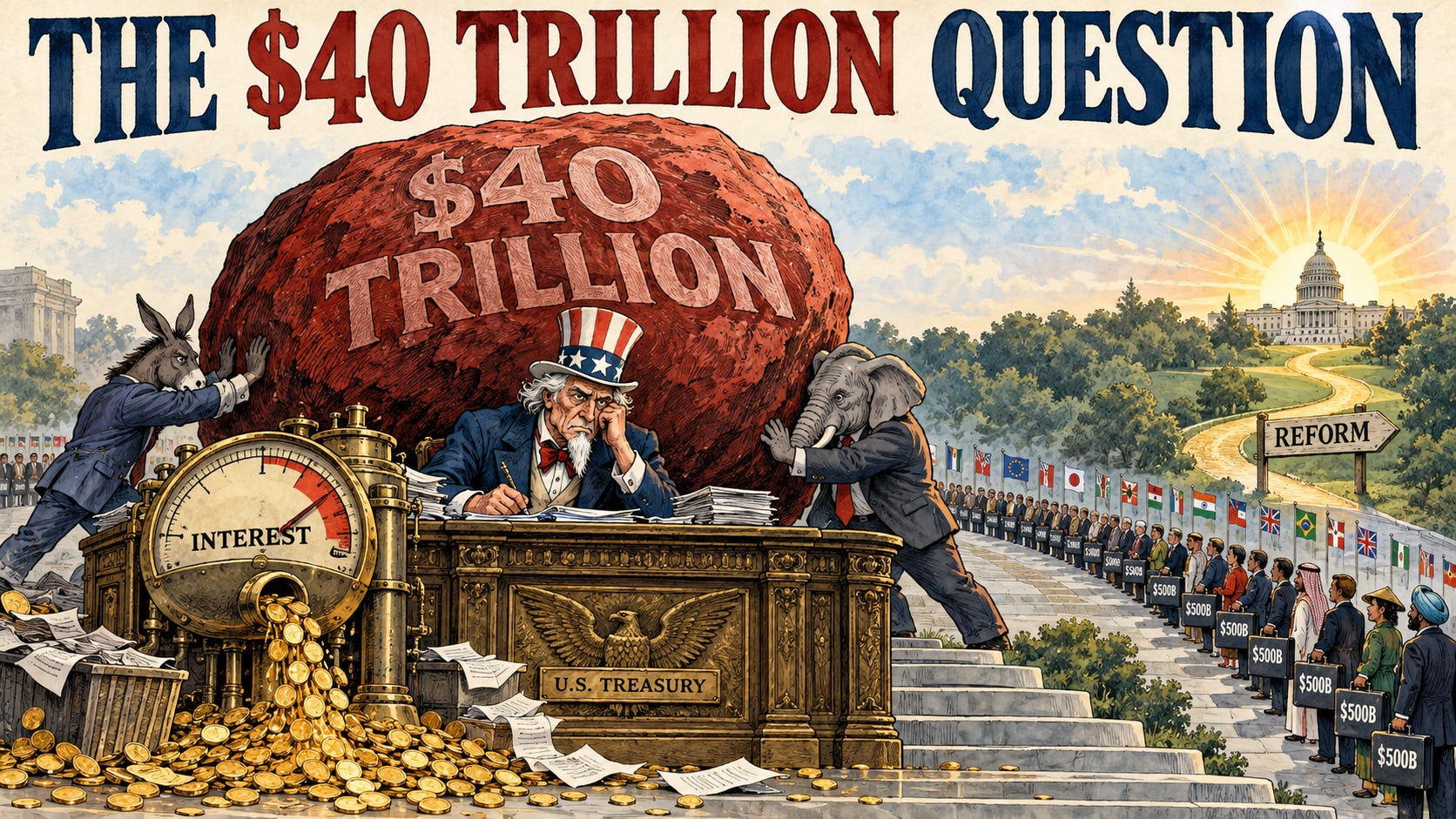
The scale can be illustrated through a simple international comparison. Eighty countries would each have to give the United States $500 billion to produce $40 trillion. That calculation is mathematically correct, but it is not a realistic rescue strategy because most countries could not afford such a transfer and would have no reason to provide it without demanding repayment, assets, influence, or strategic concessions. Foreign governments already purchase Treasury securities as investments, but those purchases represent loans that must be repaid with interest. The thought experiment is valuable because it shows that America cannot expect the rest of the world to eliminate obligations created through American fiscal decisions.
A workable solution must combine deficit reduction, additional revenue, responsible spending reform, economic growth, lower borrowing costs, and sustained principal payments. It must also protect vulnerable households and avoid abrupt austerity capable of producing a recession. Under an illustrative average interest rate of 3.5 percent, $40 trillion would produce approximately $1.4 trillion in annual interest before a single dollar of principal was eliminated. Consequently, America must first stop borrowing to finance routine operations and then generate a primary budget surplus large enough to cover both interest and principal reduction. This process would likely require several decades of consistent policy across numerous presidents and sessions of Congress.
I. The Political Meaning of $40 Trillion
The national debt is the accumulation of past federal deficits, not simply the cost of one administration or one political party. A deficit occurs when annual federal spending exceeds annual federal revenue, requiring the Treasury to borrow the difference. The debt therefore reflects decades of decisions involving taxes, defense, retirement programs, healthcare, economic emergencies, and other national commitments. Both major parties have supported policies that increased borrowing when those policies served their electoral or ideological priorities. Any serious analysis must therefore move beyond partisan blame and examine the institutional incentives that repeatedly produce deficits.
Federal debt is also different from ordinary household debt because the United States issues currency, collects taxes, and borrows through securities used throughout the global financial system. Treasury bills, notes, and bonds are held by individuals, businesses, retirement funds, banks, the Federal Reserve, state and local governments, and foreign entities. The federal government can refinance maturing securities by issuing new ones, which means the entire debt does not become payable on one date. This capacity gives the United States more flexibility than a family or private company would possess. It does not, however, make borrowing free or guarantee that investors will always accept favorable interest rates.
The political danger begins when debt service consumes resources faster than the economy and federal revenue can grow. Interest payments do not build roads, employ teachers, treat patients, or purchase equipment, even though they remain legally and financially necessary. High interest costs also reduce the government’s ability to respond to wars, recessions, pandemics, natural disasters, and other emergencies. Fiscal flexibility is an important component of national power because governments with manageable obligations can mobilize resources more easily during crises. The debt question is therefore connected to sovereignty, security, administrative capacity, and confidence in democratic government.

II. How the United States Reached This Point
The debt developed through the repeated combination of spending commitments and insufficient revenue. Congress has frequently approved tax reductions without equivalent spending reductions, while also approving new programs without permanent revenue to finance them. Military operations, financial rescues, pandemic relief, natural-disaster assistance, and economic stimulus contributed to borrowing at different moments. Social Security, Medicare, Medicaid, veterans’ benefits, and other mandatory programs have also expanded as the population has aged and healthcare prices have increased. When Social Security collected surplus revenue, the Treasury borrowed that money in exchange for special government securities and used the cash for other federal operations. Although those securities are legally owed and earn interest, repaying them requires the government to use tax revenue, cut other spending, or borrow additional money from the public. Interest on previously accumulated debt has now become an additional driver of future deficits.
Political incentives help explain why this pattern survives changes in party control. Voters generally support deficit reduction as an abstract goal, but many oppose specific tax increases or reductions in programs they value. Elected officials therefore receive political rewards for delivering benefits and tax relief while transferring the cost to future budgets. Two-year House election cycles encourage attention to immediate consequences, whereas sustainable debt reduction may require policies maintained for twenty or thirty years. The result is a collective-action problem in which nearly everyone favors fiscal responsibility but disagrees about who should sacrifice to achieve it.
The modern budget process also separates decisions that are economically connected. Tax policy, annual appropriations, entitlement formulas, emergency spending, and debt-limit legislation are often debated through different procedures and on different political schedules. The debt limit does not authorize new spending, but instead permits the Treasury to honor commitments already enacted by Congress and the president. Threatening default during a debt-limit confrontation therefore does not reverse the original policy decisions that created the obligations. A credible reform must address revenue and spending when legislation is adopted, not after the resulting bills become payable.

III. Understanding Who Holds the Debt
Gross federal debt contains two broad categories that must be distinguished. Debt held by the public consists primarily of Treasury securities held outside federal government accounts, including holdings by investors, financial institutions, the Federal Reserve, and foreign governments. Intragovernmental debt arises when federal trust funds and other government accounts invest their surpluses in Treasury securities. At the end of fiscal year 2025, the Treasury reported approximately $30.3 trillion in debt held by the public and about $7.3 trillion in intragovernmental debt. These categories together explain why different sources may publish different federal debt totals without necessarily contradicting one another. U.S. Treasury Financial Report
The distinction matters because public borrowing directly affects financial markets and federal interest costs. Debt held by the public represents claims held by people and institutions outside most federal accounting relationships. Intragovernmental holdings represent commitments from the Treasury to federal accounts, including trust funds associated with programs such as Social Security and Medicare. Those obligations are still meaningful because benefits must eventually be paid from real federal resources. However, transferring money between government accounts is economically different from sending interest or principal to an outside investor.
Foreign holdings receive considerable political attention, but foreign countries do not own the United States merely because they purchase Treasury securities. They buy those securities because Treasury debt is liquid, widely accepted, and supported by the federal government’s taxing authority. The relationship nevertheless creates mutual dependence because the United States needs buyers while investors need a reliable store of value. A sudden collapse in demand could force the Treasury to offer higher yields, increasing the cost of future borrowing. Maintaining investor confidence is therefore a national interest, even when most political disagreements concern domestic spending or taxation.

IV. The Interest Trap
The principal balance does not reveal the full cost of the debt because the government must continually pay interest. At an illustrative average effective rate of 3.5 percent, a $40 trillion balance would generate approximately $1.4 trillion in annual interest. A 4 percent rate would raise that amount to $1.6 trillion, while a 5 percent rate would produce $2 trillion. These figures are simplified scenarios because actual Treasury securities carry different rates and maturity dates. They nevertheless demonstrate how relatively small changes in average borrowing costs can add hundreds of billions of dollars to the federal budget.
Average effective rateAnnual interest on $40 trillion2.5%$1.0 trillion3.0%$1.2 trillion3.5%$1.4 trillion4.0%$1.6 trillion5.0%$2.0 trillion
Paying $1.4 trillion under the 3.5 percent scenario would only prevent the balance from growing because of interest during that year. It would not reduce the original $40 trillion principal. If the government borrowed the $1.4 trillion needed for interest, the balance would rise to approximately $41.4 trillion before accounting for other deficits or adjustments. Interest during the following year would then be calculated against a larger amount as securities matured and were refinanced. This cycle is why persistent primary deficits can transform a manageable debt into a self-reinforcing fiscal problem.
The current trajectory illustrates the pressure already developing within the federal budget. The Congressional Budget Office projects net interest outlays slightly above $1 trillion in fiscal year 2026 and approximately $2.1 trillion in 2036 under then-current law. It also projects that interest will rise from 3.3 percent of gross domestic product in 2026 to 4.6 percent in 2036. By that final year, net interest would exceed federal spending on every mandatory program other than Social Security and Medicare. The government must therefore control both the amount borrowed and the rates paid on future securities. Congressional Budget Office

V. The Eighty-Country Thought Experiment
The international comparison begins with straightforward arithmetic. If 80 countries each granted the United States $500 billion, their combined payments would equal exactly $40 trillion. Such a transfer would theoretically cover the principal if every payment arrived immediately and the modeled debt were exactly $40 trillion. It would not require 80 payments every year because the comparison concerns a one-time contribution from each country. The example is useful primarily because it converts an almost incomprehensible national figure into smaller units that can be compared across governments.
The practical obstacles are overwhelming. A $500 billion contribution would exceed the annual government budgets or accessible financial reserves of many countries. Even wealthy governments would have to raise taxes, reduce domestic spending, borrow money, liquidate assets, or draw down national reserves to participate. Their citizens would reasonably ask why their resources should be used to resolve American fiscal decisions instead of domestic needs. Governments capable of providing such sums would almost certainly demand valuable political, economic, military, or territorial concessions in return.
The word “grant” is also essential because a loan would not eliminate the debt. If another country lent the United States $500 billion, America would merely replace one creditor with another and might owe additional interest. Selling federal land, military facilities, strategic infrastructure, or public assets could also create long-term security costs exceeding the immediate fiscal benefit. Dependence on foreign rescue would weaken American bargaining power and contradict the purpose of restoring national fiscal independence. The scenario therefore proves the scale of the problem while simultaneously demonstrating why the solution must be predominantly domestic.
VI. Why Immediate Elimination Is Neither Necessary Nor Safe
The federal government does not need to eliminate every Treasury security to restore fiscal stability. Sovereign governments normally maintain some debt because government securities provide financial institutions, retirement funds, and central banks with widely traded assets. The more important measurement is whether the debt grows faster than the country’s economy and revenue base. A declining debt-to-GDP ratio can improve sustainability even while the nominal debt remains substantial. The initial policy goal should therefore be stabilization followed by gradual reduction, not a sudden attempt to reach zero.
Trying to extract $40 trillion from the economy immediately would create severe risks. Enormous tax increases would reduce household income, investment, and consumer demand, while abrupt spending cuts could eliminate jobs and destabilize state and local services. Selling public property on a massive scale could transfer strategic assets into private or foreign control at distressed prices. Creating money to pay the obligations could weaken purchasing power and produce dangerous inflation if the increase exceeded the economy’s productive capacity. Default would be the most damaging option because it could disrupt credit markets, pensions, banking, international trade, and confidence in the dollar.
A responsible strategy must distinguish fiscal consolidation from indiscriminate austerity. Fiscal consolidation means gradually aligning recurring revenue with recurring commitments while preserving investments that increase future productivity. Indiscriminate austerity cuts programs without considering whether those programs prevent larger costs or contribute to economic growth. Reducing infrastructure maintenance, education, preventive healthcare, or scientific research may improve a short-term budget number while weakening the future tax base. The correct question is not simply how much government spends, but whether each dollar produces sufficient public value.
VII. The First Requirement: Stop Creating New Debt
Principal reduction cannot begin while the federal government continues running large annual deficits. The Congressional Budget Office projects a fiscal year 2026 deficit of approximately $1.9 trillion, with revenues of about $5.6 trillion and outlays of about $7.4 trillion. That deficit includes more than $1 trillion in net interest costs, but it also contains a primary deficit generated by noninterest programs and revenue policy. Before reducing the existing debt, policymakers must close the primary deficit and then produce a primary surplus. Otherwise, new borrowing will offset or overwhelm any money formally assigned to debt reduction. Congressional Budget Office
Congress should adopt a multiyear fiscal framework that establishes targets for the primary balance, total deficit, interest burden, and debt-to-GDP ratio. Major permanent spending increases or tax reductions should generally include credible offsets unless the economy is in a declared emergency. Emergency exceptions should remain available for recessions, wars, pandemics, and major disasters, but they should include transparent costs and expiration dates. Independent fiscal scoring should evaluate the ten-year and thirty-year consequences of major legislation. These rules would not eliminate political disagreement, but they would require policymakers to acknowledge the future cost of present decisions.
Budget enforcement must also recognize the limits of annual appropriations alone. Discretionary programs attract frequent scrutiny because Congress votes on them regularly, but mandatory spending and tax preferences account for much of the long-term structural imbalance. Tax deductions, exclusions, and credits can function like spending even though they appear on the revenue side of the ledger. A comprehensive review should examine direct expenditures and tax expenditures under comparable standards of effectiveness. Fiscal discipline will fail if lawmakers cut visible programs while preserving equally costly benefits hidden within the tax code.
VIII. A Balanced Revenue Strategy
Revenue must form part of the solution because spending reductions alone would require politically and economically disruptive cuts. Congress should begin by reducing the gap between taxes legally owed and taxes actually collected. Better enforcement against sophisticated evasion, fraudulent reporting, abusive shelters, and identity-based tax fraud could raise revenue without increasing statutory rates on compliant taxpayers. Tax administration should be modernized with secure technology, trained personnel, and stronger oversight to protect civil liberties. Enforcement gains should be measured conservatively so uncertain collections are not spent before they materialize.
The tax code should also be evaluated for fairness, simplicity, and economic performance. Lawmakers could reconsider preferences that primarily benefit narrow industries or very high-income households without producing clear public value. Options include a minimum effective burden for highly profitable corporations, reforms to carried interest, and carefully designed changes to capital-gains or inheritance taxation. Any new consumption, carbon, or financial-transaction tax would require protections for lower-income households and serious analysis of market effects. The objective should be a broader and more reliable revenue base rather than punitive taxation or dependence on one volatile source.
Revenue reform should be phased in as part of a negotiated fiscal agreement. Sudden tax increases during weak economic conditions could reduce demand and make deficit reduction harder. Stronger measures can take effect during periods of low unemployment and sustained growth, while automatic stabilizers remain available during recessions. Congress could dedicate a defined portion of new revenue to a protected debt-reduction account with regular public audits. Citizens are more likely to accept sacrifice when they can see where the money goes and when spending reforms accompany the tax changes.

IX. Responsible Spending Reform
Spending reform should begin with waste, duplication, improper payments, and weak procurement practices. Defense contracts, information-technology systems, healthcare payments, grants, and emergency programs all require stronger auditing and performance measurement. A program should not survive merely because it has influential supporters or longstanding appropriations. At the same time, identifying fraud should not become an excuse to assume that every beneficiary or public employee is dishonest. Credible reform depends on evidence, due process, and measurable savings.
Healthcare deserves particular attention because federal medical spending is shaped by prices as well as the number of patients. Broader prescription-drug negotiation, improved fraud detection, preventive care, and payment reforms could reduce costs without simply denying treatment. Policymakers should compare American medical prices with those paid by other advanced economies and examine why administrative expenses remain high. Savings should be scored cautiously because projected efficiency does not always become actual budget reduction. Successful reforms must translate lower medical costs into lower federal outlays rather than higher profits elsewhere in the system.
Social Security and Medicare cannot be ignored, but abrupt reductions would violate reasonable expectations and harm people with limited ability to adjust. Reforms should protect current retirees, lower-income beneficiaries, and people with disabilities while phasing changes in for younger or higher-income populations. Options could include raising or removing portions of the Social Security taxable-earnings cap and adjusting benefits more progressively. Medicare reform should focus first on healthcare prices, market power, administration, and prevention before reducing access. Gradual implementation allows households to plan while giving Congress time to monitor unintended consequences.
X. Economic Growth as a Fiscal Strategy
Faster economic growth can make the debt more manageable by increasing employment, household income, business activity, and tax revenue. Growth also expands the denominator in the debt-to-GDP ratio, allowing the burden to decline relative to national productive capacity. However, growth is not a substitute for fiscal discipline if spending commitments and interest costs continue rising faster than revenue. Tax cuts do not automatically pay for themselves, and public spending does not automatically produce growth. Every major policy should be evaluated according to credible evidence about productivity, participation, and long-term returns.
High-value investments can strengthen the economy while supporting future debt reduction. Modern transportation, reliable energy, broadband access, scientific research, education, and workforce training can reduce commercial costs and expand productive capacity. Affordable childcare and targeted employment support can help more adults enter or remain in the labor force. Immigration policy can also affect the ratio of workers and taxpayers to retirees, although reforms must address wages, enforcement, integration, and public capacity. The best growth strategy combines physical investment, human development, technological advancement, and predictable institutions.
Fiscal policy must also protect macroeconomic stability. Excessive deficit spending during strong economic periods can increase inflationary pressure and leave less borrowing capacity for future emergencies. Severe austerity during recessions can deepen unemployment and reduce revenue, making debt ratios worse rather than better. A countercyclical rule would permit temporary deficits during downturns while requiring stronger balances during expansions. This approach treats fiscal capacity as a reserve that should be rebuilt in good times and deployed when national conditions genuinely require it.

XI. Factoring Interest Into the Repayment Plan
A repayment plan must separate interest from principal. Under the 3.5 percent illustration, a $2 trillion annual debt payment would initially allocate about $1.4 trillion to interest and only $600 billion to principal. As the principal declined, annual interest would also fall, allowing a larger share of the fixed payment to reduce the balance. If the rate remained constant, no new borrowing occurred, and payments were made annually, $2 trillion per year would retire the modeled debt in approximately thirty-five years. These assumptions are simplified because actual federal borrowing involves securities with different maturities and changing market rates.
More aggressive schedules would require much larger annual primary surpluses. A fixed payment of approximately $2.5 trillion would retire the modeled debt in roughly twenty-four years, while $3 trillion could do so in about eighteen years. A $4 trillion annual payment could complete the process in approximately thirteen years under the same assumptions. Such payments would require federal revenue to exceed noninterest spending by the amount of the payment, which would be a historic departure from present policy. Attempting to create that surplus immediately could inflict more economic damage than the faster repayment would justify.
The repayment schedule should therefore begin modestly and become stronger as fiscal reforms mature. During the first phase, America should stabilize the primary balance and stop the debt from growing faster than the economy. During the second phase, a primary surplus should cover interest and begin reducing principal. During the third phase, savings from lower interest costs should automatically remain in the debt-reduction program instead of financing unrelated policies. This structure creates a beneficial cycle in which lower principal produces lower interest, and lower interest permits faster principal reduction.
XII. Comparing Ten, Twenty, and Thirty-Year Plans
A ten-year payoff would require annual payments of approximately $4.81 trillion at a constant 3.5 percent rate. Total payments would reach about $48.1 trillion, including roughly $8.1 trillion in interest. Dividing the annual obligation among 80 countries would require each country to provide approximately $60.1 billion every year for ten years. Each participating country would ultimately contribute about $601 billion rather than the original $500 billion. This example demonstrates how even a rapid repayment plan adds trillions of dollars to the principal cost.
A twenty-year schedule would require annual payments of approximately $2.81 trillion under the same simplified assumptions. Total payments would reach about $56.3 trillion, including approximately $16.3 trillion in interest. The annual burden would be lower than under the ten-year plan, but the longer period would allow substantially more interest to accumulate. A thirty-year schedule would lower the annual payment to approximately $2.18 trillion while raising total payments to about $65.2 trillion. The central tradeoff is therefore between annual affordability and total long-term cost.
These calculations should not be mistaken for official federal projections. They model $40 trillion as if it were a conventional fixed-rate obligation with equal annual payments, no new deficits, and a constant 3.5 percent cost. Actual results would depend on inflation, economic growth, Treasury maturities, Federal Reserve policy, investor demand, tax receipts, and future legislation. The Congressional Budget Office uses more detailed models that account for projected securities and borrowing rates when estimating debt-service costs. The simplified examples remain useful because they show why a repayment plan that ignores interest will dramatically understate the resources required. CBO Debt-Service Tool
XIII. A National Debt Reduction Fund
Congress could create a National Debt Reduction Fund legally restricted to retiring publicly held federal debt. Designated revenue, unexpected surpluses, recoveries from fraud, selected asset-sale proceeds, and a share of program savings could flow into the fund. The Treasury could use the money to retire securities as they mature or conduct repurchases when market conditions make that approach advantageous. The fund would require independent audits, public dashboards, and clear rules preventing transfers for unrelated spending. Transparency would allow citizens to evaluate whether promised debt reduction was actually occurring.
The fund should not rely primarily on voluntary donations. Americans and foreign governments could be permitted to contribute, but charitable payments would be far too small and unpredictable to finance a national solution. No contribution should purchase political access, regulatory favors, immigration benefits, military concessions, or control over public assets. Foreign donations would require national-security review and full disclosure of the contributing entity. Fiscal independence should never be traded for a temporary reduction in the published debt figure.
Automatic rules could strengthen the institution. When interest costs fall below the budgeted amount, part of the savings could remain in the fund instead of being redirected automatically. A share of revenue above forecast during strong economic years could also be assigned to principal reduction. Congress could suspend those transfers during formally defined emergencies through a recorded vote and a restoration schedule. The purpose would be to make debt reduction a continuing governmental function rather than a promise revived only during election campaigns.

XIV. Political Feasibility and Democratic Legitimacy
The greatest obstacle is political agreement, not the absence of possible policies. Republicans often emphasize spending restraint and resistance to tax increases, while Democrats frequently emphasize revenue, social protection, and public investment. A durable settlement will require both sides to accept that neither spending cuts nor tax increases can carry the entire adjustment fairly. Business groups, labor organizations, retirees, defense advocates, healthcare companies, and state governments will all defend their interests. Successful reform therefore requires negotiation across institutions and social groups rather than a plan imposed by one temporary majority.
Public legitimacy depends on visible burden sharing. Working households will resist higher taxes if corporations and extremely wealthy individuals appear protected from comparable sacrifice. Beneficiaries will resist program reforms if government contractors, inefficient agencies, and tax preferences remain untouched. Investors will resist financial instability if politicians threaten default as a negotiating instrument. A credible agreement must therefore combine revenue reform, spending discipline, protection for vulnerable populations, and an absolute commitment to honor lawful obligations.
The plan should include regular democratic review without allowing every election to destroy its central framework. Congress could establish five-year evaluation periods in which independent analysts compare actual outcomes with debt, interest, growth, and distributional targets. Adjustments could respond to recessions, demographic changes, wars, technological shifts, or unexpectedly high interest rates. Major departures from the framework should require transparent scoring and a recorded explanation of how the lost savings will be replaced. Democratic flexibility and long-term credibility can coexist when changes are open, measured, and accountable.
XV. A Thirty-Year Strategy for Fiscal Independence
The first five years should focus on stabilization. Congress should reduce the primary deficit through enforceable budget rules, improved tax compliance, targeted spending reforms, and expiration of ineffective tax preferences. The government should avoid severe front-loaded measures that could trigger recession or mass unemployment. Debt growth should be limited so that it no longer consistently outpaces nominal economic growth. Emergency borrowing should remain available, but routine operations should increasingly be financed through recurring revenue.
The next ten years should establish sustained primary surpluses and begin measurable principal reduction. Gradual reforms to healthcare, retirement financing, procurement, and the tax base should be fully implemented during this period. Savings from reduced interest costs should remain committed to debt reduction. Productive investments should continue when credible analysis indicates that they expand future growth or prevent larger costs. Progress should be measured through the debt-to-GDP ratio, annual interest burden, primary balance, and real economic performance.
The final fifteen years should accelerate repayment as lower principal reduces interest costs. Policymakers could adjust the annual target according to economic conditions while preserving the long-term direction. A portion of budget surpluses should remain available for public investment and emergency reserves so that debt reduction does not weaken national capacity. The United States may decide that eliminating every Treasury security is neither necessary nor desirable. Fiscal independence would be achieved when debt is declining relative to the economy, interest is manageable, and normal government operations no longer require persistent borrowing.
Thanks for reading The Brooks Brief Substack! This post is public so feel free to share it.
Conclusion
The $40 trillion figure describes a national challenge that cannot be solved through slogans, default, inflation, or foreign rescue. Eighty countries giving $500 billion each would mathematically produce $40 trillion, but that scenario would require extraordinary transfers with no realistic political or economic justification. If the payments arrived as loans, the United States would simply exchange one set of creditors for another. If repayment occurred over time, interest could raise the total cost far above $40 trillion. The comparison therefore clarifies the size of the obligation without providing a practical escape.
Interest is the factor that turns a large balance into a continuing fiscal threat. At an illustrative rate of 3.5 percent, $40 trillion produces $1.4 trillion in annual interest before principal reduction begins. A government that continues running primary deficits must borrow for programs, interest, or both, causing the balance to grow further. A successful plan must first stop that process and then create sustained resources for principal payments. Every year of delay increases the likelihood that interest will displace important public functions.
America can regain control through a balanced strategy maintained across generations of political leadership. The necessary package includes reliable revenue, disciplined spending, healthcare reform, protected productive investment, stronger growth, lower borrowing needs, and automatic principal reduction. The process should be gradual enough to protect the economy but binding enough to survive short-term political pressure. The goal is not a theatrical one-time payment that empties the economy or sells national independence. The goal is a durable fiscal system in which the United States can meet its obligations, preserve democratic choices, and invest confidently in its future.


