How Christian Nationalism, Black Church Activism, Jewish Political Engagement, and Muslim Civic Mobilization Compete to Define Democracy
I. Introduction: Religion as a Political Force in a Polarized Democracy
As the United States enters 2026, the role of religion in politics has once again moved to the center of democratic debate. In the wake of the 2024 presidential election and ahead of contentious midterms, faith-based institutions continue to shape voter behavior, policy priorities, and political identity. Religious communities are not simply cultural actors; they are organizational forces with the capacity to mobilize millions of voters. Their influence extends from local school boards to national elections and foreign policy debates. In an era of polarization, faith increasingly functions as both a source of moral authority and a tool of political power. Understanding this dynamic is essential to evaluating the health of American democracy.
Within this landscape, stark contrasts have emerged among religious actors. Some white-aligned Christian institutions have become closely associated with nationalist ideologies that frame the United States as an exclusively Christian and implicitly white nation. These movements often claim divine justification for exclusionary policies, ranging from immigration restrictions to rollbacks of civil rights protections. In contrast, Black churches have historically embraced a theology rooted in liberation, collective struggle, and civic participation. Their political engagement emphasizes inclusion and democratic expansion rather than cultural dominance. These divergent paths illustrate how the same religious tradition can be mobilized toward radically different political ends.
Religion’s political role in the United States has never been uniform. Different faith traditions have developed distinct relationships with the state, informed by history, theology, and social position. Some religious movements emphasize pluralism, civil rights, and democratic participation. Others gravitate toward exclusionary nationalism, hierarchy, and cultural preservation. These divergent approaches are not abstract theological debates but material political forces with real consequences. The tension between inclusion and exclusion defines much of today’s religious-political landscape.
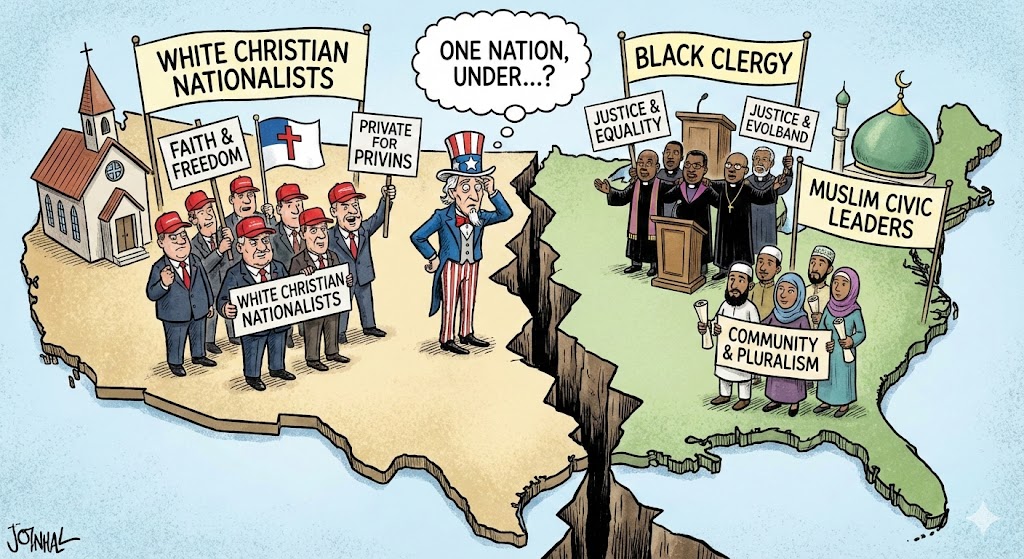
This article examines four major religious currents shaping American politics: white Christian nationalism, Black church activism, Jewish political engagement, and the growing civic influence of Muslim Americans. Together, these communities illustrate the wide spectrum of ways faith interacts with power. Some use religion to justify dominance, while others deploy it as a framework for justice and participation. Comparing these approaches reveals not only religious differences but competing visions of democracy itself. The future of American pluralism will depend on which vision prevails.
II. White Christian Nationalism and the Politics of Exclusion
White Christian nationalism has emerged as one of the most consequential religious-political movements in contemporary America. At its core, this ideology asserts that the United States was founded as a Christian nation and should remain culturally and politically aligned with a narrow vision of Christianity. This vision is often inseparable from racial and ethnic identity, implicitly framing whiteness as normative. Political goals typically include restrictive immigration policies, opposition to LGBTQ+ rights, and resistance to racial justice initiatives. These positions are framed as moral imperatives rather than political preferences. As a result, political compromise is often treated as moral betrayal.
Churches aligned with Christian nationalism frequently serve as political organizing centers. Clergy and religious media figures reinforce narratives of cultural loss and existential threat. Electoral participation is framed as a spiritual duty to “take back” the nation. This mobilization strategy has proven effective in shaping Republican primaries and policy platforms. Candidates who reject nationalist framing often face backlash from religious constituencies. In this way, theology becomes a gatekeeping mechanism within conservative politics.
Critics argue that Christian nationalism represents a sharp departure from core Christian teachings of Jesus Christ himself. The movement prioritizes power, hierarchy, and national dominance over humility, compassion, and service to the marginalized. Biblical themes of welcoming the stranger and rejecting worldly authority are often minimized or ignored. Instead, scripture is selectively interpreted to justify exclusion and control. This instrumentalization of faith transforms religion into a political weapon rather than a moral guide. The result is a theology that reinforces polarization rather than ethical reflection.
The democratic implications are significant. Christian nationalism undermines pluralism by defining legitimate citizenship in religious terms. It weakens norms of equal protection by privileging one faith identity over others. In extreme forms, it normalizes authoritarian impulses by framing leaders as divinely sanctioned. These dynamics pose a structural challenge to democratic governance. Rather than serving as a unifying moral force, religion becomes a mechanism of division and domination.
III. Black Churches and the Theology of Democratic Inclusion
Black churches occupy a fundamentally different position in American political history. Born out of slavery, segregation, and systemic exclusion, they developed as institutions of survival and resistance. From the abolitionist movement to the Civil Rights era, Black churches provided organizational infrastructure for democratic struggle. Clergy framed political participation as a moral obligation rooted in justice and collective liberation. Voting, protest, and civic engagement were understood as expressions of faith. This tradition continues to shape Black church activism today.
In the contemporary period, Black churches remain among the most effective mobilizers of democratic participation. Voter registration drives, early voting initiatives, and civic education campaigns are common features of church life. These efforts are often coordinated with civil rights organizations and local advocacy groups. Policy priorities extend beyond elections to include housing affordability, healthcare access, labor rights, and criminal justice reform. The emphasis is consistently on expanding democracy rather than restricting it. Faith is used to motivate participation, not to police belonging.
However, Black religious politics are not without internal tension. The rise of prosperity theology has introduced a market-oriented logic into some congregations. This theology elevates individual wealth and success as indicators of divine favor, which contradicts Jesus’ teachings that the love of money is the root of all evil. While appealing in contexts of economic deprivation, critics argue it departs from traditions of collective struggle and sacrifice. It can shift attention away from structural inequality toward personal advancement. This tension reflects broader debates about the role of religion in confronting systemic injustice.
Despite these challenges, Black churches remain among the strongest institutional defenders of pluralistic democracy. Their political engagement is rooted in lived experience with exclusion and disenfranchisement. Rather than seeking dominance, they advocate inclusion and equal participation. This approach stands in direct contrast to nationalist religious movements. It offers a vision of faith as a force for democratic expansion rather than contraction.
IV. Jewish Faith in America: Pluralism, Power, and Pro-Israel Advocacy
Judaism has played a distinctive and enduring role in American political life, shaped by immigration, persecution, and a strong commitment to constitutional protections. Jewish Americans have historically viewed pluralism and the separation of church and state as essential safeguards. High levels of voter participation and civic engagement reflect this orientation. Many Jewish institutions frame political involvement as a moral responsibility rooted in ethical tradition. Concepts such as justice, communal obligation, and historical memory strongly influence political priorities. This has positioned Jewish Americans as consistent defenders of democratic norms.
Politically, the Jewish community is diverse but has leaned toward liberal and progressive coalitions for much of the modern era. Advocacy around civil rights, immigration reform, labor protections, and religious freedom has been central. At the same time, ideological diversity within the community is significant. Orthodox, Conservative, Reform, and secular Jewish populations often emphasize different policy priorities. These internal differences complicate simplistic portrayals of Jewish political alignment. Judaism’s political influence is best understood as plural rather than monolithic.
In recent years, pro-Israel advocacy has become the most visible dimension of Jewish political power. Organizations like the American Israel Public Affairs Committee have garnered significant public attention for their effective lobbying and electoral influence, especially after the events on October 7th, 2022. However, some individuals have accused Israel of committing genocide and other war crimes against the Palestinians. AIPAC’s bipartisan strategy and willingness to engage directly in primary elections have demonstrated its organizational strength. Supporters view this as legitimate democratic participation in foreign policy advocacy. Critics argue that such influence can narrow debate and marginalize dissenting voices, including within the Jewish community itself. This tension reflects broader questions about power, accountability, and democratic deliberation.
The prominence of pro-Israel lobbying highlights a central tension in Jewish political life. While many Jewish Americans prioritize pluralism and minority rights domestically, foreign policy advocacy has increasingly aligned with establishment and conservative actors. This has created friction with progressive Jewish organizations that emphasize human rights and diplomatic restraint. These debates mirror national struggles over the role of money, lobbying, and influence in democracy. Judaism’s political engagement thus illustrates both the strengths and contradictions of faith-based advocacy. It underscores how minority communities can wield power while still grappling with pluralistic ideals.
V. Muslim Americans and the Struggle for Civic Belonging
Muslim Americans represent one of the fastest-growing and most politically dynamic religious communities in the United States. Over the past decade, Muslim civic engagement has expanded significantly at the local, state, and national levels. Record numbers of Muslim candidates have been elected to public office, reflecting sustained grassroots organizing. Voter registration and turnout efforts have intensified, particularly among younger Muslims. These developments signal a maturation of Muslim political participation. Faith has become a catalyst for civic inclusion rather than withdrawal.
Mosques and Islamic centers increasingly function as hubs of political education and social services. Much like Black churches, they provide spaces for organizing, mutual aid, and voter engagement. Islamic teachings emphasizing justice, charity, and accountability inform this activism. Muslim communities often align with broader coalitions advocating civil rights and immigrant protections. Despite theological differences, there are shared ethical commitments across faith traditions. These commonalities create opportunities for interfaith democratic cooperation.
At the same time, Muslim political participation continues to face intense scrutiny. Islamophobia remains deeply embedded in political rhetoric and media narratives. Muslim candidates and officials are frequently portrayed as outsiders, regardless of their civic credentials. Symbolic expressions of faith, such as swearing an oath on the Quran, provoke disproportionate backlash. These reactions expose the fragility of religious freedom in practice. They also reveal how national identity is often policed along religious lines.
Nevertheless, Muslim Americans continue to assert their place in the democratic system. Advocacy efforts focus on combating hate, countering disinformation, and building multiracial coalitions. Rather than retreating in the face of hostility, Muslim civic engagement has intensified. This trajectory reinforces the possibility of a pluralistic democracy rooted in equal participation. It also challenges exclusionary narratives that define “Americanness” in narrow terms. Muslim political engagement represents both resistance and renewal.
VI. Comparative Analysis: Faith as a Tool of Dominance or Inclusion
Across these religious traditions, faith functions as a powerful organizing force, but its political expression varies dramatically. White Christian nationalism uses religion to justify hierarchy and exclusion. Black churches deploy faith to expand democratic participation and social equity. Jewish political engagement balances pluralism with assertive advocacy, particularly in foreign policy. Muslim Americans mobilize faith as a pathway to belonging and representation. These differences reflect competing moral frameworks rather than theological inevitabilities.
The central divide is not religion versus secularism, but dominance versus inclusion. Nationalist movements frame politics as zero-sum and identity-based. Inclusive traditions emphasize shared humanity and democratic access. Prosperity theology and lobbying power complicate this divide by introducing market logics into faith-based politics. In every case, religion amplifies existing political incentives. The question is how that amplification is directed.
VII. Implications for America’s Democratic Future
Religious polarization increasingly maps onto partisan divisions in American politics. Conservative Christian identities align closely with Republican coalitions, while Democrats draw support from multifaith and secular constituencies. This alignment intensifies conflict over immigration, education, and civil rights. In its most extreme forms, religious nationalism threatens democratic norms and institutional trust. The risk is not religion itself, but its fusion with exclusionary power.
Yet faith also offers pathways to democratic resilience. Black churches, Jewish pluralist traditions, and Muslim civic mobilization demonstrate how religion can strengthen participation and accountability. Interfaith coalitions and theological critiques of extremism provide counterweights to authoritarian impulses. As the United States approaches its 250th anniversary, these dynamics will shape debates over identity and democracy. The outcome will depend on which moral visions gain institutional power. Faith remains a battleground for the future of pluralism.
Thanks for reading The Brooks Brief Substack! This post is public so feel free to share it.
VIII. Conclusion
Religion in American politics is neither inherently democratic nor inherently authoritarian. Its impact depends on how faith is interpreted, organized, and mobilized. White Christian nationalism illustrates how religion can be distorted to justify exclusion and hierarchy. Black church activism highlights faith’s capacity to expand democracy and demand justice. Jewish political engagement demonstrates both pluralistic commitment and the complexities of institutional power. Muslim civic participation underscores the ongoing struggle for equal belonging. Together, these traditions reveal that the future of American democracy will be shaped not by faith itself, but by how faith is wielded.