Tag: political legitimacy

  • From the League of Nations to the Global Council

    From the League of Nations to the Global Council


    War, Sovereignty, and the Evolution of Global Governance

    Introduction: Global Order After Global War

    Global governance develops when sovereign nations recognize that certain problems cannot be contained within national borders. Wars, pandemics, environmental disasters, economic crises, mass migration, and advanced weapons can affect countries far removed from where the original problem began. Yet every attempt to create collective authority encounters the same political question: who has the legitimate jurisdiction to make decisions for multiple sovereign nations? The answer has changed as wars have destroyed old political orders and victorious coalitions have constructed new ones. The League of Nations, the United Nations, and a proposed Global Council can therefore be understood as successive stages in the continuing evolution of global governance.

    The League of Nations arose from the devastation of World War I, while the United Nations emerged from the greater destruction of World War II. Each institution attempted to correct the failures of the system that preceded it. The League tried to replace unrestricted power politics with collective security, but it lacked the participation and enforcement mechanisms necessary to defend its principles. The United Nations created stronger enforcement tools, broader membership, and a Security Council dominated by the principal Allied victors. Its structure consequently reflects both a commitment to international cooperation and the distribution of power that existed in 1945.

    Thanks for reading The Brooks Brief Substack! This post is public so feel free to share it.

    Share

    A future war over global jurisdiction could once again expose the inability of an existing international collective to defend itself or enforce its rules. If the old order were defeated, the victorious power or coalition would possess considerable de facto authority, meaning power exercised in practice. However, victory alone would not create a legitimate right to govern the world. A new collective would need to transform postwar power into lawful authority through sovereign consent, regional representation, human-rights protections, and institutional accountability. Above this political hierarchy, Christian theology introduces another category of authority by identifying God as the Sovereign of sovereigns, whose claimed jurisdiction does not originate from any human election, treaty, or military alliance.

    I. The League of Nations and the First Modern Collective

    Before World War I, international politics largely operated through alliances, empires, military competition, and shifting balances of power. Sovereign governments negotiated treaties, but no permanent organization possessed broad responsibility for maintaining international peace. Alliances intended to discourage war sometimes produced the opposite result by connecting local disputes to larger military obligations. When conflict began in 1914, mobilization plans and alliance commitments helped transform a regional crisis into a world war. The devastation produced political demand for a more organized international system.

    The League of Nations represented the first major attempt to create a permanent collective-security organization. Established through the postwar settlement associated with the Treaty of Versailles, it sought to promote cooperation, arbitration, disarmament, and peaceful dispute resolution. Its underlying principle was that aggression against one country should concern the broader community of nations. This was a major development in political thought because peace was no longer treated exclusively as the private responsibility of individual governments. International stability was becoming a collective political interest.

    The League achieved limited successes in humanitarian work and the resolution of smaller disputes, but its security structure remained weak. It possessed no standing military force and depended on member governments to enforce its decisions. Important decisions often required unanimity, allowing national disagreements to produce institutional paralysis. The United States never joined, while Japan, Germany, and Italy eventually withdrew as they pursued aggressive policies. The League therefore lacked both the universal participation and practical power necessary to restrain states determined to overturn the existing order.

    II. The Collapse of Collective Security

    The crises of the 1930s revealed the difference between declaring a rule and possessing the authority to enforce it. Japan expanded into Manchuria, Italy invaded Ethiopia, and Nazi Germany rejected important restrictions imposed by the postwar settlement. The League could investigate, debate, and condemn aggression, but it could not compel the major powers to undertake the risks necessary to reverse it. Limited sanctions failed to create sufficient deterrence because governments continued placing their immediate interests above their collective commitments. Aggressive states learned that the international community’s stated principles were stronger than its willingness to defend them.

    The League’s failure was not simply the result of an imperfect organizational chart. Collective security requires governments to accept real economic and military costs when another member is threatened. The League’s members frequently wanted the benefits of international order without assuming the burdens necessary to maintain it. As enforcement became less credible, withdrawal and defiance became more attractive. The organization continued to exist formally, but its practical authority steadily disappeared. It could not protect vulnerable members because it could not protect the political order upon which its own relevance depended.

    World War II demonstrated that a collective which cannot defend its rules may eventually be displaced by force. The Axis powers were not merely seeking individual territorial adjustments but were attempting to create imperial orders built around their own authority. The Allied victory prevented those projects from becoming the foundation of the next international system. It also placed the victorious coalition in a position to write the rules of the postwar order. The League formally dissolved in 1946, after briefly coexisting with the newly established United Nations. United Nations Geneva records that transition and the final transfer of the League’s assets and responsibilities.

    III. The United Nations and the Authority of the Victors

    The United Nations was established through a Charter signed in June 1945 as World War II approached its conclusion. The Charter created a more comprehensive organization dedicated to international peace, sovereign equality, human rights, social progress, and cooperation. Unlike the League, the new organization included the United States and the other principal powers of the victorious coalition. Its legitimacy came from a multilateral treaty, but its institutional structure also reflected the outcome of the war. The new global order was therefore constructed through both sovereign agreement and the practical authority held by the victors.

    The Security Council became the executive center of the new collective-security system. The United States, United Kingdom, Soviet Union, France, and China received permanent membership and the ability to block substantive resolutions. This arrangement was unequal, but it was intended to keep the strongest powers inside the organization rather than outside or openly hostile to it. The UN Charter gives the Security Council primary responsibility for international peace and security, while Chapter VII permits sanctions and other enforcement measures. These powers made the United Nations structurally stronger than the League, even though enforcement continued to depend heavily on member governments. The Charter defines the Council’s responsibilities and powers in Articles 24 through 26.

    The UN also developed peacekeeping as an important instrument for monitoring ceasefires, separating forces, protecting civilians, and supporting political transitions. Peacekeeping is not expressly established as a distinct system in the Charter, but it evolved through institutional practice. The Security Council can also authorize force when nonmilitary measures have proven inadequate, although the UN does not possess a permanent conventional army under its exclusive command. Every substantial mission consequently depends on political authorization and contributions from participating countries. The United Nations describes both the evolved legal basis of peacekeeping and the enforcement options available under Chapter VII.

    IV. Power, Victory, and Legitimate Jurisdiction

    A victorious military coalition possesses the practical ability to dismantle hostile institutions, occupy territory, impose conditions, and sponsor a replacement government. This is de facto authority because it describes control that exists as a matter of political reality. Such control can determine who participates in negotiations and which proposals become part of a new settlement. It can also prevent a defeated institution from protecting itself against the victor. Nevertheless, the ability to impose a system should not be confused with a legitimate right to govern every sovereign nation.

    This distinction becomes especially important during a war over global jurisdiction. Such a war would concern more than borders, resources, or individual security disputes. Its participants would also be contesting who possesses the authority to establish and enforce the international order. If the existing collective were defeated, its laws might remain written on paper while losing their practical restraining power. The victorious coalition could then construct a new system, but that opportunity would not automatically make it the lawful government of humanity.

    Military victory may decide who survives a war, but consent must help determine who governs after it. A new system established exclusively by the victor risks becoming an empire disguised as a collective. Lasting global authority requires the meaningful participation of defeated, neutral, nonaligned, small, and developing states. It must also distinguish the political power to compel obedience from the legal and moral authority to command it. A postwar institution will remain unstable if it merely freezes one generation’s military dominance into permanent privilege.

    V. From International Jurisdiction to Global Jurisdiction

    International authority and global authority should not be treated as identical concepts. Two sovereign nations can create an international relationship, while a large military alliance can create an international institution. Neither necessarily possesses the legitimacy to speak for the overwhelming majority of the world. Genuine Global Jurisdiction would require a much broader foundation than ordinary alliance politics. It would have to arise from the voluntary cooperation of sovereign nations rather than the unilateral declaration of a dominant state.

    The Global Jurisdiction Doctrine developed in “Beyond Sovereignty” proposes an 85 percent participation threshold. Under this standard, Global Jurisdiction would exist when at least 85 percent of the world’s sovereign nations voluntarily unite within a common federation or legal framework. The threshold is intentionally difficult because an institution claiming worldwide authority should require more legitimacy than an ordinary majority. The authority would belong collectively to the participating sovereign nations, not inherently to one president, judge, secretary-general, commander, or bureaucracy. No participating state would individually own the global federation or the nations outside it.

    This proposal also establishes a Principle of Least Necessary Global Authority. Jurisdiction should rise only as high as the problem legitimately requires, leaving domestic matters under national authority whenever possible. A trade disagreement between two governments may remain bilateral, while a regional security problem may be handled by the affected countries and their regional institutions. A pandemic, world war, catastrophic environmental threat, or global financial collapse may require authority at a much higher level. Global Jurisdiction should fill genuine political gaps without becoming an excuse for unnecessary centralized control.

    VI. Establishing a Representative Global Council

    A Global Council could translate the consent of sovereign nations into an accountable decision-making structure. One proposal would organize representation through six initial regional unions: Africa, Asia, Europe, the Middle East, North America, and South America. Each regional union would select two representatives, creating a 12-member council. Additional consideration would be needed for the Caribbean, Pacific island states, and nations whose identities or interests do not fit neatly within one regional category. The objective should be meaningful representation rather than forcing the world’s political diversity into an inflexible map.

    Each representative could require the approval of at least 70 percent of the sovereign nations within the represented region. Representatives would serve two-year terms and would have to maintain at least a 45 percent regional approval rating. A representative falling below that standard could be recalled and replaced through a vote within the regional union. These rules would make council members accountable to multiple sovereign governments rather than to a single dominant country. They would also prevent regional offices from becoming permanent possessions of particular states.

    Regional representation would organize the council, while the 85 percent global threshold would provide the foundation for Global Jurisdiction. A council could not legitimately claim worldwide authority merely because six regions were nominally represented. The federation would still need the voluntary participation of at least 85 percent of sovereign nations. Major decisions involving force, membership, protected rights, or changes to the governing charter should require broader approval beyond the 12 council representatives. This division would combine an efficient executive body with the continuing sovereign authority of the wider membership.

    VII. Diplomacy, War, and Collective Enforcement

    The first responsibility of a legitimate global institution should be preserving communication. A declaration of war, substantial preemptive strike, or qualifying interstate conflict should automatically trigger a Meeting of Nations. The meeting should occur as soon as reasonably possible and no later than seven calendar days after hostilities begin. No individual government should possess unilateral authority to prevent the international community from assembling. When governments choose war, the world’s political institutions should not be permitted to choose silence.

    The meeting should hear the claims of each party without presuming that diplomacy is a trial whose verdict has already been determined. Independent evidence should be examined alongside official statements, intelligence assessments, verified imagery, humanitarian reports, and applicable legal arguments. The immediate agenda should address civilian protection, ceasefire possibilities, displacement, prisoners, food, medicine, and the danger of regional escalation. The process should follow a defined sequence: notification, communication, diplomacy, assessment, mediation, and proportional response. This order allows defensive action when necessary without permitting fear or political convenience to replace investigation.

    Enforcement should also proceed through graduated measures. The council could begin with investigation, mediation, public findings, and negotiated settlement before considering targeted sanctions, peacekeeping, or collective force. Military action should require strong evidence, broad authorization, and a clearly defined objective. No victorious nation should receive a permanent unilateral veto merely because it possessed superior power during the previous war. A new collective must be capable of defending itself without becoming the permanent instrument of the coalition that created it.

    VIII. God as the Sovereign of Sovereigns

    Political jurisdiction flows upward from people, governments, treaties, recognition, and sovereign consent. Divine jurisdiction, within religious theology, rests on a fundamentally different claim. God is not presented as receiving authority from an election, constitution, military victory, or federation of nations. Scripture identifies God as the “God of gods and Lord of lords,” language that places divine authority above subordinate rulers and political institutions. Deuteronomy 10:17 presents this title as ancient theological authority rather than authority delegated by a human government.

    God can therefore be described in political-theological language as the Sovereign of sovereigns. Kings, presidents, councils, and nations exercise limited authority within particular places and historical periods, while God’s sovereignty is understood as original and universal. The biblical title “Lord of Heaven’s Armies” similarly portrays divine command as existing beyond the military forces organized by earthly governments. Joshua 5 describes a commander of the Lord’s army whose allegiance is not reduced to the political interests of either human side. That passage places the army of the Lord under a sacred command that stands apart from ordinary national alignment.

    Revelation later presents heavenly armies accompanying the figure called King of kings and Lord of lords. Within Christian eschatology, these titles existed before modern states and do not depend on recognition by the United Nations or a Global Council. God would therefore occupy the theological ceiling of the jurisdictional hierarchy, above national, international, global, planetary, interplanetary, and galactic institutions. This is a theological proposition rather than a rule presently administered by international courts. Revelation 19 connects heavenly armies with the title King of kings and Lord of lords.

    IX. Divine Ownership, Planetary Visitation, and National Stewardship

    Christian theology also challenges the idea that governments possess absolute ownership of the planet. Psalm 24 states that the Earth, everything within it, and its inhabitants belong to the Lord. Under this belief, national borders divide political responsibilities among human governments without dividing God’s ultimate creation into territory beyond divine jurisdiction. Governments may regulate entry by people, organizations, and other governments, but they cannot place theological limits on the Creator’s presence. Psalm 24:1 provides the scriptural foundation for understanding the world as belonging ultimately to God.

    Within that theological framework, the true God would not need a visa, treaty invitation, landing permit, or council resolution to enter a planet already within divine jurisdiction. The claim follows from ownership and sovereignty rather than from a diplomatic exception granted by a state. A national government cannot logically grant the Creator permission to enter what the Creator already owns. If life exists on other worlds, the same reasoning would extend divine sovereignty beyond Earth because national jurisdiction cannot restrict a universal Creator to one planet. Planetary and interplanetary governments would remain subordinate jurisdictions within creation rather than independent authorities over God.

    The proposal that nations should lease land when they have moved far from God can be understood as a covenantal or stewardship principle. Governments would not possess the Earth absolutely but would hold territory in trust, with obligations to protect life, administer justice, preserve resources, and respect human dignity. A lease-like model emphasizes that political control is temporary and conditional, while divine ownership is permanent. Nations that abandon justice or misuse creation would be violating the moral conditions of their stewardship, even when their conduct remains lawful under their own statutes. This theological lease should not be confused with an existing commercial contract or used by private individuals to seize property, demand payment, cross borders, or initiate violence without lawful authority.

    X. Limits on Both Global and Religious Power

    A 75 percent population in the federation would possess extraordinary political influence, which makes enforceable limitations essential. Global Jurisdiction should never authorize governments to eliminate fundamental human rights simply because enough states voted together. People are not the property of their governments, and minority rights cannot depend entirely on majority convenience. Independent review, transparent procedures, due process, and written limits on authority should be built into the new charter. Global power must answer to rights even when it claims to act for most of humanity.

    The same distinction is necessary when theological beliefs enter political life. A religion may teach that God possesses supreme authority, owns creation, commands heavenly armies, and can appear anywhere within divine jurisdiction. Human governments should protect the freedom to hold, express, teach, and practice those beliefs peacefully. However, a human claim of divine appointment does not automatically become self-executing authority under domestic or international law. Religious conviction alone cannot authorize a person to confiscate land, command public forces, ignore borders, or deprive other people of their rights.

    This boundary does not place human government above God within Christian theology. It recognizes that political institutions cannot conclusively verify divine status or administer unlimited powers on the basis of competing personal claims. The most defensible political arrangement protects religious exercise while requiring coercive actions by human beings to remain subject to evidence, due process, and law. In this way, theological sovereignty and civil jurisdiction can be discussed without converting faith into unchecked personal power. A Global Council should respect spiritual belief while preventing governments or individuals from weaponizing divine language against the rights of others.

    The Brooks Brief Substack is a reader-supported publication. To receive new posts and support my work, consider becoming a free or paid subscriber.

    Conclusion: The Next Collective

    The League of Nations established the principle of collective security but lacked the participation and enforcement power necessary to preserve it. The United Nations created a stronger system that included the major powers and authorized sanctions and collective action. Yet its Security Council still reflects the victorious coalition and political conditions of 1945. If another war destroys that order, the existing collective may become unable to protect itself from the authority exercised by the victor. Humanity would then face the difficult task of creating another international system without transforming military victory into permanent global domination.

    A legitimate successor should be constructed through the voluntary consent of sovereign nations. The proposed 85 percent threshold would distinguish Global Jurisdiction from an ordinary military alliance or regional coalition. Regional representation, limited terms, recall procedures, human-rights guarantees, and the Principle of Least Necessary Global Authority would prevent excessive centralization. An automatic Meeting of Nations would require governments to communicate when war begins, while graduated enforcement would preserve the ability to respond to genuine threats. The purpose would not be to erase nations but to establish lawful collective authority where national or regional institutions are insufficient.

    Above this human structure, Christian political theology recognizes God as the Sovereign of sovereigns, God of gods, Lord of lords, and Lord of Heaven’s Armies. Under that belief, Earth belongs ultimately to God, nations govern as temporary stewards, and no planetary institution can grant or deny the Creator permission to enter creation. Nations far from divine principles can be understood as occupying their territories under a lease-like moral obligation to justice, stewardship, and human dignity. That theological claim remains distinct from the positive law governing human conduct, property, borders, and international relations. Power may determine who wins a war, but consent, rights, accountability, and respect for higher moral authority must determine the legitimacy of the peace that follows.


  • The Sovereign of Sovereigns

    The Sovereign of Sovereigns

    Divine Authority, Popular Sovereignty, and the Limits of Political Power

    Introduction: What Makes a Sovereign Sovereign?

    Political science normally defines sovereignty as the highest governing authority within a particular political order, but that definition immediately raises a deeper question: what, if anything, stands above the sovereign? The God of Gods. A state cannot declare itself sovereign because it owns nothing on the planet that did not come from God. A government does not own the people, land, flora, fauna, and natural resources. It is only a group of elected people. If a group of people come onto my land and claim rights without ownership, the more powerful owner can always reclaim that land by war or through court. The Constitution may describe supreme law, and international institutions may recognize the independence of nations, yet none of those answers necessarily resolves the philosophical origin of political authority, but the bible does. The American founding itself invokes concepts that precede the federal government, including natural law, a Creator, inherent rights, and the consent of the governed. The Declaration of Independence describes Americans as entitled to a “separate and equal station” under the “Laws of Nature and of Nature’s God” and says people are endowed by their Creator with unalienable rights. Once the people have acknowledged God, they are able to govern themselves, but even though they have land, they do not own it. Even if men have and use the penis, we do not own it, and we did not create it; God did. The Declaration gave power to the Constitution to then declare that governments are instituted among human beings and derive their just powers from the consent of the governed. We the people are a collection of thoughts, minds, and bodies created and owned by God. We have the bible as proof since it was written before the American founding.

    This language provides the foundation for a theological theory of sovereignty in which God may be conceptualized as the Sovereign of Sovereigns. Under that theory, political sovereignty is not the highest conceivable form of authority but a subordinate jurisdiction exercised by human beings within a larger natural and divine order. A government can control territory, command armed forces, issue currency, levy taxes, and enact laws, but none of those abilities establishes that government as the ultimate authority over existence itself. If God is understood religiously as the creator and ruler of the universe, then divine sovereignty would logically precede every human jurisdiction because the political community itself exists inside the created order. This is a theological-political truth when we look at lower jurisdictions. The federal government can always use its authority to enter state or local jurisdictions. No doctrine is presently recognized as overriding the United States Constitution except the Holy Bible, since the First Amendment guarantees free exercise of religion by acknowledging a faith in the Creator.

    The Brooks Brief Substack is a reader-supported publication. To receive new posts and support my work, consider becoming a free or paid subscriber.

    The distinction matters because political science can analyze a claim without treating every part of that claim as existing positive law. The argument developed here is that American courts presently recognize divine law as a superior judicial system capable of nullifying federal statutes. The Pledge of Allegiance states, “One Nation Under God” which includes all branches and was voted on by Congress and signed by the President. This means the United States government has acknowledged God in the Declaration of Independence and the United States Constitution. If God gives a judgment as “Judge as the Living and the Dead” for someone to die, the Supreme Court, Congress, and the President (the nation under god) cannot kill the body and bring the body back to life, but God can. This proves he operates in a higher jurisdiction, along with the language in the Pledge of Allegiance. Instead, the question is whether the assumptions contained in natural-law and religious theories of sovereignty create a conceptual hierarchy extending beyond constitutional government. Under that framework, sovereignty can be imagined as a ladder: constitutional authority beneath popular sovereignty, popular sovereignty beneath natural law, and natural law ultimately beneath divine sovereignty. God, within this model, becomes not merely another sovereign but the source from which the concept of legitimate sovereignty ultimately descends.

    I. Independence Came Before the Constitution

    The United States did not become independent because the Constitution was written in 1787. The Declaration of Independence preceded the Constitution by eleven years and announced that the former colonies were “Free and Independent States,” possessing the power to wage war, conclude peace, contract alliances, establish commerce, and perform other acts independent states could rightfully perform. The Declaration also grounded the legitimacy of government in the consent of the governed rather than simply in the authority of an existing government. The National Archives accordingly describes the Declaration as stating principles underlying American government and identity while noting that the document itself is not legally binding in the way the Constitution is today. This is an attempt to distance themselves from God, but sovereignty is granted in the Declaration of Independence, and without a sovereign people a sovereign-less constitution is worthless, much like fiat currency not backed by anything. So, in God We Trust became a slogan on federal reserve currency because we still rely upon God for rain and more for food.

    This chronology creates an important distinction between sovereignty and constitutional organization. The political community claiming independence (on God’s land) must fight to win independence from the sovereign. The present Constitution, and representatives acting for that political community, later designed a constitutional structure for exercising governmental authority over their mortal citizens, but not God. The Constitution itself reinforces popular sovereignty with its opening declaration, “We the People,” which was a people that gained sovereignty from the Declaration of Independence’s mention of a Creator who gave rights. The assertion that the people “do ordain and establish this Constitution” is true, but they must be sovereign because more money does not give someone control over the next person, only the consent of the people. God is constrained by royal birth, but politicians rule by the elected people. Royals are born into office, not elected. The man-made legal documents in America therefore present the Constitution as something ordained by the politicians rather than portraying the people as creatures created by God. The Constitution attempts to replace God, but paper written by men in the 1700s cannot create life, nor energy/time. Without energy, nations, people, animals, and everything else will fail.

    From a political-science perspective, this distinction means that a constitution and sovereignty should not automatically be treated as synonymous. A constitution organizes, delegates, restricts, and institutionalizes political authority, while sovereignty addresses the deeper question of who possesses ultimate political authority within the system. American constitutionalism places that constituent authority in “the People,” while the Declaration simultaneously invokes a Creator, natural law, inherent rights, and consent as principles preceding ordinary government. A theological sovereignty theory can therefore ask one additional question that constitutional law generally does not attempt to answer: if the people possess authority to establish government, from where does the moral status of the people themselves originate? The answer is clear: our moral compass is guided by our life’s choices and God. The knowledge of good and evil gives us the ability to think with free will, and we experience positive reinforcement for good acts and negative reinforcement for bad ones. However, since God is omnipresent, he must be defeated on all his land/planets to take his sovereign land, or he can always come back.

    II. The Creator Above the Created Government

    The Declaration offers one possible philosophical answer by saying human beings possess rights endowed by their Creator. That formulation does not establish a theocracy, nor does it identify a particular religion as the law of the United States. It nevertheless places certain rights conceptually before government because government exists to secure rights that the Declaration says were already possessed. In this sense, government is presented as an instrument rather than the creator of every legitimate human entitlement. The theological argument can extend this logic by contending that if the Creator precedes humanity, and humanity precedes its governments, then government cannot logically be the highest conceivable source of authority. In all honesty, the government is governed by “we the people,” but all people are subject to time.

    This produces a proposed hierarchy of authority: Divine Sovereignty → Natural Law and inherent rights → Popular Sovereignty → Constitutional Government → Statutory and administrative authority. The first stages of that hierarchy are philosophical or theological propositions, while the latter stages describe recognizable concepts within American political theory and law. The distinction is essential because the United States legal system currently identifies the Constitution as the supreme law within the American legal order. The National Archives summarizes Article VI in precisely those terms. Divine sovereignty therefore operates here as a theory about the ultimate origin and limits of legitimate authority, not as a substitute description of what an American court presently treats as controlling law.

    The resulting concept may be called the Sovereign of Sovereigns Doctrine. A president exercises authority within an office, a legislature within delegated legislative powers, a nation within its territorial and international jurisdiction, and humanity within the physical environment that permits civilization to exist. God, under classical monotheistic theology, is not similarly dependent upon a human institution for jurisdiction. Divine authority would consequently be conceived as transcending federal, international, global, hypothetical galactic, intergalactic, and universal political jurisdictions. The proposition is straightforward within its theological premises: a government governing part of creation cannot possess greater ultimate authority than the creator of the order within which that government exists.

    III. Free Exercise and the Boundary Between Divine and Civil Law

    The First Amendment adds another dimension because American constitutional government expressly protects religious exercise. Its actual language provides that “Congress shall make no law respecting an establishment of religion, or prohibiting the free exercise thereof,” before separately protecting speech, press, assembly, and petition. Religious liberty therefore protects an unusually broad domain of conscience, worship, belief, and religious practice. At the same time, current constitutional doctrine does not establish that describing conduct as religious automatically removes that conduct from otherwise applicable law. Supreme Court doctrine has distinguished protection against governmental targeting of religion from a general right to disregard every neutral and generally applicable law.

    That legal distinction becomes especially important when divine law and civil law allegedly conflict. Religions have developed concepts of sin, divine command, judgment, duty, and moral prohibition for thousands of years, and many traditions understand these obligations as transcending the commands of governments. A believer may therefore regard divine law as superior to federal law in American courts. This belief recognizes that faith has an independent legal jurisdiction (Divine) capable of invalidating federal authority by stating “One Nation Under God” in the federal pledge of allegiance proposed by a bill in Congress and signed by the President. The most recent alteration of its wording came on Flag Day (June 14) in 1954, when the words “under God” were added by the 83rd United States Congress and signed into law by President Dwight D. Eisenhower. Conversely, government cannot simply suppress a religion because officials dislike its theology. Supreme Court precedent recognizes strong constitutional protection against laws that target religious beliefs or religious conduct for discriminatory treatment.

    The Sovereign of Sovereigns does not recognize any challenger on his property when he whips their ass and makes them pick huckleberries for 3 weeks for deviation from divine law with their “sin”. Within American law, the Constitution remains supreme with sovereignty. Without sovereignty, no one can determine who’s in charge. Within a theological worldview, however, a believer may regard divine authority as superior to the Constitution itself because God is understood to precede both the nation and humanity. Those propositions can coexist even though they occupy different systems of authority, but when force is applied, the opposer loses or dies. To the victor go the spoils.

    IV. Divine Law Before Earthly Law

    The temporal argument for divine sovereignty reaches substantially farther than American history. In many theological systems, divine law does not begin with the formation of a terrestrial government and may not even begin with humanity. Concepts involving rebellion against divine authority, angels, cosmic judgment, creation, and sin are presented within religious traditions as belonging to a history extending beyond human political institutions. Under those beliefs, divine jurisdiction would precede Washington, Rome, Babylon, and civilization itself. No legislature could therefore claim chronological priority over the divine order from which religious law supposedly originates.

    This produces an important political-theory distinction between enacted law and pre-political law. Congress creates statutes through constitutionally prescribed procedures, while natural-law theories contend that some standards of right and wrong exist independently of legislative enactment. Divine-law theories go further by locating the source of those standards in a transcendent authority. A statute can be repealed by another political institution possessing the necessary authority, but a divine command, according to this theological model, cannot be repealed merely because a human legislature votes against it. Human institutions would possess delegated or territorial authority, while divine authority would be treated as intrinsic.

    The theory cannot therefore extend jurisdiction conceptually beyond Earth. A federal system in another time or place must consent to being governed since it is federal jurisdiction, and not a global or Universal one. A federal government from the past/future must submit to the jurisdiction in the present when travelling time. A federal government governs within a federation, international law concerns relations among states and other recognized actors, and a hypothetical future interplanetary system might develop institutions governing several worlds. Yet none of those territorial expansions would answer the theological question of ultimate authority, unless you understand God is energy/time. If God is defined as sovereign over creation itself, adding another planet, galaxy, or political federation merely enlarges the territory governed by subordinate institutions. Under the Sovereign of Sovereigns model, no quantity of subordinate jurisdictions can collectively become greater than the authority from which existence itself is claimed to originate.

    V. Fiat Money, Faith, and Material Reality

    Modern American money introduces another useful distinction between political authority and material resources. The dollar operates as fiat currency, meaning its value is not legally redeemable for a fixed quantity of gold or another commodity. Its functioning depends on institutions, economic production, taxation, monetary policy, legal arrangements, financial markets, and confidence in the issuing political and economic system. Fiat money is money backed by “faith,” not tangible goods or services. So, it’s practically worthless unless bartered for something of value. Fiat money or fiat currency is a type of government-issued currency, generally created by a central bank, authorized by government regulation to be legal tender but not backed by a precious metal, such as gold or silver, nor by any other tangible asset or commodity.

    It cannot eliminate material constraints merely by creating units of account. Dollars can price water, food, energy, minerals, land, and labor, but currency cannot substitute for those resources when the underlying physical supply disappears. A country experiencing catastrophic crop failure cannot manufacture wheat simply by printing additional dollars. A civilization without sufficient accessible water cannot solve the physical shortage merely by increasing nominal wealth. Money therefore represents claims within an economic system, while natural resources remain part of the material foundation that makes economic activity possible.

    A theological interpretation can push the argument one step further. If nature itself belongs to the created order, then the resources supporting governments ultimately exist outside the government’s ability to manufacture from nothing. Drought, famine, disease, geological catastrophe, asteroid impacts, and other extreme natural events demonstrate the vulnerability of political institutions to forces beyond their control. Extinction is scientifically established as a phenomenon in Earth’s history, although science does not establish that particular extinction events constitute divine punishment. A theological framework may interpret catastrophe through divine providence or judgment, while political science can independently observe the narrower fact that sovereignty does not grant a government sovereignty over nature itself.

    VI. Extinction as the Ultimate Limit on Political Power

    The extinction of species exposes the difference between legal authority and existential power. A legislature can declare something unlawful, but legislation cannot order an asteroid to change course, repeal the laws of physics, or guarantee that a species survives indefinitely. Governments can develop planetary-defense systems, environmental protections, medicine, disaster planning, and other technologies that reduce particular risks. They nevertheless remain organizations operating within physical systems they did not create. Political sovereignty is consequently immense within its jurisdiction but extraordinarily limited when measured against nature.

    The theological argument interprets this limitation as evidence of hierarchy. If God possesses authority over the natural order itself, while government possesses authority only over people and institutions within that order, divine sovereignty would belong to a fundamentally different category from state sovereignty. The state commands through law, enforcement, legitimacy, and institutions. God, according to the theological model, possesses authority over existence, creation, life, death, and the conditions permitting political communities to exist. This is why the phrase Sovereign of Sovereigns means something more expansive than simply calling God a particularly powerful king.

    Claims connecting specific disasters or extinction events to divine judgment, however, remain theological interpretations rather than empirically demonstrated conclusions of political science. Maintaining that distinction actually strengthens the conceptual analysis. Political science can establish that states depend upon ecological and material conditions beyond their complete control without claiming knowledge of why a particular natural disaster occurred. Theology can separately ask whether those conditions themselves fall within divine sovereignty. The two disciplines can therefore examine the same vulnerability from different epistemological starting points.

    VII. Immortality and the Theory of Divine Warfare

    The concept of an immortal sovereign radically changes conventional theories of warfare, but only within the assumptions of the theological model. Human warfare is constrained by casualties, logistics, recruitment, morale, industrial capacity, political legitimacy, economic resources, and ultimately mortality. Governments wage war knowing that soldiers can die and that military losses can eventually destroy the state’s capacity to continue fighting. Political leaders themselves are mortal, and governments can collapse when their institutions lose the ability to command obedience. Conventional strategic theory is therefore built around scarcity and vulnerability.

    A literally immortal divine sovereign would violate those assumptions. If such a being could not permanently die and possessed the supernatural ability to restore deceased followers to life, ordinary attrition would no longer operate in the conventional manner. This is a theological hypothetical, not an empirically established military capability. Within the hypothetical, however, warfare against such an authority becomes strategically asymmetrical because one side remains constrained by finite personnel and material resources while the other does not. Traditional concepts such as deterrence, attrition, replacement rates, and acceptable casualties would consequently require fundamental reconsideration.

    This thought experiment also illustrates why political science normally separates supernatural claims from operational military analysis. States can measure troop strength, weapons inventories, industrial production, logistics, geography, and economic endurance, but supernatural immortality or resurrection can only be incorporated into an empirical military balance with independently verifiable evidence, such as God. The concept can nevertheless function productively as political theology. It asks what sovereignty would mean if the highest authority were not subject to the mortality and material limitations governing ordinary states. The answer is that such sovereignty would differ categorically, rather than merely quantitatively, from human political power.

    VIII. Force, Authority, and the Fall of Governments

    History demonstrates that constitutional texts alone cannot guarantee the survival of the governments they establish. Governments can collapse through revolution, invasion, civil war, institutional disintegration, negotiated dissolution, or loss of effective control. Political science distinguishes de jure authority, meaning lawful or formally recognized authority, from de facto control, meaning actual control exercised in practice. A defeated government may lose effective control even while its legal claims continue to receive recognition. Conversely, a victorious armed movement may exercise effective territorial control without immediately receiving lawful or international recognition.

    For this reason, saying that a government defeated by force automatically “loses its constitution” is too absolute as a description of existing political science or international law. Instead, the victor of the war chooses which constitution the citizens may use. Since they have lost the war, what other option does the nations/nations have except to die? Once dead (which was proven in war), they are subject to the next jurisdiction away from Earth. Constitutions can survive occupation, governments can operate in exile, states can regain territory, and international recognition may continue despite “temporary” military defeat. Once a majority of the soldiers are dead under a military siege with the flag at the capital flipped upside down, the land is lost to the loser and won by the victor. Force demonstrates capacity, but capacity and legitimate sovereignty are not identical concepts. The American Declaration itself reflects this distinction because it did not merely announce military separation from Britain; it offered an argument explaining why political separation was legitimate.

    The Sovereign of Sovereigns theory nevertheless raises a deeper philosophical proposition. If sovereignty ultimately comes from an authority higher than government, then political institutions cannot make themselves metaphysically supreme simply by declaring themselves supreme. The power must be proven, since God is omnipotent. Their constitutions remain instruments for organizing human government, not necessarily statements about the ultimate structure of existence. Under a divine-sovereignty worldview, the destruction or replacement of a political regime would not destroy divine authority because that authority was never created by the regime. Human sovereignty would therefore be contingent while divine sovereignty would be intrinsic and supreme.

    IX. Can Sovereignty Be Revoked?

    The Declaration provides a distinctly American answer to one version of this question. It says governments derive their just powers from the consent of the governed and maintains that people may alter or abolish a government that becomes destructive of the purposes for which government exists. That is a theory of popular constituent authority rather than a legal mechanism allowing any individual to unilaterally dissolve the contemporary United States. It nevertheless demonstrates that the American founding did not conceptualize government as possessing unconditional authority independent of the people.

    Divine-sovereignty theory adds another layer above popular sovereignty. If rights are endowed by a Creator, natural law precedes political organization, and humanity itself possesses no authority independent of the created order, then the theory can characterize state sovereignty as conditional rather than absolute. Under that theological premise, God would possess the authority to withdraw whatever legitimacy ultimately derives from divine order. This is the meaning of saying that the Sovereign of Sovereigns can “revoke” sovereignty, but the proposition belongs to political theology rather than a currently recognized constitutional procedure. Many Kings and Queens may have been stripped of their titles in the past to prove that it can be revoked, like Prince Andrew’s.

    The difference between those propositions should remain explicit. Under existing American constitutional law, neither an individual’s religious declaration nor a theological claim automatically terminates federal sovereignty or nullifies the Constitution. Under the theoretical model developed here, however, the Constitution occupies only one level within a much larger hierarchy of authority. Political sovereignty governs institutions; popular sovereignty establishes political authority; natural law supplies pre-political principles; and divine sovereignty represents the proposed ultimate source. Revocation at the divine level would consequently mean the loss of ultimate legitimacy in the theological sense, not the filing of some constitutional instrument recognized by federal courts.

    Thanks for reading The Brooks Brief Substack! This post is public so feel free to share it.

    Share

    X. The Sovereign of Sovereigns Doctrine

    The Sovereign of Sovereigns Doctrine can therefore be stated as a political-theological proposition: no created political authority can possess greater ultimate sovereignty than the authority responsible for the existence of the sovereign, its people, its territory, and the natural order upon which all of them depend. Under American founding philosophy, the people possess constituent authority to establish government, while the Declaration simultaneously speaks of natural law, a Creator, inherent rights, and governmental power derived from popular consent. Under contemporary “constitutional” law, the Constitution remains the supreme law of the United States and the Free Exercise Clause protects religion without automatically converting religious commands into superior civil law, unless a conflict exists. Since God can end the world and bring it back without the offending country, we see him as the victor with energy/time under his control. America can never own time, and will never have time to.

    Its answer is a hierarchy rather than a contradiction. Federal supremacy answers which rules prevail within the federal constitutional system. Popular sovereignty answers who possesses constituent political authority within American political theory. Natural-law theory asks whether rights and moral principles can precede government. Divine sovereignty asks the final question: whether even the people themselves exist beneath an authority they did not create. If the answer is yes, then God can be conceptualized not simply as another sovereign competing with nations but as the Sovereign of Sovereigns (King of Kings), categorically above the entire architecture of human jurisdiction, much like the God of Gods.

    That conclusion does not require political science to certify supernatural propositions as empirical facts. Rather, it demonstrates what follows logically once the theological premises are adopted. Constitutions can organize nations, governments can command armies, central banks can issue currency, and international organizations can establish rules among states, but all remain institutions operating inside a larger physical and philosophical order. The American founding documents themselves leave room for discussion of Creator-endowed rights, natural law, popular sovereignty, and limited government, even though modern American law does not treat theological claims as automatically overriding constitutional law. The enduring question posed by the Sovereign of Sovereigns Doctrine is therefore not merely who governs America, but what, if anything, stands above every institution that claims the authority to govern? God.

  • The Differential Protection Principle

    The Differential Protection Principle

    How Perceived Unequal Protection Shapes Legitimacy, Loyalty, and Collective Stability


    Executive Summary

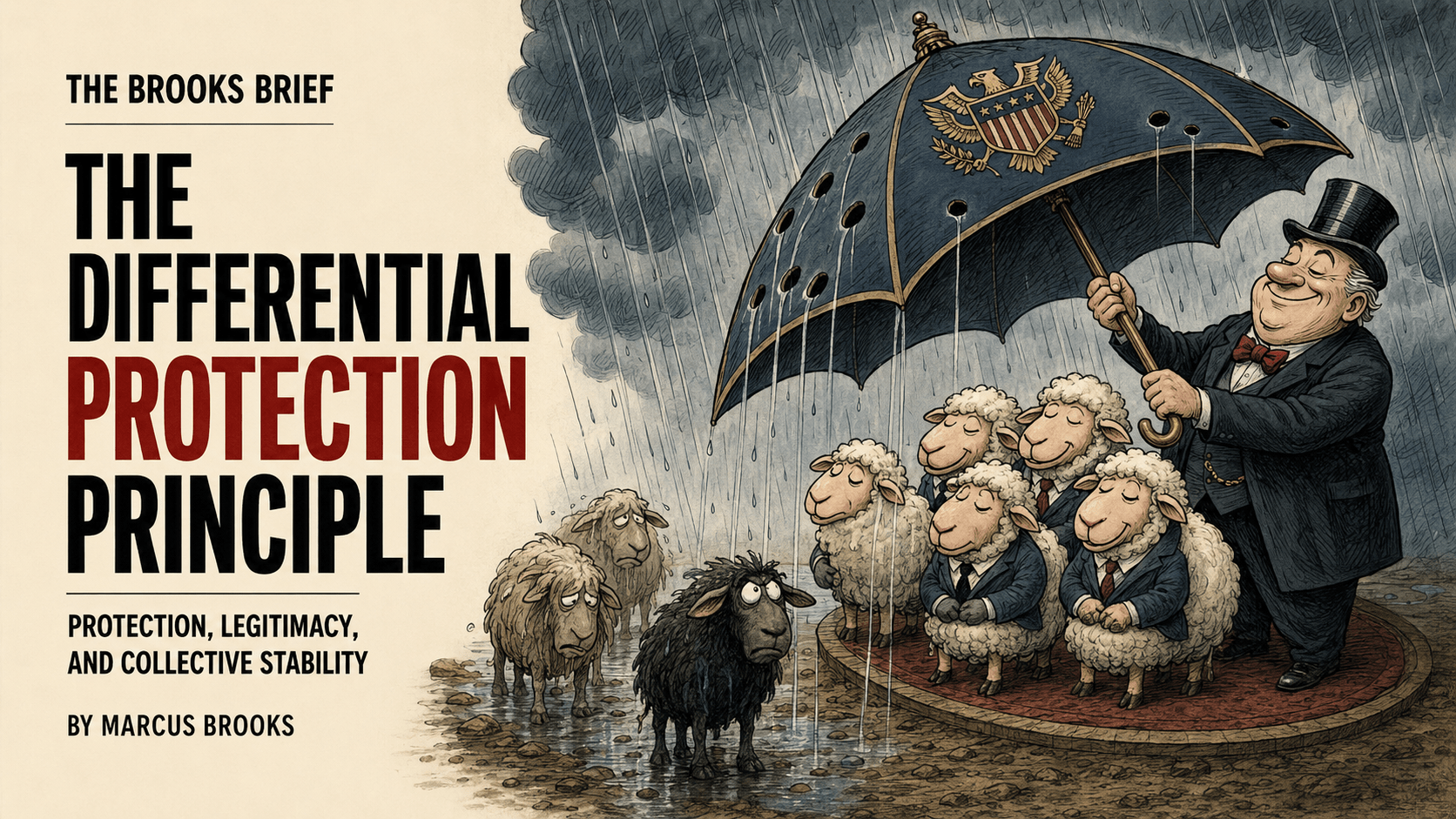
    Human beings form collectives because organized cooperation can provide more security, opportunity, and stability than isolated action. Governments, political parties, corporations, alliances, religious institutions, social movements, and families all ask their members to accept obligations in exchange for some form of protection. Yet collective protection is rarely distributed equally, and unequal distribution does not always produce the same political or social response. Some differences are accepted as necessary, while others are interpreted as evidence that the collective values certain members more than others. The [Differential Protection Principle](https://thebrooksbrief.com/2026/07/29/the-differential-protection-principle/) explains how those judgments influence institutional trust, political loyalty, and collective stability. It proposes that the durability of a collective depends not only on the amount of protection it produces, but also on whether its members consider the distribution of that protection legitimate.

    The principle can be stated formally: within any collective that provides or promises protection, increases in the perceived illegitimate disparity between the protection received by a member and that received by comparable members will tend to reduce trust, identification, cooperation, and loyalty. As those bonds weaken, the probability of complaint, protest, resistance, withdrawal, defection, or alternative collective formation increases. This is a probabilistic relationship rather than a claim that every person will react identically under every condition. Members may remain inside an unfair institution because they lack alternatives, fear punishment, depend on its resources, or retain emotional loyalty to it. Their continued membership, however, does not necessarily demonstrate continuing trust. A collective can preserve outward compliance long after it has lost the internal allegiance of the people it governs.

    The Herd Cohesion Principle begins from the proposition that individuals often accept limits on autonomy because collective membership provides security, stability, and opportunity.

    The Differential Protection Principle is intended as a bridge across the social arts, meaning the disciplines and practices concerned with organizing collective life. It connects questions traditionally studied in political science, sociology, economics, law, psychology, organizational leadership, public administration, and international relations. Existing research on procedural justice, organizational fairness, relative deprivation, institutional legitimacy, and exit behavior supports several parts of the proposed causal relationship. The distinctive contribution of this principle is to place protection at the center of the analysis and to connect individual comparisons with the long-term resilience of the collective providing that protection. It also complements the [Herd Cohesion Principle] (https://thebrooksbrief.com/2026/06/14/the-herd-cohesion-principle/) which explains why individuals accept some limits on autonomy in return for the benefits of collective membership. Together, the two principles offer a broader account of how collectives form, maintain cooperation, lose legitimacy, and eventually reform or fragment.

    The Social Arts and the Search for General Principles

    Modern societies often describe politics, economics, sociology, public administration, and related fields as social sciences. Earlier intellectual traditions also treated governing, diplomacy, persuasion, law, and institution building as social arts because they require judgment as well as knowledge. The two descriptions need not conflict, since the same field can study social behavior systematically while also applying that knowledge to practical problems. The harder question is whether these fields share any principles broad enough to operate across their institutional boundaries. A general social principle should describe a recurring relationship that can be observed in different cultures, organizations, and levels of political authority. It should also generate claims that can be tested, challenged, refined, or rejected through evidence.

    The social sciences do not need a single exceptionless law in order to qualify as sciences. Human beings interpret events, learn from experience, conceal preferences, and alter their behavior when institutions change, which makes social outcomes less mechanically predictable than many physical processes. Social research therefore often produces conditional and probabilistic findings rather than universal equations with identical results in every case. This limitation does not make general principles impossible, but it does require precision about the conditions under which they operate. A useful principle must identify a recurring cause, an observable mechanism, an expected outcome, and the factors that strengthen or weaken the relationship. The Differential Protection Principle is best understood as a candidate for this kind of law-like social regularity.

    Protection is a promising organizing concept because nearly every durable collective performs some protective function. A state protects territory and legal rights, a company protects wages and working conditions, an alliance protects members from external attack, and a family protects physical and emotional welfare. Even groups formed primarily for production, belief, or political advocacy must protect members sufficiently to retain their participation. Members therefore evaluate not only what the collective accomplishes, but also whether it will stand behind them when they become vulnerable. That evaluation links institutional performance to identity, loyalty, and legitimacy across many different social settings. A theory centered on protection may consequently illuminate relationships that disciplinary boundaries often examine separately.

    Defining Differential Protection

    A collective is any organized group that coordinates behavior, establishes expectations, and distributes benefits or burdens among members. Protection refers to action that reduces a member’s exposure to danger, arbitrary power, legal vulnerability, economic loss, political exclusion, institutional retaliation, or social abandonment. The term is broader than physical security, but it should not become a synonym for every desirable social benefit. Economic opportunity qualifies as protection when institutions prevent discriminatory exclusion or catastrophic deprivation, not simply whenever one person receives a better outcome than another. Political representation qualifies when it gives members a meaningful defense against decisions made without their interests or participation. Clear boundaries are necessary if the principle is to remain measurable rather than becoming a general statement that all unfairness causes dissatisfaction.

    A protection differential exists when comparable members receive different levels, forms, or reliability of protection from the same collective. The comparison may involve individuals, communities, social classes, racial or religious groups, political factions, corporate departments, or states inside an alliance. Some differentials are objectively measurable through budgets, response times, legal outcomes, insurance coverage, military commitments, or access to decision makers. Other differentials exist primarily in public perception, which may be shaped by personal experience, media narratives, political rhetoric, or historical memory. Objective and perceived differences can reinforce each other, but they should not be treated as identical. Institutions must understand both because objective equality cannot preserve legitimacy when members sincerely believe that protection remains unequal.

    The updated Differential Protection Principle states that perceived illegitimate disparities in protection tend to weaken the relationship between a member and the collective responsible for that protection.

    The principle concerns illegitimate differential protection rather than inequality by itself. A hospital may legitimately direct more resources toward critically ill patients, and a disaster agency may prioritize communities facing the greatest immediate danger. Members are more likely to accept unequal protection when the reasons are transparent, consistent, relevant, and open to review. They are more likely to reject it when differences appear arbitrary, discriminatory, corrupt, politically selective, or inconsistent with the collective’s stated obligations. Fairness therefore does not require identical treatment under every circumstance. It requires a defensible relationship between different treatment and a legitimate difference in need, risk, responsibility, or agreed rules.

    The Formal Principle and Its Causal Mechanism

    The updated Differential Protection Principle states that perceived illegitimate disparities in protection tend to weaken the relationship between a member and the collective responsible for that protection. The process begins with an expectation established by law, custom, membership, contribution, identity, or an explicit institutional promise. Members then compare the protection they receive with the protection provided to people they consider similarly situated. If the difference appears justified, cohesion may remain intact even when outcomes are unequal. If it appears unjustified, members begin to question whether the collective recognizes their status as full and valued participants. That judgment converts a distributive difference into a crisis of legitimacy.

    The next stage is psychological and political rather than merely material. Members who perceive illegitimate differential protection may conclude that institutional rules are unreliable, leadership is biased, or continued cooperation will not be reciprocated. Trust declines because the member can no longer confidently predict that the collective will honor its obligations. Identification declines because unequal protection communicates that some members belong more completely than others. Loyalty weakens because sacrifice for the collective appears irrational when protection is distributed selectively. The member’s response then depends on available choices, personal resources, attachment to the group, and the expected cost of opposition.

    Possible responses include silence, complaint, reform efforts, protest, covert obstruction, reduced participation, defection, physical departure, or the creation of an alternative collective. These responses are not mutually exclusive and may develop sequentially. This sequence extends [Albert Hirschman’s exit, voice, and loyalty framework](https://www.tandfonline.com/doi/full/10.1080/10967494.2021.1878314) by treating unequal protection as a trigger for those choices. A citizen may first complain, later join a protest movement, and eventually migrate or transfer political allegiance. An employee may remain at work while reducing effort, withholding ideas, searching for another position, and encouraging colleagues to organize. A state may stay inside an alliance while building independent military capacity and developing relationships with rival powers. The common mechanism is a declining belief that existing membership provides protection on legitimate terms.

    Relationship to the Herd Cohesion Principle

    The Herd Cohesion Principle begins from the proposition that individuals often accept limits on autonomy because collective membership provides security, stability, and opportunity. Coordinated groups can pool information, share risk, defend territory, establish norms, and produce resources that isolated individuals cannot easily obtain. Membership therefore involves an exchange in which individuals contribute obedience, labor, loyalty, taxes, conformity, or other forms of cooperation. In return, the collective offers protection and access to shared benefits. This exchange helps explain why people join institutions even when membership imposes real constraints. It also explains why authority can remain legitimate without relying exclusively on force.

    The Differential Protection Principle examines what happens after that exchange has been established. Members do not evaluate protection only by comparing collective membership with total isolation. They also compare their treatment with the treatment of other people inside the same collective. A person may still receive some benefit from membership while believing that others receive stronger protection for similar obligations. This relative comparison can weaken loyalty even when the collective remains materially useful. The question changes from whether the group provides protection to whether the group recognizes the member as equally deserving of legitimate concern.

    Together, the two principles describe a cycle of collective formation and erosion. Collectives attract members when the expected protection and opportunity exceed the perceived costs of participation. They maintain cohesion when members believe that the exchange remains effective and reasonably fair. They begin to weaken when protection becomes unreliable, when obligations become excessive, or when benefits are distributed according to illegitimate distinctions. Leaders may respond through reform, explanation, compensation, coercion, or denial. The long-term direction of the collective depends on whether those responses restore confidence or deepen the original protection gap.

    Protection, Legitimacy, and Institutional Trust

    Legitimacy is the belief that an institution has a rightful claim to exercise authority and that its decisions deserve some degree of acceptance. Force can produce obedience, but legitimacy reduces the amount of force required to sustain cooperation. People are more willing to follow rules, share information, pay costs, and tolerate unfavorable decisions when they regard the institution as broadly fair. Research on procedural justice has repeatedly connected fair treatment with confidence in legal authorities and willingness to cooperate. In their [study of public support for policing](https://www.cambridge.org/core/journals/law-and-society-review/article/role-of-procedural-justice-and-legitimacy-in-shaping-public-support-for-policing/3EB985ACD855B32B3C10EDAAD0B0EA57), Jason Sunshine and Tom Tyler found that legitimacy and procedural fairness were central to public cooperation, not merely perceptions of police performance. That research supports the broader proposition that the manner in which protection is administered can matter as much as the amount delivered.

    Institutional trust concerns whether people expect an organization and its representatives to act competently, consistently, and with acceptable motives. Differential protection damages each component of that expectation. Selective enforcement raises doubts about consistency, repeated neglect raises doubts about competence, and favoritism raises doubts about institutional motives. Once distrust becomes established, even neutral decisions may be interpreted through the memory of earlier disparities. This creates a feedback loop in which weak trust magnifies perceptions of unfairness and those perceptions further weaken trust. Repair consequently becomes harder the longer an institution dismisses or conceals credible grievances.

    Organizational research provides a parallel pattern in workplaces and other formal institutions. [Studies of organizational justice](https://pmc.ncbi.nlm.nih.gov/articles/PMC4562203/) associate perceived fairness with identification, commitment, trust, and willingness to contribute beyond minimum requirements. The Differential Protection Principle builds on that insight by asking which institutional function is being distributed and how the distribution affects collective durability. Protection is especially important because it becomes visible when members face danger, accusation, retaliation, exclusion, or loss. A collective reveals its hierarchy of concern most clearly when it decides whose vulnerability deserves action. Those decisions can become lasting symbols of membership, abandonment, or unequal worth.

    Applications Across the Social Arts

    Democratic government offers the most direct application because the state claims authority over people while promising equal protection under law. Citizens compare police response, courtroom treatment, disaster assistance, infrastructure investment, public health protection, voting access, and government attention across communities. Persistent disparities can convince disadvantaged citizens that formal citizenship does not produce equal membership in practice. That conclusion may lead to lower participation, outsider candidacies, civil disobedience, constitutional reform movements, or rejection of established parties. Privileged groups can also perceive differential protection when they believe institutions impose unequal burdens or selectively disregard their concerns. The political consequences depend less on which group is objectively correct than on whether institutions can demonstrate a legitimate and consistent basis for their actions.

    Corporations, universities, unions, political parties, and social movements display similar dynamics on a smaller institutional scale. Employees notice whose mistakes are excused, whose complaints receive investigation, whose careers survive controversy, and whose safety receives investment. Party members observe which candidates receive money, endorsements, legal assistance, committee assignments, or public defense from leadership. Movement participants evaluate whether organizers protect vulnerable members or treat some constituencies as expendable for strategic advantage. Unequal support may initially appear efficient because leaders can reward the most useful or loyal actors. Over time, however, permanent exclusion can reduce morale, participation, innovation, fundraising, and organizational unity.

    International institutions extend the principle from individuals to states. Alliances promise collective defense, but members may doubt whether the promise applies equally to large and small countries or to strategically central and peripheral regions. International organizations may adopt universal rules while enforcing them selectively against weaker states. Development institutions may impose strict conditions on some governments while accommodating others with greater geopolitical influence. When states perceive an illegitimate protection differential, they may hedge by increasing armaments, restricting cooperation, forming regional blocs, or courting rival powers. Formal membership can therefore persist while the practical cohesion of the institution deteriorates.

    Perception, Comparison, and Political Communication

    Objective disparities matter because they shape lived experience, but human beings respond to interpreted reality rather than administrative data alone. Members must first recognize a difference, identify a comparison group, and decide whether the difference violates a legitimate expectation. Political entrepreneurs can intensify this process by selecting emotionally powerful examples and presenting them as proof of systematic abandonment. Institutions can also minimize authentic disparities by publishing averages that conceal unequal local experiences. Neither perception nor measurement should automatically be treated as superior. A serious analysis must investigate how objective conditions, personal experiences, institutional explanations, and public narratives interact.

    The choice of comparison group is especially important. People do not compare themselves equally with every other member of a society or organization. They tend to focus on those they consider similarly situated by contribution, need, status, geography, identity, or institutional promise. A rural community may compare disaster response with another rural community rather than with a major city, while a junior employee may compare treatment with colleagues hired at the same level. Leaders sometimes respond to grievances with irrelevant comparisons that show the dissatisfied group is better protected than some distant population. Such answers often fail because they do not address the comparison that produced the perceived injustice.

    Communication influences legitimacy, but communication cannot permanently substitute for material correction. Transparent explanations can preserve trust when unequal protection reflects genuine differences in danger, cost, or responsibility. Consistent procedures can also reassure members that unfavorable outcomes did not result from hostility or exclusion. By contrast, public relations campaigns that deny visible disparities may deepen distrust and create a second grievance about institutional honesty. Effective communication must explain the rule, demonstrate its consistent application, disclose relevant evidence, and provide a credible route for appeal. The goal is not to eliminate every disagreement, but to show that members remain entitled to reasons and institutional consideration.

    Testable Hypotheses and Expected Outcomes

    The first hypothesis is that larger perceived illegitimate protection disparities will be associated with lower levels of institutional trust. The second is that declining trust will mediate the relationship between protection disparities and reduced loyalty, meaning the disparity weakens loyalty partly because it changes expectations about future institutional behavior. The third is that perceived disparities will sometimes predict behavior more strongly than objectively measured disparities. These propositions can be tested through surveys, experiments, administrative data, interviews, and comparisons across institutions. Researchers should measure objective distribution and subjective interpretation separately rather than assuming one represents the other. Evidence that unequal protection has no relationship with trust across diverse settings would challenge the central principle.

    A second group of hypotheses concerns the form taken by dissatisfaction. Members with credible alternatives should be more likely to exit, while members without such alternatives should be more likely to complain, protest, remain silent, or engage in covert resistance. Strong prior loyalty may delay exit and encourage reform efforts because attached members prefer repairing the collective to abandoning it. Repression may reduce visible protest without restoring trust, producing an appearance of cohesion that conceals growing alienation. External threats may temporarily suppress internal conflict by increasing the immediate value of collective membership. If the threat recedes while the protection differential remains, previously suppressed grievances should return and may become more intense.

    A third group of hypotheses concerns institutional response and repair. Transparent allocation standards should reduce the destabilizing effect of unequal outcomes when members regard the standards as relevant and consistently applied. Independent review and meaningful appeals should increase legitimacy by giving members a peaceful mechanism for challenging error or bias. Acknowledgment of institutional failure should restore more trust than denial when evidence of the disparity is already widely accepted. Material correction should be more effective when paired with explanation, accountability, and safeguards against repetition. Symbolic inclusion without changed protective behavior should produce only temporary improvement. These hypotheses allow the principle to evaluate remedies rather than merely diagnose decline.

    Boundary Conditions, Objections, and Limits

    The most obvious objection is that many people remain loyal to collectives that treat them unequally. Continued membership can occur because departure is costly, alternatives are dangerous, identity is deeply rooted, or members hope the institution will improve. Some people also accept hierarchy as legitimate and do not expect identical protection across ranks or roles. These cases do not automatically disprove the principle because it predicts a tendency whose expression depends on surrounding conditions. Researchers must nevertheless avoid explaining every contrary case as hidden resentment, since a theory that cannot be disproved is not scientifically useful. Direct measures of trust, legitimacy, identification, and behavior are necessary to determine whether the predicted erosion actually exists.

    A second objection is that institutions possess finite resources and must prioritize. The principle accepts this reality and does not demand equal spending, equal attention, or identical outcomes for every member. Scarcity becomes politically destabilizing when allocation rules are opaque, inconsistent, exclusionary, or unrelated to legitimate differences in need and responsibility. In some cases, equal distribution would itself constitute differential protection because highly vulnerable groups require additional resources to obtain comparable security. The relevant question is therefore whether unequal treatment can be publicly justified to those subject to the institution’s authority. This standard is demanding, but it is more realistic than mechanical equality.

    A third limitation concerns the breadth of protection as a concept. If protection includes every benefit, preference, and opportunity, the principle risks collapsing into the general observation that unfairness causes dissatisfaction. The theory should therefore focus on institutional actions that reduce exposure to threat, loss, exclusion, retaliation, or arbitrary power. Researchers should specify the protected interest, the responsible collective, the comparison population, and the expected obligation before testing a claim. They should also distinguish failures of capacity from intentional favoritism, even though both may weaken confidence. Greater conceptual discipline will make it possible to determine when differential protection adds explanatory power beyond existing theories of justice and inequality.

    Institutional Repair and Democratic Resilience

    Institutions can reduce destructive protection differentials by establishing transparent standards before crises occur. Allocation rules should identify relevant differences in need, risk, responsibility, and contribution while rejecting distinctions unrelated to legitimate institutional purposes. Decision makers should publish enough information for members to understand how priorities were established and whether similar cases received similar treatment. Independent review can help separate unavoidable scarcity from bias, corruption, or administrative convenience. Appeals must be accessible to people with limited money, time, expertise, or political influence. A procedure that exists only on paper cannot provide credible protection.

    Repair also requires institutions to treat recognition as part of protection. Communities often interpret silence as evidence that leaders either do not understand their vulnerability or do not consider it important. Acknowledging a failure does not by itself replace lost resources, legal rights, employment, safety, or political voice. It can, however, signal that the collective recognizes the injured members as legitimate claimants rather than disposable obstacles. Effective repair combines acknowledgment with material correction, accountability, and institutional safeguards against recurrence. The sequence matters because compensation offered without recognition may appear transactional, while apology without correction may appear empty.

    Democratic resilience depends on the capacity to correct protection gaps without requiring members to abandon the political system. Elections, courts, legislative oversight, independent journalism, public records, unions, inspectors general, and peaceful protest all provide channels for converting grievance into reform. Leaders weaken those channels when they treat criticism as disloyalty or protect supporters from standards imposed on opponents. A democracy may survive intense disagreement if citizens continue to believe that peaceful action can alter institutional behavior. It becomes more fragile when communities conclude that protection depends permanently on identity, wealth, geography, or partisan alignment. Equal citizenship therefore requires more than formal rights because it also requires credible access to the institutions that make those rights effective.

    A Research Agenda for Political Science

    The next stage of the Differential Protection Principle should be empirical development across different political and cultural settings. Researchers could construct a protection differential index comparing expected protection, observed protection, and the treatment of relevant reference groups. Surveys could measure whether citizens regard the disparity as justified and how those judgments relate to trust, participation, protest, or intended exit. Administrative records could test whether perceived differences correspond with response times, legal outcomes, public investment, or access to institutional remedies. Longitudinal studies would be especially valuable because the principle describes a process that develops over time. Repeated measurements could reveal whether distrust precedes withdrawal or whether declining participation changes perceptions of institutional protection.

    Comparative research should examine democracies, authoritarian systems, corporations, alliances, universities, religious organizations, and voluntary associations. This variation would show whether the same mechanism operates when membership is voluntary, partly constrained, or effectively compulsory. Experiments could present participants with identical protection disparities accompanied by different explanations, procedures, and opportunities for appeal. Historical studies could revisit episodes of party realignment, separatism, organizational collapse, mutiny, migration, or alliance fragmentation through the protection framework. Qualitative interviews could reveal which comparison groups people use and when unequal treatment becomes interpreted as abandonment. No single method will establish the principle, but convergence across methods would strengthen confidence in its generality.

    The research program should also examine competing explanations. Economic decline, ideological disagreement, leadership failure, identity conflict, foreign intervention, and technological disruption can all weaken collectives without beginning in differential protection. In many cases, these forces may interact with the principle by determining which members receive protection from the resulting costs. Researchers should test whether differential protection independently predicts trust and loyalty after accounting for these alternative causes. They should publish negative findings and identify cases where unequal protection does not produce the expected response. A mature principle becomes stronger through defined limitations, not through claims that it explains every form of social instability.

    Toward a General Principle of Collective Stability

    The Differential Protection Principle offers a common analytical language for problems that appear in different social disciplines. Political scientists study legitimacy, sociologists study belonging, economists study incentives, legal scholars study equal protection, psychologists study fairness, and organizational researchers study commitment. Each field examines part of the relationship between institutional treatment and collective cooperation. A protection-centered framework can connect those findings without erasing the important distinctions among them. Its value depends on whether it produces clearer predictions and better comparisons than existing concepts alone. The principle should therefore be offered as an invitation to research rather than a declaration that debate has ended.

    If supported, the principle would identify a recurring tension at the heart of organized life. Collectives need discretion because threats, needs, and resources are unequal. Members need assurance that this discretion will not become a license for abandonment, favoritism, or arbitrary exclusion. Institutions must therefore distribute protection unequally in some circumstances while maintaining a shared belief that every member remains worthy of protection. This is not simply an administrative problem because allocation communicates status and belonging. A decision about protection is also a decision about whose vulnerability the collective recognizes as its responsibility.

    This framework also clarifies why powerful institutions can become unstable even when their material capabilities remain impressive. A government may possess wealth, armed forces, advanced technology, and administrative reach while losing the confidence of communities that feel selectively exposed. A corporation may remain profitable while employees quietly withdraw commitment, and an alliance may retain formal treaties while members prepare to act alone. Material strength can postpone the consequences of declining legitimacy, but it cannot automatically reverse them. Durable cohesion requires both effective protection and a defensible distribution of that protection. Power preserves a collective most reliably when members believe that its strength can be claimed on legitimate terms.

    Thanks for reading The Brooks Brief Substack! This post is public so feel free to share it.

    Share

    Conclusion

    Human beings surrender portions of their independence because collective organization can protect them more effectively than isolation. That exchange is foundational to governments, markets, alliances, organizations, communities, and families. Yet the existence of protection does not guarantee cohesion when members believe that protection is selectively distributed. Illegitimate disparities weaken trust by making institutional behavior appear unreliable and membership appear unequal. The resulting response may take the form of voice, protest, reduced cooperation, psychological withdrawal, physical exit, or alternative collective formation. The specific outcome varies, but the underlying relationship connects protection, legitimacy, and loyalty.

    The principle does not claim that every unequal outcome is unjust or that every dissatisfied member will leave. It recognizes scarcity, hierarchy, different levels of need, and the practical necessity of institutional prioritization. Its central claim is narrower and more testable: when comparable members perceive a protection disparity as illegitimate, cohesion tends to decline. Dependence, repression, identity, external danger, and available alternatives determine how quickly that decline becomes visible. Institutions can interrupt the process through transparent standards, consistent procedures, meaningful appeals, acknowledgment, and material correction. They cannot reliably repair it through coercion, symbolism, or public relations alone.

    The Differential Protection Principle ultimately asks institutions to confront a question deeper than whether they possess enough power to protect their members. It asks whether members believe they are recognized as people for whom that power will be used. A collective begins to weaken when protection becomes a privilege of favored membership rather than a credible obligation owed on legitimate terms. At that point, obedience may continue while allegiance disappears. The long-term survival of the collective depends on whether it can restore the connection between authority, responsibility, and equal human worth. People do not judge a collective only by the strength it possesses, but by whether that strength will stand beside them when protection matters most.

    References

    Adams, J. S. (1965). Inequity in social exchange. In L. Berkowitz (Ed.), Advances in experimental social psychology (Vol. 2, pp. 267–299). Academic Press. https://doi.org/10.1016/S0065-2601(08)60108-2

    Brooks, M. (2026a, July 29). The differential protection principle. The Brooks Brief. https://thebrooksbrief.com/2026/07/29/the-differential-protection-principle/

    Brooks, M. (2026b, June 14). The herd cohesion principle. The Brooks Brief. https://thebrooksbrief.com/2026/06/14/the-herd-cohesion-principle/

    Chen, S.-Y., Wu, W.-C., Chang, C.-S., Lin, C.-T., Kung, J.-Y., Weng, H.-C., Lin, Y.-T., & Lee, S.-I. (2015). Organizational justice, trust, and identification and their effects on organizational commitment in hospital nursing staff. BMC Health Services Research, 15, Article 363. https://doi.org/10.1186/s12913-015-1016-8

    Colquitt, J. A., Conlon, D. E., Wesson, M. J., Porter, C. O. L. H., & Ng, K. Y. (2001). Justice at the millennium: A meta-analytic review of 25 years of organizational justice research. Journal of Applied Psychology, 86(3), 425–445. https://doi.org/10.1037/0021-9010.86.3.425

    Hirschman, A. O. (1970). Exit, voice, and loyalty: Responses to decline in firms, organizations, and states. Harvard University Press.

    James, O., & John, P. (2021). Testing Hirschman’s exit, voice, and loyalty model: Citizen and provider responses to decline in public health services. International Public Management Journal, 24(3), 378–393. https://doi.org/10.1080/10967494.2021.1878314

    Runciman, W. G. (1966). Relative deprivation and social justice: A study of attitudes to social inequality in twentieth-century England. University of California Press.

    Sunshine, J., & Tyler, T. R. (2003). The role of procedural justice and legitimacy in shaping public support for policing. Law & Society Review, 37(3), 513–547. https://doi.org/10.1111/1540-5893.3703002

    Tyler, T. R. (1990). Why people obey the law. Yale University Press.

    Corresponding in-text citations

    • Differential Protection Principle: (Brooks, 2026a)
    • Herd Cohesion Principle: (Brooks, 2026b)
    • Equity theory: (Adams, 1965)
    • Organizational justice and commitment: (Chen et al., 2015; Colquitt et al., 2001)
    • Exit, voice, and loyalty: (Hirschman, 1970; James & John, 2021)
    • Relative deprivation: (Runciman, 1966)
    • Procedural justice and legitimacy: (Sunshine & Tyler, 2003; Tyler, 1990)