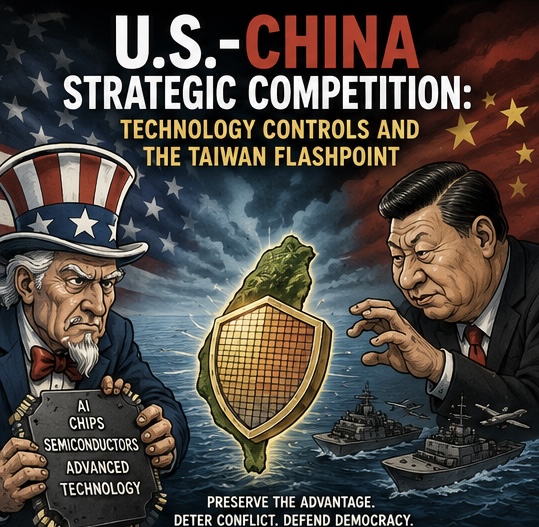
Technology Controls and the Taiwan Flashpoint
Executive Summary
The strategic competition between the United States and the People’s Republic of China has increasingly centered on two interconnected issues: technological dominance and the future security of Taiwan. American policymakers view advanced semiconductors, artificial intelligence, and other dual use technologies as essential to maintaining military superiority, economic competitiveness, and geopolitical influence in the twenty first century. Export controls have therefore become a primary instrument for slowing China’s technological advancement and limiting the military applications of foreign innovation. Taiwan occupies a uniquely important position in this rivalry because it produces a majority of the world’s most advanced semiconductors. Its semiconductor industry creates strong incentives for all major powers to avoid military conflict due to the catastrophic economic consequences that would follow disruption. At the same time, Taiwan’s industrial importance also increases its strategic value to Beijing and intensifies cross-strait tensions.
American strategy must therefore integrate economic statecraft with military deterrence in a far more coordinated manner than in previous decades. Policymakers can no longer treat export controls, semiconductor resilience, and Taiwan security as separate policy domains because developments in one area directly affect the others. Restrictions on semiconductor manufacturing equipment and AI related technologies influence China’s military modernization efforts, while Taiwan’s security directly affects global technology supply chains. Recent bipartisan initiatives in Washington, including the proposed MATCH Act, demonstrate growing concern over enforcement gaps and diversion risks that allow restricted technologies to continue reaching Chinese firms through intermediary states. Simultaneously, the People’s Liberation Army has expanded military exercises around Taiwan and intensified pressure campaigns designed to weaken Taipei without triggering outright war. These parallel developments have elevated the Taiwan Strait into one of the most dangerous geopolitical flashpoints in the world.
A coherent long term strategy will require sustained allied coordination, credible deterrence, and resilient industrial planning. The United States retains substantial advantages in advanced semiconductor design, elite research institutions, and strategic alliances with major technology producing nations such as Japan and the Netherlands. However, these advantages could erode if enforcement remains inconsistent or if short term commercial interests override long term national security objectives. Washington must also continue strengthening Taiwan’s asymmetric defenses while improving contingency planning for semiconductor supply disruptions in the event of crisis. Effective policy will depend on balancing deterrence with restraint in order to reduce the risk of escalation while preserving regional stability. The outcome of this strategic competition will shape the future distribution of power in Asia and influence the structure of the global economy for decades to come.

Introduction and Strategic Context
The strategic rivalry between the United States and China increasingly revolves around technological leadership and military influence in the Indo-Pacific region. Semiconductors, artificial intelligence, quantum computing, and cyber capabilities are now viewed not only as commercial innovations but also as critical foundations of national power. Governments recognize that dominance in advanced computing will shape future military capabilities, economic productivity, and intelligence gathering. Taiwan stands at the center of this competition because it combines strategic geography with unparalleled semiconductor manufacturing capacity. The island serves as both a potential military flashpoint and a central node in global technology supply chains. As a result, any instability in the Taiwan Strait would have immediate geopolitical and economic consequences far beyond East Asia.
Over the past decade, a bipartisan consensus has emerged in Washington identifying the People’s Republic of China as America’s primary systemic rival. This consensus has produced a more confrontational approach toward trade policy, technology restrictions, military posture, and industrial planning. Despite broad agreement on the strategic challenge posed by Beijing, significant debate remains over how aggressively the United States should employ export controls and whether current deterrence policies toward Taiwan remain sufficient. Some policymakers argue that stronger restrictions are necessary to preserve American technological leadership and slow China’s military modernization. Others warn that overly broad controls could damage U.S. companies, encourage Chinese self sufficiency, and fragment the global economy. These debates have become increasingly urgent as China accelerates investments in advanced computing and artificial intelligence.
The relationship between technological competition and Taiwan security is deeply interconnected. Advanced semiconductors power emerging military applications such as autonomous systems, targeting platforms, intelligence analysis, and cyber warfare capabilities. At the same time, Taiwan’s dominance in chip production gives it immense strategic importance in global markets and military supply chains. A conflict in the Taiwan Strait would disrupt global manufacturing, damage financial markets, and create severe shortages across multiple industries ranging from defense production to consumer electronics. Policymakers must therefore approach technology competition and regional deterrence as components of a single strategic challenge rather than isolated issues. Failure to integrate these areas into a coherent policy framework could weaken deterrence and increase the risk of crisis escalation. The stakes involved extend far beyond bilateral tensions between Washington and Beijing and could reshape the international order itself.

Historical Background: Taiwan’s Separation from China and Japan
Taiwan’s modern political status emerged through centuries of imperial competition, colonial administration, and civil war. During the late seventeenth century, the Qing Dynasty established sustained control over Taiwan and gradually expanded imperial administration across the island. In 1885, Taiwan was formally designated as a province of the Qing Empire, reflecting its growing strategic importance. However, China’s defeat in the First Sino-Japanese War dramatically altered Taiwan’s trajectory. Under the 1895 Treaty of Shimonoseki, the Qing government ceded Taiwan and the Penghu Islands to Japan in perpetuity. This marked the beginning of fifty years of Japanese colonial rule that profoundly shaped Taiwan’s infrastructure, industrial development, and political evolution.
Japanese administration transformed Taiwan into one of the empire’s most economically developed colonies. Tokyo invested heavily in transportation networks, public health systems, agriculture, and industrial modernization. At the same time, colonial authorities pursued assimilation policies designed to integrate Taiwanese society into the broader Japanese imperial framework. While modernization improved infrastructure and economic productivity, colonial governance also imposed strict political controls and suppressed dissent. The legacy of Japanese rule left a lasting imprint on Taiwan’s institutional development and cultural identity. These historical experiences contributed to the emergence of a distinct political consciousness that differed significantly from mainland China. The island’s colonial history continues to influence debates surrounding identity and sovereignty in contemporary Taiwan.
Following Japan’s surrender in World War II, Taiwan was transferred to the administration of the Republic of China in 1945 under the broader Allied wartime framework established through the Cairo Declaration and Potsdam Proclamation. Only a few years later, the Chinese Civil War fundamentally altered the political landscape of East Asia. After Communist forces achieved victory on the mainland in 1949, the Republic of China government under Chiang Kai-shek retreated to Taiwan alongside millions of soldiers, officials, and civilians. The People’s Republic of China subsequently established control over mainland China while the Republic of China continued governing Taiwan and several nearby islands. Over the following decades, Taiwan evolved into a prosperous liberal democracy with a vibrant economy and increasingly distinct national identity. Beijing continues to regard Taiwan as a breakaway province destined for eventual reunification, while the United States maintains unofficial relations and defensive commitments under the Taiwan Relations Act. These layered historical developments remain central to understanding the persistence of cross-strait tensions and the broader geopolitical dispute surrounding Taiwan’s future.

Technology Competition and Export Controls
Background and Evolution
Since 2018, the United States has steadily expanded export controls targeting advanced semiconductors and related technologies in an effort to constrain China’s access to cutting edge computing capabilities. Policymakers argue that these measures are necessary to preserve American technological leadership and prevent foreign innovation from strengthening China’s military modernization programs. The controls have focused particularly on advanced AI chips, semiconductor manufacturing equipment, and electronic design automation software that remain critical to producing next generation processors. Washington has also expanded Entity List restrictions and implemented outbound investment screening mechanisms aimed at reducing the transfer of sensitive expertise. These measures reflect growing concern over intellectual property theft, military civil fusion policies, and China’s long term ambitions for technological self sufficiency. Export controls have therefore become a central pillar of America’s broader strategic competition with Beijing.
The Biden and Trump administrations both contributed to the expansion of technology restrictions, creating a rare area of bipartisan continuity in American foreign policy. Policymakers increasingly viewed semiconductors as strategic assets comparable to energy resources or critical infrastructure. Concerns intensified as artificial intelligence became more integrated into military planning, surveillance systems, cyber operations, and autonomous weapons development. Restrictions on advanced lithography equipment and high performance AI chips were specifically designed to slow China’s ability to produce cutting edge semiconductors domestically. American officials also pressured allied nations such as Japan and the Netherlands to align their export control regimes with Washington’s objectives. This multilateral approach reflected recognition that unilateral restrictions would prove ineffective if foreign suppliers continued filling gaps in the market. As a result, technology policy became deeply intertwined with alliance management and geopolitical strategy.
China responded by accelerating state backed investments in domestic semiconductor development and indigenous innovation programs. Beijing directed massive subsidies toward chip manufacturing, AI research, and advanced industrial initiatives under broader national development strategies. Chinese firms also sought to bypass restrictions through intermediary states, gray market procurement channels, and overseas partnerships that complicated enforcement efforts. Companies such as Huawei demonstrated that Chinese industry retained the capacity to innovate despite mounting restrictions, though major dependencies on foreign manufacturing equipment remained. These developments highlighted both the strengths and limitations of export controls as a strategic tool. While restrictions increased costs and slowed progress in some sectors, they did not eliminate China’s determination to achieve technological independence. The resulting dynamic has produced an escalating cycle of restrictions, adaptation, and countermeasures between the world’s two largest economies.
Current Dynamics
By 2026, enforcement challenges had become one of the central weaknesses of the American export control regime. Diversion through intermediary countries continued to create loopholes that enabled restricted technologies to reach Chinese firms despite official prohibitions. Limited end use verification mechanisms further complicated efforts to ensure compliance across fragmented global supply chains. Policymakers increasingly worried that inconsistent allied implementation undermined the overall effectiveness of the restrictions. These concerns contributed to bipartisan support for legislative initiatives such as the MATCH Act, which aimed to tighten controls on semiconductor manufacturing equipment and improve coordination with international partners. Supporters argued that stronger enforcement was necessary to preserve America’s compute advantage in artificial intelligence and advanced military applications. The debate surrounding these measures reflected growing anxiety about the pace of China’s technological advancement.
At the same time, American industry groups expressed concerns about the economic consequences of prolonged restrictions. Semiconductor companies depend heavily on access to international markets, including China, which remains one of the largest consumers of advanced technology products. Industry leaders warned that excessive controls could reduce revenues needed for research and development while encouraging foreign competitors to replace American suppliers. Some analysts also argued that broad restrictions risked accelerating China’s efforts to build entirely independent supply chains. This tension between national security priorities and commercial interests became a defining feature of the policy debate in Washington. Policymakers struggled to balance immediate security concerns with the long term health of the domestic technology sector. The resulting disagreements highlighted the complexity of sustaining a durable strategic approach toward China.
Technological competition also expanded beyond semiconductors into artificial intelligence, cybersecurity, quantum computing, and critical minerals essential for advanced manufacturing. Governments increasingly viewed control over emerging technologies as a decisive factor in future geopolitical influence. China’s progress in AI applications and military modernization intensified fears that the balance of power could shift if current trends continued unchecked. Meanwhile, allied nations faced pressure to align with American restrictions even when doing so risked economic retaliation from Beijing. This broader competition contributed to the fragmentation of global supply chains and the emergence of competing technological ecosystems. As economic interdependence weakened, geopolitical rivalry became more pronounced across multiple sectors. The technology struggle between Washington and Beijing therefore evolved into a defining feature of twenty first century international politics.
Analysis
The United States and its allies continue to possess significant structural advantages across critical technological chokepoints. American firms dominate advanced semiconductor design software, while allied nations maintain leadership in lithography equipment and specialized manufacturing tools. Elite research universities, venture capital ecosystems, and longstanding industrial partnerships also provide enduring advantages that China cannot easily replicate. These strengths give Washington substantial leverage in shaping the pace and direction of global technological development. However, preserving these advantages will require sustained investment, coordinated industrial policy, and long term political consistency. Technological leadership cannot be maintained through restrictions alone without parallel investments in domestic innovation and workforce development. The effectiveness of export controls therefore depends on both defensive and offensive strategic measures.
Despite their advantages, export controls face important structural limitations that complicate enforcement and long term effectiveness. Global semiconductor demand creates strong incentives for companies and intermediary actors to evade restrictions in pursuit of profit. Fragmented international supply chains make monitoring end users and enforcing compliance extremely difficult across multiple jurisdictions. Moreover, restrictions that are perceived as inconsistent or politically motivated can weaken allied cooperation and reduce policy credibility. China’s determination to achieve technological self sufficiency also means that export controls may ultimately accelerate indigenous innovation in some sectors. Policymakers must therefore recognize that restrictions are primarily tools for slowing technological advancement rather than permanently preventing it. Strategic patience and realistic expectations will be essential for evaluating policy outcomes.
The long term success of export controls should be measured through broader strategic indicators rather than short term economic disruption alone. Policymakers should assess whether restrictions meaningfully slow China’s progress in advanced semiconductor manufacturing, AI enabled military applications, and next generation computing capabilities. Evaluations should also consider whether the United States and its allies maintain a sustainable technological lead over time. Effective strategy requires balancing deterrence, innovation, industrial resilience, and alliance management simultaneously. Policies driven solely by commercial bargaining or political symbolism risk undermining long term coherence and credibility. A durable framework must integrate economic statecraft with national security planning in a coordinated and disciplined manner. The future balance of technological power will likely shape military and geopolitical competition for decades to come.

Taiwan Strait Tensions
Background
American policy toward Taiwan has historically rested on a delicate framework combining strategic ambiguity, arms sales, and the Taiwan Relations Act. This approach was designed to deter both Chinese aggression and unilateral Taiwanese declarations of formal independence. By leaving uncertain whether the United States would intervene militarily in a cross-strait conflict, policymakers hoped to preserve stability and discourage reckless behavior from all parties involved. For decades, this strategy contributed to a relatively stable balance despite periodic crises and military tensions. However, changing military realities and intensifying geopolitical rivalry have placed increasing strain on this longstanding framework. The rapid growth of Chinese military capabilities has altered strategic calculations throughout the Indo-Pacific region.
China has pursued an extensive military modernization campaign aimed at improving its ability to project power and challenge American influence in East Asia. The People’s Liberation Army invested heavily in naval expansion, missile systems, cyber warfare capabilities, and advanced air power designed to complicate U.S. intervention during a regional conflict. Beijing also intensified gray zone tactics including cyberattacks, maritime coercion, disinformation campaigns, and near daily military incursions around Taiwan. These activities sought to weaken Taiwan psychologically and strategically without crossing thresholds likely to trigger open war. Chinese leaders consistently framed reunification as a historic mission tied to national rejuvenation and sovereignty. This rhetoric increased concerns among regional actors that Beijing might eventually resort to force if peaceful unification remained unattainable.
Taiwan responded by strengthening democratic institutions, expanding defense reforms, and deepening unofficial ties with the United States and other regional partners. Public opinion on the island increasingly reflected a distinct Taiwanese identity separate from mainland China. At the same time, debates intensified within Taiwan over military readiness, defense spending, and the most effective strategies for deterrence. Many analysts advocated prioritizing asymmetric defense systems such as drones, sea mines, mobile missile launchers, and distributed command infrastructure. These systems were viewed as more practical for resisting a larger military power than expensive conventional platforms vulnerable to early destruction. Taiwan’s evolving defense posture therefore became closely linked to broader American and allied security planning in the Indo-Pacific. The island’s future emerged as a central test of regional deterrence credibility.
Current Dynamics
By 2026, military activity around Taiwan had reached some of the highest levels observed in decades. The People’s Liberation Army conducted large scale exercises simulating blockade operations, amphibious assaults, and joint force encirclement campaigns. Chinese aircraft and naval vessels regularly crossed previously observed operational boundaries near the island, increasing the risk of accidents and miscalculation. These exercises were widely interpreted as both preparation for potential conflict and coercive signaling aimed at intimidating Taiwan and its partners. At the same time, Beijing continued employing economic pressure and diplomatic isolation campaigns designed to weaken Taipei internationally. The cumulative effect of these actions intensified concerns about long term regional stability. Many analysts warned that repeated crises could eventually produce escalation through miscalculation rather than deliberate planning.
The United States responded by expanding military coordination with regional allies and approving additional arms packages for Taiwan. Security cooperation initiatives with Japan, Australia, and the Philippines became increasingly integrated into broader Indo-Pacific deterrence planning. Washington also encouraged Taiwan to accelerate defense reforms focused on asymmetric capabilities and rapid mobilization strategies. However, disagreements persisted regarding the pace of arms deliveries and Taiwan’s overall defense preparedness. Critics argued that bureaucratic delays and institutional resistance continued undermining effective implementation of defense reforms. Supporters of stronger deterrence measures warned that time increasingly favored Beijing as Chinese military capabilities expanded. These debates highlighted growing urgency within American strategic circles.
Strategic ambiguity also became a subject of intense debate within Washington policy circles. Some analysts argued that ambiguity no longer deterred Beijing effectively and instead encouraged increasingly aggressive coercive behavior. Advocates of greater strategic clarity believed explicit commitments could strengthen deterrence and reassure allies throughout the region. Others warned that abandoning ambiguity could provoke escalation, reduce diplomatic flexibility, and embolden pro independence forces within Taiwan. Policymakers therefore faced a difficult balancing act between deterrence credibility and escalation management. The challenge became even more complicated as technological competition and military rivalry continued to converge. Decisions surrounding Taiwan increasingly carried implications for the broader international order and the credibility of American alliances worldwide.
Analysis
The People’s Liberation Army’s modernization significantly altered the military balance in East Asia and increased the risks associated with crisis management. China’s growing missile capabilities, naval expansion, and anti access systems complicated traditional assumptions about American military superiority in the region. Even limited coercive scenarios such as blockades or precision strikes could impose severe economic and political costs without escalating immediately into full scale war. This ambiguity creates difficult decision making environments for both Washington and Taipei during periods of heightened tension. Miscalculation, accidental escalation, or political overreaction could rapidly transform a localized crisis into a broader regional conflict. Policymakers must therefore focus not only on deterrence but also on mechanisms for crisis communication and de escalation. The margin for strategic error has narrowed considerably.
Taiwan’s central role in global semiconductor production dramatically amplifies the stakes of any potential conflict. A disruption to Taiwanese manufacturing would affect industries ranging from defense production and telecommunications to consumer electronics and automotive manufacturing. The economic consequences would likely trigger worldwide market instability and accelerate broader geopolitical fragmentation. This reality contributes to the concept of Taiwan’s “silicon shield,” in which mutual economic dependence discourages military escalation. However, reliance on a single geographic concentration of advanced semiconductor production also creates significant vulnerabilities for the global economy. Governments increasingly recognize the need to diversify supply chains while preserving Taiwan’s deterrent value. Balancing these objectives remains one of the most difficult strategic challenges facing policymakers today.
Strategic ambiguity may no longer provide the same stabilizing benefits it once offered during earlier decades of relative military balance. China’s expanding capabilities and willingness to employ coercive tactics have changed the regional security environment substantially. Nevertheless, a sudden transition toward explicit security guarantees could also produce unintended consequences and heighten escalation risks. Policymakers must therefore calibrate deterrence measures carefully while maintaining diplomatic flexibility and alliance cohesion. Long term stability will depend on integrating military preparedness with economic resilience and technological coordination. The Taiwan issue can no longer be understood solely as a territorial dispute because it now sits at the center of global technological and geopolitical competition. How the United States and its allies manage this challenge will influence the future credibility of deterrence across the Indo-Pacific region.

Interconnections and Broader Implications
Taiwan’s semiconductor dominance, particularly through the role of Taiwan Semiconductor Manufacturing Company, creates a powerful form of strategic interdependence often described as the “silicon shield.” The island’s production of advanced chips is essential to the global economy and supports industries ranging from artificial intelligence to defense manufacturing. This interdependence increases the economic costs associated with any military conflict involving Taiwan. China itself depends heavily on semiconductor imports, meaning a major disruption would damage Beijing’s own economy alongside those of its rivals. As a result, Taiwan’s technological importance contributes to deterrence by raising the stakes for all major actors involved. However, this same importance also increases Taiwan’s value as a strategic target within the broader U.S.-China rivalry.
Efforts by the United States and allied nations to diversify semiconductor production create additional strategic complexity. Policies promoting domestic manufacturing and friend shoring seek to reduce dependence on Taiwan and improve long term supply chain resilience. While these initiatives strengthen economic security, they may also weaken some aspects of Taiwan’s deterrent value if the island becomes less central to global production networks over time. Policymakers must therefore balance resilience objectives with the need to preserve stability in the Taiwan Strait. Excessively rapid decoupling could unintentionally reduce incentives for restraint among competing powers. Conversely, insufficient diversification would leave the global economy dangerously vulnerable to disruption during crisis or conflict. These competing pressures illustrate the interconnected nature of economic and security strategy.
Technological competition also directly shapes future military balances in the Indo-Pacific region. Advances in artificial intelligence, autonomous systems, cyber operations, and advanced computing could dramatically improve operational planning, surveillance, and targeting capabilities. Chinese progress in these fields may strengthen coercive options against Taiwan and complicate American military intervention. At the same time, sustained U.S. and allied advantages in advanced technologies reinforce deterrence and military effectiveness. Allied coordination therefore remains essential not only for export controls but also for broader security cooperation frameworks such as AUKUS and the Quad. The strategic competition between Washington and Beijing increasingly involves both industrial policy and military positioning simultaneously. The outcome of this rivalry will influence global supply chains, alliance structures, and geopolitical alignments for years to come.
Policy Recommendations
1. Fortify Export Controls
The United States should continue strengthening export control mechanisms while prioritizing coordination with major allied technology producers. Measures such as the proposed MATCH Act should focus on closing diversion loopholes, improving end use verification, and tightening restrictions on critical semiconductor manufacturing equipment. Effective enforcement requires sustained cooperation with countries such as Japan and the Netherlands that control key industrial chokepoints. Policymakers should also ensure that restrictions remain targeted and strategically coherent rather than reactive or symbolic. Broad measures lacking clear objectives could damage allied cohesion and undermine long term effectiveness. Export controls must therefore be integrated into a broader industrial and geopolitical strategy.
Washington should simultaneously expand support for domestic semiconductor manufacturing and research initiatives. Investments in workforce development, advanced fabrication facilities, and scientific innovation are essential for maintaining long term competitiveness. The CHIPS and Science Act represented an important step toward strengthening domestic production capacity, but additional investment may still be necessary to preserve technological leadership. Policymakers should also encourage diversified supply chains among trusted partners in order to reduce dependence on concentrated production hubs. These efforts would strengthen resilience against future disruptions while supporting allied economic cooperation. Long term technological leadership depends on both restriction and innovation working together.
Policymakers must also establish clearer metrics for evaluating the effectiveness of export controls over time. Assessments should focus on whether restrictions meaningfully slow China’s progress in advanced semiconductor production and AI enabled military applications. Evaluations should also measure the durability of U.S. and allied technological advantages relative to Chinese capabilities. Transparent oversight mechanisms would help improve accountability and strategic consistency across administrations. Export controls should remain flexible enough to adapt to rapidly changing technological conditions while preserving long term strategic goals. Effective implementation will require balancing economic competitiveness with national security priorities in a disciplined and sustainable manner.
2. Strengthen Taiwan’s Deterrent Posture
The United States should accelerate the delivery of asymmetric defense systems designed to complicate potential Chinese military operations. Mobile missile systems, drones, sea mines, and distributed command infrastructure offer more survivable and cost effective deterrence options than many conventional platforms. Taiwan should also continue reforming reserve forces, civil defense programs, and military mobilization structures in order to improve resilience during crisis scenarios. Joint training initiatives between American and Taiwanese forces could strengthen operational coordination and preparedness. Policymakers increasingly argue that deterrence depends not only on military hardware but also on institutional readiness and societal resilience. These reforms would improve Taiwan’s ability to withstand coercive pressure and increase the potential costs of aggression.
Washington should also enhance contingency planning for semiconductor continuity during a potential cross-strait crisis. Governments and private industry stakeholders must coordinate emergency response frameworks capable of minimizing disruptions to critical technology supply chains. Strategic stockpiles, diversified sourcing agreements, and emergency manufacturing partnerships could help reduce global economic vulnerability. Allied governments should also conduct regular simulations and planning exercises focused on supply chain resilience and crisis management. These measures would improve preparedness while signaling seriousness regarding the defense of critical economic infrastructure. Semiconductor continuity planning is increasingly inseparable from broader national security strategy. The economic dimensions of deterrence now carry global significance.
American messaging toward Taiwan and China should remain firm but carefully calibrated. Policymakers should clearly communicate opposition to coercive actions while avoiding unnecessarily inflammatory rhetoric that could increase escalation risks. Diplomatic channels with Beijing remain essential for crisis communication and de escalation even amid strategic rivalry. The United States must balance deterrence credibility with the need to preserve flexibility during rapidly evolving situations. Regional allies should also be integrated more closely into deterrence planning and communication strategies. A stable deterrence framework depends on coordination, consistency, and disciplined signaling from all parties involved.
3. Integrate Technology and Security Strategy
Technology competition and Taiwan security should no longer be treated as separate policy categories within American strategic planning. Export controls, AI governance, cybersecurity, supply chain resilience, and military deterrence are now deeply interconnected components of a single geopolitical challenge. Policymakers should establish institutional mechanisms that improve coordination between economic agencies, defense planners, and diplomatic officials. This integrated approach would reduce policy fragmentation and strengthen long term strategic coherence. Coordinated planning is particularly important given the speed of technological change and the complexity of global supply chains. Effective competition with China requires sustained alignment across multiple areas of governance and national power.
The United States should also deepen cooperation with democratic allies on emerging technology standards and industrial resilience initiatives. Shared cybersecurity frameworks, joint AI research standards, and coordinated semiconductor investments would strengthen collective competitiveness. Partnerships with countries such as Japan, South Korea, Australia, and European allies remain critical for preserving technological advantages. Regional security initiatives such as AUKUS and the Quad should increasingly incorporate technological coordination alongside military planning. These alliances provide opportunities to distribute costs, reduce vulnerabilities, and reinforce deterrence credibility. Long term success will depend heavily on allied unity and strategic coordination.
Policymakers should additionally prioritize critical mineral security and advanced manufacturing supply chains. Rare earth elements and specialized industrial materials remain essential for semiconductor production, defense systems, and renewable energy technologies. Dependence on adversarial suppliers creates vulnerabilities that could undermine strategic resilience during periods of tension or conflict. Diversified sourcing agreements and domestic processing investments would reduce these risks over time. Governments must therefore view industrial policy as a central component of national security planning rather than merely an economic issue. The strategic competition with China increasingly spans every layer of technological and industrial infrastructure.
4. Institutionalize Long Term Strategic Competition
Congress and the executive branch should establish durable funding mechanisms and legal authorities capable of sustaining long term strategic competition with China. Short term political cycles often undermine policy consistency and weaken allied confidence in American commitments. Stable investment frameworks would improve planning for defense modernization, technological innovation, and industrial resilience initiatives. Policymakers should avoid subordinating national security priorities to temporary trade negotiations or immediate commercial pressures. Long term competition requires strategic patience and bipartisan continuity across multiple administrations. Institutional stability will therefore be essential for maintaining credibility and deterrence.
American leaders should also strengthen public understanding of the broader stakes involved in technological and geopolitical competition. Public support for industrial investment, alliance coordination, and defense planning will influence the sustainability of long term strategy. Policymakers must communicate that technological leadership now directly affects economic prosperity, military readiness, and national security. Transparent debate and oversight can improve accountability while reducing the risk of reactive policymaking driven by short term political pressures. Democratic resilience depends partly on maintaining informed public engagement regarding major strategic challenges. The competition with China will likely remain a defining issue of international politics for decades.
Finally, institutionalizing strategic competition requires balancing firmness with restraint. Policymakers should avoid framing rivalry with China as an inevitable military confrontation or civilizational conflict. Such rhetoric could reduce diplomatic flexibility and increase the risks of escalation or miscalculation. The objective of American strategy should remain deterrence, stability, and preservation of an open international order rather than uncontrolled confrontation. Effective competition depends on disciplined statecraft, allied coordination, and careful management of escalation risks. Long term stability in the Indo-Pacific will require sustained strategic consistency from all major actors involved.
Thanks for reading The Brooks Brief Substack! This post is public so feel free to share it.

Conclusion
The strategic competition between the United States and China increasingly revolves around the intersection of technological leadership and Taiwan’s future security. Export controls, semiconductor supply chains, artificial intelligence, and military deterrence are no longer isolated policy concerns but interconnected elements of a broader geopolitical struggle. Taiwan occupies a uniquely important position within this competition because its semiconductor industry underpins both the global economy and advanced military technologies. Any conflict in the Taiwan Strait would therefore carry consequences extending far beyond East Asia. Policymakers must recognize that economic resilience and military stability are now deeply intertwined. A fragmented or inconsistent strategy would weaken deterrence and increase global vulnerability.
The United States and its allies retain substantial advantages in advanced computing, industrial innovation, and alliance networks. However, these advantages cannot be taken for granted amid accelerating Chinese investment and technological adaptation. Effective strategy will require sustained coordination between export controls, domestic industrial policy, alliance management, and military preparedness. Policymakers must also remain realistic about the limitations of restrictions and recognize that long term competitiveness depends heavily on continued innovation and institutional resilience. The challenge is not simply to slow China’s advancement but to preserve a durable and adaptable strategic advantage over time. Success will depend on balancing deterrence, economic security, and diplomatic flexibility simultaneously.
Ultimately, the outcome of this competition will help shape the future international order for decades to come. Decisions made regarding Taiwan, semiconductors, and emerging technologies will influence global trade, military balances, and geopolitical alignments throughout the twenty first century. The stakes involved extend beyond bilateral rivalry and affect the broader stability of the Indo-Pacific region and the global economy itself. A coherent long term strategy must therefore combine credible deterrence with resilient supply chains, allied coordination, and disciplined diplomacy. Policymakers face a narrow path between complacency and escalation that will require careful management in the years ahead. The ability to preserve stability while maintaining technological leadership may become one of the defining tests of American statecraft in the modern era.


