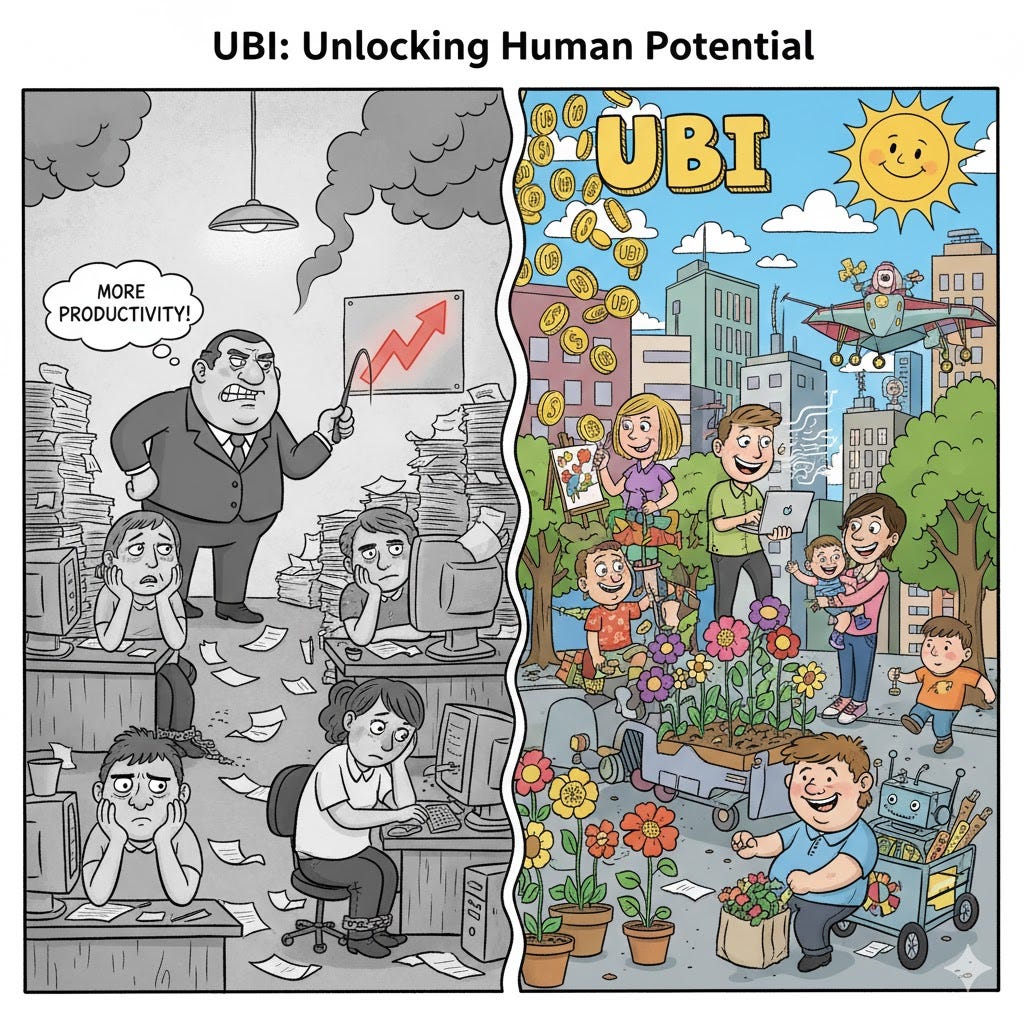
The idea that every citizen should receive a regular, no-strings-attached cash payment from the government once sounded utopian. Today, as artificial intelligence threatens to eliminate millions of jobs in a single decade, universal basic income (UBI) is no longer a fringe theory. It has become one of the most debated policy responses of our time.
A 500-Year Intellectual Journey
The intellectual roots of UBI stretch back far earlier than most people realize. In 1516, Thomas More’s Utopia described a society where basic needs were guaranteed so citizens could pursue higher callings. Two centuries later, Thomas Paine’s 1797 pamphlet Agrarian Justice argued that the earth is the common property of mankind and that those who lost access to land through private ownership deserved compensation in the form of a regular dividend.
The 20th century produced an unlikely coalition of supporters: Milton Friedman on the right, who championed a negative income tax as a simpler alternative to welfare bureaucracy; Martin Luther King Jr. on the left, who saw guaranteed income as the fastest way to abolish poverty; and even Richard Nixon, whose 1969 Family Assistance Plan came within a few Senate votes of becoming law.
In the 21st century, Silicon Valley entrepreneurs such as Elon Musk, Mark Zuckerberg, and Sam Altman have added their voices, warning that the scale of AI-driven job displacement will dwarf anything seen during the Industrial Revolution. Pilot programs in Finland, Kenya, Canada, and Stockton, California, have moved the conversation from theory to evidence.
The AI Shock That Makes UBI Urgent
Artificial intelligence is not just another wave of automation; it is the first technology capable of performing cognitive as well as physical labor at scale. Estimates suggest that up to 800 million global jobs could be lost or transformed by 2030. The probability that truck driving—the most common job in most U.S. states—will be automated within two decades exceeds 90 percent. White-collar professions are next. Legal discovery, radiology, accounting, and even software development are already being disrupted.
When entire occupations disappear faster than new ones can be created, traditional unemployment insurance and retraining programs become overwhelmed. This is the precise scenario in which advocates argue universal basic income becomes not just desirable, but necessary.
The Case for Universal Basic Income
- Poverty Reduction
UBI provides an unconditional floor beneath every citizen, virtually eliminating extreme poverty overnight. Trials consistently show that recipients do not squander the money but use it for essentials such as food, housing, healthcare, and education. - Simplifies Welfare Systems
Dozens of overlapping, means-tested programs could be replaced by a single, automatic payment. This would reduce administrative overhead and eliminate poverty traps that punish people for earning more. - Encourages Entrepreneurship and Creativity
Financial security acts as a venture-capital fund for the population. In the Kenya GiveDirectly experiment, recipients were 35 percent more likely to start a business. Artists, writers, inventors, and caregivers—work that markets chronically undervalue—could finally flourish. - Supports Workers in Transition
As AI displaces truck drivers, paralegals, and call-center workers, UBI provides breathing room to retrain, relocate, or experiment with new career paths without the threat of eviction or hunger. - Improves Mental Health
Chronic financial anxiety is a leading cause of depression, substance abuse, and suicide. Experiments in Stockton showed significant reductions in anxiety and depression among recipients after just one year of $500 monthly payments. - Promotes Freedom and Choice
When survival no longer depends on accepting any available job, people can say no to exploitative wages or abusive bosses. They can choose work that aligns with their values and talents, leading to higher overall life satisfaction and, paradoxically, greater productivity in the long run.
The Case Against Universal Basic Income
- High Cost
A UBI of $1,000 per month for every U.S. adult would cost roughly $3.2 trillion annually, more than the federal government currently collects in individual income taxes. Funding it would require steep tax increases, a national sales tax, carbon taxes, or new mechanisms such as a tax on AI-driven profits. - Potential Work Disincentive
Critics fear that guaranteed income will cause some people to work less or leave the labor force entirely. While most trials show only small reductions in work, skeptics worry about long-term cultural shifts. - Inflation Risk
Flooding the economy with trillions of new dollars could drive up rents, groceries, and other essentials, especially if landlords and retailers capture the extra income. Alaska’s oil dividend and pandemic stimulus checks produced modest inflationary pressure in specific sectors. - Equity Concerns
Paying billionaires the same $1,000 per month as the homeless seems wasteful. Alternatives such as phasing out payments at higher income levels reintroduce the bureaucracy UBI was meant to eliminate. - Political Feasibility
Large-scale redistribution requires sustained bipartisan support that has proven elusive. Opponents on the right see it as socialism, while some on the left fear it could become an excuse to dismantle other social programs. - Cultural and Social Impacts
For centuries, moral worth in many societies has been tied to paid work. A universal payment risks eroding that norm, potentially breeding resentment between those who continue working and those who opt out.
Toward a Workable Middle Ground
The perfect must not become the enemy of the good. Few advocates believe full UBI can be implemented overnight. More realistic pathways include:
- Starting with targeted versions for children, the elderly, or displaced workers
- Funding pilots through taxes on automation, data, or financial transactions
- Combining UBI with aggressive investments in lifelong education and portable benefits
Conclusion
Universal basic income is not a silver bullet, but clinging to a 20th-century social contract in a 21st-century AI-driven economy is equally unwise. The question is no longer whether technological unemployment will force us to rethink the link between work and survival, but how boldly and fairly we choose to respond.
History shows that societies that adapt to technological upheaval with imagination and compassion tend to emerge stronger. As machines take over more of what we used to call jobs, a universal basic income may prove to be the bridge that keeps human dignity and democracy intact on the other side.
Leave a Reply