I. Introduction
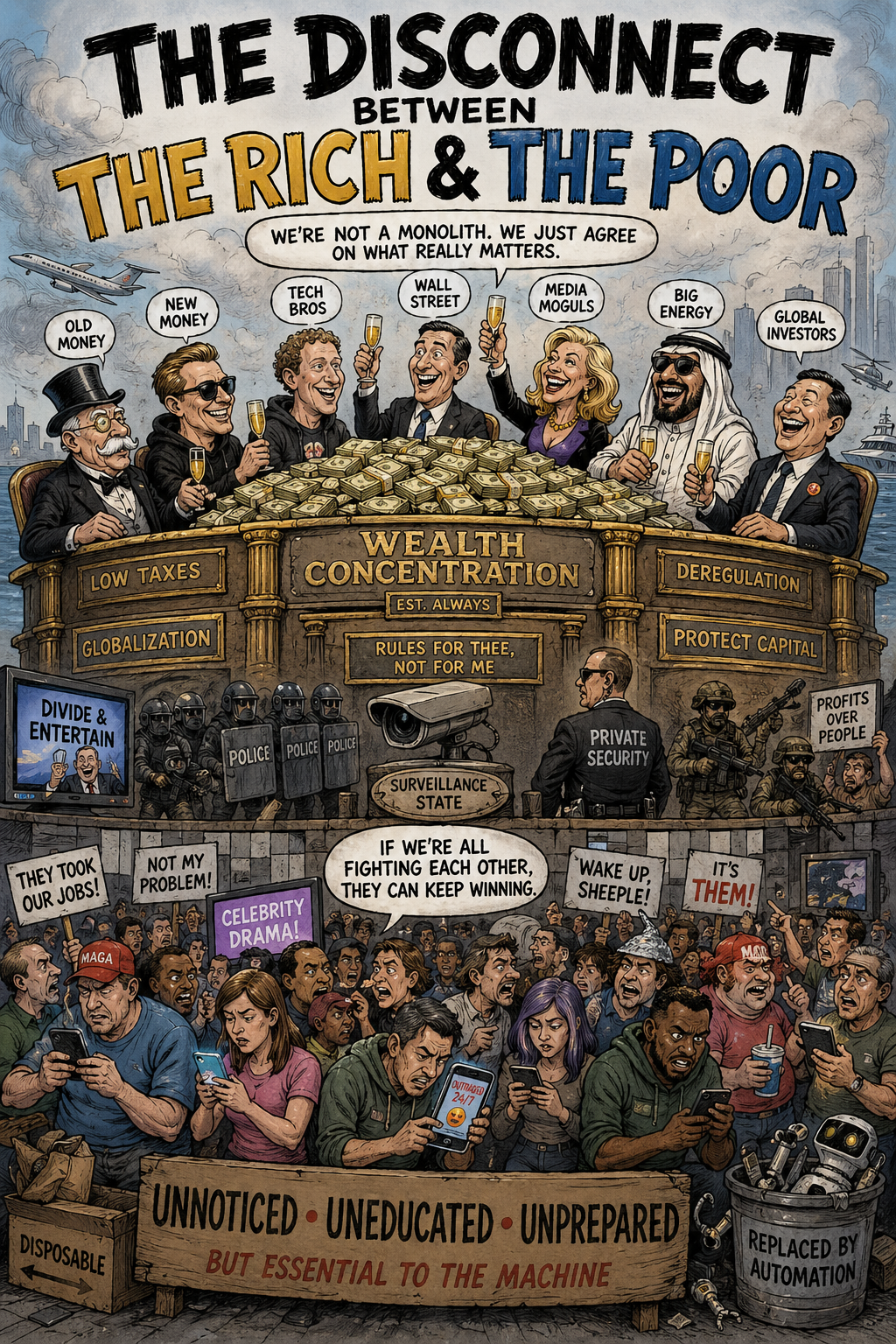
The modern political economy is increasingly defined by a widening disconnect between the wealthy elite and the broader population, marked by unprecedented levels of wealth concentration and diverging material interests. This divide is not merely economic but also institutional, cultural, and political, shaping how power is exercised and contested. While public discourse often frames inequality as a simple binary struggle between rich and poor, the reality is far more complex. Both groups are internally fragmented, with competing interests and identities that complicate any unified narrative of class conflict. These divisions weaken collective action and obscure the structural forces that sustain inequality.
At the same time, the asymmetry between concentrated capital and dispersed labor remains profound. Wealth translates into political influence, access to information, and the ability to shape the rules of economic engagement. Meanwhile, the majority navigates a system that often limits upward mobility and reinforces dependency on wage labor. The result is a paradox in which numerical superiority does not easily convert into political or economic power. This imbalance raises fundamental questions about the durability of democratic systems under conditions of extreme inequality.
The core thesis of this analysis is that fragmentation within both the rich and the poor coexists with a structural hierarchy that overwhelmingly favors capital. The poor are divided into tiers with distinct and often conflicting priorities, while the wealthy operate through competing but interconnected networks of influence. These dynamics complicate efforts to address inequality and challenge assumptions about inevitable class-based solidarity. Ultimately, the persistence of this disconnect forces a deeper inquiry into whether existing systems can reconcile efficiency, equity, and human dignity.
II. Stratification and Control of the Poor
The non-wealthy population is not a unified bloc but a stratified landscape composed of lower, middle, and upper-middle classes, each facing different economic pressures and aspirations. The lower class often contends with immediate survival concerns such as housing insecurity and unstable employment. The middle class, while more economically secure, is frequently burdened by debt and the fear of downward mobility. The upper-middle class, though relatively privileged, remains invested in preserving its status and differentiating itself from those below. These distinctions create competing priorities that hinder collective political action.
Mechanisms of division further entrench this fragmentation. Cultural, racial, regional, and partisan conflicts are often amplified through media and social platforms, redirecting attention away from shared economic concerns. Identity-based debates can overshadow structural critiques, making it more difficult to build broad coalitions around class issues. Economic dependence also plays a critical role, as individuals reliant on wages, credit, or employer-provided benefits may be less inclined to challenge the system that sustains them. These dynamics collectively reinforce a form of social control that operates without centralized coordination.
The outcome is a majority that often lacks the resources, information, and organizational capacity to mount sustained challenges to systemic inequality. Educational disparities and information asymmetries limit awareness of structural dynamics, while time and financial constraints restrict political engagement. At the same time, the system continues to extract labor value while treating workers as replaceable inputs. Automation, offshoring, and technological disruption further exacerbate this condition by reducing the long-term security of employment. This creates a cycle in which the majority remains essential to production yet increasingly vulnerable to obsolescence.

III. Fragmentation of the Rich: Not a Monolith
Contrary to popular perception, the wealthy elite is not a cohesive or unified group. Significant divisions exist between old money and new money, reflecting differences in origin, culture, and economic strategy. Established dynasties often derive wealth from traditional industries and long-standing institutions, while newer fortunes emerge from technology, finance, and entertainment sectors. These groups may have conflicting views on regulation, innovation, and globalization. Such tensions illustrate that elite interests are not always aligned in the short term.
Institutional differences also shape elite behavior. Corporate executives, shareholders, and institutional investors operate within frameworks that prioritize growth and profitability, often under public scrutiny. In contrast, family offices and private wealth structures may pursue long-term preservation strategies with less transparency. Competing industry lobbies further complicate the landscape, as sectors like technology, energy, and finance advocate for policies that serve their specific interests. These divisions can produce policy conflicts even among the most powerful actors.
Despite these differences, a set of shared priorities often leads to de facto coordination. Protection of property rights, access to global markets, and the maintenance of favorable tax and regulatory environments remain common goals. While some wealthy individuals may support redistributive policies or social initiatives, these actions are typically selective and do not fundamentally alter the broader system. In most cases, self-preservation and the stability of capital take precedence over transformative change. This duality of competition and alignment defines the political behavior of the elite.

IV. The Pronounced Divide: Empirical and Structural Reality
Empirical data underscores the scale of the divide between the rich and the rest of society. In the United States, the top 1 percent controls a substantial share of total household wealth, rivaling the combined holdings of the bottom 90 percent. The bottom half of the population holds only a minimal fraction of national wealth, highlighting the extent of concentration. The top 10 percent commands a dominant share, reinforcing the hierarchical nature of the economic system. These patterns are not isolated but reflect broader global trends of inequality.
Several structural forces have contributed to this concentration. Technological advancements have disproportionately rewarded those who own capital and intellectual property, increasing returns at the top. Financialization has shifted economic activity toward speculative and asset-based growth, further amplifying wealth disparities. Globalization has enabled capital to move freely across borders, often outpacing the regulatory capacity of individual states. Together, these dynamics have widened the gap between capital and labor despite overall economic expansion.
The implications of this divide extend beyond economics into the realm of political power. Concentrated wealth enables significant influence over policy, media narratives, and public discourse. Philanthropy, lobbying, and campaign financing provide additional channels through which elites can shape outcomes. Meanwhile, the fragmented nature of the majority limits its ability to counterbalance this influence. This structural imbalance raises concerns about the resilience of democratic institutions in the face of concentrated power.

V. Power Dynamics: Can Trillions of Dollars “Beat” the People?
The question of whether concentrated wealth can consistently override the will of the majority is central to understanding modern power dynamics. Financial resources allow elites to shape political agendas, fund campaigns, and influence regulatory frameworks. Historical evidence suggests that those with capital often play a decisive role in determining the rules under which markets and governments operate. This influence is not absolute but is frequently decisive in shaping outcomes. As a result, majority preferences may be filtered or diluted through institutional processes.
In addition to financial influence, the expansion of surveillance and security technologies has altered the balance of power. Governments and private entities increasingly invest in tools designed to monitor, predict, and manage social unrest. The growth of private security and military contractors introduces additional layers of flexibility and deniability in the exercise of force. These developments create a more complex landscape in which control is exercised through both overt and subtle means. The integration of technology into governance raises new questions about accountability and oversight.
However, the relationship between money, technology, and popular mobilization is not static. The same tools that enable surveillance also facilitate communication and organization among the public. Social media and digital platforms can accelerate the spread of information and coordinate large-scale movements. Yet these advantages are often counterbalanced by misinformation, fragmentation, and rapid response from authorities. The outcome is an ongoing contest in which neither side holds a permanent advantage, but structural conditions often favor those with greater resources.

VI. The Majority’s Capacity to Overcome the System
The capacity of the majority to challenge entrenched systems is constrained by several structural barriers. Economic dependency limits the ability of individuals to take risks or engage in sustained political action. Educational inequalities and information gaps reduce awareness of systemic issues and potential solutions. Collective-action problems further complicate efforts to organize across diverse groups with differing priorities. These factors contribute to a landscape in which dissatisfaction does not easily translate into coordinated change.
At the same time, certain conditions can create opportunities for transformation. Economic crises, political scandals, or shifts in elite consensus can open windows for reform. Numerical strength and moral arguments for fairness can also galvanize public support under the right circumstances. Instances of elite defection or internal conflict may weaken resistance to change. However, these moments are often temporary and require sustained effort to produce lasting outcomes.
A realistic assessment suggests that while change is possible, it is rarely straightforward or comprehensive. Historical patterns indicate that elites frequently adapt to challenges by employing a combination of concessions, co-optation, and resistance. Reforms may address specific issues without fundamentally altering underlying power structures. As a result, transformative change typically requires prolonged coordination and resilience among diverse groups. Without such cohesion, the system tends to revert to established patterns.

VII. Philosophical and Human Dimensions: Life Beyond Tedious Work
Beyond material considerations, the disconnect between the rich and the poor raises fundamental questions about the nature of human life and purpose. In systems heavily oriented toward profit and productivity, individuals may be valued primarily for their economic output. This perspective can reduce human experience to repetitive and transactional forms of labor. Over time, such conditions can erode a sense of meaning and fulfillment. The result is a broader cultural and psychological impact that extends beyond economic metrics.
Feelings of disposability and alienation are increasingly common in environments where job security is uncertain and work is highly specialized. The emphasis on efficiency often leaves little room for creativity, community engagement, or personal development. This dynamic can foster resentment and a sense of disconnection from both institutions and fellow citizens. Questions about the role of work in defining identity and worth become more pronounced under these conditions. These concerns highlight the limitations of purely economic approaches to policy.
Addressing these issues requires a broader ethical and philosophical framework. Policymakers and societies must consider whether existing systems adequately reflect values such as dignity, equity, and human flourishing. Reforms in taxation, education, and labor policy may help mitigate some disparities, but deeper questions remain about the structure of economic life. Balancing growth with well-being presents an ongoing challenge that cannot be resolved through technical solutions alone. This dimension underscores the importance of integrating moral considerations into political analysis.
Thanks for reading The Brooks Brief Substack! This post is public so feel free to share it.
VIII. Conclusion and Forward Implications
The persistence of the disconnect between the rich and the poor carries significant risks for political and social stability. Rising inequality can fuel cynicism, populist movements, and declining trust in institutions. If large segments of the population perceive the system as unresponsive or unjust, the legitimacy of governance structures may erode. These dynamics can lead to increased polarization and volatility. In extreme cases, they may contribute to democratic backsliding or systemic crises.
At the same time, recognizing the complexity within both the rich and the poor offers pathways for more nuanced and effective responses. Moving beyond simplistic narratives allows for targeted policies that address specific structural issues. Potential approaches include recalibrating tax systems, strengthening public education, and promoting broader access to technological resources. Cultural shifts that emphasize collective well-being alongside individual success may also play a role. These strategies require careful design to balance competing priorities and avoid unintended consequences.
Ultimately, the question of whether democratic societies can meaningfully constrain concentrated power remains open. Advances in technology and productivity have created unprecedented potential for shared prosperity. Yet the continued existence of deep disparities challenges assumptions about progress and fairness. The resolution of this tension will shape not only economic outcomes but also the perceived value of human life within these systems. The stakes are high, and the path forward will depend on the ability to navigate complexity with clarity and purpose.
Leave a Reply