Ethics, Power, and the Growing Case for Structural Reform in America’s Highest Court
I. Introduction
The question of whether the United States Supreme Court is corrupt has become a serious subject of mainstream political debate rather than a fringe accusation. Once treated as an attack on judicial independence, the issue is now openly discussed by scholars, journalists, lawmakers, and former judges. This shift reflects a broader erosion of institutional trust across American democracy. The Court’s growing visibility in partisan conflict has made its internal norms a matter of public concern. Decisions once seen as technical are now understood as profoundly political in their consequences. As scrutiny intensifies, the Court no longer benefits from the presumption of neutrality it once enjoyed.
This question carries particular weight in 2026. A wave of ethics controversies has emerged alongside landmark rulings affecting abortion rights, regulatory authority, voting access, and corporate power. These decisions shape the economic and political structure of the country for generations. At the same time, public trust in the Court has fallen to historic lows. The convergence of ethics scandals and maximalist rulings has produced a legitimacy crisis rather than an isolated reputational problem. In this context, corruption becomes a structural concern rather than a personal accusation.
Clarity of the definition for “corrupt” in this article is essential. Corruption can mean narrow criminal bribery involving explicit quid pro quo exchanges. It can also describe broader institutional failures, including conflicts of interest, elite capture, and conduct that creates a reasonable appearance of bias. The Supreme Court must be evaluated both as an institution governed by weak rules and as a collection of individual justices exercising wide discretion. This article argues that while criminal corruption has not been proven, systemic practices raise serious concerns. These practices threaten the Court’s credibility as an impartial democratic institution.
Thanks for reading The Brooks Brief Substack! Subscribe for free to receive new posts and support my work.
II. Conceptual Framework: What Counts as Judicial Corruption?
Under traditional legal standards, judicial corruption is difficult to establish. Federal statutes focus on explicit bribery, illegal gratuities, and demonstrable exchanges of official action for personal benefit. This narrow framework sets a high evidentiary bar. It is well suited for criminal courts but poorly suited for evaluating institutional legitimacy. As a result, many ethically troubling behaviors fall outside formal legal sanction. This gap creates confusion between legality and integrity. What is lawful may still be corrosive.
Political science and legal ethics scholarship offer a broader framework. Structural corruption refers to institutional designs that predictably distort decision making without requiring illegal intent. Life tenure, weak oversight, and self-policing ethics systems are central examples. Next, “appearance corruption” focuses on whether reasonable observers would question a judge’s impartiality. The Supreme Court itself endorsed this logic in Caperton v. A.T. Massey (2009). From this perspective, legitimacy depends not only on outcomes but on public confidence in fairness.
A third category involves what scholars describe as soft corruption. This includes luxury gifts, private travel, family financial entanglements, and social relationships with powerful benefactors. These practices may not alter votes directly, but they shape incentives and social alignment. Ideological capture further complicates the picture, as justices may consistently advance interests aligned with elite networks without personal enrichment. Comparative analysis underscores the problem. Other democratic high courts operate under enforceable ethics rules and independent oversight. The United States Supreme Court stands apart in its reliance on voluntary compliance.
III. Evidence of Potential Corruption: The Contemporary Record
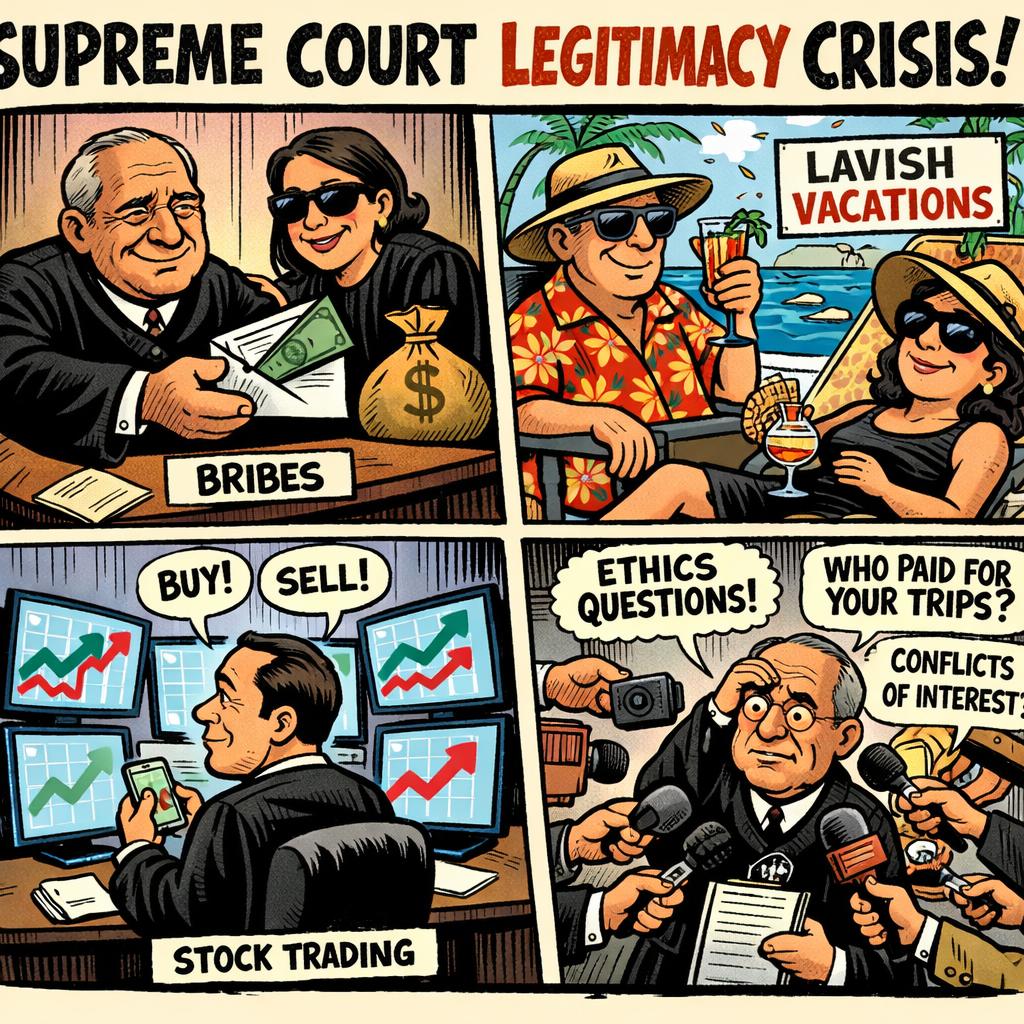
Since 2018, ethics controversies have accumulated rather than appeared in isolation. Investigative reporting has revealed extensive luxury travel, undisclosed hospitality, and financial relationships involving sitting justices. Justice Clarence Thomas has faced public scrutiny over private jet travel, resort vacations, real estate transactions, and tuition payments connected to wealthy benefactors. Justice Samuel Alito has also acknowledged publicly to accepting private air travel and exclusive recreational hospitality. These revelations have raised questions not about single incidents, but about patterns of elite patronage. The persistence of such relationships undermines claims of impartial detachment.
Other justices have also drawn attention for book deals, paid speaking engagements, and spousal income linked to politically active organizations. While many disclosures comply with existing rules, the rules themselves are permissive and inconsistently applied. The cumulative effect is a Court that appears socially embedded within the same economic and political class that frequently benefits from its rulings. This perception matters even in the absence of provable influence. Public confidence depends on distance as much as intent. The Court has failed to maintain that distance.
Self-regulation has proven inadequate. The 2023 Code of Conduct adopted by the Court is explicitly nonbinding and lacks enforcement mechanisms. There is no independent authority empowered to investigate complaints or compel compliance. Recusal decisions are left entirely to individual justices, even in cases involving personal or familial conflicts. This arrangement would be unacceptable in nearly any other branch of government. It reinforces the perception that the Court operates above the rules it applies to others.
IV. Counterarguments Against the Corruption Label
Defenders of the Court emphasize the absence of proven criminal conduct. No justice has been charged with bribery or shown to have exchanged votes for financial gain. From this view, corruption claims exaggerate ethical lapses into criminal accusations. Critics are accused of confusing disagreement with misconduct. Judicial independence, they argue, requires insulation from populist pressure. Aggressive rhetoric risks politicizing the judiciary further.
Historical context is also invoked. For much of American history, justices socialized with elites and accepted forms of hospitality now viewed with suspicion. The argument suggests that norms have shifted faster than behavior. What appears scandalous today may once have been unremarkable. This perspective frames the controversy as cultural rather than ethical. It implies that expectations, not conduct, are the problem.
Others point to ideological consistency. Many controversial rulings align with judicial philosophies articulated long before appointment. Originalist and deregulatory outcomes might stem from genuine convictions rather than being influenced by external factors. Comparisons to Congress and the executive branch further complicate the critique. Legislators routinely face ethics scandals involving insider trading and campaign finance abuses. Against that backdrop, the Court appears restrained. These arguments caution against diluting the meaning of corruption.
V. Structural and Institutional Drivers
Structural features help explain why these controversies persist. Life tenure combined with near-impossibility of removal sharply reduces accountability. Once confirmed, justices face few external constraints. Public criticism carries limited consequences. This insulation was designed to protect independence, but it may now shield misconduct.
The appointment process has also transformed the Court. Since the late twentieth century, confirmations have become ideologically rigid and strategically engineered. Judicial nominees are selected for reliability rather than open-mindedness. This politicization incentivizes long-term movement loyalty. The Court becomes a vehicle for durable partisan outcomes rather than a neutral arbiter.
Elite legal networks reinforce these dynamics. A narrow pipeline of law schools, clerkships, and firms dominates access to the Court. This homogeneity fosters shared worldviews and social alignment with economic elites. Congressional oversight after confirmation remains weak. Together, these factors create a self-reinforcing system with limited corrective mechanisms. Legitimacy erodes as accountability disappears.
VI. Public Opinion and Democratic Consequences
Public trust in the Supreme Court has declined dramatically since the 1990s. Survey data from major polling institutions show confidence at historic lows by the mid 2020s. The decline accelerated after highly visible ethics controversies and polarizing rulings. Trust is no longer assumed across ideological lines. The Court has become another contested political institution.
The decline is partisan but not symmetrical. Democratic identifiers and independents report steep losses in confidence. Republican trust has fluctuated, often tracking favorable outcomes rather than institutional principles. This asymmetry undermines the Court’s claim to neutrality. An institution trusted only when it delivers desired outcomes cannot sustain democratic legitimacy. Ethics scandals intensify this perception by personalizing institutional failure.
Sustained legitimacy erosion carries long-term risks. Compliance with rulings depends partly on perceived fairness. Political retaliation becomes more likely as norms weaken. In extreme cases, constitutional stability itself can be threatened. The Court’s authority ultimately rests on public acceptance. That acceptance may no longer be secure.
VII. Robert Reich’s Reform Agenda
Robert Reich has emerged as a prominent advocate for Supreme Court reform. Drawing on his experience as a former cabinet official and public intellectual, Reich argues that legitimacy cannot be restored through rhetoric alone. Structural change, he contends, is necessary. His critique focuses on accountability rather than ideology. Reform is presented as a democratic necessity.
Central to Reich’s agenda is an enforceable ethics code. Unlike the current aspirational framework, this code may include independent enforcement, mandatory disclosure, and binding recusal standards. The goal is to eliminate conflicts of interest and restore public confidence. Reich argues that higher courts should face higher standards, not fewer. Transparency and enforcement are essential.
Reich also supports term limits, typically proposing eighteen-year terms. Regular turnover would normalize appointments and reduce lifetime power accumulation. Court expansion is more controversial but remains part of his framework. He argues it may be necessary to counter perceived partisan capture and has been used in the past. While critics warn of escalation, Reich emphasizes urgency. Delay, he argues, exacerbates dysfunction.
VIII. Evaluating Reform Options
Minimalist reforms offer the most immediate path forward. Enforceable ethics rules and improved disclosure enjoy broad public support. They address visible legitimacy deficits without altering constitutional structure. These reforms carry low institutional risk. However, they may be insufficient if deeper problems persist.
Moderate reforms include independent ethics commissions, binding recusal standards, and term limits. These proposals face legal and political hurdles but offer meaningful accountability gains. They aim to rebalance independence with responsibility. Their feasibility depends on congressional will and public pressure. Incremental change may accumulate over time.
Radical reforms such as court expansion or constitutional amendment promise deeper transformation. They also carry greater risk of political escalation. Feasibility depends on electoral alignment and sustained mobilization. In the current environment, moderate reform appears most realistic. Yet legitimacy erosion may eventually force more dramatic action.
Thanks for reading The Brooks Brief Substack! This post is public so feel free to share it.
IX. Conclusion
The Supreme Court is not corrupt in the narrow sense of proven criminal bribery. However, it exhibits troubling patterns that fit broader definitions of institutional corruption. These patterns involve conflicts of interest, elite capture, and weak accountability. Reasonable observers may be justified in questioning the Court’s integrity.
The deeper issue is compatibility with modern democratic expectations. A judiciary that wields enormous power must demonstrate impartiality and accountability. Legitimacy cannot be demanded; it must be earned. The current system may fall short of that standard.
The most serious corruption may not lie in individual misconduct, but in what the system permits and protects. Until those structural flaws are addressed, the legitimacy crisis will persist. The future of judicial authority may not depend on whether reform follows scrutiny, but rather, whether these perceived unfair rulings will withstand the test of time or become the proverbial rejected cornerstone.
Leave a Reply