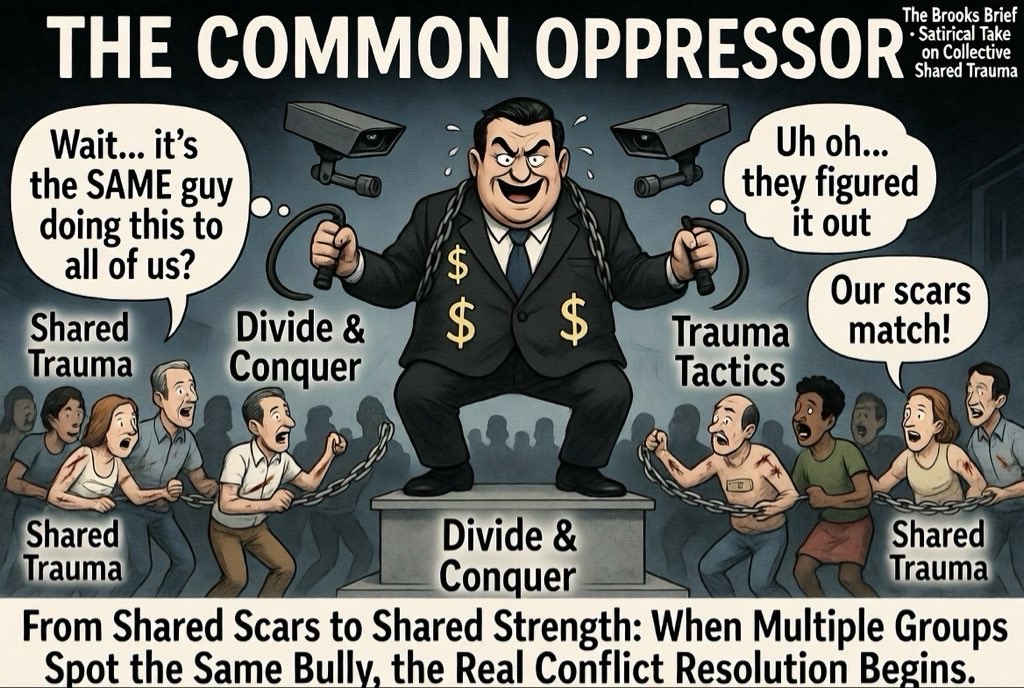
Leveraging Collective Shared Trauma for Conflict Resolution
Executive Summary
Trauma shapes not only individuals but entire societies. When experienced within a single group, it often reinforces internal divisions, heightens suspicion, and perpetuates cycles of violence. By contrast, a phenomenon we term collective shared trauma occurs when multiple, historically distinct groups experience harm from the same source. This shared suffering creates a structural opportunity for coalition-building and coordinated action against the oppressor.
Policymakers and peacebuilders can leverage collective shared trauma to break cycles of conflict. By mapping common perpetrators, facilitating cross-group dialogue, and converting shared pain into collaborative strategy, societies can turn victimhood into political and social power. Empirical evidence shows that movements unified by a common oppressor are more likely to achieve systemic change than groups confined by single-group trauma. This brief presents the theoretical foundation, comparative analysis, and actionable recommendations for operationalizing this concept in contemporary conflict environments.
Collective shared trauma reframes suffering as strategic leverage. By moving beyond isolated grievances, decision-makers can cultivate inter-group solidarity, enhance legitimacy, and drive durable, evidence-based conflict resolution. The following sections provide analysis and guidance for translating this concept into practical policy interventions.
I. Single-Group Shared Trauma and Internal Fragmentation
Shared trauma within a single society emerges when groups experience catastrophic events, including war, genocide, systemic oppression, or economic collapse. These experiences create strong internal bonds through memory, cultural narratives, and social institutions. While these bonds may foster resilience, they often turn inward, generating factionalism, mistrust, and competition among subgroups.
Psychologically, single-group trauma produces hypervigilance, rigid identity boundaries, and an “us versus them” orientation. Social manifestations include scapegoating, purges, and leadership struggles that weaken governance and cohesion. Without an external focal point, the energy generated by trauma is trapped within the society, amplifying internal conflict rather than enabling constructive reform. Historical examples include post-civil-war societies where internal divisions persisted for decades and marginalized communities targeting smaller subgroups rather than addressing systemic inequities.
From a conflict-resolution perspective, single-group trauma presents a significant barrier. Traditional interventions such as cease-fires, truth commissions, or economic assistance often address symptoms rather than the structural trauma that fuels division. Understanding the dynamics of single-group trauma is essential for designing more effective interventions that prevent societies from reproducing cycles of violence.
II. Collective Shared Trauma: A Mechanism for Cross-Group Solidarity
Collective shared trauma arises when multiple groups experience oppression from the same actor, which may include states, corporations, or ideological regimes. This shared experience creates an external focal point that reduces inward-directed conflict. Unlike single-group trauma, collective shared trauma generates recognition across groups that the same strategies of harm—such as surveillance, exploitation, or cultural suppression—were deployed against all of them.
This recognition produces a cognitive and social shift. Empathy develops across traditional boundaries, and narratives evolve from “my people suffered” to “we were targeted together.” The presence of a common oppressor creates a unique opportunity for strategic coordination. Diverse groups contribute complementary strengths, including organizational capacity, moral authority, and transnational networks, producing coalitions that can effect systemic change.
Importantly, collective shared trauma does not guarantee immediate unity. It is the combination of shared suffering, recognition, and deliberate policy or mediation interventions that transforms potential division into effective collaboration. Empirical studies of anti-colonial and transnational movements demonstrate that when disparate groups coordinate against a common oppressor, the probability of achieving structural reforms increases substantially.
III. Comparative Analysis: Single-Group versus Collective Shared Trauma
The distinction between single-group and collective shared trauma can be summarized along four dimensions:
- Focus of Energy: Single-group trauma often channels energy inward toward infighting or scapegoating. Collective shared trauma channels energy outward against a common source of oppression.
- Group Dynamics: Single-group trauma reinforces hierarchy and exclusivity. Collective shared trauma promotes alliance-building and cross-group cooperation.
- Conflict Outcomes: Single-group trauma frequently perpetuates cycles of violence. Collective shared trauma enables coordinated resistance and systemic reform.
- Resolution Potential: Single-group trauma is self-reinforcing and difficult to resolve. Collective shared trauma can catalyze large-scale political and social change.
Historical and contemporary evidence supports this distinction. Anti-colonial coalitions in Africa and Asia during the twentieth century succeeded because disparate ethnic and regional groups identified a single imperial power as the source of oppression. Modern analogs include transnational coalitions opposing authoritarian surveillance states, cross-border labor movements, and advocacy networks addressing global corporate exploitation. In each instance, the recognition of a shared oppressor allowed isolated grievances to converge into coordinated action.
IV. Policy Recommendations for Operationalizing Collective Shared Trauma
Policymakers and conflict-resolution practitioners can leverage collective shared trauma as a high-impact intervention. The following framework is recommended:
1. Map the Common Oppressor: Identify whether multiple parties are suffering from the same actor. Conduct independent assessments and publish multilateral reports to accelerate cross-group recognition. Clear identification of shared perpetrators provides a strategic focal point for coalition-building.
2. Facilitate Cross-Group Dialogue: Create neutral forums, including track-II diplomacy or civil society platforms, where groups can share experiences without competing for victim status. Highlight parallel tactics of harm to foster empathy and encourage joint strategy development.
3. Reframe Narratives: Support media, cultural, and educational initiatives that frame collective suffering as a call for solidarity. Train bridge leaders to articulate narratives that unify groups around the shared source of oppression.
4. Incentivize Coalitions: Condition international aid, sanctions relief, or diplomatic recognition on demonstrated inter-group cooperation. Conversely, actively counter divide-and-conquer strategies used by oppressors.
5. Integrate Healing into Governance: Post-liberation reconstruction should address both pre-existing trauma and potential intra-coalition tensions. Joint reconstruction projects, truth-and-reconciliation initiatives, and public acknowledgment of collective agency accelerate long-term stability.
V. Implementation Considerations and Limitations
While collective shared trauma is a powerful tool, policymakers must recognize limitations. Coalition-building requires careful management of existing rivalries, historical grievances, and unequal power dynamics within and across groups. External actors must maintain neutrality and credibility to facilitate trust. The success of interventions depends on timing, the presence of credible leadership, and the ability to convert recognition into tangible political and social coordination.
Evidence from past interventions demonstrates that mismanaged or poorly framed initiatives can backfire, reinforcing existing divisions or creating new ones. Accordingly, training in trauma-informed policy, cross-cultural negotiation, and coalition management is essential for practitioners seeking to operationalize this framework. Long-term monitoring and adaptive strategies are required to maintain coalition cohesion and prevent the resurgence of internal conflict.
Thanks for reading The Brooks Brief Substack! This post is public so feel free to share it.
VI. Conclusion: Turning Trauma into Political Capital
Single-group trauma often confines societies to cycles of internal conflict, limiting the potential for structural reform. Collective shared trauma offers a mechanism for transcending these limitations by uniting groups against a common oppressor. Recognition of shared harm, combined with deliberate policy interventions, enables coordinated resistance, strengthens legitimacy, and catalyzes systemic change.
The Brooks Brief urges governments, international organizations, and NGOs to incorporate collective shared trauma into their conflict-resolution strategies. By identifying common perpetrators, facilitating dialogue, and nurturing cross-group solidarity, decision-makers can transform past suffering into political leverage for sustainable peace. In a global context of hybrid threats, proxy wars, and transnational authoritarianism, this approach is both pragmatic and evidence-based.
Collective shared trauma, when properly understood and operationalized, becomes not a limitation but a strategic asset. It offers a pathway from managing conflict to resolving its root causes, empowering diverse societies to emerge stronger, more unified, and resilient in the face of systemic oppression.
Leave a Reply