War, Sovereignty, and the Evolution of Global Governance
Introduction: Global Order After Global War
Global governance develops when sovereign nations recognize that certain problems cannot be contained within national borders. Wars, pandemics, environmental disasters, economic crises, mass migration, and advanced weapons can affect countries far removed from where the original problem began. Yet every attempt to create collective authority encounters the same political question: who has the legitimate jurisdiction to make decisions for multiple sovereign nations? The answer has changed as wars have destroyed old political orders and victorious coalitions have constructed new ones. The League of Nations, the United Nations, and a proposed Global Council can therefore be understood as successive stages in the continuing evolution of global governance.
The League of Nations arose from the devastation of World War I, while the United Nations emerged from the greater destruction of World War II. Each institution attempted to correct the failures of the system that preceded it. The League tried to replace unrestricted power politics with collective security, but it lacked the participation and enforcement mechanisms necessary to defend its principles. The United Nations created stronger enforcement tools, broader membership, and a Security Council dominated by the principal Allied victors. Its structure consequently reflects both a commitment to international cooperation and the distribution of power that existed in 1945.
Thanks for reading The Brooks Brief Substack! This post is public so feel free to share it.
A future war over global jurisdiction could once again expose the inability of an existing international collective to defend itself or enforce its rules. If the old order were defeated, the victorious power or coalition would possess considerable de facto authority, meaning power exercised in practice. However, victory alone would not create a legitimate right to govern the world. A new collective would need to transform postwar power into lawful authority through sovereign consent, regional representation, human-rights protections, and institutional accountability. Above this political hierarchy, Christian theology introduces another category of authority by identifying God as the Sovereign of sovereigns, whose claimed jurisdiction does not originate from any human election, treaty, or military alliance.
I. The League of Nations and the First Modern Collective
Before World War I, international politics largely operated through alliances, empires, military competition, and shifting balances of power. Sovereign governments negotiated treaties, but no permanent organization possessed broad responsibility for maintaining international peace. Alliances intended to discourage war sometimes produced the opposite result by connecting local disputes to larger military obligations. When conflict began in 1914, mobilization plans and alliance commitments helped transform a regional crisis into a world war. The devastation produced political demand for a more organized international system.
The League of Nations represented the first major attempt to create a permanent collective-security organization. Established through the postwar settlement associated with the Treaty of Versailles, it sought to promote cooperation, arbitration, disarmament, and peaceful dispute resolution. Its underlying principle was that aggression against one country should concern the broader community of nations. This was a major development in political thought because peace was no longer treated exclusively as the private responsibility of individual governments. International stability was becoming a collective political interest.
The League achieved limited successes in humanitarian work and the resolution of smaller disputes, but its security structure remained weak. It possessed no standing military force and depended on member governments to enforce its decisions. Important decisions often required unanimity, allowing national disagreements to produce institutional paralysis. The United States never joined, while Japan, Germany, and Italy eventually withdrew as they pursued aggressive policies. The League therefore lacked both the universal participation and practical power necessary to restrain states determined to overturn the existing order.
II. The Collapse of Collective Security
The crises of the 1930s revealed the difference between declaring a rule and possessing the authority to enforce it. Japan expanded into Manchuria, Italy invaded Ethiopia, and Nazi Germany rejected important restrictions imposed by the postwar settlement. The League could investigate, debate, and condemn aggression, but it could not compel the major powers to undertake the risks necessary to reverse it. Limited sanctions failed to create sufficient deterrence because governments continued placing their immediate interests above their collective commitments. Aggressive states learned that the international community’s stated principles were stronger than its willingness to defend them.
The League’s failure was not simply the result of an imperfect organizational chart. Collective security requires governments to accept real economic and military costs when another member is threatened. The League’s members frequently wanted the benefits of international order without assuming the burdens necessary to maintain it. As enforcement became less credible, withdrawal and defiance became more attractive. The organization continued to exist formally, but its practical authority steadily disappeared. It could not protect vulnerable members because it could not protect the political order upon which its own relevance depended.
World War II demonstrated that a collective which cannot defend its rules may eventually be displaced by force. The Axis powers were not merely seeking individual territorial adjustments but were attempting to create imperial orders built around their own authority. The Allied victory prevented those projects from becoming the foundation of the next international system. It also placed the victorious coalition in a position to write the rules of the postwar order. The League formally dissolved in 1946, after briefly coexisting with the newly established United Nations. United Nations Geneva records that transition and the final transfer of the League’s assets and responsibilities.
III. The United Nations and the Authority of the Victors
The United Nations was established through a Charter signed in June 1945 as World War II approached its conclusion. The Charter created a more comprehensive organization dedicated to international peace, sovereign equality, human rights, social progress, and cooperation. Unlike the League, the new organization included the United States and the other principal powers of the victorious coalition. Its legitimacy came from a multilateral treaty, but its institutional structure also reflected the outcome of the war. The new global order was therefore constructed through both sovereign agreement and the practical authority held by the victors.
The Security Council became the executive center of the new collective-security system. The United States, United Kingdom, Soviet Union, France, and China received permanent membership and the ability to block substantive resolutions. This arrangement was unequal, but it was intended to keep the strongest powers inside the organization rather than outside or openly hostile to it. The UN Charter gives the Security Council primary responsibility for international peace and security, while Chapter VII permits sanctions and other enforcement measures. These powers made the United Nations structurally stronger than the League, even though enforcement continued to depend heavily on member governments. The Charter defines the Council’s responsibilities and powers in Articles 24 through 26.
The UN also developed peacekeeping as an important instrument for monitoring ceasefires, separating forces, protecting civilians, and supporting political transitions. Peacekeeping is not expressly established as a distinct system in the Charter, but it evolved through institutional practice. The Security Council can also authorize force when nonmilitary measures have proven inadequate, although the UN does not possess a permanent conventional army under its exclusive command. Every substantial mission consequently depends on political authorization and contributions from participating countries. The United Nations describes both the evolved legal basis of peacekeeping and the enforcement options available under Chapter VII.
IV. Power, Victory, and Legitimate Jurisdiction
A victorious military coalition possesses the practical ability to dismantle hostile institutions, occupy territory, impose conditions, and sponsor a replacement government. This is de facto authority because it describes control that exists as a matter of political reality. Such control can determine who participates in negotiations and which proposals become part of a new settlement. It can also prevent a defeated institution from protecting itself against the victor. Nevertheless, the ability to impose a system should not be confused with a legitimate right to govern every sovereign nation.
This distinction becomes especially important during a war over global jurisdiction. Such a war would concern more than borders, resources, or individual security disputes. Its participants would also be contesting who possesses the authority to establish and enforce the international order. If the existing collective were defeated, its laws might remain written on paper while losing their practical restraining power. The victorious coalition could then construct a new system, but that opportunity would not automatically make it the lawful government of humanity.
Military victory may decide who survives a war, but consent must help determine who governs after it. A new system established exclusively by the victor risks becoming an empire disguised as a collective. Lasting global authority requires the meaningful participation of defeated, neutral, nonaligned, small, and developing states. It must also distinguish the political power to compel obedience from the legal and moral authority to command it. A postwar institution will remain unstable if it merely freezes one generation’s military dominance into permanent privilege.
V. From International Jurisdiction to Global Jurisdiction
International authority and global authority should not be treated as identical concepts. Two sovereign nations can create an international relationship, while a large military alliance can create an international institution. Neither necessarily possesses the legitimacy to speak for the overwhelming majority of the world. Genuine Global Jurisdiction would require a much broader foundation than ordinary alliance politics. It would have to arise from the voluntary cooperation of sovereign nations rather than the unilateral declaration of a dominant state.
The Global Jurisdiction Doctrine developed in “Beyond Sovereignty” proposes an 85 percent participation threshold. Under this standard, Global Jurisdiction would exist when at least 85 percent of the world’s sovereign nations voluntarily unite within a common federation or legal framework. The threshold is intentionally difficult because an institution claiming worldwide authority should require more legitimacy than an ordinary majority. The authority would belong collectively to the participating sovereign nations, not inherently to one president, judge, secretary-general, commander, or bureaucracy. No participating state would individually own the global federation or the nations outside it.
This proposal also establishes a Principle of Least Necessary Global Authority. Jurisdiction should rise only as high as the problem legitimately requires, leaving domestic matters under national authority whenever possible. A trade disagreement between two governments may remain bilateral, while a regional security problem may be handled by the affected countries and their regional institutions. A pandemic, world war, catastrophic environmental threat, or global financial collapse may require authority at a much higher level. Global Jurisdiction should fill genuine political gaps without becoming an excuse for unnecessary centralized control.
VI. Establishing a Representative Global Council
A Global Council could translate the consent of sovereign nations into an accountable decision-making structure. One proposal would organize representation through six initial regional unions: Africa, Asia, Europe, the Middle East, North America, and South America. Each regional union would select two representatives, creating a 12-member council. Additional consideration would be needed for the Caribbean, Pacific island states, and nations whose identities or interests do not fit neatly within one regional category. The objective should be meaningful representation rather than forcing the world’s political diversity into an inflexible map.
Each representative could require the approval of at least 70 percent of the sovereign nations within the represented region. Representatives would serve two-year terms and would have to maintain at least a 45 percent regional approval rating. A representative falling below that standard could be recalled and replaced through a vote within the regional union. These rules would make council members accountable to multiple sovereign governments rather than to a single dominant country. They would also prevent regional offices from becoming permanent possessions of particular states.
Regional representation would organize the council, while the 85 percent global threshold would provide the foundation for Global Jurisdiction. A council could not legitimately claim worldwide authority merely because six regions were nominally represented. The federation would still need the voluntary participation of at least 85 percent of sovereign nations. Major decisions involving force, membership, protected rights, or changes to the governing charter should require broader approval beyond the 12 council representatives. This division would combine an efficient executive body with the continuing sovereign authority of the wider membership.
VII. Diplomacy, War, and Collective Enforcement
The first responsibility of a legitimate global institution should be preserving communication. A declaration of war, substantial preemptive strike, or qualifying interstate conflict should automatically trigger a Meeting of Nations. The meeting should occur as soon as reasonably possible and no later than seven calendar days after hostilities begin. No individual government should possess unilateral authority to prevent the international community from assembling. When governments choose war, the world’s political institutions should not be permitted to choose silence.
The meeting should hear the claims of each party without presuming that diplomacy is a trial whose verdict has already been determined. Independent evidence should be examined alongside official statements, intelligence assessments, verified imagery, humanitarian reports, and applicable legal arguments. The immediate agenda should address civilian protection, ceasefire possibilities, displacement, prisoners, food, medicine, and the danger of regional escalation. The process should follow a defined sequence: notification, communication, diplomacy, assessment, mediation, and proportional response. This order allows defensive action when necessary without permitting fear or political convenience to replace investigation.
Enforcement should also proceed through graduated measures. The council could begin with investigation, mediation, public findings, and negotiated settlement before considering targeted sanctions, peacekeeping, or collective force. Military action should require strong evidence, broad authorization, and a clearly defined objective. No victorious nation should receive a permanent unilateral veto merely because it possessed superior power during the previous war. A new collective must be capable of defending itself without becoming the permanent instrument of the coalition that created it.
VIII. God as the Sovereign of Sovereigns
Political jurisdiction flows upward from people, governments, treaties, recognition, and sovereign consent. Divine jurisdiction, within religious theology, rests on a fundamentally different claim. God is not presented as receiving authority from an election, constitution, military victory, or federation of nations. Scripture identifies God as the “God of gods and Lord of lords,” language that places divine authority above subordinate rulers and political institutions. Deuteronomy 10:17 presents this title as ancient theological authority rather than authority delegated by a human government.
God can therefore be described in political-theological language as the Sovereign of sovereigns. Kings, presidents, councils, and nations exercise limited authority within particular places and historical periods, while God’s sovereignty is understood as original and universal. The biblical title “Lord of Heaven’s Armies” similarly portrays divine command as existing beyond the military forces organized by earthly governments. Joshua 5 describes a commander of the Lord’s army whose allegiance is not reduced to the political interests of either human side. That passage places the army of the Lord under a sacred command that stands apart from ordinary national alignment.
Revelation later presents heavenly armies accompanying the figure called King of kings and Lord of lords. Within Christian eschatology, these titles existed before modern states and do not depend on recognition by the United Nations or a Global Council. God would therefore occupy the theological ceiling of the jurisdictional hierarchy, above national, international, global, planetary, interplanetary, and galactic institutions. This is a theological proposition rather than a rule presently administered by international courts. Revelation 19 connects heavenly armies with the title King of kings and Lord of lords.
IX. Divine Ownership, Planetary Visitation, and National Stewardship
Christian theology also challenges the idea that governments possess absolute ownership of the planet. Psalm 24 states that the Earth, everything within it, and its inhabitants belong to the Lord. Under this belief, national borders divide political responsibilities among human governments without dividing God’s ultimate creation into territory beyond divine jurisdiction. Governments may regulate entry by people, organizations, and other governments, but they cannot place theological limits on the Creator’s presence. Psalm 24:1 provides the scriptural foundation for understanding the world as belonging ultimately to God.
Within that theological framework, the true God would not need a visa, treaty invitation, landing permit, or council resolution to enter a planet already within divine jurisdiction. The claim follows from ownership and sovereignty rather than from a diplomatic exception granted by a state. A national government cannot logically grant the Creator permission to enter what the Creator already owns. If life exists on other worlds, the same reasoning would extend divine sovereignty beyond Earth because national jurisdiction cannot restrict a universal Creator to one planet. Planetary and interplanetary governments would remain subordinate jurisdictions within creation rather than independent authorities over God.
The proposal that nations should lease land when they have moved far from God can be understood as a covenantal or stewardship principle. Governments would not possess the Earth absolutely but would hold territory in trust, with obligations to protect life, administer justice, preserve resources, and respect human dignity. A lease-like model emphasizes that political control is temporary and conditional, while divine ownership is permanent. Nations that abandon justice or misuse creation would be violating the moral conditions of their stewardship, even when their conduct remains lawful under their own statutes. This theological lease should not be confused with an existing commercial contract or used by private individuals to seize property, demand payment, cross borders, or initiate violence without lawful authority.
X. Limits on Both Global and Religious Power
A 75 percent population in the federation would possess extraordinary political influence, which makes enforceable limitations essential. Global Jurisdiction should never authorize governments to eliminate fundamental human rights simply because enough states voted together. People are not the property of their governments, and minority rights cannot depend entirely on majority convenience. Independent review, transparent procedures, due process, and written limits on authority should be built into the new charter. Global power must answer to rights even when it claims to act for most of humanity.
The same distinction is necessary when theological beliefs enter political life. A religion may teach that God possesses supreme authority, owns creation, commands heavenly armies, and can appear anywhere within divine jurisdiction. Human governments should protect the freedom to hold, express, teach, and practice those beliefs peacefully. However, a human claim of divine appointment does not automatically become self-executing authority under domestic or international law. Religious conviction alone cannot authorize a person to confiscate land, command public forces, ignore borders, or deprive other people of their rights.
This boundary does not place human government above God within Christian theology. It recognizes that political institutions cannot conclusively verify divine status or administer unlimited powers on the basis of competing personal claims. The most defensible political arrangement protects religious exercise while requiring coercive actions by human beings to remain subject to evidence, due process, and law. In this way, theological sovereignty and civil jurisdiction can be discussed without converting faith into unchecked personal power. A Global Council should respect spiritual belief while preventing governments or individuals from weaponizing divine language against the rights of others.
The Brooks Brief Substack is a reader-supported publication. To receive new posts and support my work, consider becoming a free or paid subscriber.
Conclusion: The Next Collective
The League of Nations established the principle of collective security but lacked the participation and enforcement power necessary to preserve it. The United Nations created a stronger system that included the major powers and authorized sanctions and collective action. Yet its Security Council still reflects the victorious coalition and political conditions of 1945. If another war destroys that order, the existing collective may become unable to protect itself from the authority exercised by the victor. Humanity would then face the difficult task of creating another international system without transforming military victory into permanent global domination.
A legitimate successor should be constructed through the voluntary consent of sovereign nations. The proposed 85 percent threshold would distinguish Global Jurisdiction from an ordinary military alliance or regional coalition. Regional representation, limited terms, recall procedures, human-rights guarantees, and the Principle of Least Necessary Global Authority would prevent excessive centralization. An automatic Meeting of Nations would require governments to communicate when war begins, while graduated enforcement would preserve the ability to respond to genuine threats. The purpose would not be to erase nations but to establish lawful collective authority where national or regional institutions are insufficient.
Above this human structure, Christian political theology recognizes God as the Sovereign of sovereigns, God of gods, Lord of lords, and Lord of Heaven’s Armies. Under that belief, Earth belongs ultimately to God, nations govern as temporary stewards, and no planetary institution can grant or deny the Creator permission to enter creation. Nations far from divine principles can be understood as occupying their territories under a lease-like moral obligation to justice, stewardship, and human dignity. That theological claim remains distinct from the positive law governing human conduct, property, borders, and international relations. Power may determine who wins a war, but consent, rights, accountability, and respect for higher moral authority must determine the legitimacy of the peace that follows.
Causes of the Iran-Israel-United States Conflict and Paths Beyond Heavy-Handed Failure
I. Introduction
The conflict linking Iran, Israel, and the United States is best understood as a long strategic rivalry rather than a morality play with one innocent side and one uniquely aggressive side. Each government acts from a different combination of regime security, ideology, military doctrine, domestic politics, and competition for influence across the Middle East. Iran claims it seeks to deter threats to the Islamic Republic while projecting power through missiles, partners, and armed movements. Israel claims it seeks to prevent hostile forces from acquiring the capacity to impose catastrophic harm and to preserve freedom of action against nearby threats. The United States claims it seeks to defend Israel and other partners, protect commerce and military access, and prevent nuclear proliferation. These objectives collide because measures that appear defensive to one actor often appear offensive and potentially existential to another.
Sustainable de-escalation requires reciprocal restraint, credible deterrence, nuclear verification, and regional balance. It cannot rest on regime-change ambitions or permanent unilateral dominance.
American policy has repeatedly favored coercion because sanctions, military deployments, covert action, and threats of force promise visible leverage without requiring trust. Yet coercion has often generated high costs while delivering partial, temporary, or reversible gains. Pressure can damage an adversary’s capabilities, but it can also deepen nationalist resistance, reward hardliners, and reduce the political space for compromise. When Washington announces maximal goals and later settles for narrower outcomes, allies question its judgment while rivals advertise its limits. When pressure is applied without a credible diplomatic exit, the target has incentives to absorb pain, evade restrictions, and improve its deterrent. The result is frequently an unstable equilibrium in which every side claims resolve while becoming less secure.
A sustainable strategy therefore begins with the security dilemma, which occurs when one state’s effort to protect itself makes another state feel endangered. Iran’s missile forces and regional partnerships strengthen deterrence from Tehran’s perspective, but they increase Israeli and American fears of encirclement and surprise attack. Israeli preventive strikes and American force deployments reassure partners, but they reinforce Iranian expectations of regime change and preemption. Nuclear policy intensifies this problem because Washington demands strict limits on Iran while maintaining and modernizing a vast arsenal, and while accepting Israel’s policy of nuclear opacity. Durable de-escalation will require active listening, calibrated deterrence, reciprocal restraints, reliable verification, compromise and regional balancing instead of fantasies of unilateral dominance. The appropriate measure of success is not ideological transformation in Tehran, but a lower risk of war, nuclear breakout, proxy attack, and strategic exhaustion.
II. Core Causes of the Conflict
The first cause is a historical rupture that continues to shape threat perception on both sides. The United States helped remove Prime Minister Mohammad Mossadegh in 1953, an intervention that became a durable symbol of foreign manipulation in Iranian political memory. The 1979 Islamic Revolution then overthrew the American-backed shah, replaced the monarchy with a revolutionary theocracy, and produced the embassy hostage crisis that traumatized the United States. During the Iran-Iraq War, American policy tilted toward Baghdad even as Iraq employed chemical weapons and attacked Iranian forces and cities. Washington later constructed a broad sanctions architecture and designated Iran a state sponsor of terrorism in 1984. These events do not excuse later Iranian conduct, but they help explain why Iranian leaders interpret American pressure through a regime-survival lens.
The second cause is the Israeli-Iranian struggle over regional order and the future of the Palestinian question. Iranian leaders have repeatedly used eliminationist rhetoric toward Israel and have rejected the legitimacy of the Israeli state, even when particular translations or formulations are disputed. Tehran has provided varying forms of money, weapons, training, political support, or technology to Hezbollah, Hamas, Palestinian Islamic Jihad, and the Houthis. Israel views these relationships as an expanding network capable of applying pressure from Lebanon, Syria, Gaza, Iraq, Yemen, and the maritime approaches to the region. Israel has answered with intelligence operations, interdictions, assassinations attributed to it, and strikes on Iranian-linked assets in Syria and elsewhere. The unresolved Palestinian conflict magnifies every confrontation because it supplies ideology, legitimacy, recruitment, and public anger to actors far beyond the immediate battlefield.
The third cause is the growth of proxy and gray-zone warfare below the threshold of declared interstate war. Iran’s network is not a single chain of command, since partner organizations possess their own constituencies, interests, and degrees of autonomy. Even so, Iranian finance, training, weapons, and technical assistance can raise their capacity to attack states, shipping, energy infrastructure, and military installations. The United States and Israel respond through sanctions, cyber operations, targeted strikes, intelligence activity, and support for rival governments and forces. This indirect contest allows leaders to impose costs while denying responsibility or limiting escalation. It also creates dangerous ambiguity because a local commander’s action can trigger retaliation against a national sponsor that may not have ordered the original attack.
The fourth cause is Iran’s nuclear program, which functions simultaneously as an energy project, a symbol of technological sovereignty, a bargaining asset, and a potential threshold deterrent. Iran has enriched uranium far beyond ordinary civilian power-reactor requirements (along with Israel and America) and has accumulated knowledge that cannot be erased by bombing or sanctions. The IAEA has also reported unresolved safeguards questions, monitoring gaps, and losses of continuity in its knowledge of parts of the program. Israel’s doctrine rejects an Iranian nuclear weapon and favors preventive action if diplomacy appears unable to preserve sufficient warning time. American administrations have varied between negotiated constraints and demands approaching zero enrichment, but neither posture has eliminated the underlying capability. As breakout time shrinks, every actor faces stronger incentives to strike first, disperse assets, harden facilities, or move closer to a weapon option.
The fifth cause lies in domestic politics, ideology, economics, and great-power competition. Hardline factions in Tehran use external threats to justify repression, military budgets, and the authority of the Islamic Revolutionary Guard Corps. Israeli leaders operate under powerful public expectations that existential threats must be prevented before they mature. American politicians often face greater punishment for appearing weak than for adopting coercive policies whose costs emerge years later. Oil prices, sanctions enforcement, shipping risk, and access to energy markets give regional conflict consequences for distant economies. Chinese purchases and diplomacy, along with Russian military and political cooperation with Iran, reduce Western leverage and connect the rivalry to a wider contest over international order. A settlement must therefore survive not only strategic mistrust abroad, but also political actors at home who benefit from confrontation.
III. The Nuclear Double Standard and Its Consequences
The nuclear dispute contains a genuine legitimacy problem that cannot be solved by repeating legal obligations alone. The United States is a recognized nuclear weapon state under the Nuclear Non-Proliferation Treaty and retains a sophisticated triad while funding extensive modernization. Israel remains outside the treaty, neither confirming nor denying an arsenal that independent institutions widely assess it to possess. Iran is a non-nuclear weapon state party to the treaty and is therefore subject to safeguards and a legal prohibition against acquiring nuclear weapons. These statuses are not legally identical, but the distribution of privilege is politically conspicuous. From Tehran and much of the Global South, rules that preserve some arsenals while permanently restricting others can look less like universal law than managed hierarchy.
That perception has strategic consequences even when Iran is clearly responsible for meeting its safeguards commitments. Iranian hardliners point to American interventions, threats of regime change, and the fates of vulnerable governments as evidence that military weakness invites attack. They also point to the security enjoyed by nuclear-armed states as proof that deterrence, rather than legal restraint, protects sovereignty. American modernization and Israel’s opacity make it easier for these factions to portray enrichment as a national right and a necessary insurance policy. Outside pressure can then strengthen the very coalition most willing to reduce cooperation with inspectors or expand nuclear leverage. Expecting permanent Iranian nuclear inferiority under recurring threat is unlikely to produce a stable bargain without credible benefits and security assurances.
Apparently, acknowledging a double standard does not require accepting an Iranian bomb or abandoning the non-proliferation regime. It does require recognizing that sustainable restraint must be reciprocal in political terms, even when it cannot be equal in military terms. The United States can defend strict limits on Iranian enrichment while also supporting regional talks on missile notification, nuclear safety, crisis communication, and a future zone free of weapons of mass destruction. Washington can also demonstrate seriousness about its own treaty obligations through arms-control efforts, risk reduction, and greater transparency where security permits. Israel cannot be compelled quickly to surrender nuclear opacity, but its exceptional status should be openly included in regional threat discussions rather than treated as irrelevant. Legitimacy will improve when non-proliferation is presented as shared risk management instead of a demand that only weaker states accept vulnerability.
IV. The Pattern and Costs of American Heavy-Handed Approaches
American history offers repeated warnings about the difference between military capacity and political control. During the War of 1812, unsuccessful American campaigns in British North America were followed by British retaliation that included the burning of the Capitol and other public buildings in Washington. The conflict eventually ended through the Treaty of Ghent without the decisive conquest imagined by some expansionists. This episode should not be forced into a modern Middle Eastern analogy, but it illustrates how offensive ambition can expose unexpected vulnerability. Powerful states can win battles while misjudging an adversary’s endurance, external support, or capacity for retaliation. Strategic humility begins with the recognition that escalation is interactive rather than administered by one side.
Vietnam demonstrated the same principle on a vastly larger and more tragic scale. The United States deployed enormous conventional power, inflicted severe losses, and won many tactical engagements, yet it could not produce a durable political order at an acceptable cost. The war killed more than 58,000 American service members, devastated Vietnamese society, and intensified division inside the United States. The Tet Offensive was a military setback for communist forces, but it undermined official claims that victory was near and weakened domestic support for continued escalation. The 1973 settlement enabled American withdrawal, while the supported South Vietnamese state fell in 1975. The central lesson is not that force never works, but that battlefield superiority cannot repair an unrealistic political objective.
Afghanistan reinforced the danger of converting a limited security mission into open-ended state transformation. The initial intervention disrupted al-Qaeda and removed the Taliban government, but the mission expanded into counterinsurgency, institution building, security-force development, and national political reconstruction. The United States spent about 141 billion dollars on reconstruction alone by early 2021, in addition to much larger military expenditures. Oversight agencies repeatedly identified corruption, weak sustainability, distorted incentives, and institutions dependent on foreign money and technical support. When international forces withdrew in 2021, the supported government collapsed rapidly and the Taliban returned to power. Two decades of effort produced real gains for many Afghans, but the final political outcome exposed the gap between resources committed and institutions made durable.
The broader pattern is visible in sanctions maximalism, regime-change rhetoric, and unilateral military action. Comprehensive pressure can reduce revenue and restrict procurement, but it can also shift commerce toward opaque networks, burden civilians, raise costs for allies, and create profitable opportunities for rival powers. Public threats that are not carried out damage credibility, while threats that are carried out can begin conflicts whose political end state remains undefined. Partners become less cohesive when they bear energy, migration, or security costs without meaningful influence over strategy. Rivals such as China and Russia gain opportunities to present themselves as alternative markets, arms suppliers, diplomatic protectors, or defenders of sovereignty. American power is strongest when military and economic tools serve achievable political goals, not when punishment becomes a substitute for strategy.
V. Recommendations for Resolution or Sustainable Management
First, nuclear policy should move from zero-enrichment maximalism toward verifiable constraints that lengthen warning time and make violations visible. The Obama administration’s previous treaty with Iran, known as the “Iran Nuclear Deal,” was terminated by the Trump administration. A workable package could cap enrichment levels and stockpiles, restrict advanced centrifuge deployment, restore intrusive monitoring, and establish clear procedures for resolving access disputes. Sanctions relief should proceed in phases after verified compliance, with predefined pauses or reversals if Iran breaches agreed limits. Sunset provisions should trigger renegotiation before restrictions expire rather than allowing a sudden transition from constraint to uncertainty. Missile testing and transfers to armed groups should enter parallel negotiations so that the nuclear agreement is not expected to solve every regional problem by itself. The objective is not trust, but a monitored structure in which cheating is harder, detection is faster, and compliance produces tangible value.
Second, the parties need a security and de-escalation architecture that addresses fear of invasion, surprise attack, and uncontrolled retaliation. The United States should offer conditional assurances that it does not seek to invade Iran or forcibly change its government, provided Iran observes nuclear limits and restrains attacks on American personnel and partners. Such assurances would not prevent self-defense, but they would narrow the circumstances in which regime-change fears can justify escalation. Quiet channels involving the United States, Israel, Iran, and trusted intermediaries should establish red lines and procedures for urgent communication. Naval hotlines and incident protocols in the Gulf and Red Sea could reduce the risk that harassment, misidentification, or a local strike produces a regional war. Security guarantees become credible when they are reciprocal, specific, monitored, and linked to consequences rather than offered as vague declarations.
Third, Washington should pursue regional balance rather than permanent dominance by any single bloc. Arab-Israeli normalization can improve trade, technology, and defense cooperation, but it should not be designed as an encirclement project that gives Iran stronger incentives to sabotage the process. Saudi-Iranian dialogue and intra-Gulf diplomacy should be encouraged because direct communication can reduce miscalculation even when strategic rivalry persists. Regional states can negotiate practical measures on pilgrimage, maritime safety, energy infrastructure, prisoners, and noninterference without first resolving every ideological dispute. Policymakers should also avoid describing every armed organization as a puppet, since local actors have domestic interests that can create both danger and negotiating opportunities. A stable balance accepts plural influence while denying any actor a low-cost path to regional coercion.
Fourth, pressure should be targeted, reversible, and connected to specific behavioral demands. The United States should maintain missile defense, protect freedom of navigation, interdict clearly documented weapons transfers, and preserve the capacity to respond to direct attacks. Sanctions should focus on proliferation networks, illicit finance, hostage taking, and material support for attacks rather than treating ordinary commerce as indistinguishable from military activity. Humanitarian and civilian trade channels should be broad enough to reduce needless harm and demonstrate that policy is aimed at conduct rather than collective punishment. Every major sanction should have a stated purpose, a review date, measurable indicators, and a defined route to suspension. This design would replace the cycle of maximal demands and incomplete enforcement with pressure that can be adjusted as behavior changes.
Fifth, American strategy must reflect domestic, fiscal, and alliance constraints. Public tolerance for another open-ended Middle Eastern occupation or nation-building campaign is low after Vietnam, Iraq, and Afghanistan. The United States should therefore define narrow priorities as preventing nuclear weaponization, protecting navigation, defending personnel and allies, and limiting major transfers that enable regional war. European states can contribute diplomacy, trade incentives, verification support, and sanctions coordination, while Asian partners can reinforce energy security and commercial compliance. Regional partners should carry greater responsibility for conventional defense while receiving support that improves interoperability and reduces incentives for preventive war. A coalition built around limited objectives will be more durable than one organized around the promise of transforming Iran’s political system.
Sixth, the ideological contest should be treated as a long-term competition rather than a deadline for collapse. The Islamic Republic’s revolutionary identity is deeply institutionalized and will not disappear simply because external pressure increases. American policy should expand access to information, education, communications technology, and lawful economic exchange that benefits Iranian society without dictating its political future. Diplomatic engagement should not require approval of repression, hostage taking, anti-Israeli incitement, or support for armed groups. Instead, engagement should separate opposition to specific conduct from the belief that war can engineer liberalization. The most effective ideological advantage for the United States will come from demonstrating that its alliances deliver security and prosperity while its diplomacy leaves room for sovereignty and peaceful change.
Seventh, deescalation can only happen when all parties are willing to meet and listen to each other’s grievances at the highest level to resolve some “shared trauma.” Diplomats can spend years negotiating, but their efforts will be futile if the country’s “decision maker” only reviews progress reports without engaging directly with the negotiators. The country’s leader may not be fully informed about the situation, which could lead to the conflict persisting unnecessarily. Political pressure at home is more likely to end the conflict than negotiations with foreign leaders when all the involved leaders are uninterested in resolving the conflict for personal or political reasons.
VI. Conclusion
The Iran-Israel-United States conflict is rooted in structural rivalry, shared trauma, incompatible regional projects, and mutually reinforcing fears. Iran’s missiles and armed partnerships threaten Israel and American interests, while Israeli strikes and American coercion reinforce Iran’s expectation that only hard power can preserve the regime. The nuclear program compresses decision time and gives every crisis an existential dimension. Domestic hardliners benefit from this environment because confrontation validates their warnings and weakens advocates of compromise. No single agreement can erase these causes, and no military campaign can permanently destroy the knowledge, ideology, and political grievances that reproduce them. Effective policy must therefore manage conflict while gradually changing the incentives that sustain it.
American heavy-handedness has often mistaken punishment for a political theory of victory. The War of 1812, Vietnam, and Afghanistan differ profoundly, yet each warns that material superiority does not guarantee control over escalation, legitimacy, or institutional endurance. Maximum pressure can create leverage, but leverage expires when the target adapts, partners defect, or domestic support erodes. Regime-change ambitions are especially dangerous because they invite resistance without specifying a credible successor order. A strategy of calibrated deterrence and negotiated restraint is less emotionally satisfying than dominance, but it is better aligned with finite resources and uncertain power. Prudence is not appeasement when it is backed by defense, verification, and enforceable consequences.
The strongest path forward combines nuclear realism, reciprocal security measures, regional balancing, targeted pressure, alliance coordination, and long-term ideological competition. It also acknowledges that the nuclear order appears hypocritical when established powers modernize their arsenals while demanding permanent abstinence from threatened rivals. Legal distinctions remain important, but legitimacy requires established nuclear states to demonstrate restraint and responsibility as they enforce non-proliferation. Success should be measured through fewer attacks, longer nuclear warning time, protected shipping, resilient partnerships, and reduced demands on American lives and resources. Failure should be recognized when policy produces repeated escalation without durable behavioral change. The goal is not to make Iran, Israel, and the United States trust one another, but to build a system in which their distrust is less likely to produce catastrophe.
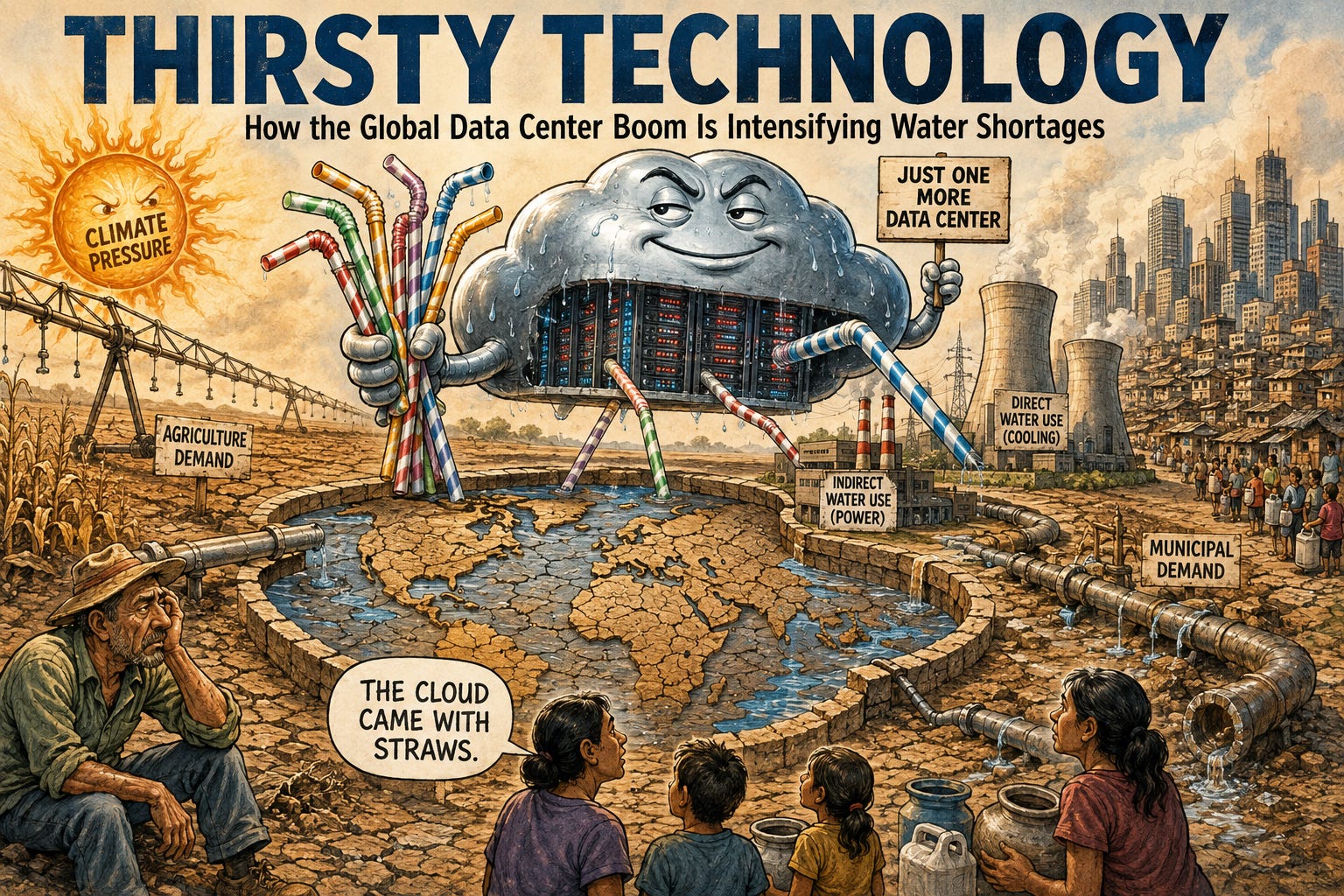
How the Global Data Center Boom Is Intensifying Water Shortages
Executive Summary
The global expansion of artificial intelligence, cloud computing, streaming services, and digital commerce is creating an unprecedented demand for data centers. These facilities depend on thousands of servers that generate heat continuously and must be cooled to prevent equipment failure. Many data centers use large quantities of water directly for cooling and indirectly through the power plants that generate their electricity. This demand is emerging while approximately four billion people experience severe water scarcity during at least one month of the year. The central policy question is therefore not whether societies should use data centers, but how governments can prevent digital growth from undermining water security.
Data centers are not the principal cause of the global water crisis. Agriculture accounts for approximately 72 percent of worldwide water withdrawals, while municipalities and industries account for most of the remainder. Climate change, population growth, pollution, deteriorating infrastructure, and groundwater depletion also contribute substantially to water insecurity. Nevertheless, data centers can intensify shortages because their demand is concentrated in particular cities, watersheds, and utility districts. A facility representing a small share of national water consumption may still become one of the largest industrial users in its local community.
Governments should require facility-level disclosure, independent water-impact assessments, drought contingency plans, and meaningful public participation before approving large data centers. Operators should be encouraged or required to use recycled wastewater, closed-loop cooling, captured rainwater, or other non-potable sources whenever technically practical. Public officials must also evaluate the combined demand of every proposed facility within the same watershed instead of reviewing each project in isolation. Companies receiving tax incentives should pay the infrastructure and environmental costs associated with their operations rather than transferring those costs to households. These protections can support technological development without treating limited freshwater supplies as an unrestricted corporate resource.
I. The Physical Infrastructure Behind the Digital Economy
The popular image of digital technology is misleadingly weightless. Terms such as cloud storage suggest that information exists somewhere above society, disconnected from physical land, energy, and water. In reality, the cloud consists of warehouses filled with servers, networking equipment, backup generators, cooling systems, and electrical infrastructure. Every artificial intelligence request, financial transaction, streamed movie, government database, and social media post depends on this physical system. The expansion of digital services therefore carries environmental consequences that are easily hidden from consumers.
Servers convert much of the electricity they consume into heat. Excessive heat can damage processors, interrupt services, shorten equipment life, and create fire or safety risks. Data centers consequently require cooling systems that operate throughout the day, often regardless of whether the surrounding community is experiencing drought. Some facilities rely heavily on air cooling, while others use cooling towers in which water absorbs heat and evaporates. Evaporative systems can reduce electricity consumption, but they may consume substantial quantities of water that are not immediately returned to the local supply.
The scale of this infrastructure is growing rapidly because artificial intelligence requires especially powerful computing systems. The International Energy Agency projects that global data center electricity consumption will rise from about 485 terawatt-hours in 2025 to approximately 950 terawatt-hours in 2030. Electricity consumption by AI-focused data centers is expected to triple during that period. Efficiency improvements will reduce the energy required for some individual computing tasks, but total consumption may continue rising as companies deploy more processors and consumers use more AI services. This rebound effect demonstrates why greater technical efficiency does not automatically produce lower overall resource consumption. International Energy Agency
II. Understanding the Data Center Water Footprint
The water footprint of a data center begins with the water used at the facility itself. Cooling towers commonly transfer heat from computer equipment into water and release some of that water into the atmosphere through evaporation. Additional water may be needed to control mineral accumulation, clean equipment, maintain humidity, or replace water discharged from the cooling system. Operators may withdraw this water from municipal systems, rivers, reservoirs, aquifers, or reclaimed-water networks. Facilities supplied by municipal utilities may receive treated drinking water even when cooling does not require water of drinking quality.
A proper assessment must distinguish between water withdrawal and water consumption. Withdrawal refers to the total volume taken from a river, aquifer, reservoir, or municipal system. Consumption refers to the portion that evaporates or is otherwise unavailable for immediate reuse within the original watershed. A facility can withdraw a large volume while returning much of it, or it can withdraw less while consuming a high percentage through evaporation. Communities need both measurements because withdrawals affect infrastructure capacity while consumption affects the amount of water remaining for other users.
Data centers also have an indirect water footprint through electricity generation. Coal, natural-gas, and nuclear power plants frequently use water to produce steam or cool generating equipment. A data center using little water on-site may therefore be responsible for significant water consumption elsewhere through its power supply. Semiconductor fabrication, construction, equipment manufacturing, and backup power production add further demands that are not always included in operational statistics. Policymakers should examine the entire water and energy system instead of judging a facility solely by the pipes entering its property.
III. A Growing Demand Within an Existing Global Crisis
Data center expansion is occurring within a much larger crisis of water scarcity and unequal access. Approximately four billion people experience severe water scarcity during at least one month each year, according to UN-Water. The 2026 United Nations World Water Development Report also states that 2.1 billion people still lack safely managed drinking water. Climate change is making rainfall less predictable while intensifying droughts, floods, heat waves, and the loss of mountain glaciers. These pressures make new industrial water demands more consequential than they might have been under historically stable conditions. UN-Water, United Nations World Water Development Report 2026
It would be inaccurate to blame data centers for worldwide water shortages as though they were the dominant global user. Agriculture accounts for approximately 72 percent of water withdrawals, compared with about 16 percent for municipalities and 12 percent for industries. Inefficient irrigation, aging water systems, pollution, population growth, and unsustainable groundwater extraction remain central causes of scarcity. However, global percentages can obscure the impact of a large facility on a small or already stressed watershed. Water policy must therefore consider both the worldwide distribution of demand and the local concentration of consumption.
The United States illustrates the difference between national and local effects. Data centers directly consumed an estimated 17.4 billion gallons of water in 2023, according to research summarized by the Missouri Science and Technology Policy Initiative. Annual direct consumption could increase to between 38 billion and 73 billion gallons by 2028, depending on computing growth and cooling technology. Those totals remain modest compared with national agricultural consumption, but the demand is not distributed evenly across the country. A cluster of facilities can become a major local burden when it depends on the same municipal system, aquifer, or drought-sensitive river. Missouri Science and Technology Policy Initiative
IV. Geography Determines the Severity of the Risk
The water impact of a data center depends heavily on where it is built. A facility using reclaimed water in a cool, water-secure region presents a different risk from an identical facility using potable water in an arid metropolitan area. Temperature, humidity, electricity sources, cooling technology, seasonal demand, and watershed conditions all affect the final footprint. Annual totals can also conceal the problem of peak demand during the hottest months, when cooling requirements and household water use may rise simultaneously. Location should therefore be treated as a central component of data center efficiency rather than a secondary business consideration.
The rapid development of facilities in the American Southwest demonstrates this concern. Arizona, Nevada, and parts of Texas combine growing populations, high temperatures, recurring drought, and expanding industrial demand. The World Resources Institute reported in 2026 that approximately two-thirds of United States data centers built or under development since 2022 were located in water-stressed areas. Communities in these regions must balance residential growth, agricultural production, tribal water rights, ecosystem preservation, and industrial investment. Approving additional facilities without cumulative analysis can commit water that may not remain reliably available throughout their operating lives. World Resources Institute
Similar conflicts are developing outside the United States. Community opposition in Chile pushed Google to reconsider a water-intensive cooling design while the Santiago region faced prolonged drought. European countries seeking investment must weigh their ambitions to become digital hubs against heat and water stress, particularly in southern Europe. India, China, and Southeast Asian countries face the combined pressures of urbanization, groundwater depletion, industrialization, and growing digital demand. Middle Eastern facilities may rely on desalination, which can provide water but requires energy and produces concentrated brine that must be managed responsibly.
V. Economic Benefits and Unequal Community Costs
Data centers provide real economic and social benefits. They support communications, banking, medical research, government services, education, entertainment, and the growing artificial intelligence industry. Construction can generate substantial temporary employment, while operating facilities create technical, maintenance, security, and administrative jobs. Local governments may also receive tax revenue or infrastructure investment from technology companies. A serious policy analysis must recognize these benefits rather than treating every data center as inherently harmful.
The distribution of those benefits, however, may not match the distribution of the costs. Data centers can receive tax abatements, discounted land, expedited permits, or specially negotiated utility arrangements in exchange for locating within a jurisdiction. Municipalities may then need to expand water-treatment plants, electrical substations, transmission lines, pipelines, wells, or wastewater systems. If contracts do not assign these expenses clearly, households and small businesses may help finance infrastructure built primarily for corporate customers. The public may also bear long-term environmental risks after short-term construction activity has ended.
The employment argument deserves particular scrutiny because modern data centers are highly automated. A multibillion-dollar campus may create thousands of construction jobs but employ a comparatively small permanent workforce once operations begin. Governments should therefore calculate the number, quality, duration, and local availability of jobs before awarding public subsidies. They should also compare data center development with alternative uses of the same land, power, and water. Economic development becomes difficult to justify when the public assumes the costs while corporate owners retain most of the gains.
VI. Transparency Is the First Policy Requirement
Effective water governance is impossible without reliable information. Some companies disclose company-wide water consumption while providing limited information about individual facilities. Global totals do not tell residents how much water is being withdrawn from their aquifer or municipal system. Companies may also use different definitions, reporting periods, and accounting boundaries, making direct comparisons difficult. Mandatory and standardized facility-level disclosure would allow governments and communities to evaluate the actual risks.
Every large data center should report annual and seasonal water withdrawals, consumption, discharge, sources, cooling methods, and Water Usage Effectiveness. Water Usage Effectiveness measures the amount of water used relative to the electricity consumed by computing equipment. This measurement is useful, but it should not be treated as a complete sustainability rating. A highly efficient facility can still consume enormous volumes if it operates at a very large scale. Reports should therefore provide both efficiency ratios and absolute volumes.
Corporate water-replenishment commitments also require closer examination. A company may fund wetlands, leak repairs, conservation programs, or watershed restoration in an effort to replace the water associated with its operations. These projects can produce genuine benefits, but replenishing water in one place does not necessarily repair the shortage created somewhere else. Timing also matters because water restored during a wet season may not compensate for heavy consumption during a summer drought. Governments should require replenishment within the affected watershed whenever possible and verify claims through independent audits.
VII. Governing the Water and Energy Tradeoff
Reducing direct water use can sometimes increase electricity consumption. Dry cooling and conventional air conditioning may conserve water but require more power, particularly during extreme heat. If that electricity comes from water-intensive or carbon-intensive generation, the facility may shift rather than eliminate its environmental burden. Conversely, evaporative cooling can reduce electricity use while consuming more local water. Policymakers must evaluate both resources together instead of maximizing one efficiency measurement at the expense of the other.
The appropriate solution will differ by climate and region. Facilities in cool environments may rely more heavily on outside air, while those in arid regions may use closed-loop liquid cooling or reclaimed wastewater. Immersion systems place computing equipment in specialized fluids that absorb heat efficiently and can reduce reliance on evaporative cooling. Advanced controls can also adjust cooling according to temperature, humidity, workload, and electricity conditions. No single technology will solve the problem in every location, but governments can require operators to demonstrate that they selected the least harmful practical system.
Electricity procurement is equally important. Wind and solar photovoltaic generation generally have lower operational water requirements than thermal power plants, although manufacturing and supply chains still carry environmental costs. Data centers can also schedule flexible computing tasks for periods when renewable electricity and water are more available. Waste heat may be captured for district heating or nearby industrial uses in suitable climates. Integrated planning can turn water, energy, and heat from separate problems into a coordinated infrastructure strategy.
VIII. A Policy Framework for Water-Secure Digital Development
The first policy priority should be water-sensitive siting. Governments should require independent assessments of present supply, future population growth, climate conditions, drought probability, agricultural demand, ecosystem requirements, and tribal or Indigenous water rights. Applications should disclose expected water consumption under normal operations, heat waves, equipment failures, and maximum computing capacity. Facilities using potable water should face heightened scrutiny in regions classified as highly or extremely water-stressed. Projects that cannot demonstrate a reliable and equitable supply should be redesigned, relocated, or rejected.
The second priority should be establishing a clear hierarchy of water use. Drinking, sanitation, public health, emergency response, and basic ecosystem protection should take precedence over discretionary industrial consumption. Data centers should use treated wastewater, captured stormwater, recycled cooling water, or other non-potable sources whenever those alternatives are safe and practical. Operators should also maintain drought plans that automatically reduce water use when reservoirs, rivers, or aquifers fall below established thresholds. These rules would provide certainty to companies while protecting communities from emergency competition.
The third priority should be assigning costs to the parties creating them. Data center operators should pay for the additional water, wastewater, and electrical infrastructure their facilities require. Tax incentives should be conditioned on independently verified employment, efficiency, transparency, and community benefits. Residential customers should not face higher rates because utilities underestimated corporate demand or negotiated inadequate service agreements. Public officials should publish contracts, impact studies, tax concessions, and water allocations before granting final approval.
IX. From Individual Permits to Watershed Governance
The traditional permitting process often evaluates one proposed facility at a time. This approach can underestimate the combined burden created when several companies build within the same region. Ten individually acceptable projects may collectively exceed the sustainable capacity of a municipal system or aquifer. Governments should therefore establish watershed-level budgets that account for every existing and proposed user. Those budgets must be updated as climate conditions, population, and industrial demand change.
Regional coordination is particularly important when water crosses political boundaries. Rivers and aquifers frequently serve multiple cities, states, provinces, tribal nations, or countries. One jurisdiction may approve a facility and receive its tax revenue while communities downstream experience reduced supply or environmental damage. Shared water commissions should have the authority to review large industrial projects with cross-border effects. Data center development should not become a method for one government to capture economic benefits while exporting resource costs to its neighbors.
Public participation must also occur before decisions become effectively irreversible. Residents should receive understandable information about anticipated water use, infrastructure costs, employment, tax incentives, and drought risks. Hearings should provide meaningful opportunities to change or reject proposals rather than merely satisfy procedural requirements. Indigenous communities and other groups with established water rights must be included as governing participants, not consulted only after plans have been developed. Democratic oversight is essential because water allocation determines which communities and economic activities will be protected during future shortages.
X. Conclusion: Deciding What Water Is For
The rise of data centers does not create the global water crisis by itself. Agricultural demand, climate change, population growth, pollution, weak infrastructure, and unsustainable extraction remain larger drivers in many regions. Data centers nevertheless represent one of the fastest-growing sources of concentrated industrial demand. Their expansion is occurring precisely when many governments are struggling to guarantee water for households, farms, and ecosystems. Ignoring this additional pressure would be both economically shortsighted and environmentally irresponsible.
The proper response is not to reject artificial intelligence or dismantle the digital economy. Governments should instead require technology companies to build in appropriate locations, disclose their water footprints, use the safest available sources, and finance the infrastructure they need. Companies must also evaluate absolute consumption rather than relying exclusively on efficiency improvements. A facility that uses less water per computation may still increase total demand if its workload expands rapidly. Sustainable digital development requires firm public standards rather than voluntary promises alone.
Water policy ultimately reflects political priorities. A community deciding whether to approve a data center is also deciding how much water should remain available for residents, food production, economic development, and the natural environment. Those choices should be made openly, with reliable evidence and enforceable protections. Artificial intelligence may operate in the cloud, but the infrastructure supporting it remains firmly rooted in physical communities. Every digital service has a material cost, and the water required to sustain it must come from somewhere on Earth.
United Nations Educational, Scientific and Cultural Organization. (2026). The United Nations world water development report 2026: Water for all people: Equal rights and opportunities. https://unesdoc.unesco.org/ark:/48223/pf0000397159
Rethinking Sovereignty, International Authority, Human Rights, Conflict Resolution, and Humanity’s Preparation for First Contact
I. The Jurisdiction Problem
Before discussing global authority, international institutions, or reforming the United Nations, we first have to answer a simpler question: Who has the legal authority to do what? That question involves jurisdiction. In simple terms, jurisdiction is the authority to make decisions, apply laws, or address particular people, places, and issues. A city may have jurisdiction over local matters. A state or province may have authority over broader regional matters. A sovereign nation possesses authority over national affairs. The question becomes more complicated when an issue crosses national borders.
The modern world is organized primarily around sovereign nations. Sovereignty means that a nation possesses the authority to govern itself rather than being governed by another country. The United States governs the United States. France governs France. Kenya governs Kenya. These nations can cooperate, enter treaties, join international organizations, and accept international obligations, but their sovereignty remains a foundation of the present international system.
Some problems, however, cannot be contained within one nation’s borders. War between two countries immediately involves more than one sovereign government. A contagious disease can spread across borders. Pollution can travel through air and water. Economic instability can affect interconnected markets. Refugees can flee from one country into another. Natural disasters can require assistance from multiple nations. Climate change can affect countries far removed from the original source of emissions.
These situations create what this article calls the jurisdiction problem. If one nation should not govern another sovereign nation, but some problems cannot be solved by one nation acting alone, where should the necessary authority come from? Existing international organizations provide part of the answer, but they do not completely resolve the question of when international cooperation becomes legitimate global authority.
A second problem is language. An agreement between two nations is international. An organization consisting of twenty nations is international. A military alliance involving dozens of governments is international. Yet none of those groups necessarily represents the world. Something can therefore be international without being genuinely global.
This article proposes that international political theory should recognize that distinction. International Jurisdiction and Global Jurisdiction should not mean the same thing.
II. A Hierarchy of Jurisdiction
Jurisdiction can be understood as a series of expanding levels of authority. For purposes of the theory proposed in this article, that hierarchy can be represented as:
Local → State/Provincial → National → International → Global → Planetary → Interplanetary → Galactic → Divine
Not every level in this hierarchy currently exists as recognized law. Local, state, national, and various forms of international jurisdiction already exist in recognizable forms. Global Jurisdiction, as defined in this article, is a proposed doctrine. Planetary, interplanetary, and galactic jurisdiction are prospective concepts designed to consider circumstances humanity may encounter in the future. Divine Jurisdiction belongs primarily to philosophical and theological analysis.
The basic idea is nevertheless straightforward. Authority should generally correspond to the level at which a problem legitimately exists. A broken traffic light does not require the United Nations. A disagreement between two national governments ordinarily does not require a city council. Different institutions exist because different problems exist at different political levels.
Higher jurisdiction should therefore not automatically replace lower jurisdiction. Instead, the higher level should become relevant when the issue legitimately exceeds the authority or practical ability of the level beneath it.
This produces one of the central principles of the proposed framework:
Jurisdiction should rise only as high as the problem legitimately requires.
III. National and International Jurisdiction
A sovereign nation possesses National Jurisdiction over matters legitimately belonging to that nation. National governments make laws, conduct foreign policy, protect their territory, regulate economic activity, maintain institutions, and perform many other functions necessary to govern their populations.
International Jurisdiction begins when the relevant matter materially involves more than one sovereign nation. If two countries negotiate a treaty, resolve a border disagreement, manage a shared river, engage in armed conflict, or cooperate against a cross-border threat, the issue has an international dimension.
International Jurisdiction does not necessarily mean that another government suddenly gains control over the countries involved. International authority can take many forms, including treaties, negotiations, arbitration, mediation, international courts where jurisdiction has been established, regional organizations, and multinational agreements.
The distinction is important because international does not mean global.
Two sovereign nations can create an international issue.
Twenty sovereign nations can create an international organization.
Even a large alliance can remain international without possessing legitimate authority to speak for the overwhelming majority of the world.
Put simply:
Two nations constitute an international relationship. Two nations do not constitute the world.
IV. The Global Jurisdiction Doctrine
This article proposes a new category called Global Jurisdiction (GJ).
Global Jurisdiction would exist when at least 85 percent of the world’s sovereign nations voluntarily unite within a common federation or legal framework. The 85 percent requirement is intentionally difficult to achieve. Authority claiming to represent the world should require substantially more legitimacy than an ordinary majority vote.
Global Jurisdiction would belong collectively to the sovereign nations participating in the federation. It would not inherently belong to a secretary-general, court, military commander, administrative office, powerful country, or international bureaucracy. Those institutions could exercise powers granted to them, but the underlying authority would originate from the sovereign nations themselves.
The theory can be summarized through a simple progression:
One sovereign nation → National Jurisdiction
Two or more sovereign nations → International Jurisdiction
At least 85 percent of sovereign nations voluntarily allied → Global Jurisdiction
The central proposition is:
No nation rules the world, but an overwhelming community of sovereign nations acting together may possess limited authority that none possesses individually.
This does not mean 85 percent of governments become owners of the remaining 15 percent. Nor does it mean countries surrender every aspect of their sovereignty when the threshold is reached. Instead, the threshold establishes when a federation has enough worldwide participation to exercise what this theory recognizes as Global Jurisdiction over appropriate global matters.
Global authority should therefore increase in proportion to global consent.
V. Sovereignty Under Global Jurisdiction
Global Jurisdiction should be created from sovereignty, not through the destruction of sovereignty.
Every participating nation would remain sovereign. Countries would continue operating their governments, legal systems, elections, economies, schools, cultural institutions, and other domestic structures. Joining a global federation should not mean surrendering every decision to an institution operating above the nation.
This framework therefore proposes a Principle of Least Necessary Global Authority. The idea is simple: even when Global Jurisdiction exists, global institutions should exercise only as much authority as reasonably necessary to address the global portion of a problem.
Consider a pandemic. A global institution might legitimately coordinate international information sharing, scientific cooperation, cross-border assistance, or measures designed to prevent international spread. That does not necessarily mean the same institution should determine every local hospital policy or individual medical decision throughout the world.
The same principle can apply to environmental policy, disaster response, economic development, conflict, and other multinational problems. Global Jurisdiction should fill genuine jurisdictional gaps rather than become an excuse for unnecessary centralized control.
Sovereignty and Global Jurisdiction therefore do not have to be enemies. Properly designed, one provides the legitimacy necessary for the other.
VI. Matters Appropriate for Global Jurisdiction
Some problems are international because they involve several nations. Others can become genuinely global because their consequences, causes, or solutions affect a substantial portion of the world.
Potential areas for Global Jurisdiction could include major armed conflicts, pandemics, multinational natural disasters, climate change, large-scale environmental threats, international economic development, humanitarian emergencies, mass displacement, global infrastructure, cross-border resource problems, and other issues whose effects extend across numerous sovereign nations.
This does not mean every international disagreement automatically becomes a global matter. A trade disagreement between two countries may remain primarily bilateral. A regional security problem may be better addressed by the affected countries and their regional institutions. The existence of a global federation should not require it to control every international dispute.
Global institutions should instead ask whether the issue can reasonably be addressed at a lower jurisdictional level.
If it can, authority should remain there.
If it cannot, higher jurisdiction may become necessary.
VII. The Global Diplomatic Response Doctrine
Language influences policy. Governments that immediately describe an unfamiliar event as a “crisis” can unintentionally shape public expectations before the facts are known. Crisis language may be appropriate when lives are in immediate danger, but not every unusual international development is automatically a crisis.
This article therefore proposes a broader concept: Global Diplomatic Response.
A Global Diplomatic Response begins with communication and assessment rather than a presumption of hostility. Its normal sequence should be:
The final step is important. Diplomacy does not require governments to ignore genuine danger. If evidence demonstrates an immediate threat, defensive or emergency measures may be necessary. The doctrine simply rejects the idea that fear should automatically come before communication.
This principle can apply to ordinary international relations today as well as extraordinary situations humanity may encounter in the future.
VIII. The Meeting of Nations
War is among the clearest examples of an international problem that can rapidly become global.
This framework therefore proposes a Meeting of Nations requirement. When a sovereign nation formally declares war against another sovereign nation, launches a substantial violent preemptive strike against another nation, or begins qualifying interstate hostilities, an international diplomatic meeting should automatically follow.
That meeting should occur as soon as reasonably possible and no later than seven calendar days after the qualifying event.
Seven days should be a maximum, not a target. A dangerous conflict threatening rapid escalation may justify international consultation within hours.
The important feature is automatic diplomatic engagement. No individual nation, including a particularly powerful nation, should possess unilateral authority to prevent the international community from meeting.
When nations choose war, the international community should not have the option of choosing silence.
IX. What Happens at the Meeting of Nations?
A Meeting of Nations should not begin with the assumption that diplomacy is a trial and one side has already been convicted.
Each party should have an opportunity to explain its position. Governments should be able to present security concerns, legal arguments, evidence, grievances, proposed solutions, and conditions they believe could end the conflict.
Independent evidence should be considered whenever reasonably possible. International institutions should examine available records, verified imagery, humanitarian reporting, official documents, and other credible information rather than relying exclusively upon the claims of governments directly participating in the conflict.
The immediate diplomatic agenda should prioritize civilians. Nations should consider ceasefire possibilities, humanitarian assistance, protection of civilians, displacement, prisoners and detainees, access to food and medicine, and ways to prevent the conflict from expanding.
A Meeting of Nations does not eliminate a country’s legitimate right to defend itself. Nor does claiming self-defense automatically remove a country’s actions from international scrutiny.
The purpose is to preserve something that war frequently destroys: communication.
X. Human Rights Above Global Jurisdiction
An 85 percent alliance would be extraordinarily powerful. That makes limitations on its authority essential.
Global Jurisdiction should never possess legitimate authority to eliminate the fundamental human rights of the world’s citizens merely because a sufficiently large number of governments voted to do so.
Governments exercise political authority over people, but people are not simply property belonging to governments. Human rights exist to establish boundaries around what political authority may legitimately do to individuals.
This framework therefore proposes:
Global authority derives from sovereign nations, but fundamental human rights belong to the world’s people.
The exact process through which the world’s citizens should participate in defining those protected rights requires additional study. International conventions, national ratification, constitutional protections, representative institutions, and potentially direct democratic mechanisms could all play roles.
But the principle should remain clear: Global Jurisdiction has limits.
Even global authority must answer to rights.
XI. The Sovereign Right to Withdraw
If Global Jurisdiction derives from voluntarily cooperating sovereign nations, membership cannot become political imprisonment.
Every participating sovereign nation should retain a right to withdraw from the federation.
Withdrawal, however, should involve a diplomatic process. A nation intending to leave would first submit a written Notice of Withdrawal explaining its reasons to the federation.
The country would then receive a guaranteed one-hour Address to the Nations before its departure becomes final.
This requirement is not intended to force the country to justify its sovereignty or ask permission to leave. Instead, it ensures that the international community hears the government’s concerns before the relationship ends.
The distinction matters:
A sovereign nation does not need permission to leave. The international community should nevertheless have an obligation to listen before it leaves.
XII. The Right of Final Address
The one-hour appearance would establish what this framework calls the Right of Final Address.
A withdrawing government could explain economic disagreements, security concerns, political grievances, perceived discrimination, sovereignty disputes, institutional failures, or any other reason contributing to its departure.
This creates a final opportunity for diplomacy.
Perhaps the dispute can be mediated. Perhaps another country shares the same concern. Perhaps an unfair policy can be changed. Perhaps the disagreement cannot be resolved at all.
The outcome is less important than creating an institutional requirement that nations communicate before separation.
If diplomacy fails, the country remains free to depart.
XIII. Prospective and Theoretical Governance Beyond Earth
The principles discussed so far address circumstances that already exist. Nations fight wars. Pandemics occur. Governments withdraw from international institutions. Climate and economic problems cross borders.
The remainder of this framework tests the theory against circumstances humanity may never encounter.
These sections do not assert or presume that extraterrestrial civilizations, extraterrestrial governments, interplanetary federations, galactic federations, or previous governmental contact with such entities have been established as fact.
Instead, they constitute prospective policy planning.
Governments plan for possibilities before they happen. Emergency plans do not prove that an emergency will occur. Military planning does not prove that a war will occur. Disaster planning does not cause an earthquake or hurricane.
Likewise, humanity can ask what peaceful diplomatic rules should exist in the event intelligent life originating beyond Earth is someday independently verified or makes contact with Earth.
XIV. Who Speaks for Earth?
Imagine, purely as a policy exercise, that intelligent visitors originating beyond Earth peacefully arrive tomorrow.
Suppose they arrive in one sovereign country.
That nation would retain territorial sovereignty. Its government would have legitimate responsibilities involving public safety, diplomacy, security, scientific assessment, and the administration of its territory.
But another question immediately appears:
Does being the first country contacted give that government the right to speak for Earth?
Under this framework, the answer should be no.
The United States can speak for the United States. Brazil can speak for Brazil. India can speak for India. Nigeria can speak for Nigeria.
No individual nation becomes the government of humanity simply because a visitor arrives inside its borders.
Global Jurisdiction provides a possible solution. An institution supported by at least 85 percent of Earth’s sovereign nations would possess substantially greater legitimacy to represent participating humanity on matters genuinely affecting the planet as a whole.
XV. The First Contact Diplomatic Principle
In the event of reasonably verified contact with intelligent non-Earth life, the existence of contact itself should not automatically constitute a crisis, emergency, threat, or act of war.
The initial international presumption should be diplomatic.
That principle can be expressed simply:
Unknown does not automatically mean hostile.
A visitor should be judged according to its conduct and available evidence rather than its place of origin.
This does not require governments to ignore danger. If a visitor demonstrates hostile behavior, governments retain legitimate responsibilities to protect their populations. The principle instead prevents unfamiliarity alone from becoming evidence of aggression.
A peaceful arrival deserves a peaceful diplomatic opportunity.
XVI. The Messenger Neutrality Principle
The visitor and the visitor’s message should also be evaluated separately.
A messenger may bring good news.
A messenger may bring bad news.
A messenger may bring a warning.
A messenger may simply ask to communicate.
The substance of an unpleasant message should not automatically transform the person or entity delivering that information into an enemy.
This framework therefore proposes the Messenger Neutrality Principle:
The delivery of alarming, unfavorable, or adverse information shall not, standing alone, constitute evidence of hostile intent by the messenger.
The reverse is also true. A pleasant message should not automatically prove peaceful intent.
Evidence and conduct should guide the response.
XVII. The 24-Hour First Contact Notification Rule
Every sovereign nation is entitled to legitimate secrets. But an event potentially affecting the entire planet creates at least some responsibility to the wider international community.
This framework therefore proposes a narrow notification requirement.
In the event a sovereign nation reasonably verifies the physical arrival, visitation, or direct communication of intelligent life originating beyond Earth, that nation should notify the designated United Nations or Global Jurisdiction authority within twenty-four hours of reasonable verification.
The requirement concerns the existence of contact.
It does not automatically concern the contents of the conversation.
The contacted government could therefore satisfy the initial requirement by notifying the appropriate international institution that verified contact occurred without automatically surrendering confidential diplomatic information.
XVIII. Sovereign Confidentiality Following First Contact
First contact should not erase sovereignty.
A contacted nation should remain entitled to protect legitimate diplomatic communications, intelligence, scientific discoveries, technologies, negotiations, agreements, security information, and other lawful state secrets.
This produces another principle:
First contact creates a duty of notification, not a duty to surrender sovereign secrets.
The distinction protects both global interests and national sovereignty. Humanity has a legitimate interest in knowing that a potentially historic event has occurred. The contacted nation retains legitimate interests in protecting sensitive communications.
Confidentiality should not necessarily be absolute. If secret activity creates credible evidence of an imminent threat to other countries or humanity, a higher disclosure standard may become appropriate. Any such exception, however, should require a clearly defined legal process and strong evidence rather than mere suspicion.
XIX. Universal Rights of Intelligent Life
First contact would create another problem that is even more fundamental than jurisdiction.
Would rights end where the human species ends?
Human-rights law developed because human beings recognized that governments and other powerful institutions should not possess unlimited authority over individuals. If humanity someday encounters another form of intelligent life, we may need to determine whether the moral principles underlying those protections extend beyond human biology.
This article proposes a prospective concept called Universal Rights of Intelligent Life (URIL).
In the event intelligent non-Earth life is encountered, extraterrestrial origin alone should not justify arbitrary killing, torture, enslavement, involuntary experimentation, arbitrary imprisonment, or treatment of an intelligent being as property.
A peaceful intelligent visitor should not automatically become a laboratory specimen, prisoner, military asset, government property, or enemy simply because humanity has never encountered its species before.
The principle is:
Authority may increase with jurisdiction. Fundamental rights do not decrease with distance from Earth.
XX. Rights and Responsibilities Beyond Humanity
Rights must exist alongside responsibilities.
If intelligent non-Earth visitors someday operate within Earth’s jurisdictions, diplomacy would need to determine their legal status and responsibilities. They should be expected to respect the lives and fundamental rights of Earth’s inhabitants just as humanity should respect theirs.
Existing categories may prove inadequate. Terms such as citizen, foreign national, diplomat, refugee, ambassador, sovereign representative, or visitor were created for relationships among humans and human governments.
New legal categories might therefore become necessary.
The objective should not be to force an unfamiliar form of intelligent life into whichever existing legal category seems closest. The objective should be to determine its status through reason, evidence, diplomacy, and respect for fundamental rights.
XXI. Global and Planetary Jurisdiction Are Different
The distinction between Global Jurisdiction and Planetary Jurisdiction becomes important at this point.
Global Jurisdiction concerns the collective authority of Earth’s sovereign nations among themselves.
Planetary Jurisdiction would concern Earth’s collective political and diplomatic position in relation to a sovereign entity beyond Earth.
The existence of Planetary Jurisdiction would not necessarily transform Earth into one sovereign country. Earth’s nations could retain their sovereignty while creating a collective mechanism for matters affecting the planet as a whole.
In simple terms:
Global Jurisdiction helps nations speak with one another. Planetary Jurisdiction could help Earth speak beyond itself.
XXII. Interplanetary Jurisdiction
Suppose humanity someday establishes diplomatic relations with another sovereign civilization.
Earth would not automatically own that civilization.
That civilization would not automatically own Earth.
Legitimate authority governing their relationship would need to arise through diplomacy, treaties, mutual recognition, federation, or another consensual legal arrangement.
This framework describes that hypothetical level as Interplanetary Jurisdiction.
The principle remains the same as it was at the national level:
Jurisdiction over oneself does not automatically create jurisdiction over another sovereign.
A civilization possessing greater technology or military power may possess greater power in practical terms. But power alone should not automatically create legitimate jurisdiction.
Power and lawful authority are not necessarily the same thing.
XXIII. Galactic Jurisdiction as Political Theory
The theory can extend another level.
In the event multiple sovereign planets or civilizations someday voluntarily participate in a common political or legal federation, authority exercised across those civilizations could theoretically constitute Galactic Jurisdiction, depending upon the federation’s actual scope.
This is a political thought experiment, not a factual assertion that such a federation currently exists.
Its value lies in testing the jurisdictional principle.
A city cannot claim national authority merely because it exists within a nation.
A nation cannot claim Global Jurisdiction merely because it exists on Earth.
Earth could not legitimately claim authority over another sovereign civilization merely because humanity encountered it.
Jurisdiction should correspond to the sovereign community that legitimately created or recognized it.
XXIV. Divine Jurisdiction and the Limit of Political Authority
The final proposed level is fundamentally different from the others.
Local, state, national, international, global, planetary, interplanetary, and hypothetical galactic jurisdictions are political concepts. Their legitimacy depends in various ways upon law, sovereignty, recognition, consent, political organization, or agreements between governing communities.
Divine Jurisdiction, within religious traditions that recognize a supreme Creator, would rest upon an entirely different claim to authority.
Within such a theological framework, God’s authority would not require recognition from 85 percent of sovereign nations. It would not originate from a treaty or vote. Its claimed authority would derive from divine sovereignty itself.
Within Christian theology, questions concerning the authority of Jesus would similarly depend upon theological understandings of his identity and divine authority rather than ordinary political jurisdiction.
The distinction can therefore be summarized as:
Collective political authority flows upward through consent. Divine authority, within the theological framework, flows downward from ultimate sovereignty.
This article does not require readers to accept a particular theological belief in order to accept the political portions of Global Jurisdiction. Divine Jurisdiction instead represents the philosophical ceiling of the hierarchy being explored.
XXV. Returning the Theory to Earth
The discussion of extraterrestrial contact serves an important purpose even if humanity never encounters another intelligent civilization.
It forces us to ask what sovereignty actually means.
It forces us to distinguish power from jurisdiction.
It forces us to ask who can legitimately speak for humanity.
And it forces us to consider whether fundamental rights come from governments or whether governments are obligated to recognize rights that exist beyond governmental convenience.
Those questions already matter.
War crosses borders. Disease crosses borders. Pollution crosses borders. Climate effects cross borders. Financial instability crosses borders. Refugees cross borders. Information and technology cross borders.
Humanity therefore does not need to wait for visitors from another world to confront the jurisdiction problem.
The problem is already here.
XXVI. The Proposed Meeting of Nations Resolution
The first practical step does not require immediately creating a new world federation.
The United Nations could begin by considering a Meeting of Nations Resolution establishing a stronger expectation of automatic diplomatic engagement following major interstate hostilities.
Under the proposal, a declaration of war, substantial violent preemptive strike, or qualifying interstate armed conflict would trigger a Meeting of Nations no later than seven days after the event.
The UN could also study the broader concepts proposed in this article, including the distinction between International and Global Jurisdiction, the proposed 85 percent Global Jurisdiction threshold, sovereignty protections, the Right of Final Address, and stronger limitations protecting human rights.
Prospective planning should also be considered. In the event humanity someday verifies intelligent life beyond Earth, international institutions should not have to invent every diplomatic rule during the first hours of an unprecedented encounter.
A prospective framework could therefore examine the 24-Hour First Contact Notification Rule, Sovereign Confidentiality Principle, First Contact Diplomatic Principle, Messenger Neutrality Principle, and Universal Rights of Intelligent Life.
Some of these proposals might be possible within existing international institutions. Others could require treaties, changes to the United Nations Charter, new institutions, or an entirely new federation.
Those legal distinctions matter.
A serious proposal should distinguish what governments can do today from what would require governments to change the international system tomorrow.
Thanks for reading The Brooks Brief Substack! This post is public so feel free to share it.
Human civilization has often created rules after tragedy demonstrated why those rules were necessary.
There is another option.
We can think ahead.
Humanity does not need another world war to recognize the importance of mandatory diplomatic communication during conflict. We do not need another pandemic to recognize that some problems exceed national borders. We do not need a catastrophic climate event to understand that environmental consequences can travel beyond the governments responsible for creating them.
And humanity does not need verified extraterrestrial contact to ask what peaceful first-contact diplomacy should look like in the event such contact ever occurs.
Global Jurisdiction begins with a simple proposition: the existence of sovereign nations does not prevent sovereign nations from creating legitimate collective authority.
But that authority requires boundaries.
Sovereignty is the foundation.
Rights are the boundary.
Diplomacy is the first response.
Jurisdiction should rise only as high as the problem legitimately requires.
The objective is not to erase nations. It is to build a political framework capable of recognizing when national authority is sufficient, when international cooperation becomes necessary, and when overwhelming participation among sovereign nations may create a legitimate form of Global Jurisdiction greater than the authority any individual nation possesses alone.
If humanity someday discovers that Earth is not the only home of intelligent life, those same principles can guide us further.
We should communicate before assuming hostility.
We should protect rights before exploiting differences.
We should distinguish power from legitimate authority.
And we should establish the rules of peaceful diplomacy before the day comes when we need them.
Sovereignty, Security Dilemmas, and the Path From Enemies to Partners
Executive Summary
The greatest challenge in international diplomacy is not defeating an enemy, but determining whether yesterday’s enemy can become tomorrow’s partner. The conflict between Iran, Israel, and the United States represents more than a struggle over nuclear capabilities and regional influence. It represents a larger question about whether nations can escape cycles of fear, retaliation, and historical resentment.
The conflict between Iran, Israel, and the United States represents more than a dispute over nuclear capabilities or regional influence. It is a confrontation shaped by competing security narratives, historical grievances, and questions about sovereignty and power. Iran views external pressure as a threat to its independence, while Israel views Iran’s military development and rhetoric as a threat to its national survival. The United States presents its involvement as a matter of protecting allies and preventing nuclear proliferation, while critics argue that broader strategic and economic interests may also influence American foreign policy decisions.
A conflict resolution approach requires moving beyond the question of who is right and examining why each side believes its actions are justified. The security dilemma at the center of this conflict has created a cycle where defensive measures by one nation are interpreted as offensive threats by another. Sustainable peace requires addressing the legitimate security concerns of all parties while creating incentives for cooperation rather than continued confrontation.
History demonstrates that former enemies can become partners when nations replace cycles of retaliation with diplomacy and shared interests. The future of the Middle East may depend not only on preventing war but also on creating pathways toward economic cooperation, regional dialogue, and reconciliation. The transformation of former adversaries into trading partners represents one of the most powerful tools available for long-term peace-building.
Key Findings
1. The conflict is driven by competing security perceptions.
Iran views military development as protection against foreign intervention, while Israel and the United States view Iranian capabilities as destabilizing threats.
2. Military superiority alone cannot create lasting stability.
Without addressing underlying fears and grievances, conflicts often reappear in new forms.
3. Economic cooperation can transform relationships.
Historical enemies have often become strategic partners when trade and diplomacy replace isolation.
4. Future American foreign policy faces a strategic choice.
The United States must decide whether long-term influence comes primarily from military dominance or from building sustainable partnerships.
Introduction: A Conflict Defined by Competing Security Narratives
The conflict between Iran, Israel, and the United States represents one of the most complex geopolitical challenges of the modern era. At its core, the confrontation is not simply about nuclear weapons or military power. It is a struggle involving sovereignty, historical grievances, regional influence, and competing visions of international security. Each participant argues that its actions are defensive responses to perceived threats from the other side. Understanding this conflict requires examining the fears and motivations that drive each actor rather than focusing only on military actions.
Iran views the conflict through the lens of national sovereignty and resistance against foreign intervention. From Tehran’s perspective, outside military pressure represents an attempt to weaken its independence and influence its political system. Iran’s leaders argue that maintaining military capabilities is necessary because powerful adversaries have historically interfered in the affairs of weaker nations. This perspective is shaped by experiences of foreign intervention, sanctions, and regional conflicts. However, Iran’s opponents argue that its regional activities and support for allied armed groups create legitimate security concerns.
Israel views Iran through the lens of national survival and deterrence. Israeli leaders have repeatedly expressed concerns about Iran’s rhetoric toward Israel, its support for hostile organizations, and its expanding military capabilities. From Israel’s perspective, preventing a potential existential threat before it becomes unavoidable is a necessary security strategy. Critics argue that preventive military actions can intensify instability and make diplomatic solutions more difficult. The challenge is finding a framework where Israel’s security concerns are addressed without creating endless cycles of escalation.
Methodology and Analytical Framework
This analysis examines the Iran conflict through the combined perspectives of conflict resolution theory, international relations, and political economy. Rather than approaching the conflict solely through the question of military capability or political ideology, this framework evaluates the underlying interests, fears, and incentives that influence each actor’s decisions. The purpose of this approach is to understand why each side believes its actions are justified and identify potential pathways toward long-term stability.
The first framework applied is the concept of the security dilemma. In international relations, a security dilemma occurs when one state increases its military capabilities for defensive reasons, but other states interpret those actions as offensive threats. This dynamic can create a cycle of escalation where each side responds to fear generated by the other. The Iran, Israel, and United States relationship demonstrates this pattern because each actor views its own actions as protective while interpreting the actions of others as threatening.
The second framework is conflict resolution theory, which focuses on transforming relationships rather than simply ending violence. Conflict resolution recognizes that lasting peace requires addressing underlying grievances, building active communication channels, and creating agreements that allow competing interests to coexist. A military victory may temporarily weaken an opponent, but it does not necessarily eliminate the conditions that produced conflict. Sustainable peace requires mechanisms that reduce fear and encourage cooperation.
The final framework is international political economy, which examines how economic interests, resources, trade relationships, and global markets influence foreign policy decisions. Nations often pursue security goals alongside economic and strategic objectives. Understanding these overlapping motivations provides a more complete picture of why states make certain choices. This approach does not assume that any single explanation fully determines foreign policy but recognizes that security, economics, and political influence often interact.
Using these frameworks, this article seeks to analyze the conflict from multiple perspectives while identifying opportunities for diplomacy and reconciliation. The objective is not to declare a winner or assign simple blame, but to examine how competing interests can potentially be transformed into a foundation for negotiation and future cooperation.
The Positions of Iran, Israel, and the United States
Iran’s primary argument is that it has the right to defend its sovereignty and maintain an independent foreign policy. Iranian officials argue that military pressure from the United States and Israel justifies the development of defensive capabilities. They also argue that their nuclear program is intended for peaceful purposes, including energy and scientific development. Opponents remain concerned that nuclear capabilities could eventually be converted into military power. The disagreement centers around whether Iran’s actions represent legitimate defense or a regional threat. It is important to note that Iran was not the aggressor and sustained losses.
Israel’s position is based on preventing what it considers an unacceptable security risk. The Israeli government argues that Iran’s past statements, military expansion, and relationships with groups hostile toward Israel require a strong response. Israel believes that waiting until a threat fully develops could create consequences that are impossible to reverse. Critics of this approach argue that military action can strengthen hardline positions and reduce opportunities for negotiation. This creates a difficult balance between deterrence and diplomacy. The hard powers that Israel is using may actually harm them if a peaceful solution is offered and they do not accept.
The United States presents its involvement through the stated goals of protecting allies, preventing nuclear proliferation, and maintaining regional stability. However, critics question whether these explanations fully represent the broader strategic interests involved. The United States possesses a significant nuclear arsenal, which creates debate about how nuclear proliferation concerns are applied internationally with bias or even malicious intent at times, which can be overlooked if they fly a certain flag. Some observers argue that American involvement may also reflect interests involving global influence, economic strategy, and regional power competition. Supporters of U.S. policy argue that American involvement is primarily designed to prevent instability and protect international security.
Conflict Resolution and the Search for a Sustainable Peace
A conflict resolution approach begins by recognizing that every side believes it is responding to a threat. Iran fears foreign domination and regime instability. Israel fears attacks and potential destruction from hostile forces. The United States fears regional instability and the expansion of rival influence. These competing fears create what international relations scholars call a security dilemma. A security dilemma occurs when one nation’s attempt to increase its security causes another nation to feel less secure.
A lasting solution requires addressing the concerns of all parties rather than attempting to achieve peace through complete victory by one side. Iran would require assurances of its sovereignty, which serves as the most fundamental starting point for all sovereign nations involved. This involves addressing concerns about the security interests of all parties. Israel would require credible assurances that its population will not be subjected to threats from Iranian military capabilities or allied groups, which also involves its own sovereignty. The United States would need to balance its alliances with a broader commitment to regional stability. Diplomacy would require compromise because no nation can achieve permanent security through force alone.Diplomacy necessitates compromise, as no nation can secure its existence solely through force. A commendable suggestion would be a gesture of good faith with the United States reducing its own nuclear arsenal.
A realistic peace framework could include nuclear transparency agreements, regional security discussions, and gradual economic cooperation. Iran could receive recognition of its right to peaceful nuclear development while accepting strict international monitoring. Israel could receive security guarantees while participating in broader diplomatic arrangements. The United States could support negotiations rather than relying exclusively on military pressure. The long term goal should be creating conditions where cooperation becomes more valuable than continued conflict.
Policy Recommendations: Moving From Containment Toward Sustainable Peace
Resolving the conflict between Iran, Israel, and the United States requires a shift from policies based primarily on deterrence toward policies that also prioritize diplomacy, economic incentives, and long-term relationship building. Military power can prevent immediate threats, but it rarely addresses the underlying conditions that create conflict. A sustainable strategy must recognize that security is not achieved only through dominance, but through creating systems where nations have incentives to cooperate. The goal of diplomacy should not be surrender by one side, but the creation of agreements where competing interests can coexist.
Establish Permanent Communication “Back” Channels
One of the most important steps toward reducing the possibility of future conflict is establishing reliable communication channels between adversaries. History has shown that misunderstandings, miscalculations, and lack of communication can transform regional tensions into larger conflicts. Even nations with deep disagreements require mechanisms to clarify intentions and prevent accidental escalation. A direct communication system between Iran, Israel, the United States, and regional partners could provide an opportunity to manage crises before they become military confrontations. Diplomacy is most effective when communication exists before a crisis begins.
Create Conditional Economic Incentives for Peace
Economic cooperation can serve as a powerful tool for transforming relationships between former adversaries. Nations are less likely to return to conflict when their economies become connected through trade, investment, and shared development. A future agreement with Iran could include gradual economic normalization tied to measurable commitments involving transparency, regional security, and compliance with international agreements. This approach recognizes that economic isolation can weaken governments but may also increase suffering among civilian populations. Sustainable peace requires creating incentives for cooperation rather than relying only on punishment.
Develop a Regional Security Framework
The future stability of the Middle East cannot depend solely on decisions made by outside powers. A lasting solution requires a broader regional security framework involving Iran, Israel, Gulf states, and international partners. Such a framework could address concerns involving nuclear capabilities, missile programs, maritime security, and regional conflicts. The purpose would not be to eliminate all disagreements, but to create institutions where disputes can be managed through negotiation rather than military confrontation. Regional security requires recognizing that the stability of one nation is connected to the stability of its neighbors.
Create Pathways for Former Enemies to Become Partners
Foreign policy should include strategies for transforming hostile relationships over time. History demonstrates that former enemies can become economic partners when leaders recognize the benefits of cooperation. The United States’ relationships with former adversaries show that diplomatic recognition and economic engagement can create new strategic opportunities. A similar approach should be considered when evaluating relationships with countries such as Iran and Cuba. A nation’s future foreign policy should not be permanently defined by past conflicts.
Balance Military Strength With Diplomatic Leadership
Military capability remains an important component of national security, but military power alone cannot create lasting peace. The United States, Israel, and Iran each possess significant strategic capabilities, yet none can achieve permanent security through force alone. A balanced approach requires combining deterrence with diplomacy, economic engagement, and conflict prevention mechanisms. The strongest foreign policy strategy is not simply the ability to defeat adversaries, but the ability to prevent future wars. Leadership in international affairs requires both strength and the wisdom to know when negotiation serves national interests.
Thanks for reading The Brooks Brief Substack! This post is public so feel free to share it.
The future of international security depends on whether nations remain trapped in cycles of retaliation or develop systems that reward cooperation. Iran, Israel, and the United States have legitimate security concerns that cannot be ignored if a lasting agreement is to be achieved. However, acknowledging another nation’s concerns does not require abandoning one’s own interests. The foundation of diplomacy is recognizing that stability is possible when nations pursue security through cooperation rather than permanent confrontation. The ultimate measure of foreign policy success is not how many enemies a nation can defeat, but how many conflicts it can prevent.
Beyond War: Transforming Former Enemies Into Future Partners
History demonstrates that former enemies can become partners when political leaders decide that cooperation provides greater benefits than continued hostility. Countries that once fought devastating wars have eventually built economic partnerships and diplomatic relationships. The transformation from enemy to ally requires acknowledging past “shared trauma” while creating incentives for future cooperation. Peace is not simply the absence of violence because lasting peace requires institutions and relationships that prevent future conflict. The greatest achievement of diplomacy is turning former rivals into stakeholders in a shared future with other friendly nations.
If Iran and its opponents eventually reach a settlement, the aftermath of conflict will present a major opportunity. Trade, energy cooperation, scientific exchange, and diplomatic communication could create new incentives for stability. Economic relationships often reduce the likelihood of future conflict because nations become connected through shared interests. However, this transition requires political leaders to move beyond narratives that define opponents as permanent enemies. A lasting agreement would require courage from all sides because reconciliation often demands difficult compromises.
Cuba represents another example of how former adversaries can eventually reconsider their relationships. For decades, the United States and Cuba have maintained deep political disagreements despite geographic proximity and historical connections. The Cuban government views American policy through the history of intervention and economic pressure. The United States has viewed the Cuban government through concerns about governance, human rights, and regional influence. The future question is whether American foreign policy will continue emphasizing isolation or whether it can create pathways toward engagement when conditions allow or become desperate.
The Brooks Brief Perspective: Strategic Assessment and Reflections
Political analysis is not created in a vacuum out of nothingness. Every analyst approaches world events through a combination of education, experience, research, and personal interpretation referred to as worldview. The purpose of this section is to provide the perspective of The Brooks Brief on the broader implications of the Iran conflict while remaining grounded in conflict resolution principles and international relations analysis.
My approach to this conflict is shaped by the belief that understanding an opponent’s perspective is necessary for achieving lasting peace. Nations, like individuals, often act according to their own perceptions of survival, security, and justice. Recognizing these perspectives does not require agreement with every action taken by a government, but it does create the foundation necessary for meaningful negotiation.
The central lesson of this conflict is that military power alone cannot create permanent stability. As Thor Valiant once wisely remarked, “Winning the war merely signifies possessing superior weapons, but it does not imply that you possess superior ideals.” Security achieved through fear often produces temporary results, while security achieved through cooperation creates conditions for long-term peace. The future of international relations will depend on whether nations continue defining themselves through historical rivalries or whether they can transform former enemies into future partners.
The role of political analysis is not only to describe events but also to examine possible alternatives. A conflict resolution perspective asks a different question than traditional geopolitical analysis. Instead of asking only who has the advantage, it asks what conditions would allow competing societies to coexist. This approach provides an opportunity to move beyond cycles of retaliation and toward a framework based on diplomacy, economic cooperation, and mutual security.
Conclusion: Building a Future Beyond Permanent Conflict
The conflict between Iran, Israel, and the United States demonstrates the difficulty of resolving disputes rooted in fear, history, and competing interests. Iran seeks recognition of its sovereignty and security. Israel seeks protection from threats it considers existential to its sovereignty. The United States seeks to maintain regional stability and protect its strategic interests and/or sovereignty. These objectives often collide because each side interprets the actions of others through a lens of distrust. Overcoming this distrust is the central challenge of diplomacy.
Military strength can create temporary advantages, but it rarely creates permanent peace. Lasting stability requires negotiation, economic cooperation, and recognition that former enemies can eventually become partners. The world has witnessed nations move from war to cooperation when leaders choose diplomacy over endless confrontation. The same principle can apply in the Middle East if security concerns are addressed through balanced agreements. Peace requires transforming relationships, not simply defeating opponents.
The future of international relations will depend on whether nations continue viewing security as a competition where one side must lose for another to win. A more sustainable model recognizes that stability can be created when former rivals develop shared interests. Iran, Israel, the United States, and Cuba all demonstrate that history does not have to permanently define future relationships. Conflict resolution requires understanding opposing perspectives while building mechanisms that reduce fear. The ultimate measure of leadership is not the ability to win wars, but the ability to create a peace that lasts.
How Unequal Protection Shapes Political Loyalty, Institutional Trust, and Collective Stability
Executive Summary
Political scientists have long examined why individuals join collective institutions despite the limitations those institutions place on personal freedom. The Herd Cohesion Principle argued that individuals willingly sacrifice some autonomy because membership within a collective provides greater security, stability, and opportunity than complete independence. This relationship between freedom and security helps explain the behavior of governments, political parties, social movements, corporations, and international alliances. Yet the existence of collective protection does not necessarily imply that every member receives equal protection. An important question therefore remains unanswered. How does unequal treatment within a collective influence the willingness of individuals to remain loyal to that collective?
The Differential Protection Principle seeks to answer this question by extending the theoretical framework established by the Herd Cohesion Principle. It proposes that collectives often distribute protection unevenly among their members based on perceived conformity, identity, status, usefulness, or political alignment. Members who believe they receive less protection than others gradually lose confidence in the collective and become more willing to leave, resist, or seek alternative communities. Rather than viewing cohesion as a uniform force, this principle recognizes that cohesion depends upon the perceived fairness of how collective benefits are allocated. When unequal protection becomes widespread, the stability of the collective itself may begin to erode.
This principle is not intended as a criticism of collective organization. Every organization must prioritize finite resources, and perfect equality of treatment is rarely achievable. Instead, the Differential Protection Principle offers a framework for examining how disparities in protection influence political behavior, institutional trust, and organizational resilience. The principle complements rather than replaces the Herd Cohesion Principle by examining a dimension of collective behavior that the original theory intentionally left unexplored. Together, the two principles provide a broader explanation for both why individuals enter collective systems and why they sometimes choose to leave them.
Theoretical Foundation
The Differential Protection Principle can be formally stated as follows: the more unequally a collective distributes protection among its members, the greater the likelihood that marginalized members will disengage from, resist, or abandon the collective. Protection extends beyond physical safety and includes legal protection, political representation, economic opportunity, institutional support, and social acceptance. Individuals constantly evaluate whether the benefits they receive justify the obligations required by membership. When those benefits appear unequal, perceptions of injustice begin to influence individual decision making. The result is a gradual weakening of the psychological bonds that sustain collective cohesion.
This principle builds directly upon the Herd Cohesion Principle rather than contradicting it. The Herd Cohesion Principle explains that collectives provide security in exchange for varying degrees of conformity and cooperation. Collective organization remains advantageous because coordinated action generally improves survival, stability, and effectiveness. The Differential Protection Principle argues that these advantages depend not only upon the existence of collective protection but also upon confidence that protection is distributed fairly among members. Cohesion therefore depends on both collective security and perceived equity within the collective itself.
In nature, herd animals often benefit from collective defense against predators because coordinated behavior reduces individual vulnerability. However, individuals that become isolated, injured, unusually conspicuous, or otherwise perceived as different may receive less effective protection from the herd. Whether this occurs intentionally or simply as a consequence of group dynamics, the result is greater vulnerability for those individuals. Human societies display similar patterns through institutions, organizations, and political communities. The principle therefore suggests that unequal protection represents a recurring feature of collective behavior across both biological and political systems.
Relationship to the Herd Cohesion Principle
The Herd Cohesion Principle explains why individuals voluntarily accept certain limitations on personal autonomy in exchange for the benefits provided by collective organization. Governments provide security through laws and public institutions. Political parties provide resources and electoral coordination. International alliances enhance national defense through collective commitments. Each of these arrangements demonstrates the fundamental exchange between individual independence and collective security. The Herd Cohesion Principle therefore focuses primarily on why collectives emerge and why they remain attractive to their members.
The Differential Protection Principle examines a different stage of collective behavior. Rather than asking why individuals join a collective, it asks why some members gradually lose confidence in the collective despite the benefits of membership. The answer often lies in perceptions that collective resources, opportunities, or protections are distributed unequally. Individuals who repeatedly observe unequal treatment may conclude that the costs of remaining within the group outweigh the benefits. Over time, this perception can produce disengagement, internal conflict, or separation from the collective altogether.
Together these principles form a complementary theoretical framework. The Herd Cohesion Principle explains the incentives that create cohesion, while the Differential Protection Principle explains one of the mechanisms through which cohesion deteriorates. One theory focuses on the relationship between security and conformity. The other focuses on the relationship between protection and perceived fairness. Combined, they suggest that durable political institutions require both sufficient collective security and sufficiently equitable treatment of their members. Strong institutions therefore depend not only upon authority but also upon legitimacy in the eyes of those they govern.
Political Implications
The Differential Protection Principle has significant implications for democratic governance because legitimacy depends heavily upon citizens believing that public institutions protect them fairly. Governments that consistently provide unequal access to justice, public services, or political representation risk creating communities that no longer view the state as a neutral protector. As these perceptions spread, trust in institutions declines and political polarization often intensifies. Citizens who believe they are systematically disadvantaged become more willing to support outsider candidates, constitutional reforms, civil disobedience, or alternative political movements. The resulting instability can weaken democratic institutions even when elections remain free and competitive.
Political parties are similarly influenced by differential protection. Successful parties often reward loyal members with campaign resources, leadership opportunities, committee assignments, and public recognition. While some degree of preferential treatment is inevitable, excessive favoritism can produce factionalism and internal fragmentation. Members who perceive themselves as permanently excluded from influence may reduce their participation, challenge party leadership, or defect to competing organizations. Over time, unequal internal support may weaken electoral competitiveness by reducing volunteer enthusiasm, fundraising capacity, and organizational unity.
The principle also provides insight into identity politics, minority representation, and social integration. Citizens evaluate not only whether rights formally exist but also whether those rights are consistently enforced. Communities that believe they receive unequal protection from law enforcement, the judicial system, or elected officials often develop lower levels of institutional trust. These perceptions can reduce civic participation, increase social alienation, and encourage the formation of parallel political identities outside mainstream institutions. Addressing these concerns requires more than legal equality because legitimacy depends upon public confidence that institutions apply their authority fairly and consistently.
International politics also illustrates the operation of differential protection. Military alliances frequently promise collective defense, yet member states often question whether larger or more influential allies receive preferential treatment. Smaller states may become concerned that alliance commitments are enforced selectively according to geopolitical interests rather than shared principles. Similar dynamics emerge within international organizations where powerful countries may exercise disproportionate influence over institutional priorities and enforcement mechanisms. When member states conclude that collective institutions protect some participants more effectively than others, support for multilateral cooperation may weaken despite the continued value of collective security.
Public policy can likewise be evaluated through the lens of differential protection. Legislators routinely allocate limited resources among competing priorities including infrastructure, healthcare, education, public safety, and disaster relief. Citizens inevitably compare these decisions with the treatment received by other communities and demographic groups. Even when disparities result from administrative constraints rather than intentional discrimination, perceptions of unequal protection may influence political attitudes and voting behavior. Policymakers therefore benefit from considering not only the objective outcomes of policy but also how fairness is perceived by the populations those policies affect.
Finally, the principle offers important insights into democratic resilience during periods of national crisis. Emergencies often require governments to make rapid decisions regarding resource allocation, law enforcement, and public communication. Citizens are generally willing to accept temporary restrictions on liberty when they believe sacrifices are being shared equitably across society. However, perceptions that particular communities receive preferential protection or disproportionate burdens can undermine national solidarity precisely when cohesion is most needed. Maintaining public confidence during crises therefore depends not only on effective leadership but also on the transparent and equitable distribution of governmental protection.
Implications for Future Research
Future scholarship should investigate how perceptions of unequal protection influence institutional trust across different political systems. Comparative research could examine democracies, authoritarian regimes, and hybrid governments to determine whether the effects of differential protection vary according to institutional design. Researchers may also explore how media coverage, political rhetoric, and social networks shape public perceptions of fairness. These studies would help determine whether objective disparities or perceived disparities exert greater influence on political behavior. Such findings could significantly expand the literature on legitimacy and democratic stability.
The principle also invites interdisciplinary collaboration. Political scientists, sociologists, psychologists, economists, and organizational scholars each study different aspects of trust, cooperation, and institutional behavior. Combining these perspectives may produce a more comprehensive understanding of how unequal protection affects collective decision making. Experimental research could investigate how individuals respond to unequal treatment within simulated organizations, while historical studies could examine whether perceptions of unequal protection contributed to political realignments or institutional decline. Such work would strengthen the empirical foundations of the theory.
Technological change presents another promising avenue for research. Artificial intelligence, predictive policing, automated decision making, and digital governance increasingly influence how governments distribute public resources and enforce public policy. These technologies may improve efficiency, but they also create new questions regarding transparency, accountability, and perceived fairness. Scholars should therefore examine whether technological systems reduce or amplify differential protection within modern democracies. Understanding these dynamics will become increasingly important as governments rely more heavily upon automated forms of governance.
Conclusion
Thanks for reading The Brooks Brief Substack! This post is public so feel free to share it.
The Differential Protection Principle expands the theoretical framework established by the Herd Cohesion Principle by examining how the unequal distribution of collective protection influences political behavior. While the Herd Cohesion Principle explains why individuals willingly exchange some autonomy for collective security, the Differential Protection Principle explains why some individuals eventually withdraw from that same collective despite its benefits. Together the two principles describe both the formation and the erosion of political cohesion. One identifies the incentives that attract individuals to collective institutions. The other identifies one of the mechanisms that weakens those institutions over time.
Political systems depend upon more than coercive authority or formal legal structures. They also depend upon widespread confidence that the benefits of collective membership are distributed in a manner perceived as legitimate and reasonably fair. When individuals lose confidence that their community, government, or organization will protect them on equal terms, cohesion begins to deteriorate regardless of the collective’s overall strength. This insight applies across governments, political parties, corporations, international alliances, and social movements. The principle therefore provides a useful analytical framework for understanding institutional resilience and decline.
Future empirical research will determine the explanatory power of the Differential Protection Principle across different political and cultural contexts. Comparative studies may identify the conditions under which unequal protection produces institutional fragmentation or political reform. Additional research may also reveal strategies that strengthen cohesion without sacrificing individual rights or organizational diversity. By complementing the Herd Cohesion Principle, the Differential Protection Principle offers another conceptual tool for understanding the enduring relationship between security, fairness, legitimacy, and political stability. Together these theories contribute to a broader discussion regarding the forces that sustain and ultimately transform collective political life.
Food insecurity remains one of the defining political and humanitarian challenges of the twenty-first century. Despite remarkable advances in agriculture, transportation, biotechnology, and global trade, hundreds of millions of people continue to experience chronic hunger while billions more face periods of food insecurity each year. This paradox raises an important question for policymakers. Is the world truly producing too little food, or are political and economic systems failing to deliver food to those who need it most? Evidence increasingly suggests that global food production is not the principal obstacle. Instead, the greatest barriers are poverty, conflict, weak infrastructure, inefficient supply chains, and unequal access to markets.
Modern agriculture has achieved unprecedented levels of productivity. Farmers around the world collectively produce enough calories to feed the global population, yet significant portions of that production never reach consumers. Some food is lost before it leaves the farm because of inadequate storage or transportation. Other food is discarded by retailers or consumers despite remaining edible. At the same time, millions of families cannot afford nutritious food because wages fail to keep pace with prices or because political instability has disrupted local economies. These realities demonstrate that food availability and food accessibility are not the same concept.
Food insecurity should therefore be viewed as both a political and economic challenge rather than solely an agricultural one. Governments influence food access through trade policy, infrastructure investment, taxation, disaster preparedness, and social welfare programs. International organizations coordinate humanitarian assistance and promote agricultural development, while private companies manage much of the global food supply chain. Success depends on cooperation among these actors rather than isolated national efforts. Policies that improve distribution and affordability often yield greater benefits than simply increasing production.
This report argues that reducing food insecurity requires governments to prioritize distribution efficiency alongside agricultural innovation. Investments in roads, ports, cold storage facilities, digital logistics, and local farming capacity can significantly reduce food losses while improving market access. Reducing armed conflict, improving governance, and expanding targeted safety net programs can further strengthen food security for vulnerable populations. The recommendations presented throughout this analysis emphasize practical reforms that recognize hunger as a solvable political problem rather than an unavoidable consequence of population growth.
Introduction
Food insecurity affects nearly every region of the world, although its causes vary considerably from one country to another. In wealthier nations, hunger often results from economic inequality, housing costs, and insufficient household income rather than a shortage of available food. In lower-income countries, infrastructure limitations, political instability, and conflict frequently prevent food from reaching local markets. Climate-related disasters further complicate these challenges by disrupting agricultural production and transportation networks. Together, these factors create conditions in which food may exist within a country while remaining inaccessible to many of its citizens.
Public discussions about hunger often assume that the world simply needs to grow more food. While agricultural innovation remains important, this assumption overlooks the complexity of modern food systems. Food must be harvested, stored, transported, marketed, purchased, and prepared before it can nourish people. Failure at any stage of this process can leave communities without reliable access to food despite healthy harvests elsewhere. Understanding these interconnected systems is essential for designing effective public policy that addresses the true causes of food insecurity.
Political institutions play a decisive role in determining whether food systems function effectively. Governments establish transportation networks, regulate markets, negotiate international trade agreements, and respond to humanitarian emergencies. They also influence household purchasing power through labor policies, taxation, and social welfare programs. When governance is effective, food moves efficiently from producers to consumers, even during periods of economic stress. When governance fails, shortages often emerge despite adequate national or global food supplies.
The objective of this analysis is not to minimize the importance of agricultural production or environmental sustainability. Instead, it seeks to broaden the discussion by emphasizing that food insecurity is fundamentally a problem of access and distribution. Increasing crop yields alone cannot eliminate hunger if food remains unaffordable or inaccessible to vulnerable populations. Likewise, humanitarian aid cannot permanently resolve structural weaknesses in national food systems. Long-term food security requires political leadership, strategic investment, and coordinated international cooperation.
I. The State of Global Food Insecurity
Food insecurity remains widespread despite decades of technological progress and economic development. Millions of households experience uncertainty about where their next meal will come from, while many others survive on diets that lack sufficient nutritional value. Hunger exists across both developing and developed nations, although its severity differs substantially between regions. Some populations face chronic malnutrition, while others experience temporary food insecurity following natural disasters or economic downturns. These differences highlight the need for policies tailored to local conditions rather than universal solutions.
Sub-Saharan Africa continues to experience some of the highest rates of food insecurity because of recurring droughts, armed conflict, and limited infrastructure. Parts of the Middle East face similar challenges as prolonged wars have displaced millions of people and disrupted agricultural production. In South Asia, rapid population growth and persistent poverty contribute to ongoing nutritional deficiencies despite expanding agricultural output. Even high-income countries are not immune, as inflation, housing costs, and wage stagnation leave many families dependent on food assistance programs. Food insecurity therefore reflects broader economic and political conditions rather than agricultural capacity alone.
The consequences of food insecurity extend far beyond hunger itself. Children experiencing chronic malnutrition often face developmental delays that reduce educational achievement and lifetime earnings. Adults suffering from inadequate nutrition may experience lower productivity, poorer health outcomes, and increased healthcare costs. National economies lose valuable human capital when citizens cannot reach their full physical and intellectual potential. These long-term effects reinforce cycles of poverty that become increasingly difficult to break without sustained policy intervention.
Food insecurity also creates political instability by increasing public dissatisfaction with governments. Sharp increases in food prices have historically contributed to protests, riots, and political unrest across multiple regions. When basic necessities become unaffordable, confidence in public institutions often declines rapidly. Governments that fail to address food affordability may experience declining legitimacy and increased social tension. Ensuring reliable access to food is therefore not only a humanitarian objective but also an important component of national security.
Urbanization has introduced additional challenges for food security policy. Growing cities depend heavily on complex supply chains that transport food from distant rural regions or foreign markets. Disruptions caused by fuel shortages, labor disputes, or transportation failures can quickly affect millions of consumers. Rural communities, meanwhile, may struggle to access profitable markets despite producing agricultural goods. Effective public policy must therefore strengthen connections between producers and consumers while improving resilience throughout the food distribution system.
The global economy has made food systems increasingly interconnected. Agricultural exports from one continent frequently supply consumers on another, creating opportunities for economic growth while increasing dependence on international trade. This interconnectedness can improve food availability during local shortages, but it also exposes countries to global price fluctuations and geopolitical tensions. Events occurring thousands of miles away can influence food affordability within days through changes in transportation costs or commodity markets. Policymakers must therefore recognize that food security has become both a domestic and international policy challenge requiring coordinated responses.
II. Is There Enough Food?
The assumption that global hunger results primarily from insufficient food production has shaped public debate for decades. While this explanation appears intuitive, it does not fully reflect the realities of modern agriculture. Technological innovation has dramatically increased crop yields through improved seed genetics, mechanization, irrigation, and precision farming. Farmers now produce far more food per acre than previous generations, allowing agricultural production to outpace global population growth over many decades. Although localized shortages occur because of drought, conflict, or natural disasters, worldwide food production has generally remained sufficient to meet humanity’s caloric needs.
Agricultural productivity has expanded across nearly every major food-producing region. Advances in fertilizer technology, disease-resistant crops, satellite monitoring, and improved farming practices have enabled countries to harvest larger quantities from the same amount of land. International trade further supplements domestic production by allowing food to move between regions experiencing surpluses and those facing temporary deficits. These developments have created a global food system capable of supporting billions of people. The existence of widespread hunger despite these advances suggests that production alone cannot explain persistent food insecurity.
Food availability should not be confused with food accessibility. A supermarket may contain fully stocked shelves while nearby families remain unable to purchase nutritious meals because of unemployment or rising living costs. Likewise, rural farmers may produce abundant harvests yet lose much of their crop because they lack reliable roads or refrigeration. Food can physically exist within a country while remaining economically or geographically inaccessible to millions of residents. Effective policy must therefore evaluate whether food reaches consumers rather than simply measuring how much food is produced.
Another overlooked factor is the enormous quantity of food lost throughout the supply chain. Crops may spoil before reaching markets because of inadequate storage facilities or poor transportation infrastructure. Retail businesses often discard edible food that no longer meets cosmetic standards or cannot be sold before expiration dates. Consumers also contribute significantly by purchasing more food than they ultimately consume. These losses represent not only wasted resources but also missed opportunities to improve food security without increasing agricultural production.
The environmental costs of food waste further strengthen the argument for improving distribution rather than simply expanding production. Producing food requires water, energy, fertilizer, labor, and land, all of which are consumed regardless of whether the food is eventually eaten. When edible food enters landfills, valuable natural resources have effectively been wasted alongside it. Reducing food losses could improve environmental sustainability while simultaneously increasing food availability. This dual benefit makes food waste reduction one of the most practical policy opportunities available to governments.
Increasing production remains necessary in some regions experiencing rapid population growth or declining agricultural output due to climate change. However, additional production alone cannot guarantee that vulnerable households will gain reliable access to nutritious food. Without improvements in transportation, affordability, and governance, new harvests may simply reinforce existing inequalities within food markets. Policymakers should therefore view agricultural expansion as one component of a broader food security strategy rather than its sole objective.
III. The Real Problem: Distribution
Poverty and Economic Access
The most significant barrier to food security is often not the absence of food but the absence of purchasing power. Families living below or near the poverty line may have grocery stores nearby yet remain unable to afford balanced diets. Rising housing costs, healthcare expenses, and transportation costs frequently consume household budgets before food purchases can be made. Inflation compounds these pressures by increasing food prices faster than wages in many economies. As a result, hunger often reflects economic inequality more than agricultural scarcity.
Food insecurity therefore shares many characteristics with income insecurity. Households experiencing unstable employment or irregular wages frequently reduce food quality before reducing food quantity. Parents may skip meals so children can eat, while families purchase inexpensive processed foods instead of healthier alternatives. These coping mechanisms reduce immediate hunger but contribute to long-term health problems such as diabetes, obesity, and cardiovascular disease. Public policy should recognize that nutrition is inseparable from broader economic conditions.
Governments can strengthen food security by improving household purchasing power through targeted economic policies. Investments in workforce development, wage growth, affordable housing, and employment opportunities increase families’ ability to purchase nutritious food independently. Temporary assistance programs remain important during economic downturns, but long-term prosperity depends upon sustainable economic growth and labor market participation. Policies that reduce poverty often reduce food insecurity without requiring dramatic increases in food production. Economic opportunity therefore serves as an essential component of food security policy.
Conflict and Political Instability
Armed conflict remains one of the most destructive forces affecting global food security. Wars interrupt agricultural production by displacing farmers, damaging irrigation systems, and destroying equipment necessary for cultivation. Transportation routes become dangerous or impassable, preventing harvested crops from reaching markets. Food processing facilities, warehouses, and distribution centers may also suffer damage during military operations. Even regions capable of producing sufficient food may experience shortages when conflict disrupts normal economic activity.
Political instability extends beyond active warfare. Weak governments often struggle to maintain transportation infrastructure, regulate markets, or protect property rights necessary for agricultural investment. Corruption may divert humanitarian assistance away from intended recipients while undermining public confidence in institutions. Investors become reluctant to finance agricultural development when political uncertainty threatens future returns. These conditions discourage long-term improvements that could strengthen domestic food systems.
Food has also been used as a political weapon throughout history. Siege warfare, blockades, and restrictions on humanitarian aid have demonstrated how controlling food supplies can influence military and political outcomes. Civilian populations often bear the greatest burden when access to food becomes entangled in geopolitical disputes. International humanitarian law seeks to protect civilians from such practices, yet enforcement remains inconsistent. Preventing hunger therefore requires both humanitarian assistance and stronger diplomatic efforts to reduce armed conflict.
Infrastructure and Supply Chains
Transportation infrastructure forms the backbone of every successful food system. Roads, railways, ports, bridges, and airports connect agricultural producers with domestic and international markets. When these systems function efficiently, food moves quickly from farms to consumers while minimizing spoilage. Poor infrastructure, however, increases transportation costs and delays deliveries, reducing both food quality and profitability for farmers. Investment in logistics therefore produces benefits that extend throughout the economy.
Cold storage represents another critical but often overlooked component of food distribution. Fruits, vegetables, dairy products, meat, and seafood require refrigeration to preserve quality during transportation and storage. Many developing countries lack sufficient cold chain infrastructure, causing large quantities of nutritious food to spoil before reaching consumers. Expanding refrigerated transportation and storage facilities could significantly reduce post-harvest losses while improving food availability. Such investments often yield substantial economic returns through increased agricultural productivity and reduced waste.
Modern supply chains increasingly depend upon digital technologies to improve efficiency and transparency. Artificial intelligence, satellite tracking, predictive analytics, and real-time inventory management allow distributors to anticipate shortages before they occur. These technologies can optimize transportation routes, reduce delays, and improve coordination between producers, wholesalers, and retailers. Governments should encourage the adoption of these innovations while ensuring that smaller farmers and local businesses have access to emerging technologies. Digital modernization can strengthen food security by making distribution systems more responsive and resilient.
Distribution challenges ultimately demonstrate that hunger is not merely an agricultural issue but a governance issue. Nations that invest strategically in infrastructure, maintain stable institutions, and promote competitive markets generally experience stronger food security than countries facing chronic instability. Political leadership determines whether roads are built, ports are modernized, corruption is reduced, and supply chains remain resilient during crises. Improving distribution therefore requires sustained public investment alongside private sector innovation. Addressing these structural weaknesses offers one of the most effective paths toward reducing global hunger.
IV. Additional Contributing Factors
Climate Change and Agricultural Vulnerability
While food insecurity is primarily a distribution challenge, environmental pressures increasingly complicate global efforts to create stable food systems. Climate change has altered traditional agricultural patterns by increasing the frequency of droughts, floods, extreme temperatures, and unpredictable weather events. Farmers who depend on seasonal rainfall are particularly vulnerable when weather patterns become less reliable. These disruptions can reduce crop yields, damage livestock, and increase production costs. However, climate change alone does not explain global hunger because societies with strong infrastructure and financial resources often adapt more effectively than vulnerable communities.
The relationship between climate change and food insecurity is largely determined by resilience. Wealthier nations can invest in irrigation systems, crop insurance, agricultural research, and emergency food reserves. Poorer communities often lack these resources, leaving farmers more exposed to environmental shocks. A drought in one region may become a humanitarian crisis because communities lack storage capacity, transportation networks, or financial assistance. The same environmental event may have limited consequences elsewhere because governments and markets are better prepared.
Addressing climate-related food insecurity requires a combination of adaptation and innovation. Governments must support farmers in developing more resilient agricultural practices, including drought-resistant crops, efficient irrigation systems, and sustainable soil management. Investments in agricultural research can help producers maintain productivity despite changing environmental conditions. Climate policy should therefore be viewed not only as an environmental issue but also as a food security strategy. Protecting agricultural systems protects communities and economies.
Water Scarcity
Water availability represents another major challenge facing global food production. Agriculture remains one of the largest users of freshwater resources, and many farming regions already experience significant water stress. Competition between agricultural, industrial, and residential water needs is increasing as populations grow and cities expand. Without effective water management policies, shortages may limit agricultural productivity in important food-producing regions. However, water scarcity can often be reduced through better technology, conservation, and governance.
Modern irrigation methods can dramatically improve agricultural efficiency by delivering water directly to crops rather than relying on inefficient flood irrigation. Technologies such as drip irrigation, precision agriculture, and soil monitoring allow farmers to produce more food with fewer resources. Governments can encourage adoption of these practices through financial incentives, education programs, and infrastructure investment. Water conservation policies must also consider the needs of rural communities and small farmers who may lack access to advanced technologies.
Water security and food security are deeply interconnected. When communities lack reliable access to water, agricultural production declines, food prices increase, and economic instability grows. International cooperation will become increasingly important as countries share rivers, aquifers, and other water resources. Effective water management agreements can reduce conflict while promoting sustainable agricultural development. Ensuring adequate water supplies is therefore a critical component of any comprehensive strategy to eliminate hunger.
Population Growth and Urbanization
Population growth is frequently identified as a major cause of future food insecurity. A growing global population does create additional demand for food, but population size alone does not determine whether people experience hunger. Historical evidence demonstrates that agricultural innovation and improved distribution systems can support large populations when properly managed. The challenge is ensuring that food systems expand efficiently while maintaining environmental sustainability. The central issue remains access rather than the simple number of people requiring food.
Urbanization creates both opportunities and challenges for food security. Cities provide economic opportunities and access to markets, but they also create dependence on complex supply chains. Urban residents often rely almost entirely on external food producers, making transportation networks essential. A disruption to fuel supplies, trade routes, or distribution centers can quickly affect millions of people. Building resilient urban food systems requires emergency planning, diversified suppliers, and efficient logistics.
Rapid urban growth also changes the relationship between rural producers and urban consumers. Farmers may produce food for growing cities but struggle to receive fair compensation because of inefficient market systems. Middlemen, transportation costs, and limited bargaining power can reduce farmer income while increasing consumer prices. Strengthening direct connections between producers and consumers can improve economic outcomes for both groups. Policies supporting farmers’ markets, cooperatives, and regional food networks can increase resilience.
Economic Inequality
Economic inequality remains one of the strongest predictors of food insecurity. Global food systems often produce enough food overall while leaving vulnerable populations unable to participate effectively in markets. Individuals with limited income frequently face difficult choices between food, housing, healthcare, and other essential expenses. This reality demonstrates that hunger is often connected to broader economic structures rather than agricultural limitations. Reducing inequality is therefore an essential part of reducing food insecurity.
Income inequality affects not only individuals but entire communities. Areas with concentrated poverty may lack grocery stores that provide affordable and nutritious options, creating what are often called food deserts or food access challenges. Residents may rely on expensive convenience stores or travel long distances to purchase quality food. These conditions demonstrate how geography and economics combine to influence nutritional outcomes. Public investment can help address these disparities by encouraging food retailers, transportation options, and community-based solutions.
A comprehensive food security strategy must recognize that economic development and nutrition are closely connected. Policies that expand employment opportunities, improve education, and strengthen social mobility indirectly improve access to food. Likewise, nutrition programs can support economic productivity by improving health outcomes and reducing preventable medical costs. Food security should not be treated as an isolated welfare issue but as a foundation for national economic strength. Societies function more effectively when citizens have reliable access to basic necessities.
V. Case Studies: Food Insecurity Across Different Political Systems
Developed Nations: Abundance Alongside Hunger
Developed countries demonstrate the complexity of modern food insecurity because many possess highly advanced agricultural systems while still experiencing significant hunger. Nations with enormous food production capacity can still have citizens who struggle to afford adequate nutrition. This contradiction highlights the difference between national wealth and household food security. A country may be prosperous overall while certain communities remain economically vulnerable. The existence of food insecurity within wealthy societies demonstrates that distribution and affordability remain central challenges.
In many developed nations, food insecurity is closely connected to wages, housing costs, healthcare expenses, and economic instability. Families experiencing job loss or unexpected financial hardship may quickly become dependent on food assistance programs. Older adults living on fixed incomes may struggle as food and housing costs increase. Children in low-income households may experience nutritional challenges that affect academic performance and long-term development. These issues demonstrate that hunger exists even where supermarkets and agricultural abundance are widespread.
Government programs can reduce food insecurity in developed nations through targeted interventions. Nutrition assistance, school meal programs, and emergency food networks provide immediate support for vulnerable populations. However, long-term solutions require addressing the underlying economic conditions that create dependency. Improving wages, reducing poverty, and expanding economic opportunity can help families achieve greater food independence. Effective policy must therefore combine immediate assistance with structural economic reform.
Developing Nations: Infrastructure and Market Access Challenges
Developing countries often experience food insecurity because agricultural potential is limited by infrastructure and investment challenges. Many regions have fertile land and hardworking farming communities but lack the roads, storage facilities, and financing necessary to reach larger markets. Farmers may lose significant portions of their harvest before products ever reach consumers. These losses reduce farmer income while limiting food availability in nearby communities. Improving agricultural infrastructure can therefore create benefits for both producers and consumers.
Small farmers represent a crucial part of global food production, particularly in developing economies. However, many struggle to access credit, modern equipment, quality seeds, and reliable markets. Without these resources, farmers may remain trapped in low-productivity cycles despite possessing valuable agricultural knowledge. Supporting smallholder farmers through training, technology access, and financial services can significantly improve local food systems. Agricultural development should focus not only on increasing production but also on empowering producers.
International assistance can play an important role in strengthening food security in developing nations. However, aid programs are most effective when they build local capacity rather than create permanent dependency. Investments in infrastructure, education, and agricultural technology provide communities with tools to become more self-sufficient. Foreign assistance should therefore prioritize sustainable development alongside emergency relief. The goal should be creating stronger food systems capable of supporting communities for generations.
VI. Case Studies: Food Insecurity Across Different Political Systems (Continued)
Conflict Zones: When Politics Becomes a Barrier to Survival
Conflict represents one of the clearest examples of food insecurity as a human-made crisis. Wars do not simply destroy physical infrastructure; they disrupt the entire economic ecosystem required to produce and distribute food. Farmers may be forced to abandon their fields, transportation networks may become unsafe, and markets may cease functioning. Even when food exists within a conflict-affected region, civilians may be unable to access it because of violence, displacement, or political restrictions. In these circumstances, hunger becomes a consequence of human decisions rather than an unavoidable natural event.
Armed conflicts create immediate and long-term damage to agricultural systems. The destruction of irrigation networks, storage facilities, and transportation routes can reduce food production for years after fighting ends. Displaced populations often lose access to land, employment, and traditional sources of food. Children growing up in conflict zones face increased risks of malnutrition, which can affect physical development and educational opportunities. The consequences of war therefore extend beyond the battlefield and shape the economic future of entire generations.
Political leaders have a responsibility to recognize food security as a component of peace and national stability. Protecting agricultural infrastructure, maintaining humanitarian access, and preventing the deliberate targeting of food supplies should be international priorities. Diplomatic efforts aimed at ending conflicts are among the most effective strategies for preventing hunger. Food insecurity cannot be permanently solved through emergency deliveries if the political conditions causing instability remain unresolved.
VII. Recommendations for Solving Food Insecurity
Improving Distribution Infrastructure
The first step toward reducing global food insecurity is recognizing that food systems require infrastructure as much as they require agricultural production. Roads, railways, ports, warehouses, and refrigeration networks determine whether food successfully reaches consumers. A farmer who produces an abundant harvest cannot contribute to food security if transportation failures prevent that harvest from reaching markets. Infrastructure investment should therefore be considered a fundamental food policy rather than merely an economic development strategy.
Governments should prioritize investments in rural transportation networks that connect agricultural communities with regional and national markets. Improved roads reduce transportation costs, decrease spoilage, and allow farmers to earn greater income from their products. Expanding storage facilities can protect harvests from weather damage and prevent unnecessary losses. Cold chain systems are especially important for preserving fruits, vegetables, dairy products, and other nutritious foods. These investments strengthen the entire food supply chain from production to consumption.
Public-private partnerships can accelerate infrastructure improvements by combining government resources with private sector expertise. Businesses involved in agriculture, logistics, and technology have valuable knowledge that can improve efficiency throughout food systems. Governments can create incentives for companies to invest in underserved regions while maintaining public oversight to ensure equitable outcomes. Strategic cooperation between the public and private sectors can transform food distribution networks. The objective should be a system where geography no longer determines whether people have access to sufficient nutrition.
Reducing Food Waste
Reducing food waste represents one of the most immediate opportunities to improve global food security. Large quantities of food are lost every year due to inefficient harvesting methods, inadequate storage, transportation problems, retail practices, and consumer behavior. This waste occurs while millions of people struggle to obtain sufficient nutrition. Addressing food waste would increase effective food availability without requiring proportional increases in land, water, or agricultural inputs.
Governments can reduce food waste by encouraging better supply chain management and supporting food recovery programs. Businesses can improve inventory systems to reduce unnecessary disposal of edible products. Restaurants and retailers can partner with community organizations to redirect surplus food toward people experiencing hardship. Consumers can contribute by improving meal planning, storage practices, and awareness of expiration labeling. These combined efforts could significantly reduce the gap between food production and food consumption.
Food waste reduction also creates environmental benefits. Agriculture requires enormous amounts of water, energy, and land, meaning wasted food represents wasted natural resources. Reducing waste lowers pressure on ecosystems while improving the efficiency of existing food systems. This approach demonstrates that environmental sustainability and humanitarian goals are not competing priorities. Policies that reduce waste can simultaneously protect the planet and feed more people.
Strengthening Local Agriculture
Supporting local farmers is another essential component of long-term food security. Small and medium-sized agricultural producers often possess valuable knowledge of local environments but lack access to financing, equipment, and technology. Strengthening these producers can increase regional food supplies while improving economic opportunities in rural communities. Agricultural policy should focus not only on large-scale production but also on empowering local food systems.
Governments can assist farmers through affordable financing programs, agricultural education, research partnerships, and access to modern technology. Improved irrigation systems, climate-resilient crops, and precision farming tools can increase productivity while reducing resource consumption. Farmers should also have stronger connections to markets so they receive fair compensation for their labor. When farmers prosper, communities often experience broader economic benefits through increased employment and local investment.
Food security is strongest when nations maintain diverse agricultural systems. Dependence on a limited number of suppliers creates vulnerabilities during economic disruptions, natural disasters, or geopolitical crises. Local agriculture provides additional resilience by creating alternative sources of food production. A balanced approach that combines global trade with strong domestic and regional agriculture can provide greater stability. Diversity within food systems functions similarly to diversity within financial or energy systems by reducing risks from unexpected disruptions.
VIII. Promoting Fair Trade and Open Markets
International trade plays a major role in modern food security. No country possesses every resource needed to produce all forms of food efficiently, making global markets essential for maintaining variety and availability. Trade allows regions with agricultural surpluses to support areas facing shortages. However, trade systems must be designed carefully to ensure that economic benefits reach both producers and consumers. Poorly designed policies can increase inequality and create additional barriers to food access.
Governments should avoid unnecessary trade restrictions that limit the movement of essential food products. Export bans during crises may provide short-term political benefits but can worsen global shortages by reducing available supplies. Transparent trade policies create greater confidence among producers, consumers, and international partners. Cooperation among nations can improve stability by preventing sudden disruptions in food markets. Food security depends not only on what countries produce but also on how effectively they cooperate.
Fair trade policies should also consider the interests of farmers in developing economies. Many agricultural producers receive only a small portion of the final value of the products they grow. Improving market access, reducing exploitative practices, and increasing transparency can help farmers earn sustainable incomes. Stronger rural economies create communities that are better equipped to withstand food-related challenges. Trade should serve as a tool for shared prosperity rather than a mechanism that deepens inequality.
IX. Expanding Social Safety Nets
Even with improved infrastructure, stronger agriculture, and efficient markets, some populations will continue to experience temporary or permanent economic hardship. Social safety nets provide an essential protection against hunger during periods of unemployment, illness, economic downturns, or personal emergencies. Programs such as food assistance, school meal initiatives, and targeted financial support help ensure that vulnerable populations maintain access to basic nutrition. These programs represent investments in human development rather than simply short-term relief.
Children are among the most important beneficiaries of food assistance programs. Adequate nutrition during childhood improves educational outcomes, physical development, and future economic opportunities. School meal programs can provide stability for children who may otherwise experience inconsistent access to food at home. These programs also reduce pressure on families facing financial hardship. Supporting children’s nutrition creates long-term benefits that extend throughout society.
However, effective safety nets must balance immediate assistance with long-term economic mobility. Programs should help individuals survive difficult circumstances while supporting pathways toward financial independence. Employment opportunities, education, and workforce development remain essential components of reducing chronic food insecurity. The goal of public policy should be to create conditions where fewer people require assistance because more people have reliable economic security. A strong social safety net protects citizens while strengthening national resilience.
X. Investing in Technology and Innovation
Technology has become one of the most powerful tools available for improving global food security. While traditional agricultural knowledge remains essential, modern technology can significantly improve how food is produced, transported, monitored, and distributed. Digital systems can help governments, farmers, and businesses identify problems before they become humanitarian emergencies. From artificial intelligence to satellite imaging, emerging technologies provide opportunities to create more efficient and resilient food systems. However, policymakers must ensure that technological advancements are accessible to smaller farmers and developing communities rather than benefiting only the wealthiest participants in the global economy.
Artificial intelligence can improve food distribution by analyzing complex supply chain data and predicting potential disruptions. AI systems can monitor weather patterns, transportation delays, market conditions, and inventory levels to help decision-makers respond more quickly. For example, governments could use predictive models to identify regions at risk of food shortages before a crisis develops. Businesses could use similar systems to reduce waste by improving inventory management and transportation efficiency. Technology should not replace human decision-making, but it can provide leaders with better information for making effective policy choices.
Precision agriculture represents another major opportunity for improving food security. Farmers can use sensors, drones, satellite imagery, and data analysis to determine exactly where crops need water, fertilizer, or pest management. These methods allow producers to increase yields while reducing unnecessary resource consumption. Small farmers who gain access to these technologies can improve productivity without requiring significant increases in land or environmental impact. Expanding access to agricultural technology should therefore become a major priority for governments and development organizations.
Technology can also strengthen emergency response systems. Early warning platforms can identify droughts, floods, disease outbreaks, and other threats before they create widespread hunger. Governments and humanitarian organizations can use this information to prepare food reserves, coordinate transportation, and deliver assistance more efficiently. Faster responses reduce the severity of crises and prevent temporary disruptions from becoming long-term humanitarian disasters. The future of food security will depend increasingly on the ability to anticipate problems rather than simply react after they occur.
XI. Improving Governance and Transparency
Effective governance is one of the most important factors determining whether food systems succeed or fail. Countries with strong institutions are generally better equipped to manage agricultural resources, regulate markets, and respond to emergencies. By contrast, corruption, weak administration, and political instability can prevent food from reaching vulnerable populations. Food insecurity often reflects failures of organization and leadership rather than failures of production. Strengthening institutions is therefore essential for creating reliable food systems.
Corruption remains a significant obstacle to food security in many regions. Resources intended for agricultural development, humanitarian assistance, or infrastructure projects may be diverted away from their intended purposes. When citizens lose trust in government institutions, cooperation becomes more difficult and economic development slows. Improving transparency, accountability, and oversight can ensure that food-related programs achieve their intended goals. Strong institutions create the foundation necessary for long-term improvements in food access.
Governments should also improve coordination among agencies responsible for agriculture, transportation, healthcare, emergency management, and economic policy. Food security is not the responsibility of a single department because hunger is connected to many aspects of society. Fragmented approaches often result in inefficient spending and incomplete solutions. A comprehensive national food strategy should bring together multiple sectors to address both immediate needs and structural challenges. Coordinated governance produces stronger outcomes than isolated programs.
International organizations also require transparency and accountability. Foreign assistance and humanitarian programs must be designed to maximize benefits for affected communities. Donor nations, international agencies, and local governments should work together to ensure resources reach the populations they are intended to serve. Effective aid should strengthen local capacity rather than create dependency. The ultimate goal should be empowering communities to build sustainable food systems.
XII. Addressing Conflict and Political Instability
Conflict remains one of the greatest barriers to eliminating global hunger. No agricultural policy can succeed if wars destroy farms, disrupt transportation, and prevent humanitarian assistance from reaching civilians. Ending conflicts and preventing political instability must therefore be viewed as essential elements of food security policy. Diplomacy, peacebuilding, and international cooperation are not separate from hunger prevention. They are among the most powerful tools available to protect food systems.
The international community should strengthen protections for civilian food supplies during conflicts. Agricultural infrastructure, humanitarian corridors, and essential transportation routes should receive greater protection under international agreements. Starvation should never be used as a weapon of war or political pressure. Protecting access to food during conflict does not resolve the underlying dispute, but it can prevent unnecessary civilian suffering while diplomatic solutions are pursued.
Post-conflict reconstruction must also prioritize rebuilding food systems. Restoring peace without restoring agriculture and markets can leave communities vulnerable to future crises. Reconstruction efforts should include repairing roads, rebuilding irrigation networks, supporting farmers, and restoring economic opportunities. These investments can reduce the likelihood that instability returns after a conflict ends. Sustainable peace requires both political stability and economic recovery.
Preventing conflict remains more effective than responding after humanitarian disasters occur. Investments in diplomacy, economic development, and democratic institutions can reduce the conditions that contribute to instability. When citizens have access to economic opportunity, reliable institutions, and basic necessities, societies are often more resilient against political violence. Food security should therefore be integrated into broader strategies for international peace and security.
XIII. The Role of International Organizations
Global food security requires cooperation beyond national borders. International organizations provide essential resources, expertise, and coordination during humanitarian emergencies. No single country can solve global hunger alone because food systems are interconnected through trade, climate, migration, and economic relationships. International cooperation allows countries to share knowledge, coordinate responses, and address challenges that cross borders. A successful global food strategy requires both national responsibility and international collaboration.
Organizations focused on agriculture, humanitarian assistance, and economic development play important roles in strengthening food systems. They provide emergency food aid, technical expertise, agricultural support, and development financing. These efforts have helped millions of people survive crises and improve agricultural productivity. However, emergency assistance must be combined with long-term development strategies. The objective should be moving communities from crisis response toward sustainable food independence.
International financial institutions can also support food security by funding infrastructure projects and agricultural development. Investments in transportation, irrigation, energy, and technology create the foundation for stronger food systems. Developing nations often face financial barriers that prevent them from making these necessary investments independently. Strategic international financing can accelerate progress while creating economic opportunities. These investments should be viewed as partnerships that promote global stability.
Private companies also have a significant role in global food security. Agricultural businesses, logistics companies, technology firms, and retailers influence how food is produced and distributed. Responsible private sector participation can improve efficiency, reduce waste, and expand market access. However, governments must maintain appropriate oversight to ensure that profit incentives do not undermine public welfare. The strongest food systems combine innovation from the private sector with accountability from public institutions.
XIV. Challenges to Implementation
Although the solutions to food insecurity are increasingly understood, implementing them remains politically and economically challenging. Large-scale infrastructure projects require significant financial resources and long-term planning. Governments must balance food security investments with other priorities such as healthcare, education, defense, and economic development. In many cases, political leaders face pressure to prioritize short-term concerns over long-term solutions. Creating sustainable food systems requires patience, commitment, and consistent policy direction.
Political disagreements can also prevent effective cooperation. Different nations may have competing economic interests, security concerns, or ideological differences that complicate collaboration. Trade disputes, resource competition, and geopolitical tensions can limit efforts to create coordinated responses. However, food security represents an area where cooperation benefits all nations because hunger contributes to instability, migration pressures, and economic disruption. Shared challenges often require shared solutions.
Funding remains another major obstacle. Developing countries may understand the importance of infrastructure improvements but lack the financial resources to implement them. International assistance can help, but donor priorities and funding limitations may restrict available resources. Creative financing methods, public-private partnerships, and responsible investment strategies will be necessary to close these gaps. Addressing hunger requires treating food security as a long-term investment rather than a temporary expense.
Finally, public awareness and political will remain essential. Food insecurity often receives significant attention during major crises but less attention during periods of relative stability. Preventing hunger requires continuous investment before emergencies occur. Citizens and policymakers must recognize that food security affects economic growth, public health, and national stability. Long-term progress depends on maintaining commitment even when food crises are no longer dominating headlines.
Thanks for reading The Brooks Brief Substack! This post is public so feel free to share it.
The future of global food security will depend on whether governments recognize hunger as a solvable policy challenge rather than an unavoidable consequence of human development. Throughout history, societies have overcome major agricultural obstacles through innovation, cooperation, and institutional reform. The current challenge is not simply producing more food but ensuring that existing resources are distributed effectively and equitably. A world with advanced technology, global trade networks, and unprecedented agricultural capacity should be capable of preventing widespread hunger. The remaining barriers are largely political, economic, and organizational.
The next generation of food security policy must move beyond emergency responses and focus on prevention. Humanitarian assistance remains essential when disasters, conflicts, or economic crises occur, but emergency relief alone cannot solve the structural causes of hunger. Long-term solutions require investment in infrastructure, education, technology, economic development, and stable governance. Preventing food insecurity before it becomes a crisis is more efficient and more humane than responding after communities have already suffered. Governments should therefore prioritize resilience as a central component of national and international food policy.
Food security will also become increasingly connected to national security. Countries that cannot reliably provide basic necessities for their populations may experience political instability, economic disruption, and increased migration pressures. Hunger can weaken public trust in institutions and create conditions where extremist movements or political unrest gain influence. Ensuring access to food is therefore not only a humanitarian responsibility but also a strategic investment in stability. Nations that strengthen food systems strengthen their overall security.
Economic development will remain a critical factor in determining future food security outcomes. Food access depends heavily on whether individuals and families have sufficient resources to participate in markets. Expanding employment opportunities, improving wages, and reducing extreme poverty will allow more people to secure food independently. Economic growth that benefits broad populations creates stronger communities and more resilient food systems. Hunger cannot be permanently solved without addressing the economic conditions that allow it to persist.
Technological innovation will also shape the future of agriculture and food distribution. Artificial intelligence, biotechnology, renewable energy, and advanced logistics systems provide opportunities to make food production more efficient and sustainable. However, technology must be implemented responsibly to avoid creating new inequalities between wealthy and poor communities. Governments should ensure that farmers, especially small producers in developing regions, have access to modern tools and training. The purpose of innovation should be expanding opportunity rather than concentrating power.
The future of food security will ultimately depend on cooperation. Governments must work with businesses, farmers, researchers, humanitarian organizations, and local communities to create effective solutions. No single institution possesses all the resources or knowledge required to address a challenge as complex as global hunger. Collaboration allows societies to combine agricultural expertise, technological innovation, financial resources, and political authority. The elimination of hunger will require a shared commitment to building systems that serve all people.
XVI. Conclusion: Hunger Is a Policy Choice, Not an Inevitable Reality
Food insecurity remains one of the greatest contradictions of the modern world. Humanity has developed the ability to produce extraordinary quantities of food, yet millions of people continue to experience hunger and uncertainty. This contradiction demonstrates that the central challenge is not simply agricultural capacity but the ability to distribute resources effectively. Food exists, but political, economic, and logistical barriers prevent it from reaching everyone who needs it. Hunger persists not because humanity lacks the means to solve the problem, but because global systems remain imperfectly organized.
The evidence presented in this analysis suggests that food insecurity is primarily a distribution crisis. Poverty limits access to available food, conflict disrupts production and transportation, weak infrastructure increases waste, and ineffective governance prevents resources from reaching vulnerable populations. These challenges are created or intensified by human decisions, meaning they can also be addressed through human action. The world has already demonstrated the ability to overcome significant agricultural obstacles. The next challenge is creating systems that ensure the benefits of food production reach every community.
A comprehensive solution requires a combination of policies rather than a single intervention. Governments must invest in transportation networks, storage facilities, agricultural innovation, and sustainable farming practices. Communities must work to reduce food waste and strengthen local food systems. Businesses must improve supply chain efficiency while maintaining social responsibility. International organizations must support development efforts that create long-term independence rather than temporary relief. Each sector has a role in creating a more secure and equitable food system.
Economic policy must also become a central part of food security discussions. People cannot access food consistently if they lack the financial resources necessary to purchase it. Efforts to reduce poverty, increase economic opportunity, and strengthen social mobility are therefore essential components of hunger prevention. Food assistance programs provide necessary support during difficult periods, but lasting solutions require creating conditions where individuals and families can achieve economic stability. A society that invests in its people invests in its own future.
The international community must also recognize that food security and peace are deeply connected. Conflict prevention, diplomacy, and humanitarian protections are necessary to prevent political disputes from becoming humanitarian disasters. The deliberate disruption of food supplies should be viewed as a threat to human security. Peaceful societies are better positioned to build strong agricultural systems, attract investment, and create economic opportunities. Stability provides the foundation upon which food security can grow.
Ultimately, ending global hunger is a question of political will. The world possesses the knowledge, technology, and resources required to dramatically reduce food insecurity. The challenge is aligning institutions, policies, and priorities toward that goal. Future generations should not inherit a world where hunger exists alongside abundance because governments failed to solve a problem within their ability to address. Food security is not merely an agricultural issue; it is a measure of humanity’s ability to organize itself around shared prosperity.
A world without widespread hunger is not an unrealistic ideal. It is a policy objective that requires commitment, cooperation, and responsible leadership. The question facing humanity is not whether there is enough food. The question is whether societies will build the systems necessary to ensure that everyone has access to it. Solving food insecurity will require recognizing that hunger is not a permanent condition of human existence but a challenge created by systems that can be improved. The future of food security depends on the choices made by governments, institutions, and communities today.
The international human rights system is often presented as a collection of universal freedoms that belong to every person simply because they are human. Documents such as the Universal Declaration of Human Rights establish principles intended to protect dignity, liberty, and equality across nations. While these frameworks have influenced constitutions and legal systems around the world, debates continue over the true nature of rights and the limits that accompany them. Governments frequently disagree over where individual liberty ends and collective responsibility begins. These disagreements have fueled philosophical and legal debates for generations. A deeper examination suggests that rights are better understood not as unlimited freedoms, but as structured protections that exist within society.
The Brooks Brief Substack is a reader-supported publication. To receive new posts and support my work, consider becoming a free or paid subscriber.
The Free Will Doctrine offers an alternative framework for understanding human rights and the purpose of law. This doctrine proposes that human beings possess free will by nature, but that societies voluntarily establish laws to preserve the free will of all individuals rather than allowing one person’s choices to dominate another’s. Under this view, human rights represent recognized freedoms that communities choose to protect through legal institutions. Rights therefore exist alongside responsibilities because unrestricted freedom exercised by one individual can diminish the freedom of another. The doctrine emphasizes that law is not simply an instrument of government authority. Instead, it functions as a mechanism for balancing competing exercises of free will.
Rights therefore exist alongside responsibilities because unrestricted freedom exercised by one individual can diminish the freedom of another.
This article argues that the Free Will Doctrine provides a useful lens for examining international human rights, constitutional law, and public policy. Rather than asking whether a right is absolute, the doctrine asks whether exercising that right unjustifiably interferes with another person’s ability to exercise their own free will. This approach shifts legal analysis away from ideological debates and toward questions of reciprocity and balance. It also highlights why legal systems recognize both freedoms and limitations. By viewing rights as mutually protected expressions of free will, policymakers may gain a more coherent framework for evaluating future legal challenges involving technology, security, and global governance.
The Foundation of the Free Will Doctrine
The Free Will Doctrine begins with the premise that every individual possesses the natural capacity to make choices. This freedom exists independently of governments because it arises from human agency itself. People may choose their beliefs, relationships, occupations, and methods of expression within the limits of their abilities and circumstances. However, when individuals live together in organized societies, their choices inevitably affect one another. The doctrine therefore recognizes that completely unrestricted freedom often produces conflict rather than liberty. Legal institutions emerge as mechanisms for coordinating these competing freedoms.
Under this theory, laws do not create free will because free will already exists. Instead, laws establish boundaries that prevent one person’s exercise of free will from destroying another person’s opportunity to exercise their own. Criminal laws prohibit murder because taking another person’s life permanently eliminates that person’s capacity to make future choices. Laws against theft protect an individual’s ability to use and enjoy property acquired through lawful means. Contract law protects voluntary agreements by ensuring that promises made through mutual consent can be enforced. In each case, the law serves to preserve rather than eliminate meaningful freedom.
This perspective also distinguishes between natural freedom, recognized rights, and legal enforcement. Natural freedom refers to the inherent ability to choose. Human rights represent freedoms that societies collectively agree deserve protection because they promote human dignity and peaceful coexistence. Legal systems then define procedures for enforcing those protections while resolving conflicts between competing rights. This distinction helps explain why rights are never exercised in complete isolation. Every legal system must determine how one person’s liberty interacts with the liberties of everyone else.
Human Rights as Structured Freedom
The Free Will Doctrine proposes that human rights should be understood as structured freedoms rather than unlimited permissions. A right becomes meaningful only when society recognizes and protects it through institutions capable of resolving disputes. Freedom of speech illustrates this principle because most democratic societies protect political expression while imposing narrow restrictions on speech directly connected to criminal conduct or imminent harm. The existence of such limitations demonstrates that rights operate within legal frameworks rather than outside them. Structure does not eliminate freedom. It makes freedom sustainable in a community of equals.
This understanding also explains why different rights sometimes appear to conflict with one another. Freedom of religion may intersect with anti-discrimination laws. Privacy interests may compete with legitimate criminal investigations conducted under lawful procedures. Property rights may be limited by environmental regulations designed to protect neighboring communities. The Free Will Doctrine suggests that these conflicts should not be viewed as failures of the legal system. Instead, they represent efforts to preserve the greatest possible amount of free will for all affected parties.
Viewing rights as structured freedoms also challenges the assumption that every legal limitation is inherently oppressive. Some restrictions exist primarily because failing to impose them would allow stronger individuals or institutions to dominate weaker ones. Laws governing fraud, coercion, and violence preserve the conditions necessary for voluntary decision making. Without these protections, the free will of vulnerable individuals could be manipulated or extinguished. The doctrine therefore measures legal legitimacy by asking whether a rule ultimately preserves reciprocal freedom rather than merely restricting conduct.
International Human Rights Through the Free Will Doctrine
International human rights law seeks to establish minimum standards that apply regardless of national borders. These standards recognize that every individual possesses inherent dignity deserving of legal protection. The Free Will Doctrine complements this objective by explaining why such protections exist in the first place. If every person possesses free will, then every society has a moral interest in protecting the conditions necessary for its exercise. Human rights become practical safeguards for preserving human agency rather than abstract political ideals.
The doctrine also provides a framework for evaluating state authority. Governments possess legitimate powers to enact laws, but those powers should be justified by their ability to preserve the reciprocal free will of the population. Laws that unnecessarily suppress peaceful expression, arbitrarily imprison individuals, or discriminate without legitimate justification undermine the very purpose of legal authority. Such actions do not preserve free will. They concentrate decision making in the hands of the state while reducing the autonomy of citizens. International human rights norms can therefore be viewed as standards designed to prevent excessive concentrations of coercive power.
International institutions face continuing challenges because states often disagree about sovereignty, culture, and enforcement. The Free Will Doctrine does not eliminate these disagreements, but it provides a consistent evaluative principle. Policymakers can ask whether a particular law enhances or diminishes the reciprocal exercise of free will among affected populations. This question applies regardless of political ideology or geographic region. A framework centered on preserving reciprocal liberty may offer a more stable foundation for international cooperation than competing claims rooted solely in political tradition or national interest.
Policy Implications and Future Applications
The rapid development of artificial intelligence, digital surveillance, and biotechnology presents new challenges for human rights law. Technologies capable of influencing decisions, collecting personal information, or automating critical governmental functions raise questions about autonomy and accountability. The Free Will Doctrine suggests that legal systems should evaluate these technologies according to their effects on individual agency. Policies that preserve informed consent, transparency, and meaningful personal choice are more consistent with the doctrine than policies that encourage manipulation or coercion. Protecting free will becomes an essential objective of technological governance.
The doctrine also has implications for criminal justice and public safety. Effective legal systems should discourage conduct that unjustifiably interferes with another person’s ability to exercise free will while avoiding unnecessary restrictions on peaceful behavior. Sentencing policies, policing practices, and rehabilitation programs should therefore be evaluated according to whether they restore conditions that allow individuals and communities to exercise meaningful autonomy. Justice should protect society without imposing avoidable limitations on liberty. This balance reflects the reciprocal nature of the doctrine itself.
International policymakers may also find value in applying the doctrine to future treaty negotiations and constitutional reform. Instead of framing debates as conflicts between liberty and regulation, governments could evaluate whether proposed policies preserve reciprocal freedom across society. This perspective encourages legal restraint while recognizing the legitimate need for protective institutions. It also provides a common philosophical language that may bridge differences between legal traditions. As global challenges become increasingly interconnected, a framework centered on preserving free will may contribute to more coherent and durable human rights policy.
Thanks for reading The Brooks Brief Substack! This post is public so feel free to share it.
The Free Will Doctrine offers a new way of understanding the relationship between human rights, law, and political authority. Rather than viewing rights as unlimited freedoms or government-created privileges, the doctrine recognizes them as structured protections designed to preserve the reciprocal exercise of free will. Laws exist not to eliminate human choice, but to prevent one person’s choices from unjustifiably destroying the choices available to others. This principle provides a coherent explanation for both legal protections and carefully justified legal limitations. It also aligns individual liberty with social responsibility.
Laws exist not to eliminate human choice, but to prevent one person’s choices from unjustifiably destroying the choices available to others. This principle provides a coherent explanation for both legal protections and carefully justified legal limitations.
Understanding human rights through the lens of free will encourages policymakers to focus on the practical effects of law rather than ideological labels. The central question becomes whether a legal rule preserves or diminishes the capacity of individuals to make meaningful choices within society. This framework provides a consistent method for evaluating constitutional rights, criminal law, international agreements, and emerging technologies. It also reinforces the importance of accountability whenever governments exercise coercive power. Laws should serve liberty rather than replace it.
As international institutions confront new political, technological, and ethical challenges, the need for coherent philosophical foundations becomes increasingly important. The Free Will Doctrine contributes to this discussion by emphasizing reciprocity, balance, and the preservation of human agency. Future scholarship may refine and expand the doctrine, but its central insight remains clear. Human rights derive their greatest value when they protect the free will of every person equally. A legal system that preserves reciprocal freedom is more likely to promote justice, stability, and lasting human dignity.
A Policy Framework for Universal Basic Income, Infrastructure Investment, and Twenty-First Century Fiscal Reform
Executive Summary
The United States is entering one of the most significant economic transformations in modern history as artificial intelligence, robotics, and automation reshape the relationship between labor, productivity, and wealth creation. For more than a century, the American tax system has relied primarily on human employment as the foundation of public revenue. Workers generate wages, wages generate payroll and income taxes, and those taxes finance government operations, infrastructure, defense, and social programs. However, an increasingly automated economy creates a challenge because machines can produce economic value without receiving traditional wages or contributing directly to payroll-based taxation. The United States must consider whether its fiscal system is prepared for an economy where productivity increasingly comes from automated systems rather than human labor.
The Robot Wage Tax is a proposed policy framework designed to capture a portion of the economic value created by advanced automation. Under this proposal, qualifying autonomous systems would be assigned an imputed productive wage of $15 per hour based on the concept that machines performing human-equivalent labor should contribute to the public systems that enable technological advancement. Because automated systems can operate continuously, a robot working 24 hours per day, 365 days per year, would represent approximately $131,400 in annual productive labor value. A tax applied to this artificial wage would create a new revenue stream that could support infrastructure, workforce development, national debt reduction, and economic security programs such as universal basic income.
The Robot Wage Tax should not be viewed as a replacement for traditional taxation but as part of a broader modernization of American fiscal policy. The proposal should be combined with significant reductions in unnecessary federal spending, defense procurement reform, elimination of inefficient programs, and modernization of government operations. The United States should maintain military superiority while reducing waste and reallocating resources toward emerging national priorities such as artificial intelligence, cybersecurity, energy independence, and economic competitiveness. The purpose of this framework is not to discourage innovation but to ensure that technological progress strengthens the broader economy rather than concentrating wealth exclusively among those who own automated systems.
The Brooks Brief Substack is a reader-supported publication. To receive new posts and support my work, consider becoming a free or paid subscriber.
I. The Economic Challenge: A Tax System Built for Human Labor
The Declining Foundation of Labor-Based Taxation
The modern American tax system developed during an era when human workers represented the primary source of economic production. Factories, offices, and service industries depended heavily on human employees whose wages formed the foundation of household consumption and government revenue. Payroll taxes became essential funding mechanisms for programs such as Social Security and Medicare because employment generated predictable streams of contributions. Income taxation also depended heavily on workers receiving compensation for their labor. This structure worked effectively because economic growth and employment growth generally moved together.
The rise of artificial intelligence and robotics challenges this historical relationship. Companies can increasingly increase production while reducing their dependence on human labor through automated manufacturing, AI-powered services, and autonomous systems. A business may experience higher productivity and larger profits while simultaneously employing fewer workers. This creates a potential mismatch where economic output rises but traditional wage-based tax revenues decline. Policymakers must consider whether a tax system designed around human wages can remain sustainable in an economy increasingly powered by machines.
The federal government should begin developing an automation-based taxation framework before labor displacement creates significant fiscal problems. Waiting until payroll tax revenues decline substantially could force policymakers into rushed decisions during an economic crisis. A proactive approach would allow businesses, workers, and government agencies time to adapt. The United States should establish clear definitions of qualifying automation systems, create reasonable implementation timelines, and ensure that smaller businesses are not disproportionately burdened. The objective should be a gradual transition toward a tax system that recognizes both human labor and machine productivity.
Artificial Intelligence and the Future of Work
Artificial intelligence represents a major shift because automation is no longer limited to repetitive physical tasks. Earlier industrial automation primarily affected manufacturing jobs, but modern AI systems can perform analytical, administrative, customer service, coding, research, and creative functions. This expansion means automation may influence both blue-collar and white-collar employment sectors. The central policy challenge is determining how society should respond when productivity gains increasingly come from technologies rather than traditional employment.
Historically, technological advancement has often created new industries and employment opportunities while eliminating older forms of work. The agricultural revolution reduced farm employment while expanding industrial production. The computer revolution eliminated some clerical positions while creating entirely new technology sectors. However, artificial intelligence may occur at a faster pace and affect a broader range of occupations simultaneously. Policymakers must therefore consider economic transition strategies that allow workers to benefit from technological progress rather than experience prolonged instability.
A national automation strategy should combine innovation incentives with public investment in workers and communities affected by technological disruption. Companies adopting advanced automation should be encouraged to provide retraining opportunities and contribute to transition programs. Government should focus on preparing workers for emerging industries rather than attempting to prevent technological advancement. The goal should be an economy where automation increases national productivity while maintaining social stability.
The Need for a New Economic Contract
The traditional economic contract between government, businesses, and workers was based on the assumption that employment was the primary pathway to financial security. Individuals worked for wages, employers created jobs, and government collected taxes from economic activity. The automation economy requires reconsidering this relationship because economic contribution may increasingly come from ownership of technology rather than direct employment. A new economic framework must determine how the benefits of automation are distributed across society.
The Robot Wage Tax is based on the principle that automated production relies on public investments and institutions. Advanced technology depends on infrastructure, education systems, scientific research, legal protections, energy systems, and public security. These systems are financed collectively and provide the foundation for private technological innovation. If automation generates significant economic gains from these shared resources, policymakers should consider whether automated systems should contribute toward maintaining them.
The recommendation of this analysis is that the United States create an Automation Revenue Commission to study and implement a national framework for taxing automated productivity. The commission should include economists, technology experts, labor representatives, business leaders, and public policy specialists. Its purpose should be to design a fair system that captures economic value without unnecessarily restricting innovation. The United States should lead the development of an automation tax model rather than wait for other nations to determine the future rules of the AI economy.
II. The Robot Wage Tax Framework
Defining the Robot Wage Concept
The Robot Wage Tax would establish an accounting mechanism that assigns a productive wage value to advanced automated systems. Under this model, robots and artificial intelligence systems would not become employees, citizens, or legal persons. Instead, companies operating qualifying automation would pay a tax based on the estimated economic contribution of those systems. The concept is similar to assigning a taxable value to other forms of economic activity such as property, capital gains, or corporate profits. The goal is to recognize automation as a major source of production within the economy.
A $15 per hour benchmark provides a simple starting point for evaluating the potential revenue impact. If an automated system performs productive labor continuously, its annual imputed wage value would be calculated based on 8,760 operating hours per year. Multiplying $15 by 8,760 hours produces approximately $131,400 in annual productive labor value. This figure represents the theoretical economic contribution of a machine operating around the clock. A tax applied to this value would allow automation to contribute similarly to the way human labor contributes through payroll taxation.
The recommendation is not that every machine receive the same tax classification. A basic computer program should not necessarily face the same taxation as an autonomous industrial robot replacing dozens of workers. The policy should focus on high-impact automation systems that significantly replace human labor or generate substantial economic output. A tiered approach could classify automation based on productivity, autonomy, revenue generation, and labor displacement effects.
Revenue Potential From Automated Labor
The revenue potential of a Robot Wage Tax depends on the number of qualifying automated systems and the tax rate applied. If the United States developed five million automated workers and each generated $131,400 in imputed labor value, the taxable economic base would equal approximately $657 billion annually. A 25 percent automation contribution would generate approximately $164 billion per year. This level of revenue would represent a significant new source of funding for national priorities.
Under a larger automation scenario involving ten million automated workers, the taxable economic base would exceed $1.3 trillion annually. A 25 percent contribution would generate approximately $328 billion per year. At twenty million automated workers, potential annual revenue could approach $657 billion. These estimates demonstrate that even a modest automation tax could become a major component of federal revenue as artificial intelligence and robotics expand.
The federal government should avoid immediately assuming maximum revenue projections because automation adoption will develop gradually. A responsible policy would phase in taxation as industries reach certain levels of automation. Initial revenue should focus on research, worker transition programs, infrastructure modernization, and reducing federal deficits. Over time, if automation becomes a dominant source of economic production, the revenue model could expand to support broader economic programs.
Part 2: Fiscal Reform, Universal Basic Income, and Government Modernization
III. Financing a New Economic Model Through Automation Revenue
Integrating Robot Taxation With Universal Basic Income
A major purpose of the Robot Wage Tax is to create a sustainable revenue stream for an economy where automation increasingly replaces traditional employment. One potential use of this revenue is funding a universal basic income system designed to provide economic stability in an era of technological disruption. A universal basic income would provide citizens with a guaranteed financial foundation while allowing individuals greater flexibility to pursue education, entrepreneurship, caregiving, and career transitions. The purpose would not be to eliminate work but to reduce economic insecurity during periods of rapid economic change.
The American Prosperity Act proposes a universal basic income beginning at age 18 for eligible United States citizens. Under this framework, individuals would receive a monthly payment designed to establish a minimum economic floor. A major argument supporting this policy is that automation may increase national wealth while reducing the availability of certain traditional jobs. If artificial intelligence and robotics generate extraordinary productivity gains, a portion of those gains could be returned to citizens through a modernized economic security system.
The recommendation of this analysis is that automation revenue should become one component of a broader UBI funding strategy rather than the only source of financing. A responsible approach would combine Robot Wage Tax revenue with progressive income taxation, corporate tax reform, capital income taxation, government efficiency savings, and economic growth. This diversified approach would reduce dependence on any single revenue source. It would also ensure that the benefits of automation are shared while maintaining fiscal discipline.
Tax Reform and Capturing Economic Gains From Automation
The growth of artificial intelligence and robotics will likely increase returns to capital because companies that own advanced technology may capture a larger share of economic production. Traditional labor income taxation may become less effective if a greater portion of national income flows through corporate profits, investment gains, and automated production. A modern tax system must therefore ensure that economic gains from technology contribute fairly to public finances. This does not require eliminating private investment incentives, but it requires recognizing that technological wealth is created within a broader public ecosystem.
The American Prosperity Act should include a balanced approach to progressive taxation. Individual income tax reforms should focus on ensuring that extremely high-income households contribute a larger share while maintaining incentives for entrepreneurship and investment. A top marginal income tax rate capped at 40 percent could provide additional revenue without returning to historical tax rates that exceeded 70 percent during certain periods. The objective should be a tax system that promotes economic growth while preventing excessive wealth concentration.
Corporate taxation should also be modernized to reflect the realities of an automated economy. Large multinational corporations should face stronger enforcement against profit shifting, offshore accounting strategies, and artificial reductions of taxable income. Companies receiving substantial productivity gains from artificial intelligence should contribute to the public systems that make technological development possible. A combination of corporate tax reform and automation taxation could create a more balanced relationship between technological advancement and public investment.
Capital Income and Wealth Tax Considerations
Automation is expected to increase the importance of capital ownership because companies that own artificial intelligence systems, robotics platforms, and advanced computing infrastructure may capture significant economic benefits. This creates a potential divide between individuals who own productive technology and individuals who rely primarily on wages. A modern economic system must consider whether taxation should focus only on labor income or also include wealth generated through ownership of automated production.
Capital gains reform could provide one method for addressing this challenge. Policymakers could examine whether extremely high investment income should receive treatment closer to labor income while still protecting long-term investment incentives. A balanced approach could preserve entrepreneurship and capital formation while ensuring that extraordinary gains from automation contribute to public priorities. The objective should not be punishing investment but maintaining a sustainable revenue base.
A carefully designed wealth tax could also be considered for ultra-high-net-worth households. However, significant constitutional and administrative challenges would need to be addressed. Valuing private businesses, preventing avoidance, and maintaining international competitiveness would require careful implementation. The recommendation is that wealth taxation should be studied alongside broader capital reforms rather than implemented without consideration of economic consequences.
IV. Government Spending Reform: Reducing Federal Costs While Funding the Future
The Need for Federal Modernization
A sustainable economic transformation requires both new revenue and responsible spending reform. Increasing taxes without addressing government inefficiency would limit public confidence and increase political opposition. The federal government should conduct a comprehensive review of every major department, program, and expenditure category. The goal should be identifying outdated programs, eliminating duplication, reducing administrative waste, and improving service delivery.
Government modernization should focus on efficiency rather than across-the-board cuts. Some programs may require additional investment because they support national competitiveness, public safety, and economic growth. Other programs may have continued for decades without meaningful evaluation of outcomes. A modern government should use data analysis, performance measurement, and technology to determine which programs produce measurable benefits.
The recommendation is the creation of a Federal Efficiency Commission responsible for reviewing government operations over a five-year period. The commission should identify savings opportunities while protecting essential services. Savings should be directed toward debt reduction, infrastructure investment, artificial intelligence research, and programs that prepare Americans for the future economy.
Defense Spending Reform and National Security Priorities
Defense spending represents one of the largest categories of federal expenditures and should be included in any serious fiscal assessment. The United States must maintain a capable military because national security remains a fundamental responsibility of the federal government. However, maintaining military strength does not require unlimited spending or inefficient procurement practices. A changing security environment requires the United States to examine whether current spending patterns match modern threats.
Defense reform should focus on eliminating waste rather than weakening national defense. The Department of Defense should continue auditing procurement contracts, reducing unnecessary administrative costs, eliminating outdated weapons systems, and improving acquisition efficiency. Resources should shift toward emerging areas such as cybersecurity, artificial intelligence defense systems, space security, and advanced technology development.
The recommendation of this analysis is a targeted reduction in defense spending growth rather than abrupt military cuts. A responsible goal would be identifying hundreds of billions of dollars in long-term savings through efficiency reforms, improved contracting practices, and strategic prioritization. These savings could support economic competitiveness while maintaining the United States’ position as the world’s leading military power.
Reforming Federal Programs and Eliminating Duplication
Beyond defense spending, federal programs across government should undergo systematic evaluation. The United States operates thousands of programs administered across multiple departments, and some overlap may reduce efficiency. Modernizing these systems could produce significant savings while improving public services. The goal should be better government rather than simply smaller government.
Programs in areas such as education, agriculture, transportation, energy, and commerce should be evaluated based on effectiveness and national priorities. Some programs may require expansion because they support economic growth, infrastructure, or workforce development. Others may need consolidation if multiple agencies perform similar functions. Every federal program should be evaluated according to measurable outcomes.
The recommendation is a shift toward performance-based budgeting. Federal agencies should justify expenditures by demonstrating results rather than relying primarily on historical funding levels. Savings generated through modernization should be redirected toward future-oriented investments, including artificial intelligence research, workforce training, infrastructure, and deficit reduction.
V. Building the AI Infrastructure Economy
Investing in Technology and National Competitiveness
The United States cannot simply tax automation without investing in the industries that create future economic growth. Artificial intelligence, robotics, semiconductor manufacturing, and advanced computing infrastructure will determine global economic competitiveness. Countries that successfully develop these technologies will likely gain significant advantages in productivity and national power. The United States must therefore combine automation taxation with policies that encourage innovation.
Revenue generated from automation should support strategic investments in emerging industries. These investments could include semiconductor production, energy infrastructure, secure data systems, and advanced research programs. Public investment has historically contributed to major technological breakthroughs, including the internet, aerospace technologies, and medical innovations. The AI economy will likely require similar cooperation between government, universities, and private industry.
The recommendation is establishing an AI Infrastructure Fund supported partly by Robot Wage Tax revenue. This fund would finance projects that strengthen American technological leadership while ensuring that automation benefits the broader economy. The purpose would be to create a cycle where technology generates revenue, revenue supports infrastructure, and infrastructure creates additional innovation.
The Brooks Brief
The Robot Wage Tax: Financing the AI Economy Through Automation Revenue
Part 3: Labor Markets, Inflation, Fiscal Sustainability, and Political Feasibility
VI. Labor Market Effects of Automation and Universal Basic Income
The Future Relationship Between Work and Technology
The introduction of artificial intelligence and robotics will fundamentally change the American labor market. Historically, technological innovation has eliminated certain occupations while creating new industries and opportunities. However, artificial intelligence represents a unique challenge because it can replace both physical and cognitive tasks. Unlike previous industrial transitions, AI may affect workers across manufacturing, transportation, finance, administration, healthcare, education, and creative industries. The United States must prepare for an economy where productivity continues to rise even as traditional employment structures change.
A major argument for the Robot Wage Tax is that automation should contribute to economic stability when it reduces demand for human labor. If companies achieve higher profits through automated production, a portion of those gains should support workers adapting to the changing economy. This could include funding for retraining programs, education initiatives, entrepreneurship support, and temporary income assistance. The objective is not preventing automation but ensuring that workers are not left behind during technological transitions.
The recommendation is that automation policy should focus on worker mobility rather than job preservation. Government cannot realistically protect every occupation from technological change. Instead, policy should help individuals transition into emerging industries while maintaining financial security during periods of adjustment. A combination of universal basic income, workforce training, and automation revenue could provide a more flexible economic foundation for the twenty-first century.
Universal Basic Income and Worker Bargaining Power
A universal basic income could significantly alter the relationship between workers and employers. When individuals have a guaranteed financial foundation, they may have greater ability to reject unsafe working conditions, seek additional education, start businesses, or negotiate better employment terms. Supporters argue that this could increase economic freedom by reducing dependence on any single employer. Critics argue that guaranteed income could reduce incentives to work if benefits are too generous.
The economic impact of UBI would depend heavily on design choices. A properly structured system should supplement economic participation rather than discourage it. By combining UBI with a strong labor market, education opportunities, and entrepreneurship incentives, policymakers could create an environment where individuals have greater choices without removing incentives for productivity. The goal should be increasing economic security while preserving the importance of work and innovation.
The recommendation is that UBI should be viewed as an economic foundation rather than a replacement for employment. Citizens should continue to have incentives to work, create businesses, develop skills, and contribute to society. The purpose of guaranteed income should be reducing extreme insecurity in an economy where technological change creates uncertainty. A modern economy should reward both labor contribution and technological productivity.
Entrepreneurship and Innovation Effects
One potential benefit of universal basic income is increased entrepreneurship. Many individuals do not start businesses because they lack financial security during the early stages of development. A guaranteed income could provide a small safety net that allows individuals to pursue new ideas, launch companies, and invest in personal development. In this sense, UBI could function as an economic innovation program rather than only a social assistance program.
Automation may also create new opportunities for entrepreneurs who use artificial intelligence as a productivity tool. Small businesses could use AI systems to compete with larger corporations by reducing administrative costs and improving efficiency. However, without policies that distribute technological benefits broadly, the ownership of AI systems could become concentrated among a small number of corporations. The challenge is ensuring that technological advancement expands opportunity rather than increasing economic inequality.
The recommendation is that a portion of Robot Wage Tax revenue should support entrepreneurship grants, small business technology adoption, and innovation programs. The United States should encourage citizens to become participants in the AI economy rather than passive observers of technological change. Economic policy should promote widespread ownership and use of new technologies.
VII. Inflation Analysis and Economic Stability
Would a Robot Wage Tax and UBI Increase Inflation?
One of the most significant criticisms of universal basic income is the concern that additional purchasing power could increase inflation. If consumers receive more money but the supply of housing, healthcare, food, and other essential goods remains limited, prices may rise. This concern is particularly important because inflation reduces the purchasing power of all households, including those receiving benefits. Any UBI proposal must therefore be analyzed alongside supply-side economic policies.
The inflationary impact of UBI would depend on several factors, including the size of payments, economic growth, productivity improvements, and the availability of goods and services. If automation significantly increases production efficiency, additional consumer demand may be absorbed without creating severe inflationary pressure. However, sectors with limited supply capacity, especially housing, may experience upward price pressure without additional investment.
The recommendation is that UBI implementation must be paired with aggressive supply expansion. The federal government should encourage housing construction, energy production, infrastructure development, and healthcare innovation. Income support alone cannot solve affordability problems if the economy does not produce enough goods and services. A successful economic reform strategy must increase both purchasing power and productive capacity.
Productivity Growth as an Inflation Counterbalance
A major argument supporting automation investment is that productivity growth can offset some inflationary pressures. When businesses produce more goods and services with fewer resources, the economy’s capacity expands. Historically, productivity improvements have helped increase living standards by lowering production costs and creating new economic opportunities. Artificial intelligence has the potential to create another major productivity increase if properly managed.
The Robot Wage Tax proposal recognizes this relationship by attempting to capture some of the economic gains created by automation while continuing to encourage technological progress. A tax system that only extracts revenue without supporting innovation could harm growth. However, a balanced system that invests automation revenue back into infrastructure, education, and research could strengthen long-term productivity.
The recommendation is that automation taxation should be designed around economic growth rather than redistribution alone. Revenue should fund investments that expand the economy’s productive capacity. The strongest argument for an automation tax is not that technology creates a fixed amount of wealth that must be divided, but that technology can create more wealth if managed correctly.
Monetary Policy and Fiscal Coordination
The success of a major economic reform program would require coordination between fiscal policy and monetary policy. The Federal Reserve would continue to manage inflation, interest rates, and financial stability. Congress and the administration would manage taxation, spending, and economic investment. Large-scale reforms must consider how government actions influence inflation expectations, investment decisions, and consumer behavior.
A responsible implementation strategy would avoid sudden increases in government spending without corresponding economic capacity. Gradual implementation would allow policymakers to monitor inflation, employment, and productivity effects. Economic adjustments could be made based on measurable outcomes rather than political assumptions.
The recommendation is a phased approach to automation taxation and UBI expansion. Initial Robot Wage Tax revenues should prioritize infrastructure, workforce development, and fiscal stabilization before expanding long-term commitments. Policymakers should maintain flexibility as technology develops and economic conditions change.
VIII. Fiscal Assessment of the American Prosperity Framework
Revenue From Robot Taxation
The Robot Wage Tax represents a potential new revenue source that could become increasingly important as automation expands. Using the $15 per hour productivity model, each continuously operating automated worker represents approximately $131,400 in annual imputed labor value. A 25 percent contribution would generate approximately $32,850 per automated system annually. At scale, this could create hundreds of billions of dollars in federal revenue.
A mature automation economy with millions of autonomous systems could significantly expand the federal tax base. Five million automated workers could generate approximately $164 billion annually under the 25 percent model. Ten million automated workers could generate approximately $328 billion annually. Twenty million automated workers could generate approximately $657 billion annually.
The recommendation is that these revenues should not be used as a justification for unlimited government expansion. Instead, automation revenue should support targeted national priorities. These priorities should include infrastructure, deficit reduction, workforce development, AI competitiveness, and carefully designed economic security programs.
Combining New Revenue With Spending Reductions
A sustainable economic framework requires both revenue increases and spending reform. New taxation alone cannot resolve long-term fiscal challenges. The federal government must examine existing expenditures, eliminate inefficiencies, and prioritize programs that strengthen national competitiveness. A modern economic strategy requires discipline alongside investment.
Defense reform represents one potential area for savings. The United States should maintain military superiority while reducing wasteful spending, outdated programs, and inefficient procurement practices. Other federal departments should undergo similar reviews to identify duplication, administrative waste, and programs that no longer meet national priorities. Savings should be redirected toward future-oriented investments.
The recommendation is a balanced fiscal strategy combining Robot Wage Tax revenue, targeted tax reform, and federal spending modernization. The goal should be reducing long-term deficits while investing in economic growth. A successful twenty-first-century fiscal model must recognize that both taxation and spending require modernization.
Long-Term Debt and Economic Growth Effects
The United States faces significant long-term fiscal challenges due to rising national debt, entitlement obligations, and interest costs. Economic growth remains one of the most important factors in managing debt sustainability. Policies that increase productivity, innovation, and workforce participation can improve the government’s ability to manage obligations. Automation represents both a challenge and an opportunity in this regard.
If managed effectively, artificial intelligence and robotics could significantly increase economic output. Higher GDP growth could generate additional tax revenue while improving national competitiveness. However, if technological gains are concentrated among a small number of companies and individuals, inequality could increase while government revenue becomes less stable.
The recommendation is that automation policy should focus on maximizing broad-based economic growth. The United States should encourage innovation while ensuring that technological gains contribute to national prosperity. The Robot Wage Tax is one possible mechanism for connecting private technological advancement with public economic stability.
IX. Political Feasibility of the Robot Wage Tax and the American Prosperity Framework
The Political Debate Over Automation and Economic Distribution
The Robot Wage Tax would introduce a major debate about the future relationship between technology, capitalism, and government responsibility. Supporters would argue that automation creates enormous economic value and that a portion of those gains should contribute to maintaining the public systems that enable technological progress. They would argue that roads, universities, scientific research, energy systems, and legal institutions all contribute to the development of advanced technologies. Therefore, companies benefiting from automation should help sustain the foundation that makes innovation possible.
Opponents would likely argue that taxing automation could discourage investment, reduce competitiveness, and interfere with technological advancement. Many businesses would contend that automation already requires significant capital investment and that additional taxation could reduce incentives to develop new technologies. Free-market economists may argue that economic growth itself creates new opportunities and that government should focus on reducing barriers to innovation rather than creating new taxes.
The recommendation is that policymakers frame the Robot Wage Tax as an automation contribution rather than a punishment for innovation. The purpose should be capturing a portion of extraordinary productivity gains while preserving incentives for research, entrepreneurship, and investment. A successful policy must recognize that technology companies are essential partners in economic growth while also recognizing that economic systems require shared investment.
Building a Bipartisan Economic Coalition
Any major economic reform requires broad political support. A proposal combining universal basic income, automation taxation, tax reform, and spending reductions would attract support and opposition from different political groups. Progressives may support the poverty reduction and inequality components, while conservatives may support government efficiency reforms and replacing certain inefficient programs with more direct economic assistance.
The strongest bipartisan argument for automation taxation is that technological change affects all political constituencies. Workers across industries face uncertainty from artificial intelligence and robotics. Businesses need predictable economic rules. Government requires sustainable revenue sources. A framework that addresses these concerns could create common ground between groups that traditionally disagree on economic policy.
The recommendation is that implementation should begin with a bipartisan commission focused on research and pilot programs. Policymakers should avoid presenting the Robot Wage Tax as a finalized system without economic testing. A measured approach would allow supporters and critics to evaluate outcomes based on evidence rather than political assumptions.
Public Opinion and Social Acceptance
Public acceptance will depend heavily on how the policy is explained. Many Americans may oppose the idea of “taxing robots” if they believe it represents government interference with technology. However, public support may increase if the policy is framed around ensuring that technological progress benefits society. Citizens may be more receptive to the idea that companies benefiting from automation should contribute toward infrastructure, education, and economic security.
Transparency will be essential. The government must clearly explain how revenue is collected, where funds are spent, and how businesses are affected. A lack of accountability could create opposition regardless of the policy’s economic goals. Public trust will determine whether automation taxation becomes a legitimate economic reform or a politically controversial experiment.
The recommendation is establishing clear public reporting requirements for automation tax revenue. Every dollar collected should have a transparent purpose connected to national priorities. Public confidence will depend on demonstrating that automation revenue strengthens communities rather than expanding inefficient government spending.
X. International Comparisons and Global Economic Competition
Lessons From International Automation Policies
Several countries have explored policies related to automation, universal basic income, and technological transitions. Some nations have examined whether automation should contribute more directly to public revenue, while others have focused on workforce training and social programs. These discussions reflect a global recognition that artificial intelligence may transform traditional economic structures.
The United States has historically relied more heavily on market-driven innovation than many other developed countries. This approach has produced major technological successes, but it has also created concerns about economic inequality and worker displacement. A successful American model must preserve innovation while addressing the social consequences of rapid technological change.
The recommendation is that the United States should study international experiments while developing its own approach. America should not simply copy foreign systems because its economy, labor market, and political structure are unique. However, ignoring global policy developments could leave the United States unprepared for economic changes already underway.
Maintaining American Technological Leadership
The United States faces increasing competition in artificial intelligence, semiconductor manufacturing, robotics, and advanced computing. Countries that successfully develop these technologies will likely gain economic and geopolitical advantages. Any automation tax system must therefore avoid weakening America’s ability to compete internationally.
A poorly designed Robot Wage Tax could encourage companies to relocate automated production overseas. However, a carefully structured system could strengthen competitiveness by funding infrastructure, research, and workforce development. The key question is whether automation revenue is used as a restriction on technology or as an investment in the future.
The recommendation is to connect automation taxation with industrial policy. Revenue should support domestic manufacturing, energy infrastructure, semiconductor production, and artificial intelligence research. The United States should create an environment where companies want to develop advanced technologies domestically because the broader economy provides strong support.
Global Cooperation on Artificial Intelligence Taxation
Because technology companies operate globally, automation taxation may eventually require international coordination. If countries establish dramatically different tax systems, businesses may attempt to move automated operations to lower-tax jurisdictions. Similar challenges already exist with corporate taxation and multinational profit shifting.
International cooperation could create shared standards for defining automated labor, measuring productivity, and preventing tax avoidance. Organizations focused on economic cooperation could provide forums for developing common approaches. However, the United States should maintain leadership in shaping these standards rather than allowing other countries to define the rules.
The recommendation is that the United States pursue international discussions on automation taxation while prioritizing domestic economic interests. The goal should be preventing unfair competition without creating unnecessary barriers to innovation. A coordinated global framework could ensure that automation benefits societies rather than only the owners of advanced technologies.
XI. Implementation Strategy for the American Prosperity Framework
Phase One: Research and Evaluation
The first phase of implementation should focus on research, measurement, and economic analysis. The federal government should establish an Automation Economic Commission responsible for studying the impact of artificial intelligence and robotics on employment, taxation, and productivity. This commission should develop clear definitions for qualifying automated systems and evaluate potential revenue models.
The government should avoid immediately applying broad taxation to all forms of technology. Many software systems improve productivity without replacing human labor. The policy should focus on advanced automation systems that generate significant economic value or directly replace substantial amounts of human labor.
The recommendation is a five-year research period involving economic modeling, industry consultation, and limited pilot programs. Policymakers should gather evidence before implementing a nationwide system. Data-driven policymaking would increase the likelihood of success and reduce unintended consequences.
Phase Two: Gradual Automation Contribution System
After sufficient research, the United States could begin implementing a phased Robot Wage Tax system. Large corporations operating significant automated systems would likely be the initial focus because they possess the greatest ability to absorb compliance costs. Smaller businesses could receive exemptions, credits, or delayed implementation schedules.
The initial tax rate should be moderate to prevent economic disruption. Revenue should be dedicated to clearly defined purposes, including infrastructure modernization, workforce development, debt reduction, and AI competitiveness. As automation expands and economic impacts become clearer, policymakers could adjust the system.
The recommendation is that automation taxation should grow alongside automation adoption. The government should not impose a static tax structure on a rapidly changing technology landscape. Flexibility will be necessary as artificial intelligence capabilities evolve.
Phase Three: Integration With Long-Term Economic Reform
The final phase would integrate automation revenue into the broader American Prosperity framework. At this stage, Robot Wage Tax revenue could become one component of a diversified fiscal system supporting universal basic income, infrastructure, education, and national competitiveness.
The long-term goal would be creating an economy where technological advancement increases prosperity rather than insecurity. Automation would no longer be viewed only as a threat to employment but as a contributor to national wealth. Citizens would benefit from the productivity gains generated by advanced technologies.
The recommendation is that automation policy should be treated as a permanent component of economic planning. Artificial intelligence is not a temporary trend but a foundational transformation comparable to previous industrial revolutions. The United States must create institutions capable of adapting to this new economic reality.
XII. Final Policy Recommendations
Recommendation One: Establish a National Automation Revenue Framework
The United States should create a national framework for taxing significant automation activity. This framework should use an imputed wage model beginning with the $15 per hour productivity assumption. A continuously operating automated worker represents approximately $131,400 in annual productive value. Taxing a portion of this value would create a new revenue stream aligned with the realities of the AI economy.
The system should focus on high-impact automation rather than ordinary technology adoption. Businesses should receive incentives for responsible automation practices, worker training, and domestic investment. The goal should be balancing economic growth with public responsibility.
Recommendation Two: Combine Automation Revenue With Spending Reform
New revenue should be combined with significant federal spending reform. The government should reduce unnecessary expenditures, modernize outdated programs, and eliminate duplication. Defense spending should be reviewed carefully to identify waste while preserving national security capabilities.
Savings should support strategic investments rather than simply increasing government spending. Priorities should include infrastructure, artificial intelligence, cybersecurity, energy independence, and workforce development. Fiscal responsibility must remain a central component of economic modernization.
Recommendation Three: Build an Economy Prepared for Artificial Intelligence
The United States should prepare for a future where productivity is increasingly generated by machines. The economic question of the twenty-first century is not whether automation will happen, but how society will distribute the benefits created by automation.
A Robot Wage Tax provides one possible framework for ensuring that technological progress contributes to national prosperity. Combined with responsible spending reform, economic growth strategies, and worker protections, automation revenue could help build a more resilient economic system.
The future economy should not be defined by a conflict between humans and machines. It should be defined by a partnership where technology expands prosperity and society ensures that prosperity reaches the people who make innovation possible.
Thanks for reading The Brooks Brief Substack! This post is public so feel free to share it.
The transition into the artificial intelligence economy represents one of the greatest economic challenges and opportunities in American history. The traditional tax system was built around human wages, but the future economy may increasingly depend on automated production. A government that fails to adapt may experience declining revenue at the same time that economic inequality expands.
The Robot Wage Tax offers a potential solution by recognizing automation as a new source of economic value. A robot operating continuously at a $15 per hour productivity equivalent represents approximately $131,400 in annual productive capacity. At national scale, millions of automated systems could generate hundreds of billions of dollars in potential revenue.
However, taxation alone cannot solve the challenges of automation. The United States must also reform federal spending, modernize government operations, maintain national security efficiently, and invest in the industries that will define the future. The purpose of this framework is not limiting technological progress but ensuring that technological progress strengthens the entire nation.
The central policy question is simple:
If machines become a major source of economic production, should the wealth created by those machines help build the society that supports them?
The American Prosperity framework argues that the answer should be yes. A future built on artificial intelligence should also be a future built on shared prosperity, economic security, and continued American innovation.
Rethinking International Law Through Shared Sovereignty
Executive Summary
The international system has undergone remarkable transformation since the end of the Second World War. Nations have established treaties governing trade, diplomacy, human rights, maritime navigation, aviation, environmental protection, and the conduct of armed conflict. International organizations have expanded cooperation in nearly every area of global affairs, reflecting a shared recognition that many challenges extend beyond national borders. Despite these achievements, one structural weakness remains largely unresolved. International law lacks a consistent and impartial mechanism capable of enforcing its rules when states refuse to comply.
Unlike domestic governments, the international community does not possess a universally accepted authority capable of compelling compliance with legal obligations. Courts may issue judgments, treaties may establish responsibilities, and diplomatic bodies may adopt resolutions, yet enforcement often depends upon the political interests of individual nations rather than a uniform application of legal principles. Powerful states frequently possess greater ability to shape outcomes than weaker states, while smaller nations often depend upon military alliances or external assistance to preserve their sovereignty. This uneven system contributes to uncertainty, selective enforcement, and continuing geopolitical competition. As a result, military capability frequently becomes the final guarantor of international agreements rather than law itself.
This paper argues that the long-term stability of the international system may require a carefully designed framework of shared sovereignty rather than unrestricted national independence or an all-powerful world government. A representative world body with narrowly delegated authority, balanced by strong regional unions and constitutional safeguards, could strengthen collective security, coordinate disaster response, promote scientific cooperation, and improve the peaceful resolution of disputes while preserving meaningful national and regional self-government. The objective is not to eliminate sovereignty but to modernize international institutions so they better reflect the interconnected challenges of the twenty-first century. By examining both the opportunities and risks of institutional reform, this paper seeks to contribute to an ongoing discussion about the future of global governance.
Introduction
International law represents one of humanity’s most ambitious political achievements. Throughout history, nations relied primarily upon military power, shifting alliances, and diplomatic negotiations to manage disputes. Over time, however, governments increasingly recognized that predictable legal frameworks could reduce uncertainty, facilitate trade, and encourage peaceful cooperation. This recognition led to the development of treaties, international courts, humanitarian conventions, and organizations dedicated to preserving peace and stability. Although these institutions have achieved significant successes, their authority remains fundamentally limited by the principle of national sovereignty.
Modern governments routinely ask their citizens to obey laws because domestic institutions possess the authority to investigate violations, conduct fair judicial proceedings, and enforce legal judgments. The legitimacy of those legal systems depends not only upon the laws themselves but also upon institutions capable of applying them consistently. International law operates under a different model. While states voluntarily accept legal obligations through treaties and agreements, compliance often depends upon political willingness rather than compulsory enforcement. This distinction creates an institutional gap that continues to shape international politics.
The central question facing policymakers is therefore not whether international cooperation should continue, but whether existing institutions remain sufficient to address increasingly global challenges. Climate change, cyber threats, pandemics, humanitarian crises, transnational crime, space exploration, and emerging technologies frequently transcend national borders. At the same time, military conflicts continue to demonstrate the limitations of legal systems that depend largely upon voluntary compliance. These realities suggest that the international community may eventually confront a choice between preserving existing institutional arrangements or carefully expanding collective mechanisms capable of enforcing agreed-upon rules while respecting democratic accountability and national diversity.
Section I: The Enforcement Gap in International Law
International law occupies a unique position within the global political system because it governs sovereign states rather than individual citizens. Unlike domestic legal systems, where governments possess recognized authority over people living within their jurisdiction, the international system operates through the voluntary participation of independent nations. States negotiate treaties, join international organizations, and recognize legal obligations because cooperation often serves their national interests. However, those same states generally retain the ability to withdraw from agreements, challenge legal interpretations, or refuse compliance when political or security considerations outweigh legal commitments. This structural characteristic distinguishes international law from virtually every domestic legal system in existence. It also explains why enforcement remains one of the greatest unresolved questions in international relations.
The absence of a universally accepted enforcement authority does not mean international law lacks value. On the contrary, international legal frameworks have contributed significantly to global commerce, aviation, maritime navigation, telecommunications, humanitarian assistance, public health cooperation, and diplomatic relations. These systems function effectively because most nations recognize that predictable rules create mutual benefits that outweigh the costs of compliance. In many circumstances, governments voluntarily honor their obligations because doing so strengthens international trust, promotes economic growth, and reduces unnecessary conflict. The challenge emerges when legal obligations collide with perceived national interests, strategic competition, or questions of national survival. During those moments, the limitations of voluntary enforcement become increasingly apparent.
This distinction reveals an important institutional paradox. Humanity has developed increasingly sophisticated international legal principles while leaving their implementation largely dependent upon the political calculations of sovereign governments. Courts may issue judgments, investigative commissions may publish findings, and international organizations may adopt resolutions, yet the practical effect of those actions frequently depends upon whether states choose to cooperate. The strength of international law therefore rests not solely upon legal doctrine but also upon diplomacy, political consensus, and, in some cases, military deterrence. This reliance upon political discretion produces an enforcement gap that continues to shape the behavior of states throughout the international system.
Law Without Consistent Enforcement
Every functioning legal system depends upon more than written laws. It also requires institutions capable of interpreting those laws, resolving disputes, and enforcing legitimate decisions through recognized legal authority. Domestic governments generally achieve this balance through legislatures that create laws, courts that interpret them, and executive agencies that implement judicial decisions. While individual governments differ considerably in effectiveness and legitimacy, most share the common feature of possessing institutions responsible for enforcing legal outcomes. Citizens may disagree with particular laws, but the authority of the legal system itself is generally recognized within national borders.
International law operates according to a fundamentally different principle. Sovereign equality means that no nation automatically exercises legal authority over another independent state. As a result, enforcement mechanisms frequently depend upon diplomatic negotiations, voluntary compliance, economic sanctions, multilateral cooperation, or collective military action authorized through existing international institutions. Each of these tools possesses strengths under certain circumstances, yet each also depends upon political agreement among sovereign governments. When that agreement cannot be reached, enforcement may become inconsistent or unavailable despite the existence of established legal principles.
This inconsistency creates practical consequences for both large and small nations. Larger states often possess greater military, economic, and diplomatic resources with which to defend their interests independently. Smaller nations, by contrast, may rely more heavily upon alliances, regional organizations, or broader international support to protect their sovereignty. The resulting imbalance can produce perceptions that international law is applied unevenly depending upon the relative influence of the states involved. Whether or not those perceptions are always accurate, they influence how governments evaluate both the credibility and effectiveness of international institutions.
The Costs of Selective Enforcement
Selective enforcement presents challenges that extend far beyond individual disputes. When governments believe that legal obligations will be enforced inconsistently, they may become increasingly reluctant to rely upon legal institutions during future crises. Instead, states often invest more heavily in military modernization, strategic alliances, intelligence capabilities, and deterrence as safeguards against uncertainty. While defensive preparation remains a legitimate responsibility of every sovereign government, excessive reliance upon military competition may also increase regional tensions and reduce opportunities for diplomatic resolution. The enforcement gap therefore affects not only legal institutions but also long-term strategic stability.
This dynamic may contribute to what political scientists often describe as a security dilemma. When one nation expands its military capabilities for defensive purposes, neighboring states may interpret those actions as potential threats regardless of their original intent. Those neighbors may respond by increasing their own military preparedness, leading to cycles of competition that neither side originally desired. International law seeks to reduce these dynamics by establishing predictable rules and peaceful dispute resolution mechanisms. However, when confidence in enforcement declines, governments frequently return to traditional calculations based primarily upon military capability rather than legal certainty.
An important philosophical distinction should also be recognized when discussing military conflict. Victory in war demonstrates the ability to prevail under specific political, economic, technological, and military conditions. It does not automatically establish the moral superiority of the victor’s political ideals or system of government. Superior technology, industrial capacity, logistics, intelligence, leadership, geography, and alliances have all influenced the outcomes of wars throughout history. Recognizing this distinction reinforces the importance of strengthening legal institutions capable of evaluating disputes according to shared principles rather than allowing armed conflict alone to determine international outcomes.
Toward a More Credible International System
Recognizing the enforcement gap does not require rejecting the principle of national sovereignty. Rather, it invites policymakers to consider whether certain narrowly defined responsibilities might be exercised more effectively through carefully designed international institutions. Many governments have already accepted limited forms of shared governance in areas such as civil aviation, maritime safety, telecommunications, public health coordination, and international commerce because cooperation produces mutual benefits. These examples demonstrate that sovereignty can be delegated selectively without eliminating national independence. The challenge lies in determining where additional cooperation strengthens both security and liberty simultaneously.
A representative world body could potentially serve as one mechanism for addressing specific enforcement challenges while remaining subject to constitutional limitations and democratic oversight. Rather than exercising unlimited authority, such an institution could receive clearly defined responsibilities delegated voluntarily by member states. Those responsibilities might include coordinating collective responses to aggression, enforcing narrowly defined international legal obligations approved through representative institutions, and supporting peaceful dispute resolution before conflicts escalate into armed confrontation. National governments would continue exercising primary authority over domestic affairs, while regional organizations could provide an additional layer of accountability and representation. Such a model would seek to complement existing sovereignty rather than replace it.
Ultimately, the future of international law depends upon the credibility of the institutions responsible for preserving it. Laws that cannot be implemented consistently risk becoming aspirations rather than effective rules of conduct. Conversely, enforcement without meaningful democratic accountability risks concentrating excessive authority in centralized institutions. The challenge for future generations will therefore be designing a constitutional framework capable of balancing sovereignty, accountability, representation, and collective security. Successfully addressing that challenge may determine whether international law continues evolving as humanity’s primary instrument for resolving disputes peacefully in the decades ahead.
Section II: Collective Security and the Limits of Military Deterrence
Rethinking Security in an Interdependent World
For centuries, national security has been understood primarily through the lens of military strength. Governments have invested enormous resources into building armies, navies, air forces, intelligence services, and strategic deterrence because history has repeatedly demonstrated that nations unable to defend themselves often become vulnerable to coercion or conquest. Military preparedness remains a legitimate responsibility of every sovereign state, particularly in an international system where no universally recognized enforcement authority exists. Yet this model also produces significant costs, including regional arms races, overlapping military expenditures, and persistent uncertainty regarding the intentions of neighboring states. As global challenges become increasingly interconnected, it is worth considering whether security can be strengthened through greater institutional cooperation rather than relying almost exclusively upon national military capabilities.
The current international system places vastly different burdens upon nations depending upon their size, wealth, and geography. Larger countries generally possess greater economic capacity to maintain advanced military forces and sustain long-term defense programs. Smaller states often lack those resources despite facing many of the same security concerns. As a result, many governments rely upon alliances, bilateral security agreements, or the diplomatic support of larger powers to preserve their independence. While these arrangements can provide valuable protection, they are not universally available and frequently depend upon changing geopolitical interests rather than permanent legal obligations.
This disparity raises an important policy question concerning the future of collective security. If international law is intended to protect the sovereignty of all nations equally, should its enforcement depend primarily upon the independent military capabilities of individual states? A representative world body with carefully limited authority could provide a framework in which legal commitments are supported by collective institutions rather than by the relative strength of national militaries alone. Such an approach would not eliminate the need for national defense but could reduce disparities between nations by reinforcing the principle that sovereignty deserves protection regardless of military size. In doing so, the international community could gradually shift from a system centered primarily on deterrence toward one increasingly grounded in shared responsibility.
Collective Defense as a Public Good
One of the most significant advantages of a representative world body would be its ability to extend credible security guarantees to smaller nations that currently possess limited defensive capabilities. Under the existing international system, many countries maintain relatively modest armed forces because their economic resources, geographic size, or population make larger militaries impractical. These governments frequently depend upon diplomacy and regional partnerships to discourage aggression. While diplomacy remains an essential component of international stability, it may prove insufficient when confronted by overwhelming military force. A collective security framework could strengthen deterrence by ensuring that aggression against one member state would generate a coordinated international response rather than leaving individual nations to defend themselves in isolation.
Such a framework would also change the strategic calculations of potential aggressors. Instead of evaluating the military capabilities of a single target, governments contemplating the use of force would need to consider the broader consequences of confronting a unified international response. The objective would not be to create a larger military for its own sake but to reduce the likelihood that military force would be viewed as an effective tool for resolving disputes. Effective deterrence often depends less upon the use of force than upon the credible expectation that unlawful aggression will encounter organized resistance. By strengthening collective commitments, international institutions could make peaceful negotiation a more attractive option before conflicts escalate.
Collective defense may also be understood as a global public good rather than simply a military arrangement. Stable international commerce, humanitarian assistance, scientific cooperation, and economic development all depend upon reasonably secure international conditions. When conflict spreads across regions, the resulting instability frequently disrupts trade, displaces civilian populations, strains neighboring governments, and diverts resources away from long-term development. Strengthening collective security therefore produces benefits that extend well beyond defense policy alone. A more stable international environment creates opportunities for investment, innovation, education, and international cooperation that ultimately serve the interests of both large and small nations.
Military Power and Political Legitimacy
Military capability has long influenced the balance of power among nations, yet history demonstrates that battlefield success alone cannot determine political legitimacy. Victories often reflect advantages in technology, logistics, industrial production, intelligence, leadership, geography, economic resilience, or coalition building. These factors help explain why some nations prevail in war while others do not. They do not, however, resolve deeper questions concerning justice, legality, or the moral foundations of political authority. Separating military success from moral legitimacy remains essential if international law is to serve as more than an extension of military competition.
Throughout history, many military victories have later been reassessed through changing ethical standards and historical scholarship. Governments once celebrated for conquest have sometimes faced later criticism for the methods they employed or the policies they pursued after victory. Likewise, nations that initially suffered military defeat have occasionally come to be recognized for defending principles that later gained broader international acceptance. These examples illustrate that military outcomes and moral evaluation frequently follow different paths. The ability to win a conflict demonstrates capacity, but it does not automatically establish the righteousness of the cause.
A stronger international legal system could help reinforce this distinction by placing greater emphasis upon legal review, diplomatic mediation, and institutional accountability before disputes reach the battlefield. If governments possess greater confidence that grievances can be addressed through credible international institutions, they may become less inclined to rely upon unilateral military action. The purpose of strengthening collective security is therefore not merely to improve defense capabilities but also to elevate the role of law in resolving disputes. Over time, success would be measured less by the number of wars won and more by the number of wars successfully prevented.
The Limits of a World Military
Any proposal involving collective security naturally raises concerns about the concentration of military power. History offers numerous examples of governments that accumulated significant authority only to misuse it against those they were intended to serve. For this reason, any discussion of a representative world body must distinguish between a constitutional system of collective security and an unrestricted global military authority. The objective should never be to replace national sovereignty with centralized coercion. Instead, carefully limited powers should be exercised only under transparent legal procedures established through broad international agreement.
A future collective security institution could operate according to narrowly defined constitutional principles. Military action might require approval through multiple representative bodies rather than a single executive authority. Regional unions could participate directly in authorizing operations, ensuring that no individual institution possesses unilateral control over the use of force. Independent judicial review could determine whether proposed actions satisfy agreed legal standards before implementation. These procedural safeguards would seek to ensure that collective security remains accountable to law rather than becoming an instrument of unchecked political power.
The success of any future international security framework would therefore depend not only upon its ability to deter aggression but also upon its ability to restrain itself. Institutions designed to preserve peace must themselves remain subject to constitutional limitations, democratic oversight, transparency, and meaningful checks on authority. Achieving this balance would undoubtedly present significant challenges, yet constitutional democracies have long demonstrated that divided powers can reduce the risks associated with concentrated authority. Applying similar principles to carefully defined international institutions may provide a foundation for stronger collective security without sacrificing the political diversity and independence that remain essential to the international system.
Section III: Regional Unions as Constitutional Checks on Global Authority
A Constitutional Alternative to Centralization
One of the most common criticisms of global governance is the concern that it could concentrate excessive political authority within a single international institution. Throughout history, governments at every level have demonstrated that power without meaningful oversight can threaten liberty regardless of the intentions of those exercising it. This concern deserves careful consideration because any proposal involving shared sovereignty must also include equally robust mechanisms of accountability. Rather than dismissing these concerns, institutional design should treat them as foundational principles. A representative world body should therefore be constructed upon the same constitutional philosophy that has influenced many successful democratic governments, namely that authority should be divided, limited, and subject to multiple independent checks.
The objective of a representative world body should not be to create a single global government exercising unlimited authority over every nation. Instead, its purpose should be to coordinate a narrow set of responsibilities that no individual nation can effectively manage alone while preserving the primary authority of national governments over domestic affairs. National constitutions already distinguish between local, state or provincial, and national responsibilities because different problems require different levels of governance. The international system could evolve according to a similar principle by recognizing that some challenges are best addressed locally, others regionally, and a limited number globally. Such an approach would preserve political diversity while improving coordination where collective action is clearly beneficial.
This constitutional philosophy recognizes that sovereignty need not exist as an absolute concept exercised exclusively at one level of government. In practice, many nations already participate simultaneously in municipal governments, state or provincial governments, national governments, and regional organizations without eliminating the authority of any one institution. Authority is divided according to function rather than concentrated in a single office. Applying this principle internationally would allow nations to retain meaningful self-government while voluntarily delegating specific responsibilities to regional unions and a representative world body. Shared sovereignty, when carefully defined, becomes a mechanism for cooperation rather than a surrender of independence.
Regional Unions as the Foundation of Global Representation
Regional organizations have become increasingly important components of international cooperation because neighboring countries often share common economic interests, security concerns, cultural ties, and geographic realities. Cooperation among neighboring states frequently allows governments to coordinate infrastructure, trade, transportation, environmental policy, disaster response, and regional security more effectively than isolated national efforts. These experiences suggest that regional institutions could serve as an essential bridge between national governments and any future representative world body. Rather than bypassing nations, regional unions could amplify their voices through coordinated representation. This layered approach would strengthen both regional cooperation and global accountability.
A future constitutional framework might envision several broadly representative regional unions corresponding to the major geographic regions of the world. Europe, Africa, Asia, North America, South America, the Middle East, and Oceania could each develop representative institutions reflecting their unique political traditions, cultures, and strategic priorities. Membership, organizational structure, and internal governance would remain matters for the participating nations themselves. The representative world body would therefore receive input from institutions that already understand the challenges facing their respective regions. Such an arrangement would reduce the likelihood that global policy would become disconnected from regional realities.
Regional unions would also encourage greater cooperation among neighboring countries before disputes reached the global level. Many disagreements concerning trade, migration, shared waterways, infrastructure, and border management could be addressed through regional institutions that possess greater familiarity with local conditions. Only matters involving broader international consequences would require consideration by the representative world body. This layered system would promote subsidiarity, the principle that decisions should be made at the lowest effective level of governance whenever possible. By reserving global authority for genuinely global issues, the international system could remain both more efficient and more democratic.
A System of Institutional Checks and Balances
Effective constitutional systems rarely rely upon a single institution to exercise unchecked authority. Instead, legislatures, executives, courts, and regional governments often possess overlapping responsibilities designed to prevent excessive concentration of power. A representative world body could adopt a similar philosophy by distributing authority among multiple institutions that balance one another. Rather than creating a centralized hierarchy, international governance could operate through shared decision making requiring agreement across several representative bodies. Such an arrangement would encourage negotiation while reducing opportunities for unilateral action.
One possible framework would establish a World Assembly in which every sovereign nation receives one vote, affirming the principle of sovereign equality under international law. A second chamber could consist of representatives selected by the major regional unions, providing an institutional voice for broader geographic interests and helping balance differences in population, economic power, and regional priorities. Major international decisions could require approval from both bodies before taking effect. This bicameral approach would reduce the likelihood that either large or small states could dominate global decision making independently. It would also encourage coalition building across regions rather than competition among individual powers.
Additional safeguards could further strengthen accountability. An independent international judiciary could review whether proposed actions comply with the constitutional framework and the limited authorities delegated to the representative world body. Public transparency requirements could ensure that deliberations, budgets, and legal opinions remain available for international scrutiny whenever national security considerations do not require temporary confidentiality. Independent auditing institutions could oversee financial accountability, while regular constitutional review conferences would permit member states to amend or clarify institutional responsibilities through broad international consensus. Together, these mechanisms would seek to establish a government of laws rather than a government of personalities.
Shared Sovereignty as a Partnership Rather Than a Transfer of Power
Discussions of global governance often assume that sovereignty can only be possessed or surrendered. This assumption overlooks the reality that modern governance already operates through multiple layers of shared authority. Citizens routinely participate in local governments, regional administrations, national governments, and international agreements without concluding that any one institution has eliminated the others. The practical question is therefore not whether sovereignty can be shared, but how responsibilities should be allocated among different levels of governance to maximize both liberty and effective administration. A constitutional approach focuses on function rather than ideology.
Under this model, national governments would continue exercising primary authority over criminal law, taxation, education, healthcare, cultural policy, elections, domestic infrastructure, and other internal matters. Regional unions would coordinate issues that naturally extend across neighboring countries, including transportation corridors, environmental management, regional trade, and certain aspects of collective security. The representative world body would remain limited to matters that genuinely affect humanity as a whole, such as international peacekeeping authorized under constitutional procedures, disaster coordination, planetary defense, space governance, pandemic response, and other challenges beyond the practical capacity of any single nation. By clearly defining these jurisdictions, the international community could reduce institutional overlap while preserving meaningful self-government.
Ultimately, constitutional design matters more than institutional size. History demonstrates that small governments may become oppressive when left unchecked, while larger systems may preserve liberty when authority is carefully divided and constrained by law. The enduring challenge is not merely limiting power but distributing it wisely among institutions capable of balancing one another. A representative world body supported by strong regional unions offers one possible framework for achieving that balance. Whether humanity chooses to pursue such a model will depend not only upon political will but also upon the wisdom to design institutions that protect freedom while strengthening international cooperation.
Section IV: Beyond War: Disaster Relief, Scientific Cooperation, Space Exploration, and Humanity’s Shared Future
Global Challenges Require Global Coordination
Although discussions surrounding international institutions frequently focus on war and diplomacy, many of humanity’s greatest challenges arise outside the battlefield. Earthquakes, hurricanes, tsunamis, pandemics, cyberattacks, food insecurity, environmental disasters, and technological disruptions routinely affect multiple nations simultaneously. These events often overwhelm the capabilities of individual governments regardless of their economic strength or political system. In many cases, the speed of response determines whether thousands or millions of lives are saved. As the world becomes increasingly interconnected through trade, communications, and transportation, the need for coordinated international action becomes increasingly apparent.
Most existing international responses rely upon temporary coalitions assembled after disasters have already occurred. Governments contribute personnel, equipment, financial assistance, and humanitarian supplies according to their available resources and political priorities. While these efforts have often saved countless lives, they also reveal the limitations of an international system built primarily upon voluntary coordination. Delays in communication, uncertainty regarding available resources, and overlapping administrative responsibilities can slow relief efforts during the most critical periods. A permanent institutional framework could improve readiness long before disasters occur.
A representative world body with narrowly defined humanitarian responsibilities could establish standardized emergency procedures without replacing national emergency management agencies. International logistics centers could coordinate transportation, medical supplies, engineering teams, satellite imagery, communications systems, and emergency funding through preexisting agreements rather than improvised negotiations. Nations would continue directing domestic disaster operations while benefiting from rapid international reinforcement when local capacity becomes overwhelmed. Such a framework would recognize that natural disasters do not distinguish between political ideologies, economic systems, or national borders. Humanity’s response to shared suffering should therefore be guided by preparedness rather than improvisation.
Building a Permanent Global Humanitarian Infrastructure
One of the most valuable contributions of a representative world body would be the creation of permanent humanitarian institutions capable of responding immediately to international emergencies. Rather than maintaining separate systems that may or may not coordinate effectively during crises, member nations could voluntarily contribute personnel, specialized equipment, transportation assets, and emergency funding to a common international reserve. These resources would remain under constitutional oversight and could only be activated under clearly defined legal circumstances approved through representative institutions. By establishing these mechanisms before disasters occur, the international community could significantly reduce delays associated with emergency mobilization.
Medical cooperation provides an especially compelling example of the potential benefits of institutional coordination. Future pandemics, emerging infectious diseases, and large-scale humanitarian emergencies will likely require rapid sharing of scientific information, laboratory research, medical personnel, pharmaceuticals, and public health expertise. Individual governments possess considerable medical capabilities, yet disease spreads without regard for national boundaries. A permanent international framework could facilitate faster information sharing while respecting national public health authorities and scientific independence. The objective would be to improve coordination rather than centralize healthcare policy.
The same principle extends beyond medicine into engineering, infrastructure restoration, food distribution, communications, and refugee assistance. Following major natural disasters, governments frequently require temporary support rebuilding transportation systems, restoring electrical infrastructure, repairing water treatment facilities, and coordinating humanitarian logistics. Instead of depending solely upon bilateral aid agreements negotiated after each crisis, member nations could rely upon standing institutions specifically designed for these circumstances. Such preparation would not eliminate tragedy, but it could substantially reduce human suffering through faster and more organized international cooperation.
Scientific Cooperation as an Investment in Humanity
Scientific progress has historically accelerated when knowledge, resources, and expertise are shared across national boundaries. Advances in medicine, astronomy, engineering, agriculture, communications, and environmental science have frequently resulted from collaboration among researchers representing diverse countries and institutions. Although healthy competition often stimulates innovation, unnecessary duplication of expensive research projects can divert resources that might otherwise advance scientific discovery. A representative world body could encourage greater international cooperation while respecting the independence of national research institutions. The purpose would be to expand humanity’s collective capacity for discovery rather than replace existing scientific organizations.
Large-scale scientific initiatives increasingly exceed the practical capabilities of many individual nations acting alone. Projects involving fusion energy, quantum computing, deep-ocean exploration, planetary defense, advanced medical research, and climate observation often require decades of sustained investment and international collaboration. Shared funding mechanisms could distribute financial responsibility among participating nations while ensuring that scientific benefits remain broadly accessible. Such cooperation would reduce unnecessary duplication while allowing countries of varying economic capacity to contribute according to their available resources. Science would become not merely a national investment but a shared civilizational endeavor.
International scientific cooperation also possesses important diplomatic value. Collaborative research creates relationships among universities, laboratories, engineers, physicians, and technical specialists that often continue despite periods of political disagreement between governments. These professional networks encourage dialogue, mutual understanding, and the peaceful exchange of knowledge across cultural and ideological boundaries. While scientific cooperation cannot eliminate geopolitical competition entirely, it can establish channels of communication that remain valuable during periods of international tension. In this sense, science becomes both a driver of innovation and an instrument of long-term peacebuilding.
Humanity’s Future Beyond Earth
Space exploration represents one of the clearest examples of an undertaking that naturally invites international cooperation. Establishing permanent lunar facilities, conducting human missions to Mars, developing asteroid mining technologies, constructing planetary defense systems, and expanding astronomical research require extraordinary financial, scientific, and engineering resources. Many nations have already demonstrated impressive capabilities in space exploration, yet the scale of future missions may increasingly favor collaborative investment rather than isolated competition. A representative world body could provide an institutional framework through which nations voluntarily coordinate ambitious projects that advance the interests of humanity as a whole. Shared exploration need not diminish national achievement but may instead amplify it.
Planetary defense offers an especially compelling rationale for international cooperation. Near-Earth asteroids, solar storms, and other natural hazards present risks that affect every nation regardless of political alignment or geographic location. Detecting, tracking, and potentially mitigating these threats requires coordinated observation systems, shared scientific data, and agreed emergency procedures. Because no single nation owns the planet, protecting Earth from naturally occurring existential risks represents a responsibility shared by all humanity. Cooperative institutions provide the most practical means of organizing such efforts before emergencies arise.
The expansion of human activity into space also raises important questions regarding future governance. As permanent settlements, commercial enterprises, and scientific installations become more common beyond Earth, nations will likely confront new legal and diplomatic challenges involving resource management, environmental protection, and peaceful coexistence. A representative world body with carefully limited authority could assist in developing legal frameworks that encourage cooperation while preventing unnecessary conflict. Such institutions would not govern human civilization in space but could facilitate dialogue among sovereign participants engaged in shared exploration. Preparing these legal foundations today may reduce uncertainty as humanity enters a new era of exploration.
Preparing for Extraordinary Possibilities
Although discussions concerning extraterrestrial intelligence remain speculative, responsible governance requires considering low-probability events with potentially profound consequences. Throughout history, governments have developed contingency plans for natural disasters, emerging diseases, technological failures, and other unlikely scenarios because the consequences of inadequate preparation can be significant. Contact with an extraterrestrial civilization would almost certainly affect humanity collectively rather than any single nation. Questions concerning communication, scientific investigation, diplomacy, public information, and international security would extend beyond existing national jurisdictions. Preparing institutional procedures does not presume that such contact will occur, but it reflects prudent long-term planning.
A representative world body could provide a neutral forum through which nations coordinate scientific evaluation, diplomatic communication, and international decision making should extraordinary circumstances arise. Decisions of such importance would benefit from broad international participation rather than fragmented national responses that might generate misunderstanding or unnecessary competition. Constitutional safeguards, transparency requirements, and scientific oversight would remain essential to maintaining public trust throughout any such process. The objective would not be to centralize authority but to ensure that humanity responds thoughtfully and cooperatively to unprecedented events. Even if these preparations are never required, the institutional capacity developed for them could strengthen international cooperation in many other areas.
Ultimately, the broader value of a representative world body extends beyond preventing conflict. Its greatest contribution may lie in helping humanity organize around shared aspirations rather than shared fears. Disaster relief, scientific discovery, public health, environmental stewardship, space exploration, and preparations for future challenges all reflect opportunities for constructive international cooperation. These endeavors remind us that civilization advances not only through competition but also through collaboration. If the twenty-first century becomes defined by humanity’s ability to solve problems collectively, then institutions designed for cooperation may prove as important to history as those originally designed for war.
Section V: A Constitutional Framework for a Representative World Body
From International Organization to Constitutional Institution
If humanity ever chooses to strengthen international governance, institutional design will determine whether such a system protects liberty or concentrates authority. History demonstrates that stable political systems are not created simply by granting power to governments. They endure because power is carefully distributed among competing institutions that monitor, restrain, and balance one another. Constitutional democracies generally recognize that no individual, legislature, court, or executive should exercise unlimited authority. Those same constitutional principles should guide any future representative world body.
The objective should not be to replace sovereign nations with a centralized global government. National governments remain the institutions most familiar with the cultures, traditions, histories, and constitutional values of their own citizens. Domestic policy concerning education, taxation, criminal justice, healthcare, elections, property rights, and cultural affairs should continue to remain primarily within national jurisdiction. A representative world body should instead receive authority only in areas where international cooperation clearly produces better outcomes than independent national action. Clearly defining those responsibilities would help prevent unnecessary institutional expansion over time.
Constitutional limitations would therefore become as important as constitutional powers. Every delegated authority should be explicitly identified, publicly debated, and approved through democratic procedures before becoming effective. Any powers not specifically delegated to the representative world body would remain with sovereign nations or regional unions. This principle would establish a presumption in favor of national self government rather than centralized administration. In effect, the constitution would exist not merely to authorize government but to define its limits.
A Bicameral Model for Global Representation
One possible institutional design would establish a bicameral legislative system modeled upon the principle that both sovereign equality and regional representation deserve constitutional recognition. The first chamber, referred to here as the World Assembly, would consist of one representative vote for every sovereign member state. This arrangement would affirm the longstanding principle that every recognized nation possesses equal legal standing regardless of population, economic size, or military capability. Smaller countries would therefore retain a meaningful voice within the legislative process. Equal representation would reinforce the legitimacy of international law by recognizing the sovereign dignity of every member nation.
The second chamber could be organized around regional unions rather than individual countries. Europe, Africa, Asia, North America, South America, the Middle East, and Oceania would each determine their own methods for selecting delegates according to constitutional procedures established within their respective regions. This chamber would encourage regional cooperation while ensuring that broader geographic interests receive institutional representation alongside individual states. Large multinational issues often affect neighboring countries in similar ways, making regional coordination both practical and politically valuable. Regional participation would also reduce the likelihood that any single group of nations could dominate global legislation without broader international consensus.
Major legislation could require approval from both chambers before becoming binding international law. This bicameral structure would encourage negotiation between national and regional perspectives while making unilateral decision making considerably more difficult. Compromise would become an institutional necessity rather than a political afterthought. Governments seeking broad international action would need to persuade both sovereign states and regional representatives that proposed measures serve the common interest. Such a process would inevitably require patience, yet constitutional systems often favor deliberate decision making over rapid concentration of authority.
Executive Authority Under Constitutional Constraint
Any representative world body would require an executive institution capable of administering programs approved through constitutional procedures. The executive branch, however, should remain administrative rather than presidential in character. Its primary responsibility would be implementing policies authorized through representative institutions rather than independently determining international policy. Executive officials would therefore function more as constitutional administrators than political rulers. Their authority would remain subject to legislative oversight, judicial review, financial auditing, and public transparency requirements.
Executive agencies could coordinate disaster response, humanitarian logistics, international scientific programs, peacekeeping administration, environmental monitoring, and other constitutionally delegated responsibilities. These agencies would operate according to laws enacted through the representative legislative process rather than exercising broad discretionary authority. Funding would require regular legislative approval, while independent inspectors could evaluate both efficiency and legal compliance. Transparency reports, public budgets, and performance reviews would strengthen institutional accountability. Administrative effectiveness would therefore develop alongside constitutional restraint.
Leadership selection should likewise emphasize institutional stability rather than personal influence. Executive officers might serve fixed terms with clearly defined responsibilities and limited opportunities for reelection. Appointment procedures could require approval from both legislative chambers, encouraging broad international confidence rather than narrow political support. Removal procedures should also exist for misconduct, abuse of authority, or constitutional violations. These safeguards would reinforce the principle that no executive office exists above the constitutional order it is entrusted to administer.
An Independent International Judiciary
No constitutional system remains credible without an independent judiciary capable of interpreting the law impartially. A representative world body would therefore require a judicial branch responsible for resolving disputes concerning constitutional authority, treaty interpretation, institutional jurisdiction, and international legal obligations. Judges should be selected through transparent procedures designed to emphasize professional qualifications, judicial independence, and geographic diversity rather than political loyalty. Fixed terms or carefully structured appointments could further strengthen impartiality. Public confidence depends not only upon judicial competence but also upon the appearance of institutional neutrality.
The judiciary would also serve as an essential safeguard against unconstitutional expansion of authority. Legislative bodies occasionally exceed their intended powers, while executive agencies may interpret statutes more broadly than originally authorized. An independent constitutional court could review such actions to determine whether they remain consistent with the limited authorities delegated by member states. Judicial review would therefore protect both the representative world body and the sovereignty of participating nations. Constitutional limitations become meaningful only when independent institutions possess the authority to enforce them.
Access to the judicial process should extend beyond governments whenever appropriate constitutional procedures permit. Regional unions, authorized international agencies, and other constitutionally recognized institutions could petition the court regarding disputes involving delegated authority. Public publication of judicial opinions would encourage transparency while contributing to the gradual development of international constitutional jurisprudence. Over time, consistent legal interpretation would strengthen institutional predictability and reinforce confidence in the rule of law. Stable legal systems depend as much upon impartial adjudication as they do upon carefully written constitutions.
Collective Security Under Civilian Authority
Perhaps no constitutional question requires greater caution than the lawful use of military force. The representative world body should never possess unrestricted authority to deploy armed force according to the preferences of a single executive or legislative institution. Instead, any collective security mechanism should remain firmly subordinate to constitutional procedures requiring multiple layers of approval. Military action should always represent a measure of last resort after diplomatic, legal, and economic alternatives have been thoroughly considered. Civilian institutions must retain ultimate authority over every stage of the decision making process.
One possible framework would require approval from both legislative chambers before authorizing collective security operations, followed by constitutional review confirming that the proposed action satisfies the legal standards established within the founding charter. Regional unions directly affected by the proposed operation could also participate in the deliberative process before final authorization. Clear mission objectives, defined operational limits, periodic legislative review, and automatic expiration provisions would prevent open ended military commitments. Funding authorization should remain separate from operational approval, ensuring continued legislative oversight throughout any mission. Such procedures would prioritize accountability over speed while preserving the ability to respond collectively when truly necessary.
The military forces participating in collective security operations need not constitute a permanent global army. Instead, member nations could voluntarily contribute personnel, equipment, logistics, and specialized capabilities under agreed constitutional procedures for specific missions authorized through representative institutions. Operational command would remain temporary and mission specific rather than permanent and centralized. This approach would preserve national military establishments while creating the institutional capacity for lawful collective action when required. In doing so, collective security would strengthen international law without creating an independent military authority beyond constitutional control.
Constitutional Evolution Through Democratic Consent
No constitution should be viewed as permanently complete. Political institutions must retain the ability to adapt responsibly as technology, demographics, scientific understanding, and international conditions evolve over time. At the same time, constitutional amendment should remain deliberately difficult to prevent temporary political majorities from fundamentally altering the institutional balance established by the founding framework. Stability requires both flexibility and restraint. Successful constitutional systems recognize that enduring legitimacy depends upon balancing those competing objectives.
Future amendments could require approval by supermajorities within both legislative chambers, followed by ratification through member nations or regional unions according to procedures established in the founding charter. This process would encourage broad international consensus before significant institutional changes become effective. Constitutional conventions held at regular intervals could evaluate whether existing structures continue serving the purposes for which they were originally created. Independent constitutional commissions composed of legal scholars, diplomats, scientists, and public policy experts might also provide recommendations without possessing direct legislative authority. Deliberate constitutional evolution would therefore replace abrupt institutional transformation.
Ultimately, a representative world body should derive its legitimacy not from military strength, economic dominance, or historical tradition, but from the informed consent of the nations choosing to participate. Its authority would exist because sovereign states voluntarily determined that limited cooperation in carefully defined areas serves the long term interests of humanity more effectively than isolated action alone. Constitutional government has long demonstrated that liberty and effective administration need not exist in opposition to one another. Applying those principles internationally presents undeniable challenges, yet it also offers an opportunity to rethink how nations cooperate in an increasingly interconnected world. The success of such an institution would depend not upon the amount of power it possesses, but upon the wisdom with which that power is constitutionally restrained.
Section VI: Risks, Criticisms, and Constitutional Safeguards
Preserving National Sovereignty
Perhaps the greatest objection to any representative world body is the concern that nations would gradually lose control over their own political futures. Critics often argue that international institutions naturally accumulate authority over time, eventually reducing the independence of sovereign governments. History provides examples of governments at every level expanding beyond their original mandates, making these concerns worthy of serious consideration rather than dismissal. Constitutional design must therefore begin with the assumption that concentrated power presents inherent risks regardless of who exercises it. A successful international framework must protect sovereignty while demonstrating why limited cooperation can strengthen rather than weaken national self government.
The proposal presented throughout this paper does not advocate replacing national constitutions or domestic democratic institutions. National governments would continue exercising primary authority over taxation, education, healthcare, criminal justice, elections, property rights, immigration policy, cultural affairs, and domestic economic regulation. These responsibilities reflect the unique histories, traditions, and constitutional preferences of individual nations. A representative world body would receive only those responsibilities that member nations voluntarily determine cannot be managed effectively through independent action alone. Clearly defined constitutional boundaries would remain essential to maintaining public confidence.
Shared sovereignty should therefore be understood as a constitutional partnership rather than a transfer of political identity. Nations already cooperate through treaties, trade agreements, aviation standards, maritime law, and scientific partnerships without surrendering their independence. The same principle could apply to collective security, humanitarian coordination, planetary defense, and other issues whose consequences extend beyond national borders. Cooperation becomes a practical tool for solving shared problems rather than an ideological commitment to political centralization. Constitutional limitations preserve the distinction between international cooperation and international control.
Preventing the Concentration of Power
Every government possesses the potential to misuse authority if sufficient safeguards are absent. Political philosophy has long recognized that liberty depends less upon trusting individual leaders than upon constructing institutions capable of limiting every leader regardless of personal character. This principle should apply with even greater force to any representative world body because the consequences of institutional abuse would extend across multiple nations. The legitimacy of international governance therefore depends upon its willingness to restrain itself constitutionally. Power must remain accountable to law rather than personality.
Multiple layers of institutional oversight would significantly reduce opportunities for abuse. Bicameral legislation, independent judicial review, regional representation, transparent budgeting, public reporting requirements, independent inspectors, constitutional amendment procedures, and regular institutional audits would each serve different accountability functions. No single institution should possess authority to legislate, interpret the law, administer programs, authorize military operations, and finance its own activities without external review. Divided authority inevitably slows decision making, yet constitutional democracies have repeatedly demonstrated that deliberate governance often produces greater long term stability than concentrated executive power. Institutional friction should therefore be viewed as a constitutional safeguard rather than an administrative weakness.
Technology also offers opportunities to improve accountability beyond what previous generations could reasonably imagine. Public access to legislative proceedings, financial records, judicial opinions, independent audits, and institutional performance metrics could strengthen democratic oversight across national boundaries. Advances in secure communications and digital transparency make it increasingly practical for citizens, journalists, scholars, and civil society organizations to evaluate governmental performance in near real time. Transparency alone cannot prevent institutional abuse, but secrecy frequently enables it. Constitutional openness should therefore become a defining characteristic of any representative international institution.
The Challenge of Political Diversity
Human civilization encompasses extraordinary diversity in language, religion, political philosophy, economic organization, legal tradition, and cultural identity. Any proposal for greater international cooperation must acknowledge that this diversity represents one of humanity’s greatest strengths rather than a problem requiring elimination. Political systems develop in response to different historical experiences and social conditions. No single constitutional model is likely to satisfy every nation equally. Successful international institutions must therefore accommodate diversity rather than attempt to erase it.
Regional unions provide one mechanism through which political diversity can remain institutionally represented. Neighboring nations frequently possess shared historical experiences and common regional priorities while still maintaining distinct constitutional traditions. Regional institutions allow governments to coordinate matters of mutual concern without requiring uniformity across the entire international system. A representative world body built upon regional participation would therefore reflect multiple political perspectives rather than a single ideological framework. Diversity becomes an institutional asset rather than an obstacle to cooperation.
Consensus building will inevitably remain more difficult within a diverse international community than within individual nation states. Decisions involving dozens or even hundreds of governments require patience, negotiation, and compromise. Critics may argue that slower decision making reduces institutional effectiveness during periods of crisis. Yet constitutional democracies have long accepted that careful deliberation often produces more legitimate outcomes than rapid concentration of authority. The challenge lies in balancing efficiency with democratic legitimacy rather than sacrificing one entirely for the other.
Measuring Success
If future generations pursue stronger international institutions, success should not be measured by the amount of authority accumulated by a representative world body. The true measure of success would instead be the ability of those institutions to solve shared problems while preserving liberty, constitutional accountability, and national self government. Institutions exist to serve people rather than the reverse. Their legitimacy depends upon improving the lives of those they represent without unnecessarily restricting political freedom. Constitutional restraint therefore remains as important as institutional capability.
Several practical indicators could help evaluate institutional performance over time. Reductions in interstate conflict, faster humanitarian response, improved disaster coordination, expanded scientific cooperation, stronger protection for smaller nations, greater legal consistency, and increased public confidence would each provide measurable evidence regarding institutional effectiveness. These benchmarks focus upon outcomes rather than bureaucratic expansion. Governments should continually evaluate whether delegated authority continues producing benefits that justify its existence. Accountability requires regular reassessment rather than permanent institutional growth.
Ultimately, constitutional governance depends upon a simple but enduring principle. Political power should always remain the servant of law rather than its master. Whether exercised by local governments, national legislatures, regional unions, or representative international institutions, authority remains legitimate only when it operates within clearly defined constitutional limits. If humanity ever chooses to strengthen international governance, preserving that principle will determine whether future institutions become guardians of liberty or instruments of centralized power.
Conclusion
Thanks for reading The Brooks Brief Substack! This post is public so feel free to share it.
Human civilization has entered an era in which many of its greatest opportunities and greatest dangers transcend national borders. International commerce connects economies across continents, scientific discoveries emerge through multinational collaboration, diseases spread rapidly through global transportation networks, and environmental events often affect multiple nations simultaneously. At the same time, military conflict continues to demonstrate the limitations of an international legal system that frequently depends upon voluntary compliance rather than consistent institutional enforcement. These realities invite a broader discussion regarding whether political institutions should evolve alongside the increasingly interconnected world they are expected to govern. The purpose of this paper has been to explore one possible constitutional framework for that evolution.
The central argument is not that national sovereignty should disappear, nor that a centralized world government should replace existing nations. Rather, this paper proposes that carefully limited and constitutionally defined forms of shared sovereignty may strengthen both international law and national security when applied to genuinely global challenges. Representative institutions balanced by strong regional unions, independent judicial review, transparent administration, and clearly delegated powers offer one possible model through which cooperation and accountability might coexist. Such a framework would seek to reduce reliance upon military force as the primary guarantor of international agreements while preserving the political independence of individual nations. Constitutional design, rather than institutional size, remains the determining factor in protecting liberty.
Military history teaches that victory often reflects technological capability, industrial capacity, logistics, leadership, intelligence, geography, and economic resilience. It does not necessarily establish the moral superiority of the political ideals defended by the victorious side. If international disputes increasingly depend upon military outcomes alone, then the principles of justice and law risk becoming secondary to the balance of power. Strengthening institutions capable of resolving disagreements through representative legal processes offers an alternative vision in which legitimacy derives from constitutional procedure rather than battlefield success. Peace becomes not merely the absence of war but the presence of trusted institutions capable of resolving conflict before violence becomes necessary.
The broader purpose of a representative world body extends beyond security alone. Disaster relief, scientific cooperation, pandemic preparedness, planetary defense, environmental stewardship, space exploration, and the peaceful management of emerging technologies all illustrate challenges that no nation can fully address in isolation. These issues demonstrate that cooperation is not simply an idealistic aspiration but an increasingly practical necessity. Institutions designed to coordinate these efforts would not diminish national achievement. Instead, they would provide additional mechanisms through which humanity could pursue shared goals while respecting political diversity and constitutional self government.
Whether such a system will ever emerge remains uncertain. History rarely follows predictable paths, and institutional reform often occurs gradually through practical necessity rather than comprehensive design. Nevertheless, political progress has consistently required societies to reconsider existing assumptions about governance as new challenges arise. The question confronting future generations is therefore not whether humanity will continue cooperating across borders. That process is already well underway. The more profound question is whether our institutions will evolve deliberately through constitutional principles or react only after crises expose the limitations of the systems we have inherited.
A stable international order cannot be built upon military strength alone, just as domestic constitutional government cannot depend solely upon force. Lasting peace requires institutions that command legitimacy because they operate according to law, accountability, representation, and clearly defined limits on political authority. Humanity has already demonstrated its ability to create international law. The challenge that remains is determining whether future generations possess the wisdom to develop institutions capable of enforcing that law consistently while preserving the liberty and diversity that define civilization itself.