Tag: social science

  • The Universal Pattern Theory

    The Universal Pattern Theory

    Diversity, Convergence, and the Recurring Structures of Intelligent Civilization


    Executive Summary

    For generations, humanity has debated one of the most profound questions imaginable: if intelligent life exists elsewhere in the universe, would it resemble us or would it be so fundamentally different that meaningful comparison becomes impossible? Popular culture, scientific speculation, and philosophical inquiry have often approached this question from opposing extremes. One perspective assumes that intelligent civilizations eventually become similar because reason, technology, and progress naturally guide societies toward comparable outcomes. The other assumes that extraterrestrial civilizations would be so alien in biology, culture, and psychology that human concepts would have little relevance in understanding them. The Universal Pattern Theory proposes a middle path between these competing assumptions by arguing that diversity and similarity emerge simultaneously through interacting forces that shape all intelligent societies.

    The Universal Pattern Theory states that intelligent life develops according to a dynamic balance between forces of divergence and forces of convergence. Divergence arises from environmental variation, geographical separation, historical contingency, and independent development. Convergence emerges from common physical laws, shared survival requirements, resource limitations, and potentially common design origins. The interaction of these forces produces civilizations that may appear radically different on the surface while exhibiting recognizable patterns in organization, adaptation, innovation, and collective behavior. The theory therefore rejects the assumption that intelligent life must become either identical or incomprehensibly different. Instead, it predicts a spectrum of outcomes shaped by both uniqueness and commonality.

    This framework serves as a unifying model that incorporates several previously proposed concepts, including the Civilizational Distance Principle, the Common Design Principle, the Divergence Convergence Principle, and the Universal Constraint Principle. Each of these theories addresses a specific aspect of how intelligent societies evolve and interact with their environments. The Universal Pattern Theory integrates them into a broader explanatory structure capable of analyzing not only hypothetical extraterrestrial civilizations but also human societies, political institutions, economic systems, and emerging artificial intelligences. By focusing on recurring patterns rather than specific outcomes, the theory offers a framework for understanding intelligent life across a potentially vast range of conditions and circumstances.

    The Brooks Brief Substack is a reader-supported publication. To receive new posts and support my work, consider becoming a free or paid subscriber.

    Introduction

    Throughout human history, the search for patterns has served as one of the primary engines of scientific and intellectual progress. Astronomy identified recurring motions among celestial bodies. Biology revealed common structures among living organisms. Political science uncovered recurring tendencies in governance, power, and social organization. In each case, complexity became understandable when observers recognized that seemingly unrelated phenomena often followed underlying patterns. The Universal Pattern Theory extends this approach beyond Earth by asking whether intelligent civilizations throughout the universe might also exhibit recurring structures despite vast differences in appearance and history.

    The challenge of understanding intelligent life beyond Earth is not simply a scientific problem. It is also a philosophical, political, and strategic problem. Human beings tend to interpret the unknown through familiar assumptions. Some envision extraterrestrials as technologically advanced versions of humanity. Others imagine entities so radically different that communication, cooperation, or even recognition might be impossible. Both perspectives contain elements of plausibility, yet both risk oversimplifying the forces that shape intelligent societies. A framework capable of accounting for both similarity and difference may therefore provide a more realistic basis for future analysis.

    The Universal Pattern Theory begins with the observation that intelligent systems are shaped by competing pressures. Some forces push civilizations toward uniqueness by exposing them to different environments, histories, and developmental pathways. Other forces push civilizations toward similarity because all intelligent life must solve fundamental problems associated with survival, resource acquisition, adaptation, and collective organization. These pressures do not cancel each other out. Instead, they operate simultaneously and continuously, producing a universe characterized by diversity within recurring patterns.

    From a political science perspective, this framework resembles the study of comparative government and international relations. Nations throughout human history have developed different institutions, laws, cultures, and ideologies. Yet they have also confronted many of the same challenges involving security, legitimacy, economics, and social cohesion. The existence of variation does not eliminate the existence of patterns. Likewise, the existence of patterns does not eliminate meaningful differences. The Universal Pattern Theory argues that this relationship may represent a universal characteristic of intelligent civilization itself.

    The Intellectual Foundations of the Theory

    The first foundation of the Universal Pattern Theory is the recognition that intelligent systems rarely develop in isolation from environmental influences. Geography has shaped the development of human civilizations for thousands of years. Mountain ranges, deserts, rivers, oceans, and climate conditions have influenced trade networks, military strategy, economic production, and cultural exchange. Similar environmental influences would likely affect civilizations developing elsewhere in the universe. Different conditions naturally generate different outcomes, creating the diversity observed among societies and potentially among intelligent species.

    A second foundation emerges from the observation that physical reality imposes limits on all actors regardless of their location. Human societies cannot ignore gravity, thermodynamics, resource scarcity, or biological requirements. These constraints narrow the range of viable choices available to individuals and institutions. The Universal Constraint Principle suggests that intelligent civilizations throughout the cosmos would face analogous limitations. While technologies may differ dramatically, the underlying need to operate within physical reality remains constant. Constraints therefore act as a stabilizing force that encourages recurring solutions to recurring problems.

    The third foundation involves the possibility that recurring designs may emerge across different contexts. The Common Design Principle proposes that similar structures may appear repeatedly because they represent efficient solutions rather than random outcomes. On Earth, independent evolutionary pathways often produce analogous biological features because certain designs effectively solve particular environmental challenges. Whether one attributes these patterns to natural processes, intelligent design, or some combination of both, the existence of recurring structures suggests that not every outcome is equally probable. Some forms simply work better than others under comparable conditions.

    Finally, the Divergence Convergence Principle provides the immediate mechanism through which diversity and similarity emerge simultaneously. Divergence generates variation by separating populations and exposing them to unique circumstances. Convergence generates recurring patterns by rewarding solutions that effectively address common challenges. Together these forces create a dynamic process in which civilizations continually adapt to their own environments while responding to universal realities. The Universal Pattern Theory builds upon this interaction and elevates it into a comprehensive framework for understanding intelligent life itself.

    The Forces of Divergence

    The Universal Pattern Theory begins with the recognition that diversity is not an anomaly within intelligent development. Rather, diversity is the expected outcome whenever populations experience separation, distinct environmental conditions, and independent historical trajectories. The forces that generate divergence operate continuously and often over immense periods of time. As civilizations become increasingly isolated from one another, they accumulate unique experiences that shape their institutions, technologies, cultures, and identities. This process can be observed throughout human history and may represent a universal characteristic of intelligent life. Divergence therefore serves as one of the primary engines of civilizational variation.

    One of the most significant sources of divergence is physical distance. The Civilizational Distance Principle argues that as separation increases, opportunities for cultural exchange, technological transfer, and social interaction decrease. Independent development allows civilizations to experiment with different solutions to similar problems. Over centuries or millennia, these differences compound and create increasingly distinct social systems. Even among human societies sharing the same biological origins, distance has produced substantial variation in language, religion, governance, economic organization, and cultural values. On an interstellar scale, these differences could become far more pronounced.

    Environmental variation further accelerates divergence by exposing societies to unique challenges and opportunities. A civilization developing on a world rich in water and biological diversity may evolve differently than one emerging on a dry planet characterized by scarce resources and harsh environmental conditions. Climate, geography, gravity, atmospheric composition, and available energy sources all influence how societies organize themselves and allocate resources. Different environments encourage different adaptations, creating alternative developmental pathways that may persist for thousands of years. The result is a universe in which diversity naturally emerges from local conditions.

    Historical contingency represents another powerful source of divergence. Civilizations are shaped not only by long-term structural factors but also by unexpected events that alter their developmental trajectories. Wars, natural disasters, technological breakthroughs, political revolutions, migrations, and economic transformations all influence the direction of social evolution. Small events can generate profound consequences when their effects accumulate over time. Two civilizations with nearly identical starting conditions may ultimately develop into dramatically different societies because of a handful of critical historical moments. Divergence therefore reflects both environmental realities and the unpredictable nature of history itself.

    Political institutions provide a useful example of how divergence operates. Human societies have produced monarchies, democracies, oligarchies, republics, tribal confederations, and countless hybrid systems. These forms emerged because different communities faced different challenges and possessed different historical experiences. The existence of multiple governance models demonstrates that intelligent societies are capable of pursuing numerous paths toward social organization. Universal Pattern Theory predicts that extraterrestrial civilizations may display an even wider range of institutional arrangements shaped by conditions unique to their own worlds.

    The Forces of Convergence

    While divergence generates diversity, convergence generates recurring patterns. Convergence refers to the tendency of independent civilizations to arrive at comparable solutions when confronted with similar constraints and objectives. These patterns emerge not because societies directly imitate one another but because reality itself limits the range of viable outcomes. The Universal Pattern Theory argues that convergence is every bit as important as divergence in shaping intelligent development. Understanding convergence is essential for explaining why similarities appear across otherwise unrelated societies.

    The Universal Constraint Principle provides one of the primary mechanisms driving convergence. Every intelligent civilization must operate within the boundaries imposed by physical reality. Energy must be acquired and managed. Resources must be extracted, distributed, and conserved. Populations must adapt to environmental pressures while maintaining social stability. These requirements exist regardless of culture, ideology, or biological origin. Because the challenges are similar, civilizations frequently discover comparable solutions despite developing independently.

    Survival requirements also create powerful convergent pressures. Intelligent societies that fail to secure resources, coordinate collective action, or respond effectively to threats are unlikely to persist over long periods of time. Successful civilizations therefore tend to develop institutions capable of addressing these recurring challenges. The specific forms may vary considerably, but the underlying functions remain recognizable. Governments manage order, economic systems allocate resources, and social norms regulate behavior because these functions contribute to long-term survival. Convergence emerges from the practical demands of existence rather than from cultural similarity alone.

    Technological development provides another illustration of convergent forces. Throughout human history, multiple societies independently invented agriculture, writing systems, architecture, metallurgy, and complex governance structures. These innovations appeared because they addressed recurring problems associated with population growth and social complexity. The timing and methods differed, yet the general direction of development displayed remarkable parallels. Universal Pattern Theory suggests that advanced civilizations elsewhere may experience comparable technological convergences even if the resulting technologies appear unfamiliar to human observers.

    The Common Design Principle offers an additional explanation for recurring patterns. If life shares common origins, common design frameworks, or recurring evolutionary solutions, then certain biological and structural features may emerge repeatedly throughout the universe. Similar sensory systems, locomotion methods, or organizational structures may appear because they represent efficient responses to common challenges. Whether these patterns result from natural selection, intelligent design, or some combination of influences, their existence reinforces the broader expectation that convergence plays a central role in shaping intelligent life.

    The Universal Pattern Framework

    The Universal Pattern Theory achieves its explanatory power by integrating divergence and convergence into a single analytical framework. Most theories emphasize one force at the expense of the other. Some focus primarily on diversity and uniqueness, while others emphasize recurring structures and predictable outcomes. Universal Pattern Theory argues that both forces operate simultaneously and that meaningful analysis requires understanding their interaction. Intelligent civilizations are shaped not by divergence alone or convergence alone but by the continuous balance between them.

    Under this framework, every civilization exists within a field of competing pressures. Environmental differences, historical experiences, and geographic separation encourage uniqueness. At the same time, physical laws, survival requirements, and recurring constraints encourage similarity. The observable characteristics of a civilization represent the cumulative result of these opposing influences. Diversity emerges because circumstances differ. Patterns emerge because reality imposes common requirements. Neither tendency completely overcomes the other.

    Political systems offer a useful illustration of this balance. A democracy, monarchy, technocracy, or artificial intelligence governed society may appear fundamentally different in structure and ideology. Yet each system must address many of the same practical concerns involving leadership, legitimacy, resource allocation, security, and conflict resolution. Divergence determines how these challenges are addressed. Convergence ensures that the challenges themselves remain recognizable. The result is variation within a broader pattern of functional similarity.

    Economic systems reveal a similar dynamic. Different societies have experimented with market economies, command economies, mixed systems, and communal arrangements. Despite these differences, every society must determine how resources are produced, distributed, and consumed. The methods vary while the underlying function remains constant. Universal Pattern Theory therefore predicts that intelligent civilizations throughout the universe may develop diverse economic models that nevertheless address common resource management problems.

    The framework also suggests that future discoveries should reveal both novelty and familiarity. Researchers examining alien civilizations, advanced artificial intelligences, or previously unknown social systems should expect to encounter unique adaptations alongside recognizable patterns. Extreme differences should not eliminate the possibility of understanding. Likewise, recurring patterns should not be mistaken for complete similarity. The interaction between divergence and convergence creates a universe that is simultaneously diverse and ordered, unfamiliar and understandable.

    From Human History to Universal Application

    The strongest evidence supporting the logic of Universal Pattern Theory may come from human history itself. Throughout the world, civilizations developed independently while confronting many of the same fundamental challenges. Societies separated by vast distances established governments, legal systems, religious traditions, military organizations, and economic institutions. The specific forms varied considerably, yet recurring patterns repeatedly emerged. These similarities appeared despite significant differences in language, culture, and historical experience.

    Ancient civilizations in Asia, Africa, Europe, and the Americas illustrate this phenomenon. Independent societies often developed agriculture, urban centers, systems of authority, and mechanisms for social coordination without direct contact. The timing and details differed, but the broad patterns remained recognizable. Universal Pattern Theory interprets these developments as evidence that intelligent societies frequently converge upon functional solutions while preserving substantial cultural diversity. Similar pressures produced similar responses despite different contexts.

    The theory extends this observation beyond humanity. If recurring patterns emerge among civilizations separated by oceans and continents, they may also emerge among civilizations separated by stars and galaxies. The scale changes dramatically, but the underlying logic remains consistent. Intelligent actors operating within reality must still solve problems associated with survival, cooperation, adaptation, and resource management. These requirements create the possibility of recognizable patterns even across immense distances.

    Ultimately, Universal Pattern Theory proposes that the universe may be characterized by structured diversity. Intelligent civilizations are neither identical copies nor incomprehensible anomalies. They are products of recurring forces that generate both variation and pattern. Understanding this relationship may provide a foundation for future research into comparative civilization, first contact scenarios, artificial intelligence governance, and the long-term evolution of intelligent life throughout the cosmos.

    Implications for First Contact

    One of the most significant applications of the Universal Pattern Theory concerns the possibility of first contact between humanity and an extraterrestrial civilization. Public discussion of this scenario often fluctuates between two extreme assumptions. The first assumes that extraterrestrials would be sufficiently similar to humans that communication and cooperation would occur naturally. The second assumes that alien civilizations would be so fundamentally different that meaningful interaction would be nearly impossible. Universal Pattern Theory suggests that both assumptions are incomplete because they fail to account for the simultaneous influence of divergence and convergence.

    The theory predicts that humanity would likely encounter substantial differences in biology, culture, language, social organization, and historical experience. Civilizations separated by light years and millions of years of independent development would almost certainly possess perspectives and institutions unfamiliar to human observers. Religious beliefs, social customs, concepts of identity, and political structures may differ dramatically from anything found on Earth. Such differences could create misunderstandings and complicate diplomatic engagement. Policymakers would therefore need to approach first contact with humility and a willingness to challenge long held assumptions.

    At the same time, the theory predicts that certain similarities should emerge despite profound differences. Any civilization capable of advanced technological development must have solved recurring problems associated with survival, coordination, innovation, and resource management. Such societies would likely possess mechanisms for preserving knowledge, regulating behavior, allocating resources, and resolving disputes. While the forms of these institutions may differ from human equivalents, their functions may be recognizable. Shared challenges could provide the foundation for communication and cooperation even in the presence of significant cultural distance.

    This perspective carries important implications for strategic planning. Governments and international organizations preparing for potential first contact should avoid assumptions of either complete compatibility or complete incompatibility. Instead, they should anticipate a mixture of familiar patterns and unfamiliar characteristics. The most successful approach may involve identifying common functional interests while respecting profound differences in worldview and development. Universal Pattern Theory therefore provides a framework for balancing caution with optimism in discussions regarding extraterrestrial engagement.

    Political and Strategic Applications

    Although the theory is often discussed in relation to extraterrestrial civilizations, its relevance extends well beyond the search for life beyond Earth. Universal Pattern Theory can also be applied to comparative politics, international relations, and the study of governance. Human societies demonstrate many of the same dynamics the theory predicts for intelligent civilizations in general. Nations develop unique cultures and institutions while simultaneously exhibiting recurring patterns associated with survival, security, and social organization.

    The history of state formation illustrates this principle. Governments emerged independently across different regions of the world, yet many developed comparable institutions such as legal systems, military organizations, taxation structures, and administrative bureaucracies. These similarities did not arise because every civilization followed the same path. Rather, they emerged because governments confronted many of the same challenges involving order, resource management, and collective action. Universal Pattern Theory interprets these recurring developments as evidence of convergent pressures operating within diverse environments.

    The theory may also contribute to understanding international relations. States often differ dramatically in ideology, culture, and political organization, yet they continue to pursue many of the same strategic objectives. National security, economic stability, territorial integrity, and political legitimacy remain recurring concerns across vastly different systems of government. These common interests frequently shape state behavior regardless of cultural differences. As a result, recurring patterns emerge even among actors with fundamentally different identities and values.

    From a strategic perspective, the theory encourages policymakers to focus on underlying functions rather than superficial appearances. Understanding how other societies solve common problems may provide greater insight than concentrating exclusively on visible differences. This approach could improve diplomatic engagement, conflict resolution, and international cooperation by identifying areas of convergence beneath apparent divergence. In an increasingly interconnected world, such analytical tools may become increasingly valuable.

    Toward a Mathematical Framework

    Like many grand theories in the social sciences, Universal Pattern Theory remains primarily conceptual rather than mathematical. Nevertheless, the theory lends itself to quantitative modeling because it describes relationships among identifiable variables. A mathematical framework would not eliminate complexity, but it could provide a structured method for comparing civilizations and evaluating theoretical predictions. Such a framework could also facilitate future interdisciplinary research involving political science, sociology, economics, anthropology, and astrobiology.

    At its simplest level, the theory proposes that observable civilizational characteristics are influenced by both convergent and divergent forces. This relationship may be represented as:

    P = D + C

    Where P represents the overall pattern of civilization, D represents divergent forces, and C represents convergent forces. Under this formulation, neither diversity nor similarity alone determines developmental outcomes. Instead, observable characteristics emerge from the interaction of both categories of influence.

    A more detailed version might divide divergence and convergence into component variables. Divergence could include environmental variation, geographic separation, and historical contingency. Convergence could include physical laws, survival requirements, resource constraints, and common design factors. The resulting framework would allow researchers to examine how different variables contribute to civilizational development. Although precise measurement may prove difficult, the model provides a starting point for systematic analysis.

    Future researchers may eventually develop more sophisticated equations capable of estimating the relative influence of specific variables. Such efforts could parallel attempts within economics and political science to model complex social behavior. While no equation can fully capture the complexity of intelligent civilization, mathematical modeling may help transform the theory from a philosophical framework into a testable analytical tool. This progression would represent an important step toward greater academic rigor.

    Relationship to Existing Principles

    The Universal Pattern Theory functions as an overarching framework that incorporates several previously proposed concepts. Rather than replacing these theories, it provides a structure through which they can be understood as complementary components of a larger explanatory model. Each principle addresses a specific aspect of intelligent development, while Universal Pattern Theory explains how those aspects interact.

    The Civilizational Distance Principle focuses primarily on divergence. It explains why civilizations become increasingly different as physical, cultural, temporal, or interstellar distance increases. Independent development encourages variation in institutions, technologies, beliefs, and social structures. Universal Pattern Theory incorporates this insight by recognizing distance as one of the primary mechanisms through which diversity emerges. The principle therefore represents a foundational component of the broader framework.

    The Universal Constraint Principle focuses on convergence. It argues that all intelligent civilizations must operate within common physical, environmental, and resource limitations. These constraints narrow the range of viable solutions available to any society. Universal Pattern Theory incorporates this principle by treating constraints as one of the primary sources of recurring patterns. Similar challenges often generate similar functional responses regardless of cultural differences.

    The Common Design Principle and the Divergence Convergence Principle complete the framework. The Common Design Principle explains why recurring biological or structural patterns may emerge across different forms of life. The Divergence Convergence Principle explains the mechanism through which diversity and similarity coexist. Universal Pattern Theory synthesizes these concepts into a single model, providing a comprehensive explanation for both variation and recurring structure throughout intelligent civilization.

    Criticisms and Limitations

    Like any broad theoretical framework, Universal Pattern Theory faces several important limitations. The most significant challenge is the absence of direct empirical evidence regarding extraterrestrial civilizations. At present, humanity possesses only one confirmed example of intelligent civilization: itself. Any attempt to develop universal explanations therefore relies heavily on inference, analogy, and theoretical reasoning. Critics may argue that conclusions about extraterrestrial societies remain speculative until additional evidence becomes available.

    A second criticism concerns the risk of anthropocentrism. Human observers naturally interpret the universe through the lens of human experience. Patterns that appear universal may simply reflect assumptions derived from Earth’s unique history and environment. Future discoveries may reveal forms of intelligence that challenge many of the concepts currently considered fundamental. Researchers must therefore remain cautious about projecting human characteristics onto unknown civilizations.

    The theory may also underestimate the extent of possible divergence. While common constraints encourage recurring patterns, there is no guarantee that all intelligent life will respond to those constraints in comparable ways. Different biological structures, sensory systems, or cognitive architectures could produce outcomes that appear radically unfamiliar. In some cases, convergence may prove weaker than the theory predicts. This possibility highlights the importance of maintaining flexibility in future applications of the framework.

    Despite these limitations, the theory remains valuable as a conceptual tool. Its purpose is not to provide definitive answers regarding every possible civilization. Rather, it seeks to organize existing observations and generate testable predictions. Like many early scientific theories, its usefulness may ultimately depend on its ability to guide future inquiry and stimulate productive debate. The discovery of extraterrestrial intelligence would provide the most significant opportunity to evaluate its claims.

    Thanks for reading The Brooks Brief Substack! This post is public so feel free to share it.

    Share

    Conclusion and Future Research Directions

    The Universal Pattern Theory proposes that intelligent civilizations emerge through the interaction of divergence and convergence. Diversity arises from distance, environmental variation, and independent historical development. Similarity arises from common constraints, shared survival requirements, and potentially recurring design structures. Together these forces generate civilizations that differ in detail while exhibiting recognizable patterns in function and organization. The theory therefore offers a framework for understanding both uniqueness and commonality within intelligent life.

    As a meta theory, Universal Pattern Theory integrates the Civilizational Distance Principle, Universal Constraint Principle, Common Design Principle, and Divergence Convergence Principle into a unified analytical model. Each of these concepts explains a specific aspect of civilizational development. Combined, they provide a broader explanation for why intelligent societies may be simultaneously diverse and familiar. The resulting framework extends beyond extraterrestrial life and can be applied to political systems, economic institutions, technological development, and emerging artificial intelligences.

    The theory’s greatest contribution may be its rejection of false choices. Intelligent civilizations do not need to be either identical or incomprehensibly different. Human societies themselves demonstrate that diversity and recurring patterns can coexist. Universal Pattern Theory extends this observation to the largest possible scale by suggesting that the universe may be characterized by structured diversity. Difference and similarity are not opposing outcomes but complementary products of the same developmental process.

    Future research should focus on refining the theory’s concepts, developing measurable variables, and exploring applications across multiple disciplines. Comparative political analysis, systems theory, artificial intelligence research, and astrobiology may all contribute valuable insights. The eventual discovery of extraterrestrial intelligence would provide an unprecedented opportunity to evaluate the theory’s predictions. Until that day, Universal Pattern Theory offers a framework for thinking systematically about one of humanity’s oldest questions: whether intelligent life throughout the universe is fundamentally unique, fundamentally similar, or both at the same time.

  • The Universal Constraint Principle

    The Universal Constraint Principle

    Constraints, Technology, and the Limits of Civilization


    Executive Summary

    Throughout history, scholars have attempted to explain why civilizations often develop similar institutions, technologies, and social structures despite significant differences in geography, culture, and historical experience. Traditional explanations frequently focus on common ancestry, cultural diffusion, environmental influences, or the actions of individual leaders. While these factors undoubtedly shape development, they do not fully explain why recurring patterns emerge across societies that have had little or no direct contact with one another. Political systems, economic institutions, communication networks, and technological innovations often appear in multiple regions under vastly different circumstances. This observation raises an important question regarding whether deeper forces influence the trajectory of intelligent civilizations. The Universal Constraint Principle is proposed as one possible answer to that question.

    The Universal Constraint Principle argues that all intelligent civilizations are subject to physical, environmental, informational, and resource limitations that shape the range of viable solutions available to them. Rather than emphasizing origins, ancestry, or design, the principle focuses on the realities of survival. Every civilization must acquire energy, manage resources, process information, respond to environmental conditions, and maintain sufficient social cohesion to continue functioning. These common challenges create pressures that narrow the range of successful responses available to intelligent societies. As a result, civilizations may independently develop similar institutions and technologies despite having entirely different histories. Under this framework, recurring patterns emerge because reality itself limits what is possible and rewards what is effective.

    This article expands the concept by examining the relationship between constraints and technological development. It argues that technology does not eliminate constraints but instead modifies, transfers, or reduces them. A civilization that solves one limitation often creates a new set of dependencies that must be managed through additional innovation and organization. This process creates a continuous cycle of adaptation that drives social, political, economic, and technological development. Understanding this dynamic may provide insights into human history, future technological trends, and even the possible development of extraterrestrial civilizations. The principle therefore offers a potential framework for comparative political analysis, civilizational studies, conflict resolution, and future first contact scenarios.

    The Brooks Brief Substack is a reader-supported publication. To receive new posts and support my work, consider becoming a free or paid subscriber.

    Introduction

    Human civilization can be viewed as a long process of responding to limitations imposed by nature. Early societies confronted environmental conditions that restricted food production, transportation, communication, and security. Communities that successfully adapted to these challenges gained advantages over those that could not. Over time, innovations such as agriculture, writing, metallurgy, and organized governance expanded humanity’s ability to manage increasingly complex social systems. These developments did not occur because constraints disappeared. Rather, they emerged because individuals and societies sought methods of overcoming existing limitations. The history of civilization is therefore inseparable from the history of adaptation.

    Political science often examines institutions as products of culture, economics, ideology, or historical circumstance. While these explanations provide valuable insights, they sometimes overlook the underlying pressures that make institutions necessary in the first place. Governments exist because large populations require coordination. Economic systems emerge because resources must be distributed. Legal systems develop because conflicts must be managed. Communication networks expand because information is essential for collective decision making. These functions appear repeatedly across societies because the challenges they address are universal rather than uniquely cultural. The Universal Constraint Principle seeks to identify these recurring pressures and examine their influence on civilizational development.

    The principle is particularly relevant in an era of rapid technological change. Advances in artificial intelligence, biotechnology, automation, and space exploration are transforming the relationship between humanity and many traditional limitations. Yet each breakthrough introduces new vulnerabilities and dependencies alongside new capabilities. The same technologies that increase efficiency often require vast amounts of energy, infrastructure, expertise, and resource extraction. This pattern suggests that technological progress may not represent freedom from constraints but rather a shift toward different forms of constraint. Understanding this process may become increasingly important as societies confront the challenges of the twenty first century and beyond.

    Defining the Universal Constraint Principle

    The Universal Constraint Principle states that all intelligent civilizations, regardless of origin, are subject to common physical, environmental, informational, and resource limitations that influence the development of biological, technological, social, economic, and political systems. The principle does not require civilizations to share a common ancestry, creator, or evolutionary pathway. Instead, it argues that similar outcomes may emerge because civilizations face comparable challenges. Reality imposes boundaries on what is possible, practical, and sustainable. These boundaries shape the range of viable solutions available to any intelligent society. Consequently, recurring patterns may emerge across civilizations that have never encountered one another.

    The principle differs from theories that focus primarily on origins. The Common Design Principle suggests that similarities may arise because multiple life forms share a common creator or design framework. The Universal Constraint Principle does not depend upon that assumption. It argues that similarities can emerge even among completely unrelated civilizations because constraints narrow the range of successful responses. Just as engineers across different countries often produce aircraft with comparable characteristics due to the laws of aerodynamics, intelligent societies may independently develop similar institutions because they are constrained by the realities of survival. Functionally similar solutions may therefore emerge from entirely different historical and biological origins.

    The principle also helps explain why civilizations can appear simultaneously different and familiar. Two societies may possess vastly different cultures, values, technologies, and political traditions. Despite these differences, both must still address resource allocation, collective security, information management, infrastructure development, and social coordination. The specific mechanisms may vary substantially, but the underlying functions remain recognizable. This distinction between form and function is central to the theory. Civilizations may diverge in appearance while converging in purpose because they remain subject to many of the same fundamental constraints imposed by the universe.

    First-Order Constraints: The Limits of Biology

    The first category of constraints consists of limitations imposed directly upon living organisms by biology and the physical environment. Every known form of life must acquire energy, reproduce, protect itself from threats, and adapt to changing conditions. Organisms possess finite lifespans, limited physical capabilities, and varying degrees of vulnerability to disease, injury, and environmental hazards. These realities influence behavior long before technology or formal institutions emerge. In many respects, the earliest political and social systems can be understood as collective responses to biological limitations. The need for cooperation often arises because individual organisms cannot reliably overcome these challenges alone.

    Human history provides numerous examples of biological constraints shaping social development. The need for food encouraged the transition from hunting and gathering to agriculture. The need for protection from predators, rival groups, and environmental dangers encouraged the formation of families, tribes, and eventually states. Limitations on memory and communication contributed to the development of writing systems, record keeping, and educational institutions. The vulnerability of individuals created incentives for collective action and mutual assistance. Many of humanity’s most important institutions emerged because biological limitations required cooperative solutions. Political organization became a tool for managing challenges that exceeded the capabilities of isolated individuals.

    These same pressures may influence intelligent life elsewhere in the universe. Regardless of biological form, intelligent organisms must likely contend with finite energy supplies, environmental hazards, and limitations on individual capability. While the specific nature of these constraints may differ, the existence of constraints themselves appears unavoidable. Intelligent life forms that operate within physical reality must devote resources toward survival before pursuing higher goals. This reality may create recurring patterns in the development of social structures across otherwise unrelated civilizations. Shared limitations often produce shared incentives, even when cultures and environments differ dramatically.

    The existence of first-order constraints also helps explain why cooperation repeatedly emerges throughout nature. Social insects, herd animals, primates, and human beings all demonstrate varying forms of collective behavior designed to improve survival. Cooperation allows groups to accomplish tasks that individuals cannot achieve independently. It distributes risk, expands access to resources, and increases resilience during periods of crisis. While cooperation introduces new challenges related to coordination and conflict management, the benefits frequently outweigh the costs. The repeated emergence of collective behavior suggests that biological constraints often favor social solutions.

    Understanding first-order constraints is essential because they form the foundation upon which all higher forms of civilization are built. Economic systems, governments, and technologies do not arise in isolation from biology. They emerge as responses to limitations experienced by living beings attempting to survive and prosper. Before a civilization can pursue scientific discovery, artistic expression, or interstellar exploration, it must first solve the basic problems of survival. The Universal Constraint Principle therefore begins with biology because every subsequent layer of development depends upon it.

    Technology as Constraint Reduction

    Technology represents one of the most significant tools intelligent civilizations possess for addressing limitations imposed by biology and environment. Human beings cannot naturally fly, survive in the vacuum of space, or communicate instantly across continents. Through technological innovation, however, societies have developed aircraft, spacecraft, and telecommunications systems that dramatically expand human capability. Technology allows civilizations to accomplish objectives that would otherwise remain impossible. In this sense, technological development can be understood as a process of reducing or bypassing specific constraints. The history of innovation is fundamentally a history of expanding the range of achievable outcomes.

    This perspective suggests that technological progress is not separate from the Universal Constraint Principle but rather a direct consequence of it. Civilizations innovate because they encounter obstacles. Limitations create incentives for experimentation, problem solving, and adaptation. The desire to overcome scarcity drives agricultural innovation. The need for security encourages advances in defense and infrastructure. The challenge of distance promotes improvements in transportation and communication. In each case, technology emerges as a response to a preexisting constraint. Without limitations, many of the motivations that drive innovation would not exist.

    The relationship between constraint and technology may also help explain why certain inventions appear repeatedly throughout history. Independent societies often develop similar tools because they face comparable challenges. Agricultural civilizations frequently create irrigation systems, storage facilities, and transportation networks. Industrial societies tend to develop mechanization, mass production, and energy infrastructure. Information societies invest heavily in communications and computational systems. While the details vary according to culture and environment, the underlying logic remains consistent. Similar pressures often encourage similar solutions.

    The principle may have important implications for the study of extraterrestrial civilizations. If intelligent life elsewhere faces comparable challenges related to energy, communication, transportation, and survival, similar technological categories may emerge independently. An extraterrestrial civilization’s transportation system may look very different from a human vehicle, yet it may perform a comparable function. Its communication network may rely on unfamiliar methods while still serving the purpose of information exchange. The Universal Constraint Principle suggests that technology may converge functionally even when it diverges structurally. This possibility provides a useful framework for thinking about technologies that humanity has not yet encountered.

    Technology also transforms the relationship between societies and their environment. A civilization that develops advanced energy production gains access to opportunities unavailable to less developed societies. Improved transportation expands trade and cultural exchange. Medical advances increase life expectancy and alter demographic patterns. These developments create new political and economic possibilities while simultaneously introducing new challenges. Technological progress therefore reshapes the landscape of constraints without necessarily eliminating the existence of constraints themselves.

    Second-Order Constraints: The Limits of Technology

    Although technology expands capability, it rarely removes limitations entirely. Every innovation introduces new requirements, dependencies, and vulnerabilities that must be managed. Aircraft overcome the biological inability to fly, but they require fuel, maintenance, infrastructure, and trained personnel. Digital communication allows information to move instantly across the globe, yet it depends upon electrical grids, satellites, servers, and complex networks. The same technologies that solve one problem often create several others. This observation suggests that technological advancement changes the nature of constraints rather than eliminating them.

    These newly created limitations can be described as second-order constraints. Unlike biological constraints, which arise directly from the characteristics of living organisms, second-order constraints emerge from the systems developed to overcome those biological limitations. Modern societies depend upon extensive technological infrastructure to sustain economic activity, public services, and daily life. As dependence increases, disruptions become more consequential. The reliability of transportation systems, communication networks, and energy production becomes a matter of national security rather than simple convenience. Technological progress therefore creates new layers of complexity that require ongoing management.

    The growth of artificial intelligence provides a useful contemporary example. AI systems may reduce dependence on certain forms of human labor and increase productivity across multiple sectors. At the same time, they create significant demand for computing power, electrical energy, specialized hardware, and technical expertise. Concerns regarding cybersecurity, misinformation, labor displacement, and infrastructure resilience become increasingly important as societies integrate AI into critical systems. The technology addresses some limitations while generating new challenges that policymakers must confront. This pattern reflects the broader logic of second-order constraints.

    Political institutions often evolve in response to these technological dependencies. Governments regulate transportation systems because economic stability depends upon them. Energy infrastructure receives strategic protection because modern economies cannot function without reliable power. Communications networks are increasingly treated as critical national assets because they support commerce, governance, and public safety. As technological systems become more central to society, the political significance of managing those systems grows. The Universal Constraint Principle therefore extends beyond science and engineering into the realm of governance and public policy.

    The existence of second-order constraints suggests that there may be no final stage of development in which all limitations disappear. Every solution creates new responsibilities, dependencies, and risks that require additional adaptation. Progress remains possible, but it does not represent liberation from constraint itself. Instead, it represents movement from one set of constraints to another. This insight may be one of the most important implications of the Universal Constraint Principle. Civilizations advance not by escaping limitations entirely, but by becoming increasingly capable of managing more complex forms of limitation.

    Constraint Migration: The Transfer Rather Than Elimination of Limits

    One of the most important extensions of the Universal Constraint Principle is the concept of constraint migration. Under this framework, technological progress does not eliminate limitations entirely. Instead, it transfers limitations from one domain to another. A society solves an existing problem only to encounter a new set of challenges created by the solution itself. This process creates a continuous cycle of adaptation that drives technological, political, and economic development. Rather than viewing progress as the removal of constraints, the principle views progress as the management of increasingly complex constraints.

    Human history provides numerous examples of this process. Agriculture reduced the uncertainty associated with hunting and gathering, but it created new dependencies on land management, irrigation systems, and food distribution networks. Industrialization dramatically increased productivity, yet it also increased dependence on energy production, transportation infrastructure, and raw material extraction. The digital revolution expanded access to information and communication, while simultaneously creating vulnerabilities related to cybersecurity, data privacy, and technological concentration. Each breakthrough solved important problems while generating new forms of risk and dependence. Progress therefore changed the location of constraints rather than removing them.

    Constraint migration also helps explain why periods of rapid technological advancement are often accompanied by political and social disruption. New technologies alter economic incentives, redistribute power, and create emerging challenges that existing institutions may not be prepared to manage. The transition from agricultural societies to industrial economies transformed labor markets and political structures throughout the world. The rise of the internet changed communication, commerce, and information dissemination in ways that governments continue to address. Artificial intelligence may produce a similar transformation during the twenty first century. The principle suggests that future technological revolutions will likely continue this pattern of solving old limitations while creating new ones.

    The concept has important implications for policymaking. Governments frequently focus on the benefits of innovation while underestimating the secondary effects that accompany technological change. Effective governance requires anticipating not only the problems technology solves but also the new dependencies it creates. Policymakers who fail to recognize constraint migration may inadvertently create vulnerabilities that emerge years after the original innovation is adopted. A deeper understanding of this process may improve long-term planning and institutional resilience. The management of constraint migration may therefore become one of the central responsibilities of modern governance.

    Constraint migration also reinforces the broader argument that no civilization is likely to become completely unconstrained. Every advance expands capability while introducing new requirements. The challenge facing societies is not whether constraints exist but whether they possess the institutions, knowledge, and resources necessary to manage them effectively. Civilizational success may therefore be measured not by the elimination of limitations but by the ability to adapt to increasingly sophisticated forms of limitation over time.

    Implications for Advanced Civilizations

    The Universal Constraint Principle has significant implications for how humanity thinks about advanced civilizations, particularly in discussions involving future human development or the possibility of extraterrestrial intelligence. Popular culture frequently portrays advanced civilizations as having transcended the limitations that constrain contemporary humanity. Such societies are often imagined as possessing limitless energy, perfect health, unrestricted mobility, and complete control over their environment. While technological progress may reduce many traditional limitations, the principle suggests that no civilization completely escapes constraint. Instead, advanced societies simply operate within a different set of constraints than less developed societies.

    An interstellar civilization capable of traveling between star systems would likely overcome many challenges that currently limit human expansion. It might possess advanced energy systems, highly efficient resource management capabilities, and technologies that dramatically extend lifespan. These accomplishments would represent extraordinary achievements from a human perspective. Yet such a civilization would still confront issues related to energy allocation, information management, infrastructure maintenance, and strategic decision making. The scale of the constraints would change, but the existence of constraints would remain. Greater capability does not necessarily imply unlimited capability.

    The principle suggests that advanced civilizations may be more understandable than they initially appear. While their technologies and institutions could differ dramatically from humanity’s, they would still need mechanisms for coordination, resource management, security, and adaptation. Political structures may evolve beyond current human models, but some form of collective decision making would likely remain necessary. Economic systems may become highly automated, yet resources would still require allocation. Information networks may become extraordinarily sophisticated, but information would still need to be processed and protected. The functions remain recognizable even when the forms become unfamiliar.

    This perspective may also influence future first contact scenarios. Discussions about extraterrestrial civilizations often assume overwhelming asymmetries in power and technology. While such asymmetries may exist, the Universal Constraint Principle suggests that even highly advanced civilizations would continue responding to limitations imposed by reality. They may have interests, priorities, and institutional structures shaped by the need to manage constraints within their own environment. Recognizing this possibility may encourage more realistic approaches to comparative civilizational analysis. Advanced civilizations may not be unconstrained gods but rather highly capable participants in the same universe.

    The principle further suggests that technological superiority does not necessarily eliminate political challenges. More advanced societies may still face debates over resource allocation, collective priorities, risk management, and governance. Complexity often increases as capability increases. A civilization managing multiple planets or star systems may encounter administrative challenges that exceed anything experienced by modern nation-states. Consequently, advancement may produce new political questions rather than resolving politics altogether. The existence of constraints ensures that governance remains relevant regardless of technological sophistication.

    Relationship to the Civilizational Distance Principle

    The Universal Constraint Principle complements the Civilizational Distance Principle by helping explain why civilizations may exhibit both similarities and differences simultaneously. The Civilizational Distance Principle argues that increasing separation in time, geography, experience, and development tends to produce divergence between societies. Civilizations separated by vast distances often develop distinct cultures, institutions, technologies, and worldviews. These differences accumulate over time and can become increasingly pronounced. The principle emphasizes the forces that drive variation and uniqueness among intelligent societies.

    The Universal Constraint Principle focuses on a different but complementary dynamic. While civilizations may diverge in form, they often continue responding to similar underlying challenges. Resource acquisition, security, communication, transportation, and social coordination remain necessary functions regardless of cultural differences. As a result, structurally different institutions may emerge to perform functionally similar tasks. Two civilizations may appear dramatically different on the surface while addressing many of the same practical concerns. Shared constraints create a foundation for convergence even amid substantial divergence.

    Together, the two principles help explain a recurring pattern throughout human history. Nations often develop unique political traditions shaped by local conditions, historical experiences, and cultural values. Despite these differences, most governments perform comparable functions related to law enforcement, infrastructure management, economic coordination, and public administration. The details vary, but the underlying requirements remain remarkably consistent. Divergence occurs because societies adapt to different circumstances. Convergence occurs because all societies remain subject to many of the same constraints.

    This relationship becomes particularly important when considering the possibility of extraterrestrial civilizations. A distant civilization may possess biological characteristics, technologies, and cultural traditions that differ substantially from those of humanity. Nevertheless, it may still confront familiar challenges involving energy production, information management, environmental adaptation, and collective organization. The Universal Constraint Principle suggests that common pressures may produce recognizable patterns beneath unfamiliar appearances. The Civilizational Distance Principle explains why those appearances may still differ significantly. Together, the two frameworks provide a more comprehensive approach to comparative civilization studies.

    The interaction between divergence and convergence also connects directly to the broader Divergence-Convergence Principle. Civilizations do not simply become more similar or more different over time. Instead, they often become both simultaneously. Differences emerge through unique histories and environments, while similarities emerge through shared constraints and recurring functional requirements. This dual process may represent one of the most fundamental dynamics shaping intelligent civilizations. Understanding this relationship may improve future research into political development, technological evolution, and the long-term trajectory of intelligent life.

    Thanks for reading The Brooks Brief Substack! This post is public so feel free to share it.

    Share

    Conclusion

    The Universal Constraint Principle proposes that intelligent civilizations are shaped not only by their origins but also by the limitations imposed by reality itself. Physical laws, environmental conditions, resource availability, and informational requirements create pressures that influence the development of biological systems, technologies, institutions, and societies. These constraints narrow the range of viable solutions available to civilizations attempting to survive and prosper. As a result, recurring patterns may emerge across otherwise unrelated societies. Similarities need not imply common ancestry or common design. They may simply reflect the influence of shared constraints.

    The principle further argues that technology should be understood as a response to limitation rather than an escape from it. Innovations expand capability by reducing or bypassing specific constraints, but they simultaneously create new dependencies and vulnerabilities. This process of constraint migration helps explain why progress often produces both opportunities and risks. Every solution generates new challenges that require additional adaptation. Civilizations advance by managing increasingly complex forms of limitation rather than eliminating limitation altogether. Technological development therefore reinforces the principle rather than contradicting it.

    From a political perspective, the theory highlights the importance of institutions capable of adapting to changing constraints. Governments, economic systems, and social organizations exist in part because collective action is often necessary to manage limitations that individuals cannot overcome alone. As technologies become more advanced, the complexity of these challenges is likely to increase rather than disappear. Effective governance may therefore depend upon an ability to anticipate emerging constraints before they become crises. Policymakers who understand the dynamics of constraint migration may be better positioned to navigate future disruptions.

    The principle also offers a useful framework for comparative civilization studies and future first contact analysis. It suggests that intelligent societies may possess deeper commonalities than surface differences initially reveal. Even highly advanced civilizations would likely remain subject to some form of limitation imposed by physical reality. Their technologies, institutions, and cultures may differ dramatically from humanity’s, yet they may still confront familiar challenges involving survival, coordination, and adaptation. This possibility creates opportunities for comparative analysis across a wide range of hypothetical scenarios.

    Ultimately, the Universal Constraint Principle presents a simple but far-reaching proposition. Intelligent civilizations are shaped by the constraints they face, the technologies they develop, and the institutions they create to manage both. Progress changes the relationship between civilizations and their limitations, but it does not remove limitations entirely. The struggle to adapt, innovate, and coordinate in the face of constraint may be one of the few truly universal experiences shared by intelligent life. If so, the principle may offer a foundation for understanding not only human civilization but the broader possibilities of civilization throughout the universe.

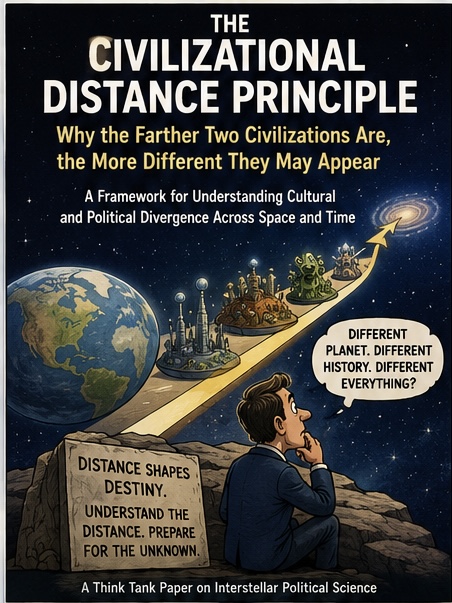
  • The Civilizational Distance Principle

    The Civilizational Distance Principle

    A Framework for Understanding Cultural and Political Divergence Across Space and Time


    Executive Summary

    The search for intelligent life beyond Earth has traditionally focused on questions of technology, biology, and astronomy. Discussions often center on how advanced extraterrestrial civilizations might be, whether they possess superior technology, and what risks or opportunities contact might create for humanity. Far less attention has been devoted to a foundational social science question: how different might another civilization actually be from our own? Popular culture frequently portrays extraterrestrials as possessing recognizable governments, economies, and social structures that differ only in appearance or technological sophistication. Such assumptions may underestimate the powerful influence that distance, isolation, and independent development exert on intelligent societies.

    Human history demonstrates that significant differences can emerge among populations sharing the same species, planet, and evolutionary origins. Geographic barriers, environmental conditions, and historical experiences have produced diverse political systems, religions, languages, and cultural traditions throughout the world. The existence of this diversity suggests that separation itself may function as a major driver of civilizational divergence. If substantial differences can emerge among human societies separated by oceans and continents, the potential differences between civilizations separated by light years and evolutionary histories may be far greater. Understanding this possibility requires a framework that extends beyond traditional political science and incorporates insights from anthropology, sociology, cultural geography, and conflict resolution studies.

    This article proposes the Civilizational Distance Principle, a theoretical framework suggesting that the probability of significant differences between civilizations increases as physical, temporal, environmental, and evolutionary distance increases. The principle does not assume that all distant civilizations will be radically different, nor does it attempt to predict the characteristics of extraterrestrial societies. Instead, it argues that increasing separation reduces opportunities for convergence while encouraging independent development. As a result, distance functions as a force that generally increases the likelihood of divergence across multiple dimensions of civilization. The implications of this framework extend beyond extraterrestrial life and offer valuable insights into the development of human societies throughout history.

    The Civilizational Distance Principle may also provide a foundation for future studies in astropolitics and interstellar governance. If humanity eventually encounters intelligent life beyond Earth, the greatest challenge may not be technological disparity but social and political misunderstanding. Successful interaction may require institutions capable of bridging differences far greater than those encountered in traditional international relations. Understanding how distance shapes civilizations may therefore become an essential component of future governance frameworks. The principle offers a starting point for examining these questions through a social science lens.

    The Brooks Brief Substack is a reader-supported publication. To receive new posts and support my work, consider becoming a free or paid subscriber.

    Introduction: Diversity on a Single Planet

    One of the most striking features of human civilization is its diversity. Across history, societies have developed dramatically different approaches to governance, economics, religion, family structure, and social organization. Ancient China, Classical Greece, Imperial Rome, the civilizations of Mesoamerica, and the kingdoms of Africa emerged under distinct historical and environmental circumstances. Although all belonged to the same species and inhabited the same planet, their institutions and worldviews often differed substantially. These differences emerged despite common biological origins and many shared survival requirements.

    Anthropologists have long argued that isolation plays a significant role in cultural development. Geographic barriers such as mountain ranges, deserts, forests, and oceans frequently limited interaction between populations. When communities experienced prolonged separation, they often developed unique languages, customs, and systems of belief. Over time, these distinctions became embedded within institutions and social structures. The result was the emergence of diverse civilizations shaped by local conditions rather than universal historical trajectories.

    Historical examples provide numerous illustrations of this process. The relative isolation of Japan for extended periods contributed to the development of distinctive political and cultural institutions. Indigenous civilizations in the Americas evolved independently from Eurasian societies for thousands of years before sustained contact occurred. Different environmental conditions and historical experiences encouraged different solutions to common human challenges. These patterns suggest that distance serves not merely as a physical measurement but as a catalyst for social divergence.

    Modern globalization has reduced many barriers to interaction, yet significant differences remain among nations and cultures. Political systems vary widely despite increasing economic integration and communication technologies. Religious traditions, legal systems, and social norms continue to reflect unique historical experiences. The persistence of these differences demonstrates that convergence is neither automatic nor inevitable. Diversity remains a defining characteristic of human civilization even in an increasingly interconnected world.

    The existence of such diversity raises an important theoretical question. If significant variation can emerge among populations sharing the same biology and planet, how much greater might the variation be among civilizations separated by vast distances in space and time? This question serves as the foundation of the Civilizational Distance Principle. The framework seeks to explain why increasing separation may encourage increasingly divergent outcomes among intelligent societies. In doing so, it expands traditional discussions of civilization beyond the boundaries of Earth.

    Theoretical Foundations

    The Civilizational Distance Principle is not intended to replace existing theories within the social sciences. Rather, it synthesizes insights from multiple academic disciplines into a broader framework for understanding civilizational development. Anthropology, sociology, evolutionary biology, cultural geography, and conflict resolution studies all provide important foundations for the concept. Each discipline contributes evidence suggesting that separation influences the development of social systems. Together, they support the argument that distance functions as a significant driver of divergence.

    One important foundation comes from cultural diffusion theory. Scholars have long observed that ideas, technologies, and social practices spread through interaction between communities. Trade routes, migration patterns, diplomatic exchanges, and communication networks facilitate the transmission of knowledge across societies. When interaction decreases, diffusion slows and independent development becomes more likely. Civilizations separated by substantial barriers therefore tend to evolve distinct characteristics over time. The Civilizational Distance Principle extends this logic beyond human societies and applies it to civilizations more broadly.

    Evolutionary biology provides another important source of support. Biological populations often diverge when isolated from one another over long periods. Different environmental pressures encourage different adaptations, producing variation among species and populations. Although civilizations are not biological organisms, they also adapt to environmental and historical conditions. Social institutions evolve in response to challenges and opportunities within their surroundings. This adaptive process can produce substantial differences even when societies begin from similar starting points.

    Conflict resolution theory also offers valuable insights. Researchers frequently identify cultural misunderstanding as a source of tension and conflict between groups. Differences in communication styles, values, historical narratives, and social expectations can complicate cooperation. As differences increase, mutual understanding often becomes more difficult. This observation suggests that divergence has practical consequences for diplomacy and governance. The Civilizational Distance Principle incorporates these concerns by examining how increasing separation may create increasingly complex barriers to communication.

    Political science provides an additional perspective through the study of institutions and governance. Different societies frequently develop unique political arrangements based on their historical experiences and environmental conditions. Democracies, monarchies, tribal systems, and hybrid structures have emerged across different regions and eras. These variations demonstrate that political development is not uniform. The principle builds upon this observation and argues that increasing distance may amplify institutional diversity rather than reduce it. Understanding this relationship may prove essential for future studies of interstellar governance and first contact scenarios.

    Defining Civilizational Distance

    The Civilizational Distance Principle begins with a broader understanding of distance than is commonly used in political science or international relations. Traditionally, distance refers to physical separation between populations, states, or regions. While physical separation remains important, it represents only one component of a much larger phenomenon. Civilizations may be separated not only by geography but also by time, environment, and evolutionary history. These forms of separation collectively shape how societies develop, adapt, and interact with one another.

    Civilizational distance can therefore be understood as the cumulative degree of separation between societies across multiple dimensions. The greater the separation, the fewer shared experiences civilizations are likely to possess. Shared experiences often create common assumptions regarding governance, morality, economics, and social organization. When those experiences differ significantly, societies may develop distinct institutions and worldviews. Over extended periods, these differences can become deeply embedded within culture and political structure.

    This framework does not argue that distance guarantees divergence. Similar environments or challenges may occasionally produce similar outcomes among otherwise unrelated societies. Human history contains examples of independent innovation, where different civilizations developed comparable technologies or social practices without direct contact. The principle instead argues that increasing distance generally raises the probability of divergence. Like many social science theories, it identifies a tendency rather than an absolute rule.

    This framework does not argue that distance guarantees divergence. The principle instead argues that increasing distance generally raises the probability of divergence.

    The concept is useful because it allows researchers to analyze multiple forms of separation simultaneously. Two societies may be geographically close yet separated by significant cultural or temporal differences. Likewise, two civilizations may occupy distant regions of space while sharing similar developmental characteristics. The principle encourages scholars to move beyond simplistic measurements and examine the broader forces shaping civilizational evolution. Such an approach may prove particularly valuable when considering the possibility of extraterrestrial intelligence.

    The framework identifies four primary dimensions of civilizational distance: physical distance, temporal distance, environmental distance, and evolutionary distance. Each dimension influences development in unique ways while interacting with the others. Together they provide a comprehensive model for understanding divergence among intelligent societies. The following sections examine each dimension in greater detail. Understanding these dimensions is essential for evaluating how civilizations may differ across space and time.

    Physical Distance and Cultural Divergence

    Physical distance represents the most intuitive component of the Civilizational Distance Principle. Throughout history, geographic separation has repeatedly contributed to cultural, political, and economic divergence. Prior to modern transportation and communication technologies, populations often experienced limited contact with distant societies. Ideas, goods, and technologies moved slowly across large distances. As a result, communities frequently developed unique identities and institutions independent of outside influence.

    The historical record provides extensive evidence supporting this relationship. Ancient civilizations often evolved within relatively isolated geographic regions shaped by local environmental conditions. The societies of East Asia, Europe, Sub-Saharan Africa, and the Americas developed distinct political traditions and cultural practices despite addressing many of the same human needs. Geographic barriers restricted interaction and allowed separate developmental pathways to emerge. Over generations, these pathways produced substantial differences in governance, religion, and social organization.

    Language offers one of the clearest examples of divergence driven by physical separation. Communities that become isolated frequently develop unique linguistic characteristics over time. Even populations sharing a common ancestral language often experience gradual differentiation when communication becomes limited. The emergence of distinct languages and dialects illustrates how separation encourages independent development. Similar processes can influence legal systems, cultural traditions, and political institutions.

    Physical distance also affects the diffusion of technology and knowledge. Innovations spread most rapidly among societies maintaining regular contact with one another. When barriers limit communication, technological development may proceed along different trajectories. Some societies may prioritize agricultural innovation while others focus on maritime trade, engineering, or military organization. These differences can influence broader social and political outcomes. Over time, divergent technological paths may reinforce existing cultural distinctions.

    The implications become even more significant when considered on an interstellar scale. Civilizations separated by hundreds or thousands of light years would face communication challenges far beyond those encountered by human societies on Earth. Information exchange could require years, centuries, or longer depending on available technology. Such conditions would encourage extensive independent development. Even civilizations sharing common origins might eventually diverge into fundamentally different societies if separated by sufficient distances.

    Physical distance therefore serves as more than a measure of geography. It functions as a mechanism that limits interaction and encourages autonomy in civilizational development. The farther civilizations are from one another, the fewer opportunities they possess for cultural exchange and mutual influence. While modern technology has reduced many barriers on Earth, no comparable solution currently exists for interstellar distances. The principle suggests that this separation may become a major source of divergence among future spacefaring civilizations.

    Temporal Distance and Historical Development

    Time represents a second major dimension of civilizational distance. Societies are not static entities that remain unchanged across generations. Instead, civilizations continuously adapt to new challenges, technologies, and historical circumstances. As a result, civilizations separated by significant periods of time may differ as much as those separated by geography. Temporal distance therefore deserves equal consideration within any comprehensive theory of civilizational development.

    Human history demonstrates the transformative effects of time. Modern societies differ dramatically from their predecessors despite occupying many of the same geographic regions. Political institutions, economic systems, scientific knowledge, and social norms have undergone profound changes over centuries. A citizen of a contemporary democracy would likely find many aspects of ancient political life unfamiliar or even incomprehensible. These differences emerged not because of physical separation but because of historical development.

    Technological advancement illustrates the influence of temporal distance particularly well. Human civilization has experienced multiple transformative periods including the Agricultural Revolution, the Industrial Revolution, and the Information Age. Each period reshaped economic systems, social relationships, and political institutions. Civilizations separated by these transitions often possessed fundamentally different understandings of power, wealth, and governance. Time therefore functions as an engine of divergence even within a single civilization.

    Historical experiences also contribute to temporal separation. Wars, migrations, pandemics, economic crises, and ideological movements leave lasting impacts on societies. Different generations inherit different historical memories and cultural narratives. These experiences influence political priorities and social values long after the original events have passed. As temporal distance increases, civilizations accumulate increasingly distinct historical experiences that shape their development.

    The concept becomes especially important when considering extraterrestrial intelligence. Humanity may encounter civilizations that are thousands, millions, or even billions of years older than our own. Such civilizations would possess historical experiences extending far beyond the scope of recorded human history. Their institutions, technologies, and philosophies may reflect developmental processes that humanity has never encountered. Temporal distance alone could create differences greater than any observed among contemporary human societies.

    Conversely, humanity may encounter civilizations that are younger than our own. Such societies could be experiencing developmental stages similar to humanity’s distant past. Their political institutions, technological capabilities, and cultural norms might reflect challenges that humans addressed centuries earlier. The resulting differences would not necessarily imply superiority or inferiority but rather different positions along separate historical trajectories. Temporal distance therefore highlights the importance of context when comparing civilizations.

    The Civilizational Distance Principle argues that time should be viewed as a form of separation comparable to geography. Just as physical distance limits interaction across space, temporal distance limits interaction across history. Civilizations separated by sufficient periods of time may become increasingly difficult to understand despite sharing common origins. Recognizing this reality may prove essential for future studies of long-term civilizational development, first contact scenarios, and interstellar governance.

    Environmental Distance and Social Organization

    Environmental conditions have influenced the development of every known human civilization. Climate, geography, resource availability, ecological pressures, and natural hazards all contribute to shaping how societies organize themselves. Throughout history, civilizations have adapted to the unique challenges and opportunities presented by their environments. These adaptations frequently influence economic systems, political institutions, military strategies, and cultural traditions. Environmental distance therefore represents an important dimension of civilizational divergence.

    Agricultural civilizations emerged in regions where environmental conditions supported large-scale food production. The abundance of fertile land and reliable water sources encouraged the growth of cities, bureaucracies, and centralized governments. In contrast, societies inhabiting deserts, mountains, or arctic regions often developed different social structures better suited to their circumstances. These variations demonstrate that environmental conditions can shape the trajectory of social and political development. Similar human needs often produce different solutions when environmental constraints differ.

    Environmental factors also influence cultural values and collective behavior. Communities facing resource scarcity may emphasize conservation, cooperation, or territorial defense. Regions with abundant resources may encourage different economic and political priorities. Over generations, these responses become embedded within social norms and institutions. Environmental adaptation therefore extends beyond survival and becomes a defining characteristic of civilization itself.

    The implications become even more significant when considering extraterrestrial civilizations. Intelligent life emerging on planets with different gravity levels, atmospheric compositions, climates, or ecological systems may develop institutions unfamiliar to humanity. A civilization originating on a world dominated by oceans may organize itself differently than one developing on a dry terrestrial planet. Likewise, a civilization adapted to extreme environmental conditions may prioritize different values and technologies than those found on Earth. Environmental distance may therefore generate forms of social organization that challenge human assumptions regarding governance and development.

    Environmental distance also suggests caution when evaluating extraterrestrial civilizations through a human lens. Political institutions and cultural practices that appear unusual from a terrestrial perspective may represent rational adaptations to local conditions. Understanding another civilization may therefore require understanding the environment that shaped it. Future diplomacy and governance frameworks must account for this possibility. The ability to interpret environmental influences may become a prerequisite for successful interstellar relations.

    Evolutionary Distance and Cognitive Diversity

    Of all the dimensions described by the Civilizational Distance Principle, evolutionary distance may produce the most profound differences between civilizations. Human civilization emerged from a specific evolutionary history shaped by Earth’s biological conditions. Human cognition, perception, communication, and social behavior all reflect millions of years of adaptation. These characteristics influence how humanity understands morality, politics, economics, and social relationships. An intelligent species originating through a different evolutionary pathway may possess fundamentally different cognitive foundations.

    Human beings often assume that intelligence naturally produces familiar concepts such as family, competition, cooperation, hierarchy, and individual identity. This assumption may not be justified. Alternative evolutionary histories could produce entirely different social structures and psychological tendencies. A species that evolved as a collective organism may perceive individuality differently than humans. Likewise, a species with different sensory capabilities may experience reality in ways that are difficult for humanity to comprehend.

    Communication presents a particularly significant challenge. Human language evolved to facilitate interaction among members of the same species. An extraterrestrial civilization may communicate through methods that do not resemble spoken or written language. Information exchange could occur through visual signals, chemical processes, electromagnetic communication, or mechanisms that humans have not yet imagined. Translation may therefore involve more than converting words between languages. It may require bridging fundamentally different systems of cognition.

    Evolutionary distance could also influence ethics and governance. Human concepts of justice, rights, responsibility, and legitimacy are rooted in human experiences and social structures. Another intelligent species may possess different assumptions regarding authority and social organization. Political systems that appear unusual or even irrational from a human perspective may function effectively within a different evolutionary context. Understanding these systems may require abandoning assumptions rooted in human biology.

    The possibility of cognitive diversity has important implications for first contact. Many discussions assume that advanced civilizations will think in ways broadly comparable to humans. The Civilizational Distance Principle challenges this assumption by emphasizing the role of evolutionary history. Differences in cognition may prove more difficult to overcome than differences in technology. Successful interaction may depend upon humanity’s ability to recognize and adapt to alternative forms of intelligence.

    Toward a Mathematical Representation of Civilizational Distance

    Like many social science theories, the Civilizational Distance Principle is primarily conceptual rather than predictive. Human behavior and civilizational development involve numerous variables that cannot be fully captured through simple equations. Nevertheless, mathematical representations can be useful for illustrating theoretical relationships. A conceptual model allows scholars to visualize how different forms of distance may contribute to civilizational divergence. Such a model should be viewed as a heuristic framework rather than a precise measurement tool.

    One possible representation is as follows:

    Civilizational Divergence = f(P + T + E + V)

    Where:

    P = Physical Distance

    T = Temporal Distance

    E = Environmental Distance

    V = Evolutionary Distance

    In this formulation, divergence is treated as a function of multiple interacting dimensions of separation. As one or more dimensions increase, the probability of significant differences between civilizations also increases. The equation does not imply that each variable contributes equally. Certain forms of distance may exert greater influence depending upon specific circumstances. The model simply illustrates the principle that civilizational differences tend to expand as cumulative separation increases.

    A more advanced version of the model might assign weights to each variable. Evolutionary distance, for example, may exert a greater influence than geographic separation because it affects cognition itself. Environmental conditions may interact with evolutionary history in ways that amplify divergence. Temporal distance may alter the impact of both variables by allowing differences to accumulate over long periods. Future researchers could refine the model through comparative studies of human civilizations and theoretical analyses of extraterrestrial societies.

    The purpose of such a framework is not to produce exact predictions. Rather, it provides a structured way to think about the forces shaping civilizational development. Political scientists, anthropologists, and future astropolitical researchers may find value in adapting the model to specific scenarios. The equation serves as a visual representation of a broader theoretical argument. Distance, in its various forms, acts as a driver of divergence among intelligent societies.

    Implications for First Contact and Governance

    The Civilizational Distance Principle carries important implications for future discussions of first contact. Popular depictions of extraterrestrial civilizations often assume a degree of similarity that may not exist in reality. Advanced technology alone does not guarantee shared values, institutions, or social norms. Human history demonstrates that misunderstandings frequently occur even among societies sharing the same species and planet. Interstellar encounters may involve differences far greater than those encountered in traditional diplomacy.

    Successful first contact may therefore depend upon expertise drawn from multiple disciplines. Linguists, anthropologists, sociologists, psychologists, conflict resolution specialists, and political scientists may prove as important as engineers and scientists. Understanding another civilization requires more than translating information. It requires understanding the historical, environmental, and evolutionary context that shaped that civilization. Without such understanding, miscommunication could become a significant source of conflict.

    The principle also raises important questions regarding governance. Existing international institutions were designed to manage relations among human societies that share certain biological and cognitive characteristics. Interstellar relations may challenge many of these assumptions. Concepts such as sovereignty, jurisdiction, rights, and diplomacy may require reconsideration when applied to non-human civilizations. New frameworks may eventually be necessary to facilitate peaceful interaction across profound civilizational differences.

    The principle further suggests that future governance structures should emphasize flexibility and adaptability. Attempts to impose human assumptions upon fundamentally different civilizations may prove ineffective or counterproductive. Instead, governance mechanisms should focus on communication, mutual understanding, and conflict management. The goal would not be uniformity but coexistence. Recognizing the reality of civilizational distance may become an essential step toward achieving that objective.

    The broader lesson extends beyond extraterrestrial life. Human societies continue to experience conflict arising from cultural misunderstanding and divergent historical experiences. The Civilizational Distance Principle highlights the importance of understanding differences before attempting cooperation or governance. In this sense, the principle offers insights relevant to both international relations and hypothetical interstellar diplomacy. The challenges of distance begin on Earth long before they extend into the stars.

    Thanks for reading The Brooks Brief Substack! This post is public so feel free to share it.

    Share

    Conclusion

    The Civilizational Distance Principle proposes that increasing physical, temporal, environmental, and evolutionary distance generally increases the probability of significant differences between civilizations. Drawing upon anthropology, sociology, cultural geography, evolutionary theory, and conflict resolution studies, the framework seeks to explain why intelligent societies diverge over time. Human history provides substantial evidence that separation encourages independent development. The principle extends this observation beyond traditional political science and applies it to broader questions of civilizational evolution.

    The theory does not claim that distance guarantees difference, nor does it attempt to predict the specific characteristics of future civilizations. Instead, it identifies a recurring pattern observable throughout human history. Societies exposed to different conditions and experiences often develop different institutions, values, and worldviews. The greater the separation, the greater the opportunity for divergence. This pattern appears consistently across geography, history, and culture.

    The framework also contributes to the emerging field of astropolitics by providing a social science perspective on first contact and interstellar governance. Discussions regarding extraterrestrial life frequently emphasize technology while overlooking the complexities of culture and cognition. The Civilizational Distance Principle suggests that social and political differences may represent the greatest challenge associated with future contact. Understanding these differences may prove more important than understanding technological capabilities.

    The principle complements broader theories regarding intelligent civilizations, including the Herd Cohesion Principle, the Survival Resource Law, and the First Contact Governance Problem. Together, these concepts form the foundation of a developing framework for examining how intelligent societies organize, survive, cooperate, and govern themselves across space and time. While speculative in its interstellar applications, the principle remains firmly rooted in established observations regarding human civilization. Its value lies not in predicting the future with certainty, but in providing a structured way to think about how distance shapes the development of intelligent societies.

    As humanity continues exploring the cosmos, questions of culture, governance, and social organization may become increasingly important. The search for intelligent life is ultimately not only a search for biology or technology. It is also a search for other civilizations and other ways of understanding reality. The Civilizational Distance Principle suggests that those civilizations may be far more different than humanity often assumes. Preparing for that possibility may become one of the most important intellectual challenges of the centuries ahead.