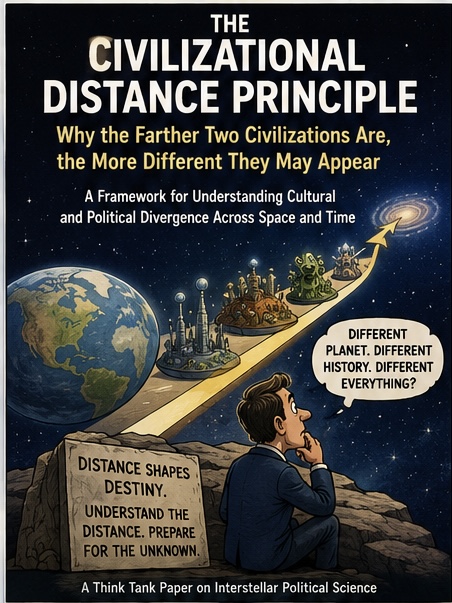
A Framework for Understanding Cultural and Political Divergence Across Space and Time

Executive Summary
The search for intelligent life beyond Earth has traditionally focused on questions of technology, biology, and astronomy. Discussions often center on how advanced extraterrestrial civilizations might be, whether they possess superior technology, and what risks or opportunities contact might create for humanity. Far less attention has been devoted to a foundational social science question: how different might another civilization actually be from our own? Popular culture frequently portrays extraterrestrials as possessing recognizable governments, economies, and social structures that differ only in appearance or technological sophistication. Such assumptions may underestimate the powerful influence that distance, isolation, and independent development exert on intelligent societies.

Human history demonstrates that significant differences can emerge among populations sharing the same species, planet, and evolutionary origins. Geographic barriers, environmental conditions, and historical experiences have produced diverse political systems, religions, languages, and cultural traditions throughout the world. The existence of this diversity suggests that separation itself may function as a major driver of civilizational divergence. If substantial differences can emerge among human societies separated by oceans and continents, the potential differences between civilizations separated by light years and evolutionary histories may be far greater. Understanding this possibility requires a framework that extends beyond traditional political science and incorporates insights from anthropology, sociology, cultural geography, and conflict resolution studies.
This article proposes the Civilizational Distance Principle, a theoretical framework suggesting that the probability of significant differences between civilizations increases as physical, temporal, environmental, and evolutionary distance increases. The principle does not assume that all distant civilizations will be radically different, nor does it attempt to predict the characteristics of extraterrestrial societies. Instead, it argues that increasing separation reduces opportunities for convergence while encouraging independent development. As a result, distance functions as a force that generally increases the likelihood of divergence across multiple dimensions of civilization. The implications of this framework extend beyond extraterrestrial life and offer valuable insights into the development of human societies throughout history.
The Civilizational Distance Principle may also provide a foundation for future studies in astropolitics and interstellar governance. If humanity eventually encounters intelligent life beyond Earth, the greatest challenge may not be technological disparity but social and political misunderstanding. Successful interaction may require institutions capable of bridging differences far greater than those encountered in traditional international relations. Understanding how distance shapes civilizations may therefore become an essential component of future governance frameworks. The principle offers a starting point for examining these questions through a social science lens.
The Brooks Brief Substack is a reader-supported publication. To receive new posts and support my work, consider becoming a free or paid subscriber.
Introduction: Diversity on a Single Planet

One of the most striking features of human civilization is its diversity. Across history, societies have developed dramatically different approaches to governance, economics, religion, family structure, and social organization. Ancient China, Classical Greece, Imperial Rome, the civilizations of Mesoamerica, and the kingdoms of Africa emerged under distinct historical and environmental circumstances. Although all belonged to the same species and inhabited the same planet, their institutions and worldviews often differed substantially. These differences emerged despite common biological origins and many shared survival requirements.
Anthropologists have long argued that isolation plays a significant role in cultural development. Geographic barriers such as mountain ranges, deserts, forests, and oceans frequently limited interaction between populations. When communities experienced prolonged separation, they often developed unique languages, customs, and systems of belief. Over time, these distinctions became embedded within institutions and social structures. The result was the emergence of diverse civilizations shaped by local conditions rather than universal historical trajectories.
Historical examples provide numerous illustrations of this process. The relative isolation of Japan for extended periods contributed to the development of distinctive political and cultural institutions. Indigenous civilizations in the Americas evolved independently from Eurasian societies for thousands of years before sustained contact occurred. Different environmental conditions and historical experiences encouraged different solutions to common human challenges. These patterns suggest that distance serves not merely as a physical measurement but as a catalyst for social divergence.
Modern globalization has reduced many barriers to interaction, yet significant differences remain among nations and cultures. Political systems vary widely despite increasing economic integration and communication technologies. Religious traditions, legal systems, and social norms continue to reflect unique historical experiences. The persistence of these differences demonstrates that convergence is neither automatic nor inevitable. Diversity remains a defining characteristic of human civilization even in an increasingly interconnected world.
The existence of such diversity raises an important theoretical question. If significant variation can emerge among populations sharing the same biology and planet, how much greater might the variation be among civilizations separated by vast distances in space and time? This question serves as the foundation of the Civilizational Distance Principle. The framework seeks to explain why increasing separation may encourage increasingly divergent outcomes among intelligent societies. In doing so, it expands traditional discussions of civilization beyond the boundaries of Earth.
Theoretical Foundations

The Civilizational Distance Principle is not intended to replace existing theories within the social sciences. Rather, it synthesizes insights from multiple academic disciplines into a broader framework for understanding civilizational development. Anthropology, sociology, evolutionary biology, cultural geography, and conflict resolution studies all provide important foundations for the concept. Each discipline contributes evidence suggesting that separation influences the development of social systems. Together, they support the argument that distance functions as a significant driver of divergence.
One important foundation comes from cultural diffusion theory. Scholars have long observed that ideas, technologies, and social practices spread through interaction between communities. Trade routes, migration patterns, diplomatic exchanges, and communication networks facilitate the transmission of knowledge across societies. When interaction decreases, diffusion slows and independent development becomes more likely. Civilizations separated by substantial barriers therefore tend to evolve distinct characteristics over time. The Civilizational Distance Principle extends this logic beyond human societies and applies it to civilizations more broadly.
Evolutionary biology provides another important source of support. Biological populations often diverge when isolated from one another over long periods. Different environmental pressures encourage different adaptations, producing variation among species and populations. Although civilizations are not biological organisms, they also adapt to environmental and historical conditions. Social institutions evolve in response to challenges and opportunities within their surroundings. This adaptive process can produce substantial differences even when societies begin from similar starting points.
Conflict resolution theory also offers valuable insights. Researchers frequently identify cultural misunderstanding as a source of tension and conflict between groups. Differences in communication styles, values, historical narratives, and social expectations can complicate cooperation. As differences increase, mutual understanding often becomes more difficult. This observation suggests that divergence has practical consequences for diplomacy and governance. The Civilizational Distance Principle incorporates these concerns by examining how increasing separation may create increasingly complex barriers to communication.
Political science provides an additional perspective through the study of institutions and governance. Different societies frequently develop unique political arrangements based on their historical experiences and environmental conditions. Democracies, monarchies, tribal systems, and hybrid structures have emerged across different regions and eras. These variations demonstrate that political development is not uniform. The principle builds upon this observation and argues that increasing distance may amplify institutional diversity rather than reduce it. Understanding this relationship may prove essential for future studies of interstellar governance and first contact scenarios.
Defining Civilizational Distance

The Civilizational Distance Principle begins with a broader understanding of distance than is commonly used in political science or international relations. Traditionally, distance refers to physical separation between populations, states, or regions. While physical separation remains important, it represents only one component of a much larger phenomenon. Civilizations may be separated not only by geography but also by time, environment, and evolutionary history. These forms of separation collectively shape how societies develop, adapt, and interact with one another.
Civilizational distance can therefore be understood as the cumulative degree of separation between societies across multiple dimensions. The greater the separation, the fewer shared experiences civilizations are likely to possess. Shared experiences often create common assumptions regarding governance, morality, economics, and social organization. When those experiences differ significantly, societies may develop distinct institutions and worldviews. Over extended periods, these differences can become deeply embedded within culture and political structure.
This framework does not argue that distance guarantees divergence. Similar environments or challenges may occasionally produce similar outcomes among otherwise unrelated societies. Human history contains examples of independent innovation, where different civilizations developed comparable technologies or social practices without direct contact. The principle instead argues that increasing distance generally raises the probability of divergence. Like many social science theories, it identifies a tendency rather than an absolute rule.
This framework does not argue that distance guarantees divergence. The principle instead argues that increasing distance generally raises the probability of divergence.
The concept is useful because it allows researchers to analyze multiple forms of separation simultaneously. Two societies may be geographically close yet separated by significant cultural or temporal differences. Likewise, two civilizations may occupy distant regions of space while sharing similar developmental characteristics. The principle encourages scholars to move beyond simplistic measurements and examine the broader forces shaping civilizational evolution. Such an approach may prove particularly valuable when considering the possibility of extraterrestrial intelligence.
The framework identifies four primary dimensions of civilizational distance: physical distance, temporal distance, environmental distance, and evolutionary distance. Each dimension influences development in unique ways while interacting with the others. Together they provide a comprehensive model for understanding divergence among intelligent societies. The following sections examine each dimension in greater detail. Understanding these dimensions is essential for evaluating how civilizations may differ across space and time.
Physical Distance and Cultural Divergence

Physical distance represents the most intuitive component of the Civilizational Distance Principle. Throughout history, geographic separation has repeatedly contributed to cultural, political, and economic divergence. Prior to modern transportation and communication technologies, populations often experienced limited contact with distant societies. Ideas, goods, and technologies moved slowly across large distances. As a result, communities frequently developed unique identities and institutions independent of outside influence.
The historical record provides extensive evidence supporting this relationship. Ancient civilizations often evolved within relatively isolated geographic regions shaped by local environmental conditions. The societies of East Asia, Europe, Sub-Saharan Africa, and the Americas developed distinct political traditions and cultural practices despite addressing many of the same human needs. Geographic barriers restricted interaction and allowed separate developmental pathways to emerge. Over generations, these pathways produced substantial differences in governance, religion, and social organization.
Language offers one of the clearest examples of divergence driven by physical separation. Communities that become isolated frequently develop unique linguistic characteristics over time. Even populations sharing a common ancestral language often experience gradual differentiation when communication becomes limited. The emergence of distinct languages and dialects illustrates how separation encourages independent development. Similar processes can influence legal systems, cultural traditions, and political institutions.
Physical distance also affects the diffusion of technology and knowledge. Innovations spread most rapidly among societies maintaining regular contact with one another. When barriers limit communication, technological development may proceed along different trajectories. Some societies may prioritize agricultural innovation while others focus on maritime trade, engineering, or military organization. These differences can influence broader social and political outcomes. Over time, divergent technological paths may reinforce existing cultural distinctions.
The implications become even more significant when considered on an interstellar scale. Civilizations separated by hundreds or thousands of light years would face communication challenges far beyond those encountered by human societies on Earth. Information exchange could require years, centuries, or longer depending on available technology. Such conditions would encourage extensive independent development. Even civilizations sharing common origins might eventually diverge into fundamentally different societies if separated by sufficient distances.
Physical distance therefore serves as more than a measure of geography. It functions as a mechanism that limits interaction and encourages autonomy in civilizational development. The farther civilizations are from one another, the fewer opportunities they possess for cultural exchange and mutual influence. While modern technology has reduced many barriers on Earth, no comparable solution currently exists for interstellar distances. The principle suggests that this separation may become a major source of divergence among future spacefaring civilizations.
Temporal Distance and Historical Development

Time represents a second major dimension of civilizational distance. Societies are not static entities that remain unchanged across generations. Instead, civilizations continuously adapt to new challenges, technologies, and historical circumstances. As a result, civilizations separated by significant periods of time may differ as much as those separated by geography. Temporal distance therefore deserves equal consideration within any comprehensive theory of civilizational development.
Human history demonstrates the transformative effects of time. Modern societies differ dramatically from their predecessors despite occupying many of the same geographic regions. Political institutions, economic systems, scientific knowledge, and social norms have undergone profound changes over centuries. A citizen of a contemporary democracy would likely find many aspects of ancient political life unfamiliar or even incomprehensible. These differences emerged not because of physical separation but because of historical development.
Technological advancement illustrates the influence of temporal distance particularly well. Human civilization has experienced multiple transformative periods including the Agricultural Revolution, the Industrial Revolution, and the Information Age. Each period reshaped economic systems, social relationships, and political institutions. Civilizations separated by these transitions often possessed fundamentally different understandings of power, wealth, and governance. Time therefore functions as an engine of divergence even within a single civilization.
Historical experiences also contribute to temporal separation. Wars, migrations, pandemics, economic crises, and ideological movements leave lasting impacts on societies. Different generations inherit different historical memories and cultural narratives. These experiences influence political priorities and social values long after the original events have passed. As temporal distance increases, civilizations accumulate increasingly distinct historical experiences that shape their development.
The concept becomes especially important when considering extraterrestrial intelligence. Humanity may encounter civilizations that are thousands, millions, or even billions of years older than our own. Such civilizations would possess historical experiences extending far beyond the scope of recorded human history. Their institutions, technologies, and philosophies may reflect developmental processes that humanity has never encountered. Temporal distance alone could create differences greater than any observed among contemporary human societies.
Conversely, humanity may encounter civilizations that are younger than our own. Such societies could be experiencing developmental stages similar to humanity’s distant past. Their political institutions, technological capabilities, and cultural norms might reflect challenges that humans addressed centuries earlier. The resulting differences would not necessarily imply superiority or inferiority but rather different positions along separate historical trajectories. Temporal distance therefore highlights the importance of context when comparing civilizations.
The Civilizational Distance Principle argues that time should be viewed as a form of separation comparable to geography. Just as physical distance limits interaction across space, temporal distance limits interaction across history. Civilizations separated by sufficient periods of time may become increasingly difficult to understand despite sharing common origins. Recognizing this reality may prove essential for future studies of long-term civilizational development, first contact scenarios, and interstellar governance.
Environmental Distance and Social Organization

Environmental conditions have influenced the development of every known human civilization. Climate, geography, resource availability, ecological pressures, and natural hazards all contribute to shaping how societies organize themselves. Throughout history, civilizations have adapted to the unique challenges and opportunities presented by their environments. These adaptations frequently influence economic systems, political institutions, military strategies, and cultural traditions. Environmental distance therefore represents an important dimension of civilizational divergence.
Agricultural civilizations emerged in regions where environmental conditions supported large-scale food production. The abundance of fertile land and reliable water sources encouraged the growth of cities, bureaucracies, and centralized governments. In contrast, societies inhabiting deserts, mountains, or arctic regions often developed different social structures better suited to their circumstances. These variations demonstrate that environmental conditions can shape the trajectory of social and political development. Similar human needs often produce different solutions when environmental constraints differ.
Environmental factors also influence cultural values and collective behavior. Communities facing resource scarcity may emphasize conservation, cooperation, or territorial defense. Regions with abundant resources may encourage different economic and political priorities. Over generations, these responses become embedded within social norms and institutions. Environmental adaptation therefore extends beyond survival and becomes a defining characteristic of civilization itself.
The implications become even more significant when considering extraterrestrial civilizations. Intelligent life emerging on planets with different gravity levels, atmospheric compositions, climates, or ecological systems may develop institutions unfamiliar to humanity. A civilization originating on a world dominated by oceans may organize itself differently than one developing on a dry terrestrial planet. Likewise, a civilization adapted to extreme environmental conditions may prioritize different values and technologies than those found on Earth. Environmental distance may therefore generate forms of social organization that challenge human assumptions regarding governance and development.
Environmental distance also suggests caution when evaluating extraterrestrial civilizations through a human lens. Political institutions and cultural practices that appear unusual from a terrestrial perspective may represent rational adaptations to local conditions. Understanding another civilization may therefore require understanding the environment that shaped it. Future diplomacy and governance frameworks must account for this possibility. The ability to interpret environmental influences may become a prerequisite for successful interstellar relations.
Evolutionary Distance and Cognitive Diversity

Of all the dimensions described by the Civilizational Distance Principle, evolutionary distance may produce the most profound differences between civilizations. Human civilization emerged from a specific evolutionary history shaped by Earth’s biological conditions. Human cognition, perception, communication, and social behavior all reflect millions of years of adaptation. These characteristics influence how humanity understands morality, politics, economics, and social relationships. An intelligent species originating through a different evolutionary pathway may possess fundamentally different cognitive foundations.
Human beings often assume that intelligence naturally produces familiar concepts such as family, competition, cooperation, hierarchy, and individual identity. This assumption may not be justified. Alternative evolutionary histories could produce entirely different social structures and psychological tendencies. A species that evolved as a collective organism may perceive individuality differently than humans. Likewise, a species with different sensory capabilities may experience reality in ways that are difficult for humanity to comprehend.
Communication presents a particularly significant challenge. Human language evolved to facilitate interaction among members of the same species. An extraterrestrial civilization may communicate through methods that do not resemble spoken or written language. Information exchange could occur through visual signals, chemical processes, electromagnetic communication, or mechanisms that humans have not yet imagined. Translation may therefore involve more than converting words between languages. It may require bridging fundamentally different systems of cognition.
Evolutionary distance could also influence ethics and governance. Human concepts of justice, rights, responsibility, and legitimacy are rooted in human experiences and social structures. Another intelligent species may possess different assumptions regarding authority and social organization. Political systems that appear unusual or even irrational from a human perspective may function effectively within a different evolutionary context. Understanding these systems may require abandoning assumptions rooted in human biology.
The possibility of cognitive diversity has important implications for first contact. Many discussions assume that advanced civilizations will think in ways broadly comparable to humans. The Civilizational Distance Principle challenges this assumption by emphasizing the role of evolutionary history. Differences in cognition may prove more difficult to overcome than differences in technology. Successful interaction may depend upon humanity’s ability to recognize and adapt to alternative forms of intelligence.
Toward a Mathematical Representation of Civilizational Distance

Like many social science theories, the Civilizational Distance Principle is primarily conceptual rather than predictive. Human behavior and civilizational development involve numerous variables that cannot be fully captured through simple equations. Nevertheless, mathematical representations can be useful for illustrating theoretical relationships. A conceptual model allows scholars to visualize how different forms of distance may contribute to civilizational divergence. Such a model should be viewed as a heuristic framework rather than a precise measurement tool.
One possible representation is as follows:
Civilizational Divergence = f(P + T + E + V)
Where:
P = Physical Distance
T = Temporal Distance
E = Environmental Distance
V = Evolutionary Distance
In this formulation, divergence is treated as a function of multiple interacting dimensions of separation. As one or more dimensions increase, the probability of significant differences between civilizations also increases. The equation does not imply that each variable contributes equally. Certain forms of distance may exert greater influence depending upon specific circumstances. The model simply illustrates the principle that civilizational differences tend to expand as cumulative separation increases.
A more advanced version of the model might assign weights to each variable. Evolutionary distance, for example, may exert a greater influence than geographic separation because it affects cognition itself. Environmental conditions may interact with evolutionary history in ways that amplify divergence. Temporal distance may alter the impact of both variables by allowing differences to accumulate over long periods. Future researchers could refine the model through comparative studies of human civilizations and theoretical analyses of extraterrestrial societies.
The purpose of such a framework is not to produce exact predictions. Rather, it provides a structured way to think about the forces shaping civilizational development. Political scientists, anthropologists, and future astropolitical researchers may find value in adapting the model to specific scenarios. The equation serves as a visual representation of a broader theoretical argument. Distance, in its various forms, acts as a driver of divergence among intelligent societies.
Implications for First Contact and Governance

The Civilizational Distance Principle carries important implications for future discussions of first contact. Popular depictions of extraterrestrial civilizations often assume a degree of similarity that may not exist in reality. Advanced technology alone does not guarantee shared values, institutions, or social norms. Human history demonstrates that misunderstandings frequently occur even among societies sharing the same species and planet. Interstellar encounters may involve differences far greater than those encountered in traditional diplomacy.
Successful first contact may therefore depend upon expertise drawn from multiple disciplines. Linguists, anthropologists, sociologists, psychologists, conflict resolution specialists, and political scientists may prove as important as engineers and scientists. Understanding another civilization requires more than translating information. It requires understanding the historical, environmental, and evolutionary context that shaped that civilization. Without such understanding, miscommunication could become a significant source of conflict.
The principle also raises important questions regarding governance. Existing international institutions were designed to manage relations among human societies that share certain biological and cognitive characteristics. Interstellar relations may challenge many of these assumptions. Concepts such as sovereignty, jurisdiction, rights, and diplomacy may require reconsideration when applied to non-human civilizations. New frameworks may eventually be necessary to facilitate peaceful interaction across profound civilizational differences.
The principle further suggests that future governance structures should emphasize flexibility and adaptability. Attempts to impose human assumptions upon fundamentally different civilizations may prove ineffective or counterproductive. Instead, governance mechanisms should focus on communication, mutual understanding, and conflict management. The goal would not be uniformity but coexistence. Recognizing the reality of civilizational distance may become an essential step toward achieving that objective.
The broader lesson extends beyond extraterrestrial life. Human societies continue to experience conflict arising from cultural misunderstanding and divergent historical experiences. The Civilizational Distance Principle highlights the importance of understanding differences before attempting cooperation or governance. In this sense, the principle offers insights relevant to both international relations and hypothetical interstellar diplomacy. The challenges of distance begin on Earth long before they extend into the stars.
Thanks for reading The Brooks Brief Substack! This post is public so feel free to share it.
Conclusion

The Civilizational Distance Principle proposes that increasing physical, temporal, environmental, and evolutionary distance generally increases the probability of significant differences between civilizations. Drawing upon anthropology, sociology, cultural geography, evolutionary theory, and conflict resolution studies, the framework seeks to explain why intelligent societies diverge over time. Human history provides substantial evidence that separation encourages independent development. The principle extends this observation beyond traditional political science and applies it to broader questions of civilizational evolution.
The theory does not claim that distance guarantees difference, nor does it attempt to predict the specific characteristics of future civilizations. Instead, it identifies a recurring pattern observable throughout human history. Societies exposed to different conditions and experiences often develop different institutions, values, and worldviews. The greater the separation, the greater the opportunity for divergence. This pattern appears consistently across geography, history, and culture.
The framework also contributes to the emerging field of astropolitics by providing a social science perspective on first contact and interstellar governance. Discussions regarding extraterrestrial life frequently emphasize technology while overlooking the complexities of culture and cognition. The Civilizational Distance Principle suggests that social and political differences may represent the greatest challenge associated with future contact. Understanding these differences may prove more important than understanding technological capabilities.
The principle complements broader theories regarding intelligent civilizations, including the Herd Cohesion Principle, the Survival Resource Law, and the First Contact Governance Problem. Together, these concepts form the foundation of a developing framework for examining how intelligent societies organize, survive, cooperate, and govern themselves across space and time. While speculative in its interstellar applications, the principle remains firmly rooted in established observations regarding human civilization. Its value lies not in predicting the future with certainty, but in providing a structured way to think about how distance shapes the development of intelligent societies.
As humanity continues exploring the cosmos, questions of culture, governance, and social organization may become increasingly important. The search for intelligent life is ultimately not only a search for biology or technology. It is also a search for other civilizations and other ways of understanding reality. The Civilizational Distance Principle suggests that those civilizations may be far more different than humanity often assumes. Preparing for that possibility may become one of the most important intellectual challenges of the centuries ahead.
Leave a Reply