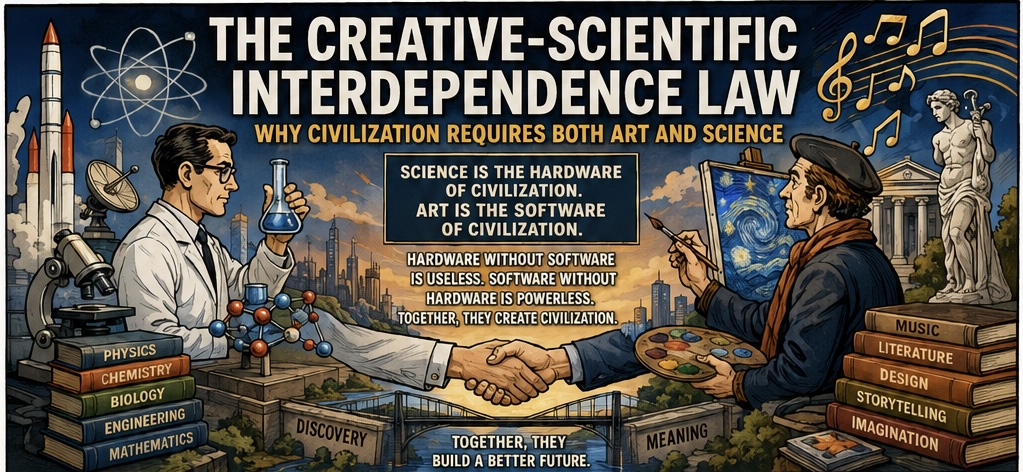
Why Civilization Requires Both Art and Science
A Political and Civilizational Analysis
Executive Summary
Modern societies often separate art and science into distinct and sometimes competing domains. Science is frequently associated with objectivity, measurement, engineering, and technological advancement. Art is commonly associated with creativity, expression, culture, and imagination. Educational institutions, public policy discussions, and economic planning often reinforce this distinction by treating science and art as fundamentally different activities. However, such a separation may obscure the deep interdependence that exists between these two domains. The advancement of civilization has historically depended upon the interaction of scientific capability and artistic imagination.
This article proposes the Creative-Scientific Interdependence Law as a framework for understanding the relationship between art, science, technology, and political development. The law argues that science provides the structures, mechanisms, and capabilities that make creation possible, while art provides the ideas, symbols, narratives, and designs that give those structures meaning and direction. Neither domain can fully function without the other. Scientific knowledge without creative vision lacks purpose, while artistic vision without scientific implementation lacks the ability to become reality. Civilization advances when these forces operate together.

The theory has implications far beyond culture and education. It suggests that political institutions, economic systems, technological innovation, and social development all depend upon the interaction of scientific and artistic processes. Science may provide the hardware of civilization, but art provides the software. Just as computer hardware requires software to perform useful functions, societies require imagination, design, and symbolic systems to direct scientific capability toward meaningful goals. Understanding this relationship may help policymakers develop more balanced approaches to innovation, education, and national development in the twenty-first century.
Introduction: Beyond the False Divide

The distinction between art and science has become deeply embedded within modern society. Universities separate the humanities from the sciences. Governments often fund scientific research and artistic programs through different institutions. Public discourse frequently portrays scientists and artists as occupying separate intellectual worlds. This division has contributed to the perception that scientific progress and artistic expression represent fundamentally different forms of human activity. Yet history suggests that some of humanity’s greatest achievements emerged from the interaction between both domains rather than from either one alone.
Scientific breakthroughs often begin as acts of imagination. Before an invention can be built, it must first be envisioned. Before a scientific theory can be tested, it must first be conceived. The process of developing hypotheses, designing experiments, and imagining new possibilities requires creativity that resembles artistic thinking. Many of history’s most influential scientists were also deeply engaged in artistic pursuits. Their discoveries were frequently driven by imagination, intuition, and the ability to visualize possibilities that did not yet exist.
Similarly, artistic creation depends upon scientific realities. Artists rely upon physical materials, biological perception, mathematical relationships, and technological tools to express their ideas. Architecture depends upon engineering. Music depends upon acoustics. Digital art depends upon computing systems. Film depends upon optics, electronics, and communications technology. While artistic expression may appear distinct from scientific activity, it remains grounded in the physical structures that science seeks to understand. The relationship is therefore not one of separation but of mutual dependence.
The Creative-Scientific Interdependence Law

The Creative-Scientific Interdependence Law states that all complex systems of creation, innovation, and civilization depend upon the interaction between artistic imagination and scientific implementation. Science provides the mechanisms through which ideas become reality, while art provides the conceptual frameworks that guide scientific capability toward specific purposes. Neither process can fully operate without the other. Together, they form a continuous cycle of imagination, experimentation, implementation, and refinement.
This relationship can be understood through the analogy of hardware and software. Hardware provides physical capability but cannot perform meaningful functions without instructions. Software provides direction and purpose but cannot operate without hardware. Similarly, science provides the structures, tools, and mechanisms that make creation possible. Art provides the symbols, narratives, designs, and visions that determine how those capabilities are used. Civilization emerges from the interaction between these complementary forces rather than from either one independently.
The law does not claim that art and science are identical. Rather, it argues that they represent different dimensions of the same creative process. Scientific inquiry seeks to understand what exists and what is possible within the constraints of reality. Artistic expression explores meaning, purpose, and alternative possibilities. Innovation frequently occurs when these domains intersect. The most transformative developments often emerge when scientific capability is paired with creative vision. Understanding this relationship may provide a broader framework for analyzing technological change, cultural development, and political progress.
The Periodic Table as Art and Science

The periodic table is often celebrated as one of the greatest achievements in scientific history. It organizes the fundamental building blocks of matter according to observable patterns and relationships. Chemists rely upon it as a practical tool for understanding atomic structure and chemical behavior. Its predictive power has enabled generations of scientific discoveries and technological innovations. From a scientific perspective, it represents a remarkable achievement in classification and explanation.
Yet the periodic table can also be viewed as a form of artistic creation. The information it contains could have been presented in countless different ways. Instead, it was organized into a coherent visual structure designed to communicate complex relationships in a form that the human mind can understand. Its arrangement reflects principles of design, symbolism, and visual communication. The table transforms raw data into an organized representation of reality. In doing so, it performs a function that is both scientific and artistic.
This dual nature highlights the broader argument of the Creative-Scientific Interdependence Law. Scientific discoveries do not automatically become useful or meaningful. They must be interpreted, organized, communicated, and integrated into human understanding. Artistic processes help transform scientific information into forms that can be taught, remembered, and applied. The periodic table therefore illustrates how scientific knowledge and artistic design often work together to advance human understanding.
Programming as Art and Science

Programming is often described as a technical discipline grounded in mathematics, logic, and engineering. Software developers use structured languages, algorithms, and computational principles to create applications that perform specific functions. From this perspective, programming appears firmly rooted within the scientific and technological domains. The operation of software ultimately depends upon physical hardware governed by the laws of physics and electrical engineering. Every line of code must conform to precise rules and logical structures in order to function correctly. These characteristics have led many observers to view programming primarily as a scientific activity.
However, programming also possesses many qualities traditionally associated with art. Programmers begin with ideas that exist only in the imagination before transforming them into functional systems. They design user experiences, create structures for communication, and develop solutions that often reflect personal style and creativity. Software architecture frequently involves choices that cannot be determined solely through scientific calculation. Developers often describe elegant code as beautiful and inefficient code as ugly, employing aesthetic language similar to that used by artists, architects, and musicians. The process of software creation therefore combines technical precision with creative expression.
Programming may be one of the clearest examples of the Creative-Scientific Interdependence Law in action. Computer code consists of symbols arranged according to shared rules, much like written language. These symbols communicate ideas from one mind to another through a technological medium. Scientific principles make computing possible, while artistic and creative processes determine what is created and how it functions. Modern software systems demonstrate that science and art are not separate domains but interconnected components of a single creative process. The digital age increasingly reveals the extent to which imagination and implementation depend upon one another.
Technology and Innovation

Innovation rarely emerges from scientific capability alone. Throughout history, transformative inventions have often begun with imaginative visions of what might be possible rather than with purely technical discoveries. The airplane existed as a dream long before it became a reality. Space travel was imagined in literature and art before it became an engineering achievement. Modern communication technologies were preceded by visions of connecting people across great distances. These examples suggest that creativity frequently provides the direction that scientific development later follows.
Scientific advancement supplies the tools and mechanisms necessary to transform ideas into reality. Engineering converts concepts into practical systems. Physics, chemistry, and mathematics provide the foundation upon which technological solutions are built. Yet scientific knowledge alone does not determine which technologies will be pursued or how they will be used. Human imagination identifies problems worth solving and opportunities worth exploring. As a result, innovation emerges from the interaction between scientific understanding and creative vision rather than from either force operating independently.
This relationship has significant implications for economic development and national competitiveness. Countries that invest heavily in science while neglecting creativity may struggle to translate knowledge into transformative innovations. Conversely, societies that encourage creativity without supporting scientific education may lack the technical capabilities necessary to realize ambitious ideas. Successful innovation ecosystems typically combine scientific expertise with artistic thinking, entrepreneurial experimentation, and cultural openness. The most dynamic economies often emerge where technical capability and creative imagination reinforce one another. Innovation therefore represents both a scientific and an artistic achievement.
Education and Public Policy

Modern educational systems often separate students into distinct academic pathways that emphasize either scientific or artistic development. Science, technology, engineering, and mathematics programs frequently prioritize analytical reasoning, measurement, and technical skills. Humanities and arts programs often focus on creativity, communication, interpretation, and cultural understanding. While specialization offers important benefits, it can also reinforce the perception that scientific and artistic thinking are fundamentally different. This separation may limit opportunities for students to develop the integrated skills required in an increasingly complex world.
The Creative-Scientific Interdependence Law suggests that education should place greater emphasis on the relationship between creativity and technical competence. Scientific literacy is essential for understanding the physical world and participating in modern economies. Artistic literacy is equally important for developing communication skills, imagination, ethical reasoning, and cultural awareness. Many of the most significant challenges facing society require both forms of thinking. Climate change, artificial intelligence, healthcare innovation, and urban development all involve technical questions as well as questions of design, meaning, and human behavior. Educational systems that cultivate both capacities may be better positioned to prepare future generations.
Public policy can also benefit from recognizing the interdependence of art and science. Governments often treat cultural funding and scientific research as unrelated policy areas. In reality, both contribute to a society’s capacity for innovation and adaptation. Scientific institutions generate knowledge and technological capability. Cultural institutions help societies imagine possibilities, communicate ideas, and build social cohesion. Policymakers who understand this relationship may be more likely to support integrated approaches that strengthen both creative and scientific capacity. Such investments can contribute not only to economic growth but also to democratic resilience and cultural vitality.
Political Implications of the Theory

The Creative-Scientific Interdependence Law has implications for how societies understand political leadership and governance. Political systems require scientific and technical expertise to address complex challenges involving infrastructure, healthcare, energy, defense, and economic management. Governments depend upon data, analysis, and evidence-based decision-making to function effectively. Scientific knowledge provides policymakers with information about what is possible and what consequences may result from particular actions. Effective governance therefore requires a strong foundation of scientific understanding.
At the same time, politics is fundamentally concerned with values, goals, and collective visions of the future. Citizens do not merely ask whether a policy can be implemented. They also ask whether it should be implemented and what purpose it serves. These questions often involve narratives, symbols, cultural identities, and competing interpretations of meaning. Political leaders frequently rely on storytelling and vision to mobilize public support and inspire collective action. Such activities draw heavily upon artistic and creative capacities.
This dual requirement helps explain why purely technical solutions often fail to resolve political disputes. Scientific expertise can identify options and predict consequences, but it cannot fully determine societal priorities. Citizens must decide how scientific capabilities should be used and toward what ends they should be directed. The interaction between scientific possibility and human meaning therefore becomes a central feature of democratic governance. Political systems function most effectively when they can integrate technical competence with imaginative leadership and public engagement.
Artificial Intelligence and the Future of Creation

Artificial intelligence represents one of the most significant tests of the Creative-Scientific Interdependence Law. AI systems are products of scientific and engineering achievement. They rely upon advances in computing, mathematics, data science, and semiconductor technology. Their development reflects decades of scientific research and technological innovation. Yet the goals assigned to AI systems and the applications they serve remain fundamentally human decisions. The technology itself does not determine its purpose.
AI also challenges traditional assumptions about creativity. Systems capable of generating text, music, images, and software raise questions regarding the relationship between artistic and scientific processes. Some observers view AI-generated content as evidence that creativity can be automated. Others argue that human imagination remains essential because machines ultimately depend upon objectives, prompts, and frameworks created by people. Regardless of one’s position, AI demonstrates the increasingly complex interaction between creative expression and technological capability. The distinction between art and science may become even more difficult to maintain in the future.
The political implications of AI are profound. Governments must determine how these technologies should be regulated, deployed, and integrated into society. Policymakers must balance innovation with concerns regarding employment, privacy, security, and democratic accountability. Addressing these challenges requires both scientific expertise and creative thinking. Technical knowledge can explain what AI systems are capable of doing, while artistic and philosophical perspectives help societies determine what they want those systems to do. The future of AI may therefore depend upon maintaining a productive relationship between scientific capability and human imagination.
Thanks for reading The Brooks Brief Substack! This post is public so feel free to share it.
Conclusion: Science as Hardware, Art as Software

The Creative-Scientific Interdependence Law proposes that art and science should not be viewed as competing domains but as complementary dimensions of creation. Science provides the structures, mechanisms, and capabilities that make civilization possible. Art provides the ideas, narratives, designs, and visions that give those capabilities meaning and direction. Neither can fully achieve its potential without the other. Together, they form the foundation of innovation, culture, governance, and social development.
The hardware and software analogy provides a useful framework for understanding this relationship. Hardware possesses capability but requires instructions to perform meaningful functions. Software provides direction but requires hardware to operate. Similarly, science supplies the tools through which ideas become reality, while art supplies the ideas that guide the use of those tools. Human civilization advances when these forces operate together in mutually reinforcing ways. The history of innovation can largely be understood as a process through which imagination and implementation continuously interact.
As societies confront increasingly complex challenges, the need to integrate scientific and artistic thinking may become even more important. Artificial intelligence, biotechnology, climate adaptation, and geopolitical competition will require both technical expertise and creative vision. Educational systems, public institutions, and policymakers may benefit from recognizing that scientific and artistic capacities are not opposing forces. They are complementary components of a broader process of human creation. If the Creative-Scientific Interdependence Law is correct, then the future of civilization will depend not on choosing between art and science, but on understanding how deeply they depend upon one another.
Leave a Reply