By The Brooks Brief Staff
November 22, 2025
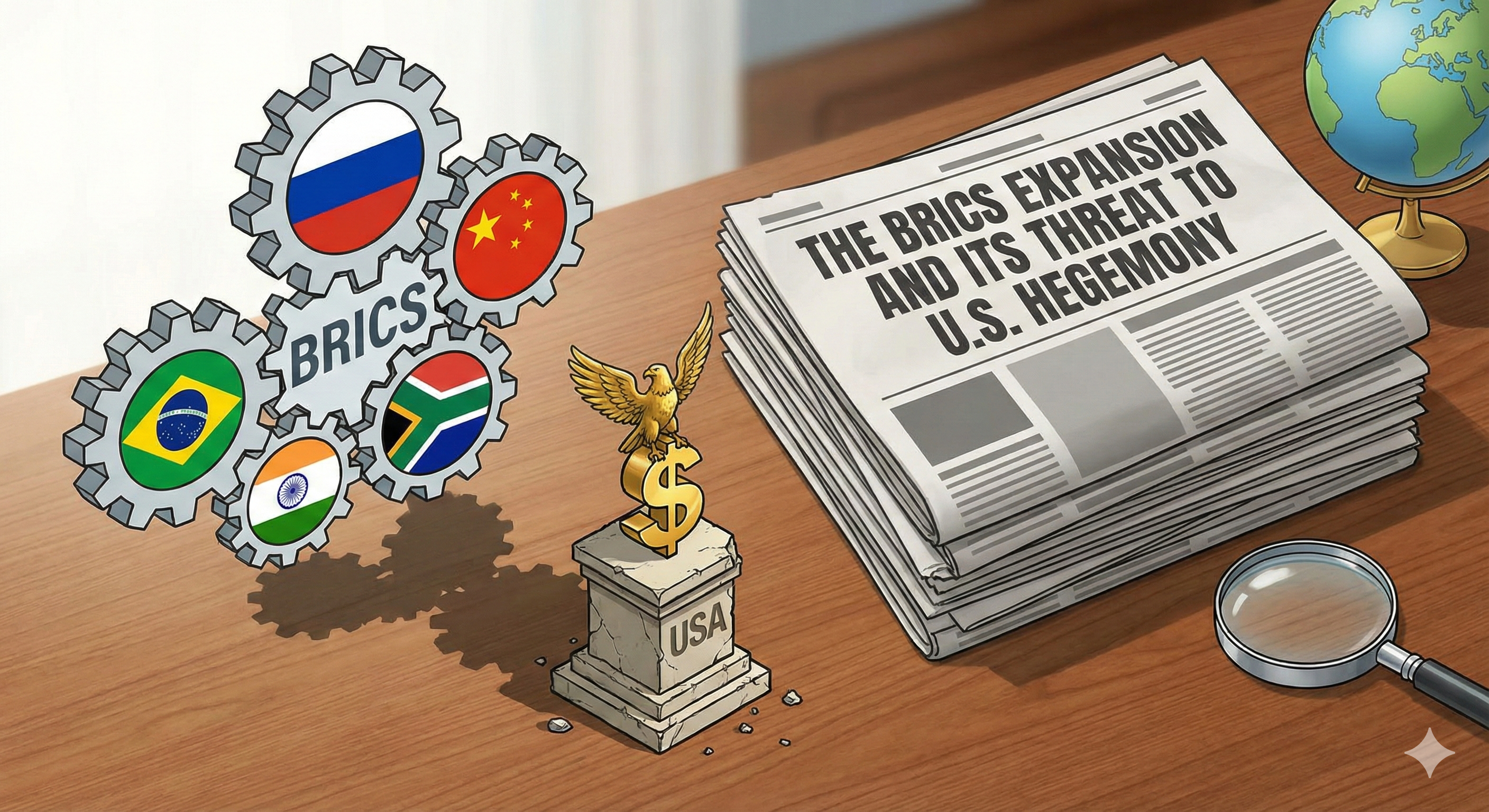
In the sweltering heat of the Caribbean, U.S. warships prowl the waters off Venezuela’s coast, a stark reminder that the ghosts of Cold War brinkmanship are far from buried. As President Trump’s administration weighs airstrikes and regime change against Nicolás Maduro’s government, the stakes extend far beyond oil fields and disputed elections. Venezuela’s overtures to join BRICS, the emerging bloc of Global South powerhouses, have ignited fears in Washington that a multipolar world is no longer a distant specter but an imminent reality. This potential flashpoint underscores a deeper geopolitical tremor: BRICS’ relentless expansion is eroding the U.S. dollar’s stranglehold as the world’s reserve currency, chipping away at America’s post-World War II hegemony one member at a time.
For decades, the dollar has been the lifeblood of global trade, sanctions, and financial leverage. As BRICS swells its ranks, nations are trading in local currencies, building parallel payment systems, and pursuing de-dollarization. The Brooks Brief’s forecast is unequivocal: the greenback faces an existential threat. If unchecked, this could cascade into economic chaos at home and abroad. Let’s unpack the bloc’s growth, its ripple effects, and the nightmare scenario of a dollar in decline.
The Core of BRICS: From Five to Ten and Beyond
BRICS began as an acronym in 2009 for Brazil, Russia, India, China, and South Africa, a loose coalition of fast-growing economies challenging Western-dominated institutions like the IMF and World Bank. These original five nations represent over 40 percent of the global population and a quarter of world GDP, with China as the undisputed heavyweight.
The real momentum came in 2023, when leaders invited new members to dilute dollar dependency. By January 1, 2024, Egypt, Ethiopia, Iran, and the United Arab Emirates formally joined, expanding BRICS to nine members and dubbing it BRICS+. This wave targeted resource-rich and strategically vital states. Egypt controls the Suez Canal, Ethiopia is Africa’s diplomatic hub, Iran wields oil leverage, and the UAE bridges East and West finance.
Fast-forward to 2025, and the bloc reached double digits. Indonesia, Southeast Asia’s largest economy, joined in January, drawn by infrastructure funding and trade diversification amid U.S.-China tensions. Today, the formal BRICS roster stands at ten: Brazil, China, Egypt, Ethiopia, India, Indonesia, Iran, Russia, South Africa, and the UAE. Collectively, they command 45 percent of the world’s population, 35 percent of global GDP at purchasing power parity, and a commanding share of energy exports.
The expansion is far from slowing. Over 20 countries have applied for full membership, with nine designated as partner countries in early 2025: Belarus, Bolivia, Cuba, Kazakhstan, Malaysia, Nigeria, Thailand, Uganda, and Uzbekistan. Others in the queue include Bahrain, Turkey, Vietnam, Sri Lanka, Mexico, and Kuwait. These applicants span Latin America, Africa, the Middle East, and Asia, united by a desire to escape dollar-centric trade traps and U.S. sanctions. Russia’s 2024–2025 chairmanship accelerated the process, culminating in a Kazan summit that greenlit partner status as a stepping stone to full integration.
How BRICS Undermines the Dollar’s Throne
At its heart, BRICS expansion strikes at the dollar’s core vulnerability: its role as the global reserve currency. Over 80 percent of international transactions and 60 percent of central bank reserves are dollar-denominated, granting the U.S. “exorbitant privilege”—cheap borrowing, sanction superpowers, and influence over global finance. BRICS is fostering alternatives. Members now settle 30 percent of intra-bloc trade in local currencies, up from 10 percent a decade ago, via systems like China’s CIPS and Russia’s SPFS. The New Development Bank, BRICS’ answer to the World Bank, has loaned $30 billion for projects, bypassing dollar loans and IMF strings.
This de-dollarization directly threatens U.S. hegemony. As more nations join, global demand for dollars declines, borrowing costs rise, and sanctions lose effectiveness. A hypothetical BRICS currency, floated in 2024, could accelerate this trend, stabilizing trade among members and eroding the dollar’s liquidity premium. Studies show intra-BRICS trade already correlates with lower dollar reserve shares in member banks.
America’s Debt and the Motivation for Resource Conflicts
The United States currently carries over $34 trillion in national debt, a figure that strains both domestic policy and global economic leverage. Servicing this debt requires significant inflows of capital, largely dependent on the dollar’s dominance. Resource-rich nations like Venezuela and Nigeria are increasingly critical to this strategy. Venezuela offers vast oil reserves and rare earth minerals essential for technology and energy sectors. Nigeria provides both oil and strategic minerals. Securing access, whether through diplomacy or military pressure, could help Washington maintain economic stability and continue financing its debt. These pressures create an incentive for U.S. policymakers to consider assertive foreign actions, particularly in regions where BRICS expansion threatens to sideline the dollar and reduce American influence over resource flows.
The Ripple Effects: What Joining BRICS Means for Nations and the World
For aspiring members, BRICS offers a lifeline from isolation. Nigeria, Africa’s top oil producer, could secure yuan-denominated deals with China, shielding itself from dollar volatility and U.S. policy influence. Malaysia and Thailand gain access to the New Development Bank for green tech and infrastructure. Cuba and Bolivia, long under U.S. sanctions, see BRICS as a sovereignty booster, while partner status builds diplomatic clout.
Broader consequences are seismic. Economically, BRICS creates a multipolar trade web: BRICS+ GDP could reach 50 percent of global output by 2030, diluting dollar pricing in commodities like oil. Politically, it provides cover for nations to hedge U.S.-China rivalry without full allegiance. For the U.S., the fallout is significant: weakened sanctions, allies like Saudi Arabia considering yuan oil sales, and Treasury demand declines, driving up interest rates.
Risks remain. Rapid growth strains cohesion—India and China have border tensions, while new members like Ethiopia face infrastructure gaps. U.S. countermeasures, including tariffs, asset freezes, or covert operations, remain possible, as Venezuela already knows.
The Dollar’s Slow Decline
Imagine the dollar gradually losing its reserve currency status. Central banks may reduce holdings of U.S. debt, yields could spike, and borrowing costs would soar. Imports would become more expensive, inflation would rise, and American households would feel the strain. Global markets would experience turbulence, emerging markets could default on dollar-denominated debt, and U.S. strategic flexibility would erode. Even a partial decline threatens both domestic stability and global influence.
The Brooks Brief Forecast: BRICS as Harbinger, Venezuela as Warning
BRICS expansion poses the gravest threat to dollar primacy since Bretton Woods. With partners like Nigeria and Thailand onboarding, intra-bloc trade could double by 2027, cutting dollar use by 20 percent. Venezuela exemplifies America’s concern. Maduro’s BRICS bid, coupled with deepening Russia-China ties, has prompted U.S. carrier deployments and strike considerations, framing Venezuela as a strategic bulwark against Beijing’s influence. Brazil’s emergency BRICS huddle signals bloc-wide alarm, with President Lula condemning U.S. tension-mongering. Escalation risks alienating the Global South, accelerating the very shifts Washington seeks to prevent.
A Multipolar Reckoning
U.S. hegemony was built on dollar supremacy, but BRICS is dismantling it from the margins. Policymakers must innovate financial tools, strengthen alliances, and engage rather than isolate. Ignore these trends, and the Venezuela flotilla becomes a prologue to a broader decline in global economic influence. The Brooks Brief will continue to monitor these developments. As the world rebalances, America must adapt or risk losing both its economic leverage and global authority.
Leave a Reply