By The Brooks Brief Staff
November 22, 2025
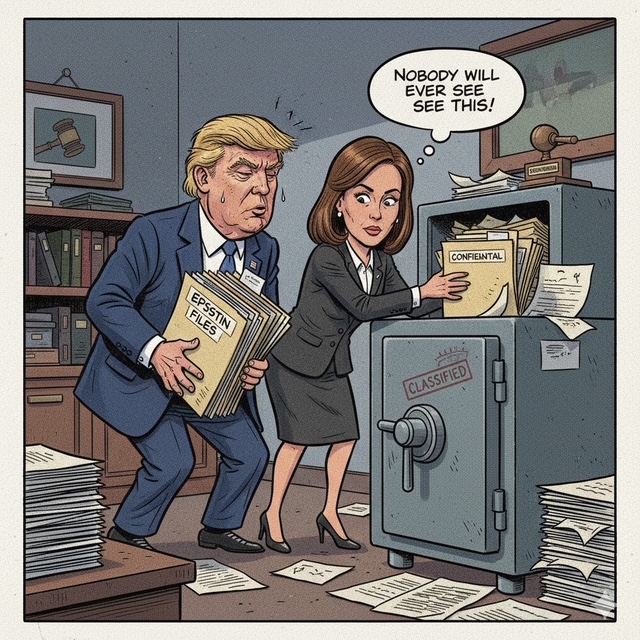
In the dim corridors of power, where fortunes are made and scandals buried, few names evoke as much dread as Jeffrey Epstein’s. The financier and convicted sex offender, who died by suicide in 2019 while awaiting trial on federal sex-trafficking charges, left behind a labyrinth of documents capable of unraveling the facades of some of America’s most influential figures. This week, with President Donald Trump’s signature on the Epstein Files Transparency Act, the clock begins ticking. The Justice Department now has 30 days to declassify and release thousands of pages from its probe into Epstein and his accomplice, Ghislaine Maxwell. For victims, it is a long-delayed opportunity for accountability. For the public, it may become a political earthquake. And for The Brooks Brief, it stands as a reminder that no one, not even a sitting president, escapes responsibility when confronting the scourge of child exploitation.
The bipartisan fervor behind this bill, which passed the House 427 to 1 and the Senate with near-unanimous approval, reflects a rare moment of unity in Washington. Republicans and Democrats have drawn a firm line against crimes involving minors. Yet as these files inch toward public release, whispers of implicated names from Bill Clinton to Prince Andrew, and even tangential references to Trump himself, underscore how high the stakes truly are. If evidence emerges pointing to complicity, legal scholars warn of potential prison terms, forfeited titles, and shattered legacies. The Brooks Brief maintains that no one should be condemned without solid evidence, but the possibility alone has political and social elites on edge.
The Epstein Enigma: A Web of Wealth and Wickedness
Jeffrey Epstein was more than a predator; he was a connector. His private island, Manhattan townhouse, and Palm Beach estate served as gathering points for presidents, princes, scientists, professors, and CEOs. Though convicted in 2008 for procuring underage girls, he avoided serious prison time through a controversial plea deal orchestrated by then-U.S. Attorney Alex Acosta. His 2019 arrest revealed the scope of his sex-trafficking network, and Maxwell’s 2021 conviction confirmed her role in grooming and abusing minors.
The documents commonly called the Epstein files include court records, FBI memos, emails, flight logs from Epstein’s private jet, and witness statements collected over nearly two decades. The first major batch was unsealed in January 2024 during Virginia Giuffre’s lawsuit against Maxwell, revealing more than 900 pages naming over 150 associates. No definitive client list emerged, but the depositions depicted Epstein’s pattern clearly: using his influence to exploit vulnerable teenage girls under the guise of “massages.”
In 2025, the story intensified. Early declassifications revealed emails between Epstein and public figures discussing philanthropy, politics, and social networks. A later release included frantic communications sent by Epstein shortly before the 2016 election, suggesting efforts to influence political outcomes through intermediaries. These revelations form part of a broader tapestry of influence, access, and illicit behavior.
The upcoming full disclosure, required under H.R. 4405, promises even more. It may include unredacted victim statements, financial records revealing the origins of Epstein’s estimated six hundred million dollar fortune, and information related to alleged intelligence ties. While many rumors remain unproven, the possibility of new evidence has both Congress and the public bracing for impact. Exceptions for ongoing investigations and national security have drawn criticism from some lawmakers who fear they could be misused to protect powerful individuals. Meanwhile, victim advocacy groups are preparing for potential backlash and increased threats as release day approaches.
Elites in the Crosshairs
The danger these files pose to the establishment is real. Epstein’s network reached across party lines and social institutions. Clinton flew on Epstein’s jet multiple times. Trump once described Epstein as a “terrific guy” before distancing himself. Prince Andrew settled a lawsuit with Giuffre, though he denied wrongdoing. A number of public figures appeared in documents or on flight manifests with no proven criminal involvement, yet proximity alone has already prompted questions and reputational damage.
In today’s political climate, where Trump has returned to the presidency, scrutiny is sharper. Opponents point to past comments and old social associations. Supporters call for full transparency, convinced the files will expose Democratic elites, even as critics claim the administration is dragging its feet on releasing the documents. Clinton’s statements of innocence remain under public pressure due to his documented connections to Epstein, further complicating the partisan landscape.
If evidence emerges showing knowledge of or participation in crimes involving minors, federal statutes impose severe penalties, including mandatory minimum sentences. Civil suits, reputation collapses, and institutional fallout could follow even for those with indirect ties.
The House Oversight Committee recently expanded its investigation to include Epstein’s enablers, such as prosecutors, executives, social connectors, and financial managers who may have helped shield him after his 2008 conviction. Epstein’s ability to move through elite circles resulted from widespread indifference and quiet acceptance of behavior that should have raised alarms.
Theories and Guardrails: Speculation Without Verdicts
Online speculation has flourished for years. Some theories involve espionage, blackmail tapes, or secret client lists. Others resurrect old conspiracy narratives. The Brooks Brief stresses that speculation, no matter how intriguing, must never replace evidence. Many widely circulated claims are not supported by any verified documents. Even the idea of a definitive “client list” has consistently proven false, despite resurfacing in public discourse.
Concerns about cover-ups persist due to Epstein’s death in federal custody under questionable circumstances and Maxwell’s sealed exhibits. However, recent releases emphasize protecting victim identities, which explains some redactions.
Transparency must be balanced with the safety and dignity of survivors. This process should illuminate the truth, not become a witch hunt.
A Societal Reckoning Beyond Politics
The release of the Epstein files is not simply a political issue. It is a societal reckoning. The survivors of Epstein’s crimes, now adults grappling with trauma, deserve answers and recognition. The disclosures may push forward legislative reforms, such as extending statutes of limitations for child abuse cases, enforcing stricter oversight of elite nonprofits, and increasing penalties for enablers.
For the powerful, it sends a message: proximity to wrongdoing invites scrutiny, and status offers no shield from accountability. The world is watching, and consequences may reach across borders and political parties.
The Brooks Brief Forecast: Justice Delayed but Not Denied
At The Brooks Brief, we anticipate a turbulent December. Expect leaks, lawsuits, political clashes, and intense media attention. Bipartisan commitment to justice may hold, though influential actors will likely attempt to delay or dilute the release. While the files may not topple every figure in Epstein’s orbit, they may end the careers and reputations of some, reminding us that no pedestal is permanent.
In the struggle between power and accountability, sunlight remains the best disinfectant. As the nation prepares for what may emerge, one truth stands firm: no elite is beyond the reach of justice. Evidence will speak. Let it speak loudly.
Leave a Reply