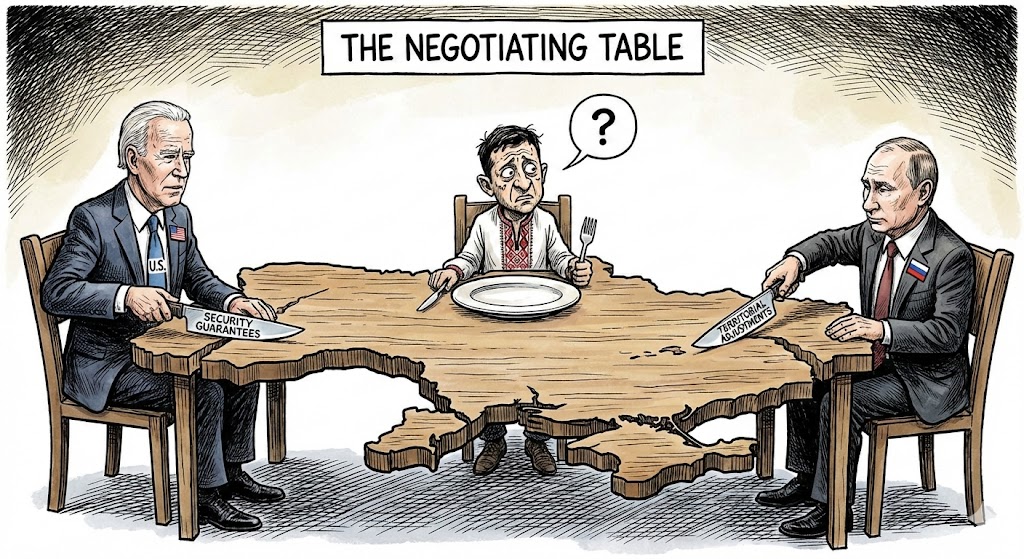
As the war in Ukraine drags into its fourth year, a major shift in international diplomacy is taking shape. In late November 2025, reports emerged of a draft 28-point peace plan, spearheaded by the United States under President Donald Trump with significant input from Russian negotiators. This framework, sent to Kyiv and Moscow, aims to broker an end to the conflict but demands steep concessions from Ukraine, including territorial cessions and military limitations. While some have hailed it as a pragmatic path to peace, it has ignited fierce debate, with Ukrainian President Volodymyr Zelenskyy warning that rejecting the plan could mean losing America’s support altogether. Russia appears poised to accept, waiting for Ukraine’s response or proposed amendments. At its core, the plan reflects not only the exhaustion of endless warfare but also the deeper geopolitical fault lines that have simmered since the end of the Cold War.
To understand the stakes, one must look back at the conflict’s origins. The Russo-Ukrainian War erupted on February 24, 2022, when Russian forces launched a full-scale invasion, citing the need to “denazify” and demilitarize Ukraine while protecting Russian-speaking populations in the Donbas region. But the roots trace back decades. Ukraine’s 2014 Euromaidan Revolution ousted pro-Russian President Viktor Yanukovych, prompting Russia to annex Crimea and fuel separatist unrest in eastern Ukraine. Moscow framed these actions as defensive measures against Western encroachment, particularly NATO’s eastward expansion.
This expansion is central to the long-standing tension between Russia and NATO. The North Atlantic Treaty Organization, formed in 1949 as a bulwark against Soviet aggression, initially pledged not to encroach on spheres of influence. Yet after the Soviet Union’s collapse in 1991, NATO welcomed former Warsaw Pact nations and even former Soviet republics into its fold. By 2004, seven Eastern European countries had joined, followed by Albania and Croatia in 2009 and Montenegro and North Macedonia in 2017 and 2020. From Russia’s perspective, this was not a benign alliance-building exercise. It represented an existential security risk. The alliance’s Article 5, which guarantees collective defense, now extended to borders mere hundreds of miles from St. Petersburg, evoking memories of historical invasions. Russian leaders, from Boris Yeltsin to Vladimir Putin, repeatedly argued that NATO’s growth violated informal assurances given during German reunification talks in 1990, when U.S. officials reportedly promised that NATO would not expand eastward.
These fears were not simple paranoia. For a nuclear-armed state with a history of catastrophic losses in the Second World War, the prospect of hostile military infrastructure in former buffer zones was intolerable. Although NATO and Russia signed a founding act in 1997 seeking partnership, military exercises near Russia’s borders and missile defense systems in Poland and Romania heightened tensions. By 2022, Ukraine’s NATO aspirations, enshrined in its constitution, served as the invasion’s justification, with Russia demanding legal guarantees against further enlargement.
Ironically, Russia once flirted with joining the very alliance it now condemns. In the early 1990s, Yeltsin proposed the idea of Russian NATO membership, imagining it as a bridge to the West. Putin echoed this sentiment in 2000, suggesting that Russia could join if treated as an equal. High-level talks followed. In 2002, Putin and NATO leaders explored cooperation on counterterrorism after the attacks of September 11. But these overtures faded. Western leaders, wary of empowering a resurgent Russia, focused instead on containing its influence. As NATO expanded without Moscow, trust eroded. Russia’s 2008 intervention in Georgia and its 2014 annexation of Crimea sealed the rift, turning a potential partnership into perpetual antagonism.
Against this backdrop comes the 28-point peace plan, a document shaped by Trump’s deal-making approach and inspired by his recent ceasefire success in Gaza. Leaked details show a framework blending American incentives, Russian demands, and Ukrainian compromises. Key provisions include:
- Confirmation of Ukraine’s sovereignty over remaining territory, excluding Crimea and parts of Donbas already under Russian control, along with additional eastern lands ceded to Moscow.
- A non-aggression pact among Russia, Ukraine, and European states, with Ukraine renouncing NATO membership indefinitely.
- Caps on Ukraine’s military at 600,000 personnel, no foreign troops on its soil, and limits on offensive weaponry.
- Economic incentives including $100 billion from frozen Russian assets funneled into U.S.-led reconstruction and a long-term U.S.-Ukraine pact for joint development of energy and natural resources. This includes critical minerals like lithium and titanium that are vital for green technologies and battery production.
- Security guarantees for Ukraine through multilateral pacts, with commitments from the United States and Europe to intervene if Russia violates the agreement.
In essence, Ukraine trades land and autonomy for peace and investment. Russia withdraws from occupied areas beyond the ceded zones, demilitarizes its border, and pledges non-interference. The plan’s relative brevity belies its ambition, as it sidesteps war crimes accountability and refugee returns to focus on pragmatic stabilization.
Critics argue that the plan reads like a Russian wishlist disguised as compromise. European allies including Britain, France, and Germany have countered with their own 28-point proposal, demanding stronger sanctions enforcement and reaffirming NATO’s open door policy. Trump’s deadline adds urgency, with U.S. officials citing progress in Geneva talks.
Why the U.S. push? Beyond war fatigue, strategic calculations loom large. Since 2022, the United States has funneled more than $175 billion in aid to Ukraine, straining federal budgets amid domestic priorities. Ending the conflict halts this financial drain. The deal also unlocks Ukraine’s vast untapped wealth, estimated at $12 trillion in minerals, natural gas, and agricultural resources, for American firms. Energy giants have long eyed Ukrainian territories, and the plan’s resource-sharing provisions accelerate their entry, countering China’s growing influence through its Belt and Road Initiative. In this light, peace becomes a pathway to profit, with Ukraine in a subordinate economic role.
Russia, having rebuffed prior talks in Istanbul, now waits for Kyiv’s response. Putin has called the plan a step forward while signaling openness to negotiated amendments. With over 20 percent of Ukrainian territory currently under Russian control, Moscow believes its battlefield leverage and America’s shifting attention give it the advantage.
For Ukraine, accepting the plan means painful concessions. Beyond the loss of land, military downsizing increases vulnerability, and NATO renunciation shatters long-held aspirations of Euro-Atlantic integration. Zelenskyy, once defiant, now suggests the country may lose a key ally if it rejects the proposal. Polls show a majority of Ukrainians oppose territorial concessions, yet years of intense fighting, heavy casualties, and mass displacement have created a climate of resignation. Kyiv may seek amendments such as phased withdrawals, transparency on frozen assets, or accelerated EU membership to soften the blow.
As negotiations continue in Geneva, the plan tests alliances on both sides of the Atlantic. Trump insists it is not final, allowing room for revisions amid political pressure at home. European leaders worry that rewarding territorial aggression sets a dangerous precedent that could embolden threats to the Baltic states. Still, if finalized, the plan could stabilize a volatile region, redirecting global attention toward other challenges such as Taiwan and climate cooperation.
Ultimately, the 28 points embody the war’s tragedy. What began as a complex clash of identity, sovereignty, and security has evolved into a geopolitical bargain shaped by exhaustion, mistrust, and resource competition. For Ukraine, the choice is between survival and sovereignty. For Russia and NATO, the agreement offers a temporary truce rather than lasting reconciliation. As winter approaches, the world watches to see whether Kyiv will accept the bitter pill or reject what may be the last viable path to peace.
Leave a Reply