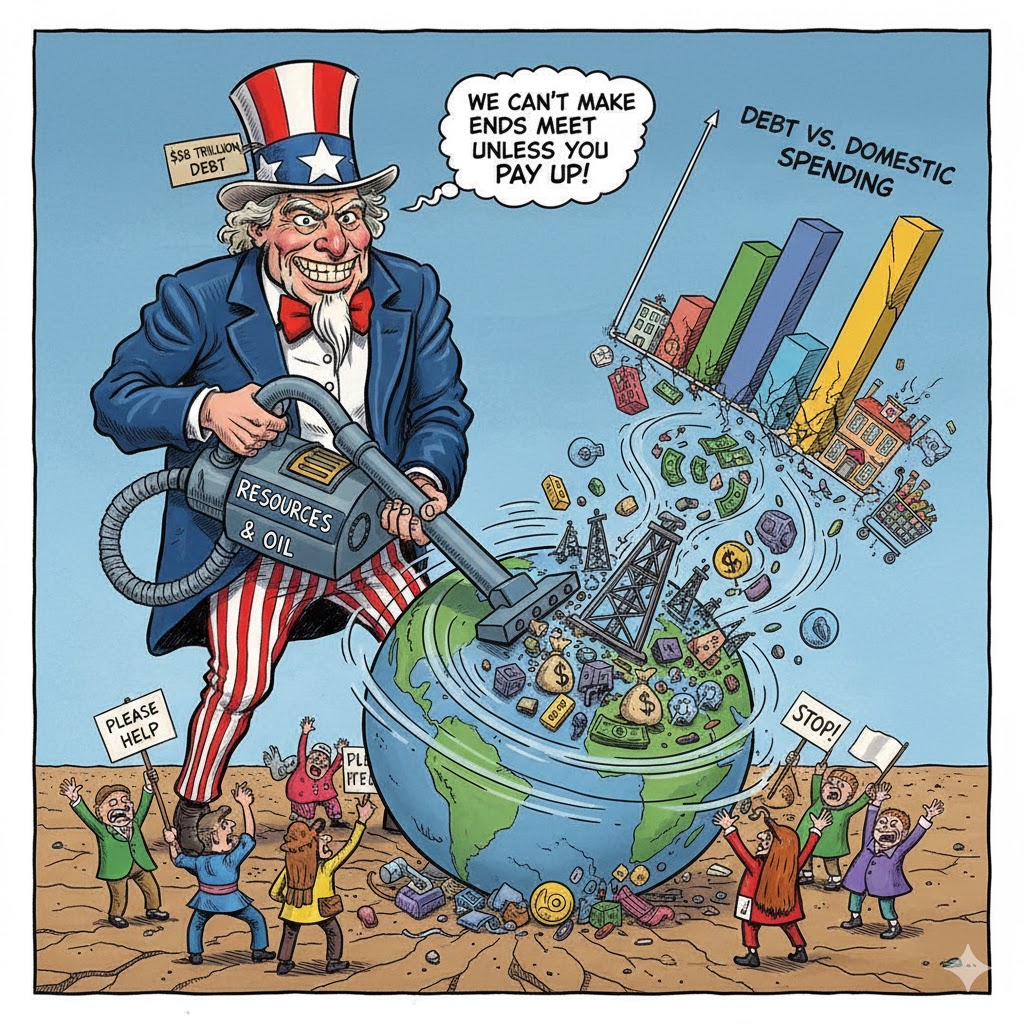
In November 2025, the United States faces a national debt that has surpassed $38 trillion. This staggering figure represents more than 100 percent of the country’s GDP. The mounting debt, fueled by years of deficit spending, tax cuts, and emergency economic measures, is no longer just a ledger entry. It is reshaping American foreign policy in profound ways. As interest payments consume an ever larger share of the federal budget and are projected to reach $1.2 trillion annually by the end of the decade, the pressure to secure economic advantages abroad intensifies. Analysts warn that this fiscal strain could push the United States toward more assertive and even hostile stances against resource rich nations. This echoes historical moments when economic desperation influenced geopolitical strategy. At home, the debt casts a long shadow over social programs and forces painful cuts that affect millions. While policymakers debate inflation, the spiraling debt has emerged as a true existential threat that could weaken America’s global standing and internal stability.
Historical Echoes: The Iraq Invasion and the Thirst for Oil
To understand where U.S. foreign policy might be headed under growing fiscal pressure, it helps to revisit the 2003 invasion of Iraq. Officially framed as a response to weapons of mass destruction and terrorism, the conflict has long been scrutinized for its underlying motives related to oil. Iraq sits atop some of the world’s largest proven oil reserves, and its industry was heavily nationalized prior to the war. Once the invasion ended Saddam Hussein’s regime, Iraq’s oil sector opened to Western companies that secured lucrative contracts and expanded global supply. Critics, including former Federal Reserve Chairman Alan Greenspan, have argued that the war was largely about oil, since securing access could stabilize prices and reduce reliance on foreign suppliers.
The invasion occurred at a time when U.S. debt was rising in the aftermath of 9/11, and military spending added trillions more. Yet the economic rationale was clear. Controlling Iraqi oil could help offset fiscal strain by ensuring cheaper energy imports and strengthening allied economies. This pattern of resource driven intervention remains a warning today. As debt climbs, similar impulses may resurface, targeting nations whose natural resources could help alleviate America’s economic burdens.
Current Flashpoints: Aggression Toward Venezuela and Nigeria
Fast forward to 2025 and signs of heightened U.S. assertiveness are emerging in dealings with Venezuela and Nigeria. Venezuela holds the largest proven oil reserves on Earth and has faced escalating pressure from the Trump administration. Recent U.S. actions have included a new phase of covert operations, increased intelligence activity, and legal designations aimed at destabilizing the Maduro regime. Measures such as labeling Venezuelan government linked groups as terrorist organizations, conducting maritime strikes, and even considering psychological warfare tactics all point to a more aggressive posture.
Many analysts argue that the underlying goal extends beyond promoting democracy. The United States may seek a government that is more aligned with American interests, especially if such a shift would open Venezuelan oil to U.S. markets. Maduro’s threats against neighboring Guyana, another emerging oil hotspot, have only heightened tensions and created opportunities for Washington to position itself as both a stabilizing force and a strategic beneficiary.
A similar pattern is developing with Nigeria, Africa’s largest oil producer. The Trump administration has redesignated Nigeria as a Country of Particular Concern over religious freedom issues, which opens the door to sanctions and expanded military involvement. Discussions of troop deployments and a $346 million weapons sale signal a shift toward a more aggressive policy. Although framed in terms of security and human rights, this pivot coincides with America’s need for reliable access to Nigeria’s oil as debt servicing demands more federal resources. The United States remains one of Nigeria’s top investors in petroleum, and deeper involvement could ensure more stable supplies and lower import costs.
These examples show how debt driven assertiveness manifests today. It does not always take the form of a full scale invasion. Instead, it emerges through escalating pressure, strategic partnerships, sanctions, and selective displays of military power aimed at securing resource access.
Domestic Fallout: Slicing Social Safety Nets
America’s aggressive pivot abroad is mirrored at home by sweeping austerity measures. In fiscal year 2025, the federal deficit reached $1.8 trillion, prompting sharp cost cutting. The One Big Beautiful Bill Act, led by Republican lawmakers, has triggered major reductions in food assistance, health care, education, and student loans. These are the largest cuts to social programs in U.S. history. Medicaid and SNAP face reductions of hundreds of billions of dollars over the coming decade, potentially stripping coverage from millions of low income Americans and triggering widespread job losses in the health care sector.
Medicare also faces major cuts, further burdening elderly and vulnerable populations. Although tariff revenues reached a record $195 billion in 2025, they are nowhere near enough to counterbalance rising debt costs. As interest rates on U.S. debt increase and the cost of servicing that debt grows, social programs become easy targets. Funds are diverted away from welfare and toward meeting financial obligations. The result is a society where fiscal priorities fuel widening inequality and weaken the foundations of the American dream.
The True Battle: Debt Over Inflation
While the Federal Reserve continues its battle against inflation, which hovered near 3 percent in late 2025, the national debt poses a more serious long term threat. Some financial analysts argue that escaping the $38 trillion debt trap may require accepting higher inflation to erode the real value of the debt. This approach carries risks for the independence of the Federal Reserve and could undermine long term economic stability. High levels of debt also threaten to crowd out private investment and push interest rates even higher. Government spending remains a primary driver of economic growth, but that growth increasingly relies on unsustainable borrowing. Debt grew by an astonishing $2.2 trillion in FY2025 alone. If left unaddressed, this pattern could create a vicious cycle that pushes the United States toward more aggressive foreign policies, deeper cuts at home, and a gradual erosion of global trust.
A Precarious Path Forward
America’s high national debt is far more than an economic statistic. It is a force that is reshaping the nation’s foreign policy and domestic landscape. From Iraq to Venezuela and Nigeria, the pattern of resource focused intervention continues. At home, millions face rising hardships as social safety nets fray. As inflation debates rage, the debt spiral demands urgent reform. Solutions might include balanced budgets, targeted tax reforms, or innovative financial strategies. Without decisive action, the debt will continue to push America toward more conflict abroad and deeper inequality at home. The question is not whether the debt will reshape the nation. The question is how far it will push the boundaries of power, policy, and sacrifice.
Leave a Reply