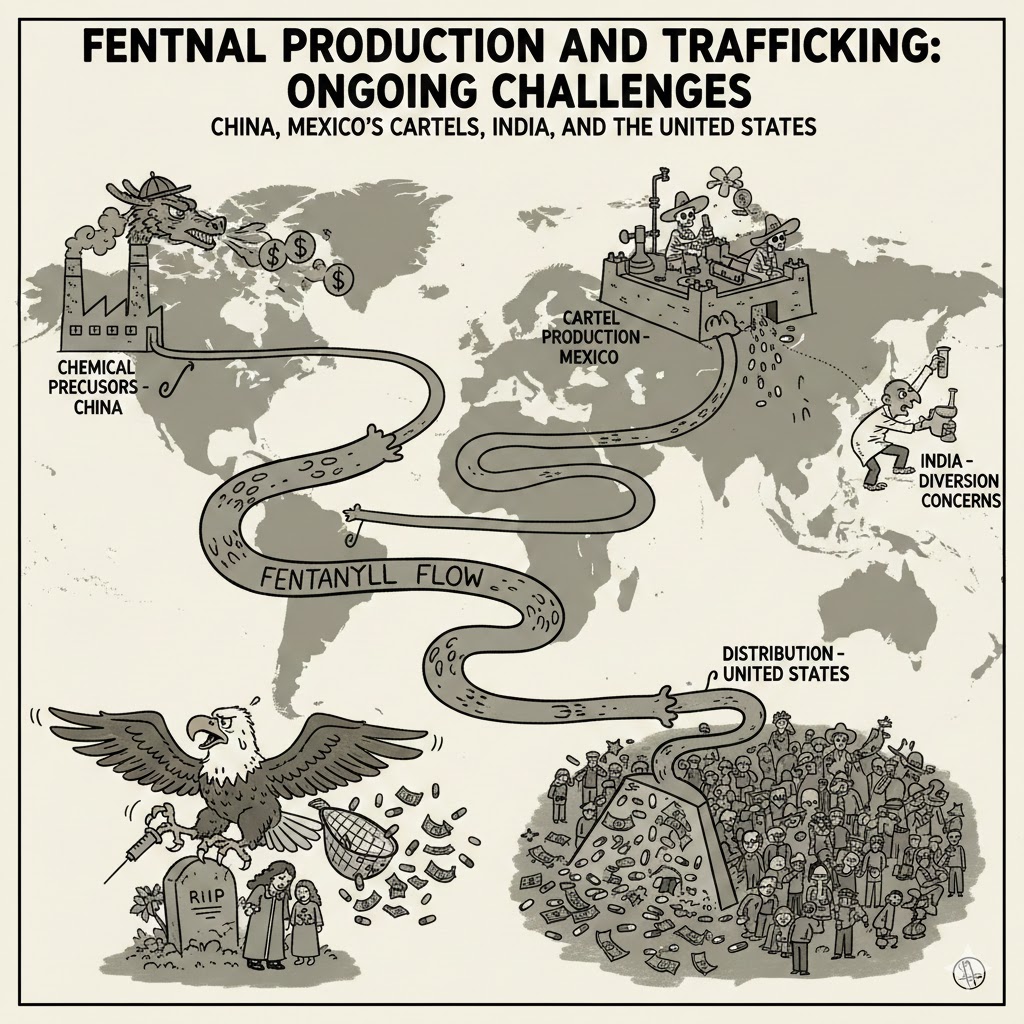
Ongoing Challenges Involving China, Mexico’s Cartels, India, and the United States
I. Introduction
Fentanyl, a synthetic opioid up to 100 times more potent than morphine, has entrenched itself as the dominant force in the United States’ ongoing opioid epidemic, far surpassing the threats posed by prescription painkillers or heroin in prior decades. This shift, accelerating since the mid-2010s, has transformed the crisis into a geopolitical flashpoint that intertwines public health with international relations, border security, and trade policy. Provisional data from the Centers for Disease Control and Prevention (https://www.cdc.gov/media/releases/2025/2025-cdc-reports-decline-in-us-drug-overdose-deaths.html ) indicates a sharp decline in U.S. drug overdose deaths, with approximately 87,000 fatalities recorded from October 2023 to September 2024. This represents a nearly 24 percent drop from the previous year’s roughly 114,000 deaths. Synthetic opioids such as fentanyl were implicated in about 69 percent of these deaths in 2023, with a similar share persisting into 2024 despite the broader reduction.
Globally, the United Nations Office on Drugs and Crime World Drug Report 2025 (https://www.unodc.org/documents/data-and-analysis/WDR_2025/WDR25_B1_Key_findings.pdf ) highlights a surge in drug users to 316 million worldwide, a 28 percent increase over the past decade, underscoring how global instability exacerbates the proliferation of synthetic opioids. Despite recent declines in U.S. overdose deaths, the fentanyl supply chain remains resilient. It is allegedly fueled by precursor chemicals sourced primarily from China and increasingly India, large-scale manufacturing by Mexican cartels such as the Sinaloa Cartel and the Jalisco New Generation Cartel, and steady smuggling into the United States. This persistence continues to strain diplomatic relationships and has prompted aggressive U.S. policy responses, including the designation of major cartels as terrorist organizations in early 2025. While enforcement and controls have reduced fatalities, the adaptability of the fentanyl ecosystem demands sustained and coordinated international action to prevent future resurgence.
II. Current State of Fentanyl Production and Supply
The global fentanyl landscape is defined by most U.S. government agencies as illicit manufacturing concentrated in Mexico and dependent on imported precursor chemicals, with no significant production documented in regions such as South America. United Nations data from 2025 emphasizes that organized crime groups consistently exploit crises and instability to sustain production and expand markets, even amid intensified controls. In the United States, overdose deaths involving fentanyl declined by roughly 25 percent between 2023 and 2024. Nevertheless, the drug remains extraordinarily lethal and is frequently found in counterfeit pills designed to mimic legitimate pharmaceuticals such as oxycodone.
Mexico serves as the primary synthesis hub, where the Sinaloa Cartel and the Jalisco New Generation Cartel allegedly operate clandestine laboratories that produce millions of counterfeit pills and large quantities of powder fentanyl. These products are often mixed with adulterants such as xylazine to enhance potency, reduce costs, and differentiate cartel supplies. China has historically supplied the majority of precursor chemicals and equipment, including pill presses, though regulatory crackdowns have reduced direct exports, allegedly. India has increasingly filled this gap, emerging as a key alternative supplier. U.S. intelligence agencies have identified India as the second-largest source of fentanyl precursors and manufacturing equipment, with indictments in January 2025 targeting Indian chemical firms accused of supplying materials destined for U.S.-bound fentanyl production.
The United States remains the primary consumption market, with minimal domestic production. Nearly all fentanyl is imported, contributing to widespread polydrug contamination. Around one in four cocaine samples tested in the U.S. now contains fentanyl (https://www.sciencedirect.com/science/article/pii/S0376871623012231), greatly increasing overdose risk. The drug’s extreme potency allows traffickers to move highly profitable quantities in small volumes, while declining purity levels have pushed cartels to experiment with additives such as nitazenes. These adaptations maintain high lethality even as law enforcement seizures increase.
III. National Roles and Control Efforts
China has played a central role in the global precursor supply but has taken notable steps to restrict fentanyl related exports. These include class-wide scheduling of fentanyl analogs in 2019 and a November 2025 requirement for export licenses covering 13 chemicals shipped to the United States, Mexico, and Canada. These measures signal improved bilateral cooperation amid gradually thawing diplomatic tensions. However, chemical suppliers have continued to evade restrictions through the development of new “designer” compounds that fall outside existing regulations, sustaining flows to Mexican laboratories, allegedly.
India’s expansive pharmaceutical and chemical sectors have also been implicated in precursor diversion. This has prompted tighter domestic controls and U.S. indictments in 2025 against firms accused of knowingly supplying cartels. In March 2025, the Drug Enforcement Administration targeted an India-based company for unlawful precursor shipments. The Mexican government, meanwhile, continues to confront corruption and cartel influence. The government has expanded precursor watchlists and deployed 10,000 National Guard troops to strategic border regions, contributing to record drug seizures in 2024.
The United States has intensified enforcement efforts under the Trump administration, including the designation of the Sinaloa Cartel, the Jalisco New Generation Cartel, and associated groups as Foreign Terrorist Organizations in February 2025. This move enabled expanded sanctions and enhanced intelligence sharing, facilitating joint operations such as the January 2025 arrest of a major trafficker through U.S.-Mexico cooperation. Despite these actions, enforcement efforts continue to face the so-called balloon effect, where pressure in one region displaces activity elsewhere, as seen in India’s rising prominence and cartel franchise expansion.
IV. Trafficking Routes and Global Flow
Fentanyl precursors are allegedly shipped from China and India to Mexican Pacific ports such as Manzanillo. From there, it is alleged the Sinaloa Cartel and the Jalisco New Generation Cartel synthesize fentanyl and smuggle it across the U.S.-Mexico border. Trafficking methods may include private vehicles at ports of entry, tunnels, commercial freight, and increasingly drones. Cartels may also rely on social media platforms for distribution, money laundering coordination, and recruitment, operating networks that span more than 40 countries and major U.S. cities including Los Angeles and Chicago.
While minor trafficking routes may include direct mail shipments from Asia or transit through Canada, the southwest border accounts for approximately 80 percent of U.S. fentanyl seizures. Emerging trends include widespread xylazine adulteration, now present in over 40 percent of tested samples, and the spread of nitazenes into Europe and Africa. Polydrug combinations have further heightened overdose risks. Declines in U.S. overdose deaths have been linked to tighter precursor controls and enforcement operations such as Customs and Border Protection’s Plaza Spike initiative in 2024. Nonetheless, cartel innovation and logistical flexibility continue to ensure supply continuity.
V. Broader Challenges and Impacts
The public health consequences of fentanyl trafficking remain severe. Synthetic opioids account for roughly 69 percent of U.S. overdose deaths, disproportionately affecting individuals aged 18 to 45. Xylazine contributes to severe tissue necrosis, while nitazenes significantly increase lethality when combined with other substances. From a security perspective, cartel violence in Mexico remains pervasive. Criminal groups are estimated to exert influence over roughly one-third of the country’s territory, fueling murder, extortion, and displacement. The fragmentation of the Sinaloa Cartel following the 2024 arrest of figures such as Ismael “El Mayo” Zambada has further intensified violence.
Allegedly, money laundering networks linked to China and the use of cryptocurrency sustain cartel operations. These practices have prompted U.S. Financial Crimes Enforcement Network actions against Mexican financial institutions in 2025. Economically and diplomatically, the fentanyl crisis has been used to justify U.S. tariffs on China, Canada, and Mexico, even as overdose rates decline. Tensions persist over enforcement responsibilities, and trilateral cooperation has been strained by the designation of cartels as terrorist organizations. Regulatory challenges also remain, particularly concerning dual-use chemicals and entrenched corruption across supply chains.
VI. Potential Solutions and Future Outlook
Effective responses require enhanced monitoring of precursor chemicals, deeper intelligence sharing, and expanded harm reduction tools such as naloxone distribution and drug checking technologies. Demand side strategies, including expanded access to treatment and recovery services, remain essential. International cooperation is critical, with efforts such as expanded United Nations drug scheduling and resumed U.S.-China counternarcotics talks playing a key role. U.S.-Mexico extraditions increased in 2025, facilitating high-profile arrests and disrupting trafficking networks.
Policy approaches should increasingly prioritize public health over militarization, while investing in economic development and alternative livelihoods in cartel-dominated regions of Mexico. Addressing poverty, inequality, and institutional corruption is essential to reducing the incentives that sustain organized crime. While recent declines in overdose deaths suggest cautious optimism, the continued adaptability of cartels and the ease of precursor diversion pose significant risks. Without sustained, coordinated action, the crisis could shift toward even deadlier synthetic substances.
Thanks for reading The Brooks Brief Substack! This post is public so feel free to share it.
VII. Conclusion
The alleged fentanyl supply chain, driven by precursors from China and India, large-scale cartel production in Mexico, and trafficking into the United States, has experienced notable disruptions in recent years. Declines in overdose deaths and increased seizures in 2024 reflect meaningful progress in enforcement and regulation. However, this interconnected and adaptive system demands a comprehensive response that combines aggressive action against trafficking organizations, global regulatory coordination, and health-centered interventions. Only through sustained, multifaceted strategies can long-term progress be secured against the evolving threat of synthetic opioids.
Leave a Reply