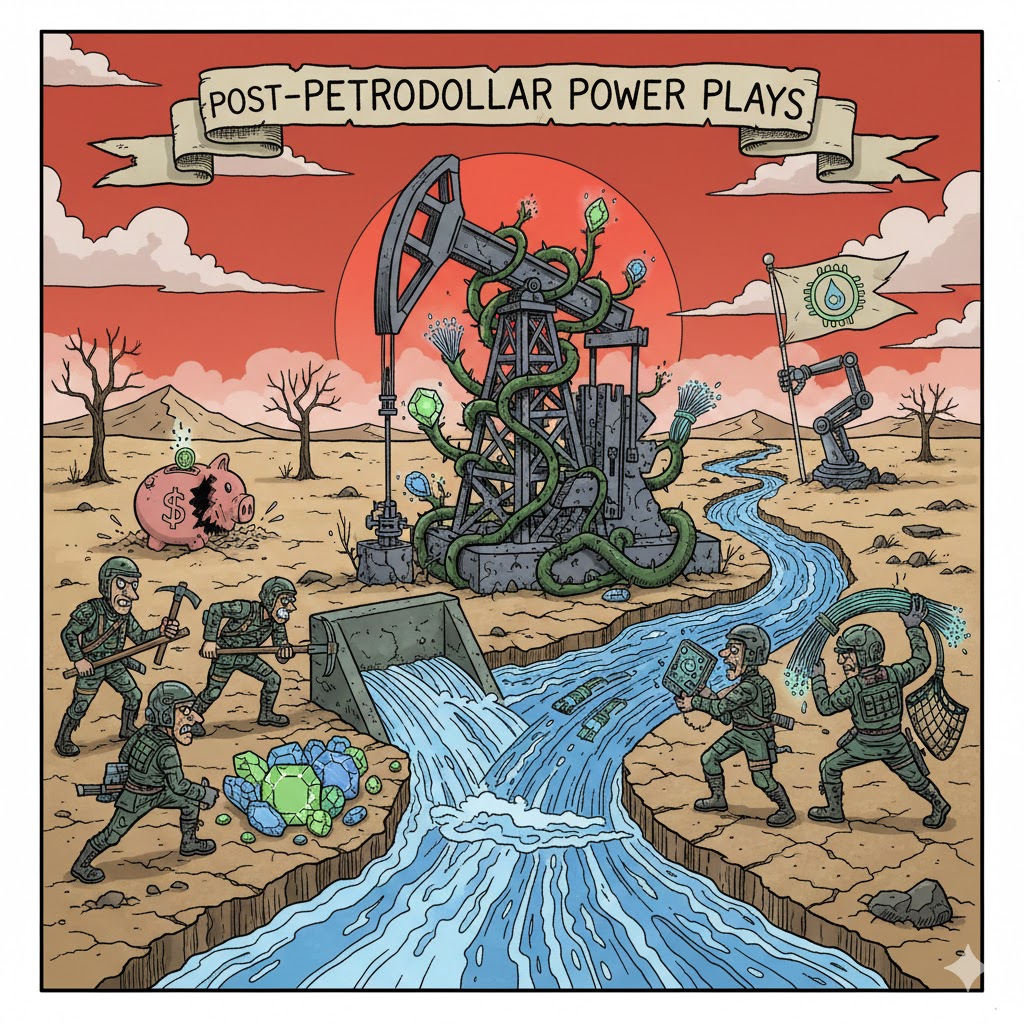
The Post-Petrodollar World
I. Introduction
Imagine a world where the flow of water from a single dam sparks threats of war between nations, or where a country’s decision to restrict exports of obscure minerals halts the production of electric vehicles and military hardware worldwide. This is no longer speculative. It is the emerging reality of a post-petrodollar era. As oil’s grip on global finance loosens, scarcities in essential resources such as water, rare earth elements, and food are poised to ignite both domestic unrest and international confrontation. In this shifting landscape, marked by the erosion of the U.S. dollar’s dominance in energy trade, nations are scrambling to secure alternatives, often at the expense of others.
The thesis is clear. In a post-petrodollar world, where the U.S. dollar no longer exclusively underpins global energy transactions, scarcities in water, rare earths, and food supply chains will intensify domestic inequality and geopolitical rivalry, fundamentally reshaping global alliances and power structures. This analysis explores these dynamics through key case studies, highlighting how de-globalization, climate change, and population pressures magnify conflict. The post-petrodollar world refers to the gradual breakdown of the system established in the 1970s, in which oil was priced in dollars and surplus revenues were recycled into U.S. financial markets, reinforcing American hegemony. Today, with major producers accepting alternative currencies and BRICS nations advancing parallel financial systems, control over physical resources is becoming the new battlefield.
II. The Post-Petrodollar Context: From Oil to Multifaceted Resource Dependencies
The petrodollar system emerged in the 1970s amid OPEC crises and required oil sales to be conducted in U.S. dollars, ensuring global demand for the currency and enabling the United States to finance deficits through recycled surpluses. Its decline accelerated in the 2020s. Russia expanded non-dollar oil sales following post-2022 sanctions, Saudi Arabia formally ended its decades-long dollar-centered energy agreement with Washington, and BRICS expansion signaled a shift toward multipolar finance. By 2025, the dollar may have fallen more than nine percent against major currencies, marking its worst decline in years amid intensifying geopolitical fragmentation. The dollar’s share of global foreign exchange reserves may have dropped to under 58 percent, a sharp fall from its dominance at the turn of the century.
This erosion has exposed vulnerabilities extending far beyond oil. Nations once insulated by petrodollar liquidity now face direct competition for essential goods, a trend exacerbated by supply chain disruptions from the COVID-19 pandemic and the war in Ukraine. By 2025, non-dollar oil trade had increased significantly, with China and India leading efforts to bypass U.S. financial leverage. Geopolitically, this transition is reinforcing a U.S.-China-Russia divide in which access to resources increasingly functions as a proxy for power. While policy efforts to revive oil leverage persist, the structural weakening of the petrodollar system is unmistakable. As renewable energy reduces oil’s centrality, conflict is shifting toward water, minerals, and arable land.
III. Water Scarcity: The Thirst for Power
Water stress already affects billions of people and is projected to intensify by mid-century due to climate change and urbanization. Agriculture alone consumes roughly 70 percent of global freshwater, making shortages a potent trigger for unrest. Domestically, disputes over the Colorado River in the U.S. Southwest have pitted states against one another amid prolonged drought, deepening political polarization. In India, irrigation inequities have fueled mass farmer protests, weakening government legitimacy and stability.
Internationally, the Nile River illustrates how water scarcity can escalate into geopolitical crisis. Ethiopia’s Grand Ethiopian Renaissance Dam, inaugurated in 2025, gives Addis Ababa significant control over the Blue Nile, which supplies the vast majority of Egypt’s freshwater and a substantial share of Sudan’s. Heavy rains that year led to flooding downstream, with Egyptian officials accusing Ethiopia of reckless water releases. Ethiopia countered that regulated flows prevented worse damage. Diplomatic talks stalled as Egypt framed the dispute as an existential threat and invoked its rights under international law. Similar dynamics are unfolding along the Mekong River, where upstream dam construction has disrupted fisheries and agriculture across Southeast Asia.
In a post-petrodollar world, water-rich states gain new leverage, while arid nations face compounding vulnerabilities. Without binding international frameworks, these disputes risk devolving into proxy conflicts, with non-state actors exploiting grievances to recruit and destabilize already fragile regions.
IV. Rare Earth Elements: The New Strategic Minerals
Rare earth elements are foundational to modern technology, powering electric vehicles, renewable energy systems, and advanced weapons platforms. China dominates global processing capacity, creating critical chokepoints in supply chains. Domestically, efforts to expand rare earth mining in the United States have sparked political battles between environmental protection and national security priorities. Similar tensions have emerged in Australia, where indigenous land rights conflict with extraction efforts.
Globally, China’s export restrictions on rare earth elements in 2025 sent shockwaves through international markets. Restrictions imposed in stages targeted both raw materials and finished components, disrupting production lines across Europe and East Asia. Although some measures were temporarily eased amid diplomatic negotiations, shortages exposed the fragility of global manufacturing. These actions echoed earlier disputes, but on a scale capable of triggering prolonged trade conflicts and cyber competition over technological dominance.
As the petrodollar fades, resource-poor economies increasingly seek bilateral access agreements, particularly in Africa and Latin America. Scarcity-driven price increases threaten to slow green energy transitions and widen inequality. While alliances aimed at supply diversification offer partial mitigation, systemic vulnerabilities remain and raise the risk of escalating economic warfare.
V. Food Supply Chains: Hunger as a Weapon
Global food systems depend heavily on a small number of exporters, leaving them acutely vulnerable to climate shocks and trade disruptions. Acute food insecurity has continued to rise, driven by conflict, extreme weather, and economic instability. Domestically, supply breakdowns during the pandemic exposed structural weaknesses, contributing to labor unrest and political backlash. In Europe, agricultural policy disputes have fueled anti-establishment movements.
Internationally, the lingering effects of disrupted grain exports have deepened food crises across parts of Africa and the Middle East. Trade tensions, disease outbreaks, and climate events have compounded volatility, driving price spikes and migration pressures. As exporters increasingly demand non-dollar payments, food itself becomes a geopolitical lever.
Post-petrodollar fragmentation heightens the risk that food scarcity will be weaponized. Competition over bioengineering, fertilizer access, and arable land could intensify conflict, even as a significant portion of global food production continues to be wasted.
VI. Interconnections and Broader Dynamics: How Scarcity Amplifies Conflict
Resource scarcities are deeply interconnected. Water shortages disrupt mineral extraction, while droughts undermine food production, creating reinforcing cycles that accelerate de-globalization. Technological solutions such as desalination and vertical farming offer potential relief, but unequal access risks deepening global divides.
Future outcomes range from cooperative international agreements to pessimistic scenarios involving proxy conflicts in strategically vital regions. Domestic scarcity often spills across borders through migration, fueling political instability and border tensions. Managing these pressures requires balancing security, sustainability, and affordability, a challenge that demands coordinated governance rather than fragmented national responses.
Thanks for reading The Brooks Brief Substack! This post is public so feel free to share it.
VII. Conclusion
The transition to a post-petrodollar world elevates resource scarcity as a primary driver of conflict, surpassing oil’s historic role. Water disputes, rare earth restrictions, and food supply disruptions demonstrate how physical resources are reshaping global power dynamics.
Policy solutions include binding international treaties, sustainable technology investment, and stronger enforcement mechanisms. Without meaningful action, the risk of cascading crises grows. The most effective long-term solution may lie in strengthened international governance capable of enforcing resource management standards, resolving disputes, and ensuring equitable access. Absent such coordination, unilateral actions will continue to fuel instability. The question facing policymakers and citizens alike is not whether resource scarcity will shape future conflicts, but whether the world will act in time to prevent them.
Leave a Reply