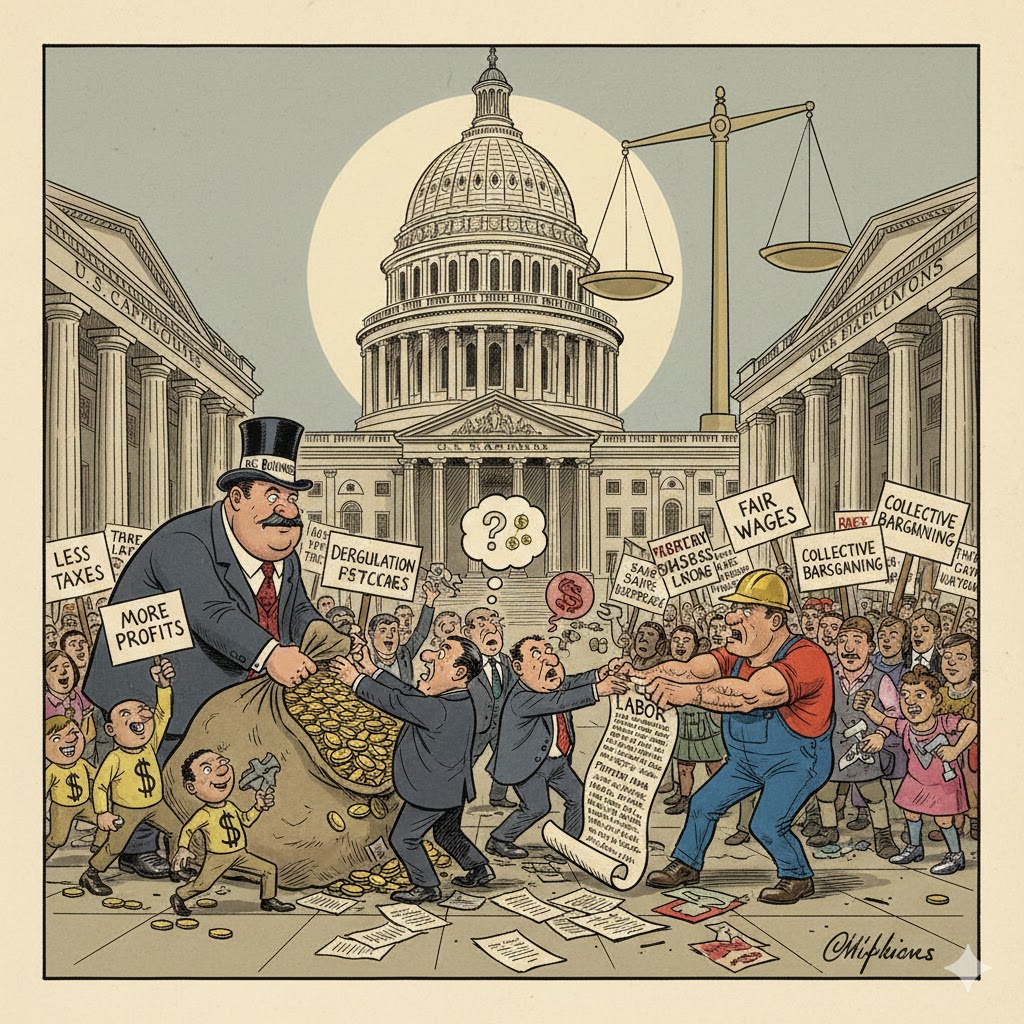
Lobbying, Regulatory Capture, and the Path to Balanced Power
Introduction
In the intricate dance of modern democracy, corporations wield an outsized influence that often tips the scales away from the public interest. This corporate sway manifests primarily through lobbying and regulatory capture, mechanisms that allow businesses to shape policies, laws, and regulations to their advantage. From the Gilded Age robber barons to today’s tech giants and pharmaceutical behemoths, the evolution of corporate power has deepened inequality and eroded trust in democratic institutions. Yet despite widespread recognition of the problem, bipartisan reform efforts consistently falter, trapped in a web of entrenched interests and political inertia.
This article explores these dynamics, arguing that while corporate lobbying is an entrenched reality, true democratic balance requires empowering workers through mandatory union formation. If corporations are permitted to pool vast resources to influence government, workers must be enabled, and in some cases compelled, to organize collectively to counter that power. A single worker’s voice or wallet pales in comparison to a multinational corporation’s financial reach, but united workers can amass significant resources and deploy powerful tactics such as boycotts and strikes. These tools are essential to restoring a more equitable distribution of political power.
Lobbying: Mechanisms and Impact
Lobbying, at its core, is the legal practice of advocating for specific interests by influencing lawmakers and government officials. Governed by frameworks such as the U.S. Lobbying Disclosure Act, it encompasses direct meetings with legislators, campaign donations, and extensive information campaigns. Corporations have mastered this process through sophisticated strategies, including channeling money into political action committees and super PACs, a trend that accelerated following the 2010 Citizens United decision. They also exploit the revolving door, where public officials move seamlessly between government roles and lucrative corporate positions, and engage in astroturfing efforts that simulate grassroots public support.
The consequences for democracy are profound. Public policy becomes distorted in favor of corporate profitability rather than societal well-being. Tax codes are reshaped to benefit the wealthiest firms, environmental protections are weakened to accommodate industry growth, and regulatory standards are diluted. This creates a pay-to-play political environment where large corporations drown out small businesses and ordinary citizens. The pharmaceutical industry provides a stark example, as aggressive lobbying during the opioid crisis delayed meaningful regulation and contributed to widespread addiction and loss of life. Similarly, major technology firms have resisted strong data privacy laws, leaving consumers exposed to misuse and surveillance.
This imbalance, however, is not inevitable. Corporations are already allowed to exercise collective power through shareholders, executives, and trade associations. To restore democratic equilibrium, workers must be granted equivalent collective capacity. Mandating union formation would allow workers to pool resources just as corporations do. While an individual employee may only be able to donate modestly to a political cause, a union representing thousands can raise substantial funds through dues and coordinated action. Beyond financial influence, unions provide leverage through strikes, boycotts, and organized advocacy. Historical precedents, such as the United Auto Workers’ role in shaping labor law and workplace safety standards, illustrate how organized labor can check corporate excess and transform lobbying into a more balanced exchange.
Regulatory Capture: Theory and Practice
Regulatory capture occurs when agencies tasked with overseeing industries instead come to serve the interests of those industries. Popularized by economist George Stigler, the concept explains how oversight bodies are compromised through information asymmetry, financial incentives, and cultural alignment. Industries often supply regulators with selective data or technical expertise, fund research that supports favorable outcomes, or entice regulators with post-government employment opportunities. Over time, regulators may come to identify more closely with corporate leaders than with the public they are meant to protect.
The real-world consequences of regulatory capture are severe. The 2008 financial crisis stands as a prominent example, driven in part by deregulated banking systems overseen by captured regulatory agencies. Public confidence erodes when citizens perceive government institutions as extensions of corporate boardrooms rather than guardians of the public interest. In the energy sector, fossil fuel companies have successfully delayed climate action by influencing environmental agencies, while in finance, key provisions of post-crisis reforms such as Dodd-Frank have been weakened through sustained corporate pressure.
Once again, the underlying issue is power asymmetry. Corporations possess the resources and organization necessary to dominate regulatory processes, while workers, who often bear the brunt of unsafe conditions or environmental degradation, lack comparable influence. Mandating unions would help correct this imbalance by providing workers with a formal role in regulatory advocacy. Through collective bargaining and pooled resources, unions could fund expert testimony, challenge regulatory rollbacks, and apply pressure through coordinated action. Strikes and boycotts not only affect corporate behavior but also send a clear signal to regulators about the human costs of weak oversight. Scandals such as the Boeing 737 MAX crisis, where employee concerns were sidelined amid compromised FAA oversight, illustrate the dangers of excluding workers from regulatory influence.
Why Bipartisan Reform Efforts Fail
Despite broad public awareness of corporate overreach, bipartisan reform efforts repeatedly collapse. Structural barriers play a central role. Both major political parties rely heavily on corporate donations to sustain expensive election campaigns, creating deep financial dependencies. Legal constraints further complicate reform, particularly Supreme Court rulings that equate political spending with protected speech. Politically, reform proposals are often weaponized, with accusations of partisan advantage undermining consensus and short-term electoral calculations eclipsing long-term democratic health.
Corporate resistance compounds these obstacles. Industries deploy aggressive counter-lobbying campaigns, media influence, litigation, and economic threats to derail reform initiatives. Past efforts reveal a consistent pattern. The Bipartisan Campaign Reform Act of 2002 attempted to curb soft money but was steadily undermined and weakened. More recently, voting and ethics reform bills stalled in Congress amid procedural roadblocks and internal party divisions, with corporate opposition playing a decisive role.
At the heart of these failures lies the absence of countervailing power. Without strong worker organizations, reform movements lack the sustained grassroots pressure necessary to overcome institutional inertia. Mandated unionization could disrupt this dynamic by mobilizing workers across ideological lines. Historically, labor movements have bridged partisan divides, contributing to civil rights advances and economic reforms. By pooling resources and coordinating action, unions could rival corporate spending on advocacy while amplifying public pressure through strikes and boycotts. In doing so, they would transform reform from an elite policy debate into a mass democratic demand.
Thanks for reading The Brooks Brief Substack! This post is public so feel free to share it.
Conclusion
Lobbying and regulatory capture have produced a democratic system tilted toward corporate elites, ensuring that bipartisan reform efforts fail under the weight of financial dependence and political gridlock. Yet this outcome is not unavoidable. By mandating worker unions as a counterbalance to corporate lobbying, power can be redistributed more equitably within the political system. While corporate financial dominance is formidable, organized workers possess tools that money alone cannot replicate, including collective action, public pressure, and moral authority.
Practical steps forward include legislative requirements for union elections in large firms, increased transparency around corporate and labor influence, and learning from international models such as Germany’s system of worker co-determination. Ultimately, a functioning democracy depends not only on restraining concentrated corporate power but on empowering citizens to meet it with organized strength. Restoring balance in democratic governance requires ensuring that the voices of the many can once again compete with the resources of the few.
Leave a Reply