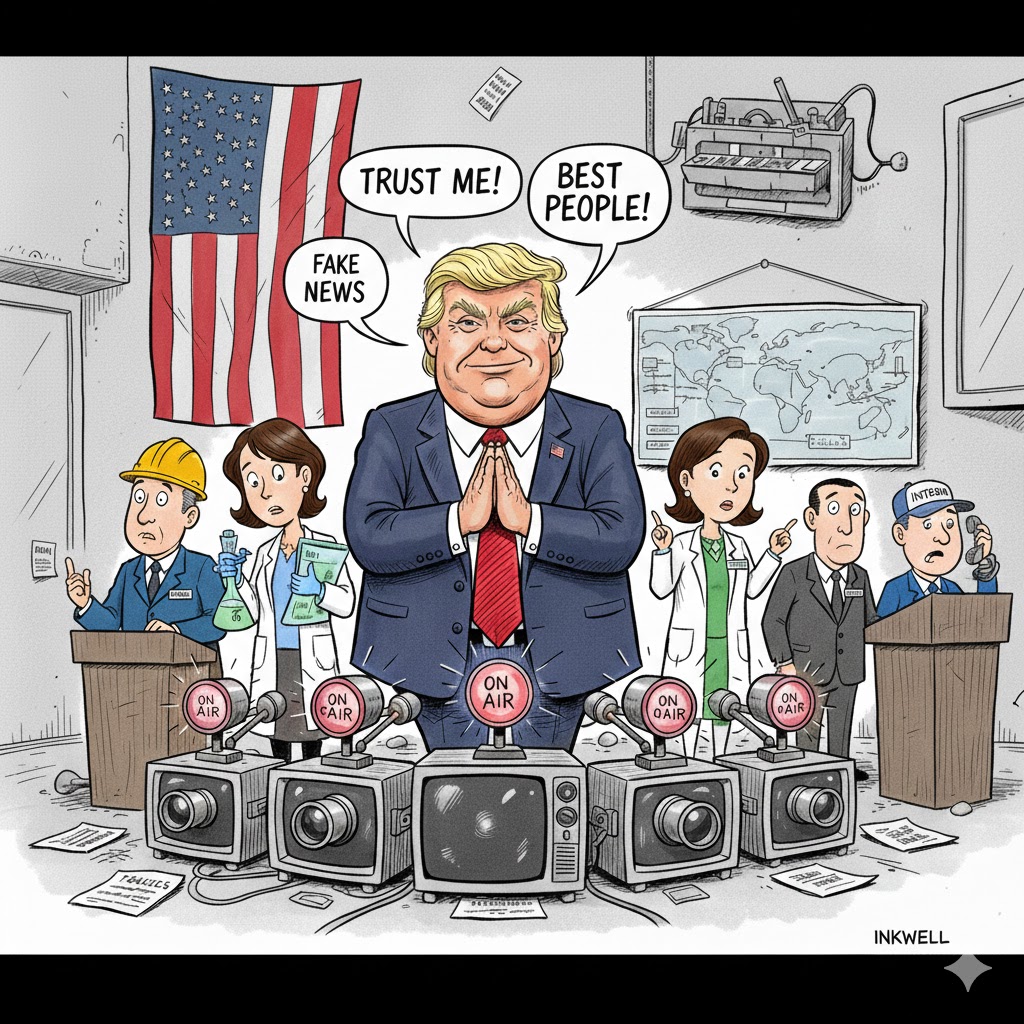
How Loyalty Politics, Abandoned Economic Pledges, and Selective Law and Order Undermine Democratic Trust
Introduction
During a 2016 campaign rally, Donald Trump famously promised that his administration would be staffed with “the best people,” presenting himself as a reformer intent on draining the swamp and restoring competence to government. That pledge became a central pillar of his political identity, reinforced by vows to prioritize merit, reward hard work, and reject entrenched elites. As his second term unfolds in early 2026, however, the gap between rhetoric and reality has become increasingly difficult to ignore. Trump continues to frame himself as a champion of fairness, economic relief, law and order, and principled leadership, even as evidence mounts that his administration routinely contradicts those claims. The result is a presidency defined less by meritocracy than by loyalty and spectacle.
Beyond staffing decisions, Trump has repeatedly made sweeping promises to American voters that have failed to materialize. From pledges of direct financial relief to assurances of principled foreign policy leadership, his statements often generate headlines without producing results. This pattern is not merely a matter of political exaggeration but reflects a governing style that prioritizes messaging over substance. Over time, such behavior erodes public confidence and weakens institutional credibility. In a polarized environment, broken promises carry consequences far beyond any single policy failure.
This article examines several core areas where Trump’s words and actions diverge sharply. These include his claims of merit-based governance, the abandonment of a $2,000 economic pledge, performative support for foreign protesters alongside domestic repression, law and order rhetoric undermined by felony convictions, and the quiet implementation of Project 2025 despite repeated denials. Taken together, these contradictions reveal a consistent pattern of hypocrisy. They also underscore the broader democratic costs of leadership untethered from accountability.
Trump’s Meritocracy Rhetoric vs. Reality in Administration Appointments
Trump has repeatedly framed meritocracy as a defining principle of his administration, particularly in his attacks on Diversity, Equity, and Inclusion initiatives. He and his allies argue that DEI undermines excellence by prioritizing identity over competence, presenting their rollback of such programs as a return to fairness. Family members and campaign surrogates have echoed this message, emphasizing success “by merit and merit alone.” In office, Trump has moved aggressively to dismantle DEI offices across federal agencies. These actions are marketed as efficiency reforms designed to elevate qualified professionals.
Yet Trump’s second-term appointments tell a markedly different story. Rather than elevating experienced technocrats, the administration has favored ideologically aligned media figures and loyalists with limited subject-matter expertise. The selection of Pete Hegseth, a former Fox News host, as Secretary of Defense sparked widespread concern over his lack of senior military leadership experience. Senate hearings further amplified scrutiny due to allegations of personal misconduct. These choices raise questions about whether loyalty and public visibility now outweigh competence in national security decision-making.
The pattern extends beyond defense. Robert F. Kennedy Jr.’s appointment to lead the Department of Health and Human Services has drawn sustained criticism due to his history of vaccine skepticism and absence of formal public health credentials. Under his leadership, HHS has pursued deep budget cuts and controversial policy reversals that alarm career professionals. Additional incidents, including the firing of a veteran NASA climate scientist and the mishandling of classified communications during the so-called Signalgate scandal, reinforce perceptions of institutional neglect. Far from restoring meritocracy, these decisions suggest a governance model built on allegiance rather than expertise.
The Reneged Promise of $2,000 to American Citizens
Economic populism has long been central to Trump’s political appeal, particularly among working- and middle-class voters. In late 2025, he reignited that appeal by promising direct financial relief in the form of $2,000 “dividend” checks. According to Trump, revenue from new tariffs on imports would generate trillions of dollars, enough to fund payments to low and middle-income Americans. He framed the proposal as a way to offset rising living costs while simultaneously reducing the national debt. The announcement gained immediate traction across conservative media and social platforms.
Within weeks, however, the promise began to unravel. By January 2026, Trump publicly distanced himself from the pledge, claiming uncertainty about when or whether he had made such a commitment. In a New York Times interview, he dismissed questions about the payments by asking, “When did I do that?” No legislative proposal followed, and no checks were issued. Economists quickly pointed out that tariff revenues fall far short of the projected figures, making the plan financially implausible from the outset.
The fallout has been significant. Critics argue that the proposal functioned as a campaign gimmick rather than a serious economic policy. Tariffs, they note, often increase consumer prices, meaning any hypothetical rebate would merely return money already extracted from households. The episode mirrors earlier unfulfilled stimulus promises from Trump’s first term. For many voters, the abandoned pledge reinforces skepticism toward his economic messaging and deepens frustration with a political system that routinely overpromises and underdelivers.
Empty Promises to Iranian Protesters and Domestic Use of Force by ICE
Trump frequently presents himself as a defender of freedom movements abroad, using dramatic language to signal moral clarity. In early 2026, amid renewed unrest in Iran, he publicly encouraged protesters to continue demonstrating and to seize control of their institutions. Through social media posts, he warned Iranian authorities of severe consequences and claimed executions had already ceased due to U.S. pressure. These statements portrayed Trump as an assertive advocate for human rights. They also generated international attention.
Despite the rhetoric, no meaningful support followed. Analysts and human rights observers noted the absence of diplomatic, economic, or humanitarian measures to back Trump’s claims. The lack of action led many to characterize his statements as performative rather than strategic. Iranian activists themselves expressed skepticism, viewing the messages as symbolic gestures disconnected from tangible assistance. Once again, bold language failed to translate into policy.
At home, Trump’s tolerance for aggressive enforcement stands in stark contrast. On January 7, 2026, ICE agent Jonathan Ross fatally shot Renee Nicole Good, a U.S. citizen, during an immigration operation in Minneapolis. Video footage may have contradicted initial official claims that she posed a lethal threat, sparking widespread protests and civil rights concerns. The juxtaposition is striking: vocal encouragement of protest abroad paired with lethal force against civilians domestically. This double standard undermines U.S. credibility and deepens mistrust within marginalized communities.
Trump’s Law and Order Claims Amid 34 Felony Convictions
“Law and order” has been one of Trump’s most enduring political slogans. He has consistently portrayed himself as a bulwark against crime, disorder, and institutional decay. His campaigns emphasize support for law enforcement, harsher penalties, and aggressive policing. These themes have justified expansive executive actions, particularly in immigration and criminal justice enforcement. They have also resonated with voters concerned about public safety.
Yet Trump’s personal legal history complicates this narrative. In May 2024, a New York jury unanimously convicted him on 34 felony counts related to falsifying business records. The charges stemmed from hush money payments made during the 2016 campaign and efforts to conceal them. While appeals are ongoing and sentencing has been delayed due to his office, the convictions remain intact. No other U.S. president has held office under such circumstances.
The contradiction is difficult to ignore. A convicted felon positioning himself as the nation’s chief law enforcement advocate embodies a selective approach to justice. Critics argue that this reinforces a “rules for others, exceptions for elites” dynamic. Over time, such inconsistencies risk normalizing impunity at the highest levels of power. They also weaken public faith in the principle that the law applies equally to all when one considers his presidential pardons.
Denial of Connection to Project 2025 While Following Its Playbook
Throughout the 2024 and 2025 campaign cycle, Trump repeatedly disavowed any connection to Project 2025. The Heritage Foundation initiative outlines an aggressive conservative blueprint for restructuring the federal government. Trump insisted he had not read the document and dismissed parts of it as unrealistic. These denials were intended to reassure moderate voters wary of radical institutional change. Publicly, he framed his agenda as pragmatic rather than ideological.
In practice, however, his administration’s actions closely track the Project 2025 playbook. Analysts estimate that more than two-thirds of Trump’s early executive orders align with recommendations from the project’s “Mandate for Leadership.” These include mass immigration raids, efforts to dismantle the Department of Education, and deep cuts to scientific and public health agencies. Many of the architects of Project 2025 have longstanding ties to Trump’s inner circle. The overlap is too extensive to dismiss as coincidence.
This strategy allows Trump to implement sweeping changes while avoiding electoral scrutiny. By denying formal involvement, he shields himself from accountability while advancing a radical agenda through executive action. The consequences are significant, including centralized power, weakened institutions, and reduced transparency. For voters, the disconnect between campaign assurances and governing reality further erodes trust. Democratic legitimacy suffers when major transformations occur without honest disclosure.
Thanks for reading The Brooks Brief Substack! This post is public so feel free to share it.
Conclusion
Across multiple domains, Trump’s second term reveals a consistent pattern of contradiction between rhetoric and reality. Claims of meritocracy collapse under the weight of cronyism and ideological appointments. Promises of economic relief dissolve into denial once political pressure subsides. Support for protesters abroad rings hollow when paired with domestic repression and unchecked enforcement. Law and order rhetoric falters in the shadow of felony convictions, while denials of Project 2025 crumble under policy alignment.
These hypocrisies carry lasting consequences. They weaken democratic institutions, distort public discourse, and deepen cynicism toward government. When words repeatedly fail to match actions, accountability becomes elusive and trust deteriorates. The damage extends beyond any single administration, shaping how citizens view political leadership itself.
Ultimately, democracy depends on more than slogans and spectacle. It requires transparency, consistency, and a genuine commitment to the principles leaders claim to uphold. As voters and citizens, scrutiny of actions must outweigh allegiance to rhetoric. Only through sustained accountability can public trust and institutional integrity be restored.
Leave a Reply