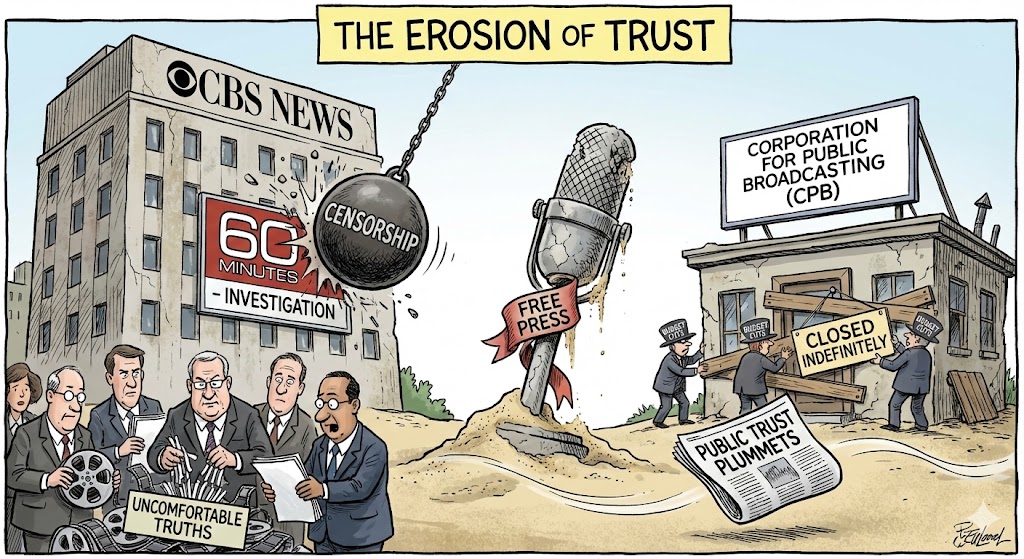
How Disinformation, Algorithmic Outrage, and Political Pressure Are Redefining the American Press
Introduction: The Disintegration of a Shared Reality
A free and independent press has historically functioned as a core democratic institution in the United States, providing citizens with reliable information and acting as a check on political power. For much of the nation’s history, journalism helped sustain a shared factual framework within which political disagreement could occur. That shared framework made compromise, accountability, and public deliberation possible. Today, however, the American information environment is increasingly fragmented. Media polarization now reflects not simply ideological division, but the collapse of commonly accepted facts.
This fragmentation is not the result of a single actor or moment. It emerges from intersecting pressures that include political intimidation, economic consolidation, algorithmic amplification, and concentrated ownership. These forces collectively reshape newsroom behavior and public expectations. Journalism is increasingly evaluated through partisan loyalty rather than factual accuracy. As a result, trust in the press has deteriorated across ideological and demographic lines.
The erosion of shared truth presents a systemic risk to democratic governance. Without agreement on basic facts, institutions struggle to function effectively and public debate becomes performative rather than substantive. The press, once a mediator of reality, is now perceived as another political actor. Understanding how this shift occurred is essential to assessing the long-term health of American democracy.
From Watchdog to Target: Political Pressure on the Press
Political hostility toward the press has intensified over the past decade, with journalists increasingly portrayed as adversaries rather than public servants. Leaders across the political spectrum, but particularly during the Trump era, normalized rhetoric that framed the media as dishonest, partisan, or illegitimate. This narrative undermined the press’s credibility and reshaped public attitudes toward accountability reporting. Over time, repeated attacks on journalists reduced the political cost of ignoring or dismissing unfavorable coverage.
Beyond rhetoric, political pressure has taken on institutional form. Media organizations are now routinely asked to accept restrictions on questioning, access, and real-time fact-checking in exchange for participation in official events. These conditions shift the balance of power away from journalists and toward political actors. Compliance becomes a prerequisite for relevance, rather than an exception.
Such arrangements have long-term consequences. Once access-based limitations are normalized, they become embedded in professional practice. Journalists internalize boundaries about what questions can be asked and when scrutiny is appropriate. This gradual adjustment weakens the press’s ability to fulfill its democratic role, even in the absence of explicit censorship.
Algorithmic Outrage and the Economics of Division
Digital platforms have profoundly altered how information circulates in modern societies. Algorithms optimized for engagement prioritize emotionally charged content over accuracy or context. Outrage, fear, and identity-based narratives consistently outperform measured analysis in visibility and reach. As a result, misinformation and polarizing content spread faster than corrections or nuanced reporting.
Economic pressures within the media industry reinforce these dynamics. As traditional advertising revenue declines, outlets increasingly depend on clicks, shares, and digital traffic. Editorial decisions are shaped by metrics that reward virality rather than public value. Investigative reporting, which is costly and slow, struggles to compete with content designed for rapid consumption.
This system produces a feedback loop. Polarized audiences consume polarized content, which platforms then amplify further. Over time, exposure to alternative perspectives diminishes and trust in neutral reporting erodes. The economic logic of digital media thus aligns with political polarization, weakening the press’s capacity to serve as a stabilizing democratic institution.
Billionaire Ownership and Structural Media Capture
The concentration of media ownership among billionaires represents a structural shift in the American press. Wealthy individuals increasingly acquire major outlets under the premise of rescuing struggling institutions. While such acquisitions may preserve operations, they also reshape editorial incentives. Ownership alone, even without direct intervention, influences newsroom culture and decision-making.
Billionaire-owned outlets tend to avoid sustained scrutiny of elite economic power, regulatory regimes, or political arrangements that affect owner interests. Journalists learn implicitly which topics invite support and which create friction. This form of influence operates through professional self-censorship rather than explicit directives. Over time, the range of acceptable debate narrows.
This ownership concentration distances media institutions from the public interest. When information flows through a small and wealthy elite, journalism risks serving stability for power rather than accountability to citizens. The press becomes less a democratic commons and more an elite-managed system of information control.
Defunding Public Interest Media and the Loss of Transparency
Publicly funded media historically provided a counterbalance to commercial and political pressures. Institutions like PBS emphasized education, depth, and public accountability rather than profitability. Their funding structure allowed greater insulation from both market forces and partisan influence. This model contributed to higher levels of trust and credibility.
The defunding of public-interest media under the Trump administration marked a significant shift in federal media policy. Reducing support for transparent, noncommercial journalism weakened one of the few remaining alternatives to corporate-owned outlets. The move also signaled that independence and transparency could be framed as political liabilities.
As public-interest media declines, audiences are increasingly dependent on outlets shaped by corporate, political, or billionaire ownership. This transition reduces the diversity of institutional models within the media ecosystem. Transparency becomes secondary to survival, and journalism that challenges power without commercial backing becomes increasingly rare.
Editorial Power, Perception, and Institutional Credibility
Editorial decisions now occur under intense public scrutiny and suspicion. High-profile cases, such as the cancellation of investigative segments that later appear abroad, reinforce perceptions of political influence. Even when editorial leaders cite procedural justifications, audiences often interpret such decisions as evidence of censorship. Perception, in this context, carries as much weight as reality.
This erosion of trust reflects broader institutional fragility. Legacy media organizations once benefited from assumed independence and credibility. Today, those assumptions no longer hold. Each controversial editorial choice contributes to cumulative skepticism.
Credibility depends not only on actual independence but also on visible resistance to power. When audiences believe that stories are shaped by political or economic considerations, trust deteriorates. Rebuilding that trust requires structural change, not rhetorical reassurance.
From Free Press to Soft Propaganda
In democratic systems, the shift from free press to propaganda rarely involves direct state control. Instead, influence operates through access, incentives, ownership, and professional norms. Journalists adjust behavior to avoid exclusion, legal risk, or institutional retaliation. Over time, confrontation gives way to caution.
This process produces what can be described as soft propaganda. Media outlets continue operating and publishing, but within narrowing boundaries. Coverage emphasizes official narratives, marginalizes dissent, and avoids sustained scrutiny of powerful interests. The result is alignment without coercion.
Soft propaganda is particularly effective because it appears organic. There are no formal bans or explicit directives. Instead, the press gradually becomes an amplifier of power rather than a counterweight to it. Democratic erosion occurs quietly and incrementally.
The Myth of Sudden Collapse
Democratic institutions rarely fail abruptly. Historical cases demonstrate that press freedom erodes through incremental normalization of restrictions. Each compromise seems manageable in isolation, but collectively they hollow out institutional independence. The process often goes unnoticed until reversal becomes difficult.
In the United States, warning signs include shrinking investigative capacity, newsroom consolidation, and declining public trust. Attacks on journalists are increasingly tolerated, and press freedom is often treated as a partisan issue rather than a democratic necessity. These trends reinforce one another.
The danger lies not in a single authoritarian move, but in cumulative complacency. When the press adapts to pressure rather than resists it, democratic accountability weakens. Collapse, when it comes, feels inevitable rather than deliberate.
Public Trust at a Breaking Point
Public confidence in the American press has reached historic lows. Trust is now sharply polarized along ideological lines, reflecting the fragmentation of the information environment. Many citizens no longer believe that neutral reporting is possible. This skepticism undermines the press’s ability to mediate political conflict.
Cynicism becomes self-reinforcing. When audiences assume bias everywhere, factual correction loses authority. Disinformation thrives in environments where trust is absent. The result is disengagement rather than accountability.
Low trust ultimately benefits those in power. Confusion weakens public oversight and reduces political costs for deception. A democracy without trusted information sources struggles to function effectively.
Thanks for reading The Brooks Brief Substack! This post is public so feel free to share it.
Conclusion: Preserving the Space for Truth
A free press is rarely destroyed outright. It is eroded gradually through political pressure, economic incentives, ownership concentration, and public apathy. Defending press freedom therefore requires sustained institutional resistance rather than reactive outrage. Structural reform matters more than rhetorical commitment.
Journalists, policymakers, and citizens all play a role in preserving independent media. Supporting diverse ownership models, public-interest journalism, and transparency is essential. So too is recognizing that press freedom is a democratic infrastructure, not a partisan preference.
The press must remain a check on power, not a partner to it. When the ability to question leaders becomes conditional, democracy itself becomes fragile, shaped not by truth but by those who control the narrative.
Leave a Reply