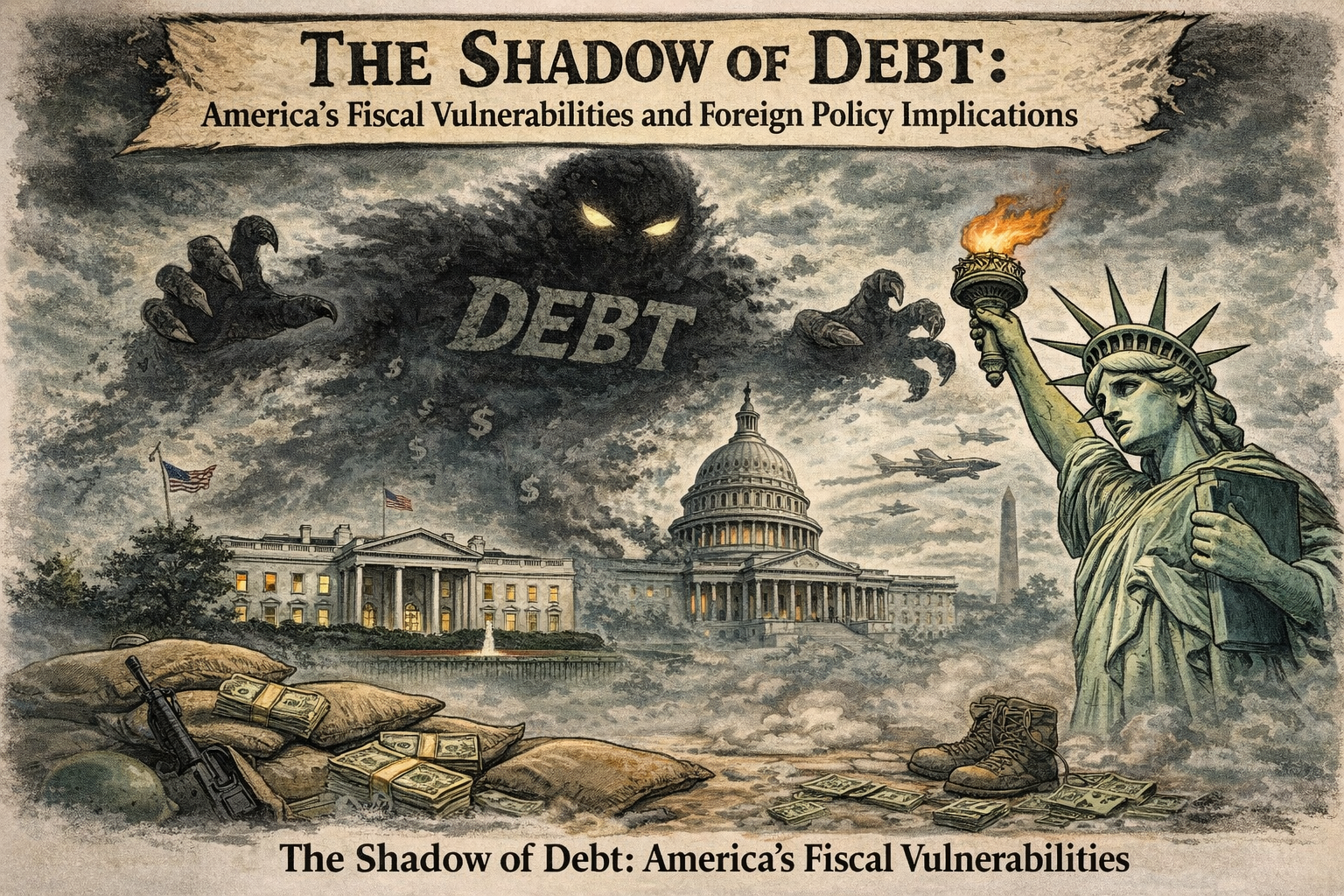
America’s Fiscal Vulnerabilities and Foreign Policy Implications
I. Introduction to America’s National Debt
The United States national debt has become one of the most defining structural features of the modern American political economy. It reflects decades of policy choices shaped by economic cycles, political priorities, demographic pressures, and repeated national emergencies. As of early 2026, total gross federal debt has surpassed $38.5 trillion, a figure that places the United States far ahead of any other sovereign borrower. Debt held by the public now exceeds $31 trillion, while intragovernmental obligations account for roughly $7.7 trillion. This accumulation is not merely an accounting issue but a fundamental constraint on future policy flexibility. The sheer scale of the debt has transformed fiscal management into a strategic concern with domestic and international consequences.
The pace of debt accumulation has accelerated sharply since the early 2000s, marking a departure from earlier periods of relative fiscal restraint. Major inflection points include the 2008 global financial crisis, the COVID-19 pandemic, and successive rounds of expansive fiscal legislation. Even during periods of economic growth, annual budget deficits have remained persistently high, averaging between 6 and 7 percent of GDP. This pattern suggests that structural imbalances, rather than cyclical downturns alone, are driving borrowing. Legislative initiatives that combined tax reductions with increased spending have compounded these pressures. Over time, these choices have normalized deficit financing as a permanent feature of governance.
By 2025, federal debt stood at approximately 121 percent of GDP, a level not seen since World War II. Long-term projections indicate that, absent meaningful reforms, this ratio could rise to 136 percent by the mid-2040s. Such levels introduce risks that extend beyond economic efficiency and into the realm of geopolitical influence. Heavy reliance on borrowing increases exposure to market sentiment and foreign capital flows. It also blurs the line between fiscal policy and foreign policy, as creditors gain indirect leverage over U.S. decision-making. In this sense, the national debt is no longer purely a domestic issue but a component of America’s international posture.
The Brooks Brief Substack is a reader-supported publication. To receive new posts and support my work, consider becoming a free or paid subscriber.
II. Foreign Holdings of U.S. Debt
Foreign entities play a central role in financing the United States government, holding roughly 30 percent of publicly held Treasury debt as of late 2025. In absolute terms, this amounts to approximately $9 trillion, representing a historic high even as the proportional share has fluctuated. Foreign ownership peaked in the mid-2010s before declining amid fiscal uncertainty, credit rating downgrades, and diversification into alternative assets. Recent years, however, have seen renewed net purchases, particularly of long-term securities. These inflows reflect continued confidence in U.S. Treasuries as a safe and liquid store of value. They also underscore the global reliance on American financial markets.
The distribution of foreign-held U.S. debt remains concentrated among a small group of major creditors. Japan is the largest holder, with roughly $1.2 trillion in Treasury securities, accounting for about 13 percent of foreign-owned debt. The United Kingdom follows closely, holding approximately $900 billion, much of it through financial intermediaries. China, once the largest foreign creditor, now holds around $700 billion, marking its lowest level since the late 2000s. Beijing’s gradual reduction reflects a strategic shift toward reserve diversification and reduced exposure to U.S. financial leverage. Despite this decline, China remains a significant stakeholder in U.S. fiscal stability.
Beyond these leading creditors, a diverse set of countries and financial hubs hold substantial amounts of U.S. debt. Belgium, Canada, and offshore centers such as the Cayman Islands and Luxembourg play outsized roles due to their function as custodians for global capital. OPEC nations and European Union member states collectively hold close to $2 trillion in Treasuries. This wide dispersion reduces the risk of coordinated action but increases systemic exposure. It also ties the stability of the global financial system to the credibility of U.S. fiscal management. As a result, American debt policy reverberates far beyond its borders.
III. Mechanisms Linking Debt to Relationships with Foreign Powers
The relationship between U.S. debt and foreign powers operates through mutually reinforcing economic mechanisms. Foreign purchases of Treasury securities help suppress U.S. interest rates, lowering borrowing costs and supporting domestic investment. This arrangement allows the United States to finance large deficits without immediately crowding out private sector activity. In return, foreign investors gain access to the world’s deepest and most liquid bond market. The result is a symbiotic relationship that has underpinned global economic stability for decades. However, this interdependence also creates vulnerabilities.
Reliance on foreign capital introduces potential leverage points that can be exploited during periods of political tension. Large creditors possess the theoretical ability to influence U.S. financial conditions by altering their holdings. Even the perception of a major sell-off could raise borrowing costs, weaken the dollar, or destabilize financial markets. While such actions would also harm creditors, the threat alone carries strategic weight. These dynamics complicate diplomatic interactions, particularly with geopolitical rivals. Fiscal dependence thus becomes an additional variable in international negotiations.
Spillover effects extend beyond bilateral relationships and into the global monetary system. Rising U.S. debt has been associated with lower policy rates in other advanced economies, as central banks adjust to capital flows and exchange rate pressures. In recent years, bond markets have shown increasing sensitivity to U.S. fiscal sustainability. During 2025 and 2026, Treasury yields remained elevated despite Federal Reserve rate cuts, signaling investor concern about long-term debt trajectories. This skepticism amplifies the influence of foreign creditors by increasing the cost of fiscal mismanagement. Over time, such dynamics could constrain both monetary and foreign policy autonomy.
IV. How Wealthier States Influence American Foreign Policy
Wealthier states with large reserve holdings exert indirect influence over U.S. foreign policy through their role as creditors. This influence rarely takes the form of explicit demands but instead operates through incentives and constraints. Policymakers in Washington must consider how diplomatic or military actions might affect financial confidence. In periods of heightened tension, preserving stable financing conditions can become an unspoken priority. As a result, debt considerations quietly shape the boundaries of acceptable policy choices. This reality complicates traditional notions of sovereignty.
China offers a prominent example of how debt holdings intersect with broader strategic competition. Its gradual reduction of Treasury holdings has coincided with escalating trade disputes and technology restrictions. While causation is difficult to prove, the parallel trends highlight the interconnected nature of economic and geopolitical rivalry. China’s actions signal a desire to reduce vulnerability to U.S. financial leverage while retaining enough exposure to avoid destabilizing its own reserves. This balancing act illustrates how debt ownership functions as both a shield and a bargaining chip. It also underscores the strategic logic behind reserve diversification.
Allied creditors also wield influence, albeit in more cooperative ways. Japan’s Treasury holdings align closely with its security partnership with the United States, particularly in the Indo-Pacific region. Financial interdependence reinforces alliance cohesion but also creates expectations of policy alignment. Similarly, oil-producing states link their investment decisions to energy and regional security considerations. Within multilateral alliances such as NATO, rising U.S. debt can erode perceptions of leadership credibility. Adversaries may exploit these vulnerabilities through economic pressure or hybrid tactics designed to amplify fiscal stress.
V. Risks and Broader Implications
The risks associated with unchecked debt growth are both immediate and long-term. A sudden shift in foreign investor sentiment could trigger sharp increases in interest rates, raising debt service costs and fueling inflation. Given the dollar’s role as the global reserve currency, such disruptions would reverberate across international markets. Financial instability of this kind could constrain crisis response capabilities at home and abroad. It would also undermine confidence in U.S. economic stewardship. These risks elevate debt management from a technical issue to a national security concern.
Fiscal constraints directly affect defense readiness and alliance commitments. Rising interest payments crowd out discretionary spending, limiting resources available for military modernization and diplomatic engagement. As obligations to creditors grow, policymakers face increasingly difficult trade-offs. Over time, these pressures could weaken deterrence and strain partnerships that rely on U.S. leadership. Adversaries may interpret fiscal vulnerability as an opportunity to challenge existing security arrangements. In this way, debt becomes a strategic liability.
Long-term income transfers to foreign creditors gradually erode economic sovereignty. As more national output is devoted to servicing debt, the United States becomes more sensitive to external pressures. Recent resistance in bond markets to monetary easing highlights emerging concerns about fiscal credibility. If deficits continue to widen, a reckoning may become unavoidable. Such an outcome would test the resilience of both domestic institutions and international alliances. The broader implication is a slow but meaningful shift in the balance of global influence.
Thanks for reading The Brooks Brief Substack! This post is public so feel free to share it.
VI. Conclusion
America’s expanding national debt has become deeply intertwined with its foreign relations, creating channels through which wealthier states can shape U.S. policy choices. As debt levels approach $40 trillion, fiscal decisions increasingly carry geopolitical consequences. This interdependence does not imply imminent loss of autonomy, but it does narrow the margin for error. Sustained reliance on foreign financing heightens exposure to market sentiment and strategic pressure. Ignoring these dynamics risks undermining long-term national power.
To mitigate these vulnerabilities, policymakers should pursue gradual and credible fiscal consolidation. Emphasis should be placed on tax reform, entitlement sustainability, and disciplined spending rather than abrupt austerity. Clear long-term frameworks can restore confidence without sacrificing economic growth. Strengthening fiscal credibility would also reinforce diplomatic leverage and alliance leadership. Ultimately, managing debt is not only an economic imperative but a strategic necessity for preserving American influence in a multipolar world.
Leave a Reply