Tag: political analysis

  • The BRICS Expansion and Its Threat to U.S. Hegemony

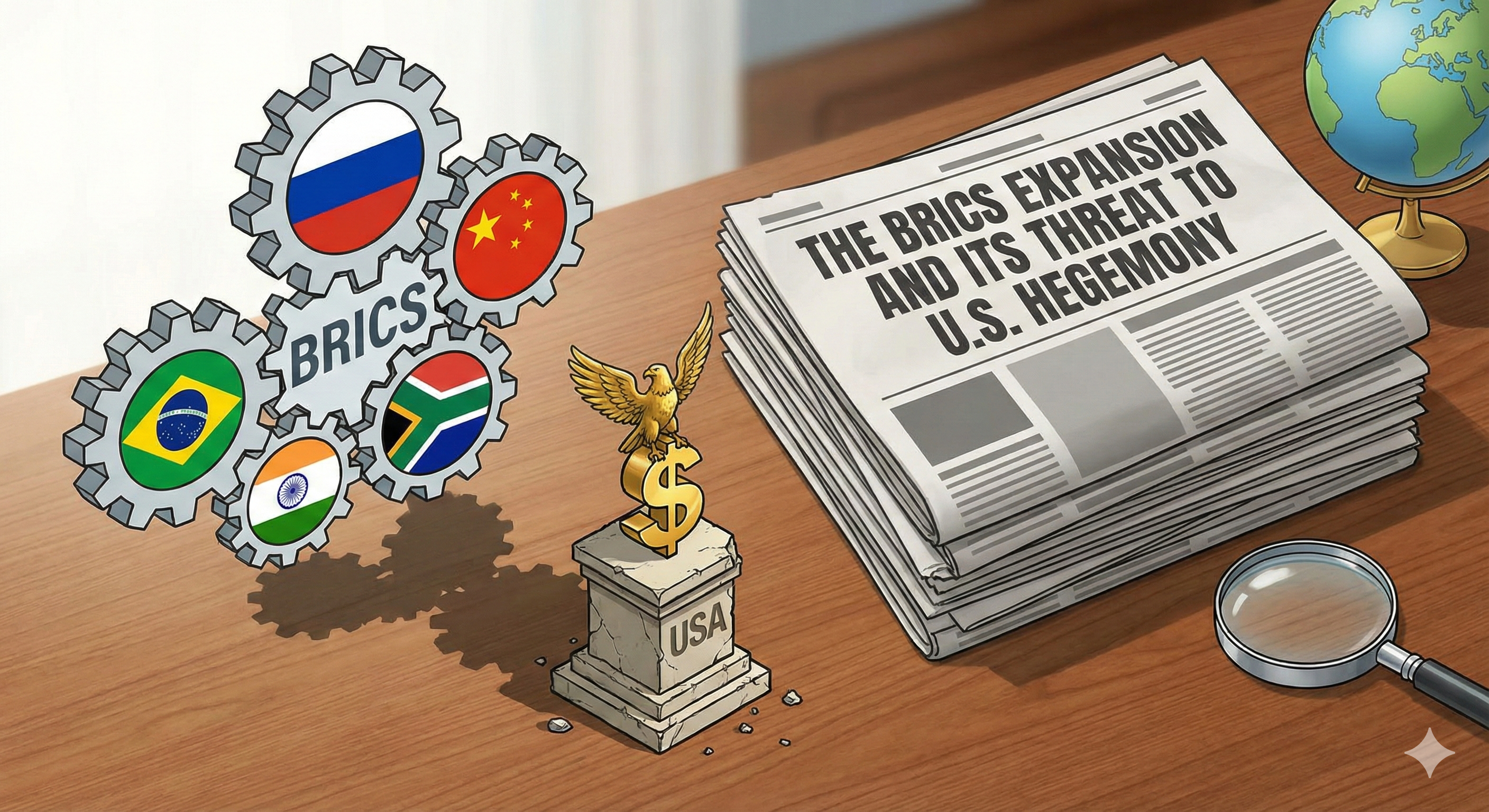
    The BRICS Expansion and Its Threat to U.S. Hegemony

    By The Brooks Brief Staff
    November 22, 2025

    In the sweltering heat of the Caribbean, U.S. warships prowl the waters off Venezuela’s coast, a stark reminder that the ghosts of Cold War brinkmanship are far from buried. As President Trump’s administration weighs airstrikes and regime change against Nicolás Maduro’s government, the stakes extend far beyond oil fields and disputed elections. Venezuela’s overtures to join BRICS, the emerging bloc of Global South powerhouses, have ignited fears in Washington that a multipolar world is no longer a distant specter but an imminent reality. This potential flashpoint underscores a deeper geopolitical tremor: BRICS’ relentless expansion is eroding the U.S. dollar’s stranglehold as the world’s reserve currency, chipping away at America’s post-World War II hegemony one member at a time.

    For decades, the dollar has been the lifeblood of global trade, sanctions, and financial leverage. As BRICS swells its ranks, nations are trading in local currencies, building parallel payment systems, and pursuing de-dollarization. The Brooks Brief’s forecast is unequivocal: the greenback faces an existential threat. If unchecked, this could cascade into economic chaos at home and abroad. Let’s unpack the bloc’s growth, its ripple effects, and the nightmare scenario of a dollar in decline.

    The Core of BRICS: From Five to Ten and Beyond

    BRICS began as an acronym in 2009 for Brazil, Russia, India, China, and South Africa, a loose coalition of fast-growing economies challenging Western-dominated institutions like the IMF and World Bank. These original five nations represent over 40 percent of the global population and a quarter of world GDP, with China as the undisputed heavyweight.

    The real momentum came in 2023, when leaders invited new members to dilute dollar dependency. By January 1, 2024, Egypt, Ethiopia, Iran, and the United Arab Emirates formally joined, expanding BRICS to nine members and dubbing it BRICS+. This wave targeted resource-rich and strategically vital states. Egypt controls the Suez Canal, Ethiopia is Africa’s diplomatic hub, Iran wields oil leverage, and the UAE bridges East and West finance.

    Fast-forward to 2025, and the bloc reached double digits. Indonesia, Southeast Asia’s largest economy, joined in January, drawn by infrastructure funding and trade diversification amid U.S.-China tensions. Today, the formal BRICS roster stands at ten: Brazil, China, Egypt, Ethiopia, India, Indonesia, Iran, Russia, South Africa, and the UAE. Collectively, they command 45 percent of the world’s population, 35 percent of global GDP at purchasing power parity, and a commanding share of energy exports.

    The expansion is far from slowing. Over 20 countries have applied for full membership, with nine designated as partner countries in early 2025: Belarus, Bolivia, Cuba, Kazakhstan, Malaysia, Nigeria, Thailand, Uganda, and Uzbekistan. Others in the queue include Bahrain, Turkey, Vietnam, Sri Lanka, Mexico, and Kuwait. These applicants span Latin America, Africa, the Middle East, and Asia, united by a desire to escape dollar-centric trade traps and U.S. sanctions. Russia’s 2024–2025 chairmanship accelerated the process, culminating in a Kazan summit that greenlit partner status as a stepping stone to full integration.

    How BRICS Undermines the Dollar’s Throne

    At its heart, BRICS expansion strikes at the dollar’s core vulnerability: its role as the global reserve currency. Over 80 percent of international transactions and 60 percent of central bank reserves are dollar-denominated, granting the U.S. “exorbitant privilege”—cheap borrowing, sanction superpowers, and influence over global finance. BRICS is fostering alternatives. Members now settle 30 percent of intra-bloc trade in local currencies, up from 10 percent a decade ago, via systems like China’s CIPS and Russia’s SPFS. The New Development Bank, BRICS’ answer to the World Bank, has loaned $30 billion for projects, bypassing dollar loans and IMF strings.

    This de-dollarization directly threatens U.S. hegemony. As more nations join, global demand for dollars declines, borrowing costs rise, and sanctions lose effectiveness. A hypothetical BRICS currency, floated in 2024, could accelerate this trend, stabilizing trade among members and eroding the dollar’s liquidity premium. Studies show intra-BRICS trade already correlates with lower dollar reserve shares in member banks.

    America’s Debt and the Motivation for Resource Conflicts

    The United States currently carries over $34 trillion in national debt, a figure that strains both domestic policy and global economic leverage. Servicing this debt requires significant inflows of capital, largely dependent on the dollar’s dominance. Resource-rich nations like Venezuela and Nigeria are increasingly critical to this strategy. Venezuela offers vast oil reserves and rare earth minerals essential for technology and energy sectors. Nigeria provides both oil and strategic minerals. Securing access, whether through diplomacy or military pressure, could help Washington maintain economic stability and continue financing its debt. These pressures create an incentive for U.S. policymakers to consider assertive foreign actions, particularly in regions where BRICS expansion threatens to sideline the dollar and reduce American influence over resource flows.

    The Ripple Effects: What Joining BRICS Means for Nations and the World

    For aspiring members, BRICS offers a lifeline from isolation. Nigeria, Africa’s top oil producer, could secure yuan-denominated deals with China, shielding itself from dollar volatility and U.S. policy influence. Malaysia and Thailand gain access to the New Development Bank for green tech and infrastructure. Cuba and Bolivia, long under U.S. sanctions, see BRICS as a sovereignty booster, while partner status builds diplomatic clout.

    Broader consequences are seismic. Economically, BRICS creates a multipolar trade web: BRICS+ GDP could reach 50 percent of global output by 2030, diluting dollar pricing in commodities like oil. Politically, it provides cover for nations to hedge U.S.-China rivalry without full allegiance. For the U.S., the fallout is significant: weakened sanctions, allies like Saudi Arabia considering yuan oil sales, and Treasury demand declines, driving up interest rates.

    Risks remain. Rapid growth strains cohesion—India and China have border tensions, while new members like Ethiopia face infrastructure gaps. U.S. countermeasures, including tariffs, asset freezes, or covert operations, remain possible, as Venezuela already knows.

    The Dollar’s Slow Decline

    Imagine the dollar gradually losing its reserve currency status. Central banks may reduce holdings of U.S. debt, yields could spike, and borrowing costs would soar. Imports would become more expensive, inflation would rise, and American households would feel the strain. Global markets would experience turbulence, emerging markets could default on dollar-denominated debt, and U.S. strategic flexibility would erode. Even a partial decline threatens both domestic stability and global influence.

    The Brooks Brief Forecast: BRICS as Harbinger, Venezuela as Warning

    BRICS expansion poses the gravest threat to dollar primacy since Bretton Woods. With partners like Nigeria and Thailand onboarding, intra-bloc trade could double by 2027, cutting dollar use by 20 percent. Venezuela exemplifies America’s concern. Maduro’s BRICS bid, coupled with deepening Russia-China ties, has prompted U.S. carrier deployments and strike considerations, framing Venezuela as a strategic bulwark against Beijing’s influence. Brazil’s emergency BRICS huddle signals bloc-wide alarm, with President Lula condemning U.S. tension-mongering. Escalation risks alienating the Global South, accelerating the very shifts Washington seeks to prevent.

    A Multipolar Reckoning

    U.S. hegemony was built on dollar supremacy, but BRICS is dismantling it from the margins. Policymakers must innovate financial tools, strengthen alliances, and engage rather than isolate. Ignore these trends, and the Venezuela flotilla becomes a prologue to a broader decline in global economic influence. The Brooks Brief will continue to monitor these developments. As the world rebalances, America must adapt or risk losing both its economic leverage and global authority.

  • A Slow-Burning Flashpoint: Will U.S.–Venezuela Tensions Ignite a Wider Conflict?

    A Slow-Burning Flashpoint: Will U.S.–Venezuela Tensions Ignite a Wider Conflict?

    The Brooks Brief – Strategic Analysis

    Over the past several months, the United States has quietly increased its military posture in the Caribbean, moving naval assets and surveillance platforms closer to Venezuela. Although Washington frames these moves as part of long-running counter-narcotics operations, the timing, intensity, and political context suggest a more complex strategic calculus emerging beneath the surface.

    Under the direction of President Trump, U.S. forces have reportedly intercepted, disabled, or destroyed multiple vessels in the region. These actions have taken place without public evidence, without transparent legal justification, and without granting the detained crews meaningful due process. Washington maintains the narrative of a “war on drugs,” but the pattern appears increasingly disconnected from narcotics interdiction and more aligned with a broader geopolitical struggle over energy, currency dominance, and the future of hemispheric influence.

    This raises a serious question: Is the United States preparing for a conflict with Venezuela not because of cocaine routes, but because of the petrodollar and the global realignment surrounding BRICS?

    The Geopolitical Foundations of a Brewing Conflict

    The Venezuelan and American relationship has been adversarial for decades, but today’s conditions are fundamentally different. Three strategic pressure points are converging at once:

    1. The petrodollar is under visible strain.
    2. BRICS is expanding into a credible economic and diplomatic bloc.
    3. Venezuela holds natural resources the United States increasingly needs, including oil and rare earth minerals essential for emerging technologies.

    To understand why the Caribbean is heating up, these three factors must be viewed together.

    BRICS, Saudi Arabia, and the Fragility of the Petrodollar

    One of the most significant geopolitical stories of the decade has gone largely unnoticed in mainstream American coverage. Saudi Arabia has formally applied for BRICS membership and has openly discussed accepting the Chinese yuan for oil sales.

    This is not symbolic. It strikes at the core of American economic power.

    Since the 1970s, the global oil market has operated in U.S. dollars. This petrodollar arrangement artificially increases worldwide demand for the dollar and U.S. debt securities. It has allowed America to print, borrow, and spend at levels unmatched by any other nation while exporting inflation abroad.

    If Saudi Arabia begins selling oil in yuan, it weakens the foundation of the entire system. If other major producers follow, including Russia, Iran, and Brazil, the petrodollar system could erode far more quickly than Washington is prepared to handle.

    The consequences would include:

    • declining global demand for dollars
    • rising U.S. borrowing costs
    • reduced American leverage abroad
    • increased influence from China

    This makes energy-rich Venezuela more than a troubled neighbor. It makes it a strategically vital asset in the Western Hemisphere.

    America’s Debt Crisis and the New Incentive for Resource Conflicts

    The United States faces a historic fiscal problem. Federal debt has surpassed levels that even optimistic analysts consider sustainable. As borrowing costs rise and global demand for U.S. bonds begins to weaken, Washington has fewer economic tools to maintain global leadership. This financial pressure creates a renewed incentive to secure foreign natural resources and stabilize the dollar’s role in global trade. In this context, Venezuelan oil and minerals become strategically important for U.S. solvency, not merely U.S. policy. Some analysts warn that similar pressures could push the United States toward deeper involvement in other resource-rich regions, including Nigeria, one of the world’s largest oil producers and an emerging target for Chinese and BRICS investment. As America’s debt grows, the motivation to secure resource access abroad is becoming a defining feature of its foreign policy strategy.

    Why Venezuela Matters: More Than Oil

    Venezuela possesses:

    • the largest proven oil reserves in the world
    • substantial deposits of gold and rare earth minerals
    • strategic Atlantic access for shipping routes
    • political alignment with Russia, China, and Iran

    For a United States facing pressure from BRICS and the potential decline of the petrodollar, Venezuela’s resources are not a distant concern. They are a direct national interest.

    Chinese firms have already invested heavily in Venezuela’s minerals. Russian military advisors are present. Iran has assisted in rebuilding Venezuela’s energy infrastructure. If the U.S. loses influence in Caracas entirely, it opens a strategic corridor for three rival powers only a few hundred miles from American shores.

    From Washington’s perspective, allowing this alignment to deepen could be far more dangerous in the long run than confronting it now.

    Why the Mobilization in the Caribbean Matters

    The increased presence of the U.S. Navy is not merely symbolic. It signals three strategic intentions:

    • monitoring Iranian, Russian, and Chinese activity in real time
    • signaling to Caracas and its allies that the use of force is possible
    • positioning rapid-response assets close to Venezuelan territory

    The pattern of intercepting foreign boats without trials or public justification fits a model of establishing maritime dominance ahead of potential escalation. These actions are consistent with pre-conflict shaping operations the U.S. has used in other regions.

    Drug interdiction may be the official explanation, but the strategic posture reflects a far more serious agenda.

    Military Outcome: The U.S. Would Likely Win, But at a High Cost

    Militarily, the question is straightforward. Could the United States defeat Venezuela in a direct conflict? The answer is yes.

    The United States has overwhelming advantages in:

    • air power
    • precision weapons
    • naval forces
    • intelligence and surveillance
    • logistical capacity

    Venezuela’s military, although not insignificant, cannot withstand a full-scale American offensive.

    But the real issue is not battlefield victory. It is perception, legitimacy, and long-term global fallout.

    The Public Relations War: America’s Most Vulnerable Front

    Even if the United States wins militarily, it could lose diplomatically and morally.

    A unilateral invasion without clear provocation would inflame:

    • Latin American governments
    • global South nations
    • BRICS member states
    • human rights organizations
    • anti-U.S. political movements

    Many countries are already skeptical of American interventionism. An unprovoked attack on Venezuela would reinforce longstanding criticisms that the United States uses military power to control weaker nations.

    This matters because:

    • BRICS could accelerate efforts to undermine the dollar.
    • U.S. allies could distance themselves to avoid political backlash.
    • American soft power, already weakened, could decline even further.

    In a world shifting toward multipolarity, legitimacy is as important as military capability.

    Forecast: The Best Outcome for the United States is Avoiding Conflict

    From a strategic perspective, the most advantageous path for the United States is to avoid war.

    A diplomatic breakthrough with Venezuela, while unlikely in the near term, could provide:

    • access to natural resources
    • energy cooperation
    • reduced Russian and Chinese influence
    • regional stability
    • opportunities for U.S. tech and energy industries

    By contrast, a military conflict could trigger consequences far beyond Venezuela:

    • rapid acceleration of BRICS expansion
    • faster global move away from the dollar
    • deeper Chinese and Russian involvement in Latin America
    • destabilization throughout the region
    • significant political backlash

    Washington may win the military battle but lose the global narrative, and with it, the strategic advantage.

    Conclusion

    The slow buildup around Venezuela is more than a drug war. It reflects a transformative shift in global power: the rise of BRICS, the vulnerability of the petrodollar, the strain of America’s rising debt, and the intensifying competition for strategic resources.

    Venezuela is not merely a troubled state on America’s doorstep. It is a potential flashpoint in a broader struggle over economic and geopolitical leadership in the twenty-first century.

    The United States may have the military capability to win a conflict. But the real contest will be fought through diplomacy, public opinion, and competing economic systems.

    Washington is now walking a narrow line. How it handles the Venezuelan question may determine the future of the U.S. dollar, the balance of power in the Western Hemisphere, and the wider trajectory of American influence in an increasingly divided world.