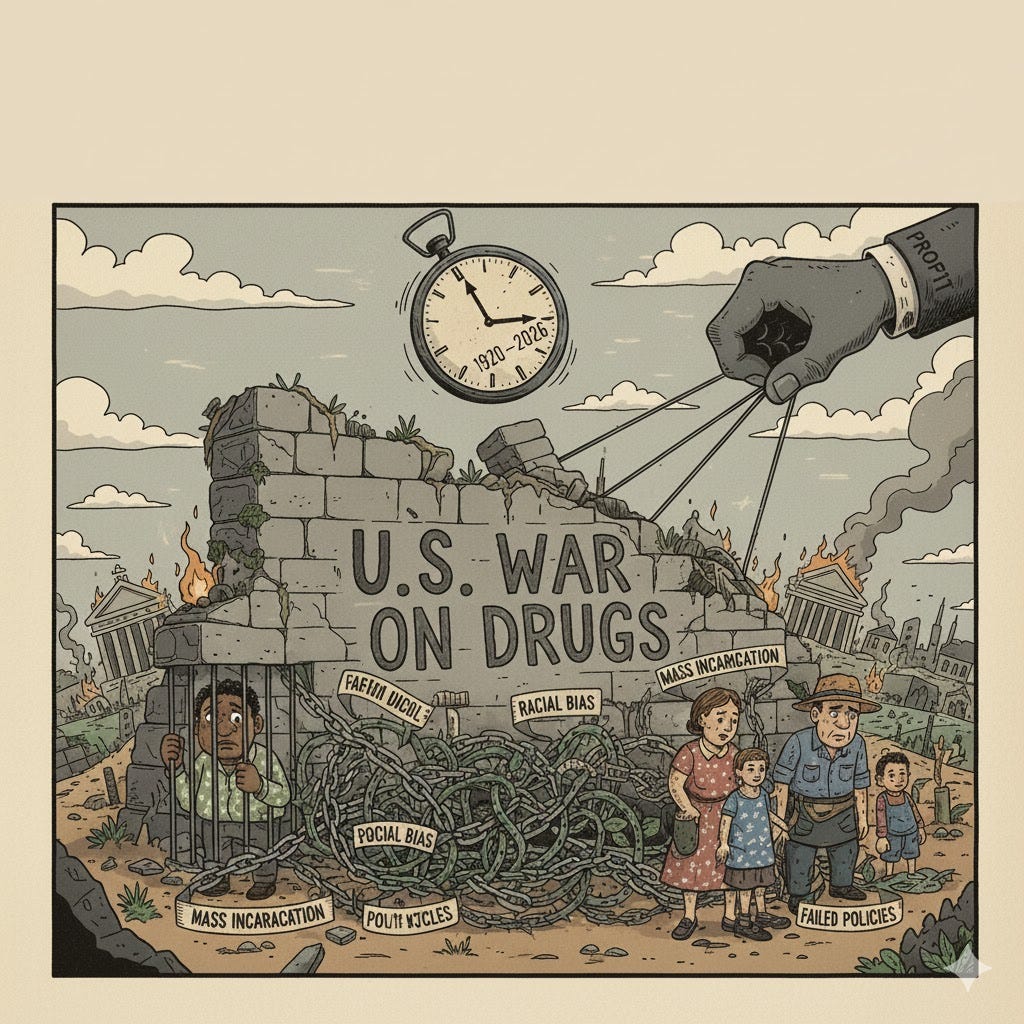
A Century of Policy Failures and Entrenched Inequities
I. Introduction
The U.S. war on drugs, now over five decades old, stands as a monumental policy failure that has deepened social divisions, economic disparities, and international tensions by 2026. What began as a purported effort to curb substance abuse has evolved into a mechanism for mass surveillance, incarceration, and geopolitical maneuvering, costing trillions while drug availability remains rampant. In an era where fentanyl overdoses claim over 50,000 lives annually, the policy’s punitive focus ignores root causes such as poverty and mental health, instead prioritizing enforcement that disproportionately affects marginalized communities. Politicians continue to tout aggressive tactics, including recent boat strikes and tariffs, as victories. Yet overdose rates have only marginally declined from peaks in prior years, suggesting superficial progress amid ongoing crises. This article traces the war’s origins from global imperial conflicts to its modern manifestations, arguing that it serves more as a tool for control and profit than genuine public health intervention. By examining historical precedents and current realities, we reveal how drug policies perpetuate inequality and justify foreign interventions under the guise of security.
As we enter 2026, the war on drugs faces renewed scrutiny amid shifting political landscapes, with some states advancing decriminalization while federal actions intensify border crackdowns and international sanctions. The Trump administration’s revival of aggressive enforcement, including threats against Mexico and China over fentanyl precursors, echoes past eras but amplifies risks of escalation into broader conflicts. Despite claims of progress, such as a 14.5 percent drop in overdose deaths by late 2025, critics argue these gains stem from prior public health initiatives now being dismantled in favor of militarized approaches. Economic incentives, from private prisons to pharmaceutical lobbying, further entrench the system, turning addiction into a lucrative industry rather than a solvable crisis. Ultimately, this ongoing war highlights a fundamental mismatch between rhetoric and reality, where victory is measured not in lives saved but in budgets allocated and enemies designated.
II. Historical Foundations: From Global Conflicts to Domestic Epidemics
The Opium Wars of the mid-19th century set a precedent for how drugs could be weaponized in international power struggles, with Britain forcing opium trade upon China to balance trade deficits and extract concessions. This imperial exploitation led to widespread addiction in China, crippling its society and economy while enriching Western powers, including early American traders who profited from the illicit market. The conflicts demonstrated drugs’ potential as tools of economic warfare, foreshadowing later U.S. policies that blended moral crusades with strategic interests. By the wars’ end, China ceded territories such as Hong Kong, illustrating how drug-related coercion could reshape global maps and alliances. These events planted the seeds for viewing narcotics not just as health issues but as levers for geopolitical dominance, a perspective that would influence American approaches in the centuries ahead.
During the American Civil War, morphine emerged as a battlefield staple, administered to wounded soldiers to alleviate pain amid brutal combat conditions. Dubbed “Soldier’s Disease,” post-war addiction afflicted tens of thousands of veterans, marking the U.S.’s first major opioid crisis and prompting initial calls for regulation. The widespread availability of morphine through patent medicines exacerbated civilian dependency, blending medical use with unchecked commercial exploitation. This era highlighted the dual-edged nature of opioids: essential for relief yet prone to abuse when poorly managed. As addiction rates soared, it spurred early federal interventions, setting the stage for viewing drugs through a lens of moral panic rather than public health.
The heroin boom of the early 1900s transformed a supposed medical miracle into a societal scourge, as Bayer marketed it as a safer alternative to morphine only for addiction to explode in urban centers. Racialized fears linked heroin to immigrant groups, fueling discriminatory laws such as the Harrison Narcotics Tax Act of 1914, which criminalized possession and shifted control from doctors to the state. This period saw heroin infiltrate everyday life, from cough syrups to recreational use, amplifying public hysteria and justifying expanded government oversight. The boom underscored how pharmaceutical innovation could backfire without regulation, creating epidemics that policymakers exploited for political gain. By associating drugs with marginalized communities, early 20th-century responses laid the groundwork for the inequities that define the war on drugs today.
Marijuana prohibition in the United States was deeply intertwined with racial prejudice and social control. In the early 20th century, anti-cannabis campaigns explicitly targeted Mexican immigrants and Black communities, portraying marijuana use as a threat to public safety and morality. Newspapers and policymakers stoked fears that marijuana caused violent behavior, crime, and moral decay among minority populations, framing the substance as inherently dangerous because of the communities associated with it. These narratives facilitated the Marihuana Tax Act of 1937, effectively criminalizing marijuana and establishing a framework that linked drug policy with racial discrimination. The stigma persisted for decades, painting marijuana users as deviant or criminal, while alcohol and tobacco, often consumed by white Americans, faced far lighter regulation. This racialized foundation shaped enforcement patterns, contributed to mass incarceration, and delayed any serious consideration of marijuana as a medical or recreational option for the broader population.
III. The Formal Declaration: Nixon’s War on Drugs from 1971 Onward
In 1971, President Nixon declared drugs “public enemy number one,” launching a comprehensive offensive that intertwined domestic law enforcement with efforts to suppress countercultural movements. This declaration led to the creation of the Drug Enforcement Administration (DEA) in 1973, centralizing federal anti-drug operations and emphasizing eradication over treatment. Policies such as mandatory minimum sentences disproportionately targeted non-violent offenders, ballooning prison populations while failing to reduce drug supply. International initiatives, including funding anti-narcotics operations in Colombia, often masked broader U.S. interventions in Latin America. Nixon’s approach, rooted in political strategy, set a tone of militarization that subsequent administrations would amplify.
Under Reagan in the 1980s, the war escalated with campaigns like “Just Say No” and the 1986 Anti-Drug Abuse Act, which imposed harsh penalties for crack cocaine, exacerbating racial disparities in sentencing. The crack-powder cocaine disparity—treating crack more severely despite similar effects—reflected biases that imprisoned Black communities at far higher rates than white communities using powder cocaine. Funding surged for interdiction and incarceration, fostering a prison-industrial complex that profited from the policy’s failures. International efforts intensified, with U.S. support for fumigation in Andean countries often damaging local economies and environments. This era solidified the war as a bipartisan endeavor, with later presidents such as Clinton expanding prisons through the 1994 Crime Bill, perpetuating a cycle of punishment over prevention.
The early 2000s saw the explosive rise of OxyContin, a prescription opioid marketed aggressively by Purdue Pharma as a safe, non-addictive painkiller. Widespread promotion to doctors and misleading claims about its addictiveness fueled mass prescription, creating a nationwide epidemic of dependency. Communities across rural and urban America experienced soaring overdose rates, while pharmaceutical companies profited immensely and faced minimal accountability for their role in the crisis. The epidemic exposed how corporate interests could manipulate medical systems, turning treatment into a vector for addiction. OxyContin’s impact extended beyond individual health, straining emergency services, increasing foster care placements, and deepening economic despair in hard-hit regions. This era cemented the link between corporate profit, regulatory failure, and the perpetuation of drug epidemics, setting the stage for the modern opioid crisis that continues to challenge policymakers in 2026.
IV. The Current Scenario in 2026: Persistent Failures and Evolving Challenges
Mass incarceration remains a hallmark of the war on drugs in 2026, with over 360,000 people imprisoned for drug offenses, comprising one in five of the total incarcerated population. Despite a 46 percent reduction in drug-related imprisonments from 2007 peaks, the U.S. still spends over $80 billion annually on incarceration, fueling debates on reform amid low crime rates. Partial decriminalization in states such as Oregon has sparked national conversations, yet federal resistance persists, with the prison-industrial complex lobbying against changes. Critics argue that incarceration does little to address addiction, instead creating barriers to reintegration and perpetuating poverty cycles. As overdose deaths hover around 52,000 yearly from fentanyl, calls for abolition or sentencing reform grow louder, highlighting the policy’s inefficacy.
In 2025, President Trump announced an initiative to reclassify marijuana from a Schedule 1 to a Schedule 3 controlled substance, signaling a potential shift in federal policy that could address one of the longstanding barriers for the legal cannabis industry. While Schedule 3 is still considered a substance controlled, it recognizes medical use and enables financial institutions to work with dispensaries more freely. This reclassification could allow cannabis businesses in legal states to open bank accounts and access credit, reducing reliance on cash operations that have posed significant security risks. Critics caution that the move may not go far enough to rectify decades of harm caused by prohibition, particularly for communities historically targeted by marijuana enforcement. Nevertheless, the policy represents a pragmatic acknowledgment that federal law must align with state-level legalization and evolving public attitudes, highlighting the tension between legacy stigma and contemporary economic and regulatory realities.
Racial and class inequalities in justice and wealth continue to define drug enforcement, with Black individuals arrested for drug offenses at rates far exceeding their actual usage, despite similar rates across demographics. Felony convictions strip voting rights and employment opportunities for many Americans, widening wealth gaps in communities of color. Pharmaceutical companies implicated in the opioid crisis face minimal accountability while private prisons profit from disproportionate sentences. The shift toward cannabis legalization generates tax revenue but benefits corporations over those historically harmed by prohibition. In 2026, these disparities underscore how the war exacerbates systemic racism, with Black people incarcerated at over four times the rate of whites for similar offenses.
Drugs also serve as a pretext for international conflicts, with U.S. interventions in Mexico and sanctions on China over fentanyl precursors masking economic and military agendas. The Trump administration’s 2025 tariffs and boat strikes against Venezuelan vessels exemplify this, claiming to disrupt trafficking but risking broader escalations. Operations such as the HALT Fentanyl Act impose mandatory minimums and target precursors, yet cartels adapt, shifting routes while U.S. deaths remain high. Proxy conflicts in Latin America, funded under anti-drug banners, advance U.S. interests but devastate local populations. As tensions with China rise over synthetic opioids, the policy blends national security with drug control, justifying sanctions and military aid that often fuel instability.
Thanks for reading The Brooks Brief Substack! This post is public so feel free to share it.
V. Conclusion
From the Opium Wars’ imperial exploitation to 2026’s militarized fentanyl crackdowns, the U.S. war on drugs has consistently prioritized control over compassion, entrenching inequalities and geopolitical strife. Historical epidemics such as morphine addiction after the Civil War and the heroin boom revealed drugs’ medical perils, yet responses veered toward criminalization rather than care. Nixon’s declaration and subsequent escalations built a punitive framework that ballooned incarceration and racial divides with little impact on supply. Today, mass imprisonment, justice inequities, and international excuses persist, costing lives and billions while overdose crises endure. This trajectory exposes policy as a mechanism for profit and power rather than public welfare.
Breaking this cycle in 2026 demands harm reduction strategies, full decriminalization, and investments in mental health and poverty alleviation rather than enforcement. With elections looming, polarized debates could spur reforms such as rescheduling cannabis federally or expanding treatment access. International cooperation, rather than unilateral strikes, might address global supply chains more effectively. Ultimately, reimagining drugs as a health issue could save resources and lives, fostering equity in a landscape scarred by decades of failure. The path forward lies in evidence-based approaches, not endless war.
Leave a Reply