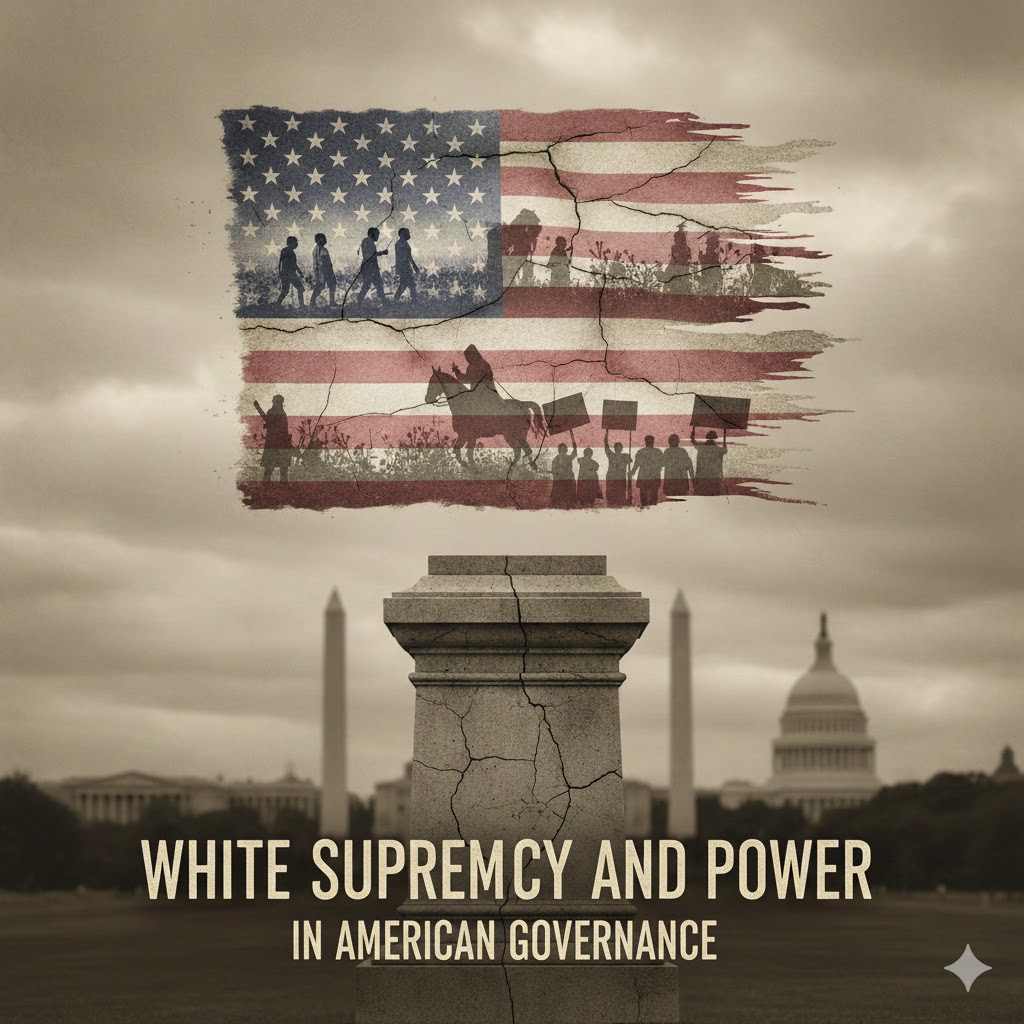
White supremacy in American politics is best understood not solely as an extremist ideology, but as a historical system of power embedded in laws, institutions, and policy outcomes. While explicit racial hierarchy has been formally rejected, its structural legacy continues to influence governance and political behavior. This analysis examines how racial hierarchy was constructed, reinforced, and adapted over time within American political systems. From the nation’s founding through the present day, race has shaped access to citizenship, representation, and economic opportunity. Contemporary political debates often reflect this inherited structure, even when race is not explicitly mentioned. Understanding this evolution is essential for evaluating current policy conflicts and democratic legitimacy.
Historical Foundations of Racial Hierarchy
The political economy of early America was inseparable from slavery and racial exclusion. Enslaved labor underwrote economic growth while shaping constitutional compromises that preserved white political dominance. The Three-Fifths Clause enhanced representation for slaveholding states while denying basic rights to enslaved people. Early citizenship laws further reinforced racial hierarchy by restricting naturalization to white individuals. Federal land policies displaced Indigenous populations and redistributed land primarily to white settlers. These decisions created a durable racial order that linked political power, land ownership, and citizenship.
Reconstruction and Institutional Retreat
The Civil War disrupted the racial hierarchy but did not dismantle it permanently. Reconstruction introduced constitutional amendments designed to establish legal equality and political inclusion for formerly enslaved Americans. For a brief period, federal enforcement enabled Black political participation and representation. However, resistance from Southern elites combined with waning political will in the North undermined these efforts. Violence, intimidation, and legal obstruction weakened Reconstruction from within. The federal government’s withdrawal in 1877 effectively restored white political control in the South. This retreat demonstrated the fragility of racial reform without sustained institutional commitment.
Jim Crow as State Policy
Jim Crow was not an informal social arrangement but a comprehensive political system enforced by law. Segregation statutes governed nearly every aspect of public life and were upheld by courts. Voting restrictions systematically excluded Black citizens while maintaining the appearance of legal neutrality. Political violence functioned as enforcement, deterring challenges to the racial order. Supreme Court decisions legitimized segregation and restricted federal intervention. This period entrenched racial hierarchy within state institutions and normalized inequality across generations. The durability of Jim Crow reflected political consensus rather than isolated regional prejudice.
Civil Rights and Conditional Reform
The Civil Rights Movement forced federal intervention through sustained political pressure. Legislative victories in the 1960s dismantled formal segregation and expanded voting rights. These reforms reshaped the electorate and altered party coalitions. However, they also triggered new political strategies designed to preserve existing power structures. Appeals to law and order reframed racial conflict in ostensibly neutral terms. Enforcement mechanisms weakened over time as political priorities shifted. The result was progress constrained by institutional resistance rather than a complete transformation of power relations.
Structural Inequality in the Post-Civil Rights Era
After overt discrimination became illegal, racial hierarchy persisted through policy design and enforcement. Criminal justice policies disproportionately impacted minority communities while claiming race neutrality. Housing and lending practices reinforced segregation and limited wealth accumulation. Electoral mechanisms such as gerrymandering reduced minority political influence despite demographic growth. Judicial rulings weakened oversight of voting protections. These outcomes reflect structural persistence rather than individual prejudice. Inequality continued through institutional momentum rather than explicit intent.
Contemporary Politics and the Trump Era
The Trump era highlighted how racial grievance politics can operate within mainstream political discourse. Campaign rhetoric framed national identity and immigration in exclusionary terms without explicit racial language. Policy decisions disproportionately affected non-white populations while emphasizing security and sovereignty. Responses to extremist violence raised concerns about political normalization. At the same time, civil rights enforcement was reduced across multiple federal agencies. Judicial appointments reshaped the legal environment governing voting rights and discrimination. These developments illustrate how leadership and institutions interact to shape long-term political outcomes.
In early 2026, President Donald Trump’s administration conducted a military operation in Venezuela that resulted in the capture and removal of President Nicolás Maduro and his wife, Cilia Flores, following U.S. airstrikes on multiple targets. Trump announced that the United States would temporarily oversee Venezuela’s transition, citing the need to stabilize the country and rehabilitate its oil infrastructure with the involvement of U.S. energy companies. This intervention echoes longstanding patterns in American foreign policy in which actions in Latin America are framed as democratic or security measures while functioning as mechanisms of control over non-white nations.
From the Monroe Doctrine through the Roosevelt Corollary, the United States has repeatedly intervened in the region while treating Latin American sovereignty as conditional. Trump’s justification for removing Maduro aligns with earlier regime change efforts that prioritized U.S. economic interests and geopolitical dominance. These interventions disproportionately affect populations in the Global South and reinforce a hierarchy in which American authority is portrayed as inherently superior. The Venezuela operation illustrates how domestic racial power structures can extend into foreign policy. It underscores the persistence of a global racial order shaped by American dominance rather than mutual sovereignty.
Rebuttal: Addressing Common Critiques
Critics often argue that focusing on white supremacy unfairly assigns racial intent to individual policymakers or exaggerates race as a factor in governance. This analysis does not claim that all political actors are motivated by racial animus. Instead, it examines how institutions and policies can produce unequal outcomes regardless of stated intent. Others contend that socioeconomic class, not race, is the primary driver of inequality. While class is a crucial factor, race has historically structured access to wealth, housing, and political power in ways that cannot be separated from class alone. Some argue that civil rights legislation resolved these issues decades ago. Persistent disparities and weakened enforcement suggest that legal reform without institutional maintenance is insufficient. The evidence indicates that racial hierarchy has adapted rather than disappeared.
Thanks for reading The Brooks Brief Substack! This post is public so feel free to share it.
Conclusion
White supremacy in American politics has evolved from explicit legal enforcement to structural and institutional persistence. Its influence remains visible in policy outcomes, political strategy, and access to democratic participation. Historical analysis reveals continuity between past and present systems of governance. Addressing inequality requires more than symbolic recognition or isolated reform. It demands sustained institutional accountability and rigorous policy evaluation. The central political question is whether American democracy will continue to accommodate inherited hierarchies or actively dismantle them through reform. The answer will shape the nation’s political trajectory for decades to come.
Leave a Reply