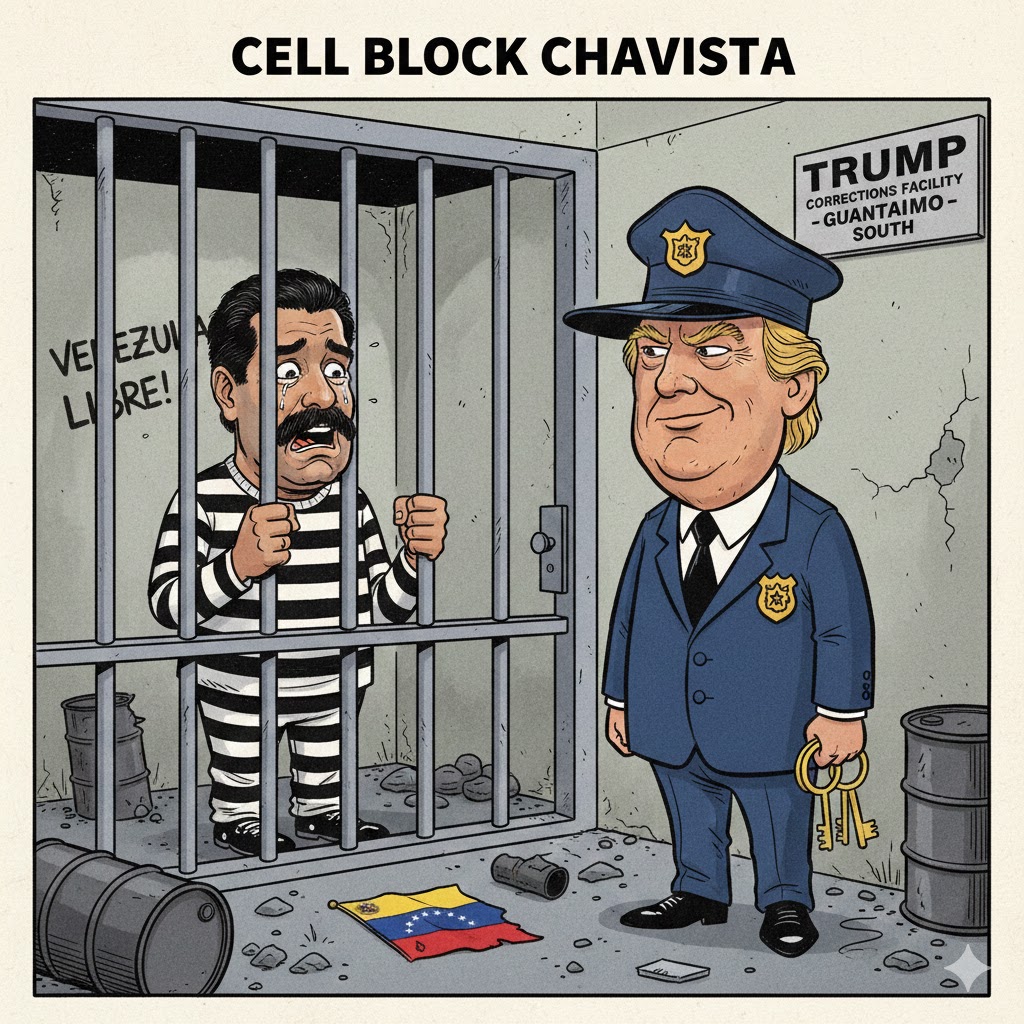
Examining the Legality of His Detention
Introduction
On January 3, 2026, U.S. special forces carried out a pre-dawn raid in Caracas, capturing Venezuelan President Nicolás Maduro and his wife, Cilia Flores, amid explosions and heavy military activity. The couple was swiftly transferred to a U.S. warship and later flown to New York, where Maduro appeared in federal court on January 5 in shackles, pleading not guilty to charges including narco-terrorism, drug trafficking, and weapons offenses. The unprecedented operation triggered widespread international condemnation, with critics questioning whether it complied with global legal norms. Many argue that the forcible removal of a sitting head of state constitutes unlawful abduction rather than a legitimate arrest.
The central debate now is whether Maduro’s detention renders him a political prisoner, targeted through extraterritorial U.S. intervention rather than standard judicial processes. As the trial approaches, the case exposes deep tensions between national sovereignty, international law, and the enforcement reach of global superpowers.
The raid, dubbed Operation Absolute Resolve, reportedly involved more than 150 aircraft and elite military units breaching Maduro’s fortified residence. President Donald Trump praised the mission as a victory against narco-terrorism, while China and Russia condemned it as an act of aggression. In court, Maduro declared himself “kidnapped” and a “prisoner of war,” insisting he remained Venezuela’s legitimate president. Legal experts have raised concerns over potential violations of the United Nations Charter, which prohibits the use of force against sovereign states. While U.S. officials emphasize criminal accountability, critics argue that the operation’s methods risk reframing the charges as political lawfare.
Background on Nicolás Maduro and Venezuela’s Political Crisis
Nicolás Maduro succeeded Hugo Chávez in 2013 and has since presided over a government marked by disputed elections, economic collapse, and accusations of authoritarianism. His reelections in 2018 and 2024 were widely rejected as fraudulent, prompting the United States and several allies to withdraw diplomatic recognition and impose severe sanctions. Venezuela has endured hyperinflation, chronic shortages, and a refugee crisis that has displaced more than seven million people. Allegations of state involvement in drug trafficking have further deepened the country’s international isolation.
In 2020, U.S. prosecutors indicted Maduro, accusing him of leading the so-called Cartel of the Suns and facilitating cocaine shipments in collaboration with Colombian guerrilla groups. A $50 million reward was offered for information leading to his arrest. These indictments formed the legal foundation for the 2026 operation.
The January raid followed months of escalating U.S. pressure, including strikes on alleged narco-trafficking vessels that reportedly resulted in significant casualties. Trump administration officials, including Secretary of State Marco Rubio, characterized the capture as a law enforcement action supported by military assets. Maduro and Flores were briefly held aboard the USS Iwo Jima before being transferred to the Metropolitan Detention Center in Brooklyn. In Caracas, Vice President Delcy Rodríguez emerged as an interim authority, leaving the country in a state of political uncertainty amid fears of unrest and power vacuums.
Defining a Political Prisoner
Organizations such as Amnesty International and the United Nations define political prisoners as individuals detained primarily for political reasons, often without fair trials or due process. This category includes cases where criminal charges are used to mask ideological or geopolitical persecution. The concept of “lawfare,” or the strategic use of legal systems to achieve political objectives, further complicates the distinction between legitimate prosecution and repression.
Historical examples frequently cited include Nelson Mandela’s imprisonment under apartheid, Alexei Navalny’s detention in Russia, and Aung San Suu Kyi’s confinement under Myanmar’s military junta. In each case, legal mechanisms were used to neutralize political threats. In Maduro’s case, the question is whether the United States is pursuing justice for alleged crimes or advancing regime change through legal means.
The forcible extraction of a sitting head of state raises unique issues under international law, particularly concerning immunity and sovereignty. Typically, even indicted leaders are subject to extradition requests rather than military seizure. Comparisons to the 1989 capture of Manuel Noriega in Panama highlight recurring criticisms of U.S. unilateralism. Determining whether Maduro qualifies as a political prisoner requires weighing serious criminal allegations against significant procedural irregularities.
Arguments in Favor of Maduro as a Political Prisoner
Many legal scholars argue that Maduro’s capture constitutes a clear breach of international law, resembling an abduction rather than a lawful arrest. The operation involved a military incursion into sovereign territory without Venezuelan consent or authorization from the United Nations, potentially violating the UN Charter. Critics describe the raid as imperialistic and argue that it sets a dangerous precedent for powerful states.
Skeptics also question the evidentiary basis of the charges, noting reliance on defectors and informants who may have political incentives. The absence of any extradition process further underscores the irregularity of the detention. Maduro’s courtroom declarations that he was kidnapped and treated as a prisoner of war have been echoed by allies such as Russia and China, as well as several Latin American governments that condemned the operation as unlawful aggression.
The timing of the raid, amid U.S. interests in Venezuelan oil and ongoing support for opposition groups, has fueled suspicions of geopolitical motives. Human rights organizations warn that normalizing such actions could erode international norms and encourage global instability. Maduro’s defenders argue that, regardless of his governance record, his detention fits broad definitions of political imprisonment due to its overtly political context and execution.
Arguments Against Maduro as a Political Prisoner
The U.S. government maintains that the operation was a lawful enforcement of long-standing criminal indictments against a fugitive accused of serious transnational crimes. Prosecutors allege that Maduro oversaw cocaine trafficking operations aimed at the United States, collaborating with armed groups and using state institutions to facilitate narco-terrorism. These charges predate the raid by several years and, according to U.S. officials, reflect criminal accountability rather than political retaliation.
In U.S. custody, Maduro is afforded legal counsel, public court proceedings, and the right to contest the charges, conditions that contrast with arbitrary political detentions. The administration also argues that Maduro lost any claim to legitimacy following the disputed 2024 election, rendering head-of-state immunity inapplicable. Supporters cite the Noriega case as precedent for prosecuting foreign leaders accused of international crimes.
Many Venezuelan exiles and opposition figures welcomed Maduro’s removal, viewing it as an opportunity for national recovery. They note the irony of Maduro invoking victimhood given his own government’s history of imprisoning political opponents. From this perspective, the detention represents justice delayed rather than political persecution, even if the methods remain controversial.
Broader Implications and International Perspectives
Maduro’s capture has far-reaching implications for international law and regional stability. Venezuela now faces the risk of political fragmentation, with uncertainty over leadership and governance. The precedent challenges long-standing principles of sovereignty and non-intervention, raising concerns among smaller states wary of unilateral enforcement by powerful nations.
Global reactions have largely followed geopolitical lines, with muted responses from Western allies and sharper criticism from the Global South. Human rights advocates stress the need for a transparent and fair trial to prevent perceptions of victor’s justice. Speculation persists that economic interests, particularly access to oil resources, influenced the timing and execution of the operation.
Diplomatic fallout may include strained relations with China and Russia, renewed debate at the United Nations, and heightened regional tensions. For many in the Venezuelan diaspora, however, the event represents a rare opening for democratic renewal. The case may ultimately redefine the boundaries of power, law, and accountability in the international system.
Thanks for reading The Brooks Brief Substack! This post is public so feel free to share it.
Conclusion
A significant body of legal opinion suggests that Nicolás Maduro’s detention may be unlawful, rooted in a military operation that violated principles of sovereignty and international norms. While the charges against him allege serious criminal conduct, the manner of his capture risks overshadowing judicial legitimacy and reinforcing claims of political persecution. Labeling Maduro a political prisoner underscores the dangers of conflating legal processes with geopolitical objectives.
The outcome of this case will likely shape future interpretations of head-of-state immunity and extraterritorial enforcement. Ensuring a fair and transparent trial is essential to maintaining credibility and preventing the erosion of the global rules-based order. As Venezuela confronts an uncertain future, the world watches closely to see whether justice or power ultimately prevails.
Leave a Reply