Tag: polarization

  • The War of Ideals

    The War of Ideals

    How Political Worldviews Cause Conflict


    Introduction

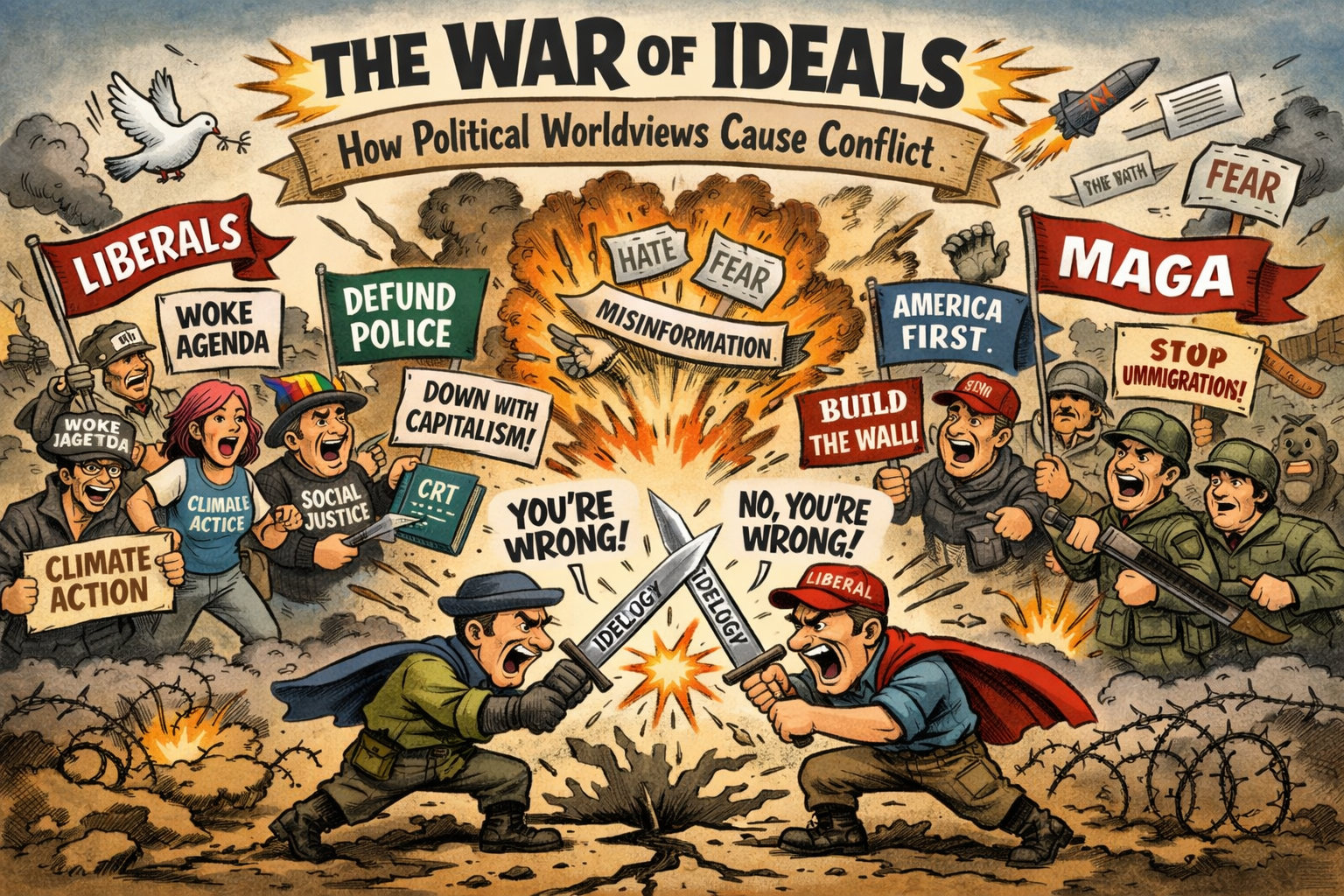
    In an era defined by fractured alliances and escalating rhetoric, political conflict increasingly transcends policy disputes and enters the realm of existential struggle. The 2024 U.S. presidential election offers a clear illustration, as debates over immigration, gender identity, and economic inequality often devolved into accusations that one side threatened the moral foundation of the nation. Similar dynamics are evident across Europe, where populist movements clash with supranational institutions over sovereignty, identity, and cultural preservation. These conflicts are not merely about legislation or governance. They reflect deeper disagreements over values, meaning, and the nature of social order. At their core, they represent a war of ideals.

    Political worldviews serve as the interpretive lenses through which individuals and societies understand reality. These frameworks shape perceptions of justice, authority, human nature, and progress, influencing how people define legitimacy and threat. When competing worldviews collide, compromise becomes difficult because the dispute is no longer transactional. Instead, opposing visions are seen as morally incompatible or even dangerous. What one group views as reform, another interprets as decay or tyranny. As a result, political disagreement becomes deeply personalized and emotionally charged.

    This article argues that political worldviews inevitably generate conflict by constructing incompatible moral realities, intensifying threat perceptions, and legitimizing defensive or aggressive actions. Unlike resource-based conflicts, which can often be resolved through negotiation or division, worldview conflicts strike at the core of identity and meaning. The article first defines political worldviews and their key dimensions. It then examines the mechanisms that transform ideological differences into antagonism. Historical and contemporary cases illustrate why these conflicts are persistent and resistant to resolution, followed by an exploration of guardrails that can reduce escalation without suppressing pluralism.

    The Brooks Brief Substack is a reader-supported publication. To receive new posts and support my work, consider becoming a free or paid subscriber.

    What Are Political Worldviews?

    Political worldviews are comprehensive belief systems that integrate values, assumptions, and prescriptions for how society should be organized. They extend beyond partisan affiliation or discrete policy preferences, functioning instead as cognitive maps that guide interpretation of events and moral judgment. Through these maps, individuals assess what is fair, legitimate, or dangerous in political life. Worldviews shape not only opinions but also emotional responses to social change. They define who belongs, who threatens the group, and what outcomes are acceptable. As such, they are foundational to political behavior.

    At the center of every political worldview are answers to fundamental questions about human nature and power. Some worldviews emphasize human perfectibility, arguing that injustice stems from flawed institutions that can be corrected through reform and education. Others stress inherent human limitations, asserting that order, tradition, and authority are necessary to restrain chaos. These assumptions directly influence attitudes toward governance. A state may be viewed as a neutral referee, a redistributor of opportunity, or a moral guardian depending on the worldview embraced.

    Worldviews also differ in their orientation toward change and inclusion. Progressive worldviews often prioritize adaptation, innovation, and expansion of rights to marginalized groups. Conservative worldviews tend to emphasize continuity, stability, and the preservation of inherited norms. Similarly, universalist perspectives extend moral concern across borders, while particularist perspectives prioritize national, cultural, or communal loyalty. These differences are not easily reconciled because they involve competing definitions of virtue and responsibility. As a result, policy debates become symbolic battles over identity rather than pragmatic problem solving.

    Crucially, worldview clashes differ from ordinary ideological disagreements. Policies such as tax rates or regulatory frameworks can be debated using shared empirical standards. Worldviews, by contrast, attach moral meaning to those policies. Inequality may be seen either as systemic injustice or as an inevitable outcome of individual variation. These interpretations create mutual incomprehension rather than simple disagreement. Opponents are not just wrong but morally alien.

    Core Mechanisms: How Worldviews Produce Conflict

    The transformation of worldview diversity into open conflict occurs through several reinforcing mechanisms. One of the most significant is moral absolutism, which frames political goals as zero-sum struggles between good and evil. When equality is perceived as incompatible with merit, or secularism as hostile to faith, compromise is seen as surrender. This framing eliminates middle ground by redefining disagreement as moral transgression. Political competition thus becomes existential rather than procedural. Each victory or loss takes on symbolic weight far beyond its practical consequences.

    Threat perception further intensifies conflict. Worldview-incongruent ideas are interpreted not as alternative preferences but as attacks on foundational truths. Nationalists may see global institutions as eroding sovereignty and cultural identity. Cosmopolitans, in turn, may view nationalism as a regression toward exclusion and conflict. These perceptions trigger defensive responses that escalate tension. Actions taken for self-protection are interpreted by opponents as confirmation of hostile intent.

    Psychological dynamics amplify these effects. In-group favoritism strengthens loyalty within ideological communities while facilitating out-group dehumanization. Political opponents are labeled with moralized terms such as extremists or enemies of the people. Group polarization intensifies views within echo chambers, pushing individuals toward more extreme positions. At the same time, epistemological closure undermines shared standards of truth, as different worldviews rely on incompatible sources of authority and evidence.

    Social and technological factors reinforce these patterns. Algorithm-driven media environments sort individuals into ideologically homogeneous networks. Exposure to opposing views becomes rare and adversarial, often mediated through caricature. Feedback loops develop in which outrage is rewarded with attention and status. Over time, these dynamics normalize hostility and reduce incentives for moderation.

    Elite rhetoric plays a critical role in sustaining these mechanisms. Political leaders and media figures often exploit worldview divisions for mobilization and power. By portraying opponents as existential threats, elites consolidate support while deepening polarization. This strategy creates self-fulfilling prophecies, as mutual distrust makes cooperation increasingly unlikely. The result is a political environment primed for escalation.

    Historical Examples of Worldview-Driven Conflicts

    History provides numerous examples of conflicts rooted in incompatible worldviews. The Cold War stands as a defining case of ideological confrontation shaping global politics. Liberal democracy, grounded in individual rights and market economies, clashed with Marxist-Leninist communism’s collectivist vision of class struggle and state control. Each side viewed the other as a fundamental threat to human progress. This ideological rivalry manifested in proxy wars, arms races, and global propaganda campaigns. The conflict persisted for decades because neither side could concede without undermining its moral foundation.

    Earlier periods reveal similar patterns. The European Wars of Religion in the sixteenth and seventeenth centuries were driven by competing theological worldviews intertwined with political authority. Protestant and Catholic factions justified violence as obedience to divine truth. The Thirty Years’ War devastated large portions of Europe, demonstrating how absolutist belief systems can prolong and intensify conflict. Compromise was difficult because doctrinal concessions were equated with spiritual betrayal. Political settlements only emerged after exhaustion rather than reconciliation.

    The twentieth century witnessed further worldview-driven catastrophes. Fascism, liberalism, and communism offered rival visions of human destiny, each claiming exclusive legitimacy. World War II represented not only a military struggle but a moral confrontation over authority, equality, and identity. Totalitarian regimes mobilized populations by framing conflict as necessary for survival and renewal. The scale of destruction reflected the depth of ideological commitment on all sides.

    Revolutionary movements also illustrate the dynamic. The French Revolution pitted radical egalitarianism against monarchist traditionalism, leading to cycles of violence such as the Reign of Terror. Anti-colonial struggles similarly involved clashes between imperial hierarchies and modernist visions of self-determination. These cases show how worldview conflicts often transcend borders, drawing in allies and spreading through ideological contagion. Once activated, they reshape international systems.

    Contemporary Manifestations

    In the contemporary era, worldview conflicts are pervasive across domestic politics. In many democracies, populist nationalism confronts progressive cosmopolitanism in battles over identity, culture, and authority. Immigration debates exemplify this divide, with one side emphasizing humanitarian obligation and the other stressing social cohesion and sovereignty. Economic policy, climate change, and education are similarly framed as moral struggles rather than technical issues. These disputes increasingly define political identity and affiliation.

    Cultural and identity politics further intensify polarization. Debates over race, gender, and historical memory are framed as contests between inclusion and tradition. For some, expanding recognition corrects long-standing injustices. For others, it represents an erosion of shared norms and social stability. These opposing interpretations fuel culture wars that spill into institutions, media, and workplaces. The result is a political environment saturated with symbolic conflict.

    On the international stage, worldview competition shapes geopolitical rivalry. The liberal international order, promoted by Western alliances, faces challenges from authoritarian nationalism. Russia’s invasion of Ukraine was justified in ideological terms, framed as resistance to Western moral decay and geopolitical expansion. China’s governance model emphasizes state-centric harmony and collective stability over liberal individualism. These competing visions collide in global institutions, trade regimes, and security arrangements.

    Digital media accelerates and globalizes these conflicts. Algorithms amplify emotionally charged content that reinforces existing beliefs. Parallel information ecosystems emerge, each sustaining its own narrative of reality. Movements such as anti-vaccine activism or transnational protest campaigns demonstrate how worldview lenses shape interpretations of facts. Local disputes can rapidly become global flashpoints, magnifying their impact.

    Why Worldview Conflicts Are Especially Difficult to Resolve

    Worldview conflicts are uniquely resistant to resolution because they are rooted in identity. Unlike material interests, which can be negotiated or divided, core beliefs define who individuals understand themselves to be. Conceding on such beliefs feels like moral surrender or self-erasure. A conservative may view compromise on social norms as abandoning truth. A progressive may see restraint as complicity in injustice. These perceptions make bargaining emotionally and psychologically costly.

    Escalation is built into the structure of worldview conflict. Actions taken by one side to defend its values are interpreted by the other as confirmation of hostile intent. This dynamic fuels mutual radicalization, as moderation appears naive or dangerous. Over time, positions harden and trust erodes. Political systems become locked in cycles of retaliation and obstruction.

    The erosion of shared reality further complicates resolution. Distrust in institutions, experts, and media undermines the possibility of fact-based dialogue. Each worldview develops its own criteria for truth and legitimacy. Evidence is selectively accepted or rejected based on narrative fit. Without common epistemic ground, persuasion becomes nearly impossible.

    Compared to resource-based disputes, worldview conflicts rarely offer win-win outcomes. Territorial or economic conflicts can be resolved through partition or compensation. Worldview wars, by contrast, demand conversion, dominance, or suppression. This structural rigidity makes them prone to stalemate, fragmentation, or violence. Resolution often comes only through exhaustion or external shock.

    Thanks for reading The Brooks Brief Substack! This post is public so feel free to share it.

    Share

    Conclusion: Beyond the War of Ideals?

    Acknowledging the inevitability of worldview diversity is essential for democratic resilience. Attempts to eliminate ideological difference risk authoritarianism and intellectual stagnation. Yet unmanaged conflict threatens social cohesion and political stability. The challenge is not to end the war of ideals but to contain its destructive potential. Effective guardrails can allow rivalry without collapse.

    Institutional design plays a critical role. Federalism, power-sharing arrangements, and independent courts can diffuse conflict by preventing total domination by any single worldview. These structures force cooperation while protecting minority perspectives. Similarly, strong civic norms and procedural fairness can sustain legitimacy even amid deep disagreement. Institutions matter most when trust is scarce.

    Cultural and psychological interventions are equally important. Encouraging epistemic humility can reduce moral absolutism and open space for dialogue. Cross-cutting identities, such as shared civic service or economic interdependence, weaken ideological silos. Exposure to diverse perspectives in non-adversarial settings can humanize opponents. These measures do not erase disagreement but soften its edges.

    Elite responsibility is decisive. Leaders who de-escalate rhetoric and model restraint can shift incentives away from polarization. By framing conflict as manageable rather than existential, they reduce the appeal of zero-sum narratives. Ultimately, societies must learn to channel ideological tension into debate rather than destruction. If managed wisely, the clash of worldviews can serve as a catalyst for renewal rather than a prelude to rupture.
  • The Engine of Division

    The Engine of Division

    How Political Polarization Serves the Elite and Weakens the Masses


    Introduction

    In an era saturated with constant political conflict, public discourse has become dominated by emotionally charged debates over cultural and social issues. From immigration and gender policy to education and policing, these disputes are presented as existential struggles that demand total allegiance. The 2024 U.S. presidential election exemplified this dynamic, with candidates framing opponents as threats to democracy or national survival. Such rhetoric deepens an “us versus them” mentality that leaves little room for compromise or collective problem-solving. While these conflicts appear organic, they are routinely amplified by powerful interests that benefit from social fragmentation. The result is a distracted public less able to confront structural economic and political inequalities.

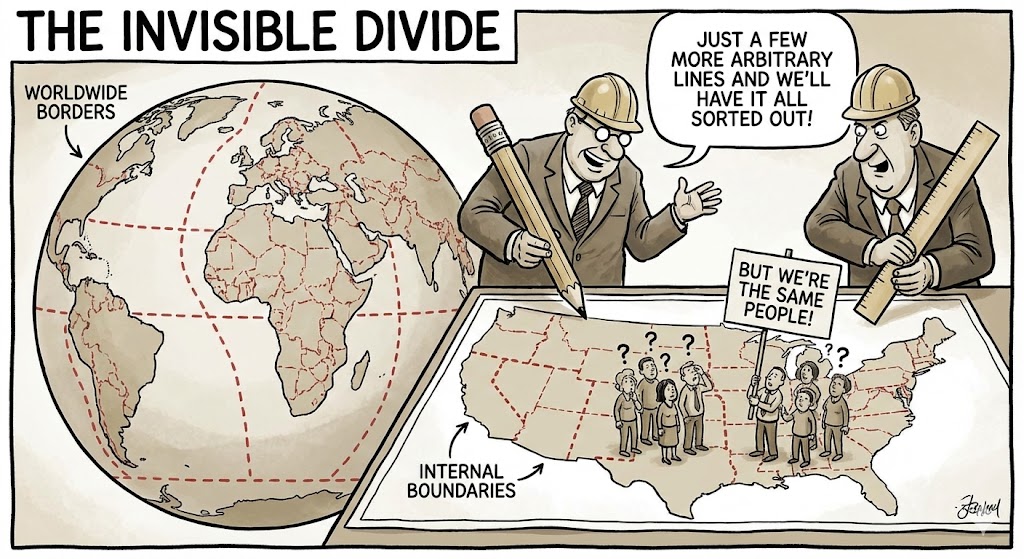
    Political division does not emerge in a vacuum, nor is it simply the byproduct of ideological diversity. It is actively cultivated through messaging strategies that emphasize identity conflict while marginalizing material concerns. Issues such as wealth concentration, corporate consolidation, and declining labor power receive far less sustained attention than cultural flashpoints. By keeping the public locked in perpetual outrage, elites redirect frustration away from institutions that shape economic outcomes. This pattern ensures that systemic failures remain intact while social trust erodes. Division, in this sense, functions as a governing strategy rather than a political accident.

    This analysis argues that polarization weakens democratic capacity by undermining solidarity among the lower and middle classes. It examines the historical roots of divide-and-rule tactics, the modern mechanisms that sustain them, and the concrete consequences for everyday people. It also evaluates contemporary case studies that illustrate how polarization correlates with elite economic gains. Finally, it outlines potential pathways for rebuilding social cohesion across political and cultural divides. The central claim is clear: societies fragmented by engineered conflict struggle to challenge entrenched power.

    Historical Context of Division as a Control Mechanism

    The use of division as a political tool predates modern democracy and is deeply embedded in imperial governance. Ancient Rome institutionalized the principle of divide and rule by fostering rivalries among conquered populations to prevent unified resistance. By distributing uneven privileges and encouraging intergroup competition, Roman authorities reduced the likelihood of coordinated rebellion. Power was preserved not through consensus but through managed conflict. This strategy proved effective precisely because it redirected resentment horizontally rather than upward. The lesson endured long after the empire itself declined.

    Colonial powers refined these methods with greater precision and scale. In British-ruled India, administrators exploited religious and ethnic distinctions to weaken nationalist movements. Policies that categorized populations along rigid communal lines intensified divisions that had previously been more fluid. Similar approaches were deployed across Africa and the Middle East, where colonial borders and governance structures entrenched long-term instability. These divisions served imperial interests by preventing mass mobilization against colonial rule. The resulting conflicts often outlasted the colonial period itself.

    Industrial capitalism in the nineteenth and early twentieth centuries adapted divide-and-rule tactics to class conflict. In the United States, industrialists during the Gilded Age exacerbated racial and ethnic tensions among workers to undermine labor organizing. Employers routinely pitted white immigrant laborers against Black workers to prevent collective bargaining. Media narratives and political rhetoric reinforced these divisions, portraying labor solidarity as dangerous or unpatriotic. By fragmenting the working class, economic elites preserved exploitative labor arrangements. History consistently shows that division functions as a stabilizing force for entrenched power.

    Mechanisms of Political Division Today

    In the contemporary political environment, division is reinforced through complex and technologically advanced systems. Digital media platforms use algorithms designed to maximize engagement, often by promoting emotionally charged and polarizing content. Users are funneled into ideological echo chambers that reinforce existing beliefs while caricaturing opposing views. This dynamic elevates cultural wedge issues while marginalizing shared economic concerns such as healthcare access or wage stagnation. Outrage becomes more visible than policy analysis, distorting public priorities. The architecture of online discourse thus rewards division over deliberation.

    Economic policy debates are similarly reframed to obscure underlying class dynamics. Trade agreements, deregulation, and austerity measures are frequently presented as cultural or regional conflicts rather than economic choices. Urban and rural populations are cast as adversaries, even when both experience job insecurity and declining public services. This framing benefits corporate and financial elites who profit from globalization while avoiding accountability. By personalizing economic pain as cultural resentment, policymakers deflect scrutiny from structural decisions. Division becomes a narrative shield for inequality.

    Political institutions and campaign finance structures further entrench polarization. Wealthy donors and corporate-backed political action committees fund messaging that emphasizes fear and antagonism over substantive policy debate. Campaigns invest heavily in negative advertising that mobilizes voters through hostility rather than shared goals. As a result, electoral competition rewards extremism and punishes coalition-building. The political system becomes less responsive to broad public interests and more attuned to narrow elite priorities. Polarization is thus continuously reproduced through institutional incentives.

    Impacts on Lower and Middle Classes

    The consequences of engineered division are most severe for the lower and middle classes. Economically, polarization weakens collective bargaining power and reduces pressure for redistributive policies. Fragmented workers struggle to organize effectively, allowing wages to stagnate while productivity gains accrue to executives and shareholders. Labor protections erode with little resistance, as divided constituencies fail to mount unified opposition. The decline of unions and the rise of precarious work reflect this imbalance. Division ultimately translates into diminished economic security.

    Social cohesion also deteriorates under sustained political conflict. Constant exposure to hostile rhetoric fosters mistrust, anxiety, and a sense of isolation. Families, workplaces, and communities fracture along partisan lines, undermining informal support networks. Research increasingly links political polarization to negative mental health outcomes, including stress and depression. Civic life suffers as individuals withdraw from collective engagement. A society consumed by internal conflict becomes less resilient in the face of crisis.

    Politically, division breeds disengagement and vulnerability to authoritarian appeals. Voter apathy increases when citizens perceive politics as irredeemably hostile or corrupt. At the same time, extreme polarization creates openings for leaders who promise order through exclusion or repression. Democratic norms weaken as compromise is portrayed as betrayal rather than governance. In this environment, the lower and middle classes lose both representation and leverage. The promise of empowerment through division consistently proves illusory.

    Case Studies from Contemporary Politics

    Recent U.S. politics provides a clear example of how polarization benefits elites. During the Trump and Biden administrations, cultural conflict dominated media coverage while wealth inequality continued to rise. Debates over identity and national identity overshadowed bipartisan support for policies favoring capital over labor. Despite rhetorical differences, tax structures and regulatory frameworks largely preserved elite advantages. Scholars such as Thomas Piketty have documented how political polarization coincides with increased income concentration. Divided electorates struggle to demand redistributive reform.

    The United Kingdom’s Brexit process illustrates a similar pattern. Political elites framed the referendum as a cultural and sovereignty struggle, pitting “Leave” against “Remain” voters. This framing obscured the economic interests that stood to benefit from deregulation and labor market flexibility. Post-Brexit outcomes have disproportionately favored large firms and financial actors while wages stagnated. Social divisions deepened, but structural inequalities persisted. Polarization once again diverted attention from material outcomes.

    Comparable dynamics appear in other democracies. In India, religious nationalism has intensified alongside rising economic inequality and corporate concentration. Populist rhetoric mobilizes identity-based loyalty while deflecting scrutiny from crony capitalism. Data from global inequality research consistently show that polarized societies experience disproportionate income growth at the top. These cases reinforce a common conclusion: division serves elite stability, not popular empowerment.

    Pathways to Overcoming Division

    Countering polarization requires intentional strategies that prioritize shared material interests. Grassroots movements have historically demonstrated the potential of cross-group solidarity. Labor campaigns that unite workers across race, region, and ideology remain among the most effective challenges to elite power. Demands for universal healthcare, fair wages, and affordable housing cut across cultural divides. Such coalitions reframe politics around common needs rather than identity conflict. Solidarity becomes a practical necessity rather than an abstract ideal.

    Media reform and civic education are also critical. Expanding media literacy can help citizens recognize manipulative narratives and resist algorithm-driven outrage. Public pressure for transparency and accountability in digital platforms may reduce the amplification of divisive content. Electoral reforms such as ranked-choice voting could incentivize broader coalition-building. These institutional changes would not eliminate disagreement but could reduce zero-sum incentives. A healthier political environment depends on structural as well as cultural change.

    Finally, democratic education should emphasize collective agency and shared responsibility. Teaching political history through a lens of class, power, and solidarity can counter simplistic partisan narratives. Citizens equipped with this perspective are better positioned to identify who benefits from division. Rebuilding trust requires sustained engagement across differences, not the denial of conflict but its contextualization. Unity is not uniformity but coordinated action toward shared goals. Without it, democratic power remains fragmented.

    Thanks for reading The Brooks Brief Substack! This post is public so feel free to share it.

    Share

    Conclusion

    Political polarization is not merely a cultural phenomenon but a strategic tool that preserves elite dominance. By amplifying division, powerful interests divert attention from systemic inequalities and weaken collective resistance. Historical patterns and contemporary case studies demonstrate that this strategy consistently benefits the few at the expense of the many. The economic, social, and political costs to the lower and middle classes are substantial and enduring. Yet polarization is not inevitable or irreversible.

    Pathways toward solidarity exist in grassroots organizing, institutional reform, and civic education. Reclaiming a shared political identity rooted in material interests can counter the fragmenting effects of divisive rhetoric. A democratic society cannot function effectively when its citizens are locked in perpetual conflict. Strength emerges from cooperation, not constant antagonism. The challenge is not eliminating disagreement, but refusing to let it be weaponized against the public itself.

  • Media Polarization and the Collapse of Shared Truth

    Media Polarization and the Collapse of Shared Truth

    How Disinformation, Algorithmic Outrage, and Political Pressure Are Redefining the American Press


    Introduction: The Disintegration of a Shared Reality

    A free and independent press has historically functioned as a core democratic institution in the United States, providing citizens with reliable information and acting as a check on political power. For much of the nation’s history, journalism helped sustain a shared factual framework within which political disagreement could occur. That shared framework made compromise, accountability, and public deliberation possible. Today, however, the American information environment is increasingly fragmented. Media polarization now reflects not simply ideological division, but the collapse of commonly accepted facts.

    This fragmentation is not the result of a single actor or moment. It emerges from intersecting pressures that include political intimidation, economic consolidation, algorithmic amplification, and concentrated ownership. These forces collectively reshape newsroom behavior and public expectations. Journalism is increasingly evaluated through partisan loyalty rather than factual accuracy. As a result, trust in the press has deteriorated across ideological and demographic lines.

    The erosion of shared truth presents a systemic risk to democratic governance. Without agreement on basic facts, institutions struggle to function effectively and public debate becomes performative rather than substantive. The press, once a mediator of reality, is now perceived as another political actor. Understanding how this shift occurred is essential to assessing the long-term health of American democracy.

    From Watchdog to Target: Political Pressure on the Press

    Political hostility toward the press has intensified over the past decade, with journalists increasingly portrayed as adversaries rather than public servants. Leaders across the political spectrum, but particularly during the Trump era, normalized rhetoric that framed the media as dishonest, partisan, or illegitimate. This narrative undermined the press’s credibility and reshaped public attitudes toward accountability reporting. Over time, repeated attacks on journalists reduced the political cost of ignoring or dismissing unfavorable coverage.

    Beyond rhetoric, political pressure has taken on institutional form. Media organizations are now routinely asked to accept restrictions on questioning, access, and real-time fact-checking in exchange for participation in official events. These conditions shift the balance of power away from journalists and toward political actors. Compliance becomes a prerequisite for relevance, rather than an exception.

    Such arrangements have long-term consequences. Once access-based limitations are normalized, they become embedded in professional practice. Journalists internalize boundaries about what questions can be asked and when scrutiny is appropriate. This gradual adjustment weakens the press’s ability to fulfill its democratic role, even in the absence of explicit censorship.

    Algorithmic Outrage and the Economics of Division

    Digital platforms have profoundly altered how information circulates in modern societies. Algorithms optimized for engagement prioritize emotionally charged content over accuracy or context. Outrage, fear, and identity-based narratives consistently outperform measured analysis in visibility and reach. As a result, misinformation and polarizing content spread faster than corrections or nuanced reporting.

    Economic pressures within the media industry reinforce these dynamics. As traditional advertising revenue declines, outlets increasingly depend on clicks, shares, and digital traffic. Editorial decisions are shaped by metrics that reward virality rather than public value. Investigative reporting, which is costly and slow, struggles to compete with content designed for rapid consumption.

    This system produces a feedback loop. Polarized audiences consume polarized content, which platforms then amplify further. Over time, exposure to alternative perspectives diminishes and trust in neutral reporting erodes. The economic logic of digital media thus aligns with political polarization, weakening the press’s capacity to serve as a stabilizing democratic institution.

    Billionaire Ownership and Structural Media Capture

    The concentration of media ownership among billionaires represents a structural shift in the American press. Wealthy individuals increasingly acquire major outlets under the premise of rescuing struggling institutions. While such acquisitions may preserve operations, they also reshape editorial incentives. Ownership alone, even without direct intervention, influences newsroom culture and decision-making.

    Billionaire-owned outlets tend to avoid sustained scrutiny of elite economic power, regulatory regimes, or political arrangements that affect owner interests. Journalists learn implicitly which topics invite support and which create friction. This form of influence operates through professional self-censorship rather than explicit directives. Over time, the range of acceptable debate narrows.

    This ownership concentration distances media institutions from the public interest. When information flows through a small and wealthy elite, journalism risks serving stability for power rather than accountability to citizens. The press becomes less a democratic commons and more an elite-managed system of information control.

    Defunding Public Interest Media and the Loss of Transparency

    Publicly funded media historically provided a counterbalance to commercial and political pressures. Institutions like PBS emphasized education, depth, and public accountability rather than profitability. Their funding structure allowed greater insulation from both market forces and partisan influence. This model contributed to higher levels of trust and credibility.

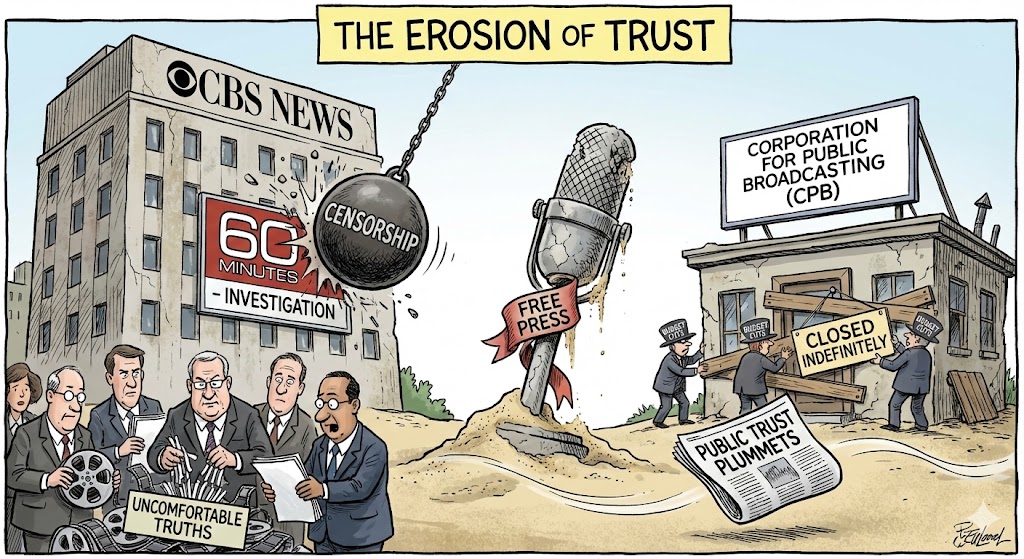
    The defunding of public-interest media under the Trump administration marked a significant shift in federal media policy. Reducing support for transparent, noncommercial journalism weakened one of the few remaining alternatives to corporate-owned outlets. The move also signaled that independence and transparency could be framed as political liabilities.

    As public-interest media declines, audiences are increasingly dependent on outlets shaped by corporate, political, or billionaire ownership. This transition reduces the diversity of institutional models within the media ecosystem. Transparency becomes secondary to survival, and journalism that challenges power without commercial backing becomes increasingly rare.

    Editorial Power, Perception, and Institutional Credibility

    Editorial decisions now occur under intense public scrutiny and suspicion. High-profile cases, such as the cancellation of investigative segments that later appear abroad, reinforce perceptions of political influence. Even when editorial leaders cite procedural justifications, audiences often interpret such decisions as evidence of censorship. Perception, in this context, carries as much weight as reality.

    This erosion of trust reflects broader institutional fragility. Legacy media organizations once benefited from assumed independence and credibility. Today, those assumptions no longer hold. Each controversial editorial choice contributes to cumulative skepticism.

    Credibility depends not only on actual independence but also on visible resistance to power. When audiences believe that stories are shaped by political or economic considerations, trust deteriorates. Rebuilding that trust requires structural change, not rhetorical reassurance.

    From Free Press to Soft Propaganda

    In democratic systems, the shift from free press to propaganda rarely involves direct state control. Instead, influence operates through access, incentives, ownership, and professional norms. Journalists adjust behavior to avoid exclusion, legal risk, or institutional retaliation. Over time, confrontation gives way to caution.

    This process produces what can be described as soft propaganda. Media outlets continue operating and publishing, but within narrowing boundaries. Coverage emphasizes official narratives, marginalizes dissent, and avoids sustained scrutiny of powerful interests. The result is alignment without coercion.

    Soft propaganda is particularly effective because it appears organic. There are no formal bans or explicit directives. Instead, the press gradually becomes an amplifier of power rather than a counterweight to it. Democratic erosion occurs quietly and incrementally.

    The Myth of Sudden Collapse

    Democratic institutions rarely fail abruptly. Historical cases demonstrate that press freedom erodes through incremental normalization of restrictions. Each compromise seems manageable in isolation, but collectively they hollow out institutional independence. The process often goes unnoticed until reversal becomes difficult.

    In the United States, warning signs include shrinking investigative capacity, newsroom consolidation, and declining public trust. Attacks on journalists are increasingly tolerated, and press freedom is often treated as a partisan issue rather than a democratic necessity. These trends reinforce one another.

    The danger lies not in a single authoritarian move, but in cumulative complacency. When the press adapts to pressure rather than resists it, democratic accountability weakens. Collapse, when it comes, feels inevitable rather than deliberate.

    Public Trust at a Breaking Point

    Public confidence in the American press has reached historic lows. Trust is now sharply polarized along ideological lines, reflecting the fragmentation of the information environment. Many citizens no longer believe that neutral reporting is possible. This skepticism undermines the press’s ability to mediate political conflict.

    Cynicism becomes self-reinforcing. When audiences assume bias everywhere, factual correction loses authority. Disinformation thrives in environments where trust is absent. The result is disengagement rather than accountability.

    Low trust ultimately benefits those in power. Confusion weakens public oversight and reduces political costs for deception. A democracy without trusted information sources struggles to function effectively.

    Thanks for reading The Brooks Brief Substack! This post is public so feel free to share it.

    Share

    Conclusion: Preserving the Space for Truth

    A free press is rarely destroyed outright. It is eroded gradually through political pressure, economic incentives, ownership concentration, and public apathy. Defending press freedom therefore requires sustained institutional resistance rather than reactive outrage. Structural reform matters more than rhetorical commitment.

    Journalists, policymakers, and citizens all play a role in preserving independent media. Supporting diverse ownership models, public-interest journalism, and transparency is essential. So too is recognizing that press freedom is a democratic infrastructure, not a partisan preference.

    The press must remain a check on power, not a partner to it. When the ability to question leaders becomes conditional, democracy itself becomes fragile, shaped not by truth but by those who control the narrative.