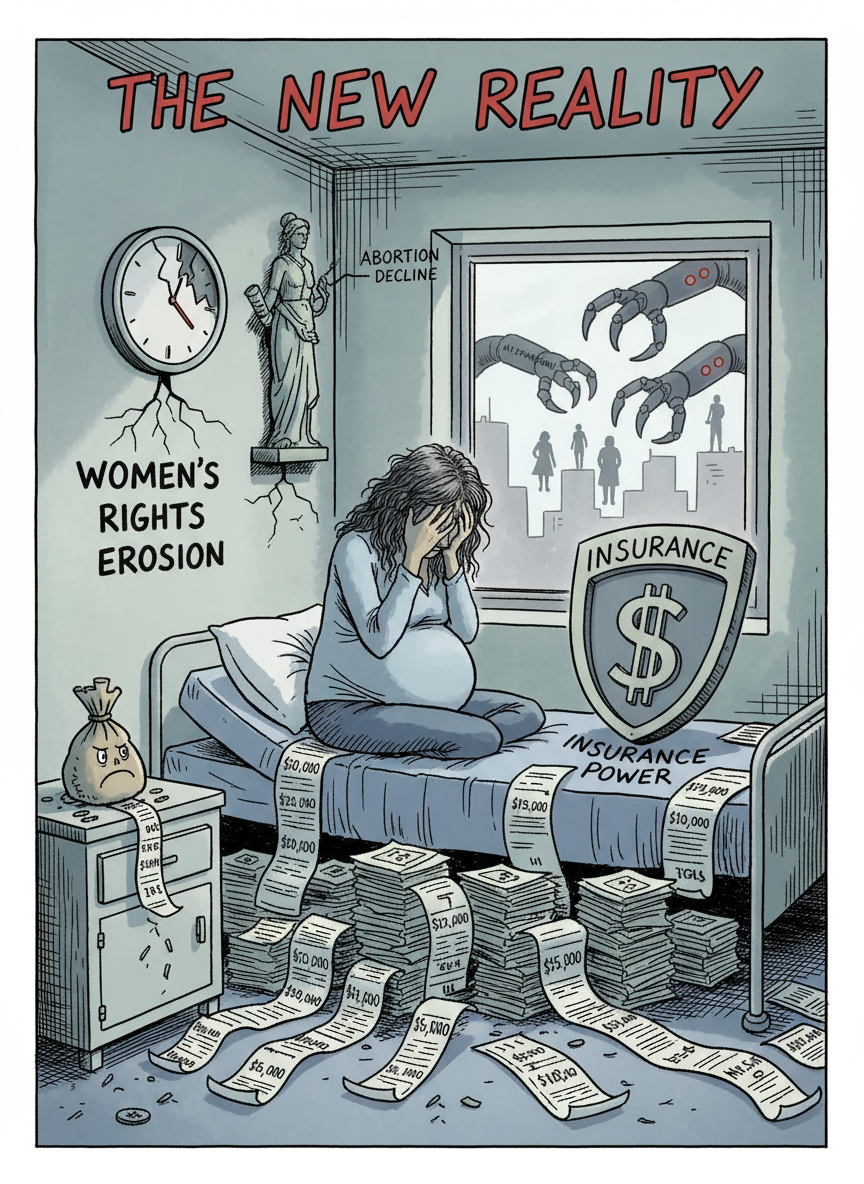
Abortion Decline, Insurance Power, AI Expansion, and the Cost Crisis
I. Introduction
In early 2026, the post-Dobbs healthcare landscape reveals a profound rollback of women’s rights across much of the United States. Abortion is now banned outright in 13 states and restricted at early gestational stages in six more, reshaping reproductive outcomes nationwide. Research indicates these policies have already resulted in tens of thousands of additional births and hundreds of preventable infant deaths in restrictive states. These outcomes are not evenly distributed, falling most heavily on low-income women, women of color, and those with limited access to healthcare infrastructure. The shift represents not only a legal change but a measurable deterioration in public health outcomes tied directly to reproductive policy.
Beyond abortion restrictions, women’s healthcare rights are increasingly constrained by broader structural forces within the healthcare system. Insurance industry dominance continues to shape access, affordability, and scope of reproductive care. At the same time, artificial intelligence tools are being rapidly deployed in healthcare without adequate safeguards against gender bias. Rising healthcare costs further compound these pressures, placing disproportionate financial burdens on women who already face wage and wealth gaps. Together, these forces form a multilayered erosion of autonomy, equity, and health security.
This analysis argues that women’s healthcare rights in 2026 are under coordinated strain from four intersecting dynamics. The decline in abortion access undermines bodily autonomy and maternal health. Insurance industry power limits reproductive coverage and shifts costs onto women. Emerging AI systems risk encoding longstanding gender disparities into medical decision making. Escalating healthcare costs transform legal rights into hollow promises for millions. Taken together, these trends threaten not only reproductive freedom but broader gender equality and economic stability in the United States.
Thanks for reading The Brooks Brief Substack! Subscribe for free to receive new posts and support my work.
II. The Decline of Women’s Rights Regarding Abortion Access
The erosion of abortion rights since the Supreme Court’s 2022 Dobbs decision has accelerated into a systemic rollback of reproductive autonomy. State-level bans and early gestational limits have fundamentally reshaped access to care, particularly in the South and Midwest. In several states, abortion services have effectively ceased to exist, forcing women to travel hundreds of miles or forgo care entirely. These restrictions have transformed abortion from a standard medical service into a privilege dependent on geography, income, and social capital. The result is a fragmented national system in which women’s rights vary sharply by state.
The legal landscape has continued to harden through 2025 and 2026 with the introduction of fetal personhood laws and expanded enforcement mechanisms. Federal policy shifts have further narrowed access for populations reliant on government programs, including veterans and low-income women. These measures extend beyond abortion itself, creating uncertainty around miscarriage care, fertility treatment, and emergency obstetric services. Providers in restrictive states report chilling effects that delay or deny care even in medically urgent situations. Such policies have institutionalized fear and risk within women’s healthcare.
The health and socioeconomic consequences of these restrictions are increasingly visible. States with abortion bans have experienced higher-than-expected fertility rates alongside measurable increases in infant mortality. These outcomes disproportionately affect Black, Latina, low-income, and unmarried women, who already face structural barriers to healthcare access. Denial of abortion care has been linked to higher poverty rates, reduced labor force participation, and long-term economic instability. Forced continuation of unwanted pregnancies compounds inequality rather than supporting family well-being.
Beyond individual outcomes, abortion restrictions represent a broader assault on women’s fundamental rights. Travel costs, lost wages, childcare expenses, and medical risks create additional burdens that function as de facto barriers to care. Federal threats to revive outdated statutes and restrict medication access further entrench inequity. Policy choices under the Trump administration have reinforced this trajectory by defunding providers and promoting misinformation around abortion pills. These actions collectively frame reproductive control as a tool of political governance rather than a matter of healthcare.
III. Insurance Industry Influence and the Erosion of Women’s Rights
The insurance industry plays a central role in shaping women’s access to healthcare, particularly reproductive services. Policy changes entering effect in 2026 have strengthened insurer leverage while weakening consumer protections. The expiration of Affordable Care Act (ACA) subsidies has led to dramatic premium increases for millions of enrollees. Women, who make up a majority of ACA marketplace participants, face significantly higher out-of-pocket costs than men. These financial pressures disproportionately affect women of childbearing age and older women managing chronic conditions.
Cuts to Medicaid and Title X family planning programs have further reduced access to affordable reproductive care. Clinic closures and service reductions have left many communities without nearby providers. Low-income women are especially vulnerable to these gaps, as Medicaid remains the primary source of coverage for maternity and reproductive services. Insurance design often excludes abortion coverage entirely, even in states where the procedure remains legal. As a result, legal rights are frequently rendered inaccessible by financial barriers.
Insurance policies also enable indirect restrictions on reproductive autonomy. Conscience protections and gag rules allow providers and institutions to deny or withhold information about reproductive services. Limitations on contraceptive coverage and maternity care represent a rollback of earlier ACA gains. Women are increasingly forced to choose between affordability and comprehensive care. These constraints transform reproductive healthcare into a conditional benefit rather than a guaranteed right.
The broader consequences of insurance dominance extend beyond healthcare access. Women consistently pay more out of pocket despite earning less on average, reinforcing gender-based economic inequality. Maternal health outcomes worsen as cost pressures delay or prevent care. Black and Latina women experience compounded harms due to intersecting racial and economic disparities. Federal policy decisions, including privacy rollbacks and targeted defunding of reproductive health providers, further centralize control over women’s healthcare choices within market-driven systems.
IV. The Rise of AI in Healthcare and Threats to Women’s Rights
Artificial intelligence is rapidly reshaping healthcare delivery, with widespread adoption in diagnostics, scheduling, and treatment planning by 2026. While these tools promise efficiency, they also reflect the biases embedded in their underlying data. Many AI systems are trained on datasets that underrepresent women or misinterpret gender-specific symptoms. This is particularly concerning in areas such as reproductive health, oncology, and cardiovascular care, where women’s symptoms have historically been understudied. Without correction, AI risks replicating and amplifying existing disparities.
The use of AI in reproductive and preventive care raises distinct concerns for women’s rights. Algorithms may underestimate risks related to fertility, menopause, or pregnancy complications due to limited training data. In abortion-restricted environments, AI tools can be used to monitor, flag, or indirectly surveil reproductive behavior. Weak governance allows unregulated or “shadow” AI systems to influence care without transparency or accountability. These developments blur the line between clinical decision making and rights enforcement.
Privacy risks further complicate the expansion of AI in women’s healthcare. Digital health data related to menstruation, pregnancy, or fertility can be vulnerable to misuse. In states hostile to reproductive rights, such data may expose women to legal or social consequences. The erosion of privacy protections transforms healthcare technologies into potential tools of control. This dynamic undermines trust between patients and providers.
Despite these risks, AI also presents opportunities if governed responsibly. Ethical oversight, representative datasets, and gender-aware design could improve diagnostic accuracy and personalized care for women. Without deliberate intervention, however, AI will widen the gender health gap rather than close it. Women’s rights in healthcare depend on ensuring that emerging technologies serve equity rather than entrench discrimination. Policy frameworks must prioritize women’s data, consent, and autonomy in the digital health era.
V. Rising Healthcare Costs and Barriers to Reproductive Rights
Healthcare costs in the United States are projected to rise sharply through 2026, with annual increases driven by aging populations, chronic disease, and policy retrenchment. The expiration of ACA subsidies has more than doubled premiums for many families. Medicaid and marketplace cuts threaten to increase the uninsured population by tens of millions. Women, who are more likely to require ongoing reproductive and preventive care, face higher financial exposure. Cost inflation transforms access to care into a function of income rather than need.
Reproductive healthcare is particularly sensitive to cost pressures. Abortion restrictions increase ancillary expenses such as travel, lodging, childcare, and lost wages. For many women, these added costs are prohibitive even when abortion remains legal. Defunding of clinics further reduces access to affordable contraception and preventive services. Cost barriers push women toward delayed care or no care at all, increasing long-term health risks.
The broader consequences of rising costs extend beyond individual decisions. The growing number of uninsured women creates feedback loops that exacerbate health outcomes and put a strain on safety net providers. Maternal mortality and morbidity rise as preventive and prenatal care become less accessible. Economic insecurity deepens as women absorb higher medical debt and reduced workforce participation. Healthcare costs thus function as a structural barrier to women’s rights and autonomy.
Addressing these challenges requires deliberate policy intervention. Without cost containment and coverage expansion, legal protections alone will fail to secure meaningful access. Rising healthcare costs threaten to hollow out women’s reproductive rights even in supportive jurisdictions. Economic barriers are increasingly central to the erosion of healthcare equity.
VI. Forced Birth, Brain Death, and the Financialization of Reproductive Control
One of the most stark illustrations of reproductive rights erosion in the post-Dobbs era is the case of a woman declared brain dead who was legally compelled to remain on life support in order to continue a pregnancy. Under strict abortion bans and fetal personhood frameworks, physicians were prohibited from withdrawing medical intervention despite the absence of maternal consciousness or recovery prospects. The state effectively assumed control over the woman’s body, transforming her into a biological vessel rather than a patient with rights. This case underscores how abortion restrictions extend beyond elective procedures into end-of-life care and medical ethics. The legal prioritization of fetal status over maternal autonomy represents a radical departure from established healthcare norms. It signals a system in which women’s bodily integrity can be overridden entirely by statute.
The consequences of this intervention did not end at birth. The infant, delivered under extraordinary circumstances, now requires extended hospitalization and specialized medical care. These costs are substantial, often reaching hundreds of thousands of dollars within weeks, and responsibility for payment remains legally ambiguous. In the absence of comprehensive public coverage, medical debt may ultimately be transferred to the woman’s surviving family members. This shifts the financial burden of a state-mandated medical decision onto private citizens who had no authority over the outcome. Reproductive control thus becomes intertwined with financial liability.
This case exposes how abortion bans and fetal personhood laws externalize moral and political decisions onto families least equipped to bear them. The state mandates birth but disclaims long-term responsibility for care, leaving families to absorb emotional, financial, and medical fallout. Such outcomes redefine reproductive coercion as both a civil rights issue and an economic one. Forced birth under these conditions transforms healthcare into an instrument of state power rather than patient-centered care. It also sets a precedent in which women’s bodies, even in death, are subject to compulsory use without consent. The implications for medical ethics, family autonomy, and women’s rights are profound and enduring.
Thanks for reading The Brooks Brief Substack! This post is public so feel free to share it.
VII. Conclusion
By 2026, women’s rights in U.S. healthcare are being undermined through intersecting legal, economic, technological, and institutional forces. Abortion access has declined sharply, producing measurable harms to maternal and infant health. Insurance industry dominance limits reproductive coverage and shifts costs onto women. Artificial intelligence threatens to encode gender bias into clinical systems while exposing women to new privacy risks. Escalating healthcare costs further restrict access and deepen inequality.
These trends pose long-term threats to gender equality, health equity, and economic stability. When reproductive autonomy is constrained, women’s educational attainment, labor participation, and family well-being suffer. Disparities widen along racial and socioeconomic lines, reinforcing structural inequality. Healthcare systems that marginalize women ultimately weaken public health outcomes for society as a whole.
Reversing this trajectory requires coordinated policy action. Federal protections for reproductive rights, renewed investment in affordable coverage, and strict governance of healthcare AI are essential. Cost containment and insurance reform must prioritize equity rather than profit. Without decisive intervention, the erosion of women’s healthcare rights will continue to reshape American democracy and economic security in profoundly unequal ways.
Leave a Reply