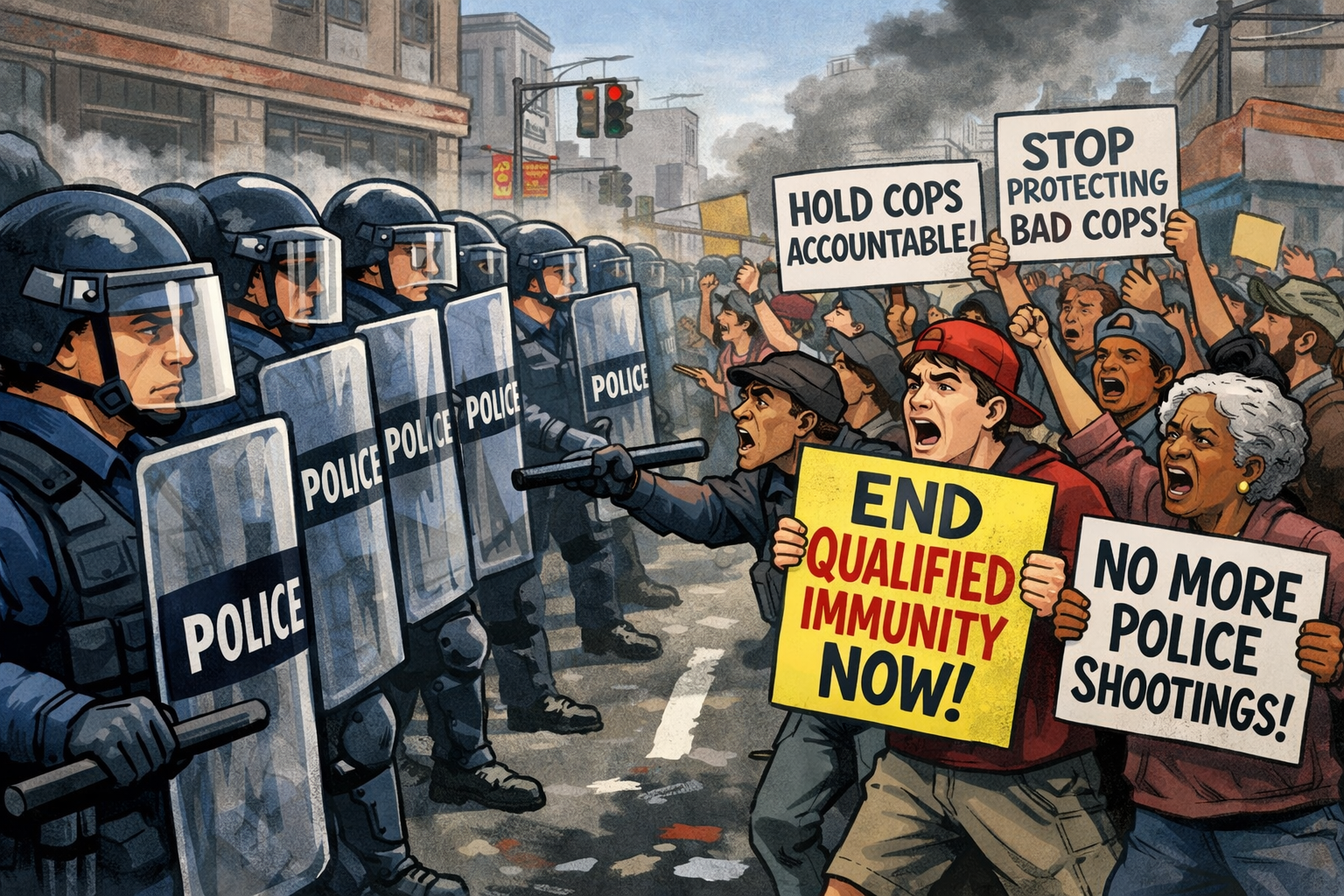
Federal Agents, Legal Immunity, and the Crisis of Accountability
Introduction
The killing of a U.S. citizen by a U.S. Border Patrol agent in Minneapolis today has ignited fierce debate across the country about how federal law enforcement is shielded from accountability. A 37-year-old Minneapolis resident, identified as Alex Pretti, was shot and killed during a federal immigration operation, marking the third fatal encounter involving federal immigration agents in the city this month. Protesters have taken to the streets, demanding transparency and justice as local officials clash with federal authorities over access to the investigation. The incident follows the January 7 killing of Renée Good by an ICE agent, which itself sparked widespread protest and ongoing scrutiny of federal tactics. Both deaths have amplified long-standing critiques of how legal protections like qualified immunity operate in deadly use-of-force cases involving federal agents. This backdrop makes today’s shooting not just a singular tragedy but a flashpoint for broader systemic concerns about enforcement, oversight, and public trust. As policymakers and civil rights advocates raise alarms, the discussion has shifted from the specifics of the operation to the legal doctrines that govern liability and review.
Qualified immunity is central to this debate because it shapes how courts evaluate claims against law enforcement officers, including Border Patrol agents and ICE personnel. Under the doctrine, government officials are protected from civil lawsuits unless they violated a “clearly established” constitutional right that a reasonable agent would have known. In practice, this standard is exceptionally difficult for plaintiffs to meet, especially in deadly force cases where the factual record may be contested or murky. As a result, many cases are dismissed before courts ever examine the substance of alleged misconduct. Critics argue that this creates a legal shield that insulates federal agents from meaningful accountability, even when the public perceives force as unjustified. Supporters of qualified immunity maintain that it protects officers from liability for split-second decisions made in dangerous situations, preserving effective law enforcement. However, those assurances ring hollow for families and communities affected by shootings that feel avoidable or excessive.
The killings in Minneapolis highlight the disconnect between community standards and legal doctrine. Public outrage has skyrocketed not only because of the loss of life but also because of the appearance that federal agents, acting deep inside a city far from any border, used deadly force under questionable circumstances. State officials, including Minnesota Governor Tim Walz, have demanded that state investigators lead the inquiries after being denied access by federal agents. This clash between state and federal authority underscores how qualified immunity and related protections can obscure accountability by placing federal agents beyond easy judicial or public review. As facts continue to surface and videos circulate, demands for reform of qualified immunity have grown louder. For many advocates, abolishing or significantly revising the doctrine is essential to restoring trust in law enforcement and ensuring that the death of U.S. citizens at the hands of federal agents does not go unanswered.
The Brooks Brief Substack is a reader-supported publication. To receive new posts and support my work, consider becoming a free or paid subscriber.
Qualified Immunity Explained
Qualified immunity began as a judicial doctrine designed to balance effective law enforcement with constitutional protections. It intends to shield officers from personal liability when performing discretionary functions unless they clearly violate established rights. In theory, it protects officials from the threat of endless lawsuits over difficult, on-the-ground decisions. In practice, the doctrine often prevents courts from even addressing whether conduct was lawful or reasonable. Instead, judges focus on whether a prior case has already established nearly identical conduct as unconstitutional. This threshold is so exacting that it often leaves victims’ families without any avenue to seek remedy in court.
In the context of federal immigration enforcement, qualified immunity takes on unique significance. Agents from U.S. Customs and Border Protection, including Border Patrol, and U.S. Immigration and Customs Enforcement operate under a broad mandate that includes deportation, detention, and interior enforcement. Their use of force policies generally mirror those of other law enforcement agencies, permitting lethal force only when agents reasonably believe there is an imminent threat of death or serious bodily injury. Still, in practice, these standards are interpreted by federal leadership, and accountability mechanisms are weak. When incidents like today’s shooting occur, the legal shield of qualified immunity means that even if evidence later suggests excessive force, civil lawsuits by families may fail at the threshold because the rights at issue were not previously defined with precision.
Critics argue that qualified immunity has consistently favored law enforcement at the expense of victims, particularly in controversial use-of-force cases. The killing of Renée Good in early January, ruled a homicide by state medical examiners, has become emblematic of these concerns. In that case, local authorities and the victim’s family have disputed the federal narrative that she posed an imminent threat, while the Department of Justice has led the investigation and restricted state access to evidence. This dynamic further fuels questions about how federal agents are held to account when using deadly force. The public perception that federal agents operate above meaningful legal scrutiny intensifies calls for reform. Abolishing qualified immunity or adjusting its standards could, proponents argue, ensure that wrongful deaths by federal agents are subject to genuine legal review rather than procedural dismissal.
Supporters of qualified immunity caution that removing it outright could expose agents to a flood of litigation and undermine their ability to act decisively in dangerous situations. They argue that officers often must make rapid judgments in complex environments and that unreasonable fear of personal liability could chill essential law enforcement functions. However, recent events in Minneapolis and across other cities suggest that the current balance may err too far in favor of institutional protection. Advocates for reform point to alternative accountability measures, such as stricter internal oversight, mandatory body cameras for all federal agents, and clearer use-of-force policies that align with constitutional standards. Many argue that such changes would improve both officer conduct and public trust without compromising safety.
The public response to today’s shooting reflects deep frustration with the status quo. Protesters have demanded transparency and justice, with some calling for the removal of federal agents from Minnesota and for independent investigations that include state authorities. This friction between local demands and federal immunity protections underscores a broader crisis of legitimacy facing federal law enforcement. If qualified immunity continues to shield agents from civil liability in deadly force cases, communities may grow increasingly skeptical of the rule of law itself. Reform efforts, already gaining traction in some states and at the federal legislative level, may now find a new sense of urgency as the nation grapples with the consequences of these tragedies.
Broader Implications and Debate
The Minneapolis shootings are not isolated incidents but part of a larger pattern of controversial use-of-force encounters involving immigration enforcement agents. National human rights groups have documented a series of shootings by ICE and Border Patrol officers in recent years under the broader federal immigration crackdown. These include cases where claims of imminent threat were disputed by eyewitnesses or video evidence later surfaced. Critics argue that these patterns reflect systemic issues rather than rare anomalies. When qualified immunity rules out meaningful civil redress in such cases, public confidence in fair and impartial justice is undermined.
The debate over qualified immunity intersects with broader concerns about federal law enforcement’s expanding role in domestic policing far from borders. Minneapolis, hundreds of miles from any border, has become a focal point for federal enforcement under “Operation Metro Surge,” drawing thousands of agents into a city already shaped by high-profile policing controversies. The heavy federal presence and repeated use of deadly force raise questions about how and why these operations are conducted. Qualified immunity, in this context, compounds the problem by making it legally difficult for civilians and families to challenge forceful actions in court.
Reform advocates argue that the doctrine’s original justifications have eroded over time, particularly as federal agents engage in more interior enforcement roles with minimal transparency. They call for a reevaluation of the legal standards that have insulated agents from liability and a shift toward accountability models that respect both officer safety and civilian rights. Some proposals include abolishing qualified immunity entirely, while others seek to clarify that constitutional rights should be defined broadly enough to encompass new enforcement contexts. These debates will likely intensify as legal scholars, civil rights organizations, and lawmakers respond to the Minneapolis shootings and similar cases nationwide.
The current crisis highlights a broader democratic tension: how to balance effective law enforcement with the imperative of holding state power accountable. Qualified immunity sits at the heart of that tension, shaping not just the fate of individual lawsuits but the public’s perception of justice itself. If the doctrine continues to block meaningful review of deadly encounters by federal agents, communities may increasingly view the government as unaccountable and arbitrary. Conversely, carefully calibrated reforms could reinforce the principle that state authority exists to protect the public rather than shield itself from scrutiny.
Thanks for reading The Brooks Brief Substack! This post is public so feel free to share it.
Conclusion
Today’s killing of a U.S. citizen by a U.S. Border Patrol agent in Minneapolis has thrust qualified immunity into the center of national discourse. The doctrine’s rigid standards have a direct impact on whether families can seek civil redress and whether the public can trust that the rule of law applies equally to all. As protests continue and investigations unfold, the pressure to revisit and reform qualified immunity has intensified. Balancing the need for effective law enforcement with genuine accountability remains a central challenge for policymakers. The Minnesota shootings may become a defining moment in that debate, pushing qualified immunity from the periphery of legal doctrine into the forefront of democratic reform efforts.
Leave a Reply