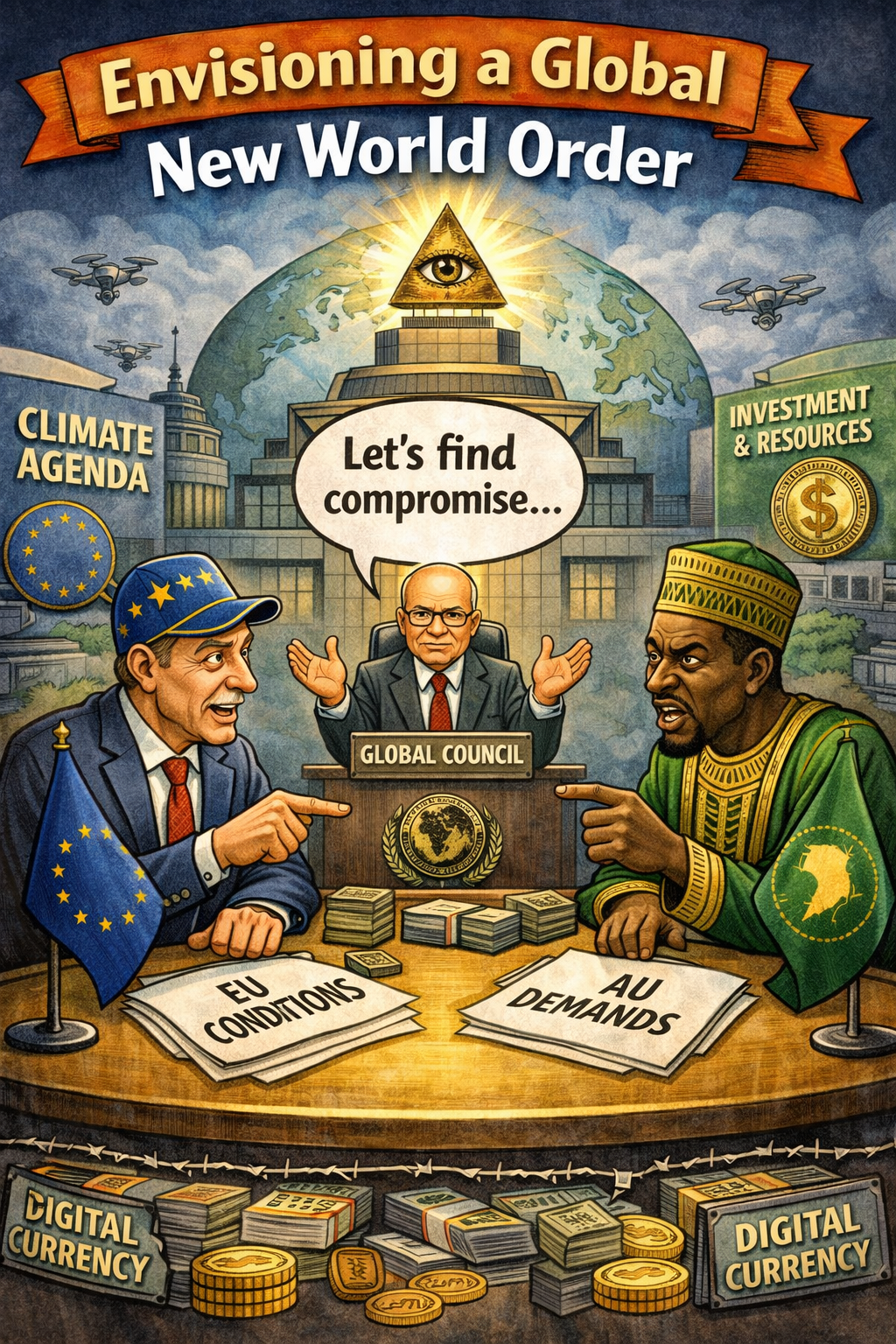
Regional Unions and the Reform of International Governance
Executive Summary
The international system is undergoing a profound transition as traditional power structures struggle to reflect contemporary geopolitical realities. Institutions such as the United Nations Security Council increasingly face criticism for their rigidity, limited representativeness, and inability to respond effectively to global crises. As emerging powers gain influence and longstanding powers experience relative decline, the gap between global governance mechanisms and global realities continues to widen. This analysis argues that without structural reform, existing institutions risk losing legitimacy and relevance. A new framework is therefore required to address collective action problems in an increasingly fragmented international environment.
This paper proposes a multipolar global order anchored in regional unions formed primarily through geographic proximity. Such unions are better positioned to manage shared economic, security, environmental, and infrastructural challenges because physical closeness reduces coordination costs and strengthens mutual accountability. Drawing from existing examples such as the European Union and the African Union, the analysis demonstrates that proximity-based cooperation enhances resilience and policy coherence. These regional blocs can aggregate national interests into unified positions, amplifying their influence on the global stage. Rather than replacing the nation-state, this model embeds sovereignty within layered governance structures.
At the global level, the study envisions a reformed Global Council that integrates regional unions into international decision-making. This body would reduce overreliance on veto power, promote majority-based governance, and better reflect demographic and economic realities. While the system may introduce additional deliberation and institutional complexity, it offers a more equitable and adaptive form of global governance. Policy recommendations emphasize supporting organic regional integration and pursuing incremental but meaningful reforms to the United Nations system. Together, these steps provide a pragmatic pathway toward sustainable peace, stability, and shared prosperity.
The Brooks Brief Substack is a reader-supported publication. To receive new posts and support my work, consider becoming a free or paid subscriber.
I. Introduction to a Global New World Order

The international order established after World War II was designed to prevent large-scale conflict and promote cooperation among major powers. While this framework achieved notable successes, it is increasingly ill-suited to address twenty-first-century challenges such as climate change, pandemics, cyber warfare, and economic volatility. Power has become more diffuse, with influence spreading across regions rather than remaining concentrated among a few dominant states. As a result, governance structures based on mid-twentieth-century realities struggle to maintain credibility. A reimagined global order must therefore account for multipolarity as a permanent condition rather than a temporary disruption.
At the core of this emerging order is the concept of regional unions grounded in geographic proximity. Physical closeness facilitates cooperation on issues that transcend borders, including migration, infrastructure development, environmental protection, and security coordination. Neighboring states often share supply chains, ecosystems, and risk exposure, making collaboration both practical and necessary. Proximity also fosters repeated interactions that build trust and institutional familiarity over time. These dynamics make geographically anchored unions a logical foundation for renewed global governance.
Importantly, this vision does not call for the dismantling of existing international institutions. Instead, it advocates for their evolution to reflect new patterns of power and cooperation. Regional unions would serve as intermediaries between nation-states and global institutions, translating local priorities into collective global action. This layered approach mitigates unilateralism while preserving national autonomy. In doing so, it offers a balanced framework capable of addressing global fragmentation without imposing uniformity.
II. Critique of the Current UN Framework

The United Nations Security Council remains one of the most visible symbols of institutional stagnation in global governance. Its permanent membership and veto structure reflect the power balance of 1945 rather than present-day economic, demographic, or political realities. Emerging powers in Asia, Africa, and Latin America remain underrepresented, despite their growing influence on global outcomes. This imbalance has fueled perceptions of inequity and exclusion, particularly among states in the Global South. As a result, the Council’s legitimacy has increasingly been called into question.
The veto power held by the five permanent members has repeatedly obstructed collective action on urgent international crises. Conflicts involving major power interests frequently result in deadlock, preventing timely responses to humanitarian emergencies. While the number of vetoes has fluctuated in recent years, their strategic use continues to undermine the Council’s effectiveness. The structure enables powerful states to shield allies and pursue narrow interests at the expense of collective security. This dynamic weakens trust in multilateralism and encourages alternative forms of cooperation outside the UN framework.
Compounding these issues is the long-term uncertainty surrounding the relative power of current permanent members. Demographic decline, economic stagnation, and internal polarization threaten to erode their global influence over time. Yet the institutional design of the Security Council locks in their dominance regardless of future shifts. Proposed reforms, such as limiting veto use in cases of mass atrocities or requiring multiple vetoes for obstruction, have gained rhetorical support but little practical traction. Consequently, alternative governance models, including proximity-based regionalism, are increasingly viewed as necessary complements to a stalled UN system.
III. The Probable Formation of Regional Unions Based on Proximity

Regional unions are most likely to emerge along geographic lines because proximity enhances functional cooperation. Shared borders and regional ecosystems create mutual dependencies that distant alliances cannot easily replicate. Trade corridors, energy networks, and transportation infrastructure are more efficient when coordinated regionally. Cultural familiarity and historical interaction further facilitate institutional development. These factors make geographic proximity a natural foundation for deeper integration.
The European Union remains the most advanced example of proximity-driven regional integration. Its member states have developed shared policies across economic, regulatory, and political domains, demonstrating the potential of sustained cooperation. In North America, the USMCA reflects a similar logic by binding neighboring economies through trade and investment frameworks. Africa has pursued continental integration through the African Union and the African Continental Free Trade Area, seeking to enhance intra-African trade and collective bargaining power. Recent initiatives have focused on youth employment, conflict mediation, and economic resilience.
Other regions exhibit emerging forms of proximity-based cooperation. In South America, MERCOSUR has deepened economic ties among neighboring states and expanded external trade relationships. These efforts could eventually evolve into broader political coordination to address environmental protection and regional security. In the Middle East, subregional groupings such as the Gulf Cooperation Council reflect attempts to manage shared security and economic concerns. Southeast Asia’s ASEAN further reinforces the pattern of regional clustering as a response to global uncertainty. Collectively, these developments suggest that proximity-based unions are becoming a defining feature of the international landscape.
IV. Structure and Role of a Global Council

A reformed Global Council would serve as the apex institution in a proximity-based international order. Unlike the current Security Council, representation would be organized around states and regional unions rather than individual states alone. Seats could be allocated based on population, economic output, or regional size, ensuring more equitable participation. Smaller states would gain influence through collective representation rather than being marginalized. This structure would better align decision-making authority with global realities.
Decision-making within the Council would rely on majority or supermajority voting rather than unilateral vetoes. Such a system would reduce paralysis while still protecting minority interests through procedural safeguards. The Council’s mandate would include conflict resolution, norm enforcement, and coordination on transnational challenges such as climate change and global health. Regional unions would propose agendas and policy initiatives, integrating local perspectives into global deliberations. Final authority, however, would rest with the Council to ensure coherence and consistency.
By institutionalizing regional input, the Global Council would bridge the gap between local concerns and global governance. It would transform regional cooperation into a formal pillar of the international system rather than an informal alternative. This approach balances inclusivity with efficiency, reducing the incentives for unilateral action. Over time, it could restore confidence in multilateral governance by demonstrating tangible results. The Council would thus function as both a coordinator and an arbiter in a multipolar world.
V. Challenges Introduced by Proximity-Based Regional Unions

Despite their advantages, proximity-based regional unions are not without challenges. Historical rivalries, territorial disputes, and resource competition can complicate integration efforts. Internal disagreements may slow decision-making and increase bureaucratic complexity. In regions with deep-seated political or sectarian divisions, cooperation may remain fragile. These dynamics risk undermining the effectiveness of regional institutions if left unaddressed.
Regional tensions are particularly pronounced in areas with unresolved conflicts or weak governance structures. In the Middle East, sectarian divisions and overlapping crises complicate collective action. In South America, border disputes and domestic political volatility can strain regional consensus. Even in more stable regions, economic disparities among member states can generate friction. These challenges highlight the need for robust mediation and institutional capacity.
A Global Council would play a critical role in managing these tensions. By acting as an impartial mediator, it could channel regional disputes into structured diplomatic processes. Sanctions, incentives, or arbitration mechanisms could be employed to enforce compliance with collective decisions. Over time, external oversight may encourage deeper integration by reducing the costs of cooperation. In this way, challenges become catalysts for institutional maturation rather than barriers to progress.
VI. Preservation and Enhancement of National Sovereignty

A proximity-based global order preserves national sovereignty through the principle of subsidiarity. Domestic affairs remain under the authority of individual states, while regional unions address shared local challenges. Global institutions intervene only on issues that transcend regional boundaries. This layered governance model respects national autonomy while promoting cooperation. It counters fears that integration inevitably erodes state sovereignty.
For smaller states, regional unions provide a pathway to influence without sacrificing independence. Collective bargaining enhances their negotiating power in global forums. Participation in regional institutions also strengthens administrative capacity and policy coordination. Rather than being dominated by larger powers, smaller states benefit from rules-based cooperation. This framework creates a more balanced and inclusive international environment.
In the long term, the system constrains unilateralism by declining powers while enabling peaceful power transitions. Sovereignty is no longer defined by isolation but by effective participation in cooperative structures. Multipolarity becomes a stabilizing force rather than a source of conflict. By embedding sovereignty within shared institutions, the global order adapts to changing power dynamics. This approach strengthens both national and collective resilience.
VII. Implementation Path and Vision

The transition to a proximity-based global order would be gradual and incremental. Initial steps include strengthening existing regional unions through technical assistance, financial support, and institutional capacity-building. Expanding trade agreements and policy coordination within these unions would build momentum. Simultaneously, reforms within the United Nations could formally recognize regional blocs as key stakeholders. These measures would lay the groundwork for broader institutional transformation.
Over time, a treaty-based Global Council could be established to integrate regional unions into global governance. This body could initially operate alongside the Security Council before assuming expanded responsibilities. Incremental reforms would reduce resistance from entrenched interests while demonstrating practical benefits. Pilot initiatives on climate coordination or conflict mediation could showcase the model’s effectiveness. Success in these areas would build political support for deeper reform.
The long-term vision is a dynamic international system composed of natural regional clusters under shared global oversight. Such an order would reduce hegemonic dominance while enhancing equity and representation. By aligning governance structures with geographic and political realities, it would foster sustainable development and conflict prevention. By 2030, this framework could significantly improve global coordination on shared challenges. Ultimately, proximity-based governance offers a pragmatic and resilient pathway toward a more balanced world order that can enforce international law.
Leave a Reply