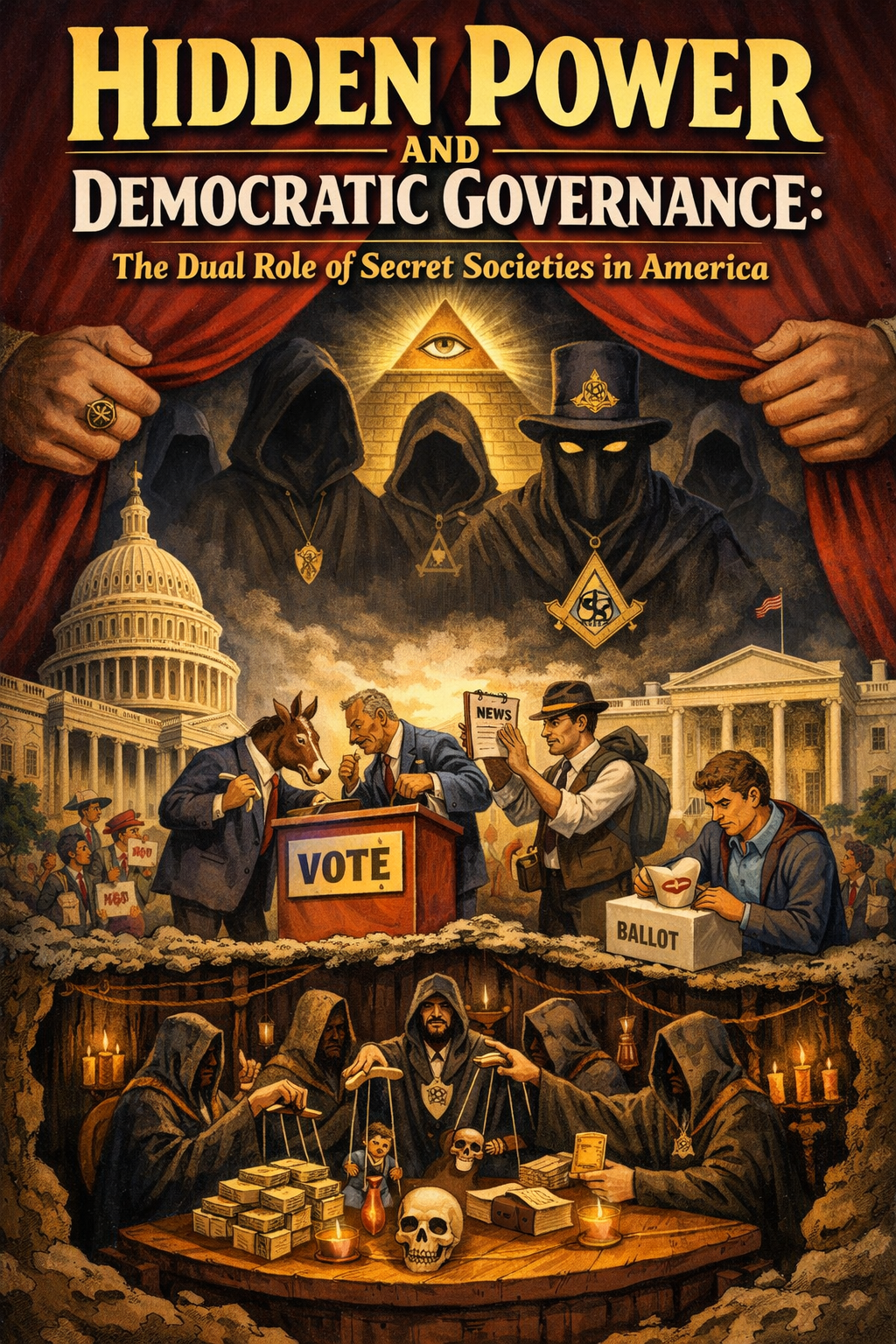
The Dual Role of Secret Societies in America
Introduction
In democratic systems built on transparency and public accountability, secret societies occupy an inherently paradoxical space. These organizations, defined by restricted membership, private rituals, and concealed deliberations, operate outside the formal mechanisms of democratic oversight. Groups such as the Freemasons, Skull and Bones, and the Bilderberg Group have long attracted suspicion due to their secrecy and concentration of elite influence. Critics often portray them as shadowy actors manipulating political outcomes behind closed doors. At the same time, supporters argue that these societies have historically contributed to civic engagement, innovation, and leadership development. This tension places secret societies at the center of enduring debates about power, legitimacy, and democratic norms.
The presence of secret societies challenges a core democratic principle: that political authority derives from the informed consent of the governed. When influential actors coordinate privately, citizens are left unable to evaluate motivations, alliances, or conflicts of interest. This opacity can weaken trust in institutions, especially during periods of political polarization or economic inequality. Yet secrecy itself is not inherently antidemocratic, as democratic governments routinely rely on confidentiality in diplomacy, intelligence, and crisis management. The critical issue lies in whether secrecy serves the public interest or entrenches private power. Understanding this distinction is essential for evaluating the democratic implications of secret societies.
This article argues that secret societies represent both a threat and a potential asset to democracy. Their closed nature can undermine accountability, reinforce elite dominance, and distort policymaking. Simultaneously, their networks have at times facilitated reform, innovation, and coordination that formal institutions struggled to achieve. Drawing on American political history, this analysis explores how secret societies have shaped democratic governance from the nation’s founding to the present. By examining both their dangers and contributions, the article seeks to inform contemporary policy debates on transparency, ethics, and power.
The Brooks Brief Substack is a reader-supported publication. To receive new posts and support my work, consider becoming a free or paid subscriber.
Historical Overview of American Secret Societies

Secret societies in the United States predate the nation itself and are deeply intertwined with its revolutionary origins. Many early American leaders were influenced by Enlightenment ideals that emphasized reason, civic virtue, and fraternity. Freemasonry, in particular, provided a structured environment for exchanging political ideas under British colonial rule. George Washington’s initiation into Freemasonry in 1752 exemplified this connection between fraternal secrecy and emerging republican values. Masonic principles of moral conduct and civic duty aligned with the aspirations of the revolutionary generation. These lodges offered a trusted space for coordination during a period when open dissent carried significant risks.
The influence of secret societies continued into the early republic and the drafting of its institutions. Prominent figures such as Benjamin Franklin and Paul Revere used fraternal networks to circulate ideas about liberty, governance, and resistance to tyranny. Symbolically, Washington’s participation in a Masonic ceremony at the laying of the U.S. Capitol cornerstone in 1793 reflected the integration of private associations into public life. While these societies did not directly govern, their interpersonal networks shaped leadership norms and political culture. At this stage, secrecy functioned less as manipulation and more as protection in a volatile political environment. Nevertheless, it established a precedent for elite coordination outside formal democratic structures.
As the United States expanded, secret societies diversified in purpose and impact. The nineteenth century witnessed the rise of organizations that used secrecy to advance exclusionary or reactionary agendas. The Know Nothing movement exploited clandestine organization to mobilize nativist sentiment and influence elections. Even more damaging was the Ku Klux Klan, which weaponized secrecy to terrorize communities and undermine Reconstruction reforms. These examples demonstrated how hidden power could directly suppress democratic participation. They also fueled public backlash, reinforcing American skepticism toward secretive political organizations.
Elite secret societies persisted into the twentieth century, particularly within academic and professional institutions. Groups such as Skull and Bones at Yale University cultivated lifelong networks among future leaders in government, finance, and media. Alumni included presidents, cabinet officials, and intelligence leaders, intensifying concerns about concentrated influence. Similarly, organizations like the Bohemian Club and later the Bilderberg Group facilitated informal interactions among global elites. While these forums lacked formal authority, their ability to shape consensus raised questions about accountability. Over time, secret societies became symbols of both elite continuity and democratic unease.
This unease was powerfully articulated by President John F. Kennedy in 1961, when he warned against the corrosive effects of excessive secrecy. Speaking during the Cold War, Kennedy acknowledged the need for confidentiality in national security while cautioning against secret oaths and hidden proceedings. His remarks reflected a broader American tradition of suspicion toward unaccountable power. They also underscored the enduring dilemma faced by democracies navigating secrecy in an interconnected world. This historical tension continues to shape contemporary debates over transparency and influence.
Threats Posed by Secret Societies to Democracy

The most significant threat posed by secret societies is their inherent lack of transparency. Democratic governance relies on public scrutiny to ensure accountability and legitimacy. When decisions or alliances are formed behind closed doors, citizens cannot evaluate whether leaders are acting in the public interest. This secrecy creates opportunities for corruption, favoritism, and policy capture. It also undermines the principle of equal political participation by privileging insiders over the broader electorate. Over time, such dynamics erode trust in democratic institutions.
Secret societies can also create conflicts of loyalty for public officials. Membership in organizations that require oaths or exclusive commitments raises questions about competing obligations. Elected leaders are accountable to voters, yet secret affiliations may influence their judgment or priorities. Even the perception of divided loyalty can damage democratic credibility. When citizens suspect that decisions are shaped by hidden networks rather than public debate, cynicism flourishes. This perception alone can weaken democratic cohesion, regardless of whether misconduct occurs.
Elite exclusivity further compounds these challenges. Many secret societies draw members from privileged social, economic, or educational backgrounds. This reinforces existing inequalities and limits access to political influence. Historically, such exclusivity has marginalized women, racial minorities, and lower income groups. The Ku Klux Klan represents an extreme example of secrecy used to enforce racial hierarchy and suppress voting rights. While modern elite societies differ in form, concerns about disproportionate influence remain salient.
The influence of secret societies extends beyond national boundaries, introducing additional democratic risks. Transnational organizations composed of political and economic elites can shape global policy agendas without public oversight. Groups like the Trilateral Commission or similar forums may advocate for policies that prioritize market stability or corporate interests over democratic accountability. In an era of globalization, these dynamics can dilute national sovereignty and democratic choice. Citizens may feel disconnected from decisions that affect their livelihoods but are made in opaque international settings.
Finally, secrecy can fuel misinformation and conspiracy thinking. When organizations refuse transparency, speculation fills the void. Historical episodes such as the Anti Masonic movement of the 1820s illustrate how distrust can escalate into political instability. In the modern media environment, secrecy amplifies polarization and undermines shared reality. Thus, even absent malicious intent, secret societies can unintentionally damage democratic discourse.
Positive Contributions Provided by Secret Societies to Democracy

Despite their risks, secret societies have at times contributed positively to democratic development. Historically, they have served as incubators for ideas and leadership during periods of political constraint. Freemasonry’s emphasis on education, civic responsibility, and moral conduct influenced early American reform movements. Members supported initiatives such as public education, charitable institutions, and gradual abolitionist efforts. In this context, secrecy provided protection rather than domination. It allowed reformist ideas to mature before entering public debate.
Secret societies can also facilitate innovation by creating spaces for candid discussion. In formal political settings, leaders are often constrained by partisanship, media scrutiny, and electoral pressures. Private forums enable policymakers, scholars, and business leaders to explore unconventional solutions without immediate political cost. Organizations like the Bilderberg Group exemplify this function by fostering informal dialogue on complex global issues. While controversial, such exchanges can reduce misunderstandings and encourage long term strategic thinking. When aligned with democratic values, these discussions can complement public institutions.
Another potential asset lies in elite coordination during periods of institutional paralysis. Democracies sometimes struggle to address urgent challenges due to polarization or procedural gridlock. Networks of influential actors can mobilize resources, expertise, and political will more rapidly than formal mechanisms allow. Philanthropic initiatives linked to elite societies have funded scientific research, environmental conservation, and public health efforts. These contributions can strengthen democratic resilience by addressing social needs that governments neglect or delay.
In authoritarian or transitional contexts, secret societies may play a protective role for democratic ideals. By operating discreetly, reform minded elites can resist repression and coordinate opposition. Historical examples from both American and global contexts show that secrecy can shield activists from retaliation. While this function is less relevant in stable democracies, it highlights secrecy’s conditional value. The democratic impact depends not on secrecy itself, but on the purposes it serves.
Ultimately, the benefits of secret societies emerge when their influence aligns with public accountability and ethical responsibility. When secrecy protects deliberation rather than power accumulation, it can enhance governance. The challenge lies in ensuring that these organizations complement democratic institutions rather than supplant them.
Balancing Threats and Assets: Policy Recommendations

Addressing the democratic implications of secret societies requires a balanced policy approach. Blanket prohibition would violate freedoms of association and expression. Instead, transparency measures should focus on public accountability for those in positions of authority. Requiring elected officials and senior appointees to disclose affiliations with secret societies would allow voters to assess potential conflicts of interest. Disclosure does not eliminate secrecy, but it reduces the risk of hidden influence.
Ethical standards within secret societies should also be encouraged. Organizations that claim civic purpose can adopt internal codes aligning their activities with democratic norms. Prohibitions on direct political manipulation or undisclosed lobbying would help mitigate risks. Think tanks, academic institutions, and civil society groups can promote best practices through research and public engagement. By setting expectations, society can distinguish benign associations from harmful ones.
Public education plays a critical role in reducing fear and misinformation. Teaching the historical context of secret societies can demystify their role in political development. Informed citizens are less susceptible to conspiracy narratives and more capable of nuanced judgment. Media literacy initiatives can further improve democratic discourse by encouraging critical evaluation of claims about hidden power. Transparency paired with education strengthens trust without sacrificing pluralism.
Given the transnational nature of many elite networks, international cooperation is also essential. Democratic governments and research institutions should collaborate to monitor cross border influence on policymaking. Shared standards for transparency and ethics can reduce the risk of unaccountable global governance. Such cooperation reinforces democratic norms in an increasingly interconnected world.
Thanks for reading The Brooks Brief Substack! This post is public so feel free to share it.
Conclusion

Secret societies have occupied a complex position within American democracy since its founding. From revolutionary era Freemasonry to modern elite networks, they have shaped political culture in both constructive and corrosive ways. Their secrecy poses genuine threats to transparency, equality, and public trust. At the same time, their capacity for coordination, innovation, and reform has at times strengthened democratic governance. The challenge for modern democracies is not to eliminate secrecy entirely, but to regulate its relationship to power.
A healthy democracy requires vigilance against unaccountable influence while preserving freedom of association. Transparency, ethical oversight, and informed public discourse are essential tools in this effort. When secrecy serves deliberation and reform, it can complement democratic institutions. When it shields power from accountability, it undermines them. Navigating this tension will remain a defining challenge as democratic societies confront both internal inequality and global complexity.
Leave a Reply