Russia, China, Iran, North Korea, BRICS, and the Erosion of U.S. Alliances in the Second Trump Era
Introduction
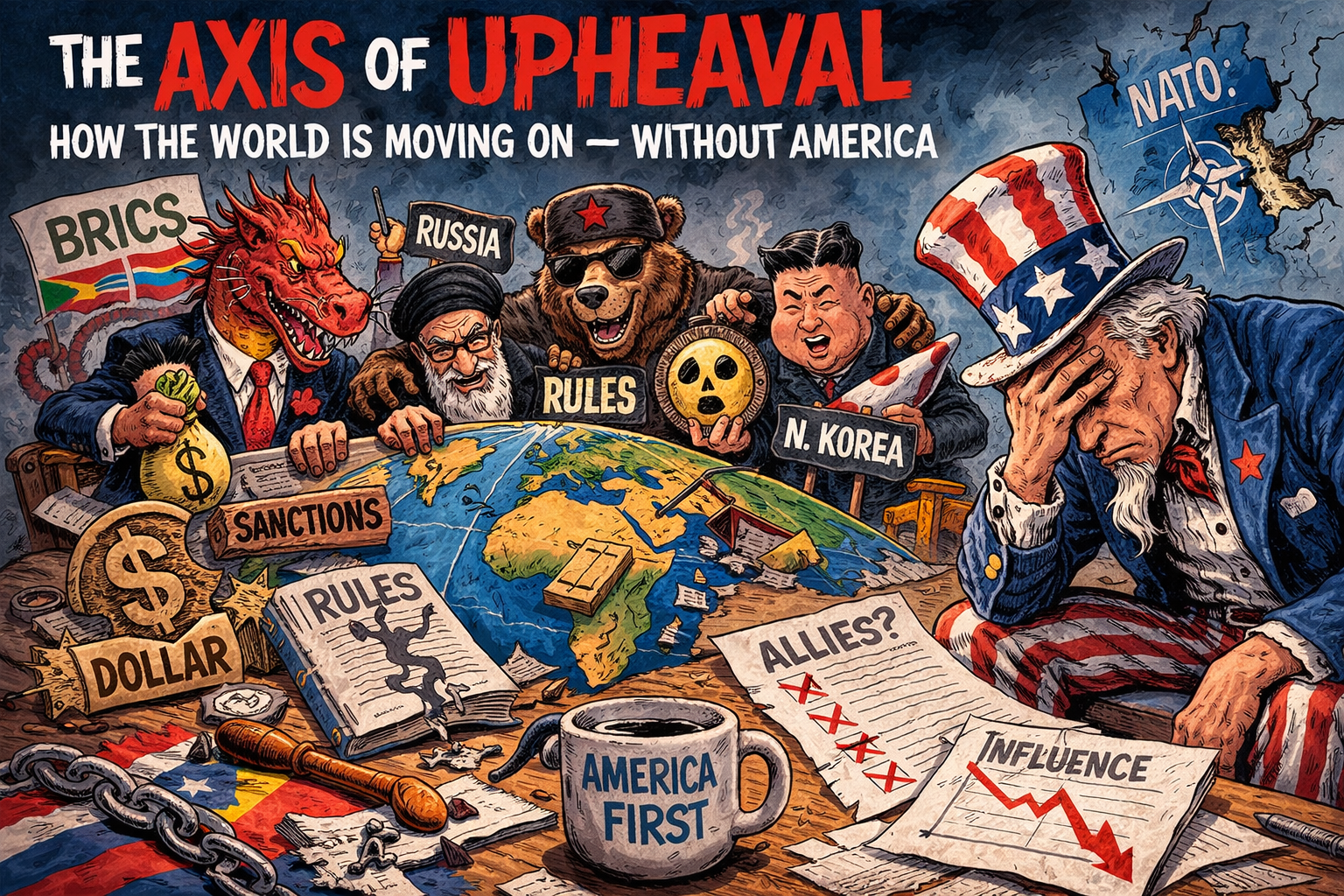
The global strategic environment is undergoing a profound transformation as power gradually shifts away from a unipolar system dominated by the United States toward a more distributed and competitive international order. One emerging geopolitical alignment frequently described by analysts as the Axis of Upheaval consists of China, Russia, Iran, and North Korea. This informal grouping has gained momentum following Russia’s full scale invasion of Ukraine in 2022 and the resulting confrontation between Moscow and Western governments. Rather than forming a formal treaty based alliance, these states have adopted a flexible framework of cooperation that allows them to collaborate where their interests overlap. Their shared objective is to weaken the influence of the United States and challenge aspects of the international system they view as unfavorable to their long term strategic ambitions. This arrangement allows each member to maintain autonomy while collectively resisting Western pressure.
Historically, geopolitical coalitions designed to counter dominant powers have emerged during periods of systemic transition. The current alignment echoes earlier attempts to balance Western influence but differs significantly in structure and motivation. In the early twenty first century, the concept of an Axis of Evil was used to identify states accused of pursuing weapons of mass destruction and supporting militant groups. The present configuration among China, Russia, Iran, and North Korea reflects a more pragmatic and less ideological form of cooperation. Each state contributes unique capabilities, including economic resources, military technologies, industrial capacity, or strategic geography. Instead of rigid alliance obligations, these partnerships operate through coordinated policies and mutually beneficial exchanges. This structure allows the alignment to remain adaptable in a rapidly changing geopolitical environment.
The emergence of this axis coincides with a shift in United States foreign policy priorities during the second Trump administration. The guiding principle of America First has emphasized national sovereignty, economic leverage, and bilateral diplomacy rather than traditional multilateral engagement. While this approach aims to protect American interests and reduce long term burdens on U.S. taxpayers, it has altered the dynamics of Washington’s relationships with longstanding allies. Several allied governments have begun to reassess their strategic assumptions regarding American reliability and leadership. Some have explored alternative economic and diplomatic partnerships to hedge against uncertainty in U.S. policy. This evolving environment provides greater strategic space for rival powers seeking to challenge American influence.
The Brooks Brief Substack is a reader-supported publication. To receive new posts and support my work, consider becoming a free or paid subscriber.
Key Members and Areas of Cooperation
Russia serves as a central hub within the Axis of Upheaval due to its ongoing confrontation with Western governments over the war in Ukraine. After extensive sanctions were imposed by the United States and European allies, Moscow increasingly turned to non Western partners for economic support and military resources. Iran has provided drones and missile technologies that have helped sustain Russia’s military operations. North Korea has reportedly supplied artillery ammunition and other conventional munitions that assist Russian forces in maintaining battlefield pressure. China has offered a vital economic lifeline through expanded energy purchases, trade flows, and financial cooperation that help mitigate the impact of Western sanctions. Together these relationships have allowed Russia to maintain strategic resilience despite significant economic and diplomatic isolation from Western markets.
China plays a distinct role within this alignment because of its global economic power and technological capabilities. Beijing has pursued a strategy that combines strategic caution with pragmatic support for partners facing Western pressure. Through expanded energy imports and infrastructure investments, China has deepened economic integration with both Russia and Iran. Diplomatic coordination between Beijing and Moscow has also increased within international institutions where both governments seek to counter Western influence. China’s broader global infrastructure initiatives provide additional opportunities for economic collaboration across Eurasia and the developing world. At the same time, Beijing carefully balances its relationships to avoid triggering severe economic retaliation from Western economies that remain critical to Chinese exports.
Iran and North Korea contribute specialized capabilities that strengthen the operational capacity of the broader network. Iran has developed an advanced drone and missile industry that has proven attractive to partners facing technological restrictions from Western sanctions regimes. Tehran also maintains extensive regional networks of political and military allies across the Middle East. North Korea offers large scale munitions production capacity along with decades of experience in nuclear weapons development and ballistic missile technologies. In exchange for these contributions, both states benefit from economic assistance, diplomatic protection, and potential access to advanced military technologies. These exchanges create a mutually reinforcing system that increases the resilience of each participant against external pressure.

Geopolitical Implications
The emergence of this axis presents complex strategic challenges for the United States and its allies because it increases the possibility of multiple simultaneous crises across several regions. Russia’s confrontation with Western governments in Eastern Europe continues to demand substantial military and financial support for Ukraine. At the same time, tensions involving Iran and its regional rivals keep the Middle East in a constant state of volatility. In East Asia, North Korea’s expanding nuclear arsenal and missile programs pose ongoing threats to South Korea and Japan. When these regional flashpoints are connected through cooperative networks among rival powers, the strategic burden on the United States becomes more difficult to manage. Washington must maintain credible deterrence across several theaters while allocating resources to different forms of competition.
Another major concern involves the potential weakening of global nonproliferation norms. Cooperation among these states could accelerate the development and transfer of advanced military technologies including missile systems and nuclear related capabilities. Such collaboration could undermine existing international frameworks designed to limit the spread of weapons of mass destruction. Regional actors observing these developments may feel compelled to pursue their own advanced military programs to maintain strategic balance. This dynamic could trigger new arms competitions in regions that already face deep security tensions. Over time, the cumulative effect may be a more dangerous and unpredictable global security environment.
The rise of this alignment also contributes to the broader transformation toward a multipolar international system. As global power becomes more widely distributed, many middle powers are choosing flexible diplomatic strategies rather than committing firmly to one geopolitical bloc. Countries in Asia, Africa, and Latin America increasingly pursue economic ties with China while maintaining security partnerships with the United States. This balancing strategy reduces the ability of any single power to organize unified responses to geopolitical challenges. The Axis of Upheaval benefits from this fragmentation because it complicates efforts by Western governments to apply coordinated economic or diplomatic pressure. As more states adopt hedging strategies, the overall structure of global governance may become increasingly decentralized.

BRICS and the Emerging Economic Challenge to the United States
Parallel to the geopolitical cooperation among China, Russia, Iran, and North Korea is the expanding influence of the BRICS economic bloc. Originally consisting of Brazil, Russia, India, China, and South Africa, the grouping has expanded to include additional emerging economies seeking greater influence in global financial institutions. Many of these countries share concerns about the dominance of Western institutions such as the International Monetary Fund and the World Bank. Through BRICS summits and development initiatives, member states aim to create alternative financial structures that provide greater autonomy from Western economic oversight. The expansion of this bloc reflects a broader desire among developing economies to diversify their economic partnerships. This trend has implications for the long term influence of the United States within the global financial system.
One of the most significant developments within BRICS discussions has been the exploration of alternative payment systems and potential currency arrangements designed to reduce dependence on the United States dollar. For decades, the dollar has served as the primary reserve currency for global trade and finance. This position provides the United States with substantial economic advantages, including the ability to impose powerful sanctions and maintain deep global demand for U.S. Treasury securities. Some BRICS members have proposed new financial mechanisms that could facilitate trade settlements using local currencies or a shared reserve instrument. Although these initiatives remain in early stages of development, their long term objective is to reduce vulnerability to Western financial pressure. If successful, such mechanisms could gradually weaken the dominance of the dollar in certain regions.
The broader economic challenge posed by BRICS lies in its potential to reshape global trade patterns and investment flows. Many BRICS members represent rapidly growing markets with large populations and significant natural resources. Increased economic integration among these states could create alternative supply chains that operate outside Western dominated financial networks. This development would reduce the leverage the United States currently exercises through sanctions and financial regulations. Additionally, infrastructure investments coordinated through BRICS affiliated institutions may accelerate economic development across parts of the Global South. Over time, these changes could contribute to a gradual redistribution of economic power away from traditional Western centers.

U.S. Policy Under the Second Trump Administration and Impact on Alliances
The second Trump administration has pursued a transactional approach to foreign policy that emphasizes economic leverage, bilateral negotiations, and national self interest. Policies such as tariffs on strategic competitors and pressure on allies to increase defense spending are intended to rebalance relationships that the administration views as unequal. Supporters argue that this strategy encourages allies to assume greater responsibility for their own security and reduces long term financial burdens on the United States. Critics contend that such policies risk undermining the trust and cooperation that historically defined the American alliance system. The reduced emphasis on multilateral institutions has also raised concerns about the durability of U.S. commitments to collective security frameworks. These debates have contributed to growing uncertainty among allied governments.
In Europe, disputes over trade policy and defense spending have fueled renewed discussions about strategic autonomy within the European Union. Several European leaders have suggested that the continent should develop stronger independent military and economic capabilities. While these proposals do not necessarily signal a complete departure from the transatlantic alliance, they reflect a desire to reduce dependence on Washington. Disagreements over military operations in the Middle East and other geopolitical crises have further complicated relations between the United States and some European partners. Domestic political pressures within European countries often influence their willingness to support U.S. initiatives. These dynamics illustrate how differences in strategic priorities can create friction within long standing alliances.
In Asia and North America, similar patterns of strategic recalibration are emerging. Discussions about potential adjustments to the U.S. military presence in South Korea have generated debate about regional security arrangements. Trade tensions with several partners have also encouraged countries to diversify their economic relationships. Canada and other middle powers increasingly explore commercial opportunities with Asian markets to reduce economic vulnerability. These moves do not necessarily represent alignment with rival powers but rather reflect efforts to maintain flexibility in an uncertain global environment. The cumulative effect of these adjustments is a gradual evolution in the structure of international partnerships.
Thanks for reading The Brooks Brief Substack! This post is public so feel free to share it.
Conclusion and Future Outlook
The continued evolution of the Axis of Upheaval combined with the expanding influence of BRICS suggests that the international system is entering a new phase of geopolitical competition. Through coordinated military cooperation, economic exchanges, and diplomatic coordination, China, Russia, Iran, and North Korea have developed a flexible network capable of resisting Western pressure. At the same time, economic initiatives within BRICS seek to reshape elements of the global financial system that have historically favored Western economies. These parallel developments indicate a broader shift toward a more fragmented and multipolar world order. The combined geopolitical and economic dimensions of this transformation present complex challenges for the United States and its allies.
For Washington, the primary challenge will be balancing strategic competition with effective alliance management. The strength of American influence has historically depended on a vast network of economic partnerships and security alliances. Maintaining these relationships requires consistent diplomatic engagement and credible commitments to shared security interests. If allies perceive U.S. policy as unpredictable or excessively transactional, they may increasingly pursue independent strategies that dilute collective responses to emerging threats. Rebuilding confidence within the alliance system may therefore become a central objective of American foreign policy. The effectiveness of this effort will shape the future balance of global power.
Looking forward, the interaction between the Axis of Upheaval, the economic ambitions of BRICS, and the evolving strategy of the United States will define the trajectory of international politics. Conflicts in Eastern Europe, the Middle East, and East Asia will remain central arenas of strategic competition. The decisions made by emerging powers in the Global South will also influence how global alignments evolve. If current trends continue, the world may move toward a decentralized order characterized by shifting partnerships rather than rigid alliances. In this environment, diplomatic agility and economic resilience will become essential tools for navigating geopolitical rivalry. The capacity of the United States to adapt to this changing landscape will determine the extent of its leadership in the decades ahead.
Leave a Reply