social sciences
-
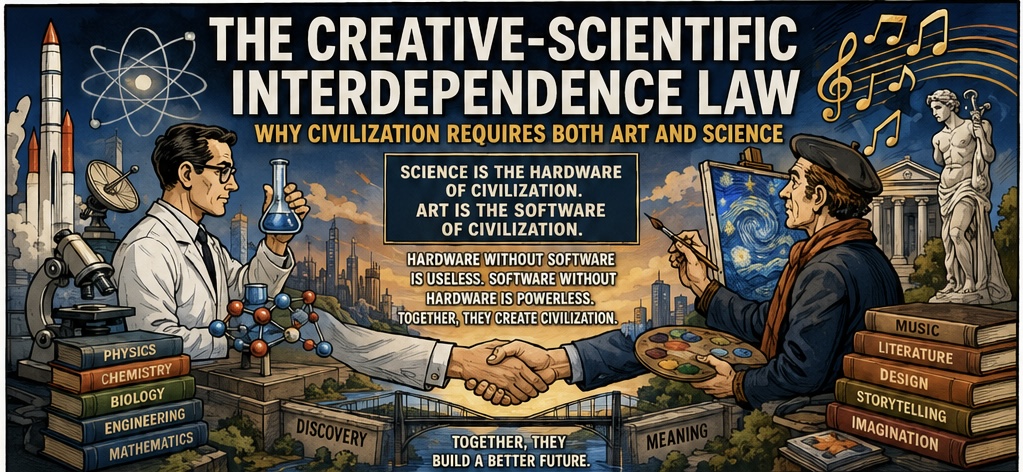
The Creative-Scientific Interdependence Law
Why Civilization Requires Both Art and Science A Political and Civilizational Analysis Executive Summary Modern societies often separate art and science into distinct and sometimes competing domains. Science is frequently associated with objectivity, measurement, engineering, and technological advancement. Art is commonly associated with creativity, expression, culture, and imagination. Educational institutions, public policy discussions, and economic…
-

Resource-Cohesion Theory
A Unified Framework for Understanding Human Civilization Executive Summary The social sciences have traditionally been divided into separate disciplines that examine different aspects of human behavior and organization. Political science studies governance and power. Economics focuses on production, distribution, and consumption. Sociology examines social relationships and institutions, while anthropology explores culture and human development. International…
-

The Resource Survival Law
A Political Analysis of Resources, Power, and Collective Survival Executive Summary Throughout history, every living organism, community, state, and civilization has faced the same fundamental challenge: survival depends upon access to resources. Food, water, energy, land, labor, capital, technology, and information are not merely assets that improve quality of life. They are prerequisites for survival…
Search
Categories
Tags
AI american foreign policy American Politics artificial intelligence Church and State conflict resolution Constitutional Law counterintelligence declaration of independence De Facto Authority Diplomacy divine sovereignty economic policy economy epstein files Global Governance healthcare human rights inflation international law international relations iran iran conflict Mtb Entertainment national debt National Sovereignty peacebuilding polarization political analysis political legitimacy political science political theory robot tax Security Dilemma social science social sciences Sovereign of Sovereigns the brooks brief Trump ubi united nations united states United States foreign policy united states policy universal basic income