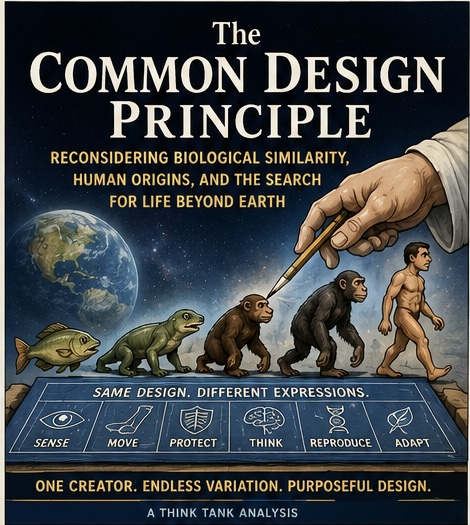
Reconsidering Biological Similarity, Human Origins, and the Search for Life Beyond Earth

Executive Summary
For more than a century, the dominant scientific explanation for biological similarity has been the theory of evolution through natural selection. According to this framework, organisms share common features because they descend from common ancestors and have been shaped by environmental pressures over vast periods of time. Evolutionary theory has generated substantial scientific evidence and remains the foundation of modern biological science. At the same time, scientific explanations of biological processes do not necessarily resolve broader philosophical questions regarding purpose, design, or ultimate origins. Throughout history, scholars, theologians, and political thinkers have offered alternative interpretations of recurring patterns in nature. These perspectives have often focused less on the mechanisms of biological development and more on the possibility that recurring patterns reflect intentional design.

The Common Design Principle emerges from this broader tradition of inquiry. The principle proposes that recurring biological structures may reflect the repeated use of successful design solutions by a common creator. Just as engineers routinely reuse proven components across multiple machines, a creator may repeatedly employ effective biological architectures across different forms of life. Similarities among species are therefore interpreted not merely as the result of common ancestry, but also as evidence of shared design logic. This perspective does not seek to dismiss scientific observations regarding adaptation or natural selection. Instead, it offers an alternative framework through which those observations may be interpreted.
The Common Design Principle states that if all life originates from a common creator, recurring anatomical, physiological, and functional patterns should be expected throughout nature because successful designs are likely to be reused.
The significance of this discussion extends beyond biology. Ideas regarding common origins and common design influence how societies understand humanity’s relationship to nature, to one another, and potentially to life beyond Earth. As scientific exploration increasingly focuses on the search for extraterrestrial intelligence, questions concerning recurring biological patterns may acquire new relevance. If life is discovered elsewhere in the universe, observers will naturally seek explanations for similarities and differences between terrestrial and extraterrestrial organisms. The Common Design Principle provides one possible framework for approaching those questions. Whether ultimately accepted or rejected, the concept offers a useful lens through which to examine the intersection of science, philosophy, religion, and public policy.
The Brooks Brief Substack is a reader-supported publication. To receive new posts and support my work, consider becoming a free or paid subscriber.
Introduction: The Puzzle of Biological Similarity

Life on Earth exhibits an extraordinary level of diversity. Millions of species inhabit environments ranging from tropical rainforests and deep oceans to deserts, mountains, and polar regions. Organisms vary dramatically in size, appearance, behavior, and ecological function. Despite this remarkable diversity, recurring patterns appear throughout the biological world. Similar structural arrangements emerge repeatedly among organisms that occupy vastly different environments and perform different functions. These recurring patterns raise important questions regarding the origins and significance of biological similarity.
One of the most striking examples involves the organization of sensory and feeding systems. In many species, the eyes are positioned above the mouth, allowing organisms to observe their surroundings while acquiring food. Similar patterns appear in the placement of brains, sensory organs, limbs, and protective structures. Bilateral symmetry is common among complex organisms. Information-processing centers frequently occupy positions near sensory organs. Protective skeletal structures often surround critical biological systems. Such similarities appear so frequently that they are often regarded as ordinary features of life itself.
The conventional scientific explanation attributes these recurring patterns to evolutionary processes. According to this perspective, natural selection favors characteristics that improve survival and reproduction. Over time, advantageous traits become more common within populations. The Common Design Principle does not deny the existence of these processes. Instead, it asks whether recurring biological solutions might also reflect intentional design choices. The central question is not whether biological change occurs, but whether recurring patterns reveal evidence of a common design philosophy operating behind that change.
Political and philosophical inquiry frequently examines competing explanations for observed phenomena. Public policy debates often involve disagreements not only about facts but also about interpretation. The same principle applies to discussions concerning biological similarity. Different frameworks may examine the same evidence while arriving at different conclusions regarding its meaning. The Common Design Principle seeks to contribute to this broader discussion by exploring whether recurring biological structures may represent evidence of design continuity. In doing so, it expands the conversation beyond purely biological mechanisms toward questions of purpose, authorship, and long-term implications for human civilization.
The Common Design Principle

The Common Design Principle states that if all life originates from a common creator, recurring anatomical, physiological, and functional patterns should be expected throughout nature because successful designs are likely to be reused. This proposition draws upon observations from both engineering and biology. Human designers rarely create entirely new solutions for every problem they encounter. Instead, successful designs are modified, refined, and adapted to address new challenges. The principle proposes that a creator may operate in a similar manner when generating diverse forms of life. Biological variation therefore emerges not from the abandonment of successful designs but from their adaptation to different circumstances.
This framework differs from approaches that emphasize entirely independent development among species. Under the Common Design Principle, recurring structures are not viewed as accidental similarities. Rather, they are interpreted as evidence of a common design logic. Just as an engineer may employ the same mechanical principles across automobiles, aircraft, and ships, a creator may repeatedly employ effective biological architectures across different species. Similarities become expected outcomes rather than surprising coincidences. The repeated appearance of comparable solutions across nature is viewed as a reflection of design efficiency and continuity.
Importantly, the principle does not require biological uniformity. Diversity remains a central feature of life under this framework. Different environments present different challenges, requiring modifications to existing designs. Aquatic organisms, terrestrial organisms, and aerial organisms face distinct ecological pressures that may necessitate significant variation. However, beneath these differences, recognizable design templates may remain visible. The persistence of these templates forms the foundation of the Common Design Principle.
The principle also provides a framework for examining potential extraterrestrial life. If life beyond Earth originates from the same creator responsible for life on Earth, similar biological solutions may emerge across multiple worlds. Extraterrestrial organisms may differ dramatically in appearance while still exhibiting recognizable design patterns. Sensory systems, locomotion structures, and information-processing centers may reflect familiar design principles adapted to unfamiliar environments. Such possibilities extend the relevance of the Common Design Principle beyond terrestrial biology into the broader search for intelligent life within the universe.
From a political and philosophical perspective, the Common Design Principle encourages a broader discussion regarding common origins and shared existence. If recurring biological patterns reflect a common creator, then humanity’s relationship with other forms of life may be more interconnected than commonly assumed. This perspective could influence future discussions regarding environmental stewardship, biotechnology, animal welfare, and the treatment of potential extraterrestrial civilizations. Whether one ultimately accepts the principle or not, it raises important questions regarding how societies interpret biological similarity and humanity’s place within a larger cosmic framework.
Design Reuse in Nature

One of the strongest observations supporting the Common Design Principle is the repeated appearance of similar biological solutions across vastly different forms of life. Engineers often reuse successful designs because doing so reduces inefficiency and increases reliability. A bridge designer does not reinvent the concept of structural support for every project, nor does an aircraft engineer abandon aerodynamic principles simply because a new aircraft is being developed. Instead, successful concepts are modified and adapted to meet new requirements. The Common Design Principle proposes that similar patterns may exist throughout the biological world. Recurring anatomical structures may therefore represent examples of successful designs being employed repeatedly across different species.
The relationship between the eyes and the mouth provides a useful example. In many animals, the eyes occupy a position above the feeding apparatus. This arrangement allows organisms to maintain awareness of their surroundings while consuming food. Predators can continue monitoring threats or opportunities while feeding, while prey species can remain alert for danger. The arrangement also reduces the likelihood that food, debris, or waste products interfere with visual perception. Although exceptions exist, the recurring appearance of this pattern across a wide range of species suggests a highly effective solution to a common biological challenge.
The same principle can be observed in the placement of sensory organs and nervous systems. Many organisms position their primary sensory structures near major information-processing centers. Eyes, ears, antennae, and other sensory mechanisms are frequently located near the brain or its functional equivalent. This arrangement reduces the distance information must travel before it can be processed and acted upon. From an engineering perspective, such efficiency is logical because it minimizes delays and conserves energy. The Common Design Principle interprets these recurring arrangements as examples of successful organizational patterns repeatedly employed throughout nature.
Protective structures provide another example of design continuity. Many species possess skeletal frameworks, shells, exoskeletons, scales, or other protective features designed to shield critical biological systems. The specific implementation varies according to environmental conditions, yet the underlying principle remains remarkably consistent. Vital organs are often protected while maintaining sufficient flexibility for movement and survival. This recurring pattern appears across organisms that otherwise share little in common. Such similarities suggest the repeated application of a common design strategy focused on balancing protection with functionality.
Critics may argue that these recurring patterns can be adequately explained through natural selection alone. The Common Design Principle does not necessarily reject this possibility. Instead, it proposes that recurring solutions may be interpreted through more than one lens. Evolutionary theory explains how advantageous traits become widespread through inheritance and adaptation. Common Design asks whether the repeated emergence of effective solutions may also reveal evidence of broader design logic. The two frameworks therefore address different dimensions of the same observations while reaching different conclusions regarding their ultimate significance.
The Four-Limb Pattern and Functional Efficiency

Among the most recognizable recurring patterns in biology is the four-limb body plan. Numerous species throughout Earth’s history have possessed four primary limbs arranged in symmetrical fashion. Mammals, reptiles, amphibians, and many extinct organisms demonstrate variations of this architecture. Although the specific functions of these limbs differ substantially, the underlying structural arrangement remains surprisingly consistent. The persistence of this pattern raises questions regarding why it has proven so successful across such a broad range of environments. The Common Design Principle interprets this recurring arrangement as evidence of a highly effective biological template.
A four-limb structure offers several practical advantages. It provides stability during movement while allowing flexibility in how different limbs are used. In many species, front limbs interact with the environment while rear limbs generate propulsion. In others, all four limbs contribute to locomotion. The arrangement allows organisms to distribute weight efficiently while maintaining balance across uneven terrain. Such versatility makes the four-limb pattern adaptable to a wide variety of ecological circumstances.
Nature demonstrates remarkable creativity in modifying this basic framework. Wings, flippers, paws, hands, claws, and hooves all represent variations of the same fundamental concept. The skeletal structures underlying these different appendages often display striking similarities despite serving very different functions. This suggests that successful designs can be modified extensively without abandoning their core architecture. Under the Common Design Principle, such variation reflects adaptation built upon continuity rather than entirely independent invention. The recurring framework remains visible even as specific features evolve to meet local needs.
The significance of the four-limb pattern extends beyond Earth. Popular depictions of intelligent extraterrestrial life frequently portray beings with two arms and two legs. While such depictions may reflect human assumptions, they also raise an interesting question. If four limbs represent an efficient solution to the challenges of mobility and environmental interaction, might similar arrangements emerge elsewhere in the universe? The Common Design Principle suggests that successful designs could be reused across multiple worlds if they effectively solve common biological problems. Similarities between terrestrial and extraterrestrial body plans would therefore not be unexpected under this framework.
This observation does not imply that all intelligent life must possess four limbs. Different planetary conditions could produce alternative solutions. Organisms inhabiting oceans, high-gravity environments, or low-gravity environments may develop radically different structures. Nevertheless, the repeated appearance of the four-limb pattern on Earth demonstrates how effective designs can persist across millions of years and countless species. The Common Design Principle argues that such persistence may reflect more than environmental adaptation alone. It may also reflect the enduring value of a successful design template.
Multiple Eyes and Adaptive Design

A common criticism of design-based frameworks is that they appear to imply uniformity. The Common Design Principle rejects this assumption. Effective design does not require identical outcomes. In engineering, successful designs are often modified to meet new challenges while retaining their underlying purpose. Biological systems demonstrate a similar pattern. Vision serves as an excellent example of how continuity and variation can coexist within the same design framework.
Human beings possess two forward-facing eyes that provide depth perception and spatial awareness. Many other mammals share similar arrangements. However, nature also presents examples of organisms possessing radically different visual systems. Spiders often possess eight eyes arranged in various configurations. Insects may possess compound eyes containing thousands of individual receptors. Some species possess eyes adapted for low-light conditions, while others are optimized for detecting movement or color. These variations illustrate how a common function can be achieved through multiple design approaches.
From the perspective of the Common Design Principle, such diversity does not weaken the argument for design continuity. Instead, it demonstrates the flexibility of successful design concepts. The goal remains visual perception, but the implementation changes according to environmental demands. Predatory species may require enhanced depth perception, while prey species may benefit from wider fields of view. Aquatic organisms face different optical challenges than terrestrial organisms. As a result, the visual systems of different species may vary considerably while still fulfilling the same fundamental purpose.
This concept has important implications for discussions regarding extraterrestrial life. Intelligent organisms on distant worlds may possess sensory systems that differ substantially from those found on Earth. Some may possess multiple eyes, while others may rely on entirely different sensory mechanisms. Nevertheless, if perception remains necessary for survival, organisms must still solve the challenge of gathering and processing environmental information. The Common Design Principle predicts that recurring solutions to this challenge may emerge even among life forms separated by vast distances.
The broader lesson is that common design does not imply rigid standardization. Instead, it suggests the existence of recurring principles that can be expressed in different ways. Just as a human engineer may produce multiple versions of a successful machine, a creator may employ numerous variations of successful biological concepts. Diversity and continuity therefore become complementary rather than contradictory. The remarkable variety observed throughout nature may represent not the absence of design, but the adaptability of a common design philosophy operating across different forms of life.
Common Design and the Search for Extraterrestrial Life

The search for extraterrestrial life represents one of the most significant scientific and philosophical endeavors of the modern era. Governments, universities, and private organizations continue to invest substantial resources into the search for evidence of life beyond Earth. While much of this effort focuses on detecting biosignatures, habitable planets, and potential technological civilizations, less attention is often given to the question of what extraterrestrial life might actually look like. Popular culture frequently assumes that alien life would be completely unfamiliar and radically different from life on Earth. The Common Design Principle offers a different perspective by suggesting that recurring biological solutions may appear throughout the universe if all life originates from a common creator.
If organisms on distant worlds face challenges similar to those faced by organisms on Earth, certain design patterns may emerge repeatedly. Intelligent life would likely require mechanisms for gathering information, processing information, acquiring energy, and interacting with the surrounding environment. While the specific biological structures may vary, the underlying functional requirements would remain similar. As a result, extraterrestrial organisms may possess recognizable sensory systems, mobility structures, and organizational patterns despite existing in environments vastly different from Earth’s. The Common Design Principle predicts that successful biological solutions could appear across multiple worlds because the same creator may repeatedly employ effective design strategies.
Reports, folklore, speculative literature, and popular depictions of extraterrestrials frequently describe beings possessing multiple eyes, bilateral symmetry, upright posture, and four primary limbs. Such accounts should not be interpreted as scientific evidence. However, the recurrence of these descriptions raises interesting theoretical questions. If certain biological arrangements represent efficient solutions to universal challenges, similar structures may emerge repeatedly regardless of planetary origin. The Common Design Principle suggests that familiar biological patterns found elsewhere in the universe would be consistent with the expectation of design continuity.
The implications extend beyond anatomy. Environmental systems may also exhibit recurring design features. Atmospheric compositions capable of supporting complex life, energy cycles that facilitate biological development, and ecological structures that encourage adaptation may appear across multiple planets. Such similarities would not necessarily prove the existence of a creator, but they would be consistent with the hypothesis that successful environmental architectures are reused in much the same way that successful biological architectures are reused. Future discoveries regarding extraterrestrial life may therefore provide opportunities to evaluate whether recurring patterns extend beyond Earth itself.
From a policy perspective, the possibility of discovering recognizable design patterns in extraterrestrial organisms would influence scientific, philosophical, and diplomatic discussions. Humanity would be forced to reconsider assumptions regarding uniqueness, biological origins, and our place within the broader cosmos. The Common Design Principle provides one framework through which such discoveries could be interpreted. Whether ultimately validated or rejected, it offers a conceptual foundation for examining future encounters with life beyond Earth.
Creation, Evolution, and Environmental Change

One of the most important misconceptions regarding design-based theories is the assumption that creation and evolution must always exist in opposition to one another. The Common Design Principle does not require such a conflict. Instead, it allows for the possibility that evolutionary processes may function within a broader framework of intentional design. Under this interpretation, creation establishes the initial architecture of life while evolution provides a mechanism through which that life adapts to changing circumstances. The two concepts may therefore operate at different levels of explanation rather than serving as mutually exclusive alternatives.
On Earth, evolutionary change is often linked to environmental pressures. Changes in climate, food availability, predation, disease, geography, and competition can influence which traits are favored within a population. Organisms possessing characteristics that improve survival and reproduction are more likely to pass those characteristics to future generations. Over long periods of time, these pressures can produce substantial biological change. Evolutionary theory provides a powerful explanation for how populations adapt to shifting environmental conditions. The Common Design Principle accepts the reality of adaptation while asking whether the capacity for adaptation itself may have been intentionally incorporated into life from the beginning.
This distinction becomes particularly important when considering the role of intelligence. Human civilization has already demonstrated the ability to alter environmental conditions on a massive scale. Agriculture transformed ecosystems. Industrialization changed atmospheric composition and land use patterns. Modern biotechnology increasingly allows humanity to influence genetic outcomes directly. These developments suggest that intelligence can shape both environmental evolution and biological evolution. If human beings possess such capabilities, it is reasonable to consider whether more advanced intelligences could exercise even greater influence.
Under the Common Design Principle, intelligent actors may accelerate, redirect, or prevent evolutionary processes. An intelligent species can create artificial environments that protect organisms from natural pressures. It can selectively breed plants and animals. It can alter genetic structures through biotechnology. In doing so, intelligence becomes a force that operates alongside traditional evolutionary mechanisms. Biological outcomes are influenced not only by environmental conditions but also by deliberate decision-making. This introduces an additional layer of complexity into discussions regarding adaptation and development.
The same logic can be extended to hypothetical extraterrestrial civilizations or a creator responsible for life itself. If sufficiently advanced intelligence exists, environmental conditions may not always be the product of random natural processes. They may instead reflect intentional management, modification, or design. Under this interpretation, evolution remains real, but the environment within which evolution occurs may itself be shaped by intelligence. Creation and evolution therefore become interconnected components of a larger system rather than opposing explanations competing for exclusivity.
Darwin’s Theory of Evolution and the Common Design Principle

The most influential explanation for biological similarity remains the theory of evolution through natural selection. Associated with the work of Charles Darwin, evolutionary theory argues that species change over time as advantageous traits become more common within populations. Organisms inherit characteristics from previous generations, and environmental pressures influence which traits are most likely to persist. Over long periods of time, these processes can produce significant biological diversity. Modern biology has expanded upon Darwin’s original insights through genetics, molecular biology, and paleontology.
Evolutionary theory explains many observable features of life. Fossil records reveal patterns of change over time. Genetic similarities indicate relationships among species. Observations of adaptation demonstrate how populations respond to environmental pressures. These findings provide substantial support for the scientific framework of evolution. For this reason, evolution remains the dominant scientific explanation for biological development within contemporary biology. Any alternative framework must acknowledge the strength of this body of evidence.
The Common Design Principle approaches the same observations from a different perspective. Rather than focusing exclusively on mechanisms of biological change, it examines recurring patterns that appear throughout nature. It asks whether the repeated use of similar solutions may indicate the presence of common design logic. Evolution explains how a biological structure may emerge and persist. Common Design asks why certain structures repeatedly appear as solutions to recurring challenges. The two frameworks therefore address different aspects of the same phenomenon.
Some proponents of Common Design may reject evolutionary explanations entirely. Others may view evolution as a mechanism operating within a broader framework of intentional design. The latter position treats evolution as a process rather than an ultimate explanation. Under this interpretation, evolutionary adaptation becomes one of the tools through which successful designs are refined and modified over time. Such an approach allows the Common Design Principle and evolutionary theory to coexist as complementary rather than competing frameworks.
The debate between these perspectives is likely to continue. Scientific inquiry focuses on empirical observation and testable mechanisms. Philosophical inquiry often explores questions of purpose, meaning, and authorship that extend beyond empirical measurement. The Common Design Principle belongs primarily within the latter category. Its value lies not in replacing established scientific theories but in offering an alternative lens through which recurring biological patterns may be interpreted.
Political and Philosophical Implications

The Common Design Principle extends beyond biology into broader questions of political philosophy and public policy. If all life shares common origins through a common creator, then humanity’s relationship with other living organisms may require reconsideration. Environmental stewardship, conservation policy, and animal welfare debates often focus on practical concerns regarding sustainability and resource management. The Common Design Principle introduces an additional ethical dimension by emphasizing shared origins and interconnected existence. Such a perspective could encourage broader responsibility toward the natural world.
The principle may also influence discussions regarding human identity and social cooperation. Political systems frequently emphasize divisions based on nationality, ethnicity, religion, ideology, or economic status. A framework emphasizing common origins and shared design encourages a different perspective. It highlights similarities rather than differences. While such a viewpoint would not eliminate political disagreements, it could provide philosophical support for greater cooperation and mutual responsibility. Shared design becomes a conceptual foundation for shared interests.
Future discoveries involving extraterrestrial life could further expand these discussions. If humanity encounters organisms exhibiting recognizable design patterns, debates regarding rights, sovereignty, diplomacy, and legal status would emerge rapidly. Questions concerning the treatment of non-human intelligent life would become matters of public policy rather than abstract speculation. The Common Design Principle suggests that recognizable similarities may encourage cooperation by emphasizing shared origins rather than perceived alienness. Such considerations could become increasingly important as scientific exploration extends beyond Earth.
The principle also has implications for emerging technologies. Advances in artificial intelligence, synthetic biology, and genetic engineering increasingly allow humanity to modify biological systems. Policymakers must decide how such technologies should be governed and what ethical boundaries should apply. A framework emphasizing design continuity may encourage caution regarding alterations to biological systems whose complexity is not yet fully understood. It may also promote greater consideration of long-term consequences when modifying life itself.
Ultimately, the Common Design Principle functions as both a biological hypothesis and a philosophical framework. It encourages societies to think beyond immediate scientific questions and consider broader issues concerning origins, responsibility, and the future of intelligent life. Whether accepted as a literal explanation or viewed as a useful conceptual model, the principle invites deeper reflection regarding humanity’s place within nature and the universe.
Thanks for reading The Brooks Brief Substack! This post is public so feel free to share it.
Conclusion

The Common Design Principle proposes that recurring biological patterns may reflect the repeated use of successful designs by a common creator. Drawing inspiration from principles commonly observed in engineering, the framework suggests that effective solutions are likely to be reused, modified, and adapted rather than discarded. Similarities among organisms therefore become evidence of continuity in design rather than merely coincidence. The principle offers a philosophical interpretation of biological similarity that complements broader discussions regarding science, religion, and public policy.
Throughout nature, recurring patterns appear in sensory systems, body structures, protective mechanisms, and environmental adaptations. The placement of eyes above mouths, the widespread appearance of bilateral symmetry, the persistence of four-limb body plans, and the diversity of visual systems all illustrate how successful solutions can be adapted to different circumstances. These examples form the empirical foundation upon which the Common Design Principle is constructed. While such observations do not prove intentional design, they provide the basis for exploring the possibility that recurring patterns reflect more than environmental necessity alone.
The relationship between Common Design and evolution remains one of the most important aspects of the framework. Rather than viewing creation and evolution as mutually exclusive, the principle allows for the possibility that evolutionary processes operate within a larger system of intentional design. Adaptation, environmental change, and natural selection remain important mechanisms of biological development. However, intelligence itself may become a force capable of shaping environmental and biological outcomes. This possibility becomes increasingly relevant as human civilization acquires greater influence over both ecosystems and genetic systems.
As humanity continues to explore the universe, questions regarding biological similarity, common origins, and intelligent design are likely to gain renewed attention. Future discoveries concerning extraterrestrial life may challenge existing assumptions regarding what life can become and how it develops. The Common Design Principle offers one framework for interpreting such discoveries. Whether ultimately embraced, modified, or rejected, it contributes to an ongoing conversation about the relationship between science, philosophy, and humanity’s understanding of its place within a larger cosmic order.
Leave a Reply