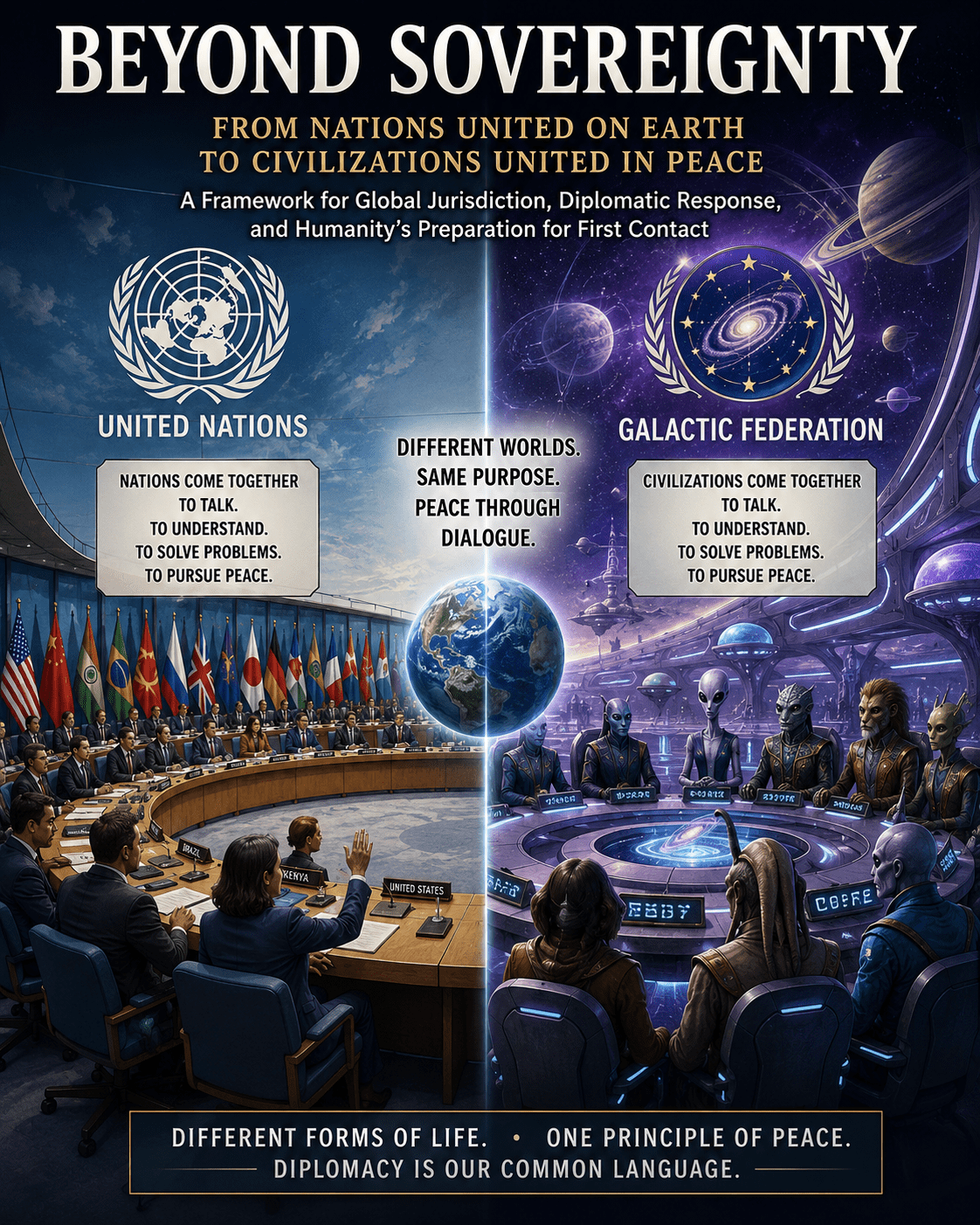
Rethinking Sovereignty, International Authority, Human Rights, Conflict Resolution, and Humanity’s Preparation for First Contact
I. The Jurisdiction Problem
Before discussing global authority, international institutions, or reforming the United Nations, we first have to answer a simpler question: Who has the legal authority to do what? That question involves jurisdiction. In simple terms, jurisdiction is the authority to make decisions, apply laws, or address particular people, places, and issues. A city may have jurisdiction over local matters. A state or province may have authority over broader regional matters. A sovereign nation possesses authority over national affairs. The question becomes more complicated when an issue crosses national borders.

The modern world is organized primarily around sovereign nations. Sovereignty means that a nation possesses the authority to govern itself rather than being governed by another country. The United States governs the United States. France governs France. Kenya governs Kenya. These nations can cooperate, enter treaties, join international organizations, and accept international obligations, but their sovereignty remains a foundation of the present international system.
Some problems, however, cannot be contained within one nation’s borders. War between two countries immediately involves more than one sovereign government. A contagious disease can spread across borders. Pollution can travel through air and water. Economic instability can affect interconnected markets. Refugees can flee from one country into another. Natural disasters can require assistance from multiple nations. Climate change can affect countries far removed from the original source of emissions.
These situations create what this article calls the jurisdiction problem. If one nation should not govern another sovereign nation, but some problems cannot be solved by one nation acting alone, where should the necessary authority come from? Existing international organizations provide part of the answer, but they do not completely resolve the question of when international cooperation becomes legitimate global authority.
A second problem is language. An agreement between two nations is international. An organization consisting of twenty nations is international. A military alliance involving dozens of governments is international. Yet none of those groups necessarily represents the world. Something can therefore be international without being genuinely global.
This article proposes that international political theory should recognize that distinction. International Jurisdiction and Global Jurisdiction should not mean the same thing.

II. A Hierarchy of Jurisdiction
Jurisdiction can be understood as a series of expanding levels of authority. For purposes of the theory proposed in this article, that hierarchy can be represented as:
Local → State/Provincial → National → International → Global → Planetary → Interplanetary → Galactic → Divine
Not every level in this hierarchy currently exists as recognized law. Local, state, national, and various forms of international jurisdiction already exist in recognizable forms. Global Jurisdiction, as defined in this article, is a proposed doctrine. Planetary, interplanetary, and galactic jurisdiction are prospective concepts designed to consider circumstances humanity may encounter in the future. Divine Jurisdiction belongs primarily to philosophical and theological analysis.
The basic idea is nevertheless straightforward. Authority should generally correspond to the level at which a problem legitimately exists. A broken traffic light does not require the United Nations. A disagreement between two national governments ordinarily does not require a city council. Different institutions exist because different problems exist at different political levels.
Higher jurisdiction should therefore not automatically replace lower jurisdiction. Instead, the higher level should become relevant when the issue legitimately exceeds the authority or practical ability of the level beneath it.
This produces one of the central principles of the proposed framework:
Jurisdiction should rise only as high as the problem legitimately requires.

III. National and International Jurisdiction
A sovereign nation possesses National Jurisdiction over matters legitimately belonging to that nation. National governments make laws, conduct foreign policy, protect their territory, regulate economic activity, maintain institutions, and perform many other functions necessary to govern their populations.
International Jurisdiction begins when the relevant matter materially involves more than one sovereign nation. If two countries negotiate a treaty, resolve a border disagreement, manage a shared river, engage in armed conflict, or cooperate against a cross-border threat, the issue has an international dimension.
International Jurisdiction does not necessarily mean that another government suddenly gains control over the countries involved. International authority can take many forms, including treaties, negotiations, arbitration, mediation, international courts where jurisdiction has been established, regional organizations, and multinational agreements.
The distinction is important because international does not mean global.
Two sovereign nations can create an international issue.
Twenty sovereign nations can create an international organization.
Even a large alliance can remain international without possessing legitimate authority to speak for the overwhelming majority of the world.
Put simply:
Two nations constitute an international relationship. Two nations do not constitute the world.

IV. The Global Jurisdiction Doctrine
This article proposes a new category called Global Jurisdiction (GJ).
Global Jurisdiction would exist when at least 85 percent of the world’s sovereign nations voluntarily unite within a common federation or legal framework. The 85 percent requirement is intentionally difficult to achieve. Authority claiming to represent the world should require substantially more legitimacy than an ordinary majority vote.
Global Jurisdiction would belong collectively to the sovereign nations participating in the federation. It would not inherently belong to a secretary-general, court, military commander, administrative office, powerful country, or international bureaucracy. Those institutions could exercise powers granted to them, but the underlying authority would originate from the sovereign nations themselves.
The theory can be summarized through a simple progression:
One sovereign nation → National Jurisdiction
Two or more sovereign nations → International Jurisdiction
At least 85 percent of sovereign nations voluntarily allied → Global Jurisdiction
The central proposition is:
No nation rules the world, but an overwhelming community of sovereign nations acting together may possess limited authority that none possesses individually.
This does not mean 85 percent of governments become owners of the remaining 15 percent. Nor does it mean countries surrender every aspect of their sovereignty when the threshold is reached. Instead, the threshold establishes when a federation has enough worldwide participation to exercise what this theory recognizes as Global Jurisdiction over appropriate global matters.
Global authority should therefore increase in proportion to global consent.

V. Sovereignty Under Global Jurisdiction
Global Jurisdiction should be created from sovereignty, not through the destruction of sovereignty.
Every participating nation would remain sovereign. Countries would continue operating their governments, legal systems, elections, economies, schools, cultural institutions, and other domestic structures. Joining a global federation should not mean surrendering every decision to an institution operating above the nation.
This framework therefore proposes a Principle of Least Necessary Global Authority. The idea is simple: even when Global Jurisdiction exists, global institutions should exercise only as much authority as reasonably necessary to address the global portion of a problem.
Consider a pandemic. A global institution might legitimately coordinate international information sharing, scientific cooperation, cross-border assistance, or measures designed to prevent international spread. That does not necessarily mean the same institution should determine every local hospital policy or individual medical decision throughout the world.
The same principle can apply to environmental policy, disaster response, economic development, conflict, and other multinational problems. Global Jurisdiction should fill genuine jurisdictional gaps rather than become an excuse for unnecessary centralized control.
Sovereignty and Global Jurisdiction therefore do not have to be enemies. Properly designed, one provides the legitimacy necessary for the other.

VI. Matters Appropriate for Global Jurisdiction
Some problems are international because they involve several nations. Others can become genuinely global because their consequences, causes, or solutions affect a substantial portion of the world.
Potential areas for Global Jurisdiction could include major armed conflicts, pandemics, multinational natural disasters, climate change, large-scale environmental threats, international economic development, humanitarian emergencies, mass displacement, global infrastructure, cross-border resource problems, and other issues whose effects extend across numerous sovereign nations.
This does not mean every international disagreement automatically becomes a global matter. A trade disagreement between two countries may remain primarily bilateral. A regional security problem may be better addressed by the affected countries and their regional institutions. The existence of a global federation should not require it to control every international dispute.
Global institutions should instead ask whether the issue can reasonably be addressed at a lower jurisdictional level.
If it can, authority should remain there.
If it cannot, higher jurisdiction may become necessary.

VII. The Global Diplomatic Response Doctrine
Language influences policy. Governments that immediately describe an unfamiliar event as a “crisis” can unintentionally shape public expectations before the facts are known. Crisis language may be appropriate when lives are in immediate danger, but not every unusual international development is automatically a crisis.
This article therefore proposes a broader concept: Global Diplomatic Response.
A Global Diplomatic Response begins with communication and assessment rather than a presumption of hostility. Its normal sequence should be:
Notification → Communication → Diplomacy → Assessment → Mediation → Proportional Response
The final step is important. Diplomacy does not require governments to ignore genuine danger. If evidence demonstrates an immediate threat, defensive or emergency measures may be necessary. The doctrine simply rejects the idea that fear should automatically come before communication.
This principle can apply to ordinary international relations today as well as extraordinary situations humanity may encounter in the future.

VIII. The Meeting of Nations
War is among the clearest examples of an international problem that can rapidly become global.
This framework therefore proposes a Meeting of Nations requirement. When a sovereign nation formally declares war against another sovereign nation, launches a substantial violent preemptive strike against another nation, or begins qualifying interstate hostilities, an international diplomatic meeting should automatically follow.
That meeting should occur as soon as reasonably possible and no later than seven calendar days after the qualifying event.
Seven days should be a maximum, not a target. A dangerous conflict threatening rapid escalation may justify international consultation within hours.
The important feature is automatic diplomatic engagement. No individual nation, including a particularly powerful nation, should possess unilateral authority to prevent the international community from meeting.
When nations choose war, the international community should not have the option of choosing silence.

IX. What Happens at the Meeting of Nations?
A Meeting of Nations should not begin with the assumption that diplomacy is a trial and one side has already been convicted.
Each party should have an opportunity to explain its position. Governments should be able to present security concerns, legal arguments, evidence, grievances, proposed solutions, and conditions they believe could end the conflict.
Independent evidence should be considered whenever reasonably possible. International institutions should examine available records, verified imagery, humanitarian reporting, official documents, and other credible information rather than relying exclusively upon the claims of governments directly participating in the conflict.
The immediate diplomatic agenda should prioritize civilians. Nations should consider ceasefire possibilities, humanitarian assistance, protection of civilians, displacement, prisoners and detainees, access to food and medicine, and ways to prevent the conflict from expanding.
A Meeting of Nations does not eliminate a country’s legitimate right to defend itself. Nor does claiming self-defense automatically remove a country’s actions from international scrutiny.
The purpose is to preserve something that war frequently destroys: communication.
X. Human Rights Above Global Jurisdiction
An 85 percent alliance would be extraordinarily powerful. That makes limitations on its authority essential.
Global Jurisdiction should never possess legitimate authority to eliminate the fundamental human rights of the world’s citizens merely because a sufficiently large number of governments voted to do so.
Governments exercise political authority over people, but people are not simply property belonging to governments. Human rights exist to establish boundaries around what political authority may legitimately do to individuals.
This framework therefore proposes:
Global authority derives from sovereign nations, but fundamental human rights belong to the world’s people.
The exact process through which the world’s citizens should participate in defining those protected rights requires additional study. International conventions, national ratification, constitutional protections, representative institutions, and potentially direct democratic mechanisms could all play roles.
But the principle should remain clear: Global Jurisdiction has limits.
Even global authority must answer to rights.

XI. The Sovereign Right to Withdraw
If Global Jurisdiction derives from voluntarily cooperating sovereign nations, membership cannot become political imprisonment.
Every participating sovereign nation should retain a right to withdraw from the federation.
Withdrawal, however, should involve a diplomatic process. A nation intending to leave would first submit a written Notice of Withdrawal explaining its reasons to the federation.
The country would then receive a guaranteed one-hour Address to the Nations before its departure becomes final.
This requirement is not intended to force the country to justify its sovereignty or ask permission to leave. Instead, it ensures that the international community hears the government’s concerns before the relationship ends.
The distinction matters:
A sovereign nation does not need permission to leave. The international community should nevertheless have an obligation to listen before it leaves.
XII. The Right of Final Address
The one-hour appearance would establish what this framework calls the Right of Final Address.
A withdrawing government could explain economic disagreements, security concerns, political grievances, perceived discrimination, sovereignty disputes, institutional failures, or any other reason contributing to its departure.
This creates a final opportunity for diplomacy.
Perhaps the dispute can be mediated. Perhaps another country shares the same concern. Perhaps an unfair policy can be changed. Perhaps the disagreement cannot be resolved at all.
The outcome is less important than creating an institutional requirement that nations communicate before separation.
If diplomacy fails, the country remains free to depart.
XIII. Prospective and Theoretical Governance Beyond Earth
The principles discussed so far address circumstances that already exist. Nations fight wars. Pandemics occur. Governments withdraw from international institutions. Climate and economic problems cross borders.
The remainder of this framework tests the theory against circumstances humanity may never encounter.
These sections do not assert or presume that extraterrestrial civilizations, extraterrestrial governments, interplanetary federations, galactic federations, or previous governmental contact with such entities have been established as fact.
Instead, they constitute prospective policy planning.
Governments plan for possibilities before they happen. Emergency plans do not prove that an emergency will occur. Military planning does not prove that a war will occur. Disaster planning does not cause an earthquake or hurricane.
Likewise, humanity can ask what peaceful diplomatic rules should exist in the event intelligent life originating beyond Earth is someday independently verified or makes contact with Earth.
XIV. Who Speaks for Earth?
Imagine, purely as a policy exercise, that intelligent visitors originating beyond Earth peacefully arrive tomorrow.
Suppose they arrive in one sovereign country.
That nation would retain territorial sovereignty. Its government would have legitimate responsibilities involving public safety, diplomacy, security, scientific assessment, and the administration of its territory.
But another question immediately appears:
Does being the first country contacted give that government the right to speak for Earth?
Under this framework, the answer should be no.
The United States can speak for the United States. Brazil can speak for Brazil. India can speak for India. Nigeria can speak for Nigeria.
No individual nation becomes the government of humanity simply because a visitor arrives inside its borders.
Global Jurisdiction provides a possible solution. An institution supported by at least 85 percent of Earth’s sovereign nations would possess substantially greater legitimacy to represent participating humanity on matters genuinely affecting the planet as a whole.

XV. The First Contact Diplomatic Principle
In the event of reasonably verified contact with intelligent non-Earth life, the existence of contact itself should not automatically constitute a crisis, emergency, threat, or act of war.
The initial international presumption should be diplomatic.
That principle can be expressed simply:
Unknown does not automatically mean hostile.
A visitor should be judged according to its conduct and available evidence rather than its place of origin.
This does not require governments to ignore danger. If a visitor demonstrates hostile behavior, governments retain legitimate responsibilities to protect their populations. The principle instead prevents unfamiliarity alone from becoming evidence of aggression.
A peaceful arrival deserves a peaceful diplomatic opportunity.

XVI. The Messenger Neutrality Principle
The visitor and the visitor’s message should also be evaluated separately.
A messenger may bring good news.
A messenger may bring bad news.
A messenger may bring a warning.
A messenger may simply ask to communicate.
The substance of an unpleasant message should not automatically transform the person or entity delivering that information into an enemy.
This framework therefore proposes the Messenger Neutrality Principle:
The delivery of alarming, unfavorable, or adverse information shall not, standing alone, constitute evidence of hostile intent by the messenger.
The reverse is also true. A pleasant message should not automatically prove peaceful intent.
Evidence and conduct should guide the response.
XVII. The 24-Hour First Contact Notification Rule
Every sovereign nation is entitled to legitimate secrets. But an event potentially affecting the entire planet creates at least some responsibility to the wider international community.
This framework therefore proposes a narrow notification requirement.
In the event a sovereign nation reasonably verifies the physical arrival, visitation, or direct communication of intelligent life originating beyond Earth, that nation should notify the designated United Nations or Global Jurisdiction authority within twenty-four hours of reasonable verification.
The requirement concerns the existence of contact.
It does not automatically concern the contents of the conversation.
The contacted government could therefore satisfy the initial requirement by notifying the appropriate international institution that verified contact occurred without automatically surrendering confidential diplomatic information.
XVIII. Sovereign Confidentiality Following First Contact
First contact should not erase sovereignty.
A contacted nation should remain entitled to protect legitimate diplomatic communications, intelligence, scientific discoveries, technologies, negotiations, agreements, security information, and other lawful state secrets.
This produces another principle:
First contact creates a duty of notification, not a duty to surrender sovereign secrets.
The distinction protects both global interests and national sovereignty. Humanity has a legitimate interest in knowing that a potentially historic event has occurred. The contacted nation retains legitimate interests in protecting sensitive communications.
Confidentiality should not necessarily be absolute. If secret activity creates credible evidence of an imminent threat to other countries or humanity, a higher disclosure standard may become appropriate. Any such exception, however, should require a clearly defined legal process and strong evidence rather than mere suspicion.
XIX. Universal Rights of Intelligent Life
First contact would create another problem that is even more fundamental than jurisdiction.
Would rights end where the human species ends?
Human-rights law developed because human beings recognized that governments and other powerful institutions should not possess unlimited authority over individuals. If humanity someday encounters another form of intelligent life, we may need to determine whether the moral principles underlying those protections extend beyond human biology.
This article proposes a prospective concept called Universal Rights of Intelligent Life (URIL).
In the event intelligent non-Earth life is encountered, extraterrestrial origin alone should not justify arbitrary killing, torture, enslavement, involuntary experimentation, arbitrary imprisonment, or treatment of an intelligent being as property.
A peaceful intelligent visitor should not automatically become a laboratory specimen, prisoner, military asset, government property, or enemy simply because humanity has never encountered its species before.
The principle is:
Authority may increase with jurisdiction. Fundamental rights do not decrease with distance from Earth.
XX. Rights and Responsibilities Beyond Humanity
Rights must exist alongside responsibilities.
If intelligent non-Earth visitors someday operate within Earth’s jurisdictions, diplomacy would need to determine their legal status and responsibilities. They should be expected to respect the lives and fundamental rights of Earth’s inhabitants just as humanity should respect theirs.
Existing categories may prove inadequate. Terms such as citizen, foreign national, diplomat, refugee, ambassador, sovereign representative, or visitor were created for relationships among humans and human governments.
New legal categories might therefore become necessary.
The objective should not be to force an unfamiliar form of intelligent life into whichever existing legal category seems closest. The objective should be to determine its status through reason, evidence, diplomacy, and respect for fundamental rights.
XXI. Global and Planetary Jurisdiction Are Different
The distinction between Global Jurisdiction and Planetary Jurisdiction becomes important at this point.
Global Jurisdiction concerns the collective authority of Earth’s sovereign nations among themselves.
Planetary Jurisdiction would concern Earth’s collective political and diplomatic position in relation to a sovereign entity beyond Earth.
The existence of Planetary Jurisdiction would not necessarily transform Earth into one sovereign country. Earth’s nations could retain their sovereignty while creating a collective mechanism for matters affecting the planet as a whole.
In simple terms:
Global Jurisdiction helps nations speak with one another. Planetary Jurisdiction could help Earth speak beyond itself.
XXII. Interplanetary Jurisdiction
Suppose humanity someday establishes diplomatic relations with another sovereign civilization.
Earth would not automatically own that civilization.
That civilization would not automatically own Earth.
Legitimate authority governing their relationship would need to arise through diplomacy, treaties, mutual recognition, federation, or another consensual legal arrangement.
This framework describes that hypothetical level as Interplanetary Jurisdiction.
The principle remains the same as it was at the national level:
Jurisdiction over oneself does not automatically create jurisdiction over another sovereign.
A civilization possessing greater technology or military power may possess greater power in practical terms. But power alone should not automatically create legitimate jurisdiction.
Power and lawful authority are not necessarily the same thing.

XXIII. Galactic Jurisdiction as Political Theory
The theory can extend another level.
In the event multiple sovereign planets or civilizations someday voluntarily participate in a common political or legal federation, authority exercised across those civilizations could theoretically constitute Galactic Jurisdiction, depending upon the federation’s actual scope.
This is a political thought experiment, not a factual assertion that such a federation currently exists.
Its value lies in testing the jurisdictional principle.
A city cannot claim national authority merely because it exists within a nation.
A nation cannot claim Global Jurisdiction merely because it exists on Earth.
Earth could not legitimately claim authority over another sovereign civilization merely because humanity encountered it.
Jurisdiction should correspond to the sovereign community that legitimately created or recognized it.

XXIV. Divine Jurisdiction and the Limit of Political Authority
The final proposed level is fundamentally different from the others.
Local, state, national, international, global, planetary, interplanetary, and hypothetical galactic jurisdictions are political concepts. Their legitimacy depends in various ways upon law, sovereignty, recognition, consent, political organization, or agreements between governing communities.
Divine Jurisdiction, within religious traditions that recognize a supreme Creator, would rest upon an entirely different claim to authority.
Within such a theological framework, God’s authority would not require recognition from 85 percent of sovereign nations. It would not originate from a treaty or vote. Its claimed authority would derive from divine sovereignty itself.
Within Christian theology, questions concerning the authority of Jesus would similarly depend upon theological understandings of his identity and divine authority rather than ordinary political jurisdiction.
The distinction can therefore be summarized as:
Collective political authority flows upward through consent. Divine authority, within the theological framework, flows downward from ultimate sovereignty.
This article does not require readers to accept a particular theological belief in order to accept the political portions of Global Jurisdiction. Divine Jurisdiction instead represents the philosophical ceiling of the hierarchy being explored.

XXV. Returning the Theory to Earth
The discussion of extraterrestrial contact serves an important purpose even if humanity never encounters another intelligent civilization.
It forces us to ask what sovereignty actually means.
It forces us to distinguish power from jurisdiction.
It forces us to ask who can legitimately speak for humanity.
And it forces us to consider whether fundamental rights come from governments or whether governments are obligated to recognize rights that exist beyond governmental convenience.
Those questions already matter.
War crosses borders. Disease crosses borders. Pollution crosses borders. Climate effects cross borders. Financial instability crosses borders. Refugees cross borders. Information and technology cross borders.
Humanity therefore does not need to wait for visitors from another world to confront the jurisdiction problem.
The problem is already here.

XXVI. The Proposed Meeting of Nations Resolution
The first practical step does not require immediately creating a new world federation.
The United Nations could begin by considering a Meeting of Nations Resolution establishing a stronger expectation of automatic diplomatic engagement following major interstate hostilities.
Under the proposal, a declaration of war, substantial violent preemptive strike, or qualifying interstate armed conflict would trigger a Meeting of Nations no later than seven days after the event.
The UN could also study the broader concepts proposed in this article, including the distinction between International and Global Jurisdiction, the proposed 85 percent Global Jurisdiction threshold, sovereignty protections, the Right of Final Address, and stronger limitations protecting human rights.
Prospective planning should also be considered. In the event humanity someday verifies intelligent life beyond Earth, international institutions should not have to invent every diplomatic rule during the first hours of an unprecedented encounter.
A prospective framework could therefore examine the 24-Hour First Contact Notification Rule, Sovereign Confidentiality Principle, First Contact Diplomatic Principle, Messenger Neutrality Principle, and Universal Rights of Intelligent Life.
Some of these proposals might be possible within existing international institutions. Others could require treaties, changes to the United Nations Charter, new institutions, or an entirely new federation.
Those legal distinctions matter.
A serious proposal should distinguish what governments can do today from what would require governments to change the international system tomorrow.
Thanks for reading The Brooks Brief Substack! This post is public so feel free to share it.

XXVII. Establish the Rules Before They Are Needed
Human civilization has often created rules after tragedy demonstrated why those rules were necessary.
There is another option.
We can think ahead.
Humanity does not need another world war to recognize the importance of mandatory diplomatic communication during conflict. We do not need another pandemic to recognize that some problems exceed national borders. We do not need a catastrophic climate event to understand that environmental consequences can travel beyond the governments responsible for creating them.
And humanity does not need verified extraterrestrial contact to ask what peaceful first-contact diplomacy should look like in the event such contact ever occurs.
Global Jurisdiction begins with a simple proposition: the existence of sovereign nations does not prevent sovereign nations from creating legitimate collective authority.
But that authority requires boundaries.
Sovereignty is the foundation.
Rights are the boundary.
Diplomacy is the first response.
Jurisdiction should rise only as high as the problem legitimately requires.
The objective is not to erase nations. It is to build a political framework capable of recognizing when national authority is sufficient, when international cooperation becomes necessary, and when overwhelming participation among sovereign nations may create a legitimate form of Global Jurisdiction greater than the authority any individual nation possesses alone.
If humanity someday discovers that Earth is not the only home of intelligent life, those same principles can guide us further.
We should communicate before assuming hostility.
We should protect rights before exploiting differences.
We should distinguish power from legitimate authority.
And we should establish the rules of peaceful diplomacy before the day comes when we need them.
Leave a Reply