Category: Political Analysis

  • Straits of Tension

    Straits of Tension


    How the Iran Crisis Could Reshape the Middle East and the World

    I. Introduction

    The current conflict involving Iran reflects the culmination of decades of geopolitical rivalry, mistrust, and periodic confrontation with the United States and several regional powers. Tensions between Washington and Tehran have fluctuated since the Iranian Revolution, which fundamentally altered the balance of power in the Middle East and reshaped diplomatic relations. Recent escalations have reportedly included targeted military strikes, covert operations, and retaliatory threats that have heightened fears of broader conflict. These developments have revived longstanding anxieties about whether confrontation between the two states could spiral into a regional war. The strategic environment is further complicated by proxy networks, ideological divisions, and competing security interests among neighboring states. As these pressures intensify, the potential consequences extend far beyond bilateral tensions. The conflict therefore requires careful examination within the broader geopolitical and economic framework shaping the modern Middle East.

    The evolving crisis highlights the fragility of regional stability and the difficulty of managing escalation in a multipolar security environment. Several Middle Eastern states view Iranian influence as a direct threat to their sovereignty and political systems. At the same time, Tehran views foreign pressure as part of a broader campaign to contain its regional ambitions and weaken its domestic leadership. Military activity in and around the Persian Gulf has therefore become a focal point of global concern. The possibility of miscalculation or unintended escalation remains significant given the density of military assets operating in close proximity. Strategic competition in the region also intersects with broader rivalries involving global powers seeking influence in Middle Eastern affairs. These overlapping dynamics increase the complexity of diplomatic efforts aimed at preventing further escalation.

    This analysis argues that the conflict risks drawing multiple actors into a widening confrontation across the Middle East. The economic consequences of such escalation would likely extend far beyond the region due to the importance of global energy supply routes. Domestic political divisions within the United States further complicate the policy environment surrounding the conflict. International reactions also reveal tensions between moral rhetoric and strategic interests among major powers. Despite these challenges, the most desirable outcome remains a negotiated peace settlement that gradually evolves into a pragmatic strategic partnership. Iran’s control over the Strait of Hormuz gives it enormous influence over global energy flows. Harnessing that strategic position through diplomacy could transform a long standing adversarial relationship into a stabilizing pillar for regional security.


    II. Background and Key Developments

    Recent developments in the conflict have centered on reports that several senior figures within Iran’s leadership structure have been targeted in precision military strikes. Although details remain contested and often obscured by competing narratives, the alleged removal of influential commanders or officials has raised concerns about internal instability within the Iranian political system. Iran’s governance model combines clerical authority with political institutions, making leadership continuity an important factor in maintaining regime cohesion. When prominent figures are removed suddenly, power struggles can emerge among factions within the government and security apparatus. These internal tensions may influence Tehran’s external behavior and its willingness to escalate or negotiate. The perception that outside actors are attempting to destabilize the regime could also strengthen hardline positions among influential factions. Consequently, leadership targeting may create unintended consequences that complicate diplomatic engagement.

    Amid speculation about internal restructuring, rumors have circulated regarding a potential leadership transition within Iran’s highest authority. Attention has focused on the possibility that the son of Ali Khamenei could assume a more prominent role in guiding the country’s political direction. Although such reports remain unconfirmed, discussions about succession highlight the uncertainty surrounding Iran’s future leadership. Leadership transitions within revolutionary systems often carry significant implications for foreign policy orientation. A successor may choose either to maintain ideological continuity or pursue pragmatic adjustments in response to domestic and international pressures. Observers therefore closely monitor elite political dynamics within Tehran. Any shift in leadership style could alter the balance between confrontation and diplomacy in Iran’s relations with the West. This uncertainty adds another layer of unpredictability to an already volatile strategic environment.

    The role of the United States in the conflict has also generated controversy within domestic and international political discourse. Policies pursued during the administration of Donald Trump intensified tensions with Iran through sanctions, military pressure, and confrontational rhetoric. Supporters of these actions often framed them within a moral or religious narrative, particularly among segments of evangelical political movements. Some political commentators argued that Trump’s leadership represented a divinely guided mission to confront perceived adversaries of Western values. This blending of religious language with national security policy has sparked debate among scholars and policymakers. Critics argue that such framing risks oversimplifying complex geopolitical realities and inflaming ideological divisions. The controversy illustrates how domestic political narratives can influence international strategy and complicate diplomatic efforts.


    III. Regional and International Risks

    One of the most significant risks associated with the Iran conflict is the possibility of broader regional involvement. Iran maintains relationships with a range of nonstate and state aligned actors throughout the Middle East. Groups such as Hezbollah and various regional militias operate within a network often described as Iran’s strategic depth. If tensions escalate further, these actors could become active participants in a widening conflict. Regional rivals such as Saudi Arabia and Israel would likely play central roles in any expanded confrontation. Their security concerns regarding Iranian influence could drive additional military responses. Such a chain reaction would transform a bilateral dispute into a complex regional conflict involving multiple fronts.

    Great power competition further complicates the strategic landscape. Both Russia and China maintain economic and diplomatic relationships with Iran that could shape their responses to escalating tensions. Moscow has historically cooperated with Tehran on security matters in regional conflicts, while Beijing values Iran as an energy partner and participant in broader infrastructure initiatives. If the crisis intensifies, these powers may seek to balance their strategic interests with efforts to avoid direct confrontation with the United States. Nevertheless, their involvement could shift the diplomatic balance and influence negotiations. Multilateral competition often transforms regional disputes into arenas of global power rivalry. This dynamic increases the difficulty of reaching consensus on conflict resolution.

    The economic implications of escalation represent another critical dimension of the crisis. The Strait of Hormuz serves as one of the most important maritime chokepoints in the global energy system. A substantial portion of the world’s oil supply passes through this narrow waterway connecting the Persian Gulf to international markets. Any disruption to shipping routes could significantly impact global energy prices and supply chains. Increased oil prices would likely intensify inflationary pressures in many economies already facing financial strain. Energy dependent nations would experience the consequences most immediately, but the ripple effects would extend worldwide. Markets often react sharply to instability in this region due to its central role in global energy security.


    IV. Political and Ethical Contradictions

    The political discourse surrounding the conflict reveals significant contradictions in the rhetoric of peace and the realities of military engagement. During periods of heightened tension, initiatives such as advisory councils or symbolic peace efforts have been promoted by political leaders. In some cases, supporters have suggested that diplomatic achievements could lead to recognition such as the Nobel Peace Prize. However, the continuation of military operations raises questions about the credibility of such narratives. Critics argue that pursuing recognition for peace while simultaneously engaging in armed conflict creates a perception of strategic inconsistency. These contradictions complicate diplomatic messaging and undermine confidence among international observers. Effective diplomacy requires coherence between public rhetoric and policy actions. Without such consistency, efforts to build trust with adversaries become significantly more difficult.

    Ethical concerns also emerge when examining the human consequences of ongoing conflict. Military engagements inevitably result in casualties, displacement, and long term instability for affected populations. Both Iranian and foreign communities bear the burden of escalating violence. The humanitarian dimension of the conflict often receives less attention than geopolitical strategy. Yet these impacts shape public opinion and influence the legitimacy of political decisions. Policymakers must therefore balance security objectives with the ethical responsibilities associated with the use of force. Ignoring these considerations can fuel resentment and prolong cycles of conflict.

    Public sentiment within the United States further complicates the political landscape. Many voters express skepticism about prolonged military involvement in Middle Eastern conflicts. Memories of extended engagements in Iraq and Afghanistan continue to influence attitudes toward new military commitments. Domestic priorities such as economic development, infrastructure investment, and social programs compete with defense spending for political attention. As a result, policymakers must navigate public pressure to avoid another costly foreign conflict. Political leaders often face the challenge of reconciling strategic objectives abroad with the preferences of their domestic constituencies. This tension shapes the boundaries of acceptable policy options.


    V. Possible Outcomes and Scenarios

    One potential scenario involves regime change within Iran following sustained external pressure or military intervention. Advocates of this approach argue that replacing the current leadership could open the door to a more pro Western political orientation. A government aligned more closely with Western interests might pursue economic liberalization and improved diplomatic relations. However, historical experience suggests that regime change often produces unintended consequences. Power vacuums can lead to internal fragmentation and prolonged instability. Insurgent movements may emerge in response to perceived foreign interference. These dynamics could transform a short military campaign into a long term regional commitment.

    Another possibility is the emergence of a prolonged conflict characterized by intermittent military exchanges. In this scenario, neither side achieves decisive victory, and the confrontation evolves into a sustained war of attrition. Proxy groups, cyber operations, and limited strikes would become recurring features of the strategic environment. Over time, such conflict could erode regional stability and weaken economic growth. Diplomatic channels might remain open but produce limited progress toward resolution. The persistence of low intensity hostilities could normalize confrontation as a permanent feature of regional politics. This outcome would impose significant costs on all parties involved.

    A third scenario involves escalatory retaliation that expands the conflict’s geographic scope. Iran or affiliated actors could launch strikes against strategic targets associated with its adversaries. These responses might include attacks on Israeli infrastructure, cyber operations targeting Western institutions, or unconventional operations abroad. Escalation of this nature could draw additional countries into direct military confrontation. The resulting crisis would likely trigger emergency diplomatic efforts to contain the conflict. However, once such escalation begins, controlling its trajectory becomes increasingly difficult. The risks associated with miscalculation would grow substantially.

    A final scenario centers on the possibility of negotiated peace. Diplomatic engagement between Iran and its adversaries could produce a formal agreement addressing security concerns and economic restrictions. A treaty framework might include provisions for sanctions relief, limits on military activities, and mechanisms for conflict resolution. Over time, successful implementation could rebuild trust between former adversaries. Such an agreement would require sustained commitment from multiple governments and international organizations. While challenging, this pathway offers the most promising route toward long term regional stability.


    VI. Preferred Pathway and Recommendations

    Among the potential outcomes, the most constructive path forward involves a comprehensive peace agreement between Iran and the United States. Such a settlement would aim not only to end the immediate crisis but also to establish a foundation for pragmatic cooperation. Iran’s geographic position and influence over the Strait of Hormuz provide an opportunity to transform a strategic chokepoint into a shared security interest. Cooperative arrangements focused on maritime stability could benefit global energy markets and reduce the likelihood of future confrontations. Economic engagement might also encourage domestic reforms within Iran by expanding opportunities for trade and development. Over time, trust building measures could gradually evolve into a limited strategic partnership. This approach would redefine the relationship between the two countries from confrontation to cautious cooperation.

    Achieving this outcome would require sustained multilateral diplomacy involving several international institutions and regional stakeholders. Organizations such as the United Nations and the European Union could play critical roles in facilitating negotiations and monitoring agreements. Regional powers would also need to participate in confidence building measures designed to reduce mutual suspicion. Ceasefires, prisoner exchanges, and transparency initiatives could serve as early steps toward broader reconciliation. Diplomatic progress often depends on incremental achievements that gradually build momentum. Patience and persistence therefore remain essential components of any successful peace process.

    Domestic political considerations within the United States must also be addressed in order to sustain diplomatic engagement. Policymakers should emphasize the tangible benefits that a peace agreement could deliver to American voters. Stabilizing global oil prices would reduce economic volatility and support long term growth. Lower military expenditures associated with reduced regional tensions could free resources for domestic investment. Framing diplomacy in terms of national economic interests may help build bipartisan support for negotiations. Transparent communication with the public would also strengthen confidence in the diplomatic process. Ultimately, aligning foreign policy objectives with domestic priorities increases the likelihood of lasting agreements.


    Thanks for reading The Brooks Brief Substack! This post is public so feel free to share it.

    Share

    VII. Conclusion

    The conflict involving Iran represents one of the most complex geopolitical challenges facing the international community. It intersects with historical grievances, regional rivalries, and global economic interests that make resolution particularly difficult. Escalation risks drawing multiple actors into a broader confrontation that could destabilize the Middle East and disrupt global markets. At the same time, internal political dynamics within the United States and Iran influence the range of policy options available to leaders. These interconnected factors create both risks and opportunities for diplomatic engagement. Understanding this complexity is essential for crafting effective strategies.

    Despite the dangers associated with continued confrontation, pathways toward peaceful resolution remain available. Diplomatic engagement offers the potential to transform long standing hostility into cautious cooperation. A stable relationship with Iran could contribute to regional security and protect critical global energy routes. Policymakers must therefore resist the temptation to view the conflict solely through the lens of military competition. Strategic patience and creative diplomacy can often achieve outcomes that force alone cannot secure. The international community has a strong interest in supporting efforts that reduce tensions.

    The ultimate challenge for policymakers is to prioritize dialogue over ideological rigidity. Constructive engagement with Iran requires recognizing the country’s strategic importance and legitimate security concerns. By pursuing negotiation rather than perpetual confrontation, global leaders can reshape the political landscape of the Middle East. A stable Iran integrated into international diplomacy would represent a significant shift from decades of hostility. Such a transformation would not occur overnight, but it remains a realistic long term objective. Achieving it would mark an important step toward lasting peace and stability in one of the world’s most strategically vital regions. Peace is the ultimate goal of any conflict, and the people of Iran and surrounding countries are at the highest risk while the conflict continues.

  • Recalibrating Engagement

    Recalibrating Engagement

    A Strategic Case for Ending the U.S. Embargo on Cuba


    I. Introduction

    The longstanding embargo imposed by the United States on Cuba has shaped bilateral relations for more than six decades. Initiated in 1960, the policy sought to isolate a newly established communist government aligned with geopolitical rivals. Over time, the embargo was expanded through legislation and executive measures designed to restrict trade, finance, and diplomatic engagement. Its underlying goal was to exert pressure that would produce political reform or regime change. Yet the global strategic environment that produced the policy has changed significantly. The Cold War has ended, ideological blocs have shifted, and regional dynamics have evolved. These transformations raise fundamental questions about whether the embargo continues to serve U.S. interests.

    The Brooks Brief Substack is a reader-supported publication. To receive new posts and support my work, consider becoming a free or paid subscriber.

    Policy continuity often reflects institutional inertia rather than strategic reassessment. Many of the assumptions that justified the embargo have eroded, yet the framework itself remains largely intact. As global economic interdependence deepens, prolonged isolation of a nearby state creates new and sometimes unintended consequences. These consequences extend beyond diplomacy to humanitarian conditions and regional stability. The persistence of the embargo has therefore become not merely a symbolic stance but an active variable shaping social and economic outcomes in the Caribbean. Analysts increasingly question whether maintaining pressure without engagement can produce meaningful reform. Instead, the policy may now generate risks that outweigh its intended benefits.

    This analysis advances the thesis that the embargo has outlived its original strategic purpose. Continued enforcement risks exacerbating humanitarian distress while limiting U.S. influence over political developments in Cuba. Economic deprivation and restricted engagement may contribute to instability that ultimately affects regional security. Moreover, sustained isolation reduces opportunities for cooperation on issues that directly affect U.S. interests. A policy designed for containment may now function as a barrier to constructive engagement. In this context, reassessing the embargo is not simply a moral question but a strategic necessity. The challenge is to evaluate whether engagement could better advance stability, security, and long term regional cooperation.

    Thanks for reading The Brooks Brief Substack! This post is public so feel free to share it.

    Share

    II. Historical Context and Outdated Rationale

    The leadership transformation in Cuba underscores how much the political landscape has changed. The death of Fidel Castro in 2016 symbolized the end of the revolutionary generation that shaped bilateral hostility. His brother, Raúl Castro, stepped down from the presidency in 2018, further signaling institutional transition. Governance subsequently passed to Miguel Díaz-Canel, who represents a post revolutionary leadership cohort. This generational shift reflects a political environment increasingly defined by bureaucratic continuity rather than revolutionary identity. The symbolism that once defined U.S. policy is therefore less directly relevant. A strategy designed to counter a specific revolutionary leadership may no longer align with contemporary realities. Political evolution within Cuba challenges the assumption that isolation alone can drive systemic transformation.

    The original justification for the embargo was deeply rooted in Cold War rivalry and ideological confrontation. At the time, policymakers viewed economic pressure as a means to weaken a regime aligned with strategic adversaries. Human rights concerns further reinforced the argument for isolation. However, decades of sustained pressure have not produced the political outcomes originally envisioned. Instead, the Cuban state adapted to long term restrictions while consolidating domestic control. The passing of revolutionary leadership further complicates the rationale for continuing policies aimed at a historical context that no longer exists. Maintaining a strategy designed for a previous geopolitical era risks diminishing its credibility. Policy effectiveness depends on alignment with current conditions rather than past assumptions.

    Failure to recalibrate policy in response to these changes carries potential risks. Continued isolation may intensify economic strain and social frustration within Cuba. Heightened hardship can contribute to internal unrest or destabilizing political pressures. Without diplomatic engagement, opportunities for peaceful adjustment diminish. Economic desperation combined with limited communication channels can heighten the probability of conflict or humanitarian crisis. Such outcomes would undermine regional stability and could require reactive intervention. A policy intended to avoid confrontation may inadvertently increase the likelihood of instability. Strategic inertia therefore carries tangible human and political consequences.

    III. Economic Impacts on Cuba and Humanitarian Concerns

    Cuba’s economic structure is heavily dependent on access to international trade. The country relies on imports for food, medicine, energy, and industrial inputs essential for domestic stability. Restrictions associated with the embargo complicate financial transactions and limit access to global supply networks. These constraints magnify the impact of internal inefficiencies and external economic shocks. Even when humanitarian exemptions exist, logistical and financial barriers often limit practical access. The cumulative effect is persistent scarcity across critical sectors. Economic vulnerability therefore becomes structurally embedded rather than episodic. The embargo functions as a multiplier of existing systemic challenges.

    The burden of these constraints falls most heavily on ordinary citizens rather than governing institutions. Limited availability of basic goods affects daily living conditions and public health outcomes. Economic isolation restricts employment opportunities and reduces household purchasing power. Vulnerable populations face disproportionate hardship, including limited access to medical supplies and nutritional resources. Engagement with international markets could alleviate some of these pressures by expanding supply channels and investment flows. Increased economic activity could also strengthen civil society through expanded professional and entrepreneurial opportunities. By contrast, continued isolation concentrates economic stress at the social level. Humanitarian considerations therefore intersect directly with policy design.

    Persistent scarcity also carries broader social consequences. Economic strain can deepen inequality as access to limited resources becomes unevenly distributed. Informal markets and survival strategies may expand in response to shortages. These dynamics can weaken institutional trust and social cohesion. Prolonged hardship increases the likelihood of unrest or large scale migration pressures. Such instability would affect not only domestic governance but also regional partners. Without economic relief, humanitarian challenges risk becoming structural features rather than temporary conditions. The long term trajectory points toward escalating social vulnerability.

    IV. Geopolitical and Security Risks

    Geography plays a central role in shaping the strategic relationship between the United States and Cuba. The island’s proximity to Florida places it within immediate regional security considerations. Isolation does not eliminate interaction but reshapes its form. When formal channels remain restricted, informal or adversarial dynamics may emerge. Economic pressure can push states to seek alternative partnerships or unconventional revenue sources. Strategic competition for influence may intensify as external actors fill engagement gaps. Geographic closeness therefore amplifies the consequences of policy choices. Stability in Cuba directly affects security conditions along U.S. borders.

    Economic desperation can also generate incentives for illicit activity. Limited legal economic opportunities may encourage participation in transnational trafficking networks. Drug trafficking routes often exploit geographic proximity to major markets. Increased narco traffic would strain maritime enforcement and border security resources. Law enforcement challenges could expand across multiple jurisdictions. Such developments would create domestic security costs that exceed the intended strategic benefits of isolation. Preventing illicit activity requires cooperative frameworks rather than unilateral pressure alone. Engagement can therefore function as a preventive security measure.

    Constructive diplomatic engagement could open pathways for coordinated action on shared challenges. Migration management requires communication and cooperative enforcement mechanisms. Counter narcotics operations benefit from intelligence sharing and joint monitoring. Environmental protection in the Caribbean depends on coordinated disaster response and resource management. Isolation limits the institutional capacity to pursue these objectives effectively. Engagement would not eliminate political differences but could reduce adversarial dynamics. Cooperative frameworks enhance predictability and reduce crisis escalation risks. Strategic stability often emerges from sustained communication rather than sustained distance.

    V. Strategic Realignment and the BRICS Alternative

    Prolonged economic isolation increases the incentive for Cuba to seek alternative international alignments. One emerging pathway involves closer integration with non Western economic blocs capable of facilitating trade outside traditional financial systems. The BRICS grouping, which includes Brazil, Russia, India, China, and South Africa, has increasingly positioned itself as an alternative economic framework. Its members have explored mechanisms for conducting trade in local currencies and developing parallel financial institutions. For a sanctioned economy seeking market access and investment, such structures offer strategic appeal. Integration into alternative economic systems can reduce dependence on Western dominated financial channels. Over time, this could erode the practical impact of U.S. economic pressure. Policy isolation may therefore accelerate geopolitical diversification rather than compliance.

    Participation in alternative economic networks could enable Cuba to circumvent restrictions associated with the embargo. Access to development financing, infrastructure investment, and expanded trade partnerships would reduce vulnerability to external pressure. Financial mechanisms outside traditional dollar denominated systems could facilitate transactions currently constrained by sanctions. This process would not eliminate domestic economic challenges but could mitigate external constraints. As alternative institutions expand, the relative leverage of unilateral sanctions may decline. The long term effect could be diminished U.S. influence over economic and political developments in Cuba. Strategic exclusion can therefore generate unintended alignment shifts.

    Such realignment also carries broader geopolitical implications for the Western Hemisphere. Increased engagement between Cuba and major non Western powers could reshape regional influence patterns. Expanded infrastructure or security cooperation with external actors may introduce new strategic dynamics near U.S. territory. Economic integration with alternative blocs could create enduring institutional ties that are difficult to reverse. Over time, these relationships may normalize external presence in a region historically shaped by U.S. leadership. A policy intended to isolate Cuba could inadvertently facilitate the expansion of competing geopolitical influence. Engagement may therefore serve as a preventative measure against strategic displacement.

    VI. Broader Benefits of Normalization

    Economic normalization offers potential gains for both countries. U.S. businesses could access new markets for agricultural goods, technology, and services. Cuban infrastructure could benefit from investment and modernization. Expanded trade would create employment opportunities on both sides of the Florida Straits. Technology transfer could improve productivity and public services within Cuba. Economic engagement often fosters interdependence that stabilizes political relations. Market integration can also generate constituencies that support continued cooperation. Economic incentives therefore reinforce diplomatic progress.

    Engagement may also provide more effective pathways for advancing human rights. Interaction exposes societies to new ideas, norms, and institutional practices. Increased contact between populations can encourage gradual social change. Diplomatic presence creates channels for dialogue on governance and civil liberties. Limited openings during the administration of Barack Obama demonstrated the potential for incremental reform through engagement. While change may be gradual, isolation has shown limited capacity to produce meaningful transformation. Constructive interaction allows influence to operate through exposure rather than coercion. Policy tools that expand contact can complement traditional advocacy.

    Normalization would also align U.S. policy with prevailing international opinion. The United Nations General Assembly has repeatedly adopted resolutions criticizing the embargo. Persistent opposition from the majority of member states places the United States in a position of diplomatic isolation on this issue. Policy divergence can complicate multilateral cooperation in other areas. Adjusting the embargo would reduce friction with allies and regional partners. Alignment with global consensus can strengthen diplomatic credibility. International legitimacy enhances the effectiveness of broader foreign policy objectives. Engagement therefore carries reputational as well as practical benefits.

    VII. Conclusion

    Reassessment of the embargo reflects a broader need to align policy with contemporary strategic realities. Isolation that once served containment now risks perpetuating humanitarian distress and regional instability. Economic hardship within Cuba can generate consequences that extend beyond national borders. Security challenges linked to migration, trafficking, and instability affect U.S. interests directly. Constructive engagement offers a framework for addressing these interconnected risks. Policy effectiveness depends on reducing threats while expanding influence. Ending the embargo represents a strategic recalibration rather than a concession.

    A gradual and structured transition could provide a practical path forward. Congressional action could modify statutory restrictions that limit trade and financial interaction. Executive measures could expand diplomatic and commercial engagement within existing legal frameworks. Confidence building steps could include expanded travel, cultural exchange, and targeted economic cooperation. Incremental reforms would allow policymakers to monitor outcomes and adjust accordingly. Building on previous periods of diplomatic thaw can provide institutional continuity. Policy change need not be abrupt to be meaningful.

    Ultimately, engagement offers the possibility of reducing the risk of humanitarian crisis, preventing potential conflict, and strengthening regional security. Economic integration could alleviate hardship while fostering cooperative relationships. Diplomatic normalization would expand tools available to address shared challenges. Strategic flexibility requires willingness to revise policies that no longer serve their intended purpose. The embargo’s longevity should not shield it from critical reassessment. A forward looking approach prioritizes stability, security, and human well being. Constructive engagement represents a pragmatic path toward those objectives.

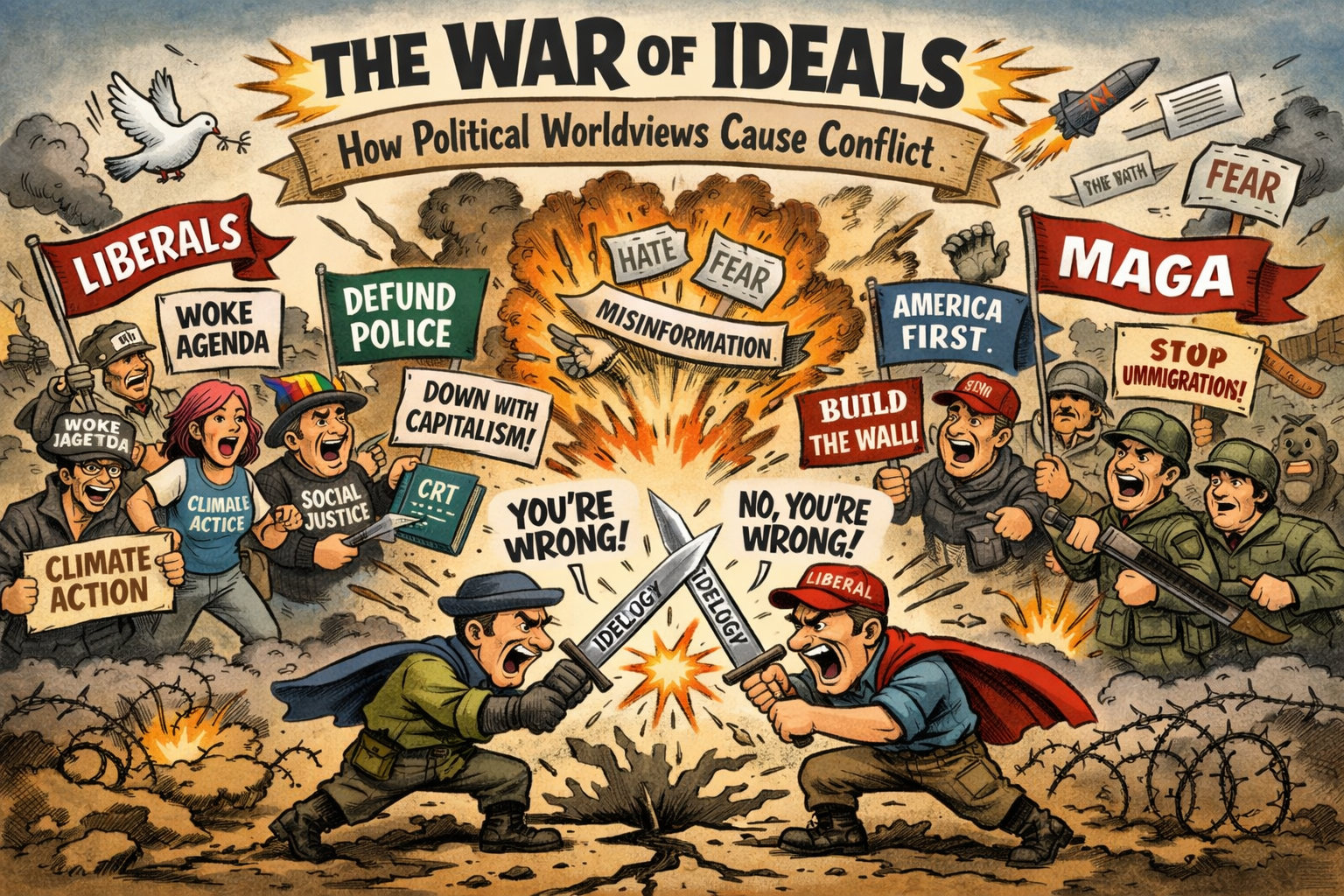
  • The War of Ideals

    The War of Ideals

    How Political Worldviews Cause Conflict


    Introduction

    In an era defined by fractured alliances and escalating rhetoric, political conflict increasingly transcends policy disputes and enters the realm of existential struggle. The 2024 U.S. presidential election offers a clear illustration, as debates over immigration, gender identity, and economic inequality often devolved into accusations that one side threatened the moral foundation of the nation. Similar dynamics are evident across Europe, where populist movements clash with supranational institutions over sovereignty, identity, and cultural preservation. These conflicts are not merely about legislation or governance. They reflect deeper disagreements over values, meaning, and the nature of social order. At their core, they represent a war of ideals.

    Political worldviews serve as the interpretive lenses through which individuals and societies understand reality. These frameworks shape perceptions of justice, authority, human nature, and progress, influencing how people define legitimacy and threat. When competing worldviews collide, compromise becomes difficult because the dispute is no longer transactional. Instead, opposing visions are seen as morally incompatible or even dangerous. What one group views as reform, another interprets as decay or tyranny. As a result, political disagreement becomes deeply personalized and emotionally charged.

    This article argues that political worldviews inevitably generate conflict by constructing incompatible moral realities, intensifying threat perceptions, and legitimizing defensive or aggressive actions. Unlike resource-based conflicts, which can often be resolved through negotiation or division, worldview conflicts strike at the core of identity and meaning. The article first defines political worldviews and their key dimensions. It then examines the mechanisms that transform ideological differences into antagonism. Historical and contemporary cases illustrate why these conflicts are persistent and resistant to resolution, followed by an exploration of guardrails that can reduce escalation without suppressing pluralism.

    The Brooks Brief Substack is a reader-supported publication. To receive new posts and support my work, consider becoming a free or paid subscriber.

    What Are Political Worldviews?

    Political worldviews are comprehensive belief systems that integrate values, assumptions, and prescriptions for how society should be organized. They extend beyond partisan affiliation or discrete policy preferences, functioning instead as cognitive maps that guide interpretation of events and moral judgment. Through these maps, individuals assess what is fair, legitimate, or dangerous in political life. Worldviews shape not only opinions but also emotional responses to social change. They define who belongs, who threatens the group, and what outcomes are acceptable. As such, they are foundational to political behavior.

    At the center of every political worldview are answers to fundamental questions about human nature and power. Some worldviews emphasize human perfectibility, arguing that injustice stems from flawed institutions that can be corrected through reform and education. Others stress inherent human limitations, asserting that order, tradition, and authority are necessary to restrain chaos. These assumptions directly influence attitudes toward governance. A state may be viewed as a neutral referee, a redistributor of opportunity, or a moral guardian depending on the worldview embraced.

    Worldviews also differ in their orientation toward change and inclusion. Progressive worldviews often prioritize adaptation, innovation, and expansion of rights to marginalized groups. Conservative worldviews tend to emphasize continuity, stability, and the preservation of inherited norms. Similarly, universalist perspectives extend moral concern across borders, while particularist perspectives prioritize national, cultural, or communal loyalty. These differences are not easily reconciled because they involve competing definitions of virtue and responsibility. As a result, policy debates become symbolic battles over identity rather than pragmatic problem solving.

    Crucially, worldview clashes differ from ordinary ideological disagreements. Policies such as tax rates or regulatory frameworks can be debated using shared empirical standards. Worldviews, by contrast, attach moral meaning to those policies. Inequality may be seen either as systemic injustice or as an inevitable outcome of individual variation. These interpretations create mutual incomprehension rather than simple disagreement. Opponents are not just wrong but morally alien.

    Core Mechanisms: How Worldviews Produce Conflict

    The transformation of worldview diversity into open conflict occurs through several reinforcing mechanisms. One of the most significant is moral absolutism, which frames political goals as zero-sum struggles between good and evil. When equality is perceived as incompatible with merit, or secularism as hostile to faith, compromise is seen as surrender. This framing eliminates middle ground by redefining disagreement as moral transgression. Political competition thus becomes existential rather than procedural. Each victory or loss takes on symbolic weight far beyond its practical consequences.

    Threat perception further intensifies conflict. Worldview-incongruent ideas are interpreted not as alternative preferences but as attacks on foundational truths. Nationalists may see global institutions as eroding sovereignty and cultural identity. Cosmopolitans, in turn, may view nationalism as a regression toward exclusion and conflict. These perceptions trigger defensive responses that escalate tension. Actions taken for self-protection are interpreted by opponents as confirmation of hostile intent.

    Psychological dynamics amplify these effects. In-group favoritism strengthens loyalty within ideological communities while facilitating out-group dehumanization. Political opponents are labeled with moralized terms such as extremists or enemies of the people. Group polarization intensifies views within echo chambers, pushing individuals toward more extreme positions. At the same time, epistemological closure undermines shared standards of truth, as different worldviews rely on incompatible sources of authority and evidence.

    Social and technological factors reinforce these patterns. Algorithm-driven media environments sort individuals into ideologically homogeneous networks. Exposure to opposing views becomes rare and adversarial, often mediated through caricature. Feedback loops develop in which outrage is rewarded with attention and status. Over time, these dynamics normalize hostility and reduce incentives for moderation.

    Elite rhetoric plays a critical role in sustaining these mechanisms. Political leaders and media figures often exploit worldview divisions for mobilization and power. By portraying opponents as existential threats, elites consolidate support while deepening polarization. This strategy creates self-fulfilling prophecies, as mutual distrust makes cooperation increasingly unlikely. The result is a political environment primed for escalation.

    Historical Examples of Worldview-Driven Conflicts

    History provides numerous examples of conflicts rooted in incompatible worldviews. The Cold War stands as a defining case of ideological confrontation shaping global politics. Liberal democracy, grounded in individual rights and market economies, clashed with Marxist-Leninist communism’s collectivist vision of class struggle and state control. Each side viewed the other as a fundamental threat to human progress. This ideological rivalry manifested in proxy wars, arms races, and global propaganda campaigns. The conflict persisted for decades because neither side could concede without undermining its moral foundation.

    Earlier periods reveal similar patterns. The European Wars of Religion in the sixteenth and seventeenth centuries were driven by competing theological worldviews intertwined with political authority. Protestant and Catholic factions justified violence as obedience to divine truth. The Thirty Years’ War devastated large portions of Europe, demonstrating how absolutist belief systems can prolong and intensify conflict. Compromise was difficult because doctrinal concessions were equated with spiritual betrayal. Political settlements only emerged after exhaustion rather than reconciliation.

    The twentieth century witnessed further worldview-driven catastrophes. Fascism, liberalism, and communism offered rival visions of human destiny, each claiming exclusive legitimacy. World War II represented not only a military struggle but a moral confrontation over authority, equality, and identity. Totalitarian regimes mobilized populations by framing conflict as necessary for survival and renewal. The scale of destruction reflected the depth of ideological commitment on all sides.

    Revolutionary movements also illustrate the dynamic. The French Revolution pitted radical egalitarianism against monarchist traditionalism, leading to cycles of violence such as the Reign of Terror. Anti-colonial struggles similarly involved clashes between imperial hierarchies and modernist visions of self-determination. These cases show how worldview conflicts often transcend borders, drawing in allies and spreading through ideological contagion. Once activated, they reshape international systems.

    Contemporary Manifestations

    In the contemporary era, worldview conflicts are pervasive across domestic politics. In many democracies, populist nationalism confronts progressive cosmopolitanism in battles over identity, culture, and authority. Immigration debates exemplify this divide, with one side emphasizing humanitarian obligation and the other stressing social cohesion and sovereignty. Economic policy, climate change, and education are similarly framed as moral struggles rather than technical issues. These disputes increasingly define political identity and affiliation.

    Cultural and identity politics further intensify polarization. Debates over race, gender, and historical memory are framed as contests between inclusion and tradition. For some, expanding recognition corrects long-standing injustices. For others, it represents an erosion of shared norms and social stability. These opposing interpretations fuel culture wars that spill into institutions, media, and workplaces. The result is a political environment saturated with symbolic conflict.

    On the international stage, worldview competition shapes geopolitical rivalry. The liberal international order, promoted by Western alliances, faces challenges from authoritarian nationalism. Russia’s invasion of Ukraine was justified in ideological terms, framed as resistance to Western moral decay and geopolitical expansion. China’s governance model emphasizes state-centric harmony and collective stability over liberal individualism. These competing visions collide in global institutions, trade regimes, and security arrangements.

    Digital media accelerates and globalizes these conflicts. Algorithms amplify emotionally charged content that reinforces existing beliefs. Parallel information ecosystems emerge, each sustaining its own narrative of reality. Movements such as anti-vaccine activism or transnational protest campaigns demonstrate how worldview lenses shape interpretations of facts. Local disputes can rapidly become global flashpoints, magnifying their impact.

    Why Worldview Conflicts Are Especially Difficult to Resolve

    Worldview conflicts are uniquely resistant to resolution because they are rooted in identity. Unlike material interests, which can be negotiated or divided, core beliefs define who individuals understand themselves to be. Conceding on such beliefs feels like moral surrender or self-erasure. A conservative may view compromise on social norms as abandoning truth. A progressive may see restraint as complicity in injustice. These perceptions make bargaining emotionally and psychologically costly.

    Escalation is built into the structure of worldview conflict. Actions taken by one side to defend its values are interpreted by the other as confirmation of hostile intent. This dynamic fuels mutual radicalization, as moderation appears naive or dangerous. Over time, positions harden and trust erodes. Political systems become locked in cycles of retaliation and obstruction.

    The erosion of shared reality further complicates resolution. Distrust in institutions, experts, and media undermines the possibility of fact-based dialogue. Each worldview develops its own criteria for truth and legitimacy. Evidence is selectively accepted or rejected based on narrative fit. Without common epistemic ground, persuasion becomes nearly impossible.

    Compared to resource-based disputes, worldview conflicts rarely offer win-win outcomes. Territorial or economic conflicts can be resolved through partition or compensation. Worldview wars, by contrast, demand conversion, dominance, or suppression. This structural rigidity makes them prone to stalemate, fragmentation, or violence. Resolution often comes only through exhaustion or external shock.

    Thanks for reading The Brooks Brief Substack! This post is public so feel free to share it.

    Share

    Conclusion: Beyond the War of Ideals?

    Acknowledging the inevitability of worldview diversity is essential for democratic resilience. Attempts to eliminate ideological difference risk authoritarianism and intellectual stagnation. Yet unmanaged conflict threatens social cohesion and political stability. The challenge is not to end the war of ideals but to contain its destructive potential. Effective guardrails can allow rivalry without collapse.

    Institutional design plays a critical role. Federalism, power-sharing arrangements, and independent courts can diffuse conflict by preventing total domination by any single worldview. These structures force cooperation while protecting minority perspectives. Similarly, strong civic norms and procedural fairness can sustain legitimacy even amid deep disagreement. Institutions matter most when trust is scarce.

    Cultural and psychological interventions are equally important. Encouraging epistemic humility can reduce moral absolutism and open space for dialogue. Cross-cutting identities, such as shared civic service or economic interdependence, weaken ideological silos. Exposure to diverse perspectives in non-adversarial settings can humanize opponents. These measures do not erase disagreement but soften its edges.

    Elite responsibility is decisive. Leaders who de-escalate rhetoric and model restraint can shift incentives away from polarization. By framing conflict as manageable rather than existential, they reduce the appeal of zero-sum narratives. Ultimately, societies must learn to channel ideological tension into debate rather than destruction. If managed wisely, the clash of worldviews can serve as a catalyst for renewal rather than a prelude to rupture.

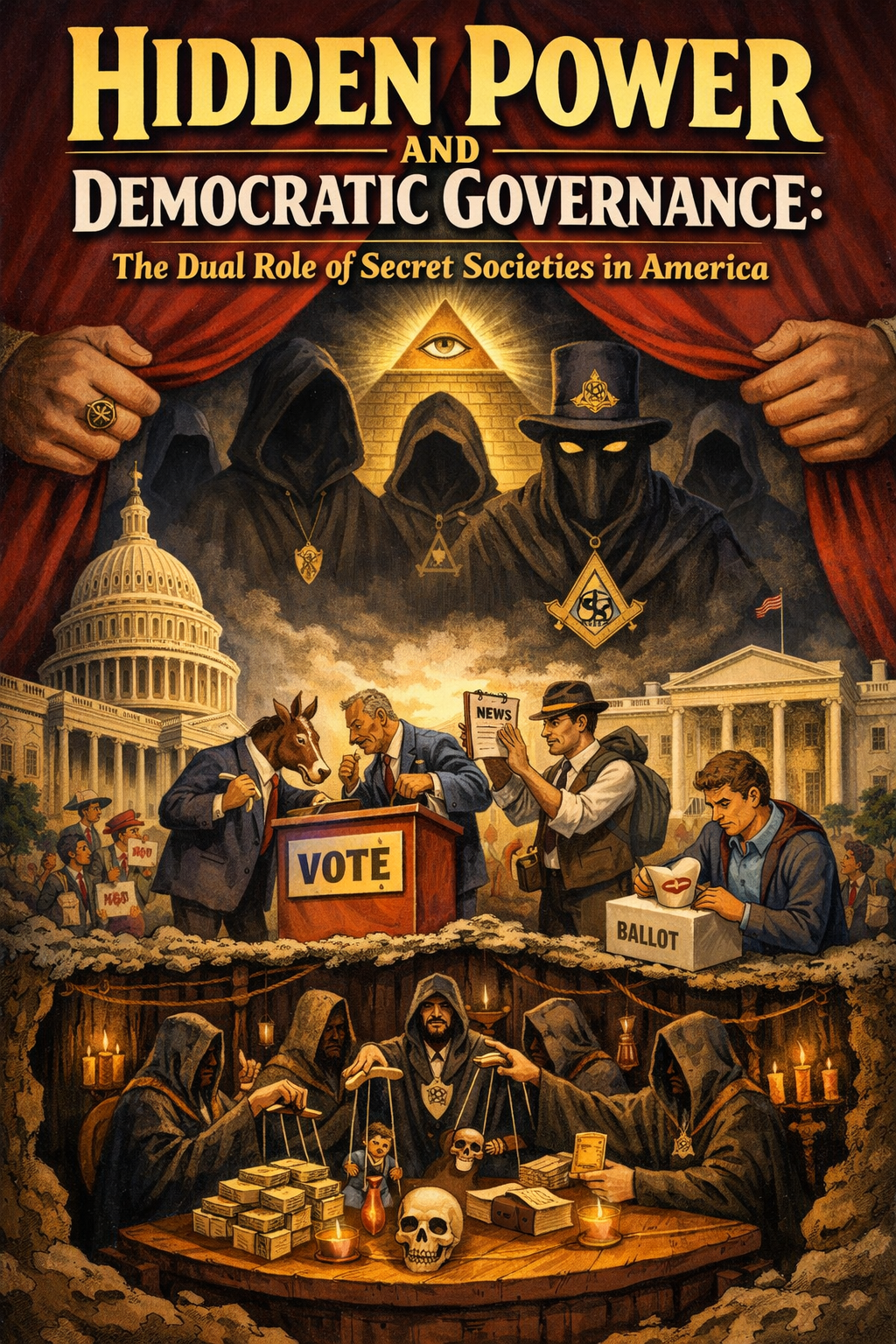
  • Hidden Power and Democratic Governance

    Hidden Power and Democratic Governance

    The Dual Role of Secret Societies in America


    Introduction

    In democratic systems built on transparency and public accountability, secret societies occupy an inherently paradoxical space. These organizations, defined by restricted membership, private rituals, and concealed deliberations, operate outside the formal mechanisms of democratic oversight. Groups such as the Freemasons, Skull and Bones, and the Bilderberg Group have long attracted suspicion due to their secrecy and concentration of elite influence. Critics often portray them as shadowy actors manipulating political outcomes behind closed doors. At the same time, supporters argue that these societies have historically contributed to civic engagement, innovation, and leadership development. This tension places secret societies at the center of enduring debates about power, legitimacy, and democratic norms.

    The presence of secret societies challenges a core democratic principle: that political authority derives from the informed consent of the governed. When influential actors coordinate privately, citizens are left unable to evaluate motivations, alliances, or conflicts of interest. This opacity can weaken trust in institutions, especially during periods of political polarization or economic inequality. Yet secrecy itself is not inherently antidemocratic, as democratic governments routinely rely on confidentiality in diplomacy, intelligence, and crisis management. The critical issue lies in whether secrecy serves the public interest or entrenches private power. Understanding this distinction is essential for evaluating the democratic implications of secret societies.

    This article argues that secret societies represent both a threat and a potential asset to democracy. Their closed nature can undermine accountability, reinforce elite dominance, and distort policymaking. Simultaneously, their networks have at times facilitated reform, innovation, and coordination that formal institutions struggled to achieve. Drawing on American political history, this analysis explores how secret societies have shaped democratic governance from the nation’s founding to the present. By examining both their dangers and contributions, the article seeks to inform contemporary policy debates on transparency, ethics, and power.

    The Brooks Brief Substack is a reader-supported publication. To receive new posts and support my work, consider becoming a free or paid subscriber.

    Historical Overview of American Secret Societies

    Secret societies in the United States predate the nation itself and are deeply intertwined with its revolutionary origins. Many early American leaders were influenced by Enlightenment ideals that emphasized reason, civic virtue, and fraternity. Freemasonry, in particular, provided a structured environment for exchanging political ideas under British colonial rule. George Washington’s initiation into Freemasonry in 1752 exemplified this connection between fraternal secrecy and emerging republican values. Masonic principles of moral conduct and civic duty aligned with the aspirations of the revolutionary generation. These lodges offered a trusted space for coordination during a period when open dissent carried significant risks.

    The influence of secret societies continued into the early republic and the drafting of its institutions. Prominent figures such as Benjamin Franklin and Paul Revere used fraternal networks to circulate ideas about liberty, governance, and resistance to tyranny. Symbolically, Washington’s participation in a Masonic ceremony at the laying of the U.S. Capitol cornerstone in 1793 reflected the integration of private associations into public life. While these societies did not directly govern, their interpersonal networks shaped leadership norms and political culture. At this stage, secrecy functioned less as manipulation and more as protection in a volatile political environment. Nevertheless, it established a precedent for elite coordination outside formal democratic structures.

    As the United States expanded, secret societies diversified in purpose and impact. The nineteenth century witnessed the rise of organizations that used secrecy to advance exclusionary or reactionary agendas. The Know Nothing movement exploited clandestine organization to mobilize nativist sentiment and influence elections. Even more damaging was the Ku Klux Klan, which weaponized secrecy to terrorize communities and undermine Reconstruction reforms. These examples demonstrated how hidden power could directly suppress democratic participation. They also fueled public backlash, reinforcing American skepticism toward secretive political organizations.

    Elite secret societies persisted into the twentieth century, particularly within academic and professional institutions. Groups such as Skull and Bones at Yale University cultivated lifelong networks among future leaders in government, finance, and media. Alumni included presidents, cabinet officials, and intelligence leaders, intensifying concerns about concentrated influence. Similarly, organizations like the Bohemian Club and later the Bilderberg Group facilitated informal interactions among global elites. While these forums lacked formal authority, their ability to shape consensus raised questions about accountability. Over time, secret societies became symbols of both elite continuity and democratic unease.

    This unease was powerfully articulated by President John F. Kennedy in 1961, when he warned against the corrosive effects of excessive secrecy. Speaking during the Cold War, Kennedy acknowledged the need for confidentiality in national security while cautioning against secret oaths and hidden proceedings. His remarks reflected a broader American tradition of suspicion toward unaccountable power. They also underscored the enduring dilemma faced by democracies navigating secrecy in an interconnected world. This historical tension continues to shape contemporary debates over transparency and influence.

    Threats Posed by Secret Societies to Democracy

    The most significant threat posed by secret societies is their inherent lack of transparency. Democratic governance relies on public scrutiny to ensure accountability and legitimacy. When decisions or alliances are formed behind closed doors, citizens cannot evaluate whether leaders are acting in the public interest. This secrecy creates opportunities for corruption, favoritism, and policy capture. It also undermines the principle of equal political participation by privileging insiders over the broader electorate. Over time, such dynamics erode trust in democratic institutions.

    Secret societies can also create conflicts of loyalty for public officials. Membership in organizations that require oaths or exclusive commitments raises questions about competing obligations. Elected leaders are accountable to voters, yet secret affiliations may influence their judgment or priorities. Even the perception of divided loyalty can damage democratic credibility. When citizens suspect that decisions are shaped by hidden networks rather than public debate, cynicism flourishes. This perception alone can weaken democratic cohesion, regardless of whether misconduct occurs.

    Elite exclusivity further compounds these challenges. Many secret societies draw members from privileged social, economic, or educational backgrounds. This reinforces existing inequalities and limits access to political influence. Historically, such exclusivity has marginalized women, racial minorities, and lower income groups. The Ku Klux Klan represents an extreme example of secrecy used to enforce racial hierarchy and suppress voting rights. While modern elite societies differ in form, concerns about disproportionate influence remain salient.

    The influence of secret societies extends beyond national boundaries, introducing additional democratic risks. Transnational organizations composed of political and economic elites can shape global policy agendas without public oversight. Groups like the Trilateral Commission or similar forums may advocate for policies that prioritize market stability or corporate interests over democratic accountability. In an era of globalization, these dynamics can dilute national sovereignty and democratic choice. Citizens may feel disconnected from decisions that affect their livelihoods but are made in opaque international settings.

    Finally, secrecy can fuel misinformation and conspiracy thinking. When organizations refuse transparency, speculation fills the void. Historical episodes such as the Anti Masonic movement of the 1820s illustrate how distrust can escalate into political instability. In the modern media environment, secrecy amplifies polarization and undermines shared reality. Thus, even absent malicious intent, secret societies can unintentionally damage democratic discourse.

    Positive Contributions Provided by Secret Societies to Democracy

    Despite their risks, secret societies have at times contributed positively to democratic development. Historically, they have served as incubators for ideas and leadership during periods of political constraint. Freemasonry’s emphasis on education, civic responsibility, and moral conduct influenced early American reform movements. Members supported initiatives such as public education, charitable institutions, and gradual abolitionist efforts. In this context, secrecy provided protection rather than domination. It allowed reformist ideas to mature before entering public debate.

    Secret societies can also facilitate innovation by creating spaces for candid discussion. In formal political settings, leaders are often constrained by partisanship, media scrutiny, and electoral pressures. Private forums enable policymakers, scholars, and business leaders to explore unconventional solutions without immediate political cost. Organizations like the Bilderberg Group exemplify this function by fostering informal dialogue on complex global issues. While controversial, such exchanges can reduce misunderstandings and encourage long term strategic thinking. When aligned with democratic values, these discussions can complement public institutions.

    Another potential asset lies in elite coordination during periods of institutional paralysis. Democracies sometimes struggle to address urgent challenges due to polarization or procedural gridlock. Networks of influential actors can mobilize resources, expertise, and political will more rapidly than formal mechanisms allow. Philanthropic initiatives linked to elite societies have funded scientific research, environmental conservation, and public health efforts. These contributions can strengthen democratic resilience by addressing social needs that governments neglect or delay.

    In authoritarian or transitional contexts, secret societies may play a protective role for democratic ideals. By operating discreetly, reform minded elites can resist repression and coordinate opposition. Historical examples from both American and global contexts show that secrecy can shield activists from retaliation. While this function is less relevant in stable democracies, it highlights secrecy’s conditional value. The democratic impact depends not on secrecy itself, but on the purposes it serves.

    Ultimately, the benefits of secret societies emerge when their influence aligns with public accountability and ethical responsibility. When secrecy protects deliberation rather than power accumulation, it can enhance governance. The challenge lies in ensuring that these organizations complement democratic institutions rather than supplant them.

    Balancing Threats and Assets: Policy Recommendations

    Addressing the democratic implications of secret societies requires a balanced policy approach. Blanket prohibition would violate freedoms of association and expression. Instead, transparency measures should focus on public accountability for those in positions of authority. Requiring elected officials and senior appointees to disclose affiliations with secret societies would allow voters to assess potential conflicts of interest. Disclosure does not eliminate secrecy, but it reduces the risk of hidden influence.

    Ethical standards within secret societies should also be encouraged. Organizations that claim civic purpose can adopt internal codes aligning their activities with democratic norms. Prohibitions on direct political manipulation or undisclosed lobbying would help mitigate risks. Think tanks, academic institutions, and civil society groups can promote best practices through research and public engagement. By setting expectations, society can distinguish benign associations from harmful ones.

    Public education plays a critical role in reducing fear and misinformation. Teaching the historical context of secret societies can demystify their role in political development. Informed citizens are less susceptible to conspiracy narratives and more capable of nuanced judgment. Media literacy initiatives can further improve democratic discourse by encouraging critical evaluation of claims about hidden power. Transparency paired with education strengthens trust without sacrificing pluralism.

    Given the transnational nature of many elite networks, international cooperation is also essential. Democratic governments and research institutions should collaborate to monitor cross border influence on policymaking. Shared standards for transparency and ethics can reduce the risk of unaccountable global governance. Such cooperation reinforces democratic norms in an increasingly interconnected world.

    Thanks for reading The Brooks Brief Substack! This post is public so feel free to share it.

    Share

    Conclusion

    Secret societies have occupied a complex position within American democracy since its founding. From revolutionary era Freemasonry to modern elite networks, they have shaped political culture in both constructive and corrosive ways. Their secrecy poses genuine threats to transparency, equality, and public trust. At the same time, their capacity for coordination, innovation, and reform has at times strengthened democratic governance. The challenge for modern democracies is not to eliminate secrecy entirely, but to regulate its relationship to power.

    A healthy democracy requires vigilance against unaccountable influence while preserving freedom of association. Transparency, ethical oversight, and informed public discourse are essential tools in this effort. When secrecy serves deliberation and reform, it can complement democratic institutions. When it shields power from accountability, it undermines them. Navigating this tension will remain a defining challenge as democratic societies confront both internal inequality and global complexity.

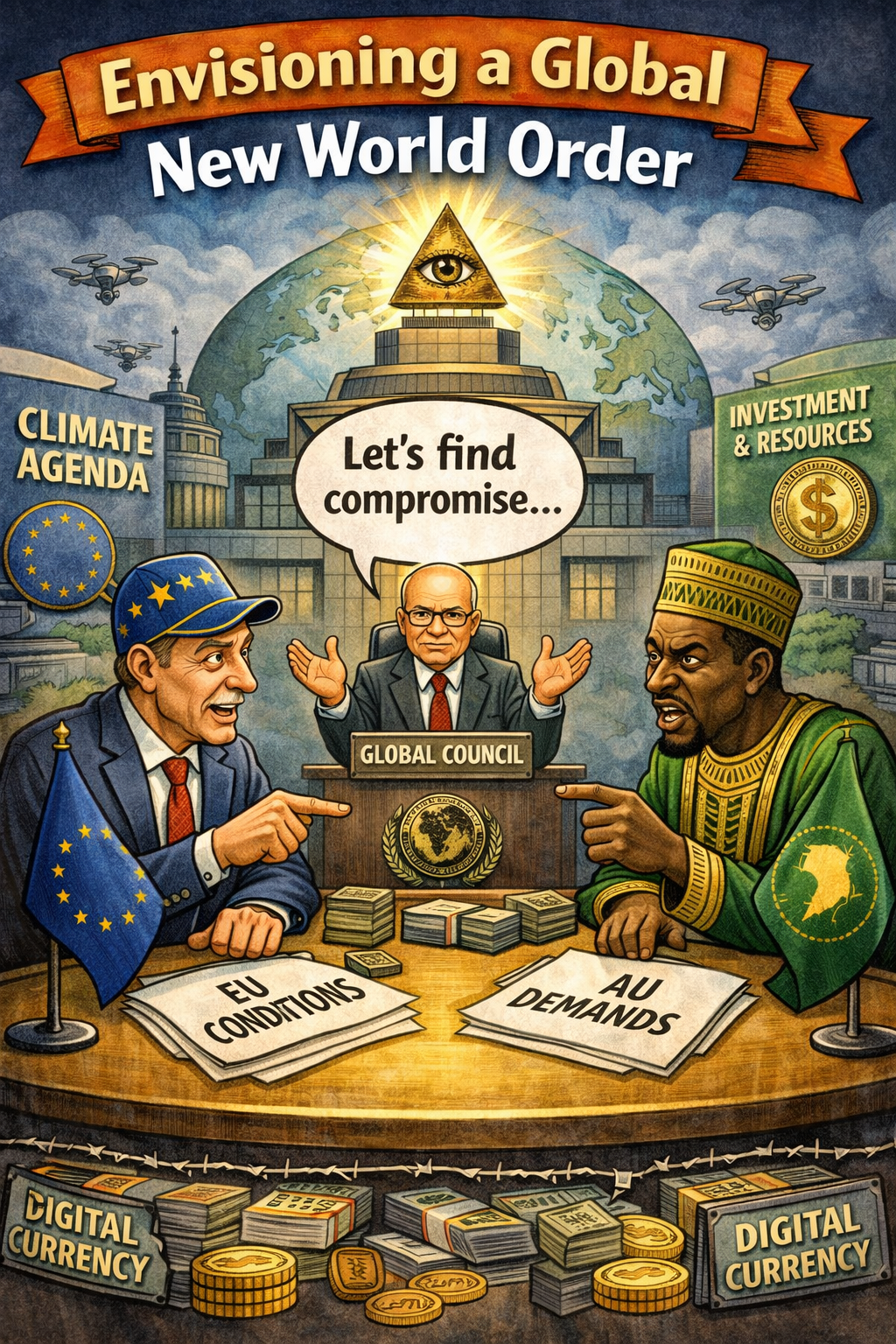
  • Envisioning a Global New World Order

    Envisioning a Global New World Order

    Regional Unions and the Reform of International Governance


    Executive Summary

    The international system is undergoing a profound transition as traditional power structures struggle to reflect contemporary geopolitical realities. Institutions such as the United Nations Security Council increasingly face criticism for their rigidity, limited representativeness, and inability to respond effectively to global crises. As emerging powers gain influence and longstanding powers experience relative decline, the gap between global governance mechanisms and global realities continues to widen. This analysis argues that without structural reform, existing institutions risk losing legitimacy and relevance. A new framework is therefore required to address collective action problems in an increasingly fragmented international environment.

    This paper proposes a multipolar global order anchored in regional unions formed primarily through geographic proximity. Such unions are better positioned to manage shared economic, security, environmental, and infrastructural challenges because physical closeness reduces coordination costs and strengthens mutual accountability. Drawing from existing examples such as the European Union and the African Union, the analysis demonstrates that proximity-based cooperation enhances resilience and policy coherence. These regional blocs can aggregate national interests into unified positions, amplifying their influence on the global stage. Rather than replacing the nation-state, this model embeds sovereignty within layered governance structures.

    At the global level, the study envisions a reformed Global Council that integrates regional unions into international decision-making. This body would reduce overreliance on veto power, promote majority-based governance, and better reflect demographic and economic realities. While the system may introduce additional deliberation and institutional complexity, it offers a more equitable and adaptive form of global governance. Policy recommendations emphasize supporting organic regional integration and pursuing incremental but meaningful reforms to the United Nations system. Together, these steps provide a pragmatic pathway toward sustainable peace, stability, and shared prosperity.

    The Brooks Brief Substack is a reader-supported publication. To receive new posts and support my work, consider becoming a free or paid subscriber.

    I. Introduction to a Global New World Order

    The international order established after World War II was designed to prevent large-scale conflict and promote cooperation among major powers. While this framework achieved notable successes, it is increasingly ill-suited to address twenty-first-century challenges such as climate change, pandemics, cyber warfare, and economic volatility. Power has become more diffuse, with influence spreading across regions rather than remaining concentrated among a few dominant states. As a result, governance structures based on mid-twentieth-century realities struggle to maintain credibility. A reimagined global order must therefore account for multipolarity as a permanent condition rather than a temporary disruption.

    At the core of this emerging order is the concept of regional unions grounded in geographic proximity. Physical closeness facilitates cooperation on issues that transcend borders, including migration, infrastructure development, environmental protection, and security coordination. Neighboring states often share supply chains, ecosystems, and risk exposure, making collaboration both practical and necessary. Proximity also fosters repeated interactions that build trust and institutional familiarity over time. These dynamics make geographically anchored unions a logical foundation for renewed global governance.

    Importantly, this vision does not call for the dismantling of existing international institutions. Instead, it advocates for their evolution to reflect new patterns of power and cooperation. Regional unions would serve as intermediaries between nation-states and global institutions, translating local priorities into collective global action. This layered approach mitigates unilateralism while preserving national autonomy. In doing so, it offers a balanced framework capable of addressing global fragmentation without imposing uniformity.

    II. Critique of the Current UN Framework

    The United Nations Security Council remains one of the most visible symbols of institutional stagnation in global governance. Its permanent membership and veto structure reflect the power balance of 1945 rather than present-day economic, demographic, or political realities. Emerging powers in Asia, Africa, and Latin America remain underrepresented, despite their growing influence on global outcomes. This imbalance has fueled perceptions of inequity and exclusion, particularly among states in the Global South. As a result, the Council’s legitimacy has increasingly been called into question.

    The veto power held by the five permanent members has repeatedly obstructed collective action on urgent international crises. Conflicts involving major power interests frequently result in deadlock, preventing timely responses to humanitarian emergencies. While the number of vetoes has fluctuated in recent years, their strategic use continues to undermine the Council’s effectiveness. The structure enables powerful states to shield allies and pursue narrow interests at the expense of collective security. This dynamic weakens trust in multilateralism and encourages alternative forms of cooperation outside the UN framework.

    Compounding these issues is the long-term uncertainty surrounding the relative power of current permanent members. Demographic decline, economic stagnation, and internal polarization threaten to erode their global influence over time. Yet the institutional design of the Security Council locks in their dominance regardless of future shifts. Proposed reforms, such as limiting veto use in cases of mass atrocities or requiring multiple vetoes for obstruction, have gained rhetorical support but little practical traction. Consequently, alternative governance models, including proximity-based regionalism, are increasingly viewed as necessary complements to a stalled UN system.

    III. The Probable Formation of Regional Unions Based on Proximity

    Regional unions are most likely to emerge along geographic lines because proximity enhances functional cooperation. Shared borders and regional ecosystems create mutual dependencies that distant alliances cannot easily replicate. Trade corridors, energy networks, and transportation infrastructure are more efficient when coordinated regionally. Cultural familiarity and historical interaction further facilitate institutional development. These factors make geographic proximity a natural foundation for deeper integration.

    The European Union remains the most advanced example of proximity-driven regional integration. Its member states have developed shared policies across economic, regulatory, and political domains, demonstrating the potential of sustained cooperation. In North America, the USMCA reflects a similar logic by binding neighboring economies through trade and investment frameworks. Africa has pursued continental integration through the African Union and the African Continental Free Trade Area, seeking to enhance intra-African trade and collective bargaining power. Recent initiatives have focused on youth employment, conflict mediation, and economic resilience.

    Other regions exhibit emerging forms of proximity-based cooperation. In South America, MERCOSUR has deepened economic ties among neighboring states and expanded external trade relationships. These efforts could eventually evolve into broader political coordination to address environmental protection and regional security. In the Middle East, subregional groupings such as the Gulf Cooperation Council reflect attempts to manage shared security and economic concerns. Southeast Asia’s ASEAN further reinforces the pattern of regional clustering as a response to global uncertainty. Collectively, these developments suggest that proximity-based unions are becoming a defining feature of the international landscape.

    IV. Structure and Role of a Global Council

    A reformed Global Council would serve as the apex institution in a proximity-based international order. Unlike the current Security Council, representation would be organized around states and regional unions rather than individual states alone. Seats could be allocated based on population, economic output, or regional size, ensuring more equitable participation. Smaller states would gain influence through collective representation rather than being marginalized. This structure would better align decision-making authority with global realities.

    Decision-making within the Council would rely on majority or supermajority voting rather than unilateral vetoes. Such a system would reduce paralysis while still protecting minority interests through procedural safeguards. The Council’s mandate would include conflict resolution, norm enforcement, and coordination on transnational challenges such as climate change and global health. Regional unions would propose agendas and policy initiatives, integrating local perspectives into global deliberations. Final authority, however, would rest with the Council to ensure coherence and consistency.

    By institutionalizing regional input, the Global Council would bridge the gap between local concerns and global governance. It would transform regional cooperation into a formal pillar of the international system rather than an informal alternative. This approach balances inclusivity with efficiency, reducing the incentives for unilateral action. Over time, it could restore confidence in multilateral governance by demonstrating tangible results. The Council would thus function as both a coordinator and an arbiter in a multipolar world.

    V. Challenges Introduced by Proximity-Based Regional Unions

    Despite their advantages, proximity-based regional unions are not without challenges. Historical rivalries, territorial disputes, and resource competition can complicate integration efforts. Internal disagreements may slow decision-making and increase bureaucratic complexity. In regions with deep-seated political or sectarian divisions, cooperation may remain fragile. These dynamics risk undermining the effectiveness of regional institutions if left unaddressed.

    Regional tensions are particularly pronounced in areas with unresolved conflicts or weak governance structures. In the Middle East, sectarian divisions and overlapping crises complicate collective action. In South America, border disputes and domestic political volatility can strain regional consensus. Even in more stable regions, economic disparities among member states can generate friction. These challenges highlight the need for robust mediation and institutional capacity.

    A Global Council would play a critical role in managing these tensions. By acting as an impartial mediator, it could channel regional disputes into structured diplomatic processes. Sanctions, incentives, or arbitration mechanisms could be employed to enforce compliance with collective decisions. Over time, external oversight may encourage deeper integration by reducing the costs of cooperation. In this way, challenges become catalysts for institutional maturation rather than barriers to progress.

    VI. Preservation and Enhancement of National Sovereignty

    A proximity-based global order preserves national sovereignty through the principle of subsidiarity. Domestic affairs remain under the authority of individual states, while regional unions address shared local challenges. Global institutions intervene only on issues that transcend regional boundaries. This layered governance model respects national autonomy while promoting cooperation. It counters fears that integration inevitably erodes state sovereignty.

    For smaller states, regional unions provide a pathway to influence without sacrificing independence. Collective bargaining enhances their negotiating power in global forums. Participation in regional institutions also strengthens administrative capacity and policy coordination. Rather than being dominated by larger powers, smaller states benefit from rules-based cooperation. This framework creates a more balanced and inclusive international environment.

    In the long term, the system constrains unilateralism by declining powers while enabling peaceful power transitions. Sovereignty is no longer defined by isolation but by effective participation in cooperative structures. Multipolarity becomes a stabilizing force rather than a source of conflict. By embedding sovereignty within shared institutions, the global order adapts to changing power dynamics. This approach strengthens both national and collective resilience.

    VII. Implementation Path and Vision

    The transition to a proximity-based global order would be gradual and incremental. Initial steps include strengthening existing regional unions through technical assistance, financial support, and institutional capacity-building. Expanding trade agreements and policy coordination within these unions would build momentum. Simultaneously, reforms within the United Nations could formally recognize regional blocs as key stakeholders. These measures would lay the groundwork for broader institutional transformation.

    Over time, a treaty-based Global Council could be established to integrate regional unions into global governance. This body could initially operate alongside the Security Council before assuming expanded responsibilities. Incremental reforms would reduce resistance from entrenched interests while demonstrating practical benefits. Pilot initiatives on climate coordination or conflict mediation could showcase the model’s effectiveness. Success in these areas would build political support for deeper reform.

    The long-term vision is a dynamic international system composed of natural regional clusters under shared global oversight. Such an order would reduce hegemonic dominance while enhancing equity and representation. By aligning governance structures with geographic and political realities, it would foster sustainable development and conflict prevention. By 2030, this framework could significantly improve global coordination on shared challenges. Ultimately, proximity-based governance offers a pragmatic and resilient pathway toward a more balanced world order that can enforce international law.

  • America’s Crumbling Infrastructure

    America’s Crumbling Infrastructure

    A Historical Reckoning and Path to Renewal


    I. Introduction

    In the shadow of rusting bridges and congested highways, America’s infrastructure stands as a stark reminder of faded national ambition. Recent incidents, including the partial collapse of the Francis Scott Key Bridge in Baltimore in 2024, underscore the fragility of systems once celebrated as engineering triumphs. While the United States pioneered infrastructure that fueled industrial growth and global leadership, decades of deferred maintenance have left these systems vulnerable. The American Society of Civil Engineers awarded U.S. infrastructure a cumulative grade of C in its 2025 report, the highest score since assessments began yet still emblematic of mediocrity. This paradox reflects incremental progress without structural transformation. As peer nations accelerate modernization, the United States risks falling further behind.

    This analysis traces the historical arc of American infrastructure from its innovative peaks to its contemporary decline. It situates domestic stagnation within a global context where countries such as China and the United Arab Emirates pursue ambitious, state-backed development strategies. Politically, the erosion of infrastructure presents an urgent bipartisan challenge, particularly as demographic shifts and remote work redefine urban utility. The future of infrastructure can no longer be measured by scale alone but by resilience, adaptability, and economic return. Lessons from history suggest that renewal is possible, but only with sustained political will. Without decisive action, the costs of inaction will compound.

    The Brooks Brief Substack is a reader-supported publication. To receive new posts and support my work, consider becoming a free or paid subscriber.

    II. Historical Overview of American Infrastructure

    America’s infrastructure story began with bold nineteenth-century projects that unified a vast and fragmented nation. The Erie Canal, completed in 1825, dramatically reduced transportation costs and expanded commercial access between the Great Lakes and the Atlantic. Its success demonstrated how public investment could unlock private economic growth. The transcontinental railroad, completed in 1869, further accelerated national integration by connecting coasts and enabling mass migration. These projects were not merely logistical achievements but instruments of nation-building. They laid the foundation for industrial dominance.

    The industrial era expanded this momentum through urbanization and technological innovation. Landmark projects such as the Brooklyn Bridge symbolized confidence in engineering and public ambition. Electrification, sewage systems, and clean water infrastructure transformed public health and productivity in rapidly growing cities. American skyscrapers defined the global skyline, with steel-frame construction originating in Chicago. For much of the twentieth century, the United States set the benchmark for vertical and horizontal infrastructure. This dominance reinforced the nation’s economic and cultural influence.

    By the late twentieth century, however, the pace of innovation slowed. Other nations began to surpass the United States in both scale and speed of infrastructure development. State-directed investment models allowed foreign governments to execute megaprojects with fewer political constraints. While American infrastructure aged, global competitors built anew. This shift marked the beginning of a long-term divergence. The consequences are now visible across nearly every sector.

    III. The New Deal and Roosevelt’s Infrastructure Legacy

    The Great Depression exposed deep vulnerabilities in America’s physical and economic foundations. With unemployment reaching historic levels, infrastructure investment became a central tool for recovery. President Franklin D. Roosevelt’s New Deal fundamentally redefined the federal government’s role in public works. Programs such as the Works Progress Administration employed millions while constructing roads, bridges, schools, and parks across the country. These projects addressed immediate economic distress while generating long-term public value. Infrastructure became both stimulus and legacy.

    Complementary initiatives expanded the scale of federal involvement. The Public Works Administration funded large-scale projects such as dams and airports that reshaped regional economies. The Tennessee Valley Authority brought electricity, flood control, and development to historically underserved regions. Together, these programs demonstrated the capacity of coordinated federal action. They also embedded infrastructure as a cornerstone of national resilience. The physical remnants of the New Deal remain functional nearly a century later.

    Politically, the New Deal was deeply contested. Critics warned of excessive government power and fiscal recklessness. Yet the long-term returns validated the investments, as infrastructure underpinned decades of growth. The failure was not in ambition but in continuity. Subsequent generations benefited from these assets without maintaining them. Today’s deterioration reflects the absence of sustained commitment rather than the failure of the original vision.

    IV. Post-New Deal Expansion and the Onset of Decline

    Following World War II, the United States entered another era of infrastructure expansion. The Federal-Aid Highway Act of 1956 created the Interstate Highway System, transforming commerce, mobility, and suburban life. Justified in part by national defense, the system facilitated economic integration on an unprecedented scale. Airports, ports, and logistics hubs expanded alongside consumer growth. Infrastructure reinforced American dominance during the postwar boom. For several decades, investment kept pace with demand.

    By the 1970s, priorities began to shift. Inflation, energy crises, and geopolitical pressures redirected federal spending toward defense and entitlement programs. Infrastructure maintenance was increasingly deferred rather than expanded. Urban sprawl strained systems designed for smaller populations. The result was gradual but cumulative degradation. Investment no longer matched usage.

    By the early twenty-first century, underfunding had become structural. Aging water systems, outdated transit networks, and vulnerable bridges became chronic liabilities. Climate change intensified these weaknesses through extreme weather and environmental stress. High-profile failures exposed the human and economic costs of neglect. Infrastructure moved from a background asset to a visible risk. The decline was no longer theoretical but tangible.

    V. The Fiscal Constraint: How National Debt Stalls Infrastructure Until Crisis

    America’s growing national debt increasingly constrains its capacity for proactive infrastructure investment. With federal debt exceeding historic thresholds, infrastructure spending is often framed as fiscally irresponsible rather than economically necessary. This perception discourages long-term planning in favor of short-term budget containment. As interest payments consume a larger share of federal outlays, discretionary spending faces heightened scrutiny. Infrastructure, despite its proven returns, is frequently postponed. The result is a cycle of delay that increases eventual costs.

    Political leaders often treat infrastructure as optional rather than essential when debt dominates fiscal discourse. Large-scale projects are deferred until failure or catastrophe forces emergency intervention. This reactive approach leads to higher repair costs and greater disruption. Preventative investment, though cheaper over time, struggles to gain traction in debt-focused debates. The absence of immediate political payoff further weakens support. Infrastructure becomes a victim of fiscal paralysis.

    If current trends persist, the United States risks waiting too long to act. Deferred investment compounds deterioration, narrowing future options. At a certain point, systems become too obsolete to repair incrementally. Rebuilding under crisis conditions strains public trust and fiscal capacity simultaneously. Debt, rather than being managed through growth-enhancing investment, becomes a justification for inaction. By the time political consensus emerges, the opportunity for efficient renewal may have passed.

    VI. Current State and International Comparisons

    As of 2026, U.S. infrastructure remains in fragile condition despite modest improvements. Tens of thousands of bridges are structurally deficient, and congestion drains billions from the economy annually. Regional disparities exacerbate national weakness, with states like California facing seismic and climate-related risks. Incremental funding has slowed deterioration but not reversed it. The system remains vulnerable to shock. Maintenance often replaces modernization.

    International comparisons further highlight the gap. The United States lags significantly in high-speed rail, while China operates the world’s largest network with aggressive expansion plans. Japan and France demonstrate how sustained investment yields efficient, low-emission transport. In contrast, U.S. projects face regulatory delays and inconsistent funding. Ambition exists, but execution falters. The disparity reflects structural rather than technical limitations.

    Urban infrastructure also faces new pressures. Remote work has reduced demand for traditional office space, undermining municipal tax bases. Vacancies force cities to reconsider land use and economic models. Forward-looking nations have embraced adaptive reuse and smart infrastructure. American cities struggle to keep pace. The challenge is no longer just decay but relevance.

    VII. Political Implications and Paths Forward

    Infrastructure remains deeply politicized. Democrats emphasize federal leadership and equity-driven investment, while Republicans prioritize fiscal restraint and private-sector involvement. Recent legislation has advanced funding but faces expiration and renewal risks. Without continuity, progress remains fragile. Infrastructure planning requires horizons longer than election cycles. Political fragmentation undermines strategic execution.

    To reclaim leadership, policymakers must reframe infrastructure as a growth strategy rather than a liability. Public-private partnerships can leverage capital while preserving public oversight. Investment must prioritize resilience, climate adaptation, and economic return. Repurposing underused urban assets can address housing and technological needs simultaneously. These approaches require coordination rather than ideology.

    Bipartisan consensus is essential. The New Deal and Interstate Highway System succeeded because they transcended partisan boundaries. Today’s challenges demand similar unity. Infrastructure is not a partisan asset but a national one. Without cooperation, decline will continue.

    VIII. Conclusion

    America’s infrastructure once symbolized innovation, ambition, and national confidence. From canals to highways, public investment shaped prosperity and global influence. Today, aging systems, fiscal hesitation, and international competition threaten that legacy. Remote work and climate change demand new priorities rooted in utility and resilience. History shows that renewal is possible when political will aligns with public need. Without decisive action, the cost of delay will exceed the cost of investment.

  • The Epstein Enigma

    The Epstein Enigma

    Mossad’s Shadow in Global Power Plays


    I. Introduction

    The death of Jeffrey Epstein in a Manhattan jail cell in 2019 transformed an already disturbing criminal case into a global mystery. Officially ruled a suicide, the circumstances surrounding his death immediately fueled public suspicion, given Epstein’s connections to some of the most powerful figures in politics, finance, and entertainment. Revelations about his long running sex trafficking operation suggested not only criminal abuse but also a possible system for collecting leverage over influential individuals. Survivors, journalists, and investigators pointed to a pattern that went beyond personal predation and hinted at organized exploitation. This pattern raised questions about who benefited from Epstein’s access and silence. In the absence of full transparency, speculation filled the vacuum left by sealed records and limited prosecutions.

    At the center of this speculation is the theory that Epstein functioned as part of an intelligence linked blackmail operation. According to this theory, Epstein was not merely a wealthy criminal but a facilitator who gathered compromising material on elites. Proponents argue that such material could be used to influence political decisions, business deals, or foreign policy outcomes. The theory often points to Epstein’s close relationship with Ghislaine Maxwell and, by extension, her father Robert Maxwell, who has been widely reported as having ties to Israeli intelligence. While none of these claims have been definitively proven in court, they persist due to the unusual convergence of wealth, access, and impunity surrounding Epstein. The theory situates Epstein within a broader history of espionage tactics rather than viewing him as an isolated offender.

    This article examines the Mossad Epstein theory with a critical but open lens. It does not assert conclusions as established fact, but instead evaluates claims, counterclaims, and historical context. Intelligence agencies around the world have long used coercion, surveillance, and blackmail to advance national interests. Declassified documents and investigative reporting show that such practices are not fictional or unprecedented. By placing Epstein’s activities within this wider framework, the discussion moves beyond sensationalism toward analytical scrutiny. Understanding these dynamics is essential for assessing vulnerabilities within democratic systems.

    The Brooks Brief Substack is a reader-supported publication. To receive new posts and support my work, consider becoming a free or paid subscriber.

    II. Background on Jeffrey Epstein’s Network

    Jeffrey Epstein’s rise remains one of the most perplexing aspects of his story. Beginning his career as a high school teacher, he rapidly transitioned into elite financial circles without a clear explanation of his credentials or capital. By the 1990s, Epstein was presenting himself as a financier managing billions for ultra wealthy clients. Despite repeated scrutiny, he never publicly identified most of his clients, and traditional markers of financial legitimacy were often absent. This opacity fueled suspicions that his wealth derived from sources other than conventional investment activity. For critics, Epstein’s unexplained ascent suggests covert backing or patronage.

    Epstein’s properties played a central role in allegations about his operations. His private island in the U.S. Virgin Islands, Little St. James, became infamous through victim testimony and investigative reporting. Survivors described a controlled environment where abuse was normalized and monitored. Reports indicated that Epstein’s residences in New York, Florida, and elsewhere were equipped with extensive surveillance systems. Cameras, hidden rooms, and restricted areas suggested that recording activity may have been intentional rather than incidental. If true, such infrastructure would be consistent with efforts to collect compromising material.

    Equally significant were Epstein’s social connections. He maintained relationships with prominent political figures, royalty, and corporate leaders across multiple countries. Photographs, flight logs, and witness accounts placed Epstein in proximity to former presidents, foreign princes, and billionaires. While association alone does not imply criminality, intelligence operations often rely on access rather than ideology. In this context, Epstein’s network could be viewed as a pool of potential leverage. The breadth of his contacts is one reason his case continues to resonate far beyond the crimes for which he was formally charged.

    III. The Maxwell Connection: From Father to Daughter

    Robert Maxwell occupies a pivotal role in theories linking Epstein to intelligence services. A British media magnate originally from Czechoslovakia, Maxwell built a global publishing empire during the Cold War. Numerous journalists and former intelligence officials have alleged that he maintained close ties with Israeli intelligence, particularly Mossad. These claims include assertions that he assisted in arms deals and intelligence operations during the 1970s and 1980s. While Israeli officials have acknowledged a relationship, the precise nature of Maxwell’s role remains contested. Nonetheless, his proximity to intelligence circles is well documented in investigative literature.

    Maxwell’s death in 1991 only deepened the intrigue. He was found dead after falling from his yacht near the Canary Islands, with authorities ruling the incident an accident. Almost immediately, alternative theories emerged suggesting suicide or assassination. Some speculated that Maxwell was killed to prevent the exposure of financial crimes or intelligence secrets. Others pointed to the extraordinary honors he received at his funeral in Israel as evidence of deeper state ties. The unresolved questions surrounding his death mirror the ambiguity that later surrounded Epstein.

    Ghislaine Maxwell represents the bridge between her father’s world and Epstein’s operation. As Epstein’s closest confidante and later a convicted accomplice, she played a central role in recruiting and managing victims. Multiple reports suggest that she viewed Epstein’s activities through a geopolitical lens rather than a purely criminal one. Some witnesses have alleged that she exercised authority exceeding Epstein’s in aspects of the trafficking operation. Speculation persists that she inherited her father’s intelligence connections or at least understood their utility. While definitive proof is lacking, her background and behavior continue to fuel scrutiny.

    IV. Espionage Tactics: The Arsenal of Intelligence Agencies

    Intelligence agencies operate using a broad array of methods designed to collect information and exert influence. These methods often combine human intelligence with technological surveillance. Recruitment of assets, cultivation of sources, and exploitation of personal vulnerabilities are standard practices across agencies worldwide. Espionage is rarely cinematic and more often relies on mundane leverage. Understanding these tools is essential for evaluating claims about intelligence linked blackmail. Epstein’s alleged activities align with several known tactics.

    One of the most notorious methods is the honey trap. Intelligence agencies have historically used sexual relationships to compromise targets and extract information. Operatives of all genders may be deployed depending on the target’s preferences. The goal is not always immediate intelligence but the creation of long term leverage. Recorded encounters can be used to coerce cooperation years later. This approach minimizes risk while maximizing potential influence.

    Technology amplifies these strategies. Hidden cameras, intercepted communications, and data storage allow intelligence handlers to document compromising behavior with precision. Advances in encryption and digital surveillance make it easier to store and transmit sensitive material securely. Beyond technology, traditional tradecraft such as dead drops and cutouts ensures plausible deniability. While extreme methods like torture are less common in influence operations, blackmail remains a favored tool due to its efficiency. In this context, Epstein’s properties resemble potential intelligence collection sites.

    V. The Mossad Epstein Theory: Evidence and Counterarguments

    Supporters of the Mossad Epstein theory cite claims from investigative journalists and former intelligence insiders. These sources allege that Epstein was recruited or supported through Maxwell linked channels. According to this view, Epstein’s role was to gather compromising material on influential figures to advance Israeli strategic interests. Advocates argue that his immunity from prosecution for years indicates protection beyond domestic law enforcement. They also point to patterns consistent with intelligence operations rather than random criminality. While circumstantial, these claims persist due to unanswered questions.

    Opposing voices strongly reject this theory. Israeli officials and mainstream media outlets have labeled the allegations unfounded and conspiratorial. Critics emphasize the absence of direct documentary evidence linking Epstein to Mossad command structures. They warn that such narratives risk deflecting responsibility from Epstein’s crimes and veering into politicized speculation. From this perspective, Epstein is best understood as a serial abuser who exploited wealth and privilege. The lack of judicial findings connecting him to intelligence agencies remains a central weakness of the theory.

    Despite disagreement, the implications merit examination. If foreign intelligence agencies used Epstein’s network to influence U.S. or allied decision making, the consequences would be profound. Such influence could shape foreign aid, diplomatic alignments, and legislative outcomes. Even the perception of compromised officials erodes public trust. Whether or not the theory is proven, the vulnerabilities it highlights are real. Democratic systems depend on transparency and accountability to resist coercion.

    VI. The Steele Dossier: Russian Kompromat and Potential Links to Epstein

    The Steele dossier introduced the concept of kompromat into mainstream American political discourse. Compiled by former British intelligence officer Christopher Steele, the dossier alleged extensive Russian efforts to influence the 2016 U.S. election. Central to these allegations was the claim that Russia possessed compromising material on Donald Trump. Such material allegedly included recordings of sexual activity intended for blackmail. Although some elements of the dossier were corroborated, others remain unverified or disputed.

    Speculation arose about whether Russian kompromat operations overlapped with Epstein’s network. Trump’s documented social interactions with Epstein in the 1990s and early 2000s fueled these questions. Public statements praising Epstein and shared social circles added to the intrigue. However, no evidence has established a direct operational link between Russian intelligence and Epstein’s trafficking ring. The methods described in the dossier, such as hotel surveillance, differ from Epstein’s alleged use of private properties. This suggests parallel rather than coordinated operations.

    Another dimension involves Trump’s ownership of beauty pageants, including Miss Teen USA. Critics have raised concerns about whether such events could have been exploited for recruitment or exploitation by predatory actors. One Epstein accuser alleged encountering Trump through Epstein related contexts, though these claims have not resulted in proven charges. There is no established evidence that Trump knowingly used pageants for trafficking. Nonetheless, the intersection of power, access to minors, and elite networks underscores systemic risks. These controversies highlight how exploitation can occur within seemingly legitimate institutions.

    VII. Political Ramifications and Conclusion

    The broader political ramifications of blackmail networks are deeply troubling. When elected officials or influential figures are compromised, democratic decision making is distorted. Policies on national security, foreign aid, and international alliances may be shaped by coercion rather than public interest. In the Middle East context, allegations of foreign influence resonate strongly due to longstanding geopolitical tensions. Even unproven theories can undermine confidence in governance. Addressing these risks requires institutional resilience.

    Calls for transparency have intensified in the wake of Epstein’s case. Advocates argue for the release of sealed records and full investigation into potential intelligence ties. Independent oversight and international cooperation are essential to prevent similar exploitation. Failure to confront these issues invites repetition. Accountability must extend beyond individual criminals to systemic enablers. Democratic societies cannot afford complacency.

    In conclusion, the Mossad Epstein link remains speculative but cannot be dismissed without examination. The convergence of Maxwell’s documented intelligence associations, known espionage tactics, and Epstein’s unexplained operations raises legitimate questions. Adding Russian kompromat theories and elite social networks reveals a complex web of potential influence. While definitive answers remain elusive, scrutiny serves the public interest. National security depends not only on defending borders but also on safeguarding institutions from covert manipulation.

  • Raising the Minimum Wage

    Raising the Minimum Wage

    A Vote for Affordability or a Recipe for Inflation?


    I. Introduction

    In the United States in 2026, millions of Americans continue to face a persistent affordability crisis that affects nearly every aspect of daily life. Housing costs remain elevated, grocery prices strain household budgets, and healthcare and education expenses consume an increasing share of income. For many workers, wages have failed to keep pace with these rising costs, creating a widening gap between earnings and basic needs. This disconnect has become especially visible among low-wage workers who rely on hourly pay to meet essential expenses. As a result, economic insecurity has become a defining feature of the current labor market. The debate over how to address this imbalance has returned to the forefront of national policy discussions.

    At the center of this debate is the federal minimum wage, which has remained at $7.25 per hour since 2009. Over nearly two decades, inflation alone has significantly eroded the purchasing power of this wage floor. While some states and municipalities have acted independently to raise wages, federal inaction has produced a fragmented system in which a worker’s income depends heavily on geography. As of January 2026, nineteen states have enacted minimum wage increases, with several exceeding sixteen dollars per hour. These disparities have renewed questions about whether national standards are outdated and insufficient for modern economic conditions.

    From a historical perspective, the stagnation of the federal minimum wage appears even more pronounced. If the minimum wage had grown alongside inflation and labor productivity since the late 1960s, it would exceed twenty-five dollars per hour today. This gap underscores decades of wage stagnation even as worker output and corporate profitability have increased. Supporters argue that correcting this imbalance is necessary to restore fairness and economic stability. Critics counter that such increases may introduce new economic risks. This article evaluates both perspectives through empirical evidence, economic theory, and political context.

    The Brooks Brief Substack is a reader-supported publication. To receive new posts and support my work, consider becoming a free or paid subscriber.

    II. The Current Economic Landscape

    The U.S. economy in 2026 reflects a mixed recovery from the disruptions of the early 2020s. While inflation has moderated from its peak levels, prices for essential goods and services remain elevated relative to wages. Housing affordability continues to pose a major challenge, particularly for first-time buyers and renters in urban and suburban markets. In many regions, home prices would need to fall substantially to return to pre-pandemic affordability levels. Rent increases have similarly outpaced income growth, forcing households to devote a larger share of earnings to shelter. These pressures disproportionately affect lower-income workers with limited financial buffers.

    Food prices also remain a key driver of household stress. Even modest increases in grocery costs can significantly impact families living paycheck to paycheck. Minimum wage workers, who are heavily represented in retail, food service, and hospitality sectors, are especially vulnerable. A substantial portion of these workers report food insecurity or reliance on credit to cover routine expenses. Healthcare costs further compound the issue, as many low-wage jobs offer limited or no employer-sponsored insurance. Together, these factors create a cycle of economic precarity that is difficult to escape through employment alone.

    Recent state and local minimum wage increases reflect an attempt to respond to these conditions. In 2026, dozens of states, cities, and counties implemented wage hikes aimed at preserving purchasing power. These measures are often framed as necessary adjustments rather than aggressive policy shifts. However, businesses implementing these changes face their own constraints, including higher input costs and lingering supply chain disruptions. Critics argue that wage mandates risk amplifying these pressures, particularly for small businesses. The current landscape thus presents a complex tradeoff between worker relief and economic stability.

    III. Arguments in Favor of Raising the Minimum Wage

    Advocates of raising the minimum wage argue that higher wages are essential for improving affordability and economic security. Low-wage workers tend to spend a larger share of their income on necessities such as food, housing, and transportation. When wages increase, this spending can stimulate local economies through increased consumer demand. Economists often describe this as a multiplier effect, where additional income circulates through communities. Unlike tax cuts for higher earners, wage increases are more likely to produce immediate economic activity. Proponents view this as a practical tool for strengthening local and regional economies.

    Another central argument in favor of higher minimum wages is poverty reduction. Research indicates that wage increases can lift millions of workers above the poverty line. Higher earnings also reduce reliance on public assistance programs, including food aid and healthcare subsidies. This shift can ease pressure on government budgets while improving individual dignity and autonomy. From this perspective, higher wages function as both an economic and social policy. Supporters argue that the long-term fiscal benefits often outweigh short-term adjustment costs.

    Proponents also emphasize historical and structural considerations. Over decades, worker productivity has risen significantly, yet wages for low-income workers have remained largely stagnant. This divergence has contributed to income inequality and reduced social mobility. Aligning wages with productivity growth is viewed as a corrective measure rather than a radical intervention. Additional benefits cited include reduced employee turnover, higher morale, and improved health outcomes. Together, these effects suggest that higher wages may yield broader social gains beyond immediate income increases.

    IV. Arguments Against Raising the Minimum Wage

    Opponents of minimum wage increases warn that higher labor costs can contribute to inflationary pressures. Businesses facing increased payroll expenses may raise prices to maintain profitability. These price increases can offset wage gains, particularly for the same workers the policy intends to help. In sectors such as food service and retail, where profit margins are often thin, cost pass-throughs may be more pronounced. Critics argue that this dynamic risks creating a cycle in which wages and prices chase one another upward. In an economy already sensitive to inflation, such risks are viewed as significant.

    Employment effects are another major concern raised by critics. Mandated wage increases may prompt employers to reduce hours, cut positions, or accelerate automation. Entry-level and low-skilled workers are often seen as most vulnerable to these adjustments. Some studies suggest that younger workers and those with limited experience may face reduced job opportunities. Small businesses, in particular, may struggle to absorb higher labor costs without reducing staff or closing altogether. These potential outcomes raise concerns about unintended consequences for the labor market.

    From a conservative economic perspective, minimum wage laws are often framed as government overreach. Critics argue that wages should be determined by market forces such as supply, demand, and worker productivity. They contend that wage mandates distort labor markets and discourage hiring. Instead, opponents emphasize education, job training, and skills development as more effective paths to higher earnings. From this viewpoint, addressing affordability requires structural reforms rather than wage floors. The debate thus reflects deeper ideological differences about the role of government in the economy.

    V. Empirical Evidence and Case Studies

    Empirical research on minimum wage effects presents a mixed picture. Some studies find minimal negative employment impacts, particularly when increases are moderate and phased in over time. These analyses often report gains in earnings and reductions in poverty among low-wage workers. In some cases, higher wages are associated with increased productivity and employee retention. However, methodological differences make it difficult to draw universal conclusions. Outcomes often vary by region, industry, and economic conditions.

    Recent state-level wage increases in 2026 provide new data points. In states where minimum wages exceed fifteen dollars per hour, early surveys suggest workers experience modest improvements in financial stability. At the same time, many businesses report raising prices or reducing discretionary benefits. These adjustments highlight the tradeoffs involved in wage policy. While no widespread employment collapse has occurred, the long-term effects remain uncertain. Ongoing analysis will be necessary to assess durability and scalability.

    International comparisons also offer insight, though contexts differ significantly. Some countries with higher wage floors maintain strong employment levels through complementary policies such as social safety nets and labor market supports. These examples suggest that wage policy outcomes depend heavily on broader institutional frameworks. A balanced interpretation of the evidence indicates that moderate increases tend to produce net benefits. Conversely, abrupt or large hikes may introduce greater risks. Policymakers must therefore consider pace, scale, and local conditions.

    VI. The Political Divide and Path Forward

    The minimum wage debate reflects broader political polarization in the United States. Public opinion consistently shows majority support for higher wages, particularly when framed around cost-of-living adjustments. Voters in several states have approved wage increases through ballot initiatives. Despite this support, federal legislative action remains stalled. Partisan divisions and competing economic philosophies continue to impede consensus. As a result, state and local governments have taken the lead.

    Both supporters and critics increasingly acknowledge that wages alone cannot resolve affordability challenges. Inflation, housing shortages, and healthcare costs all contribute to economic strain. Some analysts argue that wage increases without complementary policies risk limited effectiveness. This recognition has opened space for alternative or supplemental approaches. These include expanding the Earned Income Tax Credit, reforming zoning laws, and subsidizing essential goods. Such measures aim to target affordability more directly.

    A pragmatic path forward may involve combining moderate wage increases with broader policy reforms. Phased adjustments tied to inflation could provide predictability for both workers and employers. Pairing wage policy with investments in housing supply and workforce development may reduce unintended consequences. Evidence-based policymaking, rather than ideological positioning, is critical. The challenge lies in balancing worker protection with economic flexibility. Achieving this balance will shape the future of affordability policy.

    VII. Conclusion

    Raising the minimum wage presents clear advantages, including improved purchasing power, reduced poverty, and greater economic equity. At the same time, concerns about inflation, employment effects, and business sustainability cannot be dismissed. Historical comparisons highlight how far wages have fallen behind productivity and living costs. A minimum wage aligned with long-term economic growth could have mitigated much of today’s affordability crisis. However, such alignment must be approached carefully. The evidence suggests that design and implementation matter greatly.

    Minimum wage increases alone are not a comprehensive solution to affordability challenges. Structural factors such as housing shortages, healthcare costs, and market concentration also play significant roles. Policymakers must therefore adopt a multifaceted strategy. Gradual, data-driven wage adjustments combined with targeted social and economic reforms offer the most promising path. Ideological stubbornness risks undermining effective solutions. A balanced approach grounded in evidence can better serve American workers in 2026 and beyond.

  • Birthright Citizenship and Constitutional Authority

    Birthright Citizenship and Constitutional Authority

    Precedent, Power, and the Limits of Executive Interpretation


    I. Introduction: A Constitutional Debate Reignited

    The national debate over birthright citizenship has reemerged with renewed intensity following the January 2025 executive order seeking to restrict automatic citizenship for children born in the United States. That order, now blocked by multiple federal courts, has become a focal point for broader disputes about immigration, constitutional authority, and the separation of powers. Proponents frame the issue as a long-overdue correction rooted in original intent, while opponents argue it represents an unprecedented executive overreach. The controversy is no longer merely academic, as it directly implicates the legal status of future generations. With the Supreme Court agreeing to hear the challenge, the issue now sits at the center of constitutional law and democratic governance. The stakes extend well beyond immigration policy into the integrity of constitutional interpretation itself.

    At the heart of the debate is the Citizenship Clause of the Fourteenth Amendment, particularly the phrase “subject to the jurisdiction thereof.” Critics of birthright citizenship argue this language has been misapplied and stretched beyond its original purpose. They contend the clause was designed narrowly to address the aftermath of slavery rather than establish a permanent rule of territorial citizenship. Supporters counter that the amendment’s text and subsequent judicial interpretation clearly establish broad birthright citizenship. This disagreement reflects a deeper tension between originalist theory and constitutional precedent. How that tension is resolved will shape not only citizenship law, but the balance of power among the branches of government.

    This analysis argues that while debates over original meaning are intellectually significant, they cannot override settled judicial precedent. Constitutional interpretation in the American system ultimately rests with the courts, not the executive branch. Once the Supreme Court has established a binding interpretation, that interpretation governs until it is lawfully overturned. Attempts to redefine constitutional rights through executive action undermine both legal stability and democratic legitimacy. Understanding this framework is essential to evaluating the current controversy and its potential consequences.

    The Brooks Brief Substack is a reader-supported publication. To receive new posts and support my work, consider becoming a free or paid subscriber.

    II. Historical Context of the Fourteenth Amendment

    The Fourteenth Amendment was ratified in 1868 during the Reconstruction era, a period defined by the effort to rebuild the Union and redefine citizenship after the Civil War. Its immediate impetus was the Supreme Court’s decision in Dred Scott v. Sandford in 1857, which declared that Black Americans could not be citizens of the United States. That ruling exposed the fragility of citizenship when left to political discretion or state authority. In response, Congress sought to constitutionalize national citizenship to prevent future exclusions. The amendment was intended to place citizenship beyond the reach of shifting political winds. This historical context is essential to understanding the breadth of the amendment’s language.

    The Citizenship Clause was designed first and foremost to guarantee citizenship to formerly enslaved people and their descendants. By establishing national citizenship at birth, the amendment stripped states of the power to deny legal membership based on race or ancestry. Lawmakers explicitly sought to prevent the creation of a permanent underclass excluded from political and legal rights. Citizenship was framed not as a privilege granted by the state, but as a constitutional status conferred by birth. This shift marked a profound transformation in American constitutional law. It established a uniform national rule in place of fragmented state practices.

    Importantly, congressional debates suggest the framers were also concerned with broader principles of inclusion and legal equality. While freed slaves were the immediate focus, lawmakers consistently emphasized universal rules rather than narrow carve-outs. The goal was to ensure that anyone born under U.S. law and authority would be recognized as a member of the political community. This approach reflected fears that future political coalitions might again attempt to exclude disfavored groups. By embedding citizenship in the Constitution, Congress sought to future-proof the principle against political manipulation. That foresight remains relevant in today’s debates.


    III. Interpreting “Subject to the Jurisdiction Thereof”

    The phrase “subject to the jurisdiction thereof” has become the most contested language in the Citizenship Clause. On its face, the clause declares that all persons born in the United States and subject to its jurisdiction are citizens. Historically, this language aligned with the common-law doctrine of jus soli, or citizenship by place of birth. Under that doctrine, jurisdiction referred to legal authority rather than political allegiance. Anyone required to obey the laws of the sovereign was considered subject to its jurisdiction. This understanding formed the baseline for early interpretations of the amendment.

    During Senate debates, lawmakers clarified that the clause excluded only narrow categories of individuals. These included children of foreign diplomats, members of invading armies, and others who were immune from U.S. law. Senator Jacob Howard, who introduced the amendment, emphasized that jurisdiction meant full and complete legal authority. This definition did not require parental citizenship or permanent allegiance. Instead, it focused on whether the individual was governed by U.S. law at birth. Such statements undermine claims that the clause was intended to exclude all children of non-citizens.

    Despite this historical record, critics argue for a more restrictive reading based on allegiance and consent. They contend that jurisdiction should be understood as mutual political obligation rather than mere territorial presence. Under this view, children born to undocumented immigrants or temporary visitors would fall outside the clause’s protection. However, this interpretation lacks support in contemporaneous legal doctrine. It also conflicts with how jurisdiction was commonly understood in nineteenth-century Anglo-American law. The broader, territorial reading has consistently prevailed in judicial interpretation.


    IV. Originalist Critiques of Birthright Citizenship

    Originalist critics argue that modern birthright citizenship extends far beyond what the framers envisioned. They claim the Fourteenth Amendment was crafted to resolve a specific historical injustice rather than establish a permanent rule applicable to all future immigration patterns. According to this view, applying the clause to children of undocumented immigrants represents a distortion of original meaning. Critics emphasize that large-scale unauthorized migration was not contemplated in 1868. As a result, they argue modern applications exploit constitutional language never intended for such use.

    A central focus of these critiques is the phenomenon often labeled “birth tourism.” Critics argue that individuals traveling to the United States for the sole purpose of giving birth undermine the integrity of citizenship. They contend that granting citizenship in such cases incentivizes abuse of the system. From this perspective, the Citizenship Clause becomes a loophole rather than a safeguard. Originalists argue that constitutional interpretation should adapt to prevent outcomes that conflict with the framers’ presumed expectations. This argument resonates politically, even if its legal foundation is contested.

    Supporters of restriction often cite international comparisons to bolster their case. Many countries rely on jus sanguinis, or citizenship by descent, rather than place of birth. They argue the United States should align with these models to maintain national sovereignty and control immigration outcomes. However, comparative policy preferences do not override constitutional text or precedent. The American system deliberately chose a different path rooted in common law. Changing that choice requires constitutional amendment, not reinterpretation.


    V. United States v. Wong Kim Ark and Judicial Authority

    The Supreme Court’s decision in United States v. Wong Kim Ark remains the cornerstone of birthright citizenship jurisprudence. Wong Kim Ark was born in San Francisco to Chinese immigrant parents who were legally present but barred from naturalization. After traveling abroad, he was denied reentry on the grounds that he was not a citizen. The case presented the Court with a direct test of the Fourteenth Amendment’s scope. In 1898, the Court ruled 6–2 that Wong Kim Ark was a citizen by birth. This decision firmly established the territorial interpretation of the Citizenship Clause.

    Justice Horace Gray’s majority opinion grounded its reasoning in English common law and American legal tradition. The Court held that jurisdiction meant being subject to U.S. laws, not possessing political allegiance or parental citizenship. Only narrow exceptions applied, such as diplomats and enemy forces. The ruling explicitly rejected arguments for a more restrictive reading. In doing so, the Court affirmed that the Fourteenth Amendment codified jus soli as a constitutional rule. This interpretation has remained intact for over a century.

    Since Wong Kim Ark, lower courts have repeatedly reaffirmed its holding. The Supreme Court has never overturned or meaningfully narrowed the decision. References in later cases, including Plyler v. Doe in 1982, reinforce the principle that constitutional protections extend regardless of parental immigration status. Together, these cases establish a stable and consistent legal framework. Any departure from this framework would require extraordinary justification. Precedent, not executive preference, governs constitutional meaning.


    VI. Precedent, Separation of Powers, and the Amendment Process

    Wong Kim Ark’s case underscores the significance of stare decisis (the principle of upholding previously established legal precedents) in constitutional law. Stare decisis ensures stability, predictability, and legitimacy in the legal system. Once the Supreme Court has interpreted a constitutional provision, that interpretation binds all branches of government. The executive branch has no authority to reinterpret constitutional text unilaterally. Its role is to enforce the law as interpreted by the judiciary. This division of responsibility is foundational to the separation of powers.

    Altering the meaning of the Citizenship Clause would require a constitutional amendment. The Constitution outlines a rigorous process involving supermajorities in Congress and ratification by the states. This difficulty is intentional, ensuring that fundamental rights are not easily altered. Executive orders cannot substitute for this process. Allowing presidents to redefine constitutional citizenship would concentrate excessive power in a single branch. Such a precedent would threaten the rule of law itself.

    Defenders of birthright citizenship also warn of serious practical and moral consequences if the precedent were overturned. Restrictive interpretations could create a class of stateless individuals born and raised in the United States. Administrative burdens associated with proving parental status would increase significantly. Discriminatory enforcement risks would rise, particularly for minority communities. These concerns underscore why constitutional change must occur through democratic consensus rather than unilateral action. Precedent serves as a safeguard against instability and abuse.


    VII. Contemporary Legal and Political Implications

    The 2025 executive order has brought these constitutional tensions into sharp relief. Federal courts have uniformly blocked its enforcement, citing clear conflicts with established precedent. These rulings reaffirm that the president cannot override constitutional guarantees through executive action. The Supreme Court’s decision to hear the case signals the seriousness of the challenge, but not a predetermined outcome. Any change to existing doctrine would require the Court to explicitly revisit Wong Kim Ark. Until then, the precedent remains controlling law.

    Politically, the debate reflects deep partisan divides over immigration and national identity. Restrictionist arguments often emphasize sovereignty, border control, and cultural cohesion. Defenders of birthright citizenship emphasize constitutional fidelity, equal protection, and historical continuity. These competing narratives shape public discourse and electoral politics. However, constitutional adjudication operates within a different framework than political debate. Legal outcomes depend on precedent and doctrine, not polling or partisan preference.

    International comparisons further complicate the discussion but do not resolve it. While some nations have limited jus soli, others retain it in various forms. The United States’ constitutional commitment to birthright citizenship is distinctive and deeply rooted. Changing that commitment would redefine American identity in profound ways. Such a decision requires careful deliberation and democratic legitimacy. Courts, not executives, are tasked with navigating that process.


    VIII. Conclusion: Constitutional Fidelity and Democratic Restraint

    The debate over birthright citizenship illustrates enduring tensions within American constitutionalism. Questions of original intent, modern application, and judicial authority intersect in complex ways. While historical analysis is valuable, it does not supersede binding precedent. For more than 125 years, the Supreme Court has interpreted the Fourteenth Amendment to guarantee broad birthright citizenship. That interpretation governs until lawfully changed.

    Efforts to bypass this framework through executive action threaten the separation of powers. They undermine the stability that constitutional precedent is designed to provide. If Americans wish to redefine citizenship, the Constitution provides a clear and legitimate path. That path runs through amendment, not unilateral reinterpretation. Respecting this process preserves both democratic accountability and constitutional integrity.

    As the Supreme Court prepares to weigh in once again, the lesson of Wong Kim Ark remains central. Birthright citizenship is not a policy preference subject to executive revision. It is a constitutional rule safeguarded by judicial authority. Upholding that distinction is essential to preserving the rule of law and the credibility of American democracy.

  • Blind Loyalty in American Politics

    Blind Loyalty in American Politics

    Riding the Sinking Ship with Unwavering Devotion


    In the turbulent seas of American politics, loyalty is often praised as a civic virtue. Voters are encouraged to stand by leaders through adversity, trusting them to navigate crises on behalf of the nation. At its best, loyalty can foster stability and coherence in governance. At its worst, however, loyalty mutates into something far more dangerous: blind devotion that persists regardless of evidence, ethics, or outcomes. When supporters refuse to question leadership even as failures accumulate, democratic accountability begins to erode. This darker form of loyalty is not rooted in shared principles but in emotional attachment and identity. It transforms politics from a system of governance into a test of personal allegiance.

    Blind loyalty is often justified as resilience or strength. Supporters frame criticism of their chosen leader as attacks from hostile elites, partisan enemies, or corrupt institutions. This mindset encourages followers to reinterpret negative facts as proof of persecution rather than warning signs. Over time, the line between defending policy and defending personal conduct disappears entirely. The leader becomes synonymous with the cause, the party, and even the nation itself. Once this fusion occurs, abandoning the leader feels like abandoning one’s identity. The result is a political culture hostile to self-correction and reform.

    This phenomenon is not unique to any single era, but it has intensified in recent decades. Partisan polarization, media fragmentation, and social identity politics have all accelerated the process. Loyalty is no longer simply about agreement on issues but about belonging to a tribe. Within that tribe, dissent is treated as betrayal and skepticism as weakness. The metaphor of a sinking ship is useful here: warning bells are dismissed as sabotage, and those pointing to leaks are accused of wanting the ship to fail. This dynamic has deep historical roots in American politics, even if its modern expression is more extreme.

    The Brooks Brief Substack is a reader-supported publication. To receive new posts and support my work, consider becoming a free or paid subscriber.

    Historical Echoes: Loyalty Amid Scandal

    American history offers numerous examples of presidents whose authority was tested by scandal and controversy. One of the clearest cases is Richard Nixon during the Watergate scandal of the early 1970s. As evidence emerged that Nixon had participated in a cover-up, many Republicans initially rallied to his defense. Investigations were dismissed as partisan attacks, and critics were accused of undermining the presidency. Loyalty to Nixon was framed as loyalty to the office itself. For a time, this strategy succeeded in delaying accountability. However, the accumulation of evidence eventually made denial unsustainable.

    As the Watergate tapes became public, key Republican leaders reassessed their positions. Senator Barry Goldwater and other senior figures concluded that continued loyalty would inflict greater damage on the country and the party. Their decision to urge Nixon’s resignation marked a turning point. It demonstrated that loyalty, while powerful, still had limits when confronted with overwhelming facts. Nixon’s most devoted supporters, however, interpreted his fall differently. They viewed it not as a consequence of misconduct but as a betrayal by political elites. This narrative of victimhood would later reappear in modern political movements.

    The impeachment of Bill Clinton in the late 1990s provides another instructive comparison. Democrats largely defended Clinton during the Monica Lewinsky scandal, arguing that his actions were personal rather than a threat to democratic governance. Many voters accepted this distinction, allowing Clinton to retain relatively high approval ratings throughout the process. Still, the episode exposed how partisan loyalty can blur ethical judgment. While Clinton survived politically, public trust in institutions suffered. The scandal reinforced the idea that loyalty can delay consequences, even when wrongdoing is widely acknowledged.

    The Trump Phenomenon: Captain of the Unsinkable Cult

    Donald Trump’s rise to power in 2016 marked a significant escalation in the politics of blind loyalty. He presented himself as an outsider willing to challenge entrenched institutions and norms. For many supporters, Trump was not merely a candidate but a vehicle for resentment, frustration, and cultural backlash. This emotional investment created a bond that proved remarkably resistant to scandal. From the outset, Trump framed criticism as evidence of conspiracy rather than accountability. His supporters internalized this framing and repeated it with increasing intensity.

    Throughout his presidency, controversies accumulated at an unprecedented pace. Trump faced two impeachments, numerous ethical investigations, and persistent allegations of corruption and abuse of power. Each episode was met not with erosion of support but with intensified loyalty from his base. Trump’s own assertion that he could commit a violent act and not lose voters became a symbol of this phenomenon. Rather than distancing themselves, supporters treated each scandal as further proof that he was being unfairly targeted. Loyalty became an act of defiance rather than evaluation.

    The aftermath of the 2020 election solidified this dynamic. Despite repeated court rulings rejecting claims of widespread fraud, Trump’s insistence that the election was stolen resonated deeply with his followers. Polling showed that large segments of the Republican electorate continued to reject the legitimacy of the results years later. Legal indictments against Trump were reframed as political persecution, fueling fundraising and mobilization. The movement increasingly resembled a personal defense operation rather than a policy-driven coalition. In this environment, loyalty to Trump superseded loyalty to democratic processes themselves.

    The Dangers of Never Abandoning Ship

    Blind loyalty carries serious consequences for democratic governance. When leaders are shielded from accountability by unconditional support, norms and institutions weaken. The rule of law depends on the willingness of citizens to accept unfavorable outcomes when they are supported by evidence and procedure. Blind loyalty encourages the opposite behavior: rejection of facts that conflict with group identity. Over time, this mindset corrodes trust in courts, elections, and the media. Once these institutions are delegitimized, peaceful political competition becomes far more difficult.

    The events of January 6, 2021 illustrate the real-world dangers of this dynamic. Trump supporters, convinced that the election had been stolen, stormed the U.S. Capitol in an attempt to overturn the results. The violence resulted in deaths, injuries, and hundreds of criminal charges. Many participants believed they were acting patriotically, not criminally. This belief was rooted in blind loyalty to a leader who refused to concede defeat. The episode demonstrated how loyalty divorced from reality can escalate into direct threats against democracy.

    Comparatively, loyalty to other presidents has historically shown greater elasticity. Ronald Reagan’s Iran-Contra scandal damaged his credibility, but cooperation with investigations helped restore some public trust. Barack Obama faced criticism over issues such as surveillance and the Fast and Furious operation, yet his supporters did not uniformly reject institutional oversight. In contrast, Trumpism treats accountability itself as illegitimate. Loyalty is measured by one’s willingness to reject institutions, not engage with them. This inversion of democratic values is what makes blind loyalty uniquely dangerous in the current era.

    Toward a Healthier Politics: Jumping Ship When Necessary

    A functional democracy requires the ability to distinguish loyalty from submission. Healthy political allegiance allows citizens to support leaders while still demanding ethical behavior and competence. It accepts that leaders are fallible and that criticism is essential to improvement. Jumping ship when necessary is not an act of betrayal but an act of civic responsibility. Without this willingness, political systems stagnate and decay. Accountability is the mechanism that keeps the ship afloat.

    The persistence of Trump’s base into the mid-2020s demonstrates how difficult this shift can be. For many supporters, abandoning Trump would require acknowledging that years of belief and defense were misplaced. Cognitive dissonance makes such admissions painful and rare. However, democracy cannot function if voters refuse to revise their views in light of new evidence. Lifeboats exist in the form of independent media, critical thinking, and institutional checks. These tools are only effective if citizens are willing to use them.

    In the end, politics is not a cult of personality but a collective endeavor. Leaders are meant to serve the public, not command unconditional devotion. Blind loyalty may offer comfort and identity, but it extracts a heavy price from democratic society. When the ship is taking on water, denial does not prevent sinking. A healthier political culture recognizes when it is time to change course or change captains. The survival of democracy depends on that judgment.