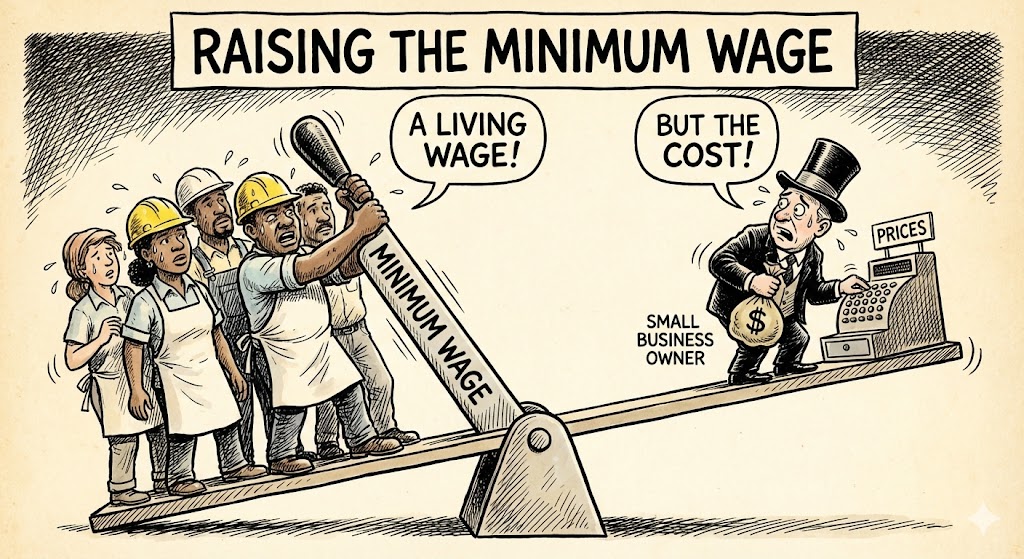
A Vote for Affordability or a Recipe for Inflation?
I. Introduction
In the United States in 2026, millions of Americans continue to face a persistent affordability crisis that affects nearly every aspect of daily life. Housing costs remain elevated, grocery prices strain household budgets, and healthcare and education expenses consume an increasing share of income. For many workers, wages have failed to keep pace with these rising costs, creating a widening gap between earnings and basic needs. This disconnect has become especially visible among low-wage workers who rely on hourly pay to meet essential expenses. As a result, economic insecurity has become a defining feature of the current labor market. The debate over how to address this imbalance has returned to the forefront of national policy discussions.
At the center of this debate is the federal minimum wage, which has remained at $7.25 per hour since 2009. Over nearly two decades, inflation alone has significantly eroded the purchasing power of this wage floor. While some states and municipalities have acted independently to raise wages, federal inaction has produced a fragmented system in which a worker’s income depends heavily on geography. As of January 2026, nineteen states have enacted minimum wage increases, with several exceeding sixteen dollars per hour. These disparities have renewed questions about whether national standards are outdated and insufficient for modern economic conditions.
From a historical perspective, the stagnation of the federal minimum wage appears even more pronounced. If the minimum wage had grown alongside inflation and labor productivity since the late 1960s, it would exceed twenty-five dollars per hour today. This gap underscores decades of wage stagnation even as worker output and corporate profitability have increased. Supporters argue that correcting this imbalance is necessary to restore fairness and economic stability. Critics counter that such increases may introduce new economic risks. This article evaluates both perspectives through empirical evidence, economic theory, and political context.
The Brooks Brief Substack is a reader-supported publication. To receive new posts and support my work, consider becoming a free or paid subscriber.
II. The Current Economic Landscape

The U.S. economy in 2026 reflects a mixed recovery from the disruptions of the early 2020s. While inflation has moderated from its peak levels, prices for essential goods and services remain elevated relative to wages. Housing affordability continues to pose a major challenge, particularly for first-time buyers and renters in urban and suburban markets. In many regions, home prices would need to fall substantially to return to pre-pandemic affordability levels. Rent increases have similarly outpaced income growth, forcing households to devote a larger share of earnings to shelter. These pressures disproportionately affect lower-income workers with limited financial buffers.
Food prices also remain a key driver of household stress. Even modest increases in grocery costs can significantly impact families living paycheck to paycheck. Minimum wage workers, who are heavily represented in retail, food service, and hospitality sectors, are especially vulnerable. A substantial portion of these workers report food insecurity or reliance on credit to cover routine expenses. Healthcare costs further compound the issue, as many low-wage jobs offer limited or no employer-sponsored insurance. Together, these factors create a cycle of economic precarity that is difficult to escape through employment alone.
Recent state and local minimum wage increases reflect an attempt to respond to these conditions. In 2026, dozens of states, cities, and counties implemented wage hikes aimed at preserving purchasing power. These measures are often framed as necessary adjustments rather than aggressive policy shifts. However, businesses implementing these changes face their own constraints, including higher input costs and lingering supply chain disruptions. Critics argue that wage mandates risk amplifying these pressures, particularly for small businesses. The current landscape thus presents a complex tradeoff between worker relief and economic stability.
III. Arguments in Favor of Raising the Minimum Wage

Advocates of raising the minimum wage argue that higher wages are essential for improving affordability and economic security. Low-wage workers tend to spend a larger share of their income on necessities such as food, housing, and transportation. When wages increase, this spending can stimulate local economies through increased consumer demand. Economists often describe this as a multiplier effect, where additional income circulates through communities. Unlike tax cuts for higher earners, wage increases are more likely to produce immediate economic activity. Proponents view this as a practical tool for strengthening local and regional economies.
Another central argument in favor of higher minimum wages is poverty reduction. Research indicates that wage increases can lift millions of workers above the poverty line. Higher earnings also reduce reliance on public assistance programs, including food aid and healthcare subsidies. This shift can ease pressure on government budgets while improving individual dignity and autonomy. From this perspective, higher wages function as both an economic and social policy. Supporters argue that the long-term fiscal benefits often outweigh short-term adjustment costs.
Proponents also emphasize historical and structural considerations. Over decades, worker productivity has risen significantly, yet wages for low-income workers have remained largely stagnant. This divergence has contributed to income inequality and reduced social mobility. Aligning wages with productivity growth is viewed as a corrective measure rather than a radical intervention. Additional benefits cited include reduced employee turnover, higher morale, and improved health outcomes. Together, these effects suggest that higher wages may yield broader social gains beyond immediate income increases.
IV. Arguments Against Raising the Minimum Wage

Opponents of minimum wage increases warn that higher labor costs can contribute to inflationary pressures. Businesses facing increased payroll expenses may raise prices to maintain profitability. These price increases can offset wage gains, particularly for the same workers the policy intends to help. In sectors such as food service and retail, where profit margins are often thin, cost pass-throughs may be more pronounced. Critics argue that this dynamic risks creating a cycle in which wages and prices chase one another upward. In an economy already sensitive to inflation, such risks are viewed as significant.
Employment effects are another major concern raised by critics. Mandated wage increases may prompt employers to reduce hours, cut positions, or accelerate automation. Entry-level and low-skilled workers are often seen as most vulnerable to these adjustments. Some studies suggest that younger workers and those with limited experience may face reduced job opportunities. Small businesses, in particular, may struggle to absorb higher labor costs without reducing staff or closing altogether. These potential outcomes raise concerns about unintended consequences for the labor market.
From a conservative economic perspective, minimum wage laws are often framed as government overreach. Critics argue that wages should be determined by market forces such as supply, demand, and worker productivity. They contend that wage mandates distort labor markets and discourage hiring. Instead, opponents emphasize education, job training, and skills development as more effective paths to higher earnings. From this viewpoint, addressing affordability requires structural reforms rather than wage floors. The debate thus reflects deeper ideological differences about the role of government in the economy.
V. Empirical Evidence and Case Studies

Empirical research on minimum wage effects presents a mixed picture. Some studies find minimal negative employment impacts, particularly when increases are moderate and phased in over time. These analyses often report gains in earnings and reductions in poverty among low-wage workers. In some cases, higher wages are associated with increased productivity and employee retention. However, methodological differences make it difficult to draw universal conclusions. Outcomes often vary by region, industry, and economic conditions.
Recent state-level wage increases in 2026 provide new data points. In states where minimum wages exceed fifteen dollars per hour, early surveys suggest workers experience modest improvements in financial stability. At the same time, many businesses report raising prices or reducing discretionary benefits. These adjustments highlight the tradeoffs involved in wage policy. While no widespread employment collapse has occurred, the long-term effects remain uncertain. Ongoing analysis will be necessary to assess durability and scalability.
International comparisons also offer insight, though contexts differ significantly. Some countries with higher wage floors maintain strong employment levels through complementary policies such as social safety nets and labor market supports. These examples suggest that wage policy outcomes depend heavily on broader institutional frameworks. A balanced interpretation of the evidence indicates that moderate increases tend to produce net benefits. Conversely, abrupt or large hikes may introduce greater risks. Policymakers must therefore consider pace, scale, and local conditions.
VI. The Political Divide and Path Forward

The minimum wage debate reflects broader political polarization in the United States. Public opinion consistently shows majority support for higher wages, particularly when framed around cost-of-living adjustments. Voters in several states have approved wage increases through ballot initiatives. Despite this support, federal legislative action remains stalled. Partisan divisions and competing economic philosophies continue to impede consensus. As a result, state and local governments have taken the lead.
Both supporters and critics increasingly acknowledge that wages alone cannot resolve affordability challenges. Inflation, housing shortages, and healthcare costs all contribute to economic strain. Some analysts argue that wage increases without complementary policies risk limited effectiveness. This recognition has opened space for alternative or supplemental approaches. These include expanding the Earned Income Tax Credit, reforming zoning laws, and subsidizing essential goods. Such measures aim to target affordability more directly.
A pragmatic path forward may involve combining moderate wage increases with broader policy reforms. Phased adjustments tied to inflation could provide predictability for both workers and employers. Pairing wage policy with investments in housing supply and workforce development may reduce unintended consequences. Evidence-based policymaking, rather than ideological positioning, is critical. The challenge lies in balancing worker protection with economic flexibility. Achieving this balance will shape the future of affordability policy.
VII. Conclusion

Raising the minimum wage presents clear advantages, including improved purchasing power, reduced poverty, and greater economic equity. At the same time, concerns about inflation, employment effects, and business sustainability cannot be dismissed. Historical comparisons highlight how far wages have fallen behind productivity and living costs. A minimum wage aligned with long-term economic growth could have mitigated much of today’s affordability crisis. However, such alignment must be approached carefully. The evidence suggests that design and implementation matter greatly.
Minimum wage increases alone are not a comprehensive solution to affordability challenges. Structural factors such as housing shortages, healthcare costs, and market concentration also play significant roles. Policymakers must therefore adopt a multifaceted strategy. Gradual, data-driven wage adjustments combined with targeted social and economic reforms offer the most promising path. Ideological stubbornness risks undermining effective solutions. A balanced approach grounded in evidence can better serve American workers in 2026 and beyond.
Leave a Reply