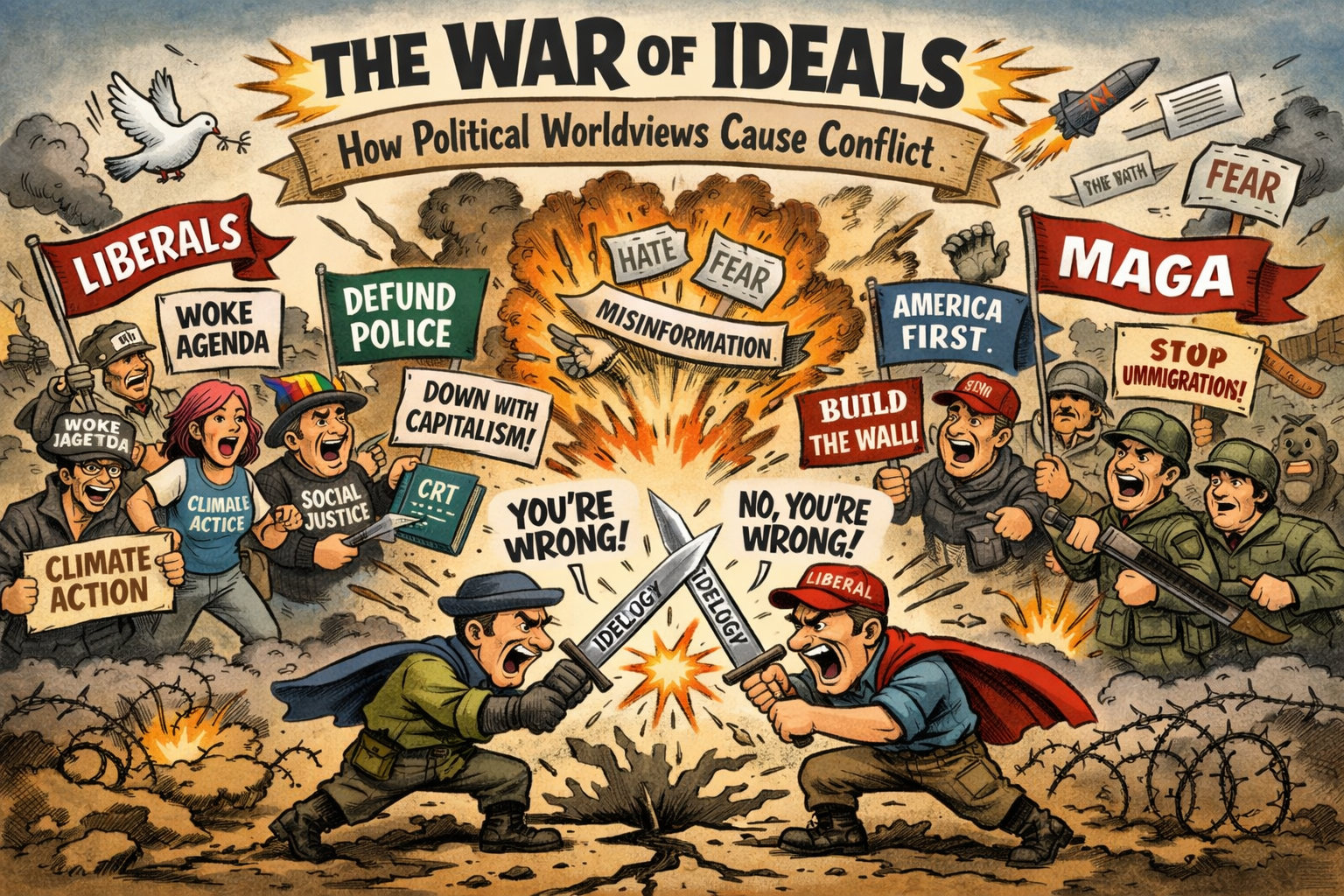
How Political Worldviews Cause Conflict
Introduction
In an era defined by fractured alliances and escalating rhetoric, political conflict increasingly transcends policy disputes and enters the realm of existential struggle. The 2024 U.S. presidential election offers a clear illustration, as debates over immigration, gender identity, and economic inequality often devolved into accusations that one side threatened the moral foundation of the nation. Similar dynamics are evident across Europe, where populist movements clash with supranational institutions over sovereignty, identity, and cultural preservation. These conflicts are not merely about legislation or governance. They reflect deeper disagreements over values, meaning, and the nature of social order. At their core, they represent a war of ideals.
Political worldviews serve as the interpretive lenses through which individuals and societies understand reality. These frameworks shape perceptions of justice, authority, human nature, and progress, influencing how people define legitimacy and threat. When competing worldviews collide, compromise becomes difficult because the dispute is no longer transactional. Instead, opposing visions are seen as morally incompatible or even dangerous. What one group views as reform, another interprets as decay or tyranny. As a result, political disagreement becomes deeply personalized and emotionally charged.
This article argues that political worldviews inevitably generate conflict by constructing incompatible moral realities, intensifying threat perceptions, and legitimizing defensive or aggressive actions. Unlike resource-based conflicts, which can often be resolved through negotiation or division, worldview conflicts strike at the core of identity and meaning. The article first defines political worldviews and their key dimensions. It then examines the mechanisms that transform ideological differences into antagonism. Historical and contemporary cases illustrate why these conflicts are persistent and resistant to resolution, followed by an exploration of guardrails that can reduce escalation without suppressing pluralism.
The Brooks Brief Substack is a reader-supported publication. To receive new posts and support my work, consider becoming a free or paid subscriber.
What Are Political Worldviews?

Political worldviews are comprehensive belief systems that integrate values, assumptions, and prescriptions for how society should be organized. They extend beyond partisan affiliation or discrete policy preferences, functioning instead as cognitive maps that guide interpretation of events and moral judgment. Through these maps, individuals assess what is fair, legitimate, or dangerous in political life. Worldviews shape not only opinions but also emotional responses to social change. They define who belongs, who threatens the group, and what outcomes are acceptable. As such, they are foundational to political behavior.
At the center of every political worldview are answers to fundamental questions about human nature and power. Some worldviews emphasize human perfectibility, arguing that injustice stems from flawed institutions that can be corrected through reform and education. Others stress inherent human limitations, asserting that order, tradition, and authority are necessary to restrain chaos. These assumptions directly influence attitudes toward governance. A state may be viewed as a neutral referee, a redistributor of opportunity, or a moral guardian depending on the worldview embraced.
Worldviews also differ in their orientation toward change and inclusion. Progressive worldviews often prioritize adaptation, innovation, and expansion of rights to marginalized groups. Conservative worldviews tend to emphasize continuity, stability, and the preservation of inherited norms. Similarly, universalist perspectives extend moral concern across borders, while particularist perspectives prioritize national, cultural, or communal loyalty. These differences are not easily reconciled because they involve competing definitions of virtue and responsibility. As a result, policy debates become symbolic battles over identity rather than pragmatic problem solving.
Crucially, worldview clashes differ from ordinary ideological disagreements. Policies such as tax rates or regulatory frameworks can be debated using shared empirical standards. Worldviews, by contrast, attach moral meaning to those policies. Inequality may be seen either as systemic injustice or as an inevitable outcome of individual variation. These interpretations create mutual incomprehension rather than simple disagreement. Opponents are not just wrong but morally alien.
Core Mechanisms: How Worldviews Produce Conflict

The transformation of worldview diversity into open conflict occurs through several reinforcing mechanisms. One of the most significant is moral absolutism, which frames political goals as zero-sum struggles between good and evil. When equality is perceived as incompatible with merit, or secularism as hostile to faith, compromise is seen as surrender. This framing eliminates middle ground by redefining disagreement as moral transgression. Political competition thus becomes existential rather than procedural. Each victory or loss takes on symbolic weight far beyond its practical consequences.
Threat perception further intensifies conflict. Worldview-incongruent ideas are interpreted not as alternative preferences but as attacks on foundational truths. Nationalists may see global institutions as eroding sovereignty and cultural identity. Cosmopolitans, in turn, may view nationalism as a regression toward exclusion and conflict. These perceptions trigger defensive responses that escalate tension. Actions taken for self-protection are interpreted by opponents as confirmation of hostile intent.
Psychological dynamics amplify these effects. In-group favoritism strengthens loyalty within ideological communities while facilitating out-group dehumanization. Political opponents are labeled with moralized terms such as extremists or enemies of the people. Group polarization intensifies views within echo chambers, pushing individuals toward more extreme positions. At the same time, epistemological closure undermines shared standards of truth, as different worldviews rely on incompatible sources of authority and evidence.
Social and technological factors reinforce these patterns. Algorithm-driven media environments sort individuals into ideologically homogeneous networks. Exposure to opposing views becomes rare and adversarial, often mediated through caricature. Feedback loops develop in which outrage is rewarded with attention and status. Over time, these dynamics normalize hostility and reduce incentives for moderation.
Elite rhetoric plays a critical role in sustaining these mechanisms. Political leaders and media figures often exploit worldview divisions for mobilization and power. By portraying opponents as existential threats, elites consolidate support while deepening polarization. This strategy creates self-fulfilling prophecies, as mutual distrust makes cooperation increasingly unlikely. The result is a political environment primed for escalation.
Historical Examples of Worldview-Driven Conflicts

History provides numerous examples of conflicts rooted in incompatible worldviews. The Cold War stands as a defining case of ideological confrontation shaping global politics. Liberal democracy, grounded in individual rights and market economies, clashed with Marxist-Leninist communism’s collectivist vision of class struggle and state control. Each side viewed the other as a fundamental threat to human progress. This ideological rivalry manifested in proxy wars, arms races, and global propaganda campaigns. The conflict persisted for decades because neither side could concede without undermining its moral foundation.
Earlier periods reveal similar patterns. The European Wars of Religion in the sixteenth and seventeenth centuries were driven by competing theological worldviews intertwined with political authority. Protestant and Catholic factions justified violence as obedience to divine truth. The Thirty Years’ War devastated large portions of Europe, demonstrating how absolutist belief systems can prolong and intensify conflict. Compromise was difficult because doctrinal concessions were equated with spiritual betrayal. Political settlements only emerged after exhaustion rather than reconciliation.
The twentieth century witnessed further worldview-driven catastrophes. Fascism, liberalism, and communism offered rival visions of human destiny, each claiming exclusive legitimacy. World War II represented not only a military struggle but a moral confrontation over authority, equality, and identity. Totalitarian regimes mobilized populations by framing conflict as necessary for survival and renewal. The scale of destruction reflected the depth of ideological commitment on all sides.
Revolutionary movements also illustrate the dynamic. The French Revolution pitted radical egalitarianism against monarchist traditionalism, leading to cycles of violence such as the Reign of Terror. Anti-colonial struggles similarly involved clashes between imperial hierarchies and modernist visions of self-determination. These cases show how worldview conflicts often transcend borders, drawing in allies and spreading through ideological contagion. Once activated, they reshape international systems.
Contemporary Manifestations

In the contemporary era, worldview conflicts are pervasive across domestic politics. In many democracies, populist nationalism confronts progressive cosmopolitanism in battles over identity, culture, and authority. Immigration debates exemplify this divide, with one side emphasizing humanitarian obligation and the other stressing social cohesion and sovereignty. Economic policy, climate change, and education are similarly framed as moral struggles rather than technical issues. These disputes increasingly define political identity and affiliation.
Cultural and identity politics further intensify polarization. Debates over race, gender, and historical memory are framed as contests between inclusion and tradition. For some, expanding recognition corrects long-standing injustices. For others, it represents an erosion of shared norms and social stability. These opposing interpretations fuel culture wars that spill into institutions, media, and workplaces. The result is a political environment saturated with symbolic conflict.
On the international stage, worldview competition shapes geopolitical rivalry. The liberal international order, promoted by Western alliances, faces challenges from authoritarian nationalism. Russia’s invasion of Ukraine was justified in ideological terms, framed as resistance to Western moral decay and geopolitical expansion. China’s governance model emphasizes state-centric harmony and collective stability over liberal individualism. These competing visions collide in global institutions, trade regimes, and security arrangements.
Digital media accelerates and globalizes these conflicts. Algorithms amplify emotionally charged content that reinforces existing beliefs. Parallel information ecosystems emerge, each sustaining its own narrative of reality. Movements such as anti-vaccine activism or transnational protest campaigns demonstrate how worldview lenses shape interpretations of facts. Local disputes can rapidly become global flashpoints, magnifying their impact.
Why Worldview Conflicts Are Especially Difficult to Resolve

Worldview conflicts are uniquely resistant to resolution because they are rooted in identity. Unlike material interests, which can be negotiated or divided, core beliefs define who individuals understand themselves to be. Conceding on such beliefs feels like moral surrender or self-erasure. A conservative may view compromise on social norms as abandoning truth. A progressive may see restraint as complicity in injustice. These perceptions make bargaining emotionally and psychologically costly.
Escalation is built into the structure of worldview conflict. Actions taken by one side to defend its values are interpreted by the other as confirmation of hostile intent. This dynamic fuels mutual radicalization, as moderation appears naive or dangerous. Over time, positions harden and trust erodes. Political systems become locked in cycles of retaliation and obstruction.
The erosion of shared reality further complicates resolution. Distrust in institutions, experts, and media undermines the possibility of fact-based dialogue. Each worldview develops its own criteria for truth and legitimacy. Evidence is selectively accepted or rejected based on narrative fit. Without common epistemic ground, persuasion becomes nearly impossible.
Compared to resource-based disputes, worldview conflicts rarely offer win-win outcomes. Territorial or economic conflicts can be resolved through partition or compensation. Worldview wars, by contrast, demand conversion, dominance, or suppression. This structural rigidity makes them prone to stalemate, fragmentation, or violence. Resolution often comes only through exhaustion or external shock.
Thanks for reading The Brooks Brief Substack! This post is public so feel free to share it.
Conclusion: Beyond the War of Ideals?

Acknowledging the inevitability of worldview diversity is essential for democratic resilience. Attempts to eliminate ideological difference risk authoritarianism and intellectual stagnation. Yet unmanaged conflict threatens social cohesion and political stability. The challenge is not to end the war of ideals but to contain its destructive potential. Effective guardrails can allow rivalry without collapse.
Institutional design plays a critical role. Federalism, power-sharing arrangements, and independent courts can diffuse conflict by preventing total domination by any single worldview. These structures force cooperation while protecting minority perspectives. Similarly, strong civic norms and procedural fairness can sustain legitimacy even amid deep disagreement. Institutions matter most when trust is scarce.
Cultural and psychological interventions are equally important. Encouraging epistemic humility can reduce moral absolutism and open space for dialogue. Cross-cutting identities, such as shared civic service or economic interdependence, weaken ideological silos. Exposure to diverse perspectives in non-adversarial settings can humanize opponents. These measures do not erase disagreement but soften its edges.
Elite responsibility is decisive. Leaders who de-escalate rhetoric and model restraint can shift incentives away from polarization. By framing conflict as manageable rather than existential, they reduce the appeal of zero-sum narratives. Ultimately, societies must learn to channel ideological tension into debate rather than destruction. If managed wisely, the clash of worldviews can serve as a catalyst for renewal rather than a prelude to rupture.
Leave a Reply