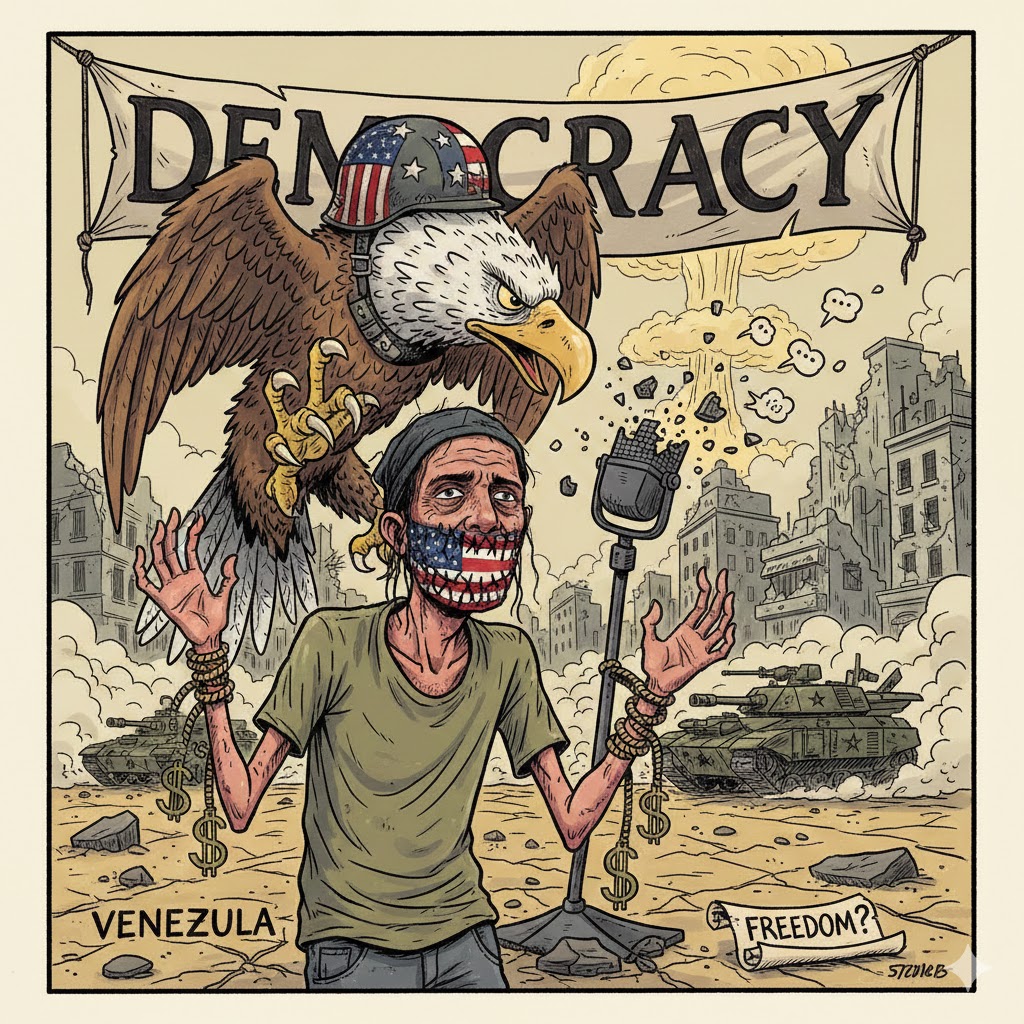
How the U.S. Ouster of Maduro Muzzled a Nation
Operation Absolute Resolve and the Promise of Liberation
In the early hours of January 3, 2026, American forces entered Caracas under an operation labeled Operation Absolute Resolve, capturing President Nicolás Maduro and his wife, Cilia Flores, on charges of narco terrorism and election fraud. President Donald Trump quickly framed the raid as a decisive victory against a failed state, asserting that the United States would help guide Venezuela toward stability and reform. The announcement was delivered with familiar rhetoric about restoring order, eliminating corruption, and giving the Venezuelan people a fresh start. International attention briefly focused on the dramatic nature of the arrest and the symbolism of removing a long sanctioned leader. For many observers, the moment appeared to signal the end of an era defined by repression and economic collapse. Expectations of rapid democratic transition rose almost immediately.
Within days, however, the reality on the ground diverged sharply from those expectations. Rather than experiencing political liberation, Venezuelans found themselves suspended in uncertainty and silence. Public dissent remained dangerous, and the structures that had enforced loyalty under Maduro showed no sign of weakening. The promised transformation failed to materialize as ordinary citizens encountered the same restrictions on speech, assembly, and political participation. Instead of opening space for reform, the intervention reinforced a sense of powerlessness. The gap between American declarations and lived Venezuelan reality widened with each passing day.
Thanks for reading The Brooks Brief Substack! Subscribe for free to receive new posts and support my work.
Continuity of Power Under a New Face
The appointment of Delcy Rodríguez as interim president underscored the continuity of Venezuela’s ruling elite. Rodríguez, a long standing ally of Maduro and vice president since 2018, has been deeply embedded in the country’s political, economic, and security apparatus for years. Sworn in by the Supreme Court under constitutional provisions intended for temporary leadership, she denounced Maduro’s capture as a kidnapping and pledged loyalty to Maduro. Her elevation was backed by powerful insiders, including Maduro’s son and senior party figures. To many Venezuelans, the change in leadership probably feels cosmetic rather than transformative. The same networks of influence and control remain firmly in place.
For a population already exhausted by hyperinflation, shortages, and mass emigration, Rodríguez’s leadership may offer little hope of relief. Her government has continued to rely on entrenched institutions that prioritize regime survival over public accountability. Efforts to purge internal rivals and consolidate authority have reinforced the sense that political renewal is not on the agenda. Economic ties to favored elites remain intact, while opposition voices are further marginalized. The promise of a clean break from the past has instead been replaced by familiar patterns of governance. In effect, the system endured, merely reshaped around a different figurehead.
Between Occupation Narratives and Suppressed Dissent
Alongside domestic continuity, a competing narrative has taken hold that the United States is now effectively directing Venezuela’s future. President Trump has publicly suggested American oversight of reconstruction efforts and even raised the prospect of extracting Venezuelan oil as compensation. These statements have fueled fears of external domination rather than partnership. At the same time, senior Venezuelan officials have rejected any notion of U.S. authority. Interior Minister Diosdado Cabello has described the operation as an occupation and called for revenge.
This clash of narratives has further narrowed the space for public expression. Citizens who question the legitimacy of Rodríguez’s government risk repression, while those who appear sympathetic to American involvement are labeled traitors. Security forces accused of past human rights abuses continue to operate with broad discretion. Anti imperialist rhetoric is used to justify crackdowns and silence criticism. As a result, Venezuelans are caught between competing power centers that both limit their agency. The outcome is deeper polarization and a chilling effect on already fragile civil liberties.
Thanks for reading The Brooks Brief Substack! This post is public so feel free to share it.
The Absence of Elections and the Erosion of Sovereignty
The constitutional path out of this crisis remains conspicuously blocked. Venezuela’s constitution mandates that a new election be held within 30 days of a president’s permanent absence, a safeguard designed to protect democratic legitimacy. Despite this provision, no serious effort has been made to organize or enforce such a vote. The United States has prioritized reconstruction and stability over electoral timelines, explicitly ruling out near term elections. Meanwhile, Venezuela’s judiciary has remained silent, declining to assert its constitutional responsibilities. The result is an open ended interim presidency with no clear mandate from the public.
This prolonged suspension of electoral rights has deepened public disillusionment. Maduro’s last reelection was widely criticized as fraudulent, a claim later reinforced by international indictments and investigations. Yet the intervention justified as a corrective to that fraud has failed to restore the basic mechanism of democratic choice. Instead, Venezuelans are left without representation or recourse. Sovereignty has eroded not through open reform but through stagnation and external influence. Until credible elections are held and institutions regain independence, the Venezuelan people remain observers rather than participants in shaping their future.
Leave a Reply