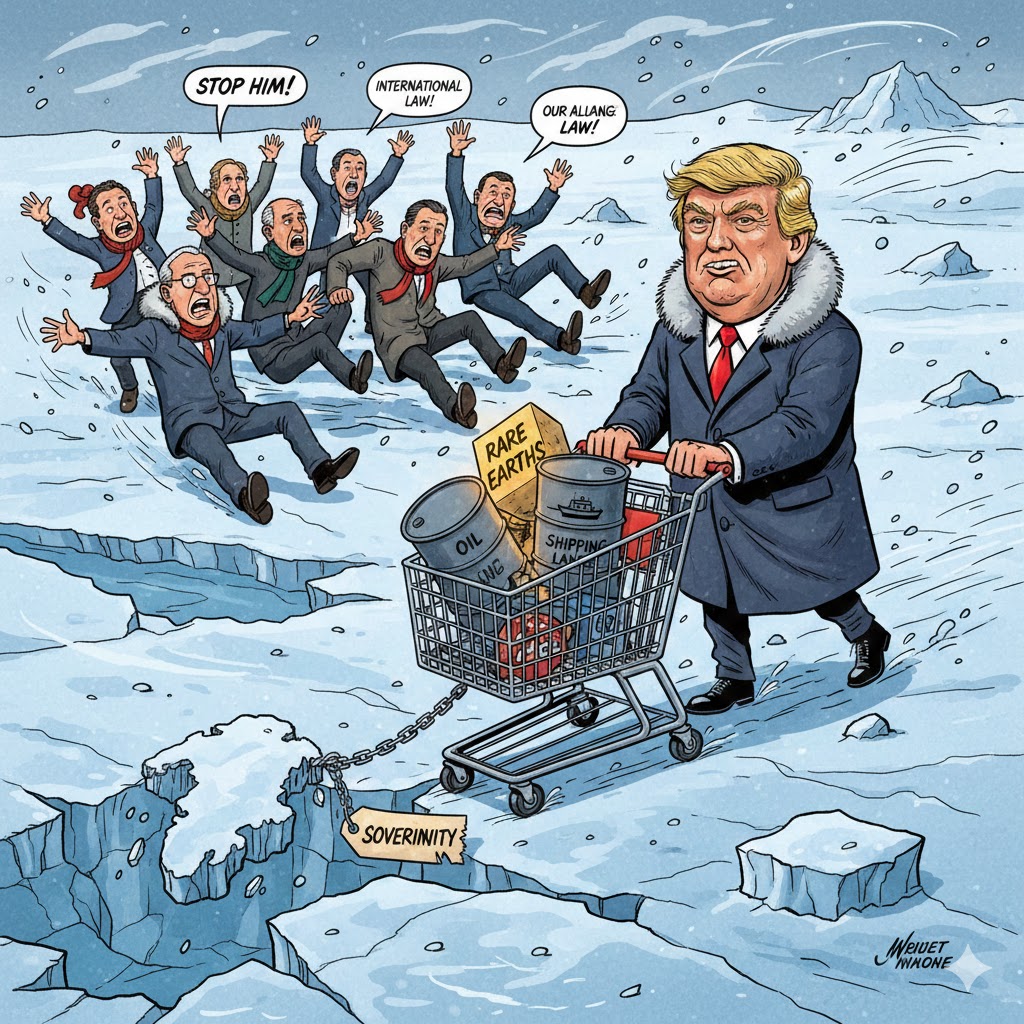
How a U.S. Invasion of Greenland Could Shatter NATO
Introduction
In the frozen expanse of the Arctic, where melting ice caps expose untapped resources and newly accessible strategic corridors, a once unthinkable scenario is gaining plausibility: the United States, under a resurgent Donald Trump administration, launching a military invasion of Greenland. Framed as a move to secure rare earth minerals, potential oil reserves, and critical military positions amid intensifying great power competition, such an action would redraw global power dynamics and pose a direct threat to the survival of NATO.
For decades, European NATO members have lagged behind the United States in military development, creating a structural imbalance that leaves the alliance fragile. When combined with America’s recent assertive behavior in resource rich regions such as Nigeria and Venezuela, a unilateral invasion of Greenland could fracture NATO beyond repair. Allies would be forced to confront the limits of collective defense in an era increasingly defined by transactional power politics.
Historical Context of NATO Imbalances
NATO was founded in the aftermath of World War II on the principle of collective defense, enshrined in Article 5, which treats an attack on one member as an attack on all. Over time, however, this principle has been undermined by persistent disparities in defense investment and military capability.
The United States has consistently carried the alliance’s burden, exceeding NATO’s 2 percent of GDP defense spending benchmark and often spending between 3 and 4 percent. This investment funds advanced weapons systems, global force projection, nuclear deterrence, and intelligence capabilities that underpin NATO’s operational effectiveness.
Many European allies, by contrast, have underinvested for decades. Germany, despite its economic strength, only recently approached the 2 percent threshold after years below 1.5 percent, leaving its military plagued by shortages and aging equipment. Italy and Spain have prioritized social spending over defense readiness, while France, though more capable, remains heavily reliant on U.S. intelligence, logistics, and airlift. This imbalance has fostered dependency and resentment, with Washington increasingly frustrated by what it perceives as free riding within the alliance.
The U.S. Shift Toward Military Aggression Under Trump
Donald Trump’s return to the White House in 2025 has transformed this frustration into policy. His administration has embraced a more assertive and openly transactional foreign policy rooted in “America First” militarism. During his first term, Trump famously proposed purchasing Greenland from Denmark, dismissing sovereignty concerns in favor of strategic utility. With climate change accelerating Arctic accessibility, that rhetoric now carries greater urgency.
Recent U.S. actions abroad illustrate this shift. In Nigeria, American forces conducted targeted operations against Boko Haram factions threatening oil infrastructure in the Niger Delta, securing refineries and pipelines linked to global energy markets. In Venezuela, U.S. backed regime change efforts included direct military involvement aimed at stabilizing oil fields amid state collapse, ensuring continued access to vast petroleum reserves. Both cases reflect a willingness to use force to protect economic and strategic interests without multilateral consensus.
Greenland fits seamlessly into this pattern. Its rare earth minerals are essential to green energy technologies and advanced weapons systems, while its geographic position offers control over emerging Arctic shipping lanes. In a transactional worldview, Danish sovereignty becomes a negotiable obstacle. An invasion could be framed as a security necessity, but it would represent a dramatic escalation from coercive diplomacy to outright force.
Potential Ramifications for NATO if the U.S. Invades Greenland
A U.S. invasion of Greenland would strike at NATO’s core. Greenland, though autonomous, remains under Danish sovereignty, and Denmark is a founding NATO member. In theory, such an attack would trigger Article 5. In practice, Europe’s limited rapid response capacity, insufficient Arctic forces, and reliance on U.S. intelligence and logistics would make meaningful resistance unlikely.
This paralysis would fracture the alliance. Some states might hesitate, citing domestic opposition or operational constraints, effectively nullifying collective defense. Trust, the foundation of NATO, would erode rapidly as accusations of American imperialism reverberated across European capitals.
Rival powers would exploit the turmoil. Russia could expand Arctic military patrols and submarine activity, while China might accelerate resource claims and infrastructure investments. The result would be a destabilized Arctic and a weakened Western security architecture.
In this context, a radical but conceivable outcome emerges: NATO expelling the United States from the alliance. While unprecedented, treaty mechanisms and political consensus could make such a move possible. European states, likely rallying behind Denmark and supported by Greenlandic independence movements, could frame expulsion as a defense of NATO’s founding principles. This would invert the conflict, transforming America from alliance leader to strategic adversary and reshaping global power alignments overnight.
Thanks for reading The Brooks Brief Substack! This post is public so feel free to share it.
Policy Recommendations and Conclusion
Preventing such a rupture requires decisive action. European NATO members must rapidly increase defense spending beyond the 2 percent benchmark, focusing on modernization, readiness, and Arctic capabilities. Joint procurement programs and coordinated Arctic exercises could reduce dependence on U.S. military infrastructure.
Diplomatically, multilateral frameworks should be strengthened to address Arctic resource competition. Negotiated access to Greenland’s resources under international oversight would offer a viable alternative to force. At the same time, NATO must clarify enforcement mechanisms and consequences for treaty violations, including expulsion protocols, to preserve institutional credibility.
A U.S. invasion of Greenland would be a watershed moment. Without correcting internal imbalances and restraining unilateral aggression, NATO risks becoming obsolete in a world increasingly driven by resource competition and power politics. The alliance’s survival depends on restoring equilibrium, mutual accountability, and respect for sovereignty, before strategic rivalry turns former allies into open adversaries.




Leave a Reply