How Inflation, Wage Stagnation, and Policy Choices Are Crushing the American Middle Class
I. Introduction
Across the United States, millions of households are confronting a worsening affordability crisis that cuts across income levels but falls most heavily on the middle and working classes. The costs of housing, food, healthcare, transportation, and utilities continue to rise faster than wages, eroding purchasing power and financial stability. Surveys and economic data show that groceries represent the single largest strain for households, followed closely by housing and healthcare expenses. For many families, these pressures are no longer cyclical inconveniences but structural features of daily life. The result is a growing share of Americans who remain employed yet cannot reliably meet basic needs. This contradiction challenges official narratives of economic strength and recovery.
By 2023, roughly one third of middle class households reported difficulty affording necessities, a figure that has worsened rather than improved in subsequent years. Even families earning between $50,000 and $100,000 annually increasingly report financial precarity once fixed costs are accounted for. These pressures are magnified for lower income households, where small price increases can immediately translate into skipped meals or delayed medical care. Despite these realities, political leaders frequently highlight aggregate indicators such as GDP growth or stock market performance as evidence of broad prosperity. Such metrics obscure the lived experience of most Americans. The gap between official optimism and household reality has become a defining feature of the current economic moment.
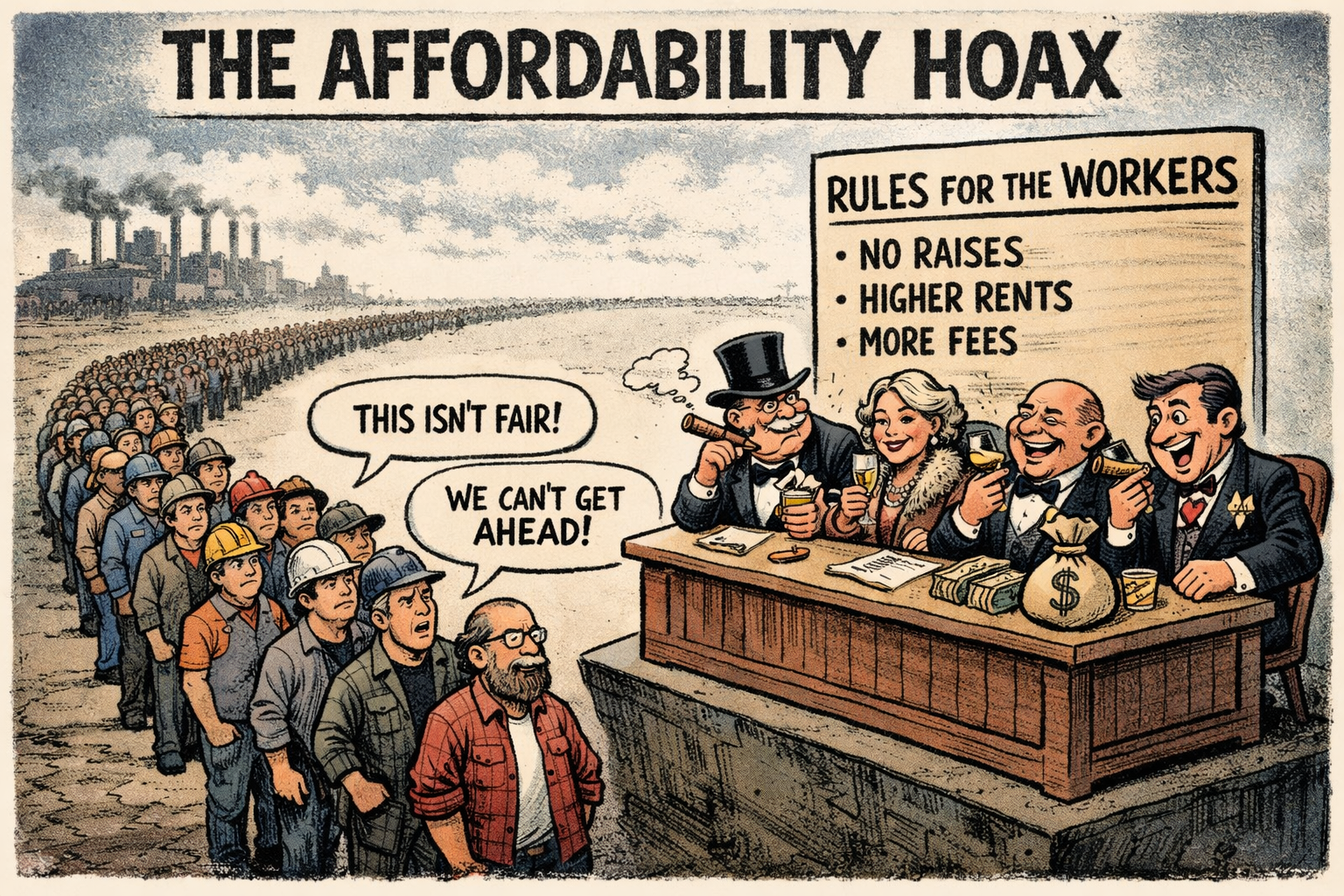
The term “affordability hoax” captures this disconnect between political rhetoric and economic reality. It refers to the narrative advanced by the Trump Administration that inflation concerns are exaggerated and that wage growth has broadly offset rising costs. This framing minimizes structural problems such as decades long wage stagnation, rising corporate concentration, and the increasing privatization of basic necessities. By labeling affordability concerns as partisan or fabricated, policymakers deflect attention from policies that disproportionately benefit high earners. This analysis argues that inflation and wage stagnation have produced a genuine affordability crisis for middle and low income Americans. It further contends that the Trump Administration has systematically dismissed or exacerbated this crisis through policy choices and rhetorical denial.
The Brooks Brief Substack is a reader-supported publication. To receive new posts and support my work, consider becoming a free or paid subscriber.
II. The Roots of the Affordability Crisis: Inflation and Wage Stagnation
The current affordability crisis did not emerge suddenly, but rather reflects long term structural trends in the U.S. economy. Since the late 1970s, wage growth for non supervisory and production workers has decoupled from productivity growth. While overall economic output has increased, the gains have disproportionately accrued to executives, shareholders, and higher income professionals. For the majority of workers, real wages have remained largely flat over decades. This divergence has left households increasingly vulnerable to price shocks. Inflation therefore operates on top of an already weakened income foundation.
Inflation, even when headline rates appear moderate, erodes purchasing power unevenly. Essential goods and services such as food, housing, energy, and healthcare often rise faster than the overall inflation rate. In 2025, inflation remained above the Federal Reserve’s stated target, with particular spikes in electricity, insurance, and food costs. For households that spend a larger share of income on necessities, these increases function as regressive taxes. Middle and low income families have little discretionary spending to absorb higher prices. As a result, modest inflation can produce outsized hardship.
Wage growth during this period has failed to compensate for these rising costs. Between 2021 and 2025, consumer prices rose faster than average wages, resulting in a net decline in real hourly earnings. While nominal wage increases were reported, these gains were unevenly distributed and often concentrated among higher earners or specific sectors. For low wage and service workers, wage growth frequently lagged inflation altogether. When adjusted for inflation, middle class wages in 2025 remained below their levels from decades earlier. This stagnation undermines long term financial security and limits upward mobility.
The interaction between inflation and wage stagnation creates a self reinforcing cycle. As households devote larger shares of income to rent, food, and healthcare, they rely more heavily on credit to maintain living standards. Rising debt burdens further constrain consumption and savings, increasing vulnerability to economic shocks. This dynamic weakens overall economic resilience while masking hardship behind employment statistics. The affordability crisis is therefore not simply a short term inflationary episode. It is the product of decades of policy choices that prioritized capital accumulation over wage growth.
III. Impacts on Middle and Low Income Classes

The consequences of the affordability crisis are most visible in the daily tradeoffs faced by households. Middle and low income families increasingly report skipping meals, delaying medical care, or postponing essential purchases due to cost concerns. Even among households traditionally considered economically stable, financial buffers have eroded. Unexpected expenses such as car repairs or medical bills can now trigger cascading financial stress. This shift reflects a broader normalization of economic insecurity. Employment alone no longer guarantees material stability.
Housing costs represent one of the most significant drivers of this pressure. Rent and mortgage payments consume a growing share of household income, particularly in metropolitan areas. For many renters, housing now absorbs more than 30 percent of monthly earnings, a level widely considered unaffordable. Lower income households face even higher burdens, often exceeding 40 percent of income. These conditions limit geographic mobility and constrain access to better job opportunities. Housing insecurity thus reinforces broader patterns of inequality.
Food insecurity has also intensified, exacerbated by policy decisions at the federal level. In 2025, Congress enacted cuts to Supplemental Nutrition Assistance Program benefits, reducing monthly assistance for millions of recipients. These reductions came at a time when grocery prices remained elevated and wages had not fully recovered purchasing power. For low income families, the cuts translated directly into reduced food consumption or reliance on food banks. The decision to reduce food assistance amid rising costs highlights a policy mismatch between economic conditions and social support. It further deepens the affordability crisis for the most vulnerable households.
Healthcare costs compound these pressures, particularly for families without comprehensive employer sponsored insurance. Out of pocket expenses, deductibles, and prescription drug costs continue to strain household budgets. Many Americans report delaying or foregoing care due to cost, increasing long term health risks and future expenses. Job insecurity in 2025 further weakened access to stable benefits for working class Americans. Together, these sector specific pressures illustrate how affordability challenges are interconnected rather than isolated. The cumulative effect is a pervasive sense of economic fragility.
IV. Trump Administration Policies Exacerbating the Crisis

Rather than mitigating affordability pressures, key Trump Administration policies have often intensified them. Tax policy remains a central example. The Tax Cuts and Jobs Act and its subsequent extensions disproportionately benefited high income households and corporations. While some middle income taxpayers received modest short term relief, these benefits were outweighed by long term fiscal costs and limited wage growth effects. The structure of the tax cuts prioritized capital gains and corporate profits over labor income. This approach reinforced existing inequalities rather than alleviating household cost pressures.
Trade policy under the Trump Administration also contributed to higher consumer prices. Expanded tariffs raised the cost of imported goods, with the burden largely falling on U.S. consumers rather than foreign producers. These costs filtered through supply chains, increasing prices for household goods, appliances, and food products. While tariffs were framed as tools to protect domestic jobs, their inflationary effects undermined real wages. For households already struggling with affordability, tariffs functioned as an indirect tax. The resulting price increases further strained family budgets.
Labor and regulatory policies compounded these effects. Rollbacks of worker protections weakened bargaining power and limited wage growth in key sectors. Cuts to housing assistance, rental support, and nutrition programs reduced the social safety net precisely as costs were rising. The reduction in food stamp benefits passed by Congress exemplifies this dynamic. Rather than expanding support during a period of elevated prices, policymakers chose austerity measures that shifted risk onto households. These decisions reflect a broader policy orientation that deprioritized affordability concerns.
Administration officials frequently countered criticism by citing periods of nominal wage growth or low unemployment. However, these aggregate indicators obscure distributional realities and regional variation. Wage gains were uneven and often insufficient to offset rising costs of living. Low income workers, in particular, saw slower wage growth than inflation. The gap between rhetoric and outcomes underscores the limitations of the Administration’s economic framework. Policies focused on headline growth failed to address the structural drivers of affordability.
V. Dismissal and Ignorance by the Trump Administration

Beyond policy choices, the Trump Administration’s rhetorical approach further undermined efforts to address affordability. Officials repeatedly dismissed concerns about rising costs as exaggerated or politically motivated. Public statements emphasized falling prices or strong economic performance despite contrary evidence at the household level. This framing delegitimized lived experiences and discouraged serious policy engagement. By labeling affordability concerns as a “hoax,” the Administration shifted debate away from structural solutions. The result was policy paralysis in the face of mounting economic stress.
This dismissal was accompanied by selective use of economic data. Aggregate inflation trends were cited without acknowledging category specific price increases that matter most to households. Similarly, wage statistics were presented without adjusting for inflation or accounting for distributional effects. Such selective framing obscured the erosion of real incomes. It also reinforced a narrative that blamed individual budgeting rather than systemic conditions. This approach weakened public trust in economic institutions and leadership.
Policy inaction followed rhetorical dismissal. Promised initiatives to lower housing, childcare, and healthcare costs failed to materialize at scale. Instead, fiscal priorities remained aligned with tax relief for high earners and spending cuts to social programs. The food stamp reductions enacted by Congress exemplify this contradiction. At a time when families faced higher grocery prices, policymakers reduced nutritional support. This disconnect illustrates how dismissal translated into tangible harm.
The Administration’s focus on cultural and partisan narratives further diverted attention from economic hardship. By emphasizing identity based conflicts, affordability concerns were sidelined in public discourse. This strategy fragmented political coalitions that might otherwise coalesce around shared economic interests. The dismissal of affordability therefore functioned not only as rhetoric but as a political strategy. It allowed structural economic problems to persist unchallenged.
VI. Broader Consequences and Political Science Perspectives

From a political economy perspective, the affordability crisis reflects patterns of elite capture and policy bias. Economic gains increasingly flow to those with capital and political influence, while costs are socialized downward. This dynamic erodes social mobility and entrenches inequality across generations. High living costs limit access to education, homeownership, and healthcare. Over time, these constraints weaken democratic participation and trust. Affordability thus becomes both an economic and political issue.
Comparative evidence suggests alternative policy approaches are possible. Other advanced economies have mitigated affordability pressures through wage supports, housing investment, and stronger social safety nets. Targeted interventions have reduced household cost burdens without sacrificing economic growth. The contrast highlights the role of political choice rather than economic inevitability. In the United States, policy decisions have consistently prioritized market outcomes over household stability. This orientation shapes long term social outcomes.
If current trends persist, the political consequences may be significant. Economic insecurity fuels voter dissatisfaction and political volatility. Households experiencing sustained cost pressures are more likely to disengage or support disruptive political movements. The affordability crisis therefore poses risks to institutional stability. Ignoring these pressures increases the likelihood of backlash in future electoral cycles. Addressing affordability is not only a matter of equity but of democratic resilience.
VII. Conclusion

The affordability crisis facing middle and low income Americans is real, measurable, and deeply rooted in structural economic trends. Inflation and wage stagnation have combined to erode purchasing power, while policy choices have failed to provide meaningful relief. The Trump Administration’s dismissal of these concerns, coupled with tax, trade, and spending policies favoring the wealthy, has worsened household insecurity. Congressional cuts to food stamp benefits further illustrate the gap between economic conditions and policy responses. Treating affordability as a hoax obscures the lived reality of millions of Americans. Confronting this crisis requires acknowledging its causes and pursuing policies that prioritize wages, affordability, and economic security for working families.
Leave a Reply