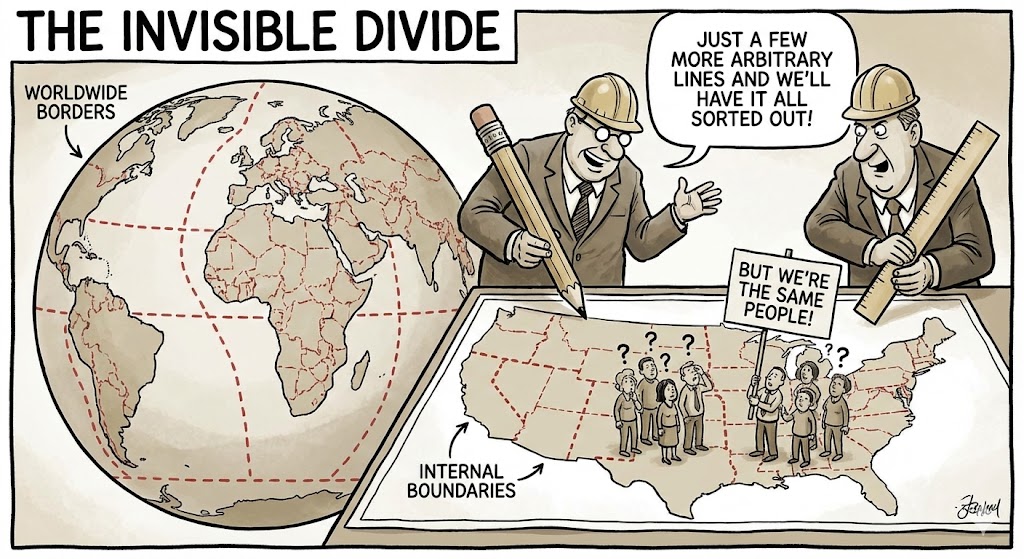
How Political Polarization Serves the Elite and Weakens the Masses
Introduction
In an era saturated with constant political conflict, public discourse has become dominated by emotionally charged debates over cultural and social issues. From immigration and gender policy to education and policing, these disputes are presented as existential struggles that demand total allegiance. The 2024 U.S. presidential election exemplified this dynamic, with candidates framing opponents as threats to democracy or national survival. Such rhetoric deepens an “us versus them” mentality that leaves little room for compromise or collective problem-solving. While these conflicts appear organic, they are routinely amplified by powerful interests that benefit from social fragmentation. The result is a distracted public less able to confront structural economic and political inequalities.
Political division does not emerge in a vacuum, nor is it simply the byproduct of ideological diversity. It is actively cultivated through messaging strategies that emphasize identity conflict while marginalizing material concerns. Issues such as wealth concentration, corporate consolidation, and declining labor power receive far less sustained attention than cultural flashpoints. By keeping the public locked in perpetual outrage, elites redirect frustration away from institutions that shape economic outcomes. This pattern ensures that systemic failures remain intact while social trust erodes. Division, in this sense, functions as a governing strategy rather than a political accident.
This analysis argues that polarization weakens democratic capacity by undermining solidarity among the lower and middle classes. It examines the historical roots of divide-and-rule tactics, the modern mechanisms that sustain them, and the concrete consequences for everyday people. It also evaluates contemporary case studies that illustrate how polarization correlates with elite economic gains. Finally, it outlines potential pathways for rebuilding social cohesion across political and cultural divides. The central claim is clear: societies fragmented by engineered conflict struggle to challenge entrenched power.
Historical Context of Division as a Control Mechanism
The use of division as a political tool predates modern democracy and is deeply embedded in imperial governance. Ancient Rome institutionalized the principle of divide and rule by fostering rivalries among conquered populations to prevent unified resistance. By distributing uneven privileges and encouraging intergroup competition, Roman authorities reduced the likelihood of coordinated rebellion. Power was preserved not through consensus but through managed conflict. This strategy proved effective precisely because it redirected resentment horizontally rather than upward. The lesson endured long after the empire itself declined.
Colonial powers refined these methods with greater precision and scale. In British-ruled India, administrators exploited religious and ethnic distinctions to weaken nationalist movements. Policies that categorized populations along rigid communal lines intensified divisions that had previously been more fluid. Similar approaches were deployed across Africa and the Middle East, where colonial borders and governance structures entrenched long-term instability. These divisions served imperial interests by preventing mass mobilization against colonial rule. The resulting conflicts often outlasted the colonial period itself.
Industrial capitalism in the nineteenth and early twentieth centuries adapted divide-and-rule tactics to class conflict. In the United States, industrialists during the Gilded Age exacerbated racial and ethnic tensions among workers to undermine labor organizing. Employers routinely pitted white immigrant laborers against Black workers to prevent collective bargaining. Media narratives and political rhetoric reinforced these divisions, portraying labor solidarity as dangerous or unpatriotic. By fragmenting the working class, economic elites preserved exploitative labor arrangements. History consistently shows that division functions as a stabilizing force for entrenched power.
Mechanisms of Political Division Today

In the contemporary political environment, division is reinforced through complex and technologically advanced systems. Digital media platforms use algorithms designed to maximize engagement, often by promoting emotionally charged and polarizing content. Users are funneled into ideological echo chambers that reinforce existing beliefs while caricaturing opposing views. This dynamic elevates cultural wedge issues while marginalizing shared economic concerns such as healthcare access or wage stagnation. Outrage becomes more visible than policy analysis, distorting public priorities. The architecture of online discourse thus rewards division over deliberation.
Economic policy debates are similarly reframed to obscure underlying class dynamics. Trade agreements, deregulation, and austerity measures are frequently presented as cultural or regional conflicts rather than economic choices. Urban and rural populations are cast as adversaries, even when both experience job insecurity and declining public services. This framing benefits corporate and financial elites who profit from globalization while avoiding accountability. By personalizing economic pain as cultural resentment, policymakers deflect scrutiny from structural decisions. Division becomes a narrative shield for inequality.
Political institutions and campaign finance structures further entrench polarization. Wealthy donors and corporate-backed political action committees fund messaging that emphasizes fear and antagonism over substantive policy debate. Campaigns invest heavily in negative advertising that mobilizes voters through hostility rather than shared goals. As a result, electoral competition rewards extremism and punishes coalition-building. The political system becomes less responsive to broad public interests and more attuned to narrow elite priorities. Polarization is thus continuously reproduced through institutional incentives.
Impacts on Lower and Middle Classes

The consequences of engineered division are most severe for the lower and middle classes. Economically, polarization weakens collective bargaining power and reduces pressure for redistributive policies. Fragmented workers struggle to organize effectively, allowing wages to stagnate while productivity gains accrue to executives and shareholders. Labor protections erode with little resistance, as divided constituencies fail to mount unified opposition. The decline of unions and the rise of precarious work reflect this imbalance. Division ultimately translates into diminished economic security.
Social cohesion also deteriorates under sustained political conflict. Constant exposure to hostile rhetoric fosters mistrust, anxiety, and a sense of isolation. Families, workplaces, and communities fracture along partisan lines, undermining informal support networks. Research increasingly links political polarization to negative mental health outcomes, including stress and depression. Civic life suffers as individuals withdraw from collective engagement. A society consumed by internal conflict becomes less resilient in the face of crisis.
Politically, division breeds disengagement and vulnerability to authoritarian appeals. Voter apathy increases when citizens perceive politics as irredeemably hostile or corrupt. At the same time, extreme polarization creates openings for leaders who promise order through exclusion or repression. Democratic norms weaken as compromise is portrayed as betrayal rather than governance. In this environment, the lower and middle classes lose both representation and leverage. The promise of empowerment through division consistently proves illusory.
Case Studies from Contemporary Politics

Recent U.S. politics provides a clear example of how polarization benefits elites. During the Trump and Biden administrations, cultural conflict dominated media coverage while wealth inequality continued to rise. Debates over identity and national identity overshadowed bipartisan support for policies favoring capital over labor. Despite rhetorical differences, tax structures and regulatory frameworks largely preserved elite advantages. Scholars such as Thomas Piketty have documented how political polarization coincides with increased income concentration. Divided electorates struggle to demand redistributive reform.
The United Kingdom’s Brexit process illustrates a similar pattern. Political elites framed the referendum as a cultural and sovereignty struggle, pitting “Leave” against “Remain” voters. This framing obscured the economic interests that stood to benefit from deregulation and labor market flexibility. Post-Brexit outcomes have disproportionately favored large firms and financial actors while wages stagnated. Social divisions deepened, but structural inequalities persisted. Polarization once again diverted attention from material outcomes.
Comparable dynamics appear in other democracies. In India, religious nationalism has intensified alongside rising economic inequality and corporate concentration. Populist rhetoric mobilizes identity-based loyalty while deflecting scrutiny from crony capitalism. Data from global inequality research consistently show that polarized societies experience disproportionate income growth at the top. These cases reinforce a common conclusion: division serves elite stability, not popular empowerment.
Pathways to Overcoming Division

Countering polarization requires intentional strategies that prioritize shared material interests. Grassroots movements have historically demonstrated the potential of cross-group solidarity. Labor campaigns that unite workers across race, region, and ideology remain among the most effective challenges to elite power. Demands for universal healthcare, fair wages, and affordable housing cut across cultural divides. Such coalitions reframe politics around common needs rather than identity conflict. Solidarity becomes a practical necessity rather than an abstract ideal.
Media reform and civic education are also critical. Expanding media literacy can help citizens recognize manipulative narratives and resist algorithm-driven outrage. Public pressure for transparency and accountability in digital platforms may reduce the amplification of divisive content. Electoral reforms such as ranked-choice voting could incentivize broader coalition-building. These institutional changes would not eliminate disagreement but could reduce zero-sum incentives. A healthier political environment depends on structural as well as cultural change.
Finally, democratic education should emphasize collective agency and shared responsibility. Teaching political history through a lens of class, power, and solidarity can counter simplistic partisan narratives. Citizens equipped with this perspective are better positioned to identify who benefits from division. Rebuilding trust requires sustained engagement across differences, not the denial of conflict but its contextualization. Unity is not uniformity but coordinated action toward shared goals. Without it, democratic power remains fragmented.
Thanks for reading The Brooks Brief Substack! This post is public so feel free to share it.
Conclusion
Political polarization is not merely a cultural phenomenon but a strategic tool that preserves elite dominance. By amplifying division, powerful interests divert attention from systemic inequalities and weaken collective resistance. Historical patterns and contemporary case studies demonstrate that this strategy consistently benefits the few at the expense of the many. The economic, social, and political costs to the lower and middle classes are substantial and enduring. Yet polarization is not inevitable or irreversible.
Pathways toward solidarity exist in grassroots organizing, institutional reform, and civic education. Reclaiming a shared political identity rooted in material interests can counter the fragmenting effects of divisive rhetoric. A democratic society cannot function effectively when its citizens are locked in perpetual conflict. Strength emerges from cooperation, not constant antagonism. The challenge is not eliminating disagreement, but refusing to let it be weaponized against the public itself.
Leave a Reply