Tag: inflation

  • Raising the Minimum Wage

    Raising the Minimum Wage

    A Vote for Affordability or a Recipe for Inflation?


    I. Introduction

    In the United States in 2026, millions of Americans continue to face a persistent affordability crisis that affects nearly every aspect of daily life. Housing costs remain elevated, grocery prices strain household budgets, and healthcare and education expenses consume an increasing share of income. For many workers, wages have failed to keep pace with these rising costs, creating a widening gap between earnings and basic needs. This disconnect has become especially visible among low-wage workers who rely on hourly pay to meet essential expenses. As a result, economic insecurity has become a defining feature of the current labor market. The debate over how to address this imbalance has returned to the forefront of national policy discussions.

    At the center of this debate is the federal minimum wage, which has remained at $7.25 per hour since 2009. Over nearly two decades, inflation alone has significantly eroded the purchasing power of this wage floor. While some states and municipalities have acted independently to raise wages, federal inaction has produced a fragmented system in which a worker’s income depends heavily on geography. As of January 2026, nineteen states have enacted minimum wage increases, with several exceeding sixteen dollars per hour. These disparities have renewed questions about whether national standards are outdated and insufficient for modern economic conditions.

    From a historical perspective, the stagnation of the federal minimum wage appears even more pronounced. If the minimum wage had grown alongside inflation and labor productivity since the late 1960s, it would exceed twenty-five dollars per hour today. This gap underscores decades of wage stagnation even as worker output and corporate profitability have increased. Supporters argue that correcting this imbalance is necessary to restore fairness and economic stability. Critics counter that such increases may introduce new economic risks. This article evaluates both perspectives through empirical evidence, economic theory, and political context.

    The Brooks Brief Substack is a reader-supported publication. To receive new posts and support my work, consider becoming a free or paid subscriber.

    II. The Current Economic Landscape

    The U.S. economy in 2026 reflects a mixed recovery from the disruptions of the early 2020s. While inflation has moderated from its peak levels, prices for essential goods and services remain elevated relative to wages. Housing affordability continues to pose a major challenge, particularly for first-time buyers and renters in urban and suburban markets. In many regions, home prices would need to fall substantially to return to pre-pandemic affordability levels. Rent increases have similarly outpaced income growth, forcing households to devote a larger share of earnings to shelter. These pressures disproportionately affect lower-income workers with limited financial buffers.

    Food prices also remain a key driver of household stress. Even modest increases in grocery costs can significantly impact families living paycheck to paycheck. Minimum wage workers, who are heavily represented in retail, food service, and hospitality sectors, are especially vulnerable. A substantial portion of these workers report food insecurity or reliance on credit to cover routine expenses. Healthcare costs further compound the issue, as many low-wage jobs offer limited or no employer-sponsored insurance. Together, these factors create a cycle of economic precarity that is difficult to escape through employment alone.

    Recent state and local minimum wage increases reflect an attempt to respond to these conditions. In 2026, dozens of states, cities, and counties implemented wage hikes aimed at preserving purchasing power. These measures are often framed as necessary adjustments rather than aggressive policy shifts. However, businesses implementing these changes face their own constraints, including higher input costs and lingering supply chain disruptions. Critics argue that wage mandates risk amplifying these pressures, particularly for small businesses. The current landscape thus presents a complex tradeoff between worker relief and economic stability.

    III. Arguments in Favor of Raising the Minimum Wage

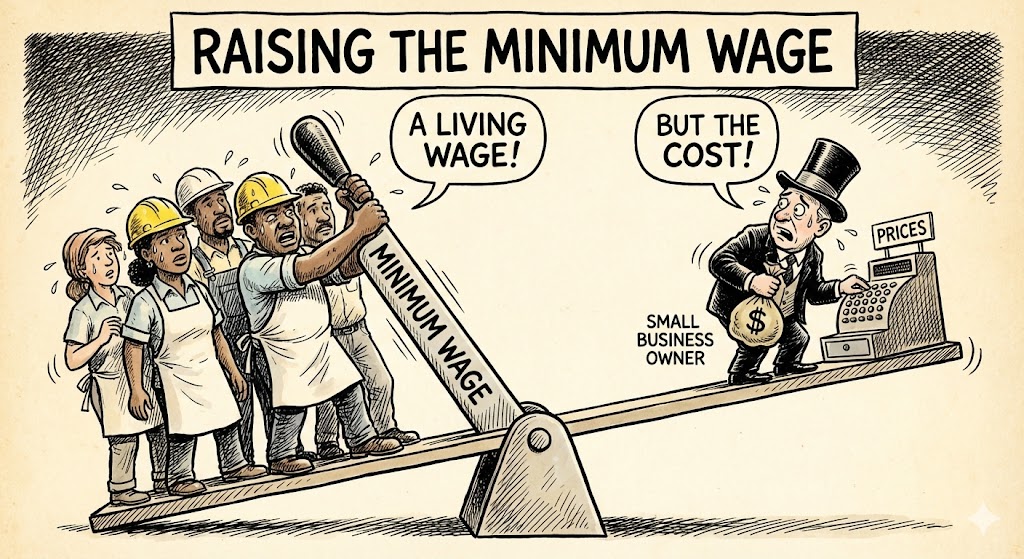
    Advocates of raising the minimum wage argue that higher wages are essential for improving affordability and economic security. Low-wage workers tend to spend a larger share of their income on necessities such as food, housing, and transportation. When wages increase, this spending can stimulate local economies through increased consumer demand. Economists often describe this as a multiplier effect, where additional income circulates through communities. Unlike tax cuts for higher earners, wage increases are more likely to produce immediate economic activity. Proponents view this as a practical tool for strengthening local and regional economies.

    Another central argument in favor of higher minimum wages is poverty reduction. Research indicates that wage increases can lift millions of workers above the poverty line. Higher earnings also reduce reliance on public assistance programs, including food aid and healthcare subsidies. This shift can ease pressure on government budgets while improving individual dignity and autonomy. From this perspective, higher wages function as both an economic and social policy. Supporters argue that the long-term fiscal benefits often outweigh short-term adjustment costs.

    Proponents also emphasize historical and structural considerations. Over decades, worker productivity has risen significantly, yet wages for low-income workers have remained largely stagnant. This divergence has contributed to income inequality and reduced social mobility. Aligning wages with productivity growth is viewed as a corrective measure rather than a radical intervention. Additional benefits cited include reduced employee turnover, higher morale, and improved health outcomes. Together, these effects suggest that higher wages may yield broader social gains beyond immediate income increases.

    IV. Arguments Against Raising the Minimum Wage

    Opponents of minimum wage increases warn that higher labor costs can contribute to inflationary pressures. Businesses facing increased payroll expenses may raise prices to maintain profitability. These price increases can offset wage gains, particularly for the same workers the policy intends to help. In sectors such as food service and retail, where profit margins are often thin, cost pass-throughs may be more pronounced. Critics argue that this dynamic risks creating a cycle in which wages and prices chase one another upward. In an economy already sensitive to inflation, such risks are viewed as significant.

    Employment effects are another major concern raised by critics. Mandated wage increases may prompt employers to reduce hours, cut positions, or accelerate automation. Entry-level and low-skilled workers are often seen as most vulnerable to these adjustments. Some studies suggest that younger workers and those with limited experience may face reduced job opportunities. Small businesses, in particular, may struggle to absorb higher labor costs without reducing staff or closing altogether. These potential outcomes raise concerns about unintended consequences for the labor market.

    From a conservative economic perspective, minimum wage laws are often framed as government overreach. Critics argue that wages should be determined by market forces such as supply, demand, and worker productivity. They contend that wage mandates distort labor markets and discourage hiring. Instead, opponents emphasize education, job training, and skills development as more effective paths to higher earnings. From this viewpoint, addressing affordability requires structural reforms rather than wage floors. The debate thus reflects deeper ideological differences about the role of government in the economy.

    V. Empirical Evidence and Case Studies

    Empirical research on minimum wage effects presents a mixed picture. Some studies find minimal negative employment impacts, particularly when increases are moderate and phased in over time. These analyses often report gains in earnings and reductions in poverty among low-wage workers. In some cases, higher wages are associated with increased productivity and employee retention. However, methodological differences make it difficult to draw universal conclusions. Outcomes often vary by region, industry, and economic conditions.

    Recent state-level wage increases in 2026 provide new data points. In states where minimum wages exceed fifteen dollars per hour, early surveys suggest workers experience modest improvements in financial stability. At the same time, many businesses report raising prices or reducing discretionary benefits. These adjustments highlight the tradeoffs involved in wage policy. While no widespread employment collapse has occurred, the long-term effects remain uncertain. Ongoing analysis will be necessary to assess durability and scalability.

    International comparisons also offer insight, though contexts differ significantly. Some countries with higher wage floors maintain strong employment levels through complementary policies such as social safety nets and labor market supports. These examples suggest that wage policy outcomes depend heavily on broader institutional frameworks. A balanced interpretation of the evidence indicates that moderate increases tend to produce net benefits. Conversely, abrupt or large hikes may introduce greater risks. Policymakers must therefore consider pace, scale, and local conditions.

    VI. The Political Divide and Path Forward

    The minimum wage debate reflects broader political polarization in the United States. Public opinion consistently shows majority support for higher wages, particularly when framed around cost-of-living adjustments. Voters in several states have approved wage increases through ballot initiatives. Despite this support, federal legislative action remains stalled. Partisan divisions and competing economic philosophies continue to impede consensus. As a result, state and local governments have taken the lead.

    Both supporters and critics increasingly acknowledge that wages alone cannot resolve affordability challenges. Inflation, housing shortages, and healthcare costs all contribute to economic strain. Some analysts argue that wage increases without complementary policies risk limited effectiveness. This recognition has opened space for alternative or supplemental approaches. These include expanding the Earned Income Tax Credit, reforming zoning laws, and subsidizing essential goods. Such measures aim to target affordability more directly.

    A pragmatic path forward may involve combining moderate wage increases with broader policy reforms. Phased adjustments tied to inflation could provide predictability for both workers and employers. Pairing wage policy with investments in housing supply and workforce development may reduce unintended consequences. Evidence-based policymaking, rather than ideological positioning, is critical. The challenge lies in balancing worker protection with economic flexibility. Achieving this balance will shape the future of affordability policy.

    VII. Conclusion

    Raising the minimum wage presents clear advantages, including improved purchasing power, reduced poverty, and greater economic equity. At the same time, concerns about inflation, employment effects, and business sustainability cannot be dismissed. Historical comparisons highlight how far wages have fallen behind productivity and living costs. A minimum wage aligned with long-term economic growth could have mitigated much of today’s affordability crisis. However, such alignment must be approached carefully. The evidence suggests that design and implementation matter greatly.

    Minimum wage increases alone are not a comprehensive solution to affordability challenges. Structural factors such as housing shortages, healthcare costs, and market concentration also play significant roles. Policymakers must therefore adopt a multifaceted strategy. Gradual, data-driven wage adjustments combined with targeted social and economic reforms offer the most promising path. Ideological stubbornness risks undermining effective solutions. A balanced approach grounded in evidence can better serve American workers in 2026 and beyond.
  • The Affordability Hoax

    The Affordability Hoax

    How Inflation, Wage Stagnation, and Policy Choices Are Crushing the American Middle Class


    I. Introduction

    Across the United States, millions of households are confronting a worsening affordability crisis that cuts across income levels but falls most heavily on the middle and working classes. The costs of housing, food, healthcare, transportation, and utilities continue to rise faster than wages, eroding purchasing power and financial stability. Surveys and economic data show that groceries represent the single largest strain for households, followed closely by housing and healthcare expenses. For many families, these pressures are no longer cyclical inconveniences but structural features of daily life. The result is a growing share of Americans who remain employed yet cannot reliably meet basic needs. This contradiction challenges official narratives of economic strength and recovery.

    By 2023, roughly one third of middle class households reported difficulty affording necessities, a figure that has worsened rather than improved in subsequent years. Even families earning between $50,000 and $100,000 annually increasingly report financial precarity once fixed costs are accounted for. These pressures are magnified for lower income households, where small price increases can immediately translate into skipped meals or delayed medical care. Despite these realities, political leaders frequently highlight aggregate indicators such as GDP growth or stock market performance as evidence of broad prosperity. Such metrics obscure the lived experience of most Americans. The gap between official optimism and household reality has become a defining feature of the current economic moment.

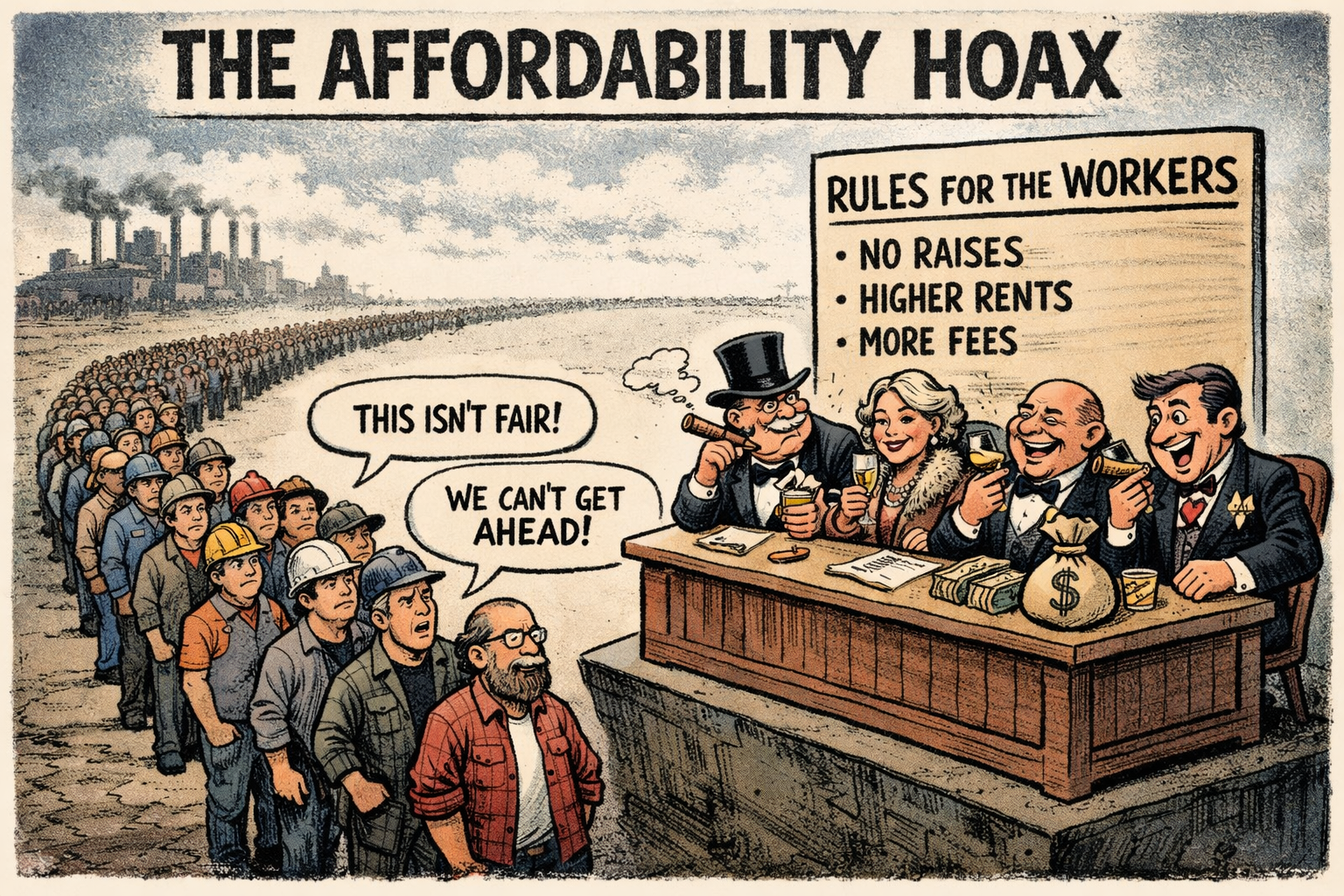
    The term “affordability hoax” captures this disconnect between political rhetoric and economic reality. It refers to the narrative advanced by the Trump Administration that inflation concerns are exaggerated and that wage growth has broadly offset rising costs. This framing minimizes structural problems such as decades long wage stagnation, rising corporate concentration, and the increasing privatization of basic necessities. By labeling affordability concerns as partisan or fabricated, policymakers deflect attention from policies that disproportionately benefit high earners. This analysis argues that inflation and wage stagnation have produced a genuine affordability crisis for middle and low income Americans. It further contends that the Trump Administration has systematically dismissed or exacerbated this crisis through policy choices and rhetorical denial.

    The Brooks Brief Substack is a reader-supported publication. To receive new posts and support my work, consider becoming a free or paid subscriber.

    II. The Roots of the Affordability Crisis: Inflation and Wage Stagnation

    The current affordability crisis did not emerge suddenly, but rather reflects long term structural trends in the U.S. economy. Since the late 1970s, wage growth for non supervisory and production workers has decoupled from productivity growth. While overall economic output has increased, the gains have disproportionately accrued to executives, shareholders, and higher income professionals. For the majority of workers, real wages have remained largely flat over decades. This divergence has left households increasingly vulnerable to price shocks. Inflation therefore operates on top of an already weakened income foundation.

    Inflation, even when headline rates appear moderate, erodes purchasing power unevenly. Essential goods and services such as food, housing, energy, and healthcare often rise faster than the overall inflation rate. In 2025, inflation remained above the Federal Reserve’s stated target, with particular spikes in electricity, insurance, and food costs. For households that spend a larger share of income on necessities, these increases function as regressive taxes. Middle and low income families have little discretionary spending to absorb higher prices. As a result, modest inflation can produce outsized hardship.

    Wage growth during this period has failed to compensate for these rising costs. Between 2021 and 2025, consumer prices rose faster than average wages, resulting in a net decline in real hourly earnings. While nominal wage increases were reported, these gains were unevenly distributed and often concentrated among higher earners or specific sectors. For low wage and service workers, wage growth frequently lagged inflation altogether. When adjusted for inflation, middle class wages in 2025 remained below their levels from decades earlier. This stagnation undermines long term financial security and limits upward mobility.

    The interaction between inflation and wage stagnation creates a self reinforcing cycle. As households devote larger shares of income to rent, food, and healthcare, they rely more heavily on credit to maintain living standards. Rising debt burdens further constrain consumption and savings, increasing vulnerability to economic shocks. This dynamic weakens overall economic resilience while masking hardship behind employment statistics. The affordability crisis is therefore not simply a short term inflationary episode. It is the product of decades of policy choices that prioritized capital accumulation over wage growth.

    III. Impacts on Middle and Low Income Classes

    The consequences of the affordability crisis are most visible in the daily tradeoffs faced by households. Middle and low income families increasingly report skipping meals, delaying medical care, or postponing essential purchases due to cost concerns. Even among households traditionally considered economically stable, financial buffers have eroded. Unexpected expenses such as car repairs or medical bills can now trigger cascading financial stress. This shift reflects a broader normalization of economic insecurity. Employment alone no longer guarantees material stability.

    Housing costs represent one of the most significant drivers of this pressure. Rent and mortgage payments consume a growing share of household income, particularly in metropolitan areas. For many renters, housing now absorbs more than 30 percent of monthly earnings, a level widely considered unaffordable. Lower income households face even higher burdens, often exceeding 40 percent of income. These conditions limit geographic mobility and constrain access to better job opportunities. Housing insecurity thus reinforces broader patterns of inequality.

    Food insecurity has also intensified, exacerbated by policy decisions at the federal level. In 2025, Congress enacted cuts to Supplemental Nutrition Assistance Program benefits, reducing monthly assistance for millions of recipients. These reductions came at a time when grocery prices remained elevated and wages had not fully recovered purchasing power. For low income families, the cuts translated directly into reduced food consumption or reliance on food banks. The decision to reduce food assistance amid rising costs highlights a policy mismatch between economic conditions and social support. It further deepens the affordability crisis for the most vulnerable households.

    Healthcare costs compound these pressures, particularly for families without comprehensive employer sponsored insurance. Out of pocket expenses, deductibles, and prescription drug costs continue to strain household budgets. Many Americans report delaying or foregoing care due to cost, increasing long term health risks and future expenses. Job insecurity in 2025 further weakened access to stable benefits for working class Americans. Together, these sector specific pressures illustrate how affordability challenges are interconnected rather than isolated. The cumulative effect is a pervasive sense of economic fragility.

    IV. Trump Administration Policies Exacerbating the Crisis

    Rather than mitigating affordability pressures, key Trump Administration policies have often intensified them. Tax policy remains a central example. The Tax Cuts and Jobs Act and its subsequent extensions disproportionately benefited high income households and corporations. While some middle income taxpayers received modest short term relief, these benefits were outweighed by long term fiscal costs and limited wage growth effects. The structure of the tax cuts prioritized capital gains and corporate profits over labor income. This approach reinforced existing inequalities rather than alleviating household cost pressures.

    Trade policy under the Trump Administration also contributed to higher consumer prices. Expanded tariffs raised the cost of imported goods, with the burden largely falling on U.S. consumers rather than foreign producers. These costs filtered through supply chains, increasing prices for household goods, appliances, and food products. While tariffs were framed as tools to protect domestic jobs, their inflationary effects undermined real wages. For households already struggling with affordability, tariffs functioned as an indirect tax. The resulting price increases further strained family budgets.

    Labor and regulatory policies compounded these effects. Rollbacks of worker protections weakened bargaining power and limited wage growth in key sectors. Cuts to housing assistance, rental support, and nutrition programs reduced the social safety net precisely as costs were rising. The reduction in food stamp benefits passed by Congress exemplifies this dynamic. Rather than expanding support during a period of elevated prices, policymakers chose austerity measures that shifted risk onto households. These decisions reflect a broader policy orientation that deprioritized affordability concerns.

    Administration officials frequently countered criticism by citing periods of nominal wage growth or low unemployment. However, these aggregate indicators obscure distributional realities and regional variation. Wage gains were uneven and often insufficient to offset rising costs of living. Low income workers, in particular, saw slower wage growth than inflation. The gap between rhetoric and outcomes underscores the limitations of the Administration’s economic framework. Policies focused on headline growth failed to address the structural drivers of affordability.

    V. Dismissal and Ignorance by the Trump Administration

    Beyond policy choices, the Trump Administration’s rhetorical approach further undermined efforts to address affordability. Officials repeatedly dismissed concerns about rising costs as exaggerated or politically motivated. Public statements emphasized falling prices or strong economic performance despite contrary evidence at the household level. This framing delegitimized lived experiences and discouraged serious policy engagement. By labeling affordability concerns as a “hoax,” the Administration shifted debate away from structural solutions. The result was policy paralysis in the face of mounting economic stress.

    This dismissal was accompanied by selective use of economic data. Aggregate inflation trends were cited without acknowledging category specific price increases that matter most to households. Similarly, wage statistics were presented without adjusting for inflation or accounting for distributional effects. Such selective framing obscured the erosion of real incomes. It also reinforced a narrative that blamed individual budgeting rather than systemic conditions. This approach weakened public trust in economic institutions and leadership.

    Policy inaction followed rhetorical dismissal. Promised initiatives to lower housing, childcare, and healthcare costs failed to materialize at scale. Instead, fiscal priorities remained aligned with tax relief for high earners and spending cuts to social programs. The food stamp reductions enacted by Congress exemplify this contradiction. At a time when families faced higher grocery prices, policymakers reduced nutritional support. This disconnect illustrates how dismissal translated into tangible harm.

    The Administration’s focus on cultural and partisan narratives further diverted attention from economic hardship. By emphasizing identity based conflicts, affordability concerns were sidelined in public discourse. This strategy fragmented political coalitions that might otherwise coalesce around shared economic interests. The dismissal of affordability therefore functioned not only as rhetoric but as a political strategy. It allowed structural economic problems to persist unchallenged.

    VI. Broader Consequences and Political Science Perspectives

    From a political economy perspective, the affordability crisis reflects patterns of elite capture and policy bias. Economic gains increasingly flow to those with capital and political influence, while costs are socialized downward. This dynamic erodes social mobility and entrenches inequality across generations. High living costs limit access to education, homeownership, and healthcare. Over time, these constraints weaken democratic participation and trust. Affordability thus becomes both an economic and political issue.

    Comparative evidence suggests alternative policy approaches are possible. Other advanced economies have mitigated affordability pressures through wage supports, housing investment, and stronger social safety nets. Targeted interventions have reduced household cost burdens without sacrificing economic growth. The contrast highlights the role of political choice rather than economic inevitability. In the United States, policy decisions have consistently prioritized market outcomes over household stability. This orientation shapes long term social outcomes.

    If current trends persist, the political consequences may be significant. Economic insecurity fuels voter dissatisfaction and political volatility. Households experiencing sustained cost pressures are more likely to disengage or support disruptive political movements. The affordability crisis therefore poses risks to institutional stability. Ignoring these pressures increases the likelihood of backlash in future electoral cycles. Addressing affordability is not only a matter of equity but of democratic resilience.

    VII. Conclusion

    The affordability crisis facing middle and low income Americans is real, measurable, and deeply rooted in structural economic trends. Inflation and wage stagnation have combined to erode purchasing power, while policy choices have failed to provide meaningful relief. The Trump Administration’s dismissal of these concerns, coupled with tax, trade, and spending policies favoring the wealthy, has worsened household insecurity. Congressional cuts to food stamp benefits further illustrate the gap between economic conditions and policy responses. Treating affordability as a hoax obscures the lived reality of millions of Americans. Confronting this crisis requires acknowledging its causes and pursuing policies that prioritize wages, affordability, and economic security for working families.