Author: Marcus Brooks

  • Is Nicolás Maduro a Political Prisoner?

    Is Nicolás Maduro a Political Prisoner?

    Examining the Legality of His Detention


    Introduction

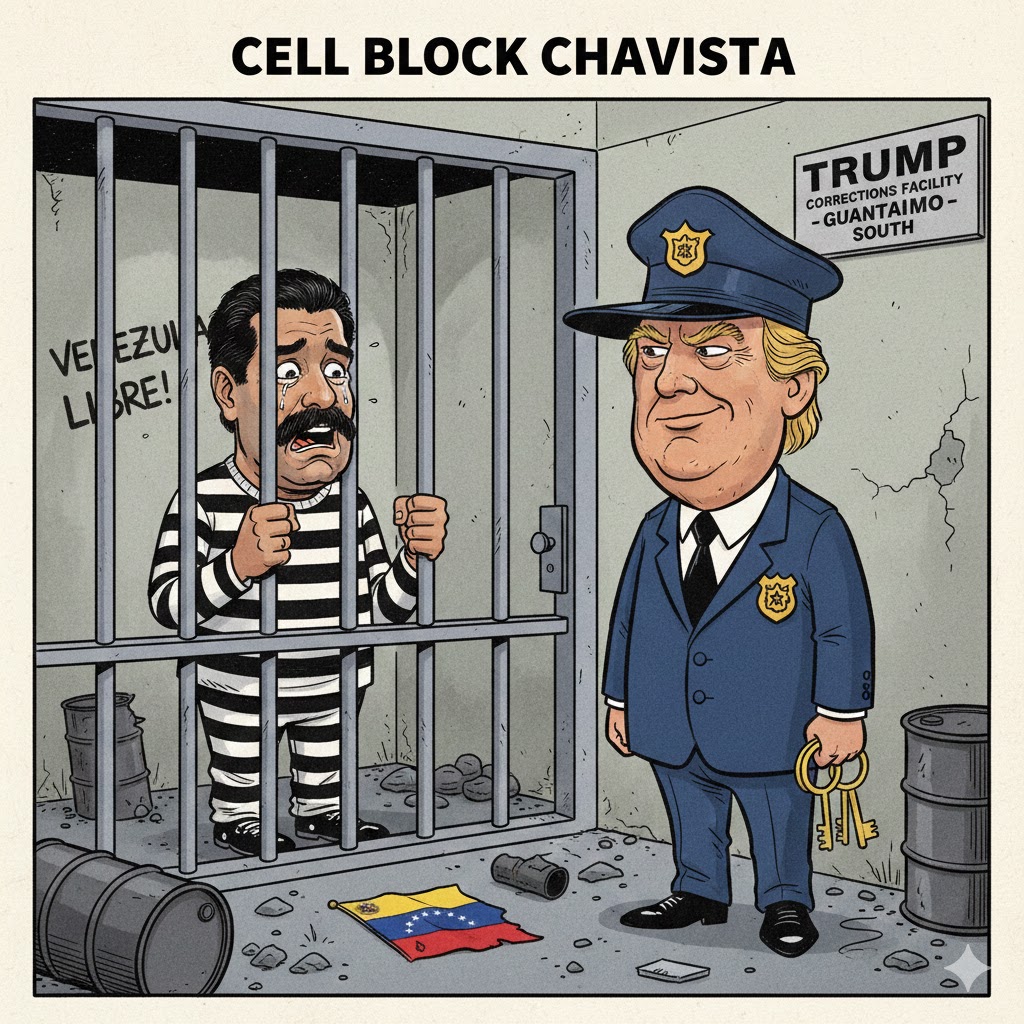
    On January 3, 2026, U.S. special forces carried out a pre-dawn raid in Caracas, capturing Venezuelan President Nicolás Maduro and his wife, Cilia Flores, amid explosions and heavy military activity. The couple was swiftly transferred to a U.S. warship and later flown to New York, where Maduro appeared in federal court on January 5 in shackles, pleading not guilty to charges including narco-terrorism, drug trafficking, and weapons offenses. The unprecedented operation triggered widespread international condemnation, with critics questioning whether it complied with global legal norms. Many argue that the forcible removal of a sitting head of state constitutes unlawful abduction rather than a legitimate arrest.

    The central debate now is whether Maduro’s detention renders him a political prisoner, targeted through extraterritorial U.S. intervention rather than standard judicial processes. As the trial approaches, the case exposes deep tensions between national sovereignty, international law, and the enforcement reach of global superpowers.

    The raid, dubbed Operation Absolute Resolve, reportedly involved more than 150 aircraft and elite military units breaching Maduro’s fortified residence. President Donald Trump praised the mission as a victory against narco-terrorism, while China and Russia condemned it as an act of aggression. In court, Maduro declared himself “kidnapped” and a “prisoner of war,” insisting he remained Venezuela’s legitimate president. Legal experts have raised concerns over potential violations of the United Nations Charter, which prohibits the use of force against sovereign states. While U.S. officials emphasize criminal accountability, critics argue that the operation’s methods risk reframing the charges as political lawfare.

    Background on Nicolás Maduro and Venezuela’s Political Crisis

    Nicolás Maduro succeeded Hugo Chávez in 2013 and has since presided over a government marked by disputed elections, economic collapse, and accusations of authoritarianism. His reelections in 2018 and 2024 were widely rejected as fraudulent, prompting the United States and several allies to withdraw diplomatic recognition and impose severe sanctions. Venezuela has endured hyperinflation, chronic shortages, and a refugee crisis that has displaced more than seven million people. Allegations of state involvement in drug trafficking have further deepened the country’s international isolation.

    In 2020, U.S. prosecutors indicted Maduro, accusing him of leading the so-called Cartel of the Suns and facilitating cocaine shipments in collaboration with Colombian guerrilla groups. A $50 million reward was offered for information leading to his arrest. These indictments formed the legal foundation for the 2026 operation.

    The January raid followed months of escalating U.S. pressure, including strikes on alleged narco-trafficking vessels that reportedly resulted in significant casualties. Trump administration officials, including Secretary of State Marco Rubio, characterized the capture as a law enforcement action supported by military assets. Maduro and Flores were briefly held aboard the USS Iwo Jima before being transferred to the Metropolitan Detention Center in Brooklyn. In Caracas, Vice President Delcy Rodríguez emerged as an interim authority, leaving the country in a state of political uncertainty amid fears of unrest and power vacuums.

    Defining a Political Prisoner

    Organizations such as Amnesty International and the United Nations define political prisoners as individuals detained primarily for political reasons, often without fair trials or due process. This category includes cases where criminal charges are used to mask ideological or geopolitical persecution. The concept of “lawfare,” or the strategic use of legal systems to achieve political objectives, further complicates the distinction between legitimate prosecution and repression.

    Historical examples frequently cited include Nelson Mandela’s imprisonment under apartheid, Alexei Navalny’s detention in Russia, and Aung San Suu Kyi’s confinement under Myanmar’s military junta. In each case, legal mechanisms were used to neutralize political threats. In Maduro’s case, the question is whether the United States is pursuing justice for alleged crimes or advancing regime change through legal means.

    The forcible extraction of a sitting head of state raises unique issues under international law, particularly concerning immunity and sovereignty. Typically, even indicted leaders are subject to extradition requests rather than military seizure. Comparisons to the 1989 capture of Manuel Noriega in Panama highlight recurring criticisms of U.S. unilateralism. Determining whether Maduro qualifies as a political prisoner requires weighing serious criminal allegations against significant procedural irregularities.

    Arguments in Favor of Maduro as a Political Prisoner

    Many legal scholars argue that Maduro’s capture constitutes a clear breach of international law, resembling an abduction rather than a lawful arrest. The operation involved a military incursion into sovereign territory without Venezuelan consent or authorization from the United Nations, potentially violating the UN Charter. Critics describe the raid as imperialistic and argue that it sets a dangerous precedent for powerful states.

    Skeptics also question the evidentiary basis of the charges, noting reliance on defectors and informants who may have political incentives. The absence of any extradition process further underscores the irregularity of the detention. Maduro’s courtroom declarations that he was kidnapped and treated as a prisoner of war have been echoed by allies such as Russia and China, as well as several Latin American governments that condemned the operation as unlawful aggression.

    The timing of the raid, amid U.S. interests in Venezuelan oil and ongoing support for opposition groups, has fueled suspicions of geopolitical motives. Human rights organizations warn that normalizing such actions could erode international norms and encourage global instability. Maduro’s defenders argue that, regardless of his governance record, his detention fits broad definitions of political imprisonment due to its overtly political context and execution.

    Arguments Against Maduro as a Political Prisoner

    The U.S. government maintains that the operation was a lawful enforcement of long-standing criminal indictments against a fugitive accused of serious transnational crimes. Prosecutors allege that Maduro oversaw cocaine trafficking operations aimed at the United States, collaborating with armed groups and using state institutions to facilitate narco-terrorism. These charges predate the raid by several years and, according to U.S. officials, reflect criminal accountability rather than political retaliation.

    In U.S. custody, Maduro is afforded legal counsel, public court proceedings, and the right to contest the charges, conditions that contrast with arbitrary political detentions. The administration also argues that Maduro lost any claim to legitimacy following the disputed 2024 election, rendering head-of-state immunity inapplicable. Supporters cite the Noriega case as precedent for prosecuting foreign leaders accused of international crimes.

    Many Venezuelan exiles and opposition figures welcomed Maduro’s removal, viewing it as an opportunity for national recovery. They note the irony of Maduro invoking victimhood given his own government’s history of imprisoning political opponents. From this perspective, the detention represents justice delayed rather than political persecution, even if the methods remain controversial.

    Broader Implications and International Perspectives

    Maduro’s capture has far-reaching implications for international law and regional stability. Venezuela now faces the risk of political fragmentation, with uncertainty over leadership and governance. The precedent challenges long-standing principles of sovereignty and non-intervention, raising concerns among smaller states wary of unilateral enforcement by powerful nations.

    Global reactions have largely followed geopolitical lines, with muted responses from Western allies and sharper criticism from the Global South. Human rights advocates stress the need for a transparent and fair trial to prevent perceptions of victor’s justice. Speculation persists that economic interests, particularly access to oil resources, influenced the timing and execution of the operation.

    Diplomatic fallout may include strained relations with China and Russia, renewed debate at the United Nations, and heightened regional tensions. For many in the Venezuelan diaspora, however, the event represents a rare opening for democratic renewal. The case may ultimately redefine the boundaries of power, law, and accountability in the international system.

    Thanks for reading The Brooks Brief Substack! This post is public so feel free to share it.

    Share

    Conclusion

    A significant body of legal opinion suggests that Nicolás Maduro’s detention may be unlawful, rooted in a military operation that violated principles of sovereignty and international norms. While the charges against him allege serious criminal conduct, the manner of his capture risks overshadowing judicial legitimacy and reinforcing claims of political persecution. Labeling Maduro a political prisoner underscores the dangers of conflating legal processes with geopolitical objectives.

    The outcome of this case will likely shape future interpretations of head-of-state immunity and extraterritorial enforcement. Ensuring a fair and transparent trial is essential to maintaining credibility and preventing the erosion of the global rules-based order. As Venezuela confronts an uncertain future, the world watches closely to see whether justice or power ultimately prevails.
  • Political Ramifications for the United States

    Political Ramifications for the United States

    Nicolás Maduro’s Upcoming Verdict on U.S. Drug Charges


    Introduction

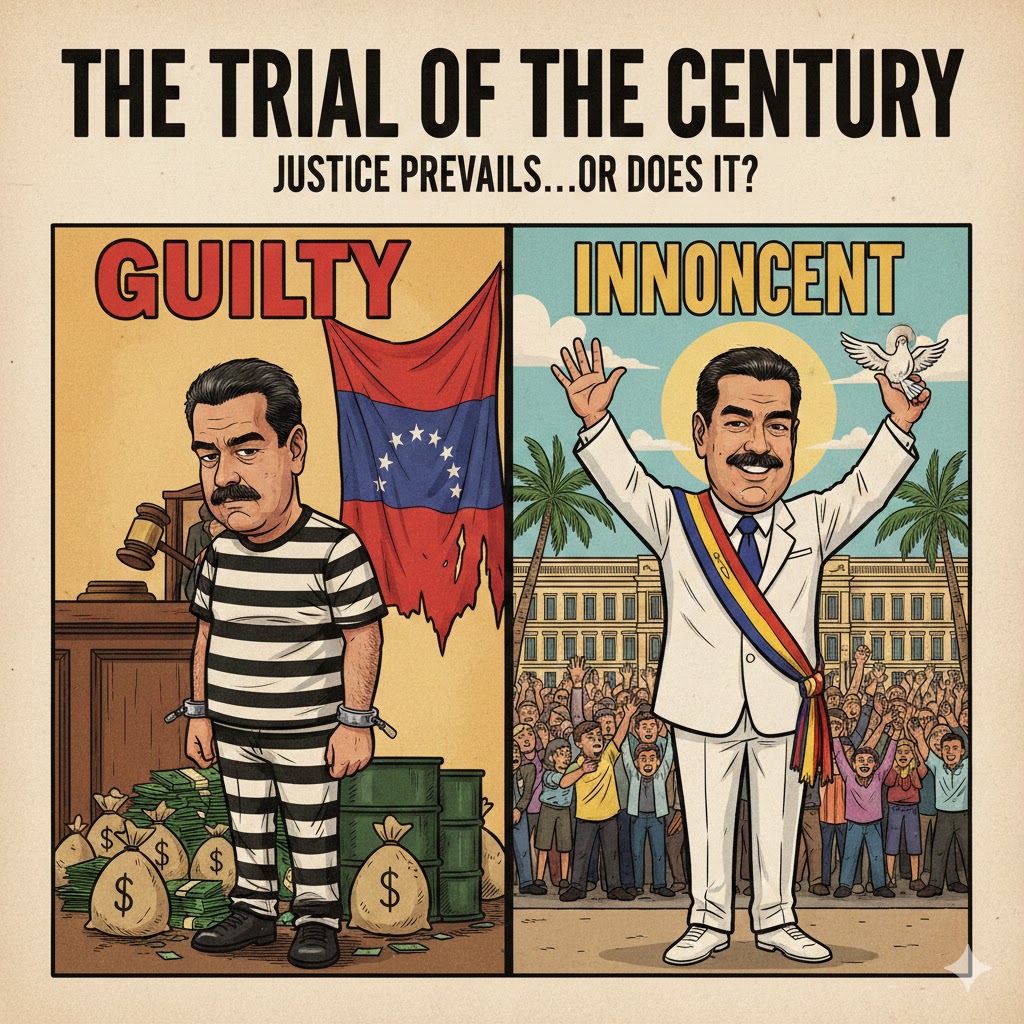
    As of January 5, 2026, the world is closely monitoring the federal trial of ousted Venezuelan leader Nicolás Maduro in a Manhattan courtroom. Maduro and his wife, Cilia Flores, face serious charges, including narco-terrorism conspiracy, conspiracy to import cocaine, and weapons offenses. Prosecutors allege that Maduro led a vast drug trafficking operation that flooded the United States with thousands of tons of cocaine over several decades. He was captured during a dramatic U.S. military operation on January 3, 2026, in Caracas, marking a bold escalation in American foreign policy. The trial’s outcome, whether guilty or innocent, could significantly influence U.S. politics, from foreign relations to domestic priorities and regional stability.

    This article examines the potential political consequences for the United States under both scenarios. Outcomes remain speculative and will depend on trial evidence, public perception, and developments within Venezuela’s transitional government under Acting President Delcy Rodríguez. A conviction could reinforce assertive U.S. action against narco-states, while an acquittal may raise serious questions about the justification of the operation and adherence to international law. Broader geopolitical reactions, including responses from Russia and China, will further shape the aftermath.

    Outcomes if Maduro Is Found Guilty

    Foreign Policy and Diplomatic Implications

    A guilty verdict would likely strengthen U.S. influence in Latin America by validating aggressive anti-narco-terrorism strategies. It could deepen partnerships with countries that opposed Maduro’s regime, such as Colombia and Brazil, fostering greater regional cooperation against drug cartels. This outcome may accelerate Venezuela’s transition toward democracy, with U.S. support directed toward opposition groups and potential sanctions relief. Globally, a conviction could deter other authoritarian leaders from entering similar drug alliances, affecting regimes in countries like Cuba or Nicaragua. However, adversaries such as Russia, China, and Iran may escalate tensions, viewing the conviction as American overreach and responding through economic pressure or proxy support for anti-U.S. actors.

    A conviction could also strain relations with international organizations that question the legality of Maduro’s capture, potentially prompting debates at the United Nations. It may encourage similar U.S. operations elsewhere, reshaping hemispheric alliances. Overall, such a verdict would reinforce the Trump administration’s hardline foreign policy approach. Risks remain if Venezuela’s political transition proves unstable. Over the long term, the outcome would position the United States as a decisive force against transnational crime.

    Domestic Political Impacts

    Domestically, a conviction would represent a significant political victory for President Trump, framing the capture and prosecution as a major success in national security and anti-drug enforcement. Conservatives would likely praise the outcome as justice served against a narco-regime, bolstering Republican support on border security and crime-related issues. Media coverage would intensify, potentially shaping public opinion and influencing upcoming elections. Voters concerned about immigration and drug trafficking tied to Venezuelan instability could rally behind the administration. At the same time, critics may continue to question the ethics, costs, and risks of the military operation.

    Congressional debates over executive authority in foreign interventions would likely intensify. Public approval of the administration could rise among voters who prioritize law and order, while isolationist voices may argue against expanded overseas involvement. The timing of the verdict could temporarily shift attention away from domestic economic or social challenges. In an already polarized political environment, the outcome would reinforce competing narratives of American power and restraint.

    Economic and Security Effects

    Economically, a guilty verdict could contribute to greater stability in global oil markets by enabling reformed Venezuelan production under new leadership, reducing U.S. reliance on volatile energy sources. Partial sanctions relief could lower energy prices for American consumers. From a security perspective, the verdict would strengthen the role of the DEA and counter-narcotics programs, potentially increasing funding for operations throughout the Western Hemisphere. A more stable Venezuela could reduce drug trafficking flows and ease migration pressures on U.S. borders.

    Improved regional alliances would enhance intelligence sharing and coordination against criminal networks. However, the risk of retaliation, including cyberattacks or covert actions, would require increased vigilance. Overall, these developments would align with broader U.S. goals of energy security and reduced transnational threats. Investor confidence in regional stability could improve, though long-term oversight of Venezuela’s economic recovery would remain essential.

    Outcomes if Maduro Is Found Innocent

    Foreign Policy and Diplomatic Implications

    An acquittal would pose a serious challenge to U.S. global credibility, suggesting that the charges were politically driven rather than supported by sufficient evidence. Maduro, if released, could return to political influence or emerge as a symbol of resistance from exile, amplifying anti-U.S. sentiment across Latin America. Allies such as Russia and China would likely intensify criticism of Washington’s actions, offering diplomatic or economic support to Venezuela and weakening American influence in the region. Future efforts to prosecute foreign leaders on similar grounds could face greater skepticism.

    At the same time, an acquittal might open the door to renewed diplomatic engagement, including negotiations over sanctions relief. Regional backlash could embolden leftist movements opposed to U.S. intervention. International forums would likely scrutinize the legality of Maduro’s capture more closely. Reduced leverage in Venezuela could prolong political and economic instability, though opportunities for multilateral diplomacy might emerge as tensions de-escalate.

    Domestic Political Impacts

    Within the United States, an innocence verdict would likely trigger intense criticism of the administration, framing the operation as a costly and unnecessary failure. President Trump’s approval ratings could suffer, particularly among voters who favor restrained foreign policy. Legal debates over sovereign immunity and executive authority could lead to congressional investigations or judicial challenges. Progressive factions may gain momentum by advocating non-interventionist approaches, while conservatives might place blame on the judiciary, deepening partisan divides.

    Media narratives would focus heavily on the financial, legal, and strategic costs of the operation. Public trust in intelligence assessments and military decision-making could erode. Calls for increased congressional oversight of foreign military actions would likely grow louder. Polarization over America’s role abroad would intensify, potentially pushing future administrations toward more cautious diplomatic strategies.

    Economic and Security Effects

    An acquittal could force a reassessment of sanctions policy, potentially affecting Venezuelan oil production and U.S. energy prices in unpredictable ways. Security risks may increase, with potential retaliatory actions such as expanded drug trafficking or cyber operations placing additional strain on U.S. resources. Continued instability in Venezuela would likely sustain migration flows, complicating domestic border policy. U.S. counter-narcotics strategies may require reevaluation in light of the trial’s outcome.

    Global energy markets could respond to perceptions of weakened U.S. influence, leading to increased volatility. Reestablishing economic ties with Venezuela would proceed cautiously, if at all. Over the long term, the acquittal would prompt deeper reflection on the costs and limits of interventionist policies. Domestic security funding priorities might shift as policymakers reassess risk. Regional partnerships would need careful rebuilding.

    Thanks for reading The Brooks Brief Substack! This post is public so feel free to share it.

    Share

    Conclusion

    The verdict in Nicolás Maduro’s trial will have far-reaching consequences for the political direction of the United States, shaped by the strength of the evidence, developments within Venezuela, and reactions from the international community. A guilty verdict could solidify an assertive U.S. posture, delivering diplomatic, economic, and security benefits. An acquittal would likely force strategic recalibration, emphasizing diplomacy and restraint over force. As proceedings continue in Manhattan, the implications extend well beyond the courtroom and into the core of American global strategy.

    Policymakers and observers must closely monitor both the trial and the global response. The case highlights enduring tensions between justice, power, and international norms. Ultimately, it serves as a test of U.S. leadership in confronting transnational crime while maintaining legitimacy on the world stage. Venezuela’s future stability remains closely tied to these outcomes. Informed foresight will be essential for navigating the challenges ahead.

  • America’s Faltering Grip

    America’s Faltering Grip

    Occupation Without Lasting Democracy


    I. Introduction

    The United States has long cast itself as the world’s leading champion of democracy, often using military force to depose authoritarian rulers and promise political renewal. In practice, American military operations have demonstrated remarkable proficiency in rapid regime change, relying on technological superiority and overwhelming force to seize control quickly. Yet the far more difficult task of nurturing stable, legitimate democratic systems has repeatedly proven elusive. Many interventions that began with decisive victories have deteriorated into prolonged instability, insurgency, and popular resentment. The January 3, 2026, Operation Absolute Resolve in Venezuela, which resulted in the capture of Nicolás Maduro and his wife Cilia Flores, exemplifies this recurring pattern. While tactically impressive, the operation has left the country’s democratic future uncertain. This contrast underscores a central argument that American power excels at military decapitation but struggles with sustainable nation-building.

    As of early 2026, Maduro’s prosecution in New York on drug trafficking and weapons charges has intensified debates over the legality and wisdom of U.S. interventionism. President Trump’s statement that the United States would temporarily “run” Venezuela revived memories of past occupations that evolved into long and costly entanglements. Venezuela’s shattered economy and deep political divisions further complicate any transition effort. Critics warn that administrative control without broad legitimacy risks inflaming nationalist backlash. Supporters counter that removing Maduro created an opening for reform that had been impossible under his rule. Whether that opening leads to democracy or renewed turmoil remains unresolved. The episode places Venezuela squarely within a long historical continuum of American interventions.

    II. Historical Successes in Occupation and Democratic Transition

    The occupations of Germany and Japan after World War II stand as the most successful examples of U.S. led democratic transformation. Both cases followed unconditional surrender, eliminating organized resistance and granting the occupiers extraordinary authority. In Germany, massive economic aid through the Marshall Plan, combined with denazification and allied coordination, laid the foundation for a stable Federal Republic. Japan’s reconstruction under General Douglas MacArthur introduced sweeping constitutional reforms, land redistribution, and demilitarization while respecting cultural continuity. These societies already possessed strong bureaucratic traditions and industrial bases that enabled rapid recovery. Broad international consensus and long-term U.S. commitment further reinforced the legitimacy of the transitions. As a result, democratic norms took hold with relatively limited resistance.

    These successes, however, were products of rare historical conditions that proved difficult to replicate. Total defeat, homogeneous societies, and shared Cold War imperatives created unusually favorable environments. Later interventions lacked similar clarity of purpose and unity of effort. Policymakers often assumed that the German and Japanese models could be exported wholesale to very different contexts. In reality, those achievements were exceptions rather than templates. Their rarity highlights the dangers of extrapolating from unique postwar circumstances. Subsequent history would show how fragile imposed political orders can be without those enabling factors. The contrast serves as a cautionary benchmark rather than a reliable precedent.

    III. Notable Failures and Mixed Outcomes

    The Vietnam War marked an early demonstration of America’s difficulties in sustaining a democratic ally under fire. Despite years of military and financial support, South Vietnam suffered from corruption, weak legitimacy, and internal divisions. These flaws undermined public confidence and allowed communist forces to maintain momentum. When U.S. forces withdrew, the government collapsed, culminating in the fall of Saigon in 1975. In Iraq, the 2003 invasion swiftly removed Saddam Hussein but dismantled state institutions through de-Ba’athification. The resulting power vacuum fueled sectarian violence and eventually enabled the rise of the Islamic State. What began as liberation devolved into prolonged instability.

    Afghanistan followed a similar trajectory on a longer timeline. Initial success against the Taliban gave way to entrenched corruption, dependence on foreign aid, and weak national cohesion. By 2021, the Afghan government collapsed almost overnight as U.S. forces departed. Shorter interventions in Haiti, Somalia, and Libya also failed to produce lasting political order. In each case, early gains dissolved into factional conflict or warlordism. These experiences reveal consistent miscalculations about local dynamics and governance capacity. Military success alone proved insufficient to secure durable political outcomes.

    IV. Recent Example: U.S. Efforts at Regime Change in Venezuela (2019–2026)

    Venezuela’s economic and humanitarian collapse under Nicolás Maduro set the stage for escalating U.S. involvement beginning in 2019. Hyperinflation, collapsing oil production, and mass emigration eroded the regime’s domestic credibility. Washington initially pursued diplomatic pressure by recognizing Juan Guaidó as interim president and imposing sweeping sanctions. Regional and international partners largely supported these measures, yet Maduro retained control through loyal security forces. Negotiations failed to produce a breakthrough, and the failed 2020 incursion underscored the limits of indirect pressure. The widely condemned 2024 election further isolated the regime but did not dislodge it. By late 2025, allegations linking Venezuelan leadership to narcotics trafficking accelerated the move toward direct action.

    Operation Absolute Resolve on January 3, 2026, marked a decisive shift in U.S. strategy. Coordinated airstrikes neutralized key defenses, allowing special forces to capture Maduro and Flores in Caracas. The operation involved more than 150 aircraft and concluded without American casualties. Within days, the couple appeared in federal court in Manhattan to face criminal charges. Venezuela’s Supreme Court appointed Vice President Delcy Rodríguez as acting president, initially rejecting U.S. authority before signaling openness to talks. President Trump emphasized American oversight of oil assets and reconstruction plans. Excluding prominent opposition figures from early arrangements raised concerns about legitimacy and representation. The rapid success avoided a full-scale invasion but revived familiar questions about the aftermath.

    International reaction was swift and divided. Some governments condemned the action as a violation of sovereignty, while others quietly welcomed Maduro’s removal. Reports of Cuban casualties heightened regional tensions. Russia and China warned against precedent-setting unilateral interventions. Inside Venezuela, uncertainty prevailed as citizens weighed relief against fear of foreign control. The operation’s focus on energy security complicated narratives of democratic liberation. These dynamics mirror earlier interventions where short-term success masked long-term fragility. Venezuela thus stands at a crossroads shaped as much by geopolitics as by internal reform.

    V. Factors Influencing U.S. Ability to Occupy and Transition

    American military doctrine prioritizes speed, precision, and overwhelming force, qualities evident in the Venezuela operation. Such capabilities allow the United States to dismantle hostile regimes with remarkable efficiency. Sustaining order afterward, however, requires prolonged political and financial commitment that often proves unpopular at home. Counterinsurgency and institution-building demand patience that clashes with electoral cycles and public fatigue. Reconstruction programs frequently falter in environments marked by corruption and weak administrative capacity. Attempts to impose Western-style governance can alienate local populations whose political cultures differ significantly. These tensions undermine legitimacy and fuel resistance.

    External actors further complicate post-intervention environments. Rival powers exploit instability to expand influence and discredit U.S. intentions. Proxy support and information campaigns erode fragile transitional authorities. In Venezuela, rhetoric emphasizing oil control risks portraying the intervention as economic exploitation. Such perceptions weaken claims of democratic intent. Without broad international backing, legitimacy remains contested. The cumulative effect limits America’s ability to translate battlefield victories into political success. Structural constraints thus shape outcomes as much as strategy.

    VI. Current Capabilities and Future Prospects (as of 2026)

    By 2026, U.S. foreign policy increasingly reflects competition with major powers rather than expansive nation-building. Lessons from Afghanistan have reinforced skepticism toward prolonged occupations. Policymakers now favor targeted operations and partnerships over large-scale deployments. Venezuela’s intervention aligns with this approach, emphasizing precision and limited exposure. Fiscal pressures and domestic polarization further restrict ambitions for transformative reconstruction. Instead, U.S. objectives increasingly prioritize stability, resource security, and counter-narcotics efforts. This shift represents a more realist assessment of American influence.

    Whether this model can succeed remains uncertain. Venezuela’s political transition will test the effectiveness of limited intervention combined with external pressure. Acting President Rodríguez faces competing demands from domestic factions and foreign sponsors. U.S. leverage may prove sufficient to shape outcomes without direct governance. Alternatively, unresolved tensions could reignite conflict. The case will influence future policy debates about the scope of American power. Its outcome may signal whether adaptive restraint can replace ambitious interventionism.

    VII. Challenges and Criticisms

    U.S. interventions routinely attract accusations of imperialism, particularly when conducted without broad multilateral approval. Reports of civilian harm and selective enforcement of international law erode moral authority. Venezuela’s case has sparked intense debate within the United Nations and regional organizations. Critics argue that unilateral regime change undermines global norms of sovereignty. Domestic constraints also limit staying power, as Congress and voters resist open-ended commitments. Political divisions weaken policy coherence over time. Adversaries amplify these critiques to challenge American leadership.

    Economic motivations further complicate perceptions. Emphasis on Venezuelan oil assets has fueled suspicions of profiteering. Such narratives resonate in regions with histories of foreign exploitation. Even successful transitions risk being delegitimized by their origins. Balancing strategic interests with ethical claims remains a persistent challenge. These criticisms expose the vulnerability of interventions conducted largely alone. They also shape global responses to future U.S. actions.

    Thanks for reading The Brooks Brief Substack! This post is public so feel free to share it.

    Share

    VIII. Conclusion

    The historical record reveals a consistent pattern in U.S. interventions: decisive military success followed by uncertain political outcomes. Postwar Germany and Japan remain rare exceptions rather than enduring models. Venezuela’s 2026 operation demonstrates that America still excels at removing hostile leaders. It also illustrates the enduring difficulty of translating force into legitimate democratic governance. Resource-driven narratives and limited international backing heighten the risk of failure. More inclusive, multilateral, and locally grounded approaches may offer better prospects. Ultimately, democracy cannot be sustainably imposed from outside. The Venezuelan case underscores the need for humility and restraint in pursuing democratic ideals abroad.

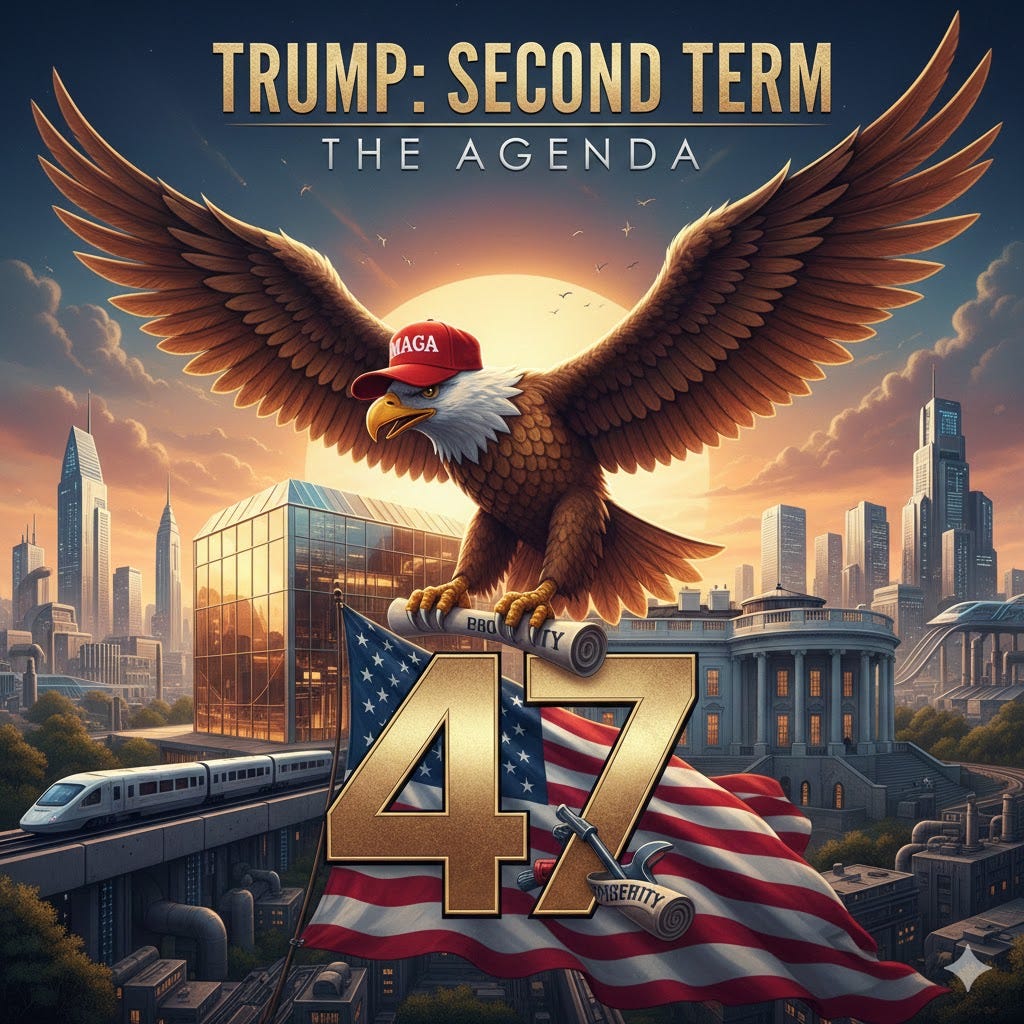
  • Trump’s Second Term

    Trump’s Second Term

    Centralizing Power Amid Domestic Debates and International Anarchy


    As President Donald Trump begins his second term in office, his administration’s aggressive pursuit of executive authority has sparked intense debate in Washington and beyond. Entering 2026, Trump’s agenda emphasizes centralization through sweeping actions on tariffs, immigration, and deregulation, challenging the traditional checks and balances embedded in the U.S. Constitution. These moves not only test the limits of presidential power at home but also highlight the anarchic nature of international law, where enforcement relies on raw power rather than a global authority. This analysis examines how Trump’s strategies are reshaping governance domestically while navigating a lawless international environment.

    Executive Actions: Tariffs as a Tool of Economic Leverage

    A cornerstone of Trump’s second-term agenda is the use of broad tariffs to protect American industries and rebalance trade. Shortly after his inauguration on January 20, 2025, Trump issued executive orders that significantly altered U.S. trade policy. He extended the suspension of heightened reciprocal tariffs on Chinese imports until November 10, 2026, signaling a temporary thaw in U.S.-China relations amid ongoing negotiations. Additional measures established a 15 percent minimum tariff on imports from more than 60 countries to counter what the administration describes as decades of unfair trade practices. Another executive order eliminated the de minimis exemption for low-value shipments under $800, applying tariffs globally to curb perceived loopholes.

    These measures are projected to increase the average tax burden on U.S. households by $1,100 in 2025 and $1,400 in 2026, according to economic analyses. Supporters argue that tariffs will strengthen manufacturing jobs and national security, while critics warn of inflationary pressures and retaliatory measures from trading partners. The Supreme Court is expected to weigh in on the constitutionality of these tariffs in 2026, with early hearings suggesting judicial skepticism.

    Immigration and Deregulation: Streamlining Authority

    Trump’s executive overhauls extend to immigration, where his administration has prioritized stricter enforcement through regulatory changes. Measures include enhanced deportation protocols and tightened asylum restrictions, building on promises from the 2024 campaign. These initiatives aim to centralize decision-making within the executive branch, bypassing bureaucratic hurdles that the administration argues slow governance.

    Deregulation is another key focus. Trump has issued orders to roll back environmental and financial safeguards imposed by previous administrations. By the end of 2025, hundreds of regulations were under review, framed as barriers to economic growth. This approach mirrors his first term but with greater intensity, using executive authority to implement changes that might otherwise require congressional approval.

    Debates on Checks and Balances: A Constitutional Test

    These policies have sparked debates about the erosion of checks and balances. Critics, including legal scholars and opposition lawmakers, argue that Trump’s reliance on executive orders circumvents Congress and the judiciary, raising the risk of a constitutional crisis. Surveys from late 2025 show growing public concern that the president is exceeding his authority, with many viewing these moves as unprecedented in modern U.S. history.

    Experts at Harvard Kennedy School warn that these actions challenge the rule of law by transforming federal operations in ways that strain the separation of powers. The Supreme Court is set to address disputes over tariff authority and regulatory overhauls in 2026. Defenders contend that the measures are necessary to fulfill campaign promises and improve efficiency, citing historical instances when presidents expanded executive power during crises. Lawmakers such as Congressman Jimmy Panetta emphasize the need to protect democratic norms, noting that checks and balances must adapt to prevent overreach. As 2026 progresses and midterm elections approach, these tensions could lead to legislative pushback or judicial rulings that redefine the limits of presidential power.

    The Anarchy of International Law: Force as the Ultimate Arbiter

    Trump’s unilateral actions also highlight the anarchic nature of international law. Unlike domestic systems with enforceable courts and police, the global order lacks a superior authority to resolve disputes or enforce penalties. States rely on self-enforcement, voluntary compliance, or the use of force (economic, military, or otherwise) to protect their interests.

    There is no formal mechanism to address violations of international norms beyond the power that individual countries can wield, as seen in trade conflicts or military interventions. Trump’s tariffs illustrate this dynamic: by imposing economic sanctions without multilateral agreement, the United States asserts dominance in a system where strength often dictates outcomes. These policies could escalate tensions with both allies and adversaries. Domestic debates are amplified as unchecked executive power at home enables bolder foreign actions, highlighting the delicate balance between domestic authority and international influence.

    Thanks for reading The Brooks Brief Substack! This post is public so feel free to share it.

    Share

    Conclusion: A Pivotal Year Ahead

    As 2026 unfolds, Trump’s drive to centralize authority through executive actions on tariffs, immigration, and deregulation will intensify scrutiny over America’s system of checks and balances. Simultaneously, these policies underscore the anarchic underpinnings of international law, where force remains the primary instrument of enforcement. Whether these measures result in economic growth, constitutional confrontation, or shifts in global power remains uncertain. One certainty is that Trump’s second term is poised to leave a lasting imprint on domestic governance and the international landscape.

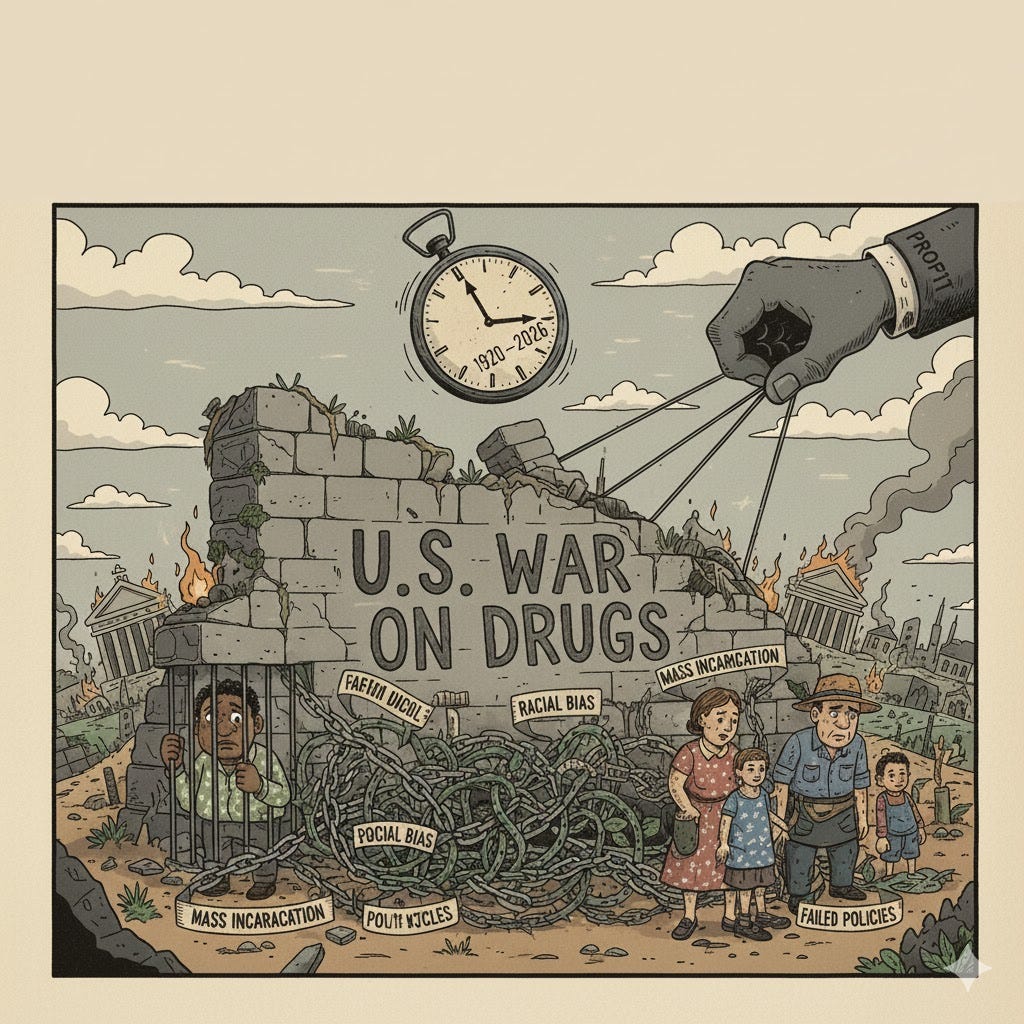
  • The U.S. War on Drugs in 2026

    The U.S. War on Drugs in 2026

    A Century of Policy Failures and Entrenched Inequities


    I. Introduction

    The U.S. war on drugs, now over five decades old, stands as a monumental policy failure that has deepened social divisions, economic disparities, and international tensions by 2026. What began as a purported effort to curb substance abuse has evolved into a mechanism for mass surveillance, incarceration, and geopolitical maneuvering, costing trillions while drug availability remains rampant. In an era where fentanyl overdoses claim over 50,000 lives annually, the policy’s punitive focus ignores root causes such as poverty and mental health, instead prioritizing enforcement that disproportionately affects marginalized communities. Politicians continue to tout aggressive tactics, including recent boat strikes and tariffs, as victories. Yet overdose rates have only marginally declined from peaks in prior years, suggesting superficial progress amid ongoing crises. This article traces the war’s origins from global imperial conflicts to its modern manifestations, arguing that it serves more as a tool for control and profit than genuine public health intervention. By examining historical precedents and current realities, we reveal how drug policies perpetuate inequality and justify foreign interventions under the guise of security.

    As we enter 2026, the war on drugs faces renewed scrutiny amid shifting political landscapes, with some states advancing decriminalization while federal actions intensify border crackdowns and international sanctions. The Trump administration’s revival of aggressive enforcement, including threats against Mexico and China over fentanyl precursors, echoes past eras but amplifies risks of escalation into broader conflicts. Despite claims of progress, such as a 14.5 percent drop in overdose deaths by late 2025, critics argue these gains stem from prior public health initiatives now being dismantled in favor of militarized approaches. Economic incentives, from private prisons to pharmaceutical lobbying, further entrench the system, turning addiction into a lucrative industry rather than a solvable crisis. Ultimately, this ongoing war highlights a fundamental mismatch between rhetoric and reality, where victory is measured not in lives saved but in budgets allocated and enemies designated.

    II. Historical Foundations: From Global Conflicts to Domestic Epidemics

    The Opium Wars of the mid-19th century set a precedent for how drugs could be weaponized in international power struggles, with Britain forcing opium trade upon China to balance trade deficits and extract concessions. This imperial exploitation led to widespread addiction in China, crippling its society and economy while enriching Western powers, including early American traders who profited from the illicit market. The conflicts demonstrated drugs’ potential as tools of economic warfare, foreshadowing later U.S. policies that blended moral crusades with strategic interests. By the wars’ end, China ceded territories such as Hong Kong, illustrating how drug-related coercion could reshape global maps and alliances. These events planted the seeds for viewing narcotics not just as health issues but as levers for geopolitical dominance, a perspective that would influence American approaches in the centuries ahead.

    During the American Civil War, morphine emerged as a battlefield staple, administered to wounded soldiers to alleviate pain amid brutal combat conditions. Dubbed “Soldier’s Disease,” post-war addiction afflicted tens of thousands of veterans, marking the U.S.’s first major opioid crisis and prompting initial calls for regulation. The widespread availability of morphine through patent medicines exacerbated civilian dependency, blending medical use with unchecked commercial exploitation. This era highlighted the dual-edged nature of opioids: essential for relief yet prone to abuse when poorly managed. As addiction rates soared, it spurred early federal interventions, setting the stage for viewing drugs through a lens of moral panic rather than public health.

    The heroin boom of the early 1900s transformed a supposed medical miracle into a societal scourge, as Bayer marketed it as a safer alternative to morphine only for addiction to explode in urban centers. Racialized fears linked heroin to immigrant groups, fueling discriminatory laws such as the Harrison Narcotics Tax Act of 1914, which criminalized possession and shifted control from doctors to the state. This period saw heroin infiltrate everyday life, from cough syrups to recreational use, amplifying public hysteria and justifying expanded government oversight. The boom underscored how pharmaceutical innovation could backfire without regulation, creating epidemics that policymakers exploited for political gain. By associating drugs with marginalized communities, early 20th-century responses laid the groundwork for the inequities that define the war on drugs today.

    Marijuana prohibition in the United States was deeply intertwined with racial prejudice and social control. In the early 20th century, anti-cannabis campaigns explicitly targeted Mexican immigrants and Black communities, portraying marijuana use as a threat to public safety and morality. Newspapers and policymakers stoked fears that marijuana caused violent behavior, crime, and moral decay among minority populations, framing the substance as inherently dangerous because of the communities associated with it. These narratives facilitated the Marihuana Tax Act of 1937, effectively criminalizing marijuana and establishing a framework that linked drug policy with racial discrimination. The stigma persisted for decades, painting marijuana users as deviant or criminal, while alcohol and tobacco, often consumed by white Americans, faced far lighter regulation. This racialized foundation shaped enforcement patterns, contributed to mass incarceration, and delayed any serious consideration of marijuana as a medical or recreational option for the broader population.

    III. The Formal Declaration: Nixon’s War on Drugs from 1971 Onward

    In 1971, President Nixon declared drugs “public enemy number one,” launching a comprehensive offensive that intertwined domestic law enforcement with efforts to suppress countercultural movements. This declaration led to the creation of the Drug Enforcement Administration (DEA) in 1973, centralizing federal anti-drug operations and emphasizing eradication over treatment. Policies such as mandatory minimum sentences disproportionately targeted non-violent offenders, ballooning prison populations while failing to reduce drug supply. International initiatives, including funding anti-narcotics operations in Colombia, often masked broader U.S. interventions in Latin America. Nixon’s approach, rooted in political strategy, set a tone of militarization that subsequent administrations would amplify.

    Under Reagan in the 1980s, the war escalated with campaigns like “Just Say No” and the 1986 Anti-Drug Abuse Act, which imposed harsh penalties for crack cocaine, exacerbating racial disparities in sentencing. The crack-powder cocaine disparity—treating crack more severely despite similar effects—reflected biases that imprisoned Black communities at far higher rates than white communities using powder cocaine. Funding surged for interdiction and incarceration, fostering a prison-industrial complex that profited from the policy’s failures. International efforts intensified, with U.S. support for fumigation in Andean countries often damaging local economies and environments. This era solidified the war as a bipartisan endeavor, with later presidents such as Clinton expanding prisons through the 1994 Crime Bill, perpetuating a cycle of punishment over prevention.

    The early 2000s saw the explosive rise of OxyContin, a prescription opioid marketed aggressively by Purdue Pharma as a safe, non-addictive painkiller. Widespread promotion to doctors and misleading claims about its addictiveness fueled mass prescription, creating a nationwide epidemic of dependency. Communities across rural and urban America experienced soaring overdose rates, while pharmaceutical companies profited immensely and faced minimal accountability for their role in the crisis. The epidemic exposed how corporate interests could manipulate medical systems, turning treatment into a vector for addiction. OxyContin’s impact extended beyond individual health, straining emergency services, increasing foster care placements, and deepening economic despair in hard-hit regions. This era cemented the link between corporate profit, regulatory failure, and the perpetuation of drug epidemics, setting the stage for the modern opioid crisis that continues to challenge policymakers in 2026.

    IV. The Current Scenario in 2026: Persistent Failures and Evolving Challenges

    Mass incarceration remains a hallmark of the war on drugs in 2026, with over 360,000 people imprisoned for drug offenses, comprising one in five of the total incarcerated population. Despite a 46 percent reduction in drug-related imprisonments from 2007 peaks, the U.S. still spends over $80 billion annually on incarceration, fueling debates on reform amid low crime rates. Partial decriminalization in states such as Oregon has sparked national conversations, yet federal resistance persists, with the prison-industrial complex lobbying against changes. Critics argue that incarceration does little to address addiction, instead creating barriers to reintegration and perpetuating poverty cycles. As overdose deaths hover around 52,000 yearly from fentanyl, calls for abolition or sentencing reform grow louder, highlighting the policy’s inefficacy.

    In 2025, President Trump announced an initiative to reclassify marijuana from a Schedule 1 to a Schedule 3 controlled substance, signaling a potential shift in federal policy that could address one of the longstanding barriers for the legal cannabis industry. While Schedule 3 is still considered a substance controlled, it recognizes medical use and enables financial institutions to work with dispensaries more freely. This reclassification could allow cannabis businesses in legal states to open bank accounts and access credit, reducing reliance on cash operations that have posed significant security risks. Critics caution that the move may not go far enough to rectify decades of harm caused by prohibition, particularly for communities historically targeted by marijuana enforcement. Nevertheless, the policy represents a pragmatic acknowledgment that federal law must align with state-level legalization and evolving public attitudes, highlighting the tension between legacy stigma and contemporary economic and regulatory realities.

    Racial and class inequalities in justice and wealth continue to define drug enforcement, with Black individuals arrested for drug offenses at rates far exceeding their actual usage, despite similar rates across demographics. Felony convictions strip voting rights and employment opportunities for many Americans, widening wealth gaps in communities of color. Pharmaceutical companies implicated in the opioid crisis face minimal accountability while private prisons profit from disproportionate sentences. The shift toward cannabis legalization generates tax revenue but benefits corporations over those historically harmed by prohibition. In 2026, these disparities underscore how the war exacerbates systemic racism, with Black people incarcerated at over four times the rate of whites for similar offenses.

    Drugs also serve as a pretext for international conflicts, with U.S. interventions in Mexico and sanctions on China over fentanyl precursors masking economic and military agendas. The Trump administration’s 2025 tariffs and boat strikes against Venezuelan vessels exemplify this, claiming to disrupt trafficking but risking broader escalations. Operations such as the HALT Fentanyl Act impose mandatory minimums and target precursors, yet cartels adapt, shifting routes while U.S. deaths remain high. Proxy conflicts in Latin America, funded under anti-drug banners, advance U.S. interests but devastate local populations. As tensions with China rise over synthetic opioids, the policy blends national security with drug control, justifying sanctions and military aid that often fuel instability.

    Thanks for reading The Brooks Brief Substack! This post is public so feel free to share it.

    Share

    V. Conclusion

    From the Opium Wars’ imperial exploitation to 2026’s militarized fentanyl crackdowns, the U.S. war on drugs has consistently prioritized control over compassion, entrenching inequalities and geopolitical strife. Historical epidemics such as morphine addiction after the Civil War and the heroin boom revealed drugs’ medical perils, yet responses veered toward criminalization rather than care. Nixon’s declaration and subsequent escalations built a punitive framework that ballooned incarceration and racial divides with little impact on supply. Today, mass imprisonment, justice inequities, and international excuses persist, costing lives and billions while overdose crises endure. This trajectory exposes policy as a mechanism for profit and power rather than public welfare.

    Breaking this cycle in 2026 demands harm reduction strategies, full decriminalization, and investments in mental health and poverty alleviation rather than enforcement. With elections looming, polarized debates could spur reforms such as rescheduling cannabis federally or expanding treatment access. International cooperation, rather than unilateral strikes, might address global supply chains more effectively. Ultimately, reimagining drugs as a health issue could save resources and lives, fostering equity in a landscape scarred by decades of failure. The path forward lies in evidence-based approaches, not endless war.

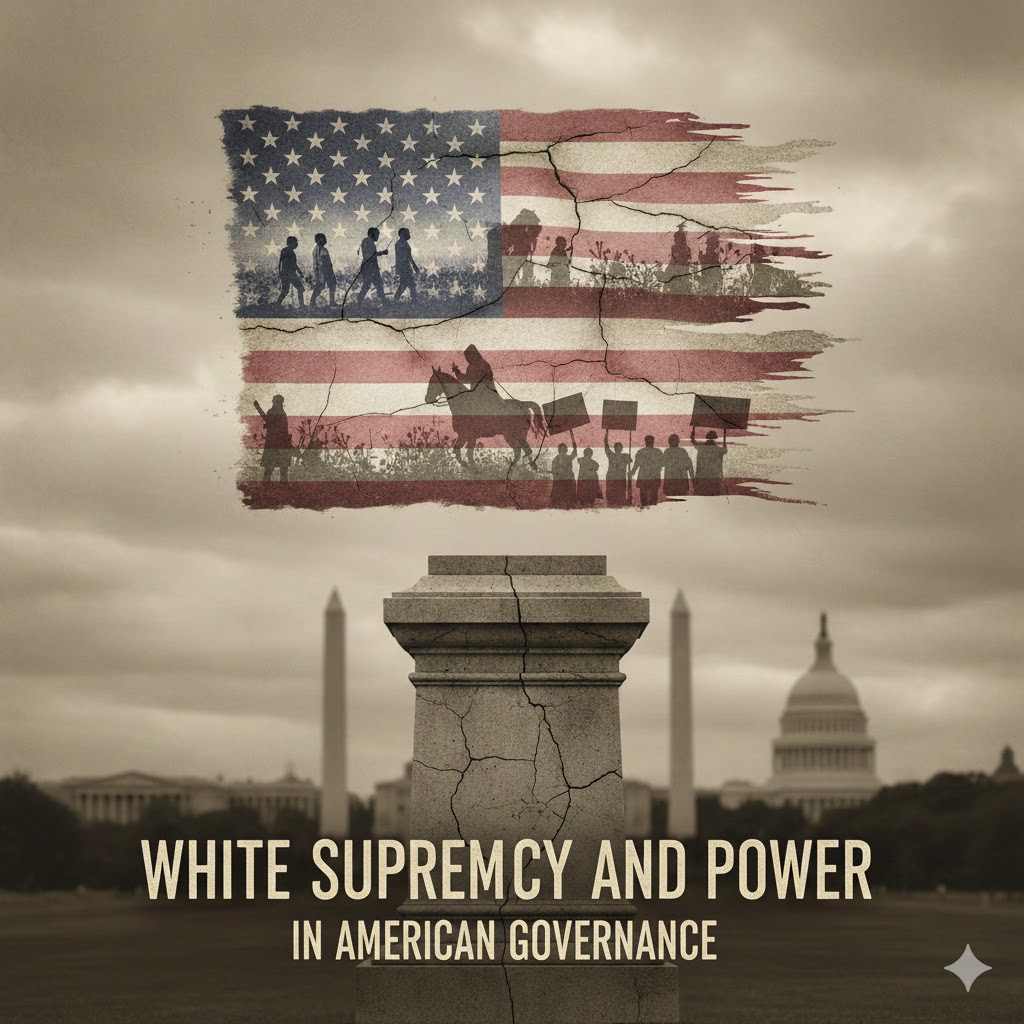
  • White Supremacy and Power in American Governance

    White Supremacy and Power in American Governance

    The Overt and Covert War


    White supremacy in American politics is best understood not solely as an extremist ideology, but as a historical system of power embedded in laws, institutions, and policy outcomes. While explicit racial hierarchy has been formally rejected, its structural legacy continues to influence governance and political behavior. This analysis examines how racial hierarchy was constructed, reinforced, and adapted over time within American political systems. From the nation’s founding through the present day, race has shaped access to citizenship, representation, and economic opportunity. Contemporary political debates often reflect this inherited structure, even when race is not explicitly mentioned. Understanding this evolution is essential for evaluating current policy conflicts and democratic legitimacy.

    Historical Foundations of Racial Hierarchy

    The political economy of early America was inseparable from slavery and racial exclusion. Enslaved labor underwrote economic growth while shaping constitutional compromises that preserved white political dominance. The Three-Fifths Clause enhanced representation for slaveholding states while denying basic rights to enslaved people. Early citizenship laws further reinforced racial hierarchy by restricting naturalization to white individuals. Federal land policies displaced Indigenous populations and redistributed land primarily to white settlers. These decisions created a durable racial order that linked political power, land ownership, and citizenship.

    Reconstruction and Institutional Retreat

    The Civil War disrupted the racial hierarchy but did not dismantle it permanently. Reconstruction introduced constitutional amendments designed to establish legal equality and political inclusion for formerly enslaved Americans. For a brief period, federal enforcement enabled Black political participation and representation. However, resistance from Southern elites combined with waning political will in the North undermined these efforts. Violence, intimidation, and legal obstruction weakened Reconstruction from within. The federal government’s withdrawal in 1877 effectively restored white political control in the South. This retreat demonstrated the fragility of racial reform without sustained institutional commitment.

    Jim Crow as State Policy

    Jim Crow was not an informal social arrangement but a comprehensive political system enforced by law. Segregation statutes governed nearly every aspect of public life and were upheld by courts. Voting restrictions systematically excluded Black citizens while maintaining the appearance of legal neutrality. Political violence functioned as enforcement, deterring challenges to the racial order. Supreme Court decisions legitimized segregation and restricted federal intervention. This period entrenched racial hierarchy within state institutions and normalized inequality across generations. The durability of Jim Crow reflected political consensus rather than isolated regional prejudice.

    Civil Rights and Conditional Reform

    The Civil Rights Movement forced federal intervention through sustained political pressure. Legislative victories in the 1960s dismantled formal segregation and expanded voting rights. These reforms reshaped the electorate and altered party coalitions. However, they also triggered new political strategies designed to preserve existing power structures. Appeals to law and order reframed racial conflict in ostensibly neutral terms. Enforcement mechanisms weakened over time as political priorities shifted. The result was progress constrained by institutional resistance rather than a complete transformation of power relations.

    Structural Inequality in the Post-Civil Rights Era

    After overt discrimination became illegal, racial hierarchy persisted through policy design and enforcement. Criminal justice policies disproportionately impacted minority communities while claiming race neutrality. Housing and lending practices reinforced segregation and limited wealth accumulation. Electoral mechanisms such as gerrymandering reduced minority political influence despite demographic growth. Judicial rulings weakened oversight of voting protections. These outcomes reflect structural persistence rather than individual prejudice. Inequality continued through institutional momentum rather than explicit intent.

    Contemporary Politics and the Trump Era

    The Trump era highlighted how racial grievance politics can operate within mainstream political discourse. Campaign rhetoric framed national identity and immigration in exclusionary terms without explicit racial language. Policy decisions disproportionately affected non-white populations while emphasizing security and sovereignty. Responses to extremist violence raised concerns about political normalization. At the same time, civil rights enforcement was reduced across multiple federal agencies. Judicial appointments reshaped the legal environment governing voting rights and discrimination. These developments illustrate how leadership and institutions interact to shape long-term political outcomes.

    In early 2026, President Donald Trump’s administration conducted a military operation in Venezuela that resulted in the capture and removal of President Nicolás Maduro and his wife, Cilia Flores, following U.S. airstrikes on multiple targets. Trump announced that the United States would temporarily oversee Venezuela’s transition, citing the need to stabilize the country and rehabilitate its oil infrastructure with the involvement of U.S. energy companies. This intervention echoes longstanding patterns in American foreign policy in which actions in Latin America are framed as democratic or security measures while functioning as mechanisms of control over non-white nations.

    From the Monroe Doctrine through the Roosevelt Corollary, the United States has repeatedly intervened in the region while treating Latin American sovereignty as conditional. Trump’s justification for removing Maduro aligns with earlier regime change efforts that prioritized U.S. economic interests and geopolitical dominance. These interventions disproportionately affect populations in the Global South and reinforce a hierarchy in which American authority is portrayed as inherently superior. The Venezuela operation illustrates how domestic racial power structures can extend into foreign policy. It underscores the persistence of a global racial order shaped by American dominance rather than mutual sovereignty.

    Rebuttal: Addressing Common Critiques

    Critics often argue that focusing on white supremacy unfairly assigns racial intent to individual policymakers or exaggerates race as a factor in governance. This analysis does not claim that all political actors are motivated by racial animus. Instead, it examines how institutions and policies can produce unequal outcomes regardless of stated intent. Others contend that socioeconomic class, not race, is the primary driver of inequality. While class is a crucial factor, race has historically structured access to wealth, housing, and political power in ways that cannot be separated from class alone. Some argue that civil rights legislation resolved these issues decades ago. Persistent disparities and weakened enforcement suggest that legal reform without institutional maintenance is insufficient. The evidence indicates that racial hierarchy has adapted rather than disappeared.

    Thanks for reading The Brooks Brief Substack! This post is public so feel free to share it.

    Share

    Conclusion

    White supremacy in American politics has evolved from explicit legal enforcement to structural and institutional persistence. Its influence remains visible in policy outcomes, political strategy, and access to democratic participation. Historical analysis reveals continuity between past and present systems of governance. Addressing inequality requires more than symbolic recognition or isolated reform. It demands sustained institutional accountability and rigorous policy evaluation. The central political question is whether American democracy will continue to accommodate inherited hierarchies or actively dismantle them through reform. The answer will shape the nation’s political trajectory for decades to come.

  • America’s Potential Next Targets

    America’s Potential Next Targets

    Resource-Driven Foreign Policy in the Post-Maduro Era

    The Brooks Brief

    Jan 03, 2026


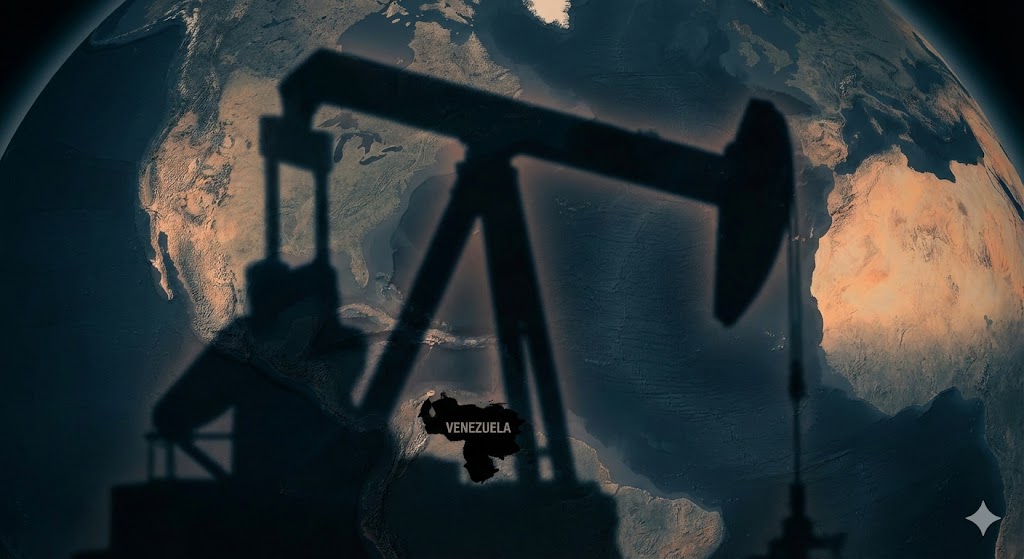
    In the wake of the swift removal of Nicolás Maduro from power in Venezuela, the United States finds itself at a crossroads in its foreign policy. The operation, which culminated in a full-scale military intervention, has been openly framed by President Donald Trump as a strategic move centered on resources, specifically Venezuela’s vast oil reserves. In a recent interview discussing the invasion, Trump candidly confirmed what many observers had long suspected: “It’s about the oil, folks. We’ve got to secure what’s ours.” This blunt admission underscores a shift in American diplomacy under the current administration, one that appears unapologetic about prioritizing economic interests over traditional claims of democracy promotion or humanitarian intervention. Whether the oil belongs to the United States or remains Venezuelan property is a question likely to linger in international courts for years. What is clear, however, is that the reserves are physically located in Venezuela, and future control over them now tilts heavily toward American influence.

    This aggressive posture raises an inevitable question. With Maduro removed and U.S. forces consolidating gains in Latin America, which country might be next? The Trump administration’s willingness to use force with limited concern for global perception or domestic oversight, reinforced by a largely compliant Republican Congress, suggests that resource-rich nations deemed vulnerable or adversarial could soon find themselves in Washington’s sights. The strategic landscape, however, is complicated by a handful of global powers capable of pushing back against American dominance. Below is an analysis of the most plausible candidates, based on geopolitical trends, historical precedent, and the administration’s own rhetoric.

    The Big Powers: China and Russia as Existential Threats, Not Immediate Targets

    At the top of any list of challengers to U.S. hegemony sit China and Russia, both of which pose systemic threats to American interests. Russia, despite being bogged down in its prolonged conflict with Ukraine, has demonstrated resilience in the face of Western sanctions. China continues its ascent as both an economic and military superpower. Their deepening cooperation through the BRICS coalition, now expanded to include Brazil, India, South Africa, and others, represents a direct challenge to the U.S.-led petrodollar system. BRICS initiatives such as alternative payment frameworks and resource-sharing agreements threaten to weaken the dollar’s dominance, particularly in global energy markets.

    Despite this, a direct U.S. military confrontation with either nation appears unlikely in the near term. Trump’s recent comments regarding Venezuela hinted at deteriorating relations with Vladimir Putin, suggesting that the previously touted rapport between the two leaders has frayed amid competing energy interests. “Putin’s got his hands full,” Trump remarked, signaling reluctance to escalate into a broader conflict. China’s military modernization and nuclear capabilities similarly make it a high-risk target. Rather than invasion, the United States is more likely to apply indirect pressure through proxy conflicts, increased support for Taiwan, or expanded involvement in Ukraine. These powers are unlikely to be next on the invasion list, but they remain the actors most capable of mobilizing international opposition should the United States overextend itself elsewhere.

    Latin American Neighbors: Colombia and Mexico Under the Guise of Security

    Closer to home, Latin America remains fertile ground for U.S. intervention, where long-standing doctrines provide ideological cover. Colombia and Mexico stand out as potential flashpoints, often justified through narratives surrounding drug trafficking and organized crime. The Trump administration could frame any military action as an extension of border security or counter-narcotics enforcement, similar to how Venezuela’s instability was used as justification for intervention.

    Colombia, which shares a border with Venezuela and possesses significant untapped oil and mineral reserves, could be portrayed as a refuge for remnants of Maduro’s regime or dissident armed groups. Mexico continues to struggle with cartel violence that spills across the U.S. border, offering a politically palatable rationale for deeper military involvement. Beneath these justifications lies access to Mexico’s Pemex oil fields and Colombia’s emerald, coal, and mineral deposits. With U.S. forces already mobilized in the region following Venezuela, any spillover operation could occur with limited additional justification. The danger lies in regional backlash, which could unify left-leaning governments against renewed perceptions of American imperialism.

    Cuba: The Longstanding Adversary Back on the Radar

    Cuba has occupied a unique and antagonistic place in American foreign policy for more than six decades, making it a perennial candidate whenever Washington adopts a more aggressive posture in the Western Hemisphere. While Cuba lacks the vast oil reserves that motivated intervention in Venezuela, its strategic location, political symbolism, and potential offshore energy resources make it a compelling target in a broader campaign to reassert U.S. dominance in the region.

    The island’s proximity to Florida has always magnified its importance. Any instability in Cuba immediately raises concerns over migration, regional security, and the influence of rival powers. In recent years, Havana has strengthened ties with Russia and China, allowing both to expand their intelligence and economic footprints just miles from U.S. shores. From Washington’s perspective, Cuba represents an unresolved Cold War relic that now risks becoming a forward operating platform for America’s geopolitical competitors.

    Domestically, Cuba’s ongoing economic hardship provides a familiar justification framework. Chronic shortages, infrastructure decay, and public protests could be framed as evidence of state failure, opening the door to calls for humanitarian intervention or regime change. The Trump administration, which rolled back Obama-era normalization efforts and reimposed hardline sanctions, has consistently portrayed the Cuban government as illegitimate and oppressive. In a post-Maduro environment, these narratives could be amplified to argue that decisive action is necessary to stabilize the region.

    While Cuba’s known oil reserves are modest compared to Venezuela or Nigeria, offshore exploration in the Gulf of Mexico remains an underdeveloped asset. More importantly, control over Cuba would deliver strategic leverage rather than raw resources. It would effectively eliminate a hostile government from the U.S. perimeter, disrupt Russian and Chinese influence in the Caribbean, and signal to Latin American nations that ideological resistance carries tangible consequences.

    An outright invasion of Cuba would carry serious risks, including international condemnation, regional unrest, and the possibility of asymmetric retaliation. However, a combination of economic strangulation, covert operations, cyber pressure, and support for internal opposition could achieve similar ends without a full-scale military commitment. Given the administration’s demonstrated willingness to bypass traditional restraints, Cuba’s long-standing defiance and symbolic value make it a plausible target should Washington seek another high-impact move closer to home.

    In an era where American power is increasingly exercised without apology, Cuba’s unresolved status may no longer be tolerated indefinitely. The question is not whether Cuba remains a thorn in U.S. foreign policy, but whether the post-Maduro momentum turns that historical rivalry into direct action.

    Africa’s Resource Giant: Nigeria’s Oil in the Spotlight

    Beyond the Western Hemisphere, Nigeria emerges as a compelling candidate in Africa, where energy security and resource extraction increasingly shape foreign policy. As Africa’s largest oil producer and a member of OPEC, Nigeria holds reserves that rival those of Venezuela, alongside substantial natural gas and mineral wealth. Persistent instability, including insurgencies and corruption scandals, could provide a convenient pretext for U.S.-led stabilization efforts.

    From a resource standpoint, Nigeria aligns perfectly with the administration’s priorities. Securing its oil would bolster U.S. energy leverage while reducing dependence on Middle Eastern suppliers. Unlike Venezuela, Nigeria lacks strong military alliances with adversarial powers such as Russia or China, making it a comparatively softer target. Still, ethnic divisions and the risk of prolonged entanglement echo the cautionary lessons of past African interventions. If Trump seeks a decisive and symbolic victory, Nigeria’s vulnerabilities could prove tempting.

    Middle East Redux: Iran’s Protests as a Window for Regime Change

    In the Middle East, Iran remains a persistent fixation for U.S. policymakers, with regime change ambitions stretching back decades. Ongoing protests driven by economic hardship and demands for reform may present an opening. The Trump administration, which withdrew from the Iran nuclear agreement and pursued a strategy of maximum pressure, could view this unrest as an opportunity to reshape Tehran’s leadership.

    Iran’s oil reserves, among the largest in the world, fit neatly into the resource-driven pattern evident in Venezuela. A successful intervention could also weaken Iran’s regional influence and disrupt its support for allied militias, recalibrating power dynamics in favor of U.S. partners. However, Iran’s strategic ties with Russia and China, along with its missile capabilities, raise the stakes considerably. While internal unrest may appear to offer leverage, miscalculation risks igniting a broader and far more costly conflict.

    The Wild Card: Greenland’s Strategic “Takeover”

    An unconventional but increasingly discussed prospect is Greenland. Trump has previously floated the idea of acquiring the Danish territory, framing it as a strategic necessity rather than a novelty. Greenland’s melting ice has exposed significant deposits of rare earth minerals, along with potential oil reserves vital to technology and energy industries. Its Arctic location also offers strategic military value amid rising competition with Russia and China.

    Because Greenland is an autonomous territory rather than a sovereign state, acquisition could theoretically occur through economic leverage or negotiation rather than force. Still, in a post-Venezuela environment marked by growing confidence, coercive measures cannot be ruled out. Such a move would strain relations with European allies but aligns closely with the administration’s transactional worldview.

    Share

    Conclusion: Unpredictability in an Era of Unchecked Power

    Identifying the next target with certainty is difficult, given President Trump’s impulsive leadership style and the Republican Party’s consistent deference to his agenda. Congressional oversight appears diminished, as demonstrated by the rapid approval of the Venezuela operation and the lack of accountability for openly resource-driven motives. The common thread is unmistakable. Strategic conflicts are increasingly about asset control, and the administration is no longer disguising that reality. Whether the objective is oil in Nigeria, minerals in Greenland, or leverage against BRICS-aligned powers, even Cuba may be targeted next for a host of reasons. The post-Maduro era signals a more overt and unapologetic phase of American exceptionalism. Global observers should prepare for heightened instability as the boundary between threat and opportunity continues to blur. The Brooks Brief will continue to monitor these developments as they unfold.

  • A Turning Point in the Hemisphere

    A Turning Point in the Hemisphere

    After Maduro’s Removal, U.S. Strategy Must Pivot to Stability

    The swift and unprecedented removal of Venezuelan President Nicolás Maduro by U.S. forces on January 3, 2026, marks the most dramatic American military action in Latin America in decades, with profound geopolitical consequences both immediate and long term. President Donald Trump announced that U.S. strikes on Venezuelan territory resulted in the capture of Maduro and his wife, Cilia Flores, who were reportedly flown out of the country following explosions and coordinated assaults on key sites around Caracas.

    This operation, a lightning strike compared by some commentators to the 1989 invasion of Panama, ended Maduro’s twelve-year rule amid deep economic collapse, widespread accusations of fraudulent elections, and documented human rights abuses. Yet the removal of an entrenched authoritarian figure is merely the opening phase of a far more complex strategic challenge.

    Thanks for reading The Brooks Brief Substack! Subscribe for free to receive new posts and support my work.

    1. A New Political Framework Must Be Announced Immediately

    The first imperative for U.S. policymakers is to publicly announce plans for new elections in Venezuela, ideally within a clearly defined timetable and under international oversight. Such an announcement is not symbolic. It is the foundation of legitimacy.

    By articulating a plan for free and fair elections supported by international observers from organizations such as the Organization of American States and the United Nations, the United States can reassure the Venezuelan people that it does not intend to occupy or permanently administer their country. Washington must instead position itself as a facilitator of democratic transition and a guarantor of electoral integrity.

    Without this clarity, Venezuela risks sliding into a power vacuum that competing factions, including regime loyalists, opposition leaders, armed militias, and external actors, could exploit. A credible electoral roadmap would reduce the likelihood of civil strife and send a clear signal that Venezuelan self-determination will be respected.

    2. Avoiding the Perception of Occupation

    The optics of foreign military intervention remain deeply sensitive in Latin America, where memories of U.S. interventionism are embedded in political culture. While Maduro’s removal may be welcomed by many Venezuelans and some international observers, significant portions of the region view the action as a breach of sovereignty.

    Leaders from Mexico, Brazil, and Chile have condemned the strikes and capture as violations of international law. This backlash risks strengthening anti-U.S. political movements and fueling resentment that could undermine cooperation on broader regional priorities, including migration, climate policy, and economic integration.

    A prompt announcement of election plans is therefore essential not only for reassuring Venezuelans, but also for stabilizing regional diplomacy. Ensuring that the transition is perceived as Venezuelan-led, with U.S. support rather than U.S. governance, will be critical to preventing long-term anti-American sentiment.

    3. Regional Responses and the Risk of Isolation

    The second major challenge for U.S. strategy lies beyond Venezuela’s borders. Several Latin American governments have expressed alarm at the military action, framing it as unwelcome interference. In this volatile environment, the next U.S. move will carry outsized influence on regional alignments.

    President Trump has signaled a harder line on organized crime, including the possibility of operations against cartels in Mexico. While border security and countering transnational crime are legitimate priorities, any military action against Mexico in the wake of the Venezuelan operation could alienate much of Latin America.

    Successive interventions may reinforce perceptions of American hegemony and deepen narratives that the United States is willing to use force to impose its will across the hemisphere. Diplomacy must therefore precede any additional deployment of force. Quiet engagement with Mexico, Brazil, Colombia, and other regional leaders on shared security challenges such as drug trafficking, human smuggling, and organized crime will determine whether the outcome is partnership or polarization.

    4. A Strategic Win, If Managed Correctly

    Despite these risks, the rapid removal of Maduro could prove one of the most consequential foreign policy successes of the decade if managed with restraint and foresight.

    The operation appears to have ended Maduro’s grip on power without a prolonged war or the level of civilian casualties seen in other interventions. That outcome alone could save the United States billions of dollars and spare it years of military entanglement.

    A stabilized Venezuela with a functioning democratic process could also emerge as a strategic ally in a region where U.S. influence has waned. Venezuela’s vast oil reserves and role in global energy markets mean that a cooperative government in Caracas could enhance regional energy security and contribute to broader geopolitical stability.

    5. Legal and Ethical Questions Remain

    The legal basis for the U.S. operation remains contested. Critics at home and abroad argue that the strikes violated international law and norms of sovereignty. Venezuelan authorities have denounced the action as military aggression, and calls for resistance have circulated domestically.

    These criticisms resonate in international institutions and among publics throughout the Americas. The United States must defend its actions not through force, but through transparent legal and ethical justification grounded in clearly defined objectives that align with human rights and democratic principles.

    6. The Path Forward: Balance, Diplomacy, and Commitment

    In the weeks and months ahead, U.S. leadership faces several critical decisions:

    • Announce a clear electoral framework for Venezuela with international participation that empowers Venezuelans to choose their own future.
    • Engage diplomatically with Latin American governments to explain objectives, address fears of imperialism, and build cooperative security frameworks.
    • Temper any further military actions with diplomacy and partnership, particularly regarding Mexico and other neighbors.
    • Support institutional rebuilding in Venezuela, including courts, law enforcement, and civil society, to prevent a relapse into autocracy or anarchy.Thanks for reading The Brooks Brief Substack! This post is public so feel free to share it.Share

    The removal of Maduro is a defining moment that could reshape hemispheric politics for a generation. The next steps will determine whether this moment becomes a pivot toward stability and cooperation or a flashpoint for resentment and division.

    Ultimately, success will depend not on military power alone, but on America’s ability to pair strength with legitimacy, offer a democratic vision Venezuelans can claim as their own, and foster regional consensus around shared security and prosperity.

  • 2026 Political Outlook

    2026 Political Outlook

    The Economy, Healthcare, and a Shifting Balance of Power

    As the United States enters 2026, the political and economic landscape is defined less by recovery and more by competition, both at home and abroad. The American economy remains resilient, but it is no longer unchallenged. Emerging markets, particularly the BRICS bloc of Brazil, Russia, India, China, and South Africa, along with their expanding partners, are no longer just alternatives to Western systems. They are positioning themselves as direct competitors. At the same time, domestic issues such as healthcare affordability and wage stagnation continue to reveal how deeply interconnected economic strength and social stability truly are.

    The global economy is moving toward a more multipolar structure. For decades, the U.S. dollar and American financial institutions sat at the center of global trade. In 2026, that dominance still exists, but it is increasingly contested. BRICS nations are promoting alternative payment systems, bilateral trade agreements that bypass the dollar, and industrial policies aimed at long-term self-sufficiency. While these efforts lack full coordination, they represent a structural challenge rather than a passing trend. Even a modest shift in global trade away from U.S.-centered systems could translate into higher borrowing costs, pressure on the dollar, and slower economic growth at home.

    These global pressures inevitably affect everyday Americans. Economic strain at the international level often filters down through persistent inflation, fragile supply chains, and uneven wage growth. Although inflation has slowed compared to earlier peaks, it has not eased enough to restore real purchasing power for many households. Wage gains have also been inconsistent, leaving millions of workers still living paycheck to paycheck.

    This is where the economy and healthcare intersect.

    Healthcare in the United States remains closely tied to employment, income stability, and personal financial risk. When wages fail to keep pace with costs, healthcare is often the first area where families cut back. Preventive care is delayed, prescriptions are stretched, and chronic conditions worsen quietly until they become medical emergencies. These outcomes ultimately cost the healthcare system far more than early treatment and prevention. A strong economy is not measured solely by growth rates or market indices, but by whether people can afford to stay healthy enough to participate fully in the workforce.

    If inflation were further reduced and wages rose substantially rather than incrementally, millions more Americans could contribute meaningfully to economic growth. Higher wages would support stronger consumer spending, increase tax revenues, and reduce reliance on emergency medical care. Healthcare access would improve not through rhetoric, but through financial stability. In this sense, healthcare reform without economic reform is incomplete, and economic growth that ignores healthcare access remains fragile.

    Markets in 2026 continue to respond as much to culture as to fundamentals. One clear example is the entertainment and technology sector. Take-Two Interactive stands out as a company positioned to benefit from global consumer demand and brand loyalty. The release of Grand Theft Auto 6 is more than a standard product launch. It has the potential to become a cultural event rivaling the biggest film or music releases in history. The franchise has demonstrated its ability to generate massive revenue across platforms and over long periods of time. In a year marked by economic uncertainty, investors often favor companies with proven brands, global reach, and dedicated audiences, qualities that position Take-Two as a notable stock to watch.

    Politically, 2026 begins with Republicans holding the White House under a president viewed by supporters as a strong leader. The Trump presidency has reinforced a confrontational, personality-driven style of governance that emphasizes authority over consensus. For Republicans, this provides clarity and cohesion. For Democrats, it creates urgency. Extended periods of centralized executive power often produce an organized counterbalance, and Democrats are likely to spend the year elevating a clear forerunner capable of unifying the party and competing aggressively for control of Congress in the midterm elections.

    Those midterms will likely turn on economic perception more than ideology. If voters experience rising wages, lower inflation, and stabilizing healthcare costs, the party in power stands to benefit. If not, frustration will drive momentum for change. Democrats do not necessarily need a perfect candidate, but they do need a credible one who can clearly link economic reform and healthcare access as inseparable priorities.

    As 2026 unfolds, the central question is not whether the United States remains powerful, but whether it can adapt quickly enough to mounting global and domestic pressures. Competition is intensifying, systems are under strain, and the connection between economic vitality and human well-being has never been more visible. The new year opens with both risk and opportunity, and the choices made now will shape the political and economic direction of the country in the years ahead.

  • The Dollar on the Edge: What a Collapse Would Mean for America and the World

    The Dollar on the Edge: What a Collapse Would Mean for America and the World

    Imagine waking up to discover that the money in your wallet, your bank account, and your retirement savings has lost most of its purchasing power overnight. Gas prices have doubled, grocery shelves are half-empty, and ATMs dispense only a few hundred dollars per customer. Lines snake around banks for blocks, social media erupts in panic, and families across the country scramble to stockpile essentials or barter for what they need. This is not science fiction. It is a plausible preview of what could unfold if the U.S. dollar, the linchpin of global finance, were to collapse.

    For more than seventy-five years, the dollar has served as the world’s primary reserve currency and the bedrock of both American prosperity and international trade. Its stability has been taken for granted. Yet that stability now rests on increasingly shaky foundations. A sudden loss of confidence in the dollar would not be confined to Wall Street. It would cascade through every corner of American life and send shockwaves across the globe.

    The Inherent Fragility of Fractional Reserve Banking

    Modern banking operates on a system known as fractional reserve banking. Banks are required to keep only a small fraction of deposits, typically around 10 percent or less, as cash reserves, while lending out the rest. When you deposit $1,000, the bank may hold just $100 and lend $900 to someone else. That $900 then becomes someone else’s deposit, which another bank can lend 90 percent of, and the process repeats. This money multiplier expands credit and fuels economic growth, but it also means the vast majority of what we call money exists only as digital entries, created in effect out of thin air.

    The system works as long as everyone trusts it. The moment trust evaporates and depositors rush to withdraw their funds, a classic bank run, the illusion collapses. Banks simply do not have enough physical cash or liquid reserves to honor all claims simultaneously. In a dollar crisis, this vulnerability could trigger a nationwide banking panic, freezing credit and bringing commerce to a halt.

    Inflation: The Silent Wealth Transfer

    Inflation is often called a hidden tax, and for good reason. When the supply of money grows faster than the supply of goods and services, each dollar buys less. Over the past century, the dollar has lost more than 96 percent of its purchasing power, largely because the Federal Reserve can create new money at will to finance government deficits or bail out the financial system.

    The Federal Reserve System was designed in secret on Jekyll Island in 1910 and granted a monopoly over money creation. This arrangement allows the government and large banks to borrow against the future productivity of citizens, effectively taxing the public through currency debasement without ever needing legislative approval for a tax increase.

    What a Dollar Collapse Would Actually Look Like in the United States

    The effects would be swift and severe:

    • Hyperinflation of everyday prices: Imported goods, everything from electronics to clothing to most pharmaceuticals, would skyrocket in cost. Food and fuel, already sensitive to currency swings, could double or triple in weeks.
    • Banking system paralysis: Mass withdrawal attempts would force banks to restrict access to funds, impose capital controls, or even close temporarily. Digital payment networks could freeze.
    • Credit markets seize up: Mortgages, car loans, credit cards, and business lines of credit would become unavailable or subject to crushing interest rates.
    • Government response: Emergency issuance of a new currency, price and wage controls, rationing, or forced conversion of dollar assets into government bonds, measures tried in other collapsing economies with mixed and often disastrous results.
    • Social breakdown: Shortages, black markets, and a rapid shift toward barter would erode the social fabric. Trust in institutions would plummet, potentially sparking protests, looting, or worse.

    Global Consequences

    Because roughly 60 percent of global foreign-exchange reserves and the majority of international trade and debt contracts are denominated in dollars, a U.S. currency collapse would be a worldwide event:

    • Central banks from Beijing to Frankfurt would watch trillions in dollar-denominated assets evaporate.
    • Oil, grains, and industrial metals, priced in dollars, would experience extreme volatility as markets searched for new pricing benchmarks.
    • Nations heavily dependent on dollar debt, many emerging markets, could default en masse.
    • Geopolitical realignments would accelerate. Countries might settle trade in yuan, euros, or even cryptocurrencies, diminishing America’s privilege and its ability to finance deficits painlessly.

    Practical Steps to Protect Yourself

    While no one can predict exactly when or if a dollar crisis will occur, individuals and families can take rational steps to reduce vulnerability:

    1. Diversify out of fiat currency: Hold a portion of wealth in physical precious metals, gold and silver, time-tested stores of value during currency debasement.
    2. Own real assets: Productive farmland, rental real estate, commodities, and even timberland tend to retain or increase value during inflationary periods.
    3. Minimize debt: Fixed-rate, high-interest debt becomes far more burdensome when currency loses value and interest rates spike.
    4. Build tangible resilience: Maintain several months’ worth of food, water filtration, medicine, and energy alternatives. Skills like gardening, basic mechanics, and first aid are ultimately more valuable than any asset.
    5. Strengthen local networks: Community gardens, barter groups, and local exchange systems often flourish when national currencies falter.
    6. Stay educated: Understand money creation, central banking, and historical examples of currency collapse such as Weimar Germany, Zimbabwe, Venezuela, and Argentina. Knowledge removes fear and sharpens decision-making.

    The Psychological and Social Dimension

    Financial crises are as much psychological as economic. When the symbols of stability, your bank balance, the price of bread, the value of your labor, suddenly become unreliable, anxiety and anger follow. Strong family ties, trusted neighbors, and practical self-reliance become the most valuable currencies of all.

    Conclusion

    The dollar’s status as the world’s reserve currency is not divinely ordained. It is a historical anomaly sustained by military power, institutional inertia, and public confidence. That confidence is fraying under the weight of unprecedented debt, persistent money creation, and eroding trust in institutions.

    A collapse is not inevitable, but neither is it impossible. History shows that all fiat currencies eventually return to their intrinsic value, zero, unless extraordinary discipline is imposed.

    The good news is that individuals are not powerless. By understanding the mechanics of money and banking, diversifying assets, reducing financial fragility, and building real-world resilience, ordinary people can weather even severe monetary storms.

    Start today. Read The Creature from Jekyll Island and other serious works on monetary history. Convert a portion of paper wealth into tangible, productive assets. Cultivate skills and relationships that do not depend on a stable dollar.

    When the dollar finally falters, the prepared will not merely survive. They will be the foundation upon which the next system is built.