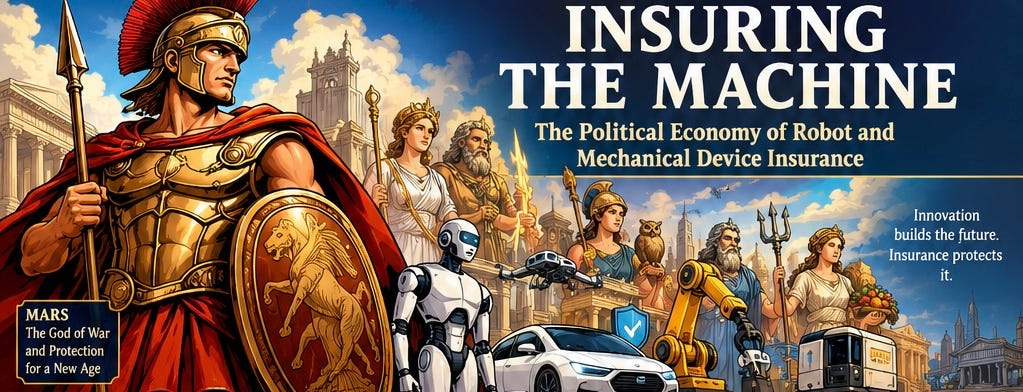
The Political Economy of Robot and Mechanical Device Insurance
Introduction: The Machine Has Entered the Insurance Market
The world is entering an era in which machines are no longer limited to performing simple mechanical tasks under constant human supervision. Robots, autonomous vehicles, drones, artificial intelligence systems, industrial machines, and automated infrastructure are increasingly capable of making decisions, moving through public spaces, interacting with people, and performing economically valuable work. These developments create enormous opportunities for productivity, economic growth, and technological innovation. They also create a fundamental political question that governments have only begun to address: who should pay when an autonomous or mechanical system causes harm? Traditional insurance systems were largely designed around human drivers, property owners, employers, manufacturers, and identifiable acts of negligence. The increasing autonomy of machines challenges those assumptions and could require governments to reconsider the relationship between technology, liability, insurance, and public responsibility.
The question of machine responsibility becomes particularly important when multiple parties contribute to the operation of a technological system. A robot may be manufactured by one company, programmed by another, purchased by a third party, maintained by a fourth company, and operated within an environment controlled by a fifth organization. An accident could therefore result from defective hardware, faulty software, inadequate maintenance, human misuse, cybersecurity vulnerabilities, or an unpredictable interaction between several systems. Determining responsibility after such an incident could become significantly more complicated than determining responsibility after a conventional automobile accident. The insurance industry could become one of the most important institutions for managing these disputes because insurers already possess mechanisms for evaluating risk and distributing financial losses. Robot insurance could therefore develop into an important component of the political economy of automation.
This article examines the possibility of creating insurance systems specifically designed for robots and other advanced mechanical devices. It considers property insurance, liability insurance, cyber insurance, software failure coverage, mechanical breakdown coverage, and insurance for autonomous operation. It also examines whether governments should require certain machines to carry liability insurance before they are permitted to operate in public or commercial environments. The broader political question is whether technological innovation should be permitted to create risks that are ultimately absorbed by individuals and the public. A carefully designed insurance system could encourage innovation while ensuring that victims have access to compensation when machines fail. The objective should not necessarily be to prevent technological development, but to establish a framework in which technological advancement carries corresponding economic responsibility.
I. What Would Robot Insurance Actually Mean?

Robot insurance would need to begin with a clear definition of what constitutes an insurable machine. A basic mechanical device with no autonomous capabilities presents different risks from an industrial robot capable of making independent decisions. A household robot vacuum, for example, generally creates relatively limited physical risk compared with an autonomous construction machine operating around workers. An autonomous vehicle creates another category of risk because it can transport people through public spaces while making decisions without continuous human control. Drones create additional concerns because they operate in three-dimensional environments and can potentially cause injury, property damage, or privacy violations. A meaningful insurance system would therefore need to distinguish between machines based on their capabilities, environments, and potential consequences.
The first major category would be property insurance. Property coverage could protect owners against theft, fire, natural disasters, collisions, mechanical destruction, and other physical losses involving machines. A second category would involve liability insurance, which could compensate people or organizations harmed by a machine. A third category could address cyber risks, including unauthorized access, malicious software, remote takeover, and manipulation of automated systems. Additional policies could cover software failures, mechanical breakdowns, business interruption, and losses resulting from defective updates. The insurance industry could eventually develop specialized policies combining several of these forms of coverage into comprehensive machine insurance packages.
Autonomous operation introduces an especially important distinction. A conventional machine usually performs an action because a human directly operates it, while an autonomous machine may independently determine how and when to perform an action. This creates a difficult question about whether traditional concepts of negligence remain sufficient. If an autonomous vehicle makes a decision that causes an accident despite functioning according to its approved programming, assigning responsibility could become substantially more complicated. The same problem could occur with a warehouse robot, medical machine, agricultural system, or industrial robot. Robot insurance would therefore need to address not only physical machinery but also the relationship between hardware, software, artificial intelligence, human supervision, and organizational responsibility.
II. Who Should Be Legally Responsible When a Robot Causes Harm?

One possible approach is an owner-responsibility model. Under this system, the person or organization that owns a robot would be responsible for maintaining insurance and compensating third parties when the machine causes damage. This model has the advantage of being relatively simple because the injured party would not necessarily need to determine which component of the machine failed. The owner would file an insurance claim and the insurer could subsequently investigate whether another party should ultimately bear the cost. This resembles existing approaches to automobile insurance in which vehicle owners can maintain coverage even when determining fault may require additional investigation. The model could provide victims with a relatively straightforward path toward compensation.
A second approach would place greater responsibility on manufacturers and software developers. Under this model, companies that design, manufacture, program, or maintain autonomous machines could bear responsibility for failures attributable to their products. Product liability law already provides a foundation for addressing defective products, but autonomous technology introduces additional complications. A machine may operate correctly when manufactured but become dangerous after a software update or interaction with another system. A manufacturer could argue that an owner improperly maintained or modified the machine, while the owner could argue that the manufacturer created a system that was inherently unsafe. Insurance could help resolve these competing claims while allowing courts and regulators to determine ultimate responsibility.
A third approach would distribute liability among multiple participants. Shared liability could recognize that complex technological systems often do not have a single cause of failure. An accident might involve defective hardware, inadequate maintenance, outdated software, and insufficient human supervision at the same time. Under a shared model, each participant could carry a defined level of insurance based on the risks associated with its role. Such a system could encourage manufacturers, owners, operators, software developers, and maintenance companies to maintain appropriate safety standards. It could also prevent victims from becoming trapped in lengthy disputes over which corporate entity should pay.
III. Should Robots Be Required to Carry Insurance?

Mandatory robot insurance could become appropriate for machines capable of causing substantial harm to the public. Governments already require insurance or financial responsibility for certain activities involving significant risks, particularly transportation. Similar reasoning could eventually apply to autonomous vehicles, commercial drones, industrial robots, construction equipment, and other machines operating around large numbers of people. A mandatory insurance requirement would ensure that victims have access to compensation after accidents. It would also force businesses to consider the financial consequences of technological risks before deploying machines. Insurance could therefore become a regulatory tool rather than merely a private financial product.
The strongest argument for mandatory coverage is public protection. A person injured by an autonomous machine should not necessarily be forced to bear the financial consequences simply because the machine’s manufacturer and owner disagree about responsibility. Insurance provides a mechanism for compensating victims while the underlying dispute is investigated. Mandatory coverage could also encourage safer technological design because insurers would have incentives to evaluate the risks associated with different machines. Companies with poor safety records could face higher premiums, while companies demonstrating strong safety performance could potentially receive lower rates. This would create a market-based incentive for technological safety.
There are also legitimate arguments against broad mandatory insurance requirements. Excessive regulation could make emerging technologies more expensive and discourage small businesses from adopting useful automation. Insurance companies may initially lack sufficient historical data to accurately calculate risks associated with new technologies. High premiums could become especially problematic for startups developing innovative robotic systems. Government regulators could also unintentionally favor established corporations that possess the financial resources to satisfy complex insurance requirements. Policymakers should therefore avoid creating a regulatory structure that protects the public at the expense of technological competition and innovation.
IV. Who Should Pay the Premium?

The simplest approach would require the owner of a robot or autonomous machine to purchase insurance. This would establish a clear financial relationship between ownership and responsibility. Owners would have an incentive to maintain their machines properly because negligent maintenance could increase their insurance costs or expose them to liability. Businesses could treat insurance as another operating expense associated with the use of automated technology. This model would also provide regulators with a straightforward party to hold accountable when an uninsured machine causes harm.
Another possibility would be to require manufacturers to contribute to insurance coverage. Manufacturers could include a liability component within the original purchase price of a machine or maintain continuing coverage for defects associated with their products. This approach would place some responsibility on companies that profit from technological development. It could also encourage manufacturers to design machines that minimize long-term risks. However, manufacturers could attempt to pass those costs onto consumers through higher prices, potentially slowing adoption of new technologies.
A shared premium system could ultimately prove more practical for advanced autonomous machines. Owners, manufacturers, software developers, and operators could each contribute according to the risks they create or control. An industry-wide insurance pool could also be established for particularly high-risk technologies. Such a system would spread catastrophic losses across many participants rather than forcing one company or individual to absorb the entire cost of an extraordinary event. The political challenge would be determining how contributions should be calculated without creating excessive bureaucracy. A successful system would need transparent rules that connect financial responsibility to actual risk.
V. The Economics of Robot Insurance

Insurance companies depend heavily on the ability to estimate risk. Traditional insurance products benefit from decades of accident records, claims histories, maintenance statistics, and actuarial data. Many emerging robotic systems lack comparable historical information. An autonomous machine introduced to the market today may operate under conditions that did not exist when previous insurance models were developed. This creates uncertainty for insurers and could initially result in higher premiums. Over time, however, accident records and operational data could allow insurers to develop increasingly sophisticated risk models.
Insurance companies could evaluate machines using a broad collection of variables. These could include the type of machine, manufacturer, operating environment, hours of use, level of autonomy, software version, maintenance record, cybersecurity protections, and accident history. An autonomous vehicle operating on controlled industrial property might receive a different risk rating from an autonomous vehicle operating on crowded city streets. Similarly, an industrial robot enclosed behind safety barriers would present different risks from a mobile robot interacting directly with members of the public. Insurance pricing could therefore become increasingly individualized as machine data improves.
The development of machine safety ratings could become an important component of this system. Governments, insurers, manufacturers, or independent organizations could create standardized Robot Risk Scores similar in concept to safety classifications used in other industries. A machine could receive a rating based on its physical capabilities, autonomy, operating environment, cybersecurity, reliability, and historical safety performance. Higher-risk machines could face higher premiums or stronger regulatory requirements. Lower-risk machines could benefit from reduced insurance costs. Such a system could transform insurance into an economic incentive for technological safety.
VI. Should Robots Have Their Own Insurance Identification System?

A future robot insurance system could require certain machines to possess unique identification numbers. The identification system could connect the machine to its manufacturer, owner, insurance policy, maintenance history, and safety certification. In the event of an accident, authorities and insurers could quickly identify the machine and determine whether it was properly insured. This could be particularly important for autonomous vehicles, commercial drones, delivery robots, and industrial machines operating across multiple locations. A standardized identification system could also reduce fraud and make insurance claims easier to investigate.
However, a machine registry would raise significant privacy and civil-liberties concerns. Governments could potentially use registration systems to track machines, their owners, and their movements. Businesses could also become concerned that proprietary information about their equipment might become accessible to competitors or government agencies. Cybersecurity would become another major concern because a centralized database containing information about critical machines could become an attractive target for criminals. Policymakers would therefore need to establish strict rules concerning what information is collected, who can access it, and how long it is retained. The objective should be accountability without creating unnecessary technological surveillance.
An identification system could also become useful for international commerce. Machines increasingly move across state and national borders, and autonomous systems may operate in multiple jurisdictions during their lifetimes. A standardized identification framework could allow insurers and regulators to determine whether a machine meets the requirements of a particular jurisdiction. International standards could eventually make it easier for autonomous vehicles, industrial equipment, and robotic systems to operate across borders. This would require cooperation among governments, insurance companies, manufacturers, and technology organizations. The political challenge would be establishing common standards without forcing every country to surrender its regulatory authority.
VII. Robot Insurance and the Labor Market

Automation has historically transformed labor markets by replacing some forms of human labor while creating new industries and occupations. Advanced robotics could accelerate this process by allowing machines to perform increasingly sophisticated physical and cognitive tasks. The economic benefits could include higher productivity, lower production costs, greater precision, and reduced exposure of workers to dangerous environments. At the same time, workers displaced by automation may experience unemployment, wage pressure, or difficulty transitioning into new occupations. Robot insurance therefore intersects with the broader political debate over how societies should distribute the benefits and costs of technological change.
One possible policy would connect certain automation-related insurance fees to worker transition programs. A portion of premiums or government assessments associated with high-risk automated industries could potentially support retraining, education, or employment programs. Such a system would recognize that technological innovation can produce social costs beyond the immediate physical risks of machines. It could also provide a mechanism for businesses benefiting from automation to contribute toward managing its broader economic effects. However, policymakers would need to determine whether such payments should be classified as insurance premiums, taxes, regulatory fees, or separate contributions. Each classification would carry different legal and political consequences.
The concept could also connect to proposals for a robot dividend or universal basic income. If automation dramatically increases productivity while reducing the demand for certain forms of human labor, governments may eventually consider mechanisms for distributing a portion of those gains throughout society. A robot-related tax or insurance assessment could theoretically contribute to such programs. The idea would not necessarily be to punish automation, but to recognize that technological productivity depends upon infrastructure, education, legal systems, and public institutions. The political debate would ultimately concern who should benefit from the economic value created by increasingly automated production. Robot insurance could therefore become one component of a much larger conversation about the distribution of technological wealth.
VIII. Robot Insurance and Government Regulation

The federal government could establish national standards for high-risk autonomous machines. These standards might include minimum insurance requirements, safety testing, registration, cybersecurity protections, and reporting requirements following major accidents. Federal standards could prevent companies from facing dramatically different rules across multiple jurisdictions. They could also provide a baseline for manufacturers designing machines for nationwide markets. At the same time, federal regulation would need to leave room for states and local governments to address circumstances unique to their jurisdictions.
States could continue regulating insurance markets and certain forms of machine operation. State governments could establish minimum coverage levels, licensing requirements, consumer protections, and rules for insurance claims. Local governments could regulate robots operating in public spaces, particularly where machines interact directly with pedestrians or public infrastructure. This division of authority would create a multi-level regulatory system. The challenge would be preventing contradictory rules from making it excessively difficult for companies to deploy technology across the country. Political institutions would need to cooperate rather than compete for regulatory control.
International regulation would create an even more complicated problem. An autonomous vehicle could be manufactured in one country, owned by a company in another country, operated in a third country, and involved in an accident near an international border. Determining jurisdiction could become extremely difficult. International insurance agreements could eventually establish rules for recognizing policies, determining liability, and compensating victims across borders. Such agreements could become increasingly important as autonomous transportation and robotics become more integrated into global commerce. The evolution of robot insurance may therefore become part of the broader development of international technology governance.
IX. The International Politics of Autonomous Machines

Autonomous machines challenge traditional concepts of territorial jurisdiction because their activities can cross borders without requiring continuous human control. Autonomous ships could travel through international waters, drones could cross national boundaries, and automated logistics systems could move goods between countries with limited human intervention. A machine could potentially commit an action in one jurisdiction based on software developed in another. These circumstances complicate the traditional assumption that governments can easily identify where an action occurred and who controlled it. Insurance could provide one mechanism for managing these cross-border risks.
International standards could establish minimum requirements for machines that operate beyond a single jurisdiction. Governments could agree upon common insurance documentation, machine identification standards, safety classifications, and liability principles. International organizations could potentially facilitate negotiations between states without eliminating national sovereignty. Such agreements could resemble existing frameworks governing aviation, maritime transportation, international trade, and other cross-border activities. The objective would be to make autonomous technology predictable enough for international commerce while preserving governments’ ability to protect their citizens.
The international politics of robot insurance could become particularly important as advanced machinery becomes strategically significant. Autonomous systems may eventually support transportation networks, energy infrastructure, military logistics, healthcare, agriculture, and communications. A major technological accident could therefore produce consequences extending beyond individual property damage. Governments may eventually treat certain autonomous systems as critical infrastructure requiring special insurance and regulatory standards. This would transform robot insurance from an ordinary commercial issue into a matter of national and international security.
X. Should There Be a Robot Insurance Tax?

A robot insurance tax would represent a significant expansion of the government’s role in managing automation. Unlike a conventional insurance premium, which compensates an insurer for assuming a specific risk, a government assessment could be used to address broader social consequences. Revenue could potentially support public safety programs, worker retraining, cybersecurity, infrastructure improvements, or accident compensation funds. The concept would therefore resemble a public policy instrument rather than a conventional insurance product. Whether such a system is justified would depend heavily on how the money is collected and spent.
Supporters could argue that highly automated industries benefit from public infrastructure and legal institutions while transferring certain risks to society. A modest assessment could ensure that businesses contributing to automation also contribute toward managing its consequences. Critics could respond that such a tax would increase the cost of technological development and potentially discourage innovation. There would also be a danger that governments could use the program primarily as a source of general revenue rather than addressing automation-related risks. Transparency would therefore be essential. Any robot-related tax or assessment should have clearly defined purposes and measurable public benefits.
The political distinction between taxation and insurance would also need to remain clear. Insurance exists primarily to compensate against defined risks, while taxation generally funds public programs and governmental functions. Combining the two concepts without careful legal definitions could create confusion and potential disputes over government authority. A better approach might involve separate systems operating alongside each other. Private insurance could cover machine-specific risks while a narrowly designed public fund could address extraordinary societal consequences. Such separation could provide greater accountability while allowing policymakers to respond to risks that private insurers may be unable or unwilling to cover.
XI. The Problem of Insuring Artificial Intelligence

Artificial intelligence introduces a new category of risk because software can influence the behavior of physical machines. A mechanical failure can sometimes be identified through physical inspection, while an AI failure may involve complex interactions between software, data, environment, and machine behavior. An autonomous system could perform an action that its developers did not specifically anticipate even though the system technically operated according to its programming. This creates a difficult question about whether the behavior should be classified as a software defect, an operational failure, or an unforeseeable event. Insurance systems will need to develop methods for evaluating these risks.
The black-box problem adds another layer of difficulty. Some advanced AI systems can produce outputs that are difficult for ordinary users to explain in simple terms. If such a system controls a physical machine, investigators may struggle to determine why a particular decision occurred. Insurers cannot effectively price risk if they cannot understand the mechanisms producing that risk. Manufacturers may therefore face pressure to create systems with greater transparency, auditability, and logging capabilities. Insurance requirements could become an economic incentive for explainable and accountable AI.
AI insurance may eventually become its own specialized industry. Policies could cover algorithmic errors, unauthorized changes, data poisoning, cyberattacks, software failures, and unexpected autonomous behavior. Insurers could require manufacturers to demonstrate testing procedures before providing coverage. They could also demand continuous monitoring and regular software updates. This would create a relationship between insurance markets and technological standards that could influence how AI systems are designed. In this sense, insurers could become informal regulators of artificial intelligence by determining which systems are financially insurable.
XII. A Proposed Framework for Robot Insurance

A practical framework could classify machines according to their potential risk rather than simply defining everything as a robot. Tier One could cover low-risk machines such as household robots and basic automated devices. Tier Two could include commercial systems such as warehouse robots, agricultural equipment, and delivery machines. Tier Three could cover high-risk autonomous systems such as autonomous vehicles and construction robots. Tier Four could include machines supporting critical infrastructure, while Tier Five could address highly strategic systems involving national security, aerospace, or other extraordinary risks.
Each tier could carry different insurance requirements. Low-risk machines might only require ordinary property coverage unless they operate in public spaces. Commercial robots could require liability coverage based on their operating environment and potential for injury. High-risk autonomous machines could require substantial liability coverage, cybersecurity protections, registration, and regular safety certification. Critical infrastructure systems could require specialized coverage and government oversight. Strategic systems could require national-level risk management rather than conventional commercial insurance alone. This tiered approach would avoid imposing the same regulatory burden on a household device and a massive autonomous industrial system.
The framework should also remain adaptable. Technology develops faster than many legislative processes, meaning regulations designed for one generation of machines could become obsolete quickly. Governments should therefore establish periodic review mechanisms allowing insurance requirements to change as evidence accumulates. Regulators could consult insurers, engineers, manufacturers, workers, consumers, cybersecurity experts, and civil-liberties organizations. Accident data could be analyzed to determine whether particular standards are actually reducing risk. The ultimate objective should be a flexible system that protects the public without unnecessarily restricting technological development.
XIII. Political Debate: Innovation Versus Protection

The central political debate surrounding robot insurance will likely involve the tension between innovation and public protection. Supporters of regulation will argue that citizens should not become involuntary participants in technological experiments. If a company deploys an autonomous machine capable of causing serious injury, that company should have the financial capacity to compensate victims. Insurance provides a mechanism for achieving that goal without necessarily prohibiting the underlying technology. Regulation could therefore establish a floor of responsibility while leaving companies free to compete above that minimum.
Opponents of excessive regulation will argue that emerging technologies require room to develop. Insurance mandates, taxes, registration systems, and liability rules could increase costs before companies have had sufficient time to establish viable business models. Small businesses and startups could be disproportionately affected because they lack the financial resources of large corporations. Excessive regulatory requirements could also encourage companies to move research and development into jurisdictions with fewer restrictions. Policymakers must therefore consider whether a rule actually reduces risk or merely increases the cost of innovation.
The most effective policy may ultimately involve a balance between market forces and public regulation. Private insurers can evaluate risk, reward safer companies with lower premiums, and distribute financial losses. Governments can establish minimum standards, protect consumers, and intervene when risks become too significant for private markets to manage alone. Manufacturers can improve technology in response to both regulation and market incentives. Consumers can make decisions based on safety records and insurance costs. The objective should be to create an economic environment in which technological freedom and technological responsibility develop together.
XIV. Conclusion: The Machine Age Needs a Risk System

The future of robotics will not be determined solely by engineers and technology companies. It will also be shaped by lawmakers, courts, insurers, workers, consumers, and governments deciding how society should distribute the benefits and risks of automation. Robot insurance could become one of the mechanisms through which these competing interests are balanced. It could provide compensation when machines cause harm, encourage manufacturers to improve safety, and give governments a reliable framework for regulating high-risk technologies. It could also create new economic incentives for cybersecurity, maintenance, software transparency, and responsible deployment. The question is therefore larger than whether robots should have insurance policies.
The deeper issue is whether technological autonomy should be accompanied by economic accountability. If society permits machines to perform increasingly important functions, the institutions surrounding those machines must evolve accordingly. An autonomous vehicle should not be able to create an uncompensated liability simply because lawmakers have not yet determined which party is responsible. A factory should not be able to deploy increasingly autonomous machinery while shifting every resulting risk onto workers and the public. At the same time, regulation should not become so expensive or restrictive that beneficial technological development becomes impossible. The political challenge is to establish responsibility without suffocating innovation.
The Brooks Brief therefore proposes that governments begin treating robot and autonomous-device insurance as an emerging field of public policy. A modern framework should combine risk-based insurance requirements, clearly defined liability rules, machine identification standards, cybersecurity protections, safety classifications, and mechanisms for compensating victims. High-risk machines should carry greater financial responsibility than low-risk devices, while manufacturers and operators should remain accountable for the risks they directly control. Policymakers should also consider whether a portion of automation-related fees could support worker transition programs or other public purposes, while maintaining a clear distinction between insurance premiums and taxation. The machine age is approaching a point where technological power must be matched by economic responsibility. If society expects machines to participate in the economy, it may eventually need to answer a simple question: when the machine causes the damage, who pays?
The Brooks Brief Policy Position

The Brooks Brief supports the development of a risk-based insurance framework for advanced robots, autonomous machines, and other mechanical systems capable of creating significant public or economic harm. The framework should not treat every mechanical device as equally dangerous, but should classify machines according to autonomy, operating environment, physical capability, cybersecurity exposure, and potential consequences. High-risk autonomous systems should generally be required to maintain liability coverage before operating in public or commercial environments. Manufacturers, owners, software developers, and operators should share responsibility according to the risks they create or control. Insurance should function as both a compensation mechanism for victims and a market incentive for safer technological development.
The Brooks Brief also supports continued research into whether automation-related insurance assessments could help finance worker retraining, technological education, infrastructure, or other programs addressing the social consequences of automation. Such programs should be transparent and should not simply become unrestricted sources of government revenue. Any public assessment should have a clearly defined relationship to the risks and social consequences generated by automation. Policymakers should also protect privacy by limiting unnecessary government access to machine-registration and insurance data. Technological accountability should not become a justification for unrestricted surveillance.
Ultimately, robot insurance represents a larger political question about the relationship between human beings and technological power. Machines may become increasingly capable of performing work, transporting people, making decisions, and interacting with the physical world. As their capabilities expand, the legal and economic institutions surrounding them must expand as well. Society should not be forced to choose between technological innovation and public protection when carefully designed insurance systems can help provide both. The goal should be a technological economy in which innovation remains possible while responsibility remains unavoidable. If machines are going to become participants in the modern economy, the risks they create must have someone financially accountable for them.


Leave a Reply